Results for “t-position”
Type a name: scientific, common, or one a species used to go by. Or narrow the catalogue with the filters.
Filters
Mystus leucophasisAsian Upside Down Catfish
authority not recorded
Max length300mm SL12in SLTank120 × 60cm48 × 24inTemp23–27°C73–81°FpH6.0–8.0Like some members of the African catfish genus Synodontis, this species spends the vast majority of it's time swimming in an inverted position. It is often seen for sale at only a couple of inches in length and may be confused with the popular (and much smaller) Synodontis nigriventris. It can easily be distinguished from this species by its patterning. It does not exhibit the or brown colours of the Synodontis and is a uniform black colour all over. Larger specimens may have some lighter c...
Neolamprologus fasciatusBarred Lamprologus
authority not recorded
Max length150mm SL6in SLTank90 × 38cm36 × 15inTemp23–27°C73–81°FpH7.5–9.0N. fasciatus is a predator by nature and its body shape has been adapted to allow it to enter small crevices and gaps in the rockwork of Lake Tanganyika to prey on invertebrates, eggs, fry and small fish. The lateral compression exhibited by this fish also makes the fish hard to spot head on, giving it an advantage over both its predators and prey. It hunts in a head down position a few feet above the substrate, moving its body in sinuous motions to counteract the water currents. It is sometimes...
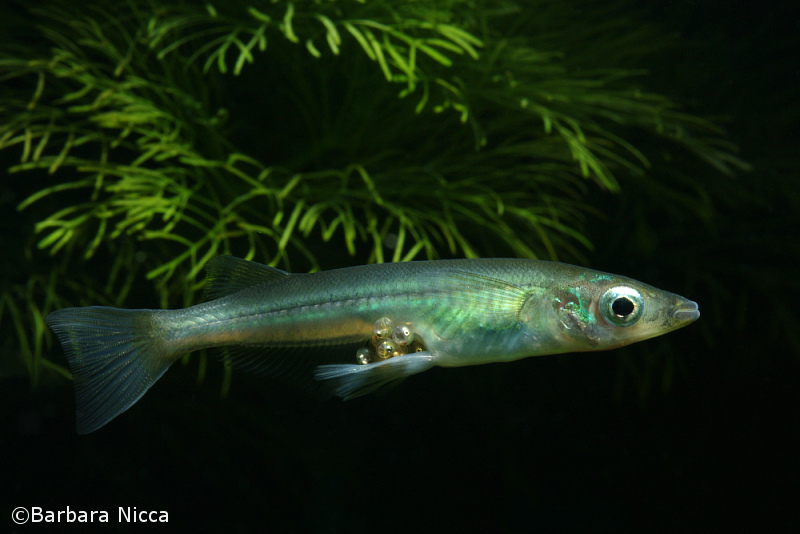
Oryzias sarasinorumSarasin's Buntingi
Popta, 1905
Max length60mm SL2.4in SLTank100 × 30cm39 × 12inTemp24–29°C75–84°FpH7.0–8.0Utilises a strategy which has become known as 'pelvic brooding'. Spawning tends to occur in the early morning, with dominant males darkening in colouration and defending their space by driving away potential competitors, while approaching ripe females in a rigid 'head-down' position. The eggs normally number 8-12 and are expelled as a single mass while being fertilised simultaneously, after which they continue to hang from th...
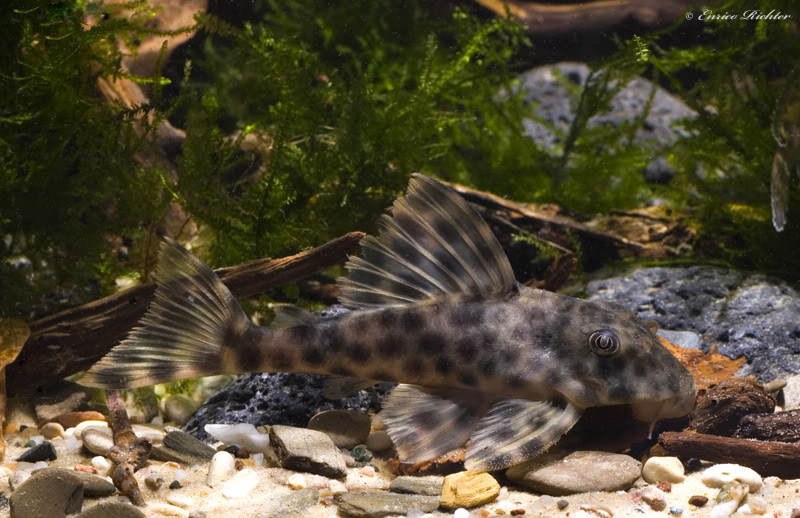
Peckoltia oligospilaL006
Günther, 1864
Max length100mm SL3.9in SLTank120 × 30cm48 × 12inTemp24–30°C75–86°FpH5.5–7.5This species can be distinguished from all congeners except P. bachi and some specimens of P. furcata by possessing only faint spots and saddles on the body. It can be told apart from P. bachi by possession of narrow (vs. wide) pelvic-fin spines, having the eyes positioned high (vs. low) on the head, and distinctly round (vs. appearing more as a mottling) spots on the body.
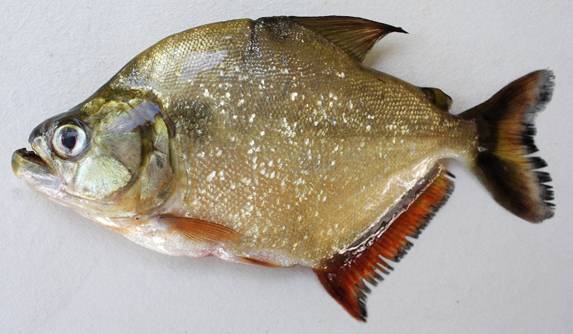
Serrasalmus brandtiiWhite Piranha
Lütken, 1875
Max length250mm SL10in SLTank150 × 60cm60 × 24inTemp20–26°C68–79°FpH5.0–8.0A number of sources state that S. brandtii can be identified by the relatively anterior position of the anal-fin origin beneath the first few dorsal-fin rays. However, images of specimens collected from the rio São Francisco, where it is the only member of the genus present, suggest that this is not always the case and this is also supported by the figure from Eigenmann (1915). No recent diagnosis of the species is available.
Synodontis contractaBig-nosed Upside-down Catfish
authority not recorded
Max length75mm SL3.0in SLTank60 × 30cm24 × 12inTemp22–27°C72–81°FpH6.2–7.2Often confused with the similar S.nigriventris, this species is imported infrequently. It is easily distinguished from nigriventris by its larger eyes and broad mouth and head. These features give rise to the common name "Big-nosed upside-down catfish". S. contracta spends the majority of its time swimming in an inverted position and this, along with its exaggerated facial features,make it a characterful and interesting addition to the community aquarium. It is also known as the Bug-e...
Synodontis nigritaFalse Upside-down Catfish
authority not recorded
Max length175mm SL7in SLTank90 × 30cm36 × 12inTemp21–28°C70–82°FpH6.0–7.8This is one of the most common Synos seen in dealers' tanks and is often incorrectly labelled "Upside-down catfish". The true upside-down catfish is S. nigriventris and S. nigrita inverts far less frequently than that species although it does often rest in this position. Moreover, S. nigrita grows far larger than S. nigriventris and it is a common sight to see several adult specimens in shops that have been returned by unsuspecting owners. S. nigrita is often confused with the...
Trachelyichthys decaradiatus
authority not recorded
Max length80mm SL3.1in SLTank60 × 38cm24 × 15inTemp20–28°C68–82°FpH6.5–7.0Very similar to its congener T. exilis, it can be distinguished by looking at the position of the eye which is set much further forward in exilis. Also, the humeral process (long spine extending from the back of the gill plate), is broader and shorter in this species than exilis. Neither are seen very often in the hobby....
Trachelyichthys exilisPygmy Driftwood Catfish
authority not recorded
Max length80mm SL3.1in SLTank60 × 38cm24 × 15inTemp22–25°C72–77°FpH6.5–7.0Very similar to its congener T. decaradiatus, it can be distinguished by looking at the position of the eye, which is set much further back in decaradiatus. Also, the humeral process (long spine extending from the back of the gill plate), is longer and thinner in this species than decaradiatus. Neither are seen very often in the hobby, but are sometimes available at specialist outlets....