Results for “sp.”
Type a name: scientific, common, or one a species used to go by. Or narrow the catalogue with the filters.
Filters
Cichla orinocensisOrinoco Peacock bass
authority not recorded
Max length600mm SL24in SLTanknot recordedTemp27–29°C81–84°FpH5.5–6.5Due to their large size, Peacock Bass are only really recommended for the experienced fishkeeper that can house them adequately. That said, they are a hardy and robust species that will adapt to a variety of conditions. Peacock Bass are becoming much more available in the hobby and are often seen for sale as cute 2" babies, often tempting people into buying a fish they will not be able to care for in the long term. Peacock Bass are also fished as a sport fish....
Cichlasoma urophthalmusMayan Cichlid
authority not recorded
Max length400mm SL16in SLTank210 × 60cm84 × 24inTemp20–30°C68–86°FpH7.0–8.0A hardy and robust fish that can tolerate and breed in full marine conditions. The Mayan cichlid is also referred to as the Mexican Mojarra and is occasionally offered for sale in the UK, or can be obtained through specialist cichlid dealers. This species is regarded as a potential pest fish in the USA due to its tolerance of a wide range of conditions and the threat it could pose to native fauna....
Copadichromis azureus
authority not recorded
Max length160mm SL6in SLTank150 × 45cm60 × 18inTemp26–28°C79–82°FpH7.5–8.5Together with the recently erected genus Mchenga, Copadichromis species form an exclusive group of Malawian cichlids commonly referred to as "Utaka" (prounounced "ooh-taw-kuh"). They're specialised to a pelagic lifestyle, and can be found living in huge numbers throughout much of Lake Malawi. Some tend to remain in the proximity of underwater reefs or rocky shorelines, while others occur mainly in more featureless, sandy habitats. Here they face the oncoming current, us...
Copadichromis borleyi
authority not recorded
Max length200mm SL8in SLTank150 × 45cm60 × 18inTemp25–29°C77–84°FpH7.5–8.5Together with the recently erected genus Mchenga, Copadichromis species form an exclusive group of Malawian cichlids commonly referred to as "Utaka" (prounounced "ooh-taw-kuh"). They're specialised to a pelagic lifestyle, and can be found living in huge numbers throughout much of Lake Malawi. Some tend to remain in the proximity of underwater reefs or rocky shorelines, while others occur mainly in more featureless, sandy habitats. Here they face the oncoming current, usi...
Copadichromis chrysonotus
authority not recorded
Max length160mm SL6in SLTank150 × 45cm60 × 18inTemp25–29°C77–84°FpH7.5–8.5Together with the recently erected genus Mchenga, Copadichromis species form an exclusive group of Malawian cichlids commonly referred to as "Utaka" (prounounced "ooh-taw-kuh"). They're specialised to a pelagic lifestyle, and can be found living in huge numbers throughout much of Lake Malawi. Some tend to remain in the proximity of underwater reefs or rocky shorelines, while others occur mainly in more featureless, sandy habitats. Here they face the oncoming current, usi...
Copadichromis ilesi
authority not recorded
Max length175mm SL7in SLTank150 × 45cm60 × 18inTemp25–29°C77–84°FpH7.5–8.5Together with the recently erected genus Mchenga, Copadichromis species form an exclusive group of Malawian cichlids commonly referred to as "Utaka" (prounounced "ooh-taw-kuh"). They're specialised to a pelagic lifestyle, and can be found living in huge numbers throughout much of Lake Malawi. Some tend to remain in the proximity of underwater reefs or rocky shorelines, while others occur mainly in more featureless, sandy habitats. Here they face the oncoming current, usi...
Copadichromis virginalis
authority not recorded
Max length130mm SL5in SLTank150 × 45cm60 × 18inTemp25–29°C77–84°FpH7.5–8.5Together with the recently erected genus Mchenga, Copadichromis species form an exclusive group of Malawian cichlids commonly referred to as "Utaka" (prounounced "ooh-taw-kuh"). They're specialised to a pelagic lifestyle, and can be found living in huge numbers throughout much of Lake Malawi. Some tend to remain in the proximity of underwater reefs or rocky shorelines, while others occur mainly in more featureless, sandy habitats. Here they face the oncoming current, usi...
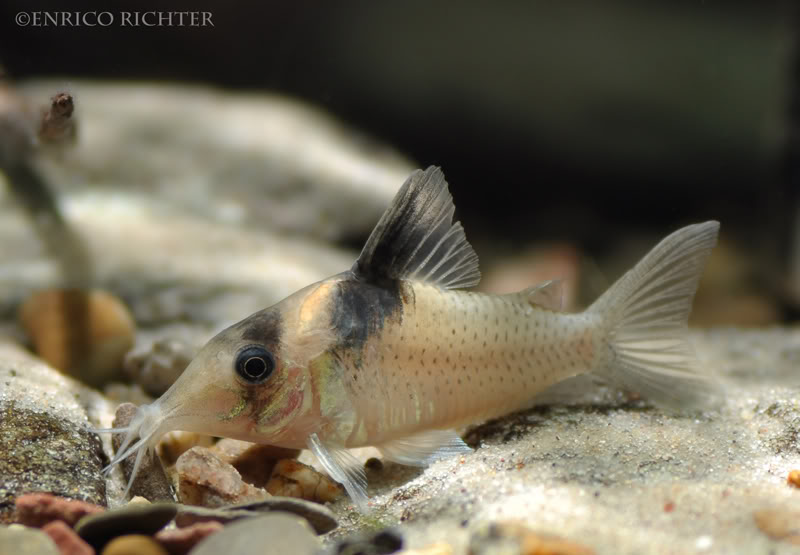
Corydoras amandajanea
Sands, 1995
Max length65mm SL2.6in SLTanknot recordedTemp23–27°C73–81°FpH6.0–7.5C. amandajanea is rare in the aquarium trade and appears to be variable in colour pattern to an extent, with some individuals posssessing relatively larger dark spots on the body, for example. Unfortunately diagnostic characters cannot be provided since we've been unable to obtain the type description, and little has been written about this species since it was published.
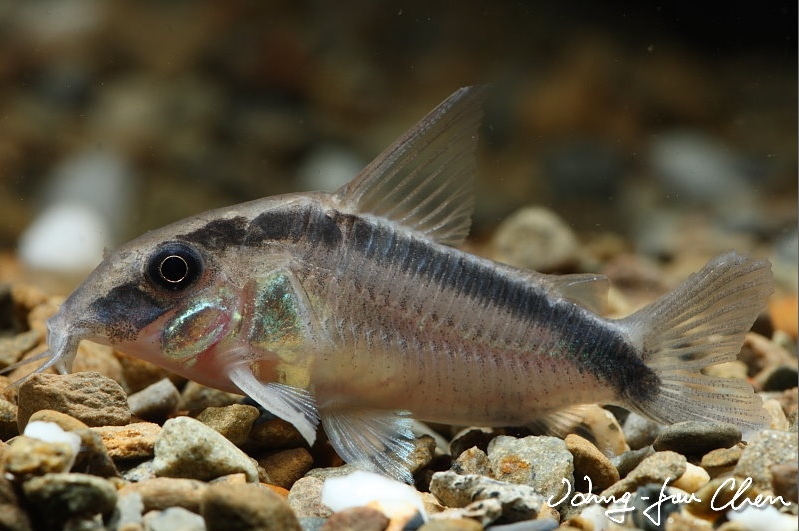
Corydoras arcuatusSkunk Cory; C020
Elwin, 1938
Max length55mm SL2.2in SLTanknot recordedTemp20–28°C68–82°FpH5.0–7.5This species is among the more popular Corydoras in the aquarium hobby and is widely available. It may also be referred to as 'arched cory'. There exist a number of similar-looking congeners, particularly C. urucu (Britto et al., 2009), described from the rio Urucu in Coari municipality, Amazonas state, Brazil, and C. narcissus from the rio Purus. The latter appears to have also been traded as C. sp. 'super arcuatus longnose' while a larg...
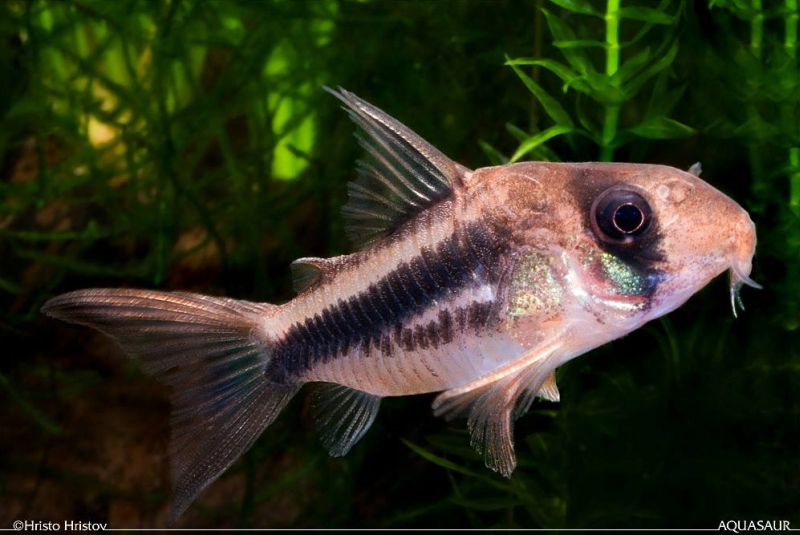
Corydoras axelrodiAxelrod's Cory
Rössel, 1962
Max length50mm SL2.0in SLTanknot recordedTemp22–26°C72–79°FpH5.0–7.0This species is somewhat variable in appearance and can have between 1-3 dark lateral stripes on each flank, for example. It's also known by the alternative common name 'pink corydoras'. It looks similar to the congener C. loxozonus plus unidentified fishes which have been assigned the codes C003 and CW021, and all four are sometimes traded under the fabricated names C. 'deckeri' or C. sp. 'decker/deker'.
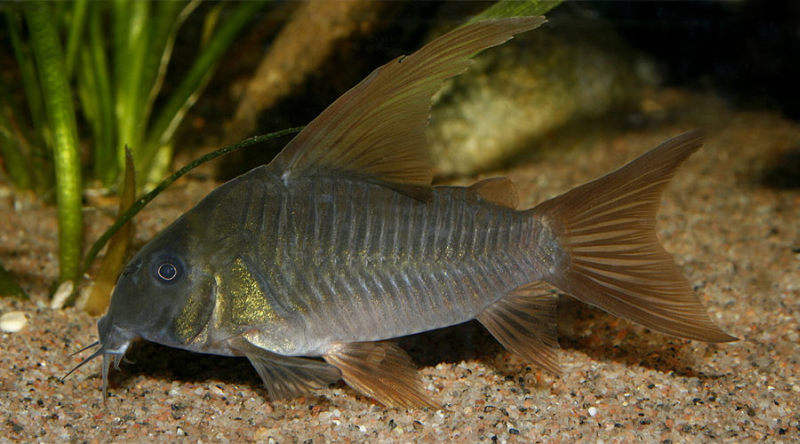
Corydoras concolorSlate Cory
Weitzman, 1961
Max length60mm SL2.4in SLTank80 × 30cm31 × 12inTemp20–26°C68–79°FpH5.5–7.0This species can be told apart from congeners by its uniformly greyish colour pattern, deep body (fitting 2.1-2.4 times in standard length), large eye (3.2-4.0 times in head length), having the pectoral fins completely surrounded by the coracoid, and relatively long dorsal-fin spine (1.1-1.2 times in head length).
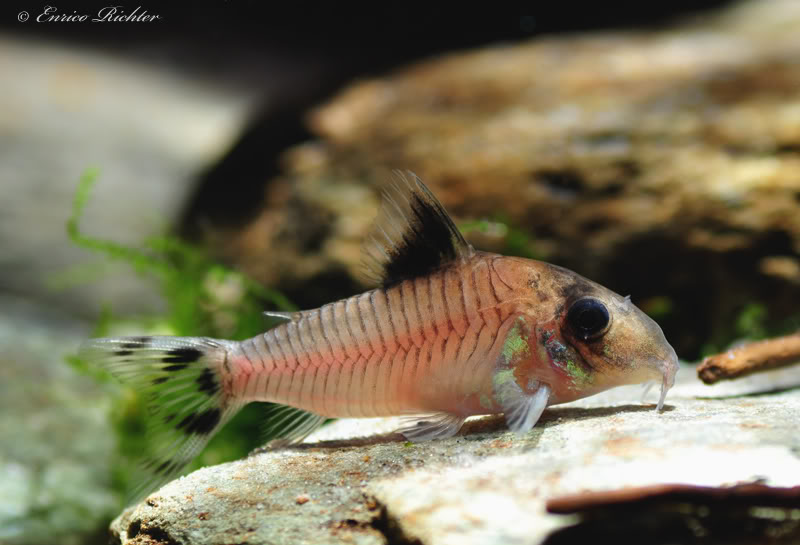
Corydoras condiscipulus
Nijssen & Isbrücker, 1980
Max length65mm SL2.6in SLTank90 × 30cm36 × 12inTemp20–26°C68–79°FpH6.0–7.5This species occurs alongside the similar-looking congener C. oiapoquensis in nature, from which it can be told apart by the following combination of characters: larger adult size; narrower body (body breadth fits 4.0-4.4 times in standard length vs. 3.4-3.8 times in C. oiapoquensis); shorter pectoral spine (3.4-3.8 times in SL vs. 2.7-3.2 times); longer snout (1.7-1.9 times in SL vs. 2.0-2.2).
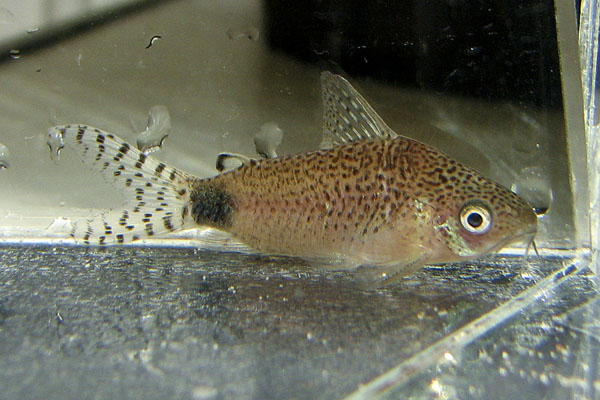
Corydoras guaporeGuaporé Cory
Knaack, 1961
Max length50mm SL2.0in SLTank90 × 30cm36 × 12inTemp22–28°C72–82°FpH5.0–7.0C. guapore is a sought after aquarium fish although it is not often traded. It exhibits slightly different behaviour to the majority of congeners in that it tends to form aggregations in midwater and spends a large proportion of its time away from the substrate. Its morphology exhibits corresponding adaptations towards a pelagic existence with a relatively large eye, a more terminal mouth position, more strongly-forked caudal-fin, and more symmetrical body shape than most other Corydoras species.
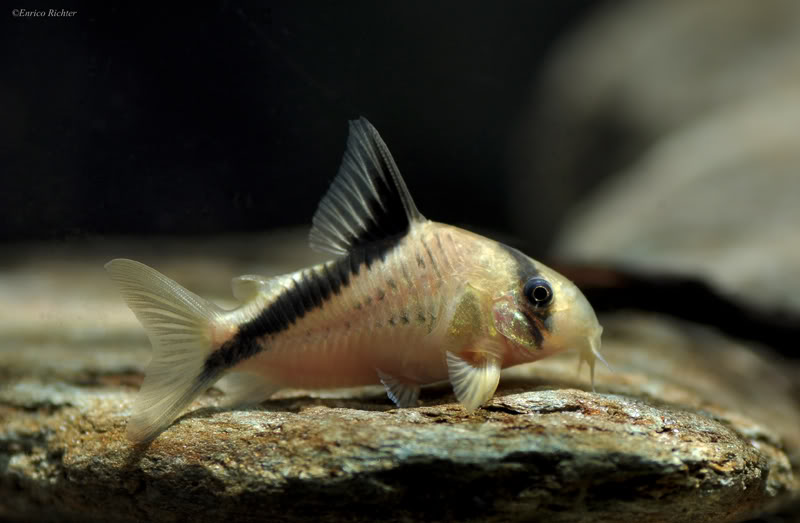
Corydoras meliniFalse Bandit Cory
Lönnberg & Rendahl, 1930
Max length50mm SL2.0in SLTank80 × 30cm31 × 12inTemp20–26°C68–79°FpH4.0–7.0In the aquarium hobby, the population from the rio Tiquié has been referred to as 'C084', while a similar, but larger, form from the Río Huallaga in Peru is known as 'C085'. Both forms have been marketed as C. sp. 'mega metae'. The existence of multiple, similarly-coloured species which coexist and sometimes form mixed schools is relatively common in the genus.
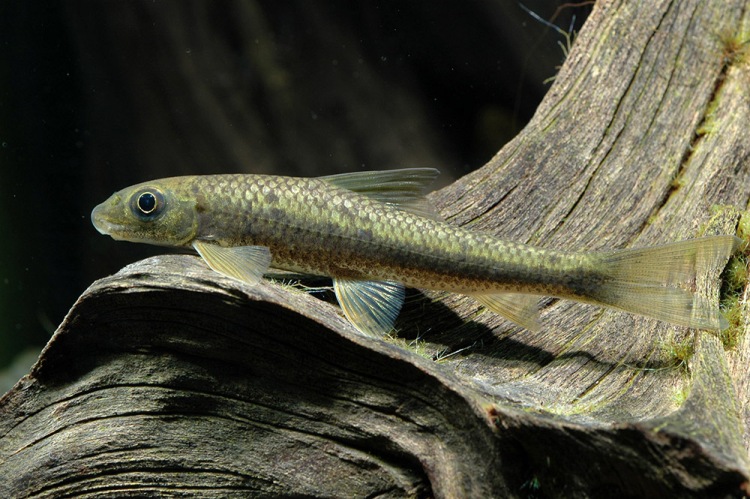
Crossocheilus latius
Hamilton, 1822
Max length150mm SL6in SLTank150 × 45cm60 × 18inTemp18–24°C64–75°FpH6.0–7.5C. latius isn't often available in the trade but makes an excellent alternative to more commonly-offered members of the genus should you be lucky enough to find some. Shipments of similar-looking Indian Garra species such as G. mullya or G. gotyla sometimes contain the odd specimen. It exhibits morphological differences when compared with other members of the genus and may be assigned to a separate taxon at some point in the future.
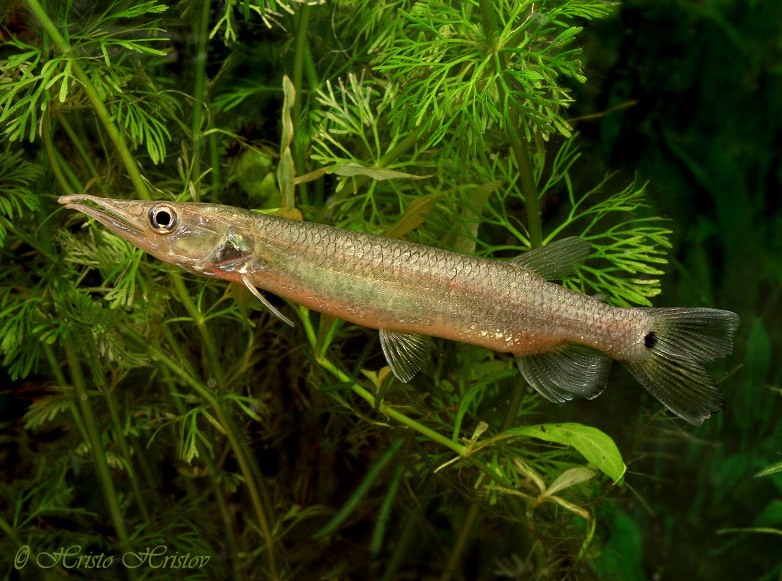
Ctenolucius hujetaGar 'Characin'
Valenciennes, 1850
Max length250mm SL10in SLTank180 × 60cm72 × 24inTemp22–28°C72–82°FpH5.0–7.5C. hujeta is traded under various names including 'slant-nosed gar', 'hujeta gar', 'rocket gar' and 'freshwater barracuda' but it and other members of the family Ctenoluciidae have traditionally been referred to as 'pike characids'. They're all predatory fishes native to South America, included in the order Characiformes and currently spread across two genera; Ctenolucius with two species and Boulengerella with five. The two genera are ...
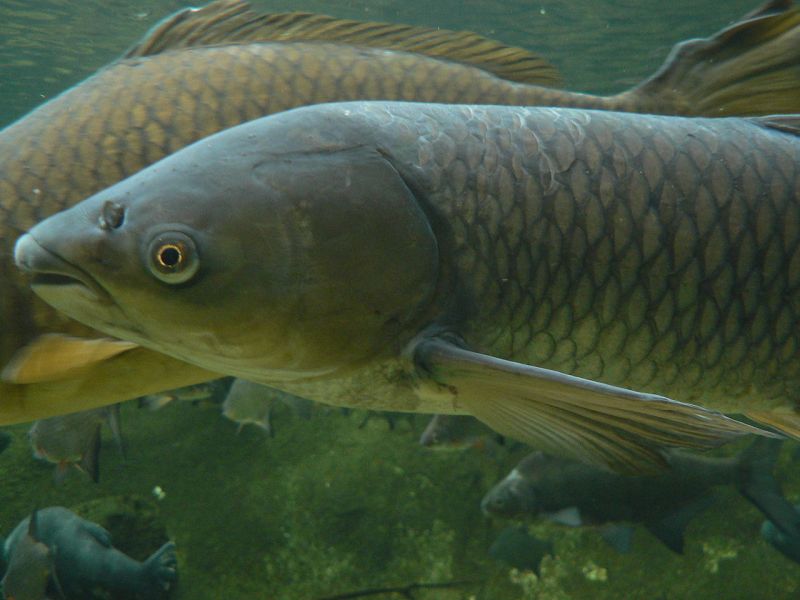
Ctenopharyngodon idellaGrass Carp
Valenciennes, 1844
Max length1200mm SL47in SLTanknot recordedTemp0–33°C32–91°FpH6.0–9.0Despite being a wholly unsuitable aquarium subject, C. idella is often traded as such, with an albino form having been developed specifically for the ornamental market. Individuals which have outgrown their aquarium or pond should never be released into natural waters, either, since this species has proven capable of causing serious environmental damage under a wide range of climatic conditions.
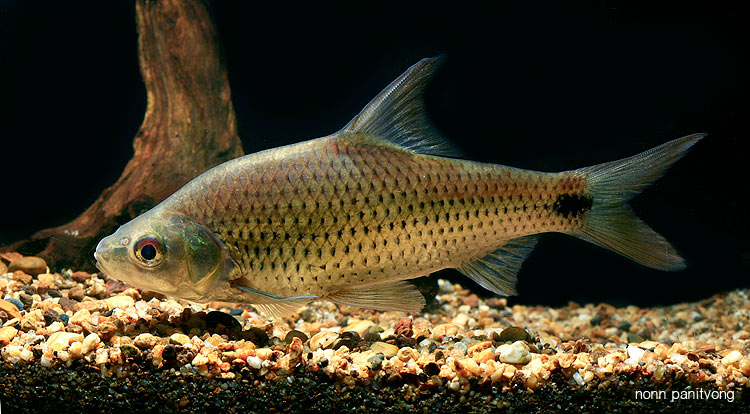
Cyclocheilichthys armatus
Valenciennes, 1842
Max length230mm SL9in SLTank180 × 60cm72 × 24inTemp20–26°C68–79°FpH6.0–8.0It can be distinguished from congeners by possessing one or two pairs of barbels, a black blotch at the base of the caudal-fin, and rows of dark spots along the lateral scale rows. Members of Cyclocheilichthys are characterised by possessing a serrated dorsal fin spine, 9 branched pelvic fin rays, a conical snout, small, subterminal...
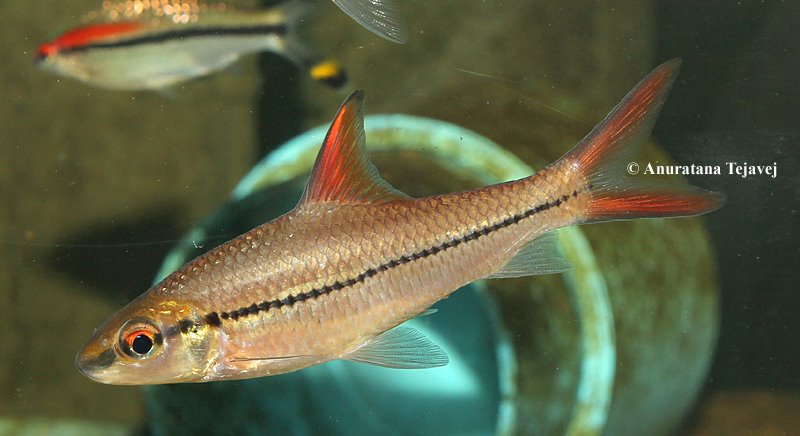
Cyclocheilichthys janthochir
Bleeker, 1854
Max length200mm SL8in SLTank180 × 45cm72 × 18inTemp22–27°C72–81°FpH4.0–7.0In the exceptionally diverse Danau Sentarum lake system of the upper Kapuas River basin, West Kalimantan, sympatric species include Scleropages formosus, Barbonymus gonionotus, B. schwanenfeldii, Crossocheilus nigriloba, Cyclocheilichthys apogon, C. repasson, Epalzeorhynchos kalopterus, Labiobarbus ocellatus , Leptobarbus hoevenii, Luciosoma spilopleura plus various representatives of Barbodes, Rasbora and Osteochilus.
Cyprichromis leptosomaSardine Cichlid
authority not recorded
Max length125mm SL5in SLTank120 × 45cm48 × 18inTemp24–27°C75–81°FpH7.8–9.0One of the favourite Tanganyikan cichlids among hobbyists, this species occurs in several geographical morphs. Each of these further exists in both blue and yellow-tailed forms. They congregate in large shoals of several thousand in nature, preying on zooplankton. In the hobby you may also see C. leptosoma sp. "Jumbo" for sale. These fish grow to the size quoted above, whilst the "true" leptosoma only reaches around 4" in length. Although it's likely we are deal...