Results for “sp.”
Type a name: scientific, common, or one a species used to go by. Or narrow the catalogue with the filters.
Filters
Hemigrammus vorderwinkleri
authority not recorded
Max length40mm SL1.6in SLTank60 × 38cm24 × 15inTemp23–27°C73–81°FpH5.5–7.0The only time you'll probably come across this species is as a contaminant among imports of other species. This is a pity, as it's an attractive, peaceful little fish. Like all Hemigrammus, the taxonomic status of this species is currently Incertae Sedis, meaning uncertain. The genus is currently used as something of a catch-all for over 70 species of small characin. Most experts agree that a full revision is required, with the likely outcome that many species will be placed into ne...
Hemigrammus boesemaniBoesman's Tetra
authority not recorded
Max length45mm SL1.8in SLTank60 × 38cm24 × 15inTemp23–26°C73–79°FpH5.5–7.0This species is very rare in the hobby, and should be snapped up if seen on sale. In the past it was considered a subspecies of H. micropterus. Supposedly, it's not a particularly common species in any of its natural waters. Like all Hemigrammus, the taxonomic status of this species is currently Incertae Sedis, meaning uncertain. The genus is currently used as something of a catch-all for over 70 species of small characin. Most experts agree that a full revision is required, with the lik...
Hemigrammus levis
authority not recorded
Max length50mm SL2.0in SLTank60 × 38cm24 × 15inTemp24–28°C75–82°FpH5.5–7.0A rather rare fish in the UK hobby. It occasionally shows up as a contaminant among imports of more popular species. Like all Hemigrammus, the taxonomic status of this species is currently Incertae Sedis, meaning uncertain. The genus is currently used as something of a catch-all for over 70 species of small characin. Most experts agree that a full revision is required, with the likely outcome that many species will be placed into new or different genera....
Hemigrammus ulreyiBroken-line Tetra
authority not recorded
Max length50mm SL2.0in SLTank60 × 38cm24 × 15inTemp23–27°C73–81°FpH6.0–7.0Other species are frequently misidentified as H. ulreyi. The true fish is quite scarce in the hobby, but makes a very attractive addition to most tanks if you can find it. Like all Hemigrammus, the taxonomic status of this species is currently Incertae Sedis, meaning uncertain. The genus is currently used as something of a catch-all for over 70 species of small characin. Most experts agree that a full revision is required, with the likely outcome that many species will be placed into new or d...
Hemisynodontis membranaceusMoustache Catfish
authority not recorded
Max length500mm SL20in SLTank120 × 60cm48 × 24inTemp22–26°C72–79°FpH6.5–7.5There is some confusion as to where this species should be placed taxonomically. It is currently the only species in the genus Hemisynodontis but it has been regularly moved between Synodontis, Hemisynodontis and Brachysynodontis. The main morphological differences that set it apart are the presence of additional gill rakers in this species and the fact it has relatively few mandibular teeth compared to Synodontis species. It also possesses the chracteristic "moustache", which is in fa...
Melanochromis chipokae
authority not recorded
Max length120mm SL5in SLTank120 × 45cm48 × 18inTemp24–28°C75–82°FpH7.6–8.8This species belongs to the group of Melanochromis often called "Pike Auratus". These species predate on the fry of other species, although M. chipokae will also eat crustaceans and algae. Female and juvenile male M. chipokae are easily confused with M. auratus. However, it can be distinguished by its noticeably more pointed mouth, denoting the predatory nature of this species (auratus has a rounded mouth which is designed for feeding on algae). The striped patterning in the also exten...
Moenkhausia oligolepisGlass Tetra
authority not recorded
Max length50mm SL2.0in SLTank60 × 38cm24 × 15inTemp24–28°C75–82°FpH5.5–7.2This species is one of a handful that closely resemble the popular red-eyed tetra, M. sanctaefilomenae. This species is seen much less often in the hobby than its relative however and is also known as the glassy tetra. The taxonomic status of all species in the genus Moenkhausia is currently Incertae Sedis, meaning uncertain. The genus is currently used as something of a catch-all for a large number of small characin species. Most experts agree that a full revision is required, with the likel...
Myloplus rubripinnisRedhook
authority not recorded
Max length250mm SL10in SLTank180 × 38cm72 × 15inTemp23–27°C73–81°FpH6.0–7.0The Redhook is another species commonly sold as a Silver Dollar in the trade. It can be distinguished from those species as the black-trimmed, redis much more obvious than any of the metynnis species. The Redhook is also capable of growing much larger than its Silver Dollar relatives. This species was until recently referred to as myleus rubripinnis and is still widel y referred to as such. The Redhook is sometimes described as a difficult fish to care for but, given a large enough aquarium, ...
Polypterus weeksiiMottled Bichir
authority not recorded
Max length550mm SL22in SLTank150 × 60cm60 × 24inTempnot recordedpHnot recordedP. weeksii is one of the "upper-jawed" tribe of polypterids so named on account of the upper jaw being longer than or equal in length to the lower jaw. It is one of the rarer bichir species in the hobby. Like other bichirs it is an incredibly hardy, nocturnal species with very poor vision, relying on its excellent sense of smell to locate food. This species along with others of its genus are some of the last surviving relatives of very ancient species. Fossils of earlier relatives have...
Protomelas taeniolatus
authority not recorded
Max length200mm SL8in SLTank120 × 45cm48 × 18inTemp24–28°C75–82°FpH7.6–8.8One of the more popular and readily available Protomelas species in the hobby, P. taeniolatus is very similar to P. fenestratus. Several colour forms of both these species exist. Some of the popular morphs of taeniolatus include "Red Empress", "Super Red Empress" and "Blue Fire". It is likely that some of these may be reclassified as distinct species in the future, as they attain different maximum sizes. None of these related species or morphs should be kept togethe...
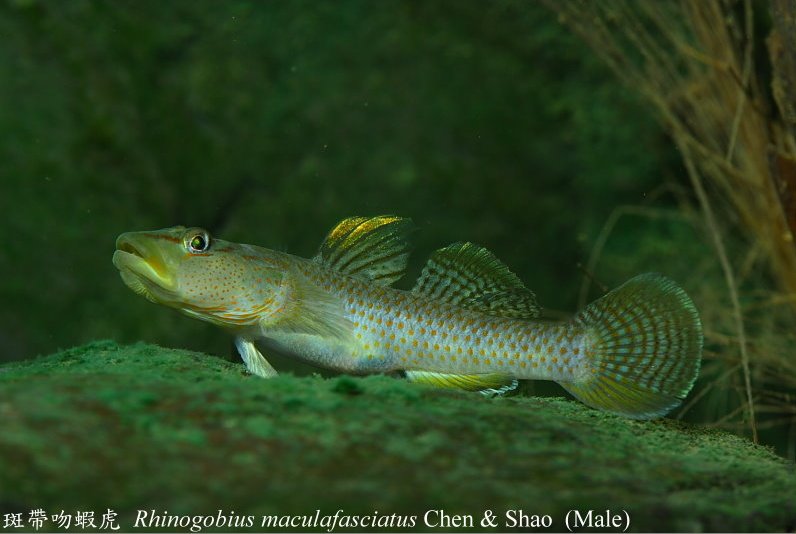
Rhinogobius maculafasciatus
Chen & Shao, 1996
Max length50mm SL2.0in SLTank60 × 30cm24 × 12inTemp18–24°C64–75°FpH6.0–8.0This species may not yet have appeared in the ornamental trade but it has been collected by a few individuals. It can be told apart from related species from Taiwan by possessing 30-32 longitudinal (lateral) scales vs. 32-39 in other species, and 6-8 scale rows between the origin of the first dorsal-fin and upper pectoral-fin base vs. 9-15 in other species.
Rineloricaria eigenmanniCommon Whiptail Catfish
authority not recorded
Max length150mm SL6in SLTank90 × 30cm36 × 12inTemp24–29°C75–84°FpH6.0–7.4One of the most common of the numerous species sold as 'whiptail catfish', R. eigenmanni is an excellent species for the newcomer to Loricariids or catfish breeding. It's certainly not the most active species, but when settled and housed with the correct kind of tankmates, it is by no means shy either. It does have a bit of a confusing taxonomic past, though. Whilst currently considered a member of Rineloricaria, it was first decribed as a species of Loricaria, before being mov...
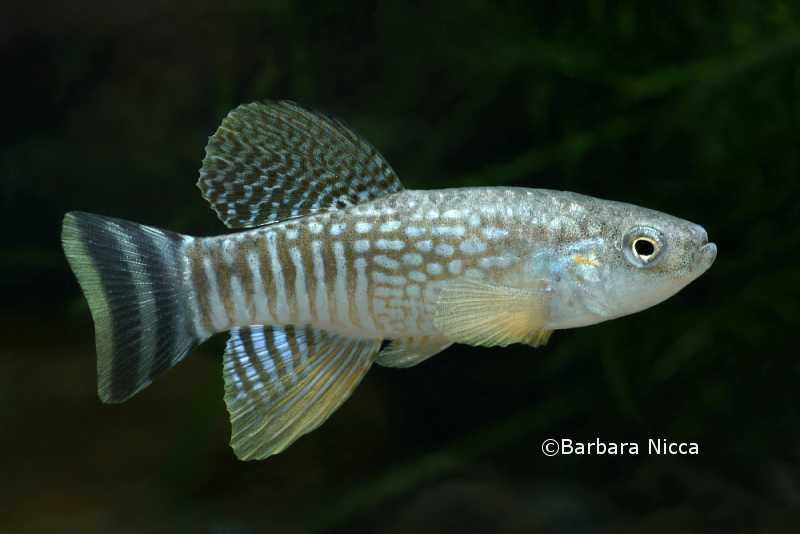
Aphaniops disparArabian Toothcarp
Rüppell, 1829
Max length80mm SL3.1in SLTank120 × 30cm48 × 12inTemp4–30°C39–86°FpH7.5–9.0A. dispar should only be considered a nominal species as demonstrated by Hrbek and Meyer (2003) who conducted an in-depth phylogenetic study covering the majority of the genus. It was found to represent a paraphyletic grouping meaning it cannot be considered to be a species following the phylogenetic species concept. A. mento, A. sirhani and especially A. ginaonis and A. richardsoni were found to be its closest surviving relatives. Hoedeman (1951) suggested that it should be moved into a separat...
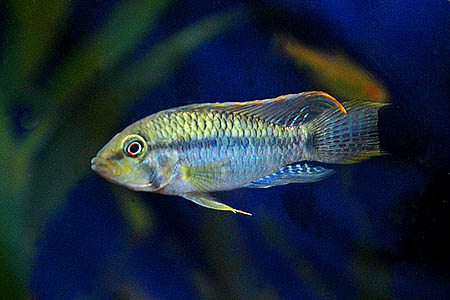
Apistogramma brevis
Kullander, 1980
Max length60mm SL2.4in SLTank45 × 38cm18 × 15inTemp26–28°C79–82°FpH6.0–7.0Apistogrammas are identified by the use of "A numbers"in a similar fashion to the "L number" system used to identify loricariids. Apistogramma brevis is identified as A168. Additionally, apistos are also grouped into type families and this species is the species type of the brevis group. Unlike some apistogramma species, a. brevis occurs only in a relatively small range and has not been found outside this. personata complex gibbiceps group...
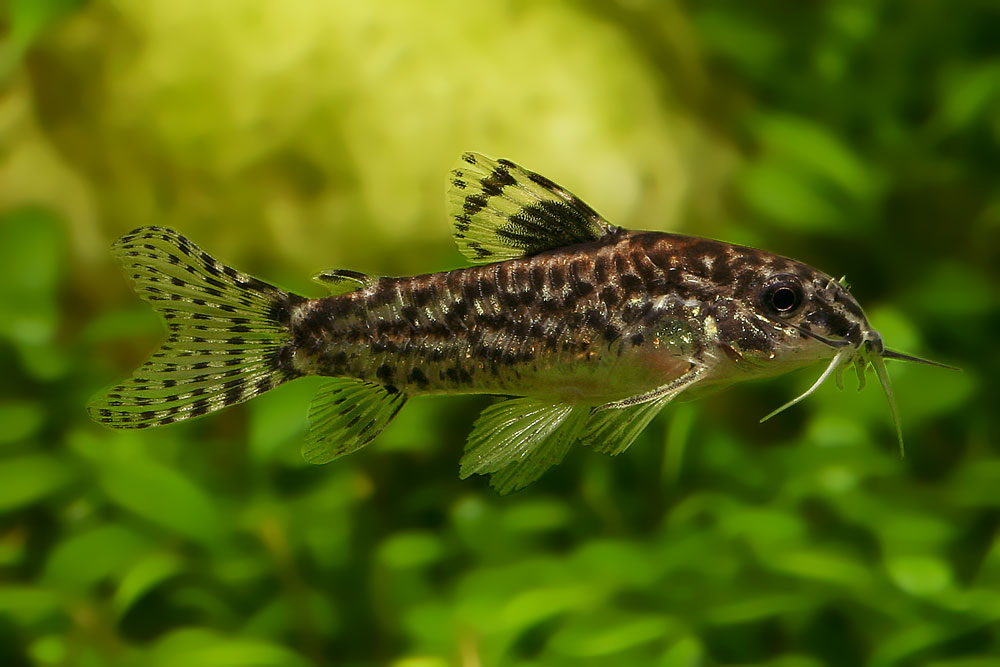
Aspidoras pauciradiatus
Weitzman & Nijssen, 1970
Max length35mm SL1.4in SLTank60 × 30cm24 × 12inTemp20–27°C68–81°FpH6.0–7.0This species is sometimes referred to as 'false corydoras' or 'sixray corydoras'. A. pauciradiatus can be distinguished from congeners by possession of 6 soft dorsal-fin rays, as opposed to 7 in other Aspidoras species, plus its distinctive colour pattern. Aspidoras species are distinguished from the very...
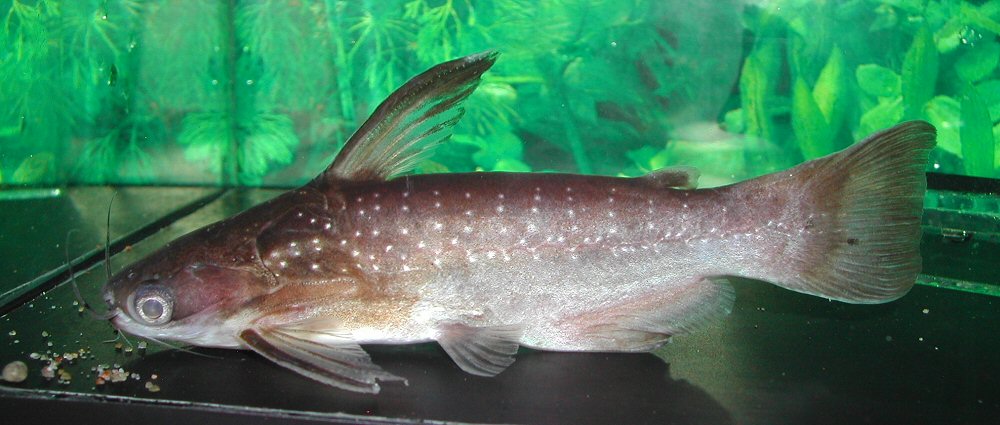
Auchenipterichthys coracoideusMidnight Catfish
Eigenmann & Allen, 1942
Max length110mm SL4in SLTank80 × 30cm31 × 12inTemp22–25°C72–77°FpH6.0–7.2This species is also known by the alternative vernacular name of 'Zamora woodcat', and is often misidentified as A. thoracatus. The latter is a valid species and very similar to A. coracoideus in that the coracoid bone is exposed ventrally and covered only by a thin layer of integument in both species. The two differ principally in the number of anal fin rays...
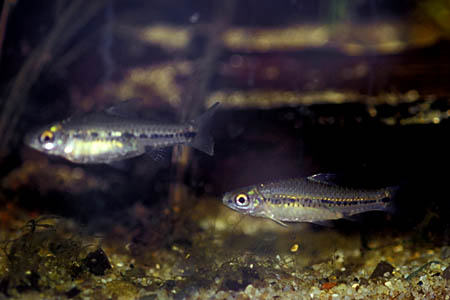
'Barbus' sublineatus
Daget, 1954
Max length100mm SL3.9in SLTank120 × 30cm48 × 12inTemp22–27°C72–81°FpH6.0–7.0The genus Barbus is in something of a confused state classification-wise. While there exist almost 340 putative species the vast majority of them do not appear to be closely-related to the genus Barbus sensu stricto. Berrebi et al. (1996) proposed that only the European, Southwest Asian and North African representatives should be included in Barbus (around 20 species) and that 'all species of Barbus sen...
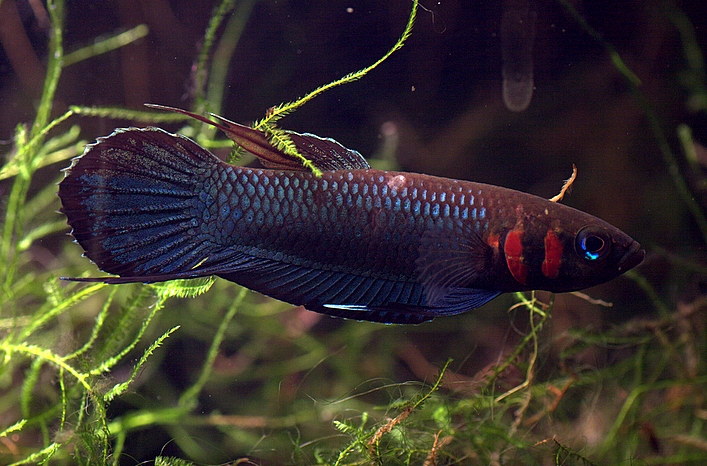
Betta foerschi
Vierke, 1979
Max length50mm SL2.0in SLTank60 × 30cm24 × 12inTemp22–28°C72–82°FpH4.0–6.0This species lends its name to the Betta foerschi group of closely-related species within the genus, of which members share the following set of characters: possession of iridescent blue or green unpaired fins; rays and interradial membranes in unpaired fins not contrasting; dorsal fin with thin, bright white distal band; opercle with two, reddish-yellow, vertical bars. Members are regarded as being closely-related to bubble nesting Betta specie...
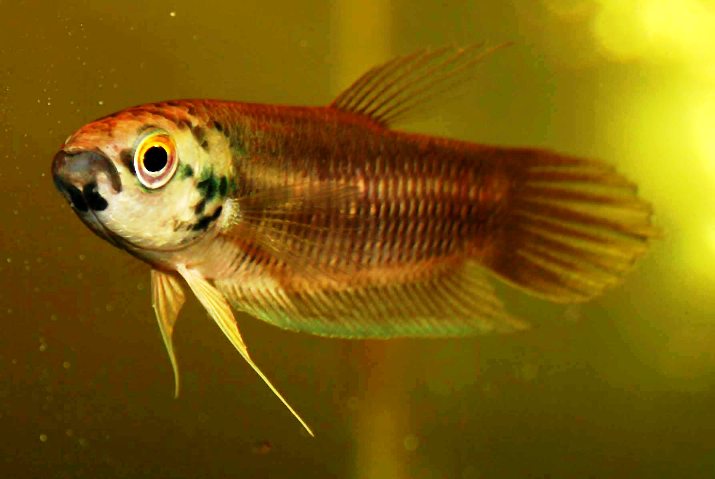
Betta pi
Tan, 1998
Max length90mm SL3.5in SLTank90 × 30cm36 × 12inTemp22–28°C72–82°FpH4.0–6.5B. pi is included in the Betta waseri group of closely-related species within the genus, an assemblage within which members share the following combination of characters: base body colouration clay yellow; opercle scales iridescent gold in mature males of all species except B. tomi; throat with black markings which join with black lower jaw in some species; no chin bar.
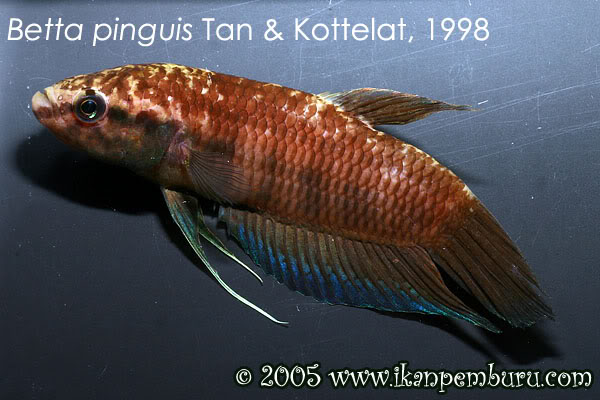
Betta pinguis
Tan & Kottelat, 1998
Max length80mm SL3.1in SLTank80 × 30cm31 × 12inTemp22–27°C72–81°FpH5.0–7.0B. pinguis is included in the Betta akarensis group/complex of closely-related species within the genus, of which members share the following set of characters: possession of pre-orbital and post-orbital stripes (the post-orbital stripe is faint or interrupted in some species); chin bar present; caudal-fin lanceolate with highly extended median rays in mature males; caudal fin usually with transverse bars; greenish or bluish iridescent scales on body of males in some species; opercle without iridescent scales except in juveniles.