Results for “species”
Type a name: scientific, common, or one a species used to go by. Or narrow the catalogue with the filters.
Filters
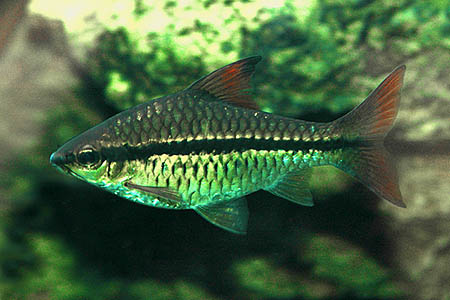
'Barbus' holotaeniaSpotscale Barb
Boulenger, 1904
Max length120mm SL5in SLTank120 × 45cm48 × 18inTemp24–30°C75–86°FpH6.0–7.0This species is native to Central West Africa where it is principally found in the great Ogooué and Congo River systems. It therefore has an extensive range and has been recorded at numerous localities right across the Democratic Republic of Congo (DRC) from the Ituri River in the far east of the country to the Luki River basin in the extreme west. The Congo River appears to represent the southernmost limit of its range as a...
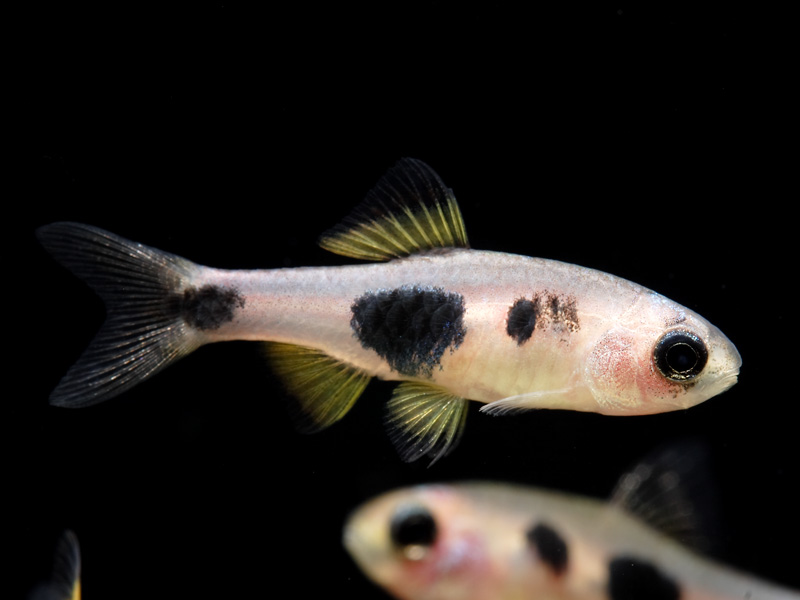
'Barbus' hulstaertiAfrican Butterfly Barb
Poll, 1945
Max length35mm SL1.4in SLTank45 × 30cm18 × 12inTemp17–24°C63–75°FpH5.0–6.5Two closely-related species are also found in the Congo basin and infrequently seen in the trade. 'B.' candens has been collected northeast of the range of 'B.' hulstaerti around the city of Kisangani (formerly Stanleyville) and nearby town of Yangambi. It can be distinguished from 'B.' hulstaerti by its paler body colouration, smaller dark markings on the body and red ventral and anal fins in males. 'B.' papillo is known only from its type locality close to the eastern town of Kindu between the Lualaba and Lomami rivers. It has an elongated central body marking and males possess black dorsal, ventral and anal fins.
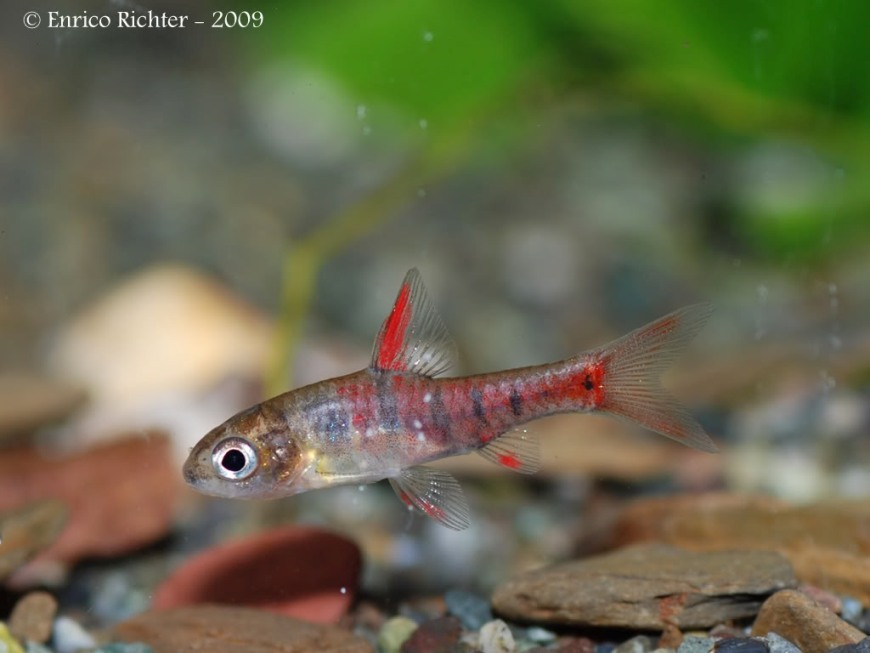
'Barbus' jae
Boulenger, 1903
Max length40mm SL1.6in SLTank45 × 30cm18 × 12inTemp17–24°C63–75°FpH5.0–6.5Although gregarious by nature it is a shoaling rather than schooling species which develops a distinct pecking order between males. It should ideally be maintained in a group of 8 or more but the tank must be of a sufficient size which will allow weaker individuals some respite from dominant conspecifics and decorated in such a way that many broken lines of sight are provided. Conversely if kept singly, in a very small group or in cramped conditions it can become withdrawn and subdominant fish may be bullied incessantly.
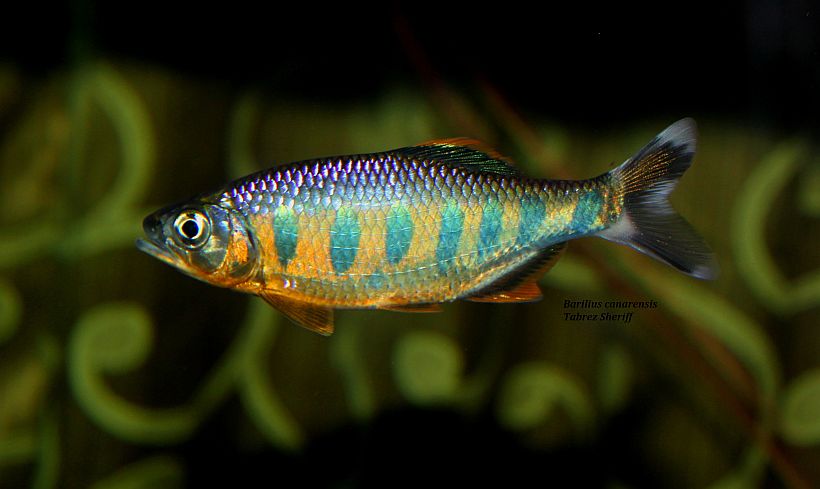
Barilius ardens
Knight, Rai, d'Souza & Vijaykrishnan, 2015
Max length105mm SL4in SLTank150 × 60cm60 × 24inTemp18–26°C64–79°FpH6.0–7.5Prior to its description this species was typically identified as the congener B. canarensis in the ornamental trade. It can be distinguished from congeners by the following combination of characters: uni...
Barilius bakeri
Day, 1865
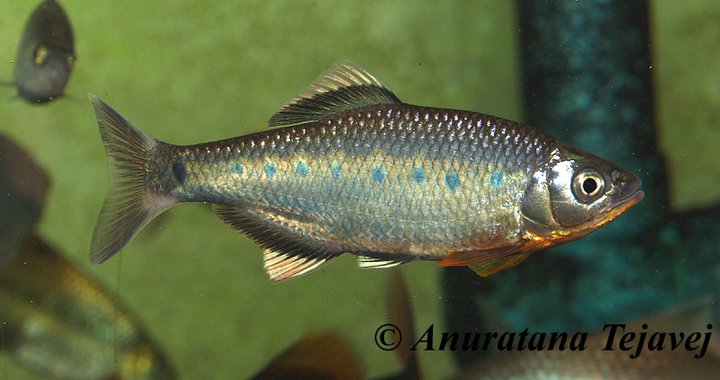
Max length130mm SL5in SLTank150 × 60cm60 × 24inTemp18–26°C64–79°FpH6.0–7.5This species is traded under several names including 'royal danio', 'blue-spotted hill trout', and 'blue-dotted mirror fish'. It can be distinguished from congeners by possessing a single row of bluish-green spots along the length of the body, white margins on the dorsal and anal fins, 37-38+1 lateral line scales, and fleshy rudi...
Barilius gatensisMalabar Baril
Valenciennes, 1844
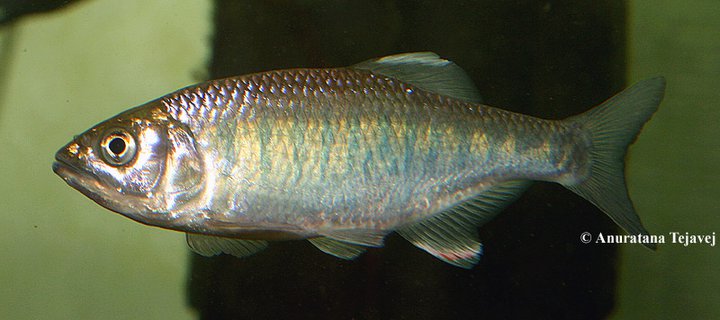
Max length130mm SL5in SLTank150 × 60cm60 × 24inTemp18–26°C64–79°FpH6.0–7.5This species is traded very occasionally, sometimes under the alternative vernacular names of 'river baril, 'river carp-baril', or 'striated hill trout'. It can be told apart from congeners by the following combination of characters: 1 pair of minute rostra...
Baryancistrus demantoidesGreen Phantom Pleco
Werneke, Sabaj Pérez, Lujan & Armbruster, 2005
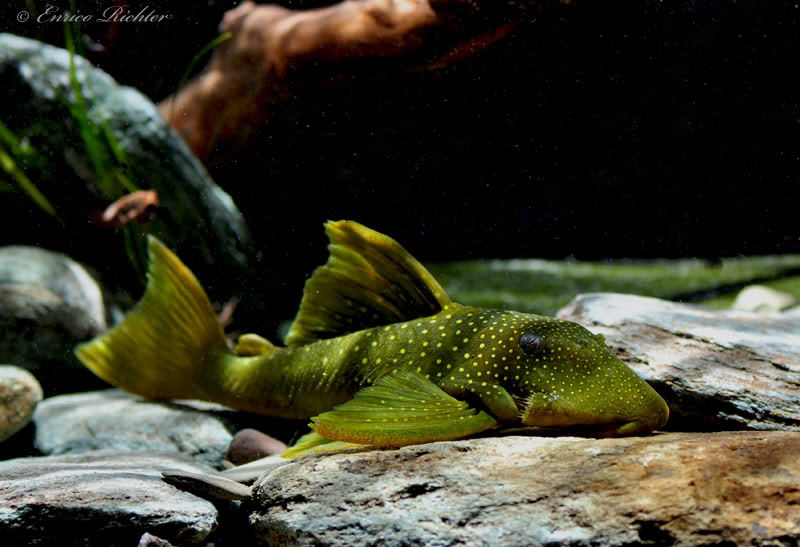
Max length151mm SL6in SLTank120 × 45cm48 × 18inTemp26–30°C79–86°FpH5.5–7.5This species is very similar to Hemiancistrus subviridis in appearance and the two occur sympatrically in nature, although B. demantoides is less common in the aquarium trade. Both have been marketed under the DATZ code L200 with B. demantoides sometimes referred to as 'L200 high-fin' or 'L200a', the former name in reference to its comparatively long dorsal-fin spine (average length in the type series 42.1 mm vs. 34.3 mm in H. subviridis).
Baryancistrus sp. cf. xanthellusGold Nugget Pleco
authority not recorded
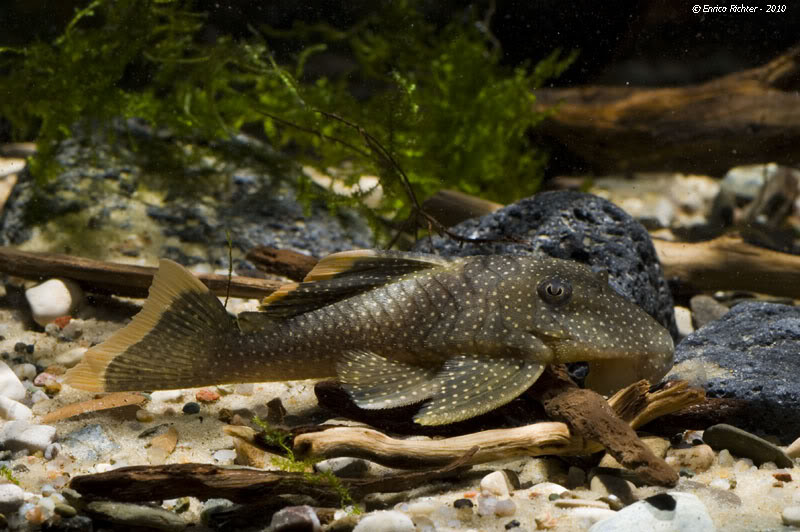
Max length180mm SL7in SLTank120 × 45cm48 × 18inTemp27–32°C81–90°FpH6.4–7.6It remains unconfirmed as to whether this fish represents a colour form of B. xanthellus or not since its DATZ code number of L081 is not referred to in the description paper whereas all other codes for 'gold nugget' plecos, i.e., L018, L085, L177 plus the 'Das Aquarium' code LDA060 are mentioned. In addition, one of the specimens in our images was apparently collected at São Félix do Xingu which is significantl...
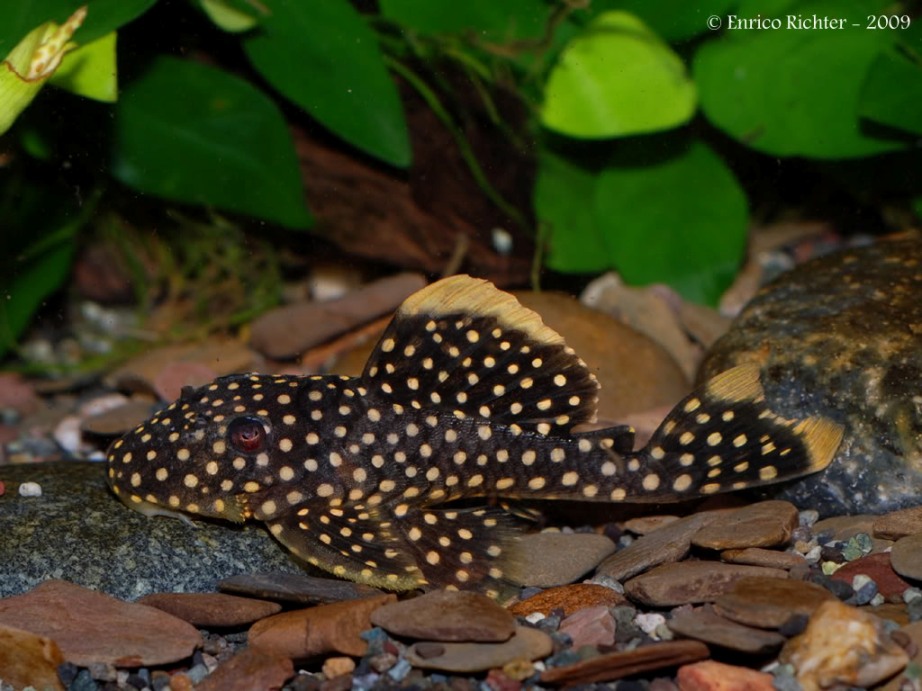
Baryancistrus xanthellusGold Nugget Pleco
Rapp Py-Daniel, Zuanon & Ribeiro de Oliveira, 2011
Max length224mm SL9in SLTank120 × 45cm48 × 18inTemp27–32°C81–90°FpH6.0–8.0Prior to description in 2011 this species was traded under the DATZ code numbers L018, L085, L077 and 'Das Aquarium' code LDA060, while a very similar-looking fish from the lower rio Xingu which has been assigned the code L081 may also represent a form of B. xanthellus but is not mentioned in the description paper. B. xanthellus can be distinguished from congeners by a combination of the following...
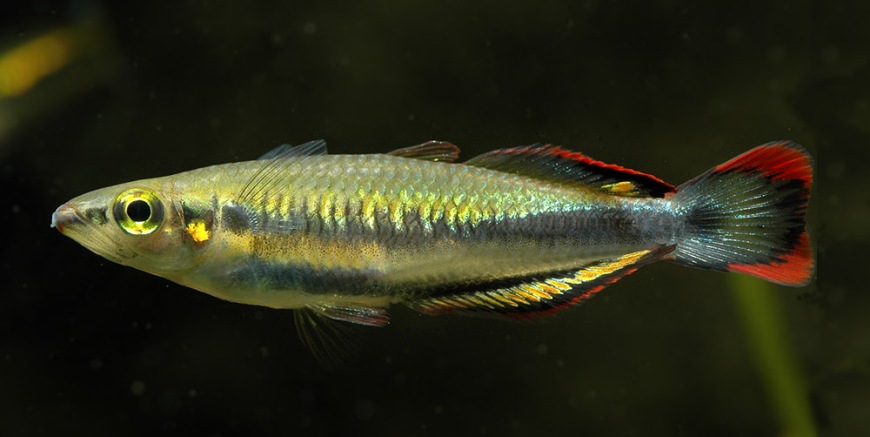
Bedotia madagascarensisMadagascan Rainbow Fish
Regan, 1903
Max length100mm SL3.9in SLTank120 × 30cm48 × 12inTemp23–32°C73–90°FpH4.5–7.5This species was first imported for the aquarium hobby during the 1950s and was for many years misidentified and traded as Bedotia geayi, a valid, but different-looking congener native to the Mananjary River system, south of the range of B. madagascarensis. In terms of external characters, the two are most easily told apart by differences in colour pattern, particularly that of the unpaired fins, and some morphometric counts.
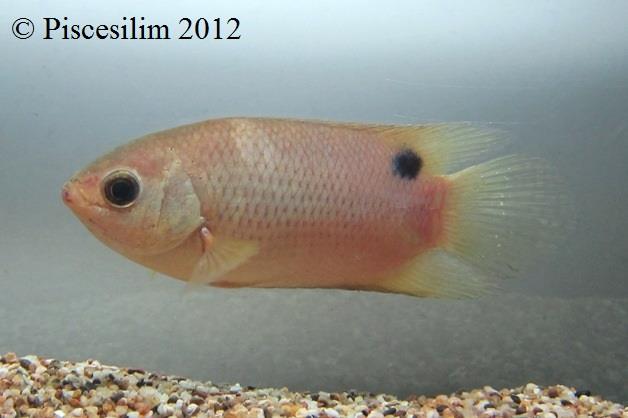
Belontia hasseltiJava Combtail
Cuvier, 1831
Max length200mm SL8in SLTank120 × 30cm48 × 12inTemp21–26°C70–79°FpH4.5–8.5This species is also referred to by the vernacular name 'Malay combtail'. In terms of external characters it differs most obviously from its only congener, B. signata by its overal brownish grey (vs. reddish) body colouration and presence of a mosaic-type patterning in the unpaired fins (vs. absence). The position of relatedness of the genus Belontia with respect to other anabantoids remains somewhat...
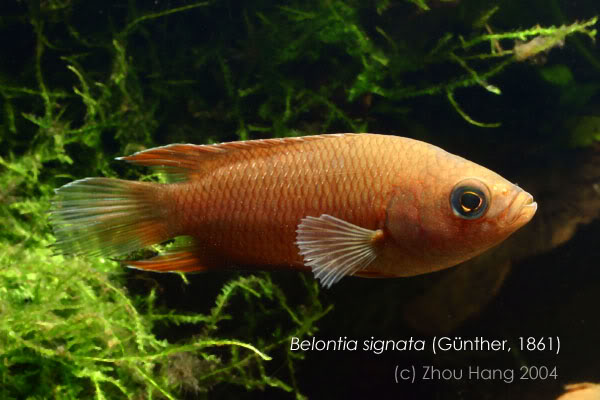
Belontia signataCeylonese Combtail
Günther, 1861
Max length120mm SL5in SLTank120 × 30cm48 × 12inTemp20–27°C68–81°FpH6.0–7.5This species is also traded/referred to by the vernacular name 'Ceylon fighting fish'. It differs from its only congener, B. hasselti, by its overall reddish (vs. brownish-grey) body colouration, and absence (vs. presence) of a mosaic-like patterning in the unpaired fins. At least three putative phenotypes have been recorded. The nominative, and commonest, mostly inhabits clear streams in rainier zones...
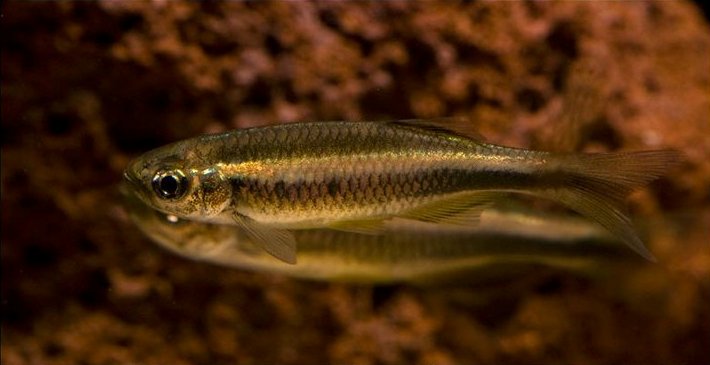
Betadevario ramachandrani
Pramod, Fang, Rema Devi, Liao, Indra, Jameela Beevi & Kullander, 2010
Max length61mm SL2.4in SLTank120 × 30cm48 × 12inTemp18–23°C64–73°FpH6.0–7.0As far as we know this species is yet to arrive to the international aquarium trade though it has been maintained by a handful of Indian aquarists. It's restricted geographical range and difficulty of collection mean it's unlikely to become available in numbers unless adopted by commercial breeders.
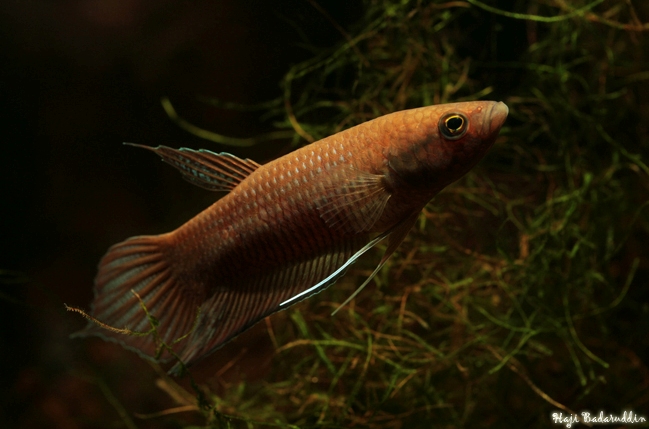
Betta akarensis
Regan, 1910
Max length80mm SL3.1in SLTank60 × 30cm24 × 12inTemp21–27°C70–81°FpH5.5–7.5Like others in the suborder Anabantoidei this species possesses an accessory breathing organ known as the labyrinth. So-called due to its maze-like structure this organ allows the fish to breathe atmospheric air to a certain extent. Comprising paired suprabranchial organs formed via expansion of the epibranchial (upper) section of the first gill arch and housed in a chamber above the gills, it contains...
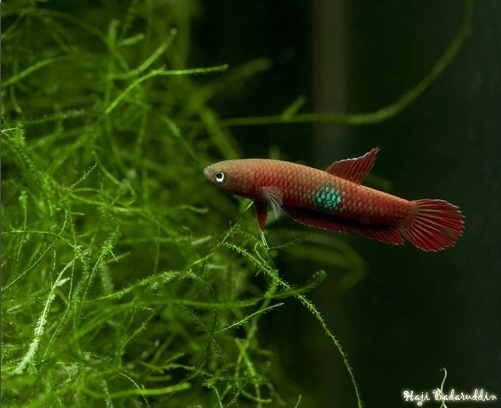
Betta brownorum
Witte & Schmidt, 1992
Max length30mm SL1.2in SLTank45 × 30cm18 × 12inTemp24–30°C75–86°FpH3.0–6.0B. brownorum is included in the Betta coccina group/complex of closely-related species within the genus. This assemblage mostly comprises small, red-coloured fishes with the exceptions of B. persephone and B. miniopinna which are darkish. Identifying some of the red ones correctly is not always easy as the patterning in them can be both similar and confusingly variable. In B. brownorum and B. livida, for example, both male and female individuals may or may not possess a green lateral blotch.
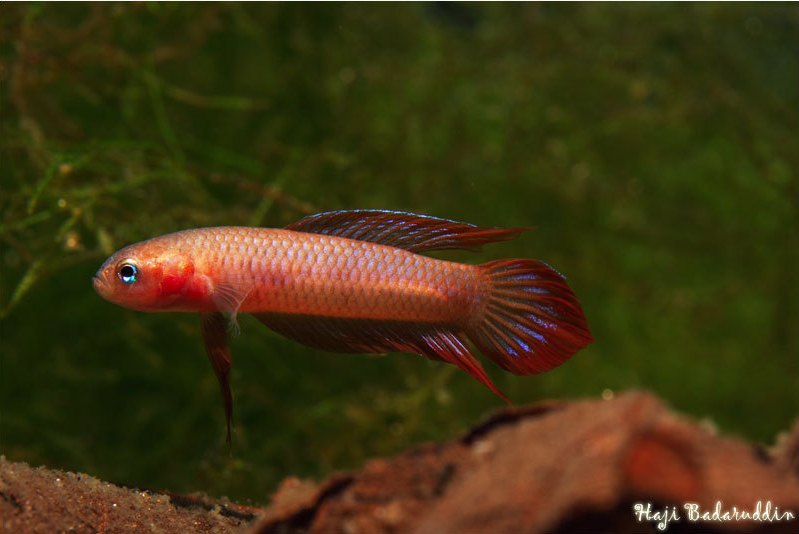
Betta burdigala
Kottelat & Ng, 1994
Max length35mm SL1.4in SLTank45 × 30cm18 × 12inTemp22–30°C72–86°FpH4.0–6.0B. burdigala is exceptionally rare in the hobby with many fishes traded or pictured as such being B. uberis or other congener. It's included in the Betta coccina group/complex of closely-related species within the genus. This assemblage mostly comprises small, red-coloured fishes with the exceptions of B. persephone and B. miniopinna which are darkish. Identifying some of the red ones correctly is not always easy as the patterning in them can be both similar and confusingly variable.
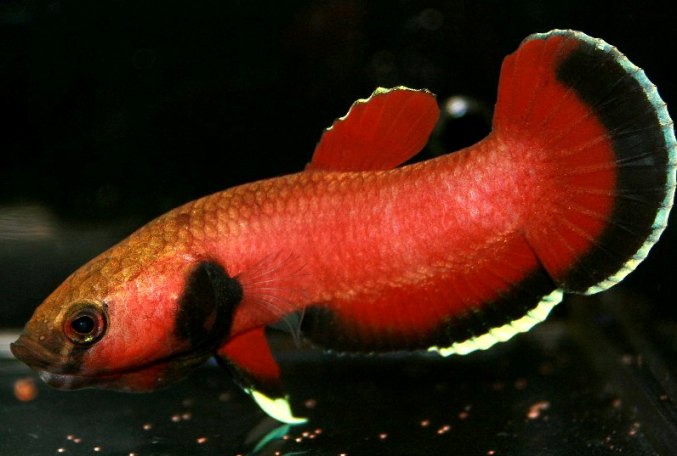
Betta channoidesSnakehead Betta
Kottelat & Ng, 1994
Max length40mm SL1.6in SLTank45 × 30cm18 × 12inTemp23–30°C73–86°FpH4.0–6.5B. channoides and B. albimarginata together comprise the Betta albimarginata group/complex of closely-related species within the genus, these differing from all other members of the genus in colour pattern and by possession of 9-12 anal-fin spines (vs. 0-4). They look very similar to one another but differ in the following characters: anal fin spines 9-11 in B. albimarginata vs. 12 in B. channoides; anal fin rays 21-23 vs. 23-25; lateral scale rows 26-27 vs. 27.5-28; trans...
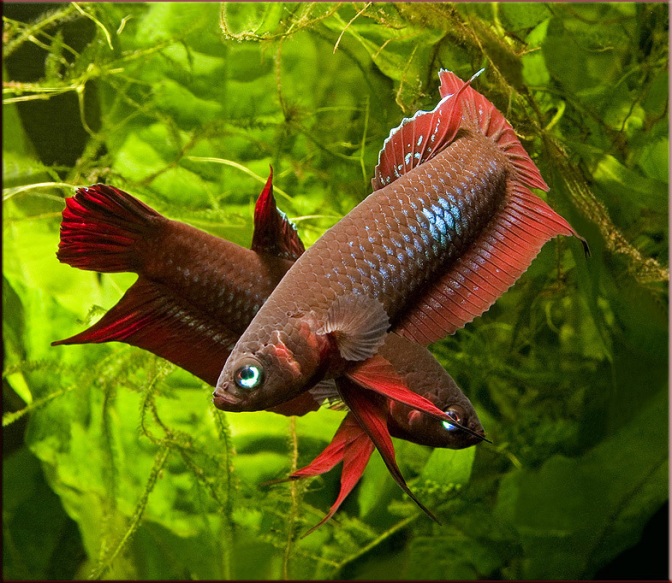
Betta coccinaScarlet Betta
Vierke, 1979
Max length40mm SL1.6in SLTank45 × 30cm18 × 12inTemp22–30°C72–86°FpH4.0–6.0B. coccina can be told apart from other members by the following combination of characters: iridescent green lateral blotch present in male, absent in female; body dark red in colour; no parallel vertical iridescent gold opercle bars; pelvic fin falcate with black filamentous tip, remainder red; median fins with discrete iridescent green spots; dorsal fin-rays 9-12; anal-fin rays 27-29; subdorsal scales 7-8; lateral scales 31-32; predorsal scales 18-21. The genus Betta is the most speciose within the family Osphronemidae with almost 70 reco...
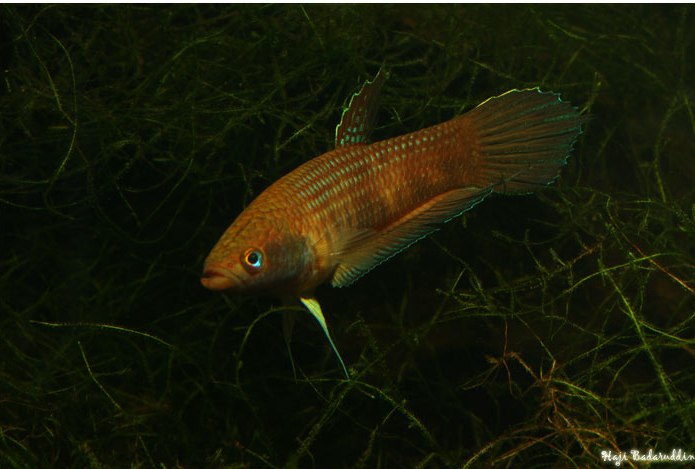
Betta cracens
Tan & Ng, 2005
Max length60mm SL2.4in SLTank80 × 30cm31 × 12inTemp22–27°C72–81°FpH5.5–6.5The type locality is a stream in a forest swamp with dense growth of Barclaya motleyi at intervals, part of which had been turned over to cultivation of rubber trees in 1997. The water depth varied between 5-80 cm, pH was 5.8 and syntopic species included 'Puntius' banksi, Rasbora einthoveni, Trigonopoma pauciperforatum, Hemirhamphodon pogonognathus, Betta pugnax, Sphaerichthys osphromenoides, Trichogaster trichopterus, Channa gachua and C. lucius.
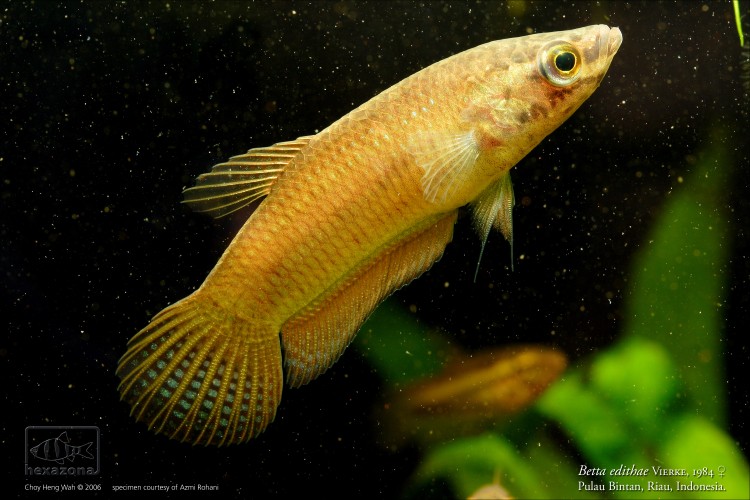
Betta edithae
Vierke, 1984
Max length60mm SL2.4in SLTank80 × 30cm31 × 12inTemp20–27°C68–81°FpH5.0–7.0This species is the only member of the B. edithae group within the genus, and separated from all other Betta spp. by the fact that the branchiostegal membrane and posterior portion of the opercle are opaque or translucent. The original diagnosis by Vierke also states that it has relatively small eyes and short fins with a typical pattern of partial barring.