Results for “várzea”
Type a name: scientific, common, or one a species used to go by. Or narrow the catalogue with the filters.
Filters
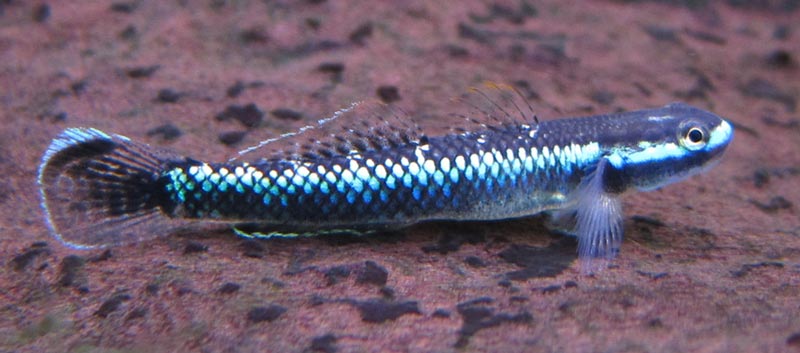
Stiphodon atropurpureusBlue Neon Goby
Herre, 1927
Max length50mm SL2.0in SLTank60 × 30cm24 × 12inTemp22–26°C72–79°FpH6.5–7.5This species is available occasionally, though not always under the correct name. We've seen it on sale as S. elegans on numerous occasions, for example, and other trade names include 'Sumatran blue neon goby' (it's not found on Sumatra), 'cobalt blue goby' and 'freshwater neon goby'. Further...
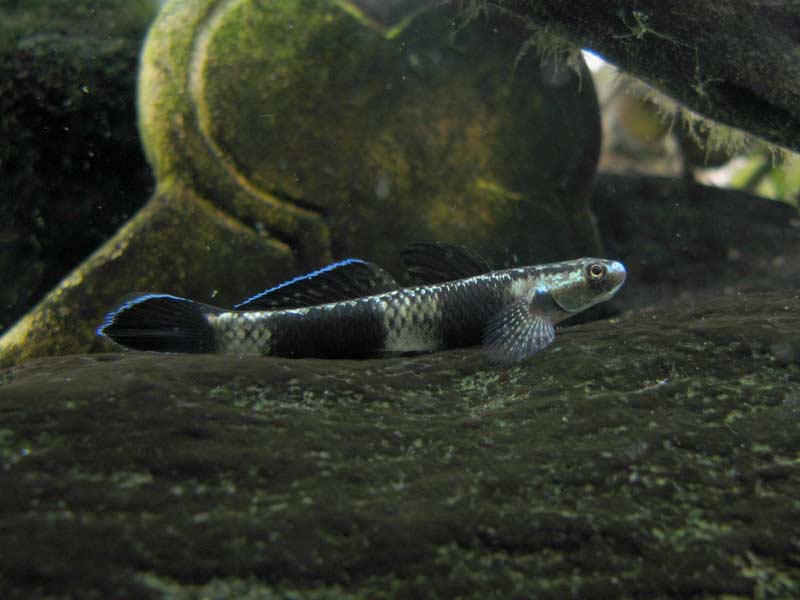
Stiphodon pelewensis
Herre, 1936
Max length45mm SL1.8in SLTank60 × 30cm24 × 12inTemp22–28°C72–82°FpH6.5–7.5This species seems not to have appeared in the trade and is similar to several congeners in appearance, most notably S. weberi which is native to the Maluku archipelago and other islands around the coast of Papua (formerly Irian Jaya). The two are said to be most easily-distinguished by examination of the belly which is fully-scaled in S. pelewensis but lacks scalation in S. weberi. The Gobiidae is the most speciose vertebrate family and notoriously problematic in terms of identifying fishes down to sp...
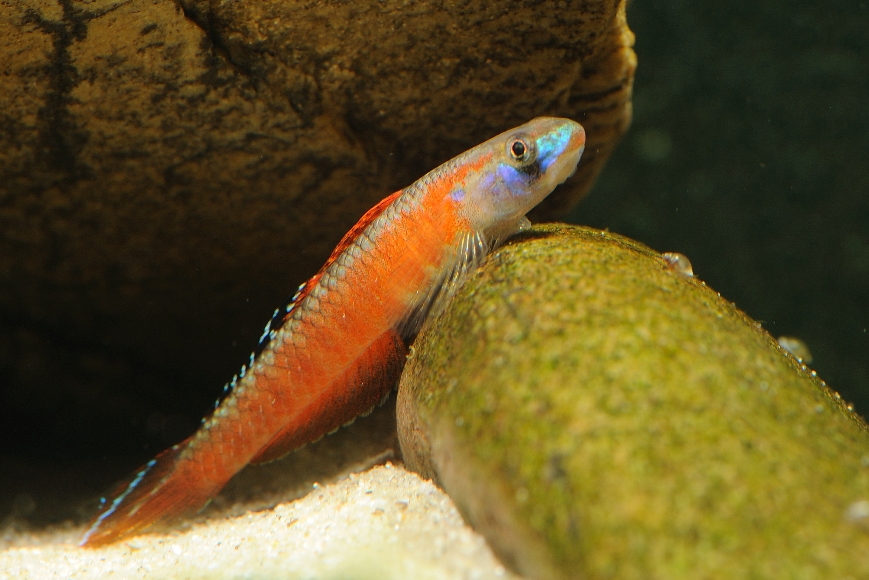
Stiphodon rutilaureus
Watson, 1996
Max length35mm SL1.4in SLTank60 × 30cm24 × 12inTemp22–28°C72–82°FpH6.5–7.5This species is not traded commercially at present and the specimen pictured above was brought back from northern Papua New Guinea by private collectors in 2008. It's diagnosable from other members in the genus by possession of 10 segmented rays in the second dorsal fin, males with filamentous spines in the firstandusually with 14 rays. Colour patterning in males is also distinctive (see 'Sexual Dimorphism'). The Gobiidae is the most speciose vert...
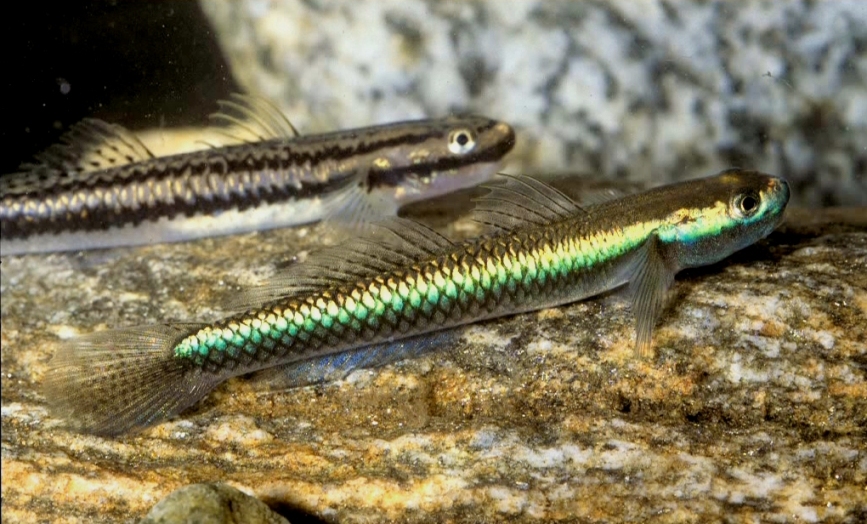
Stiphodon semoniCobalt Blue Goby
Weber, 1895
Max length50mm SL2.0in SLTank60 × 30cm24 × 12inTemp22–28°C72–82°FpH6.5–7.5This species has been traded for a number of years, though not always under the correct name. We've seen it on sale as S. elegans or S. atropurpureus on numerous occasions, for example, and other trade names include 'Sumatran blue neon goby', 'cobalt blue goby' and 'freshwater neon goby'. Further confusion has arisen because other species are sometimes sold as S. semoni meaning identification has not always been easy and there ...
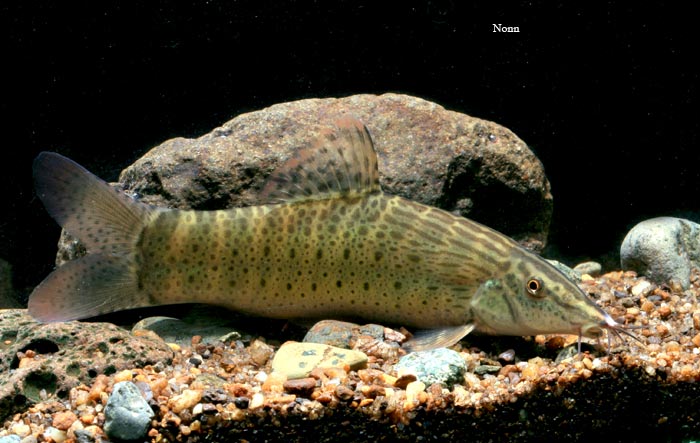
Syncrossus beaufortiChameleon Loach
Smith, 1931
Max length250mm SL10in SLTank150 × 45cm60 × 18inTemp22–30°C72–86°FpH6.0–7.5This species is very similar in appearance to S. berdmorei which is native to India and Myanmar, and has been widely mislabelled under that name in older aquarium literature. The two can appear identical on first glance but there are some notable differences, most obviously possession of 9-10 branchedrays in S. beauforti vs. 11-14 in S. bermorei, and the fact that even young specimens of S. beauforti exhibit laterally-orientated rows of small, dark markings running across the ...
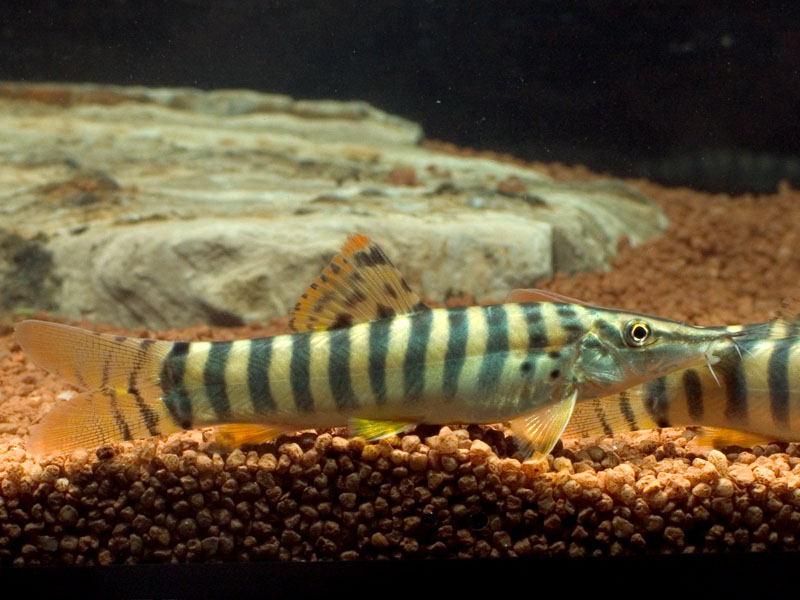
Syncrossus berdmoreiRedfin Tiger Loach
Blyth, 1860
Max length250mm SL10in SLTank180 × 45cm72 × 18inTemp21–26°C70–79°FpH6.5–7.5Interestingly some observations suggest that the character of the highest-ranked, or alpha, fish appears to affect that of the whole group though it must be said that scientific studies of botiid loach behaviour are virtually non-existent. It certainly seems that they display a degree of 'personality' with some specimens being naturally bolder/more aggressive than others. The alpha is normally the largest specimen within the group and often female. Sound also appears to be an important factor in communication since these loaches are able...
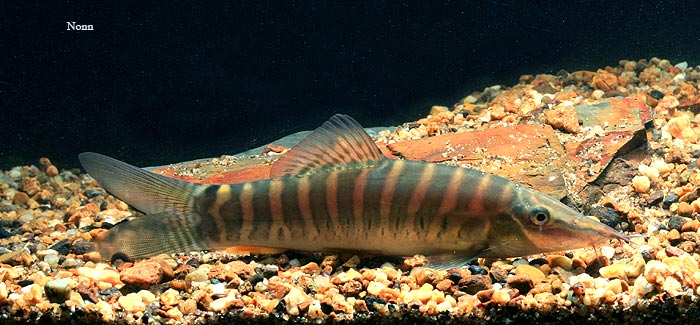
Syncrossus helodesBanded Tiger Loach
Sauvage, 1876
Max length300mm SL12in SLTank180 × 45cm72 × 18inTemp24–30°C75–86°FpH6.0–7.5This species is sometimes confused with S. hymenophysa, native to the Greater Sunda Islands and Peninsular Malaysia, but differs in several ways, the most immediately identifiable of which are possession of small, irregular, dark markings in the lower half of the body and lack of a dark spot in the dorsal-fin. It also has 10-12 vertical body bars...
Synodontis flavitaeniataPyjama Synodontis
authority not recorded
Max length195mm SL8in SLTank90 × 30cm36 × 12inTemp23–28°C73–82°FpH6.5–8.0Also known as the Orange Striped Squeaker, in our opinion this fish is one of the most attractively patterned Synos. S. flavitaeniata can vary considerably in patterning and colouration but is difficult to misidentify. This fish is more sensitive to deteriorating water quality than many Syno species so aquarium maintenance must be rigorous. When it was first imported 25 or so years ago it commanded an extortionate price but thankfully is affordable today. Its flexibility with regards to w...
Synodontis notataOne-spot Synodontis
authority not recorded
Max length275mm SL11in SLTank120 × 30cm48 × 12inTemp22–25°C72–77°FpH6.5–7.5Also known as the Domino Synodontis or the One-spot Squeaker, several regional variants of S. notata are known, some of which have 3, 6 or 12 spots and others none at all. Some of these are seen for sale under the invalid name S. ocellata. It is also often imported with similar species such as S. nummifer or S.congica. These are usually then all sold as notata. S. notata is more active during the day than many Syno species and therefore makes a good addition to aquariums with more boisterous...
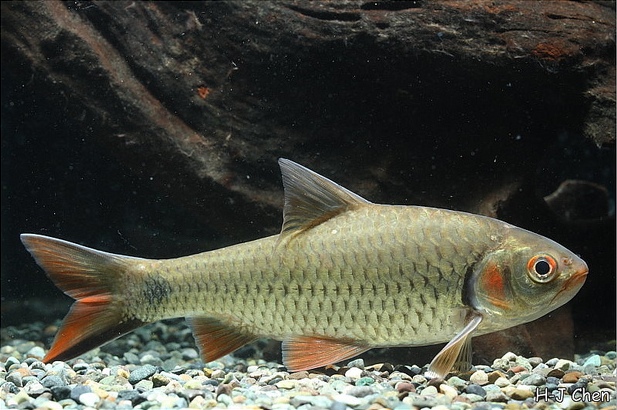
Systomus orphoides
Valenciennes, 1842
Max length250mm SL10in SLTank200 × 60cm79 × 24inTemp18–26°C64–79°FpH6.0–8.0The genus Puntius is currently viewed as something of a catch-all for well over 100 species of small to mid-sized cyprinid. Most experts agree that a full revision is required with the likely outcome that many species will be placed into new or different genera since it is clearly polyphyletic. When describing the grouping in 1822 Hamilton identified the defining characteristics as: presence or absence o...
Thayeria boehlkeiFalse Penguin Tetra
authority not recorded
Max length36mm SL1.4in SLTank60 × 38cm24 × 15inTemp22–28°C72–82°FpHnot recordedThere are only three species in the genus Thayeria, of which T. boehlkei is by far the most popular in the hobby. Of its congeners, it was the type species T. obliqua that was originally given the common name of "penguin" fish or tetra, although T. boehlkei is usually sold under the same name (we've also seen it on sale as "hockeystick" tetra). The two are easy to tell apart, as in T. boehlkei the thick black stripe extending from the lower lobe of the travels laterally ...
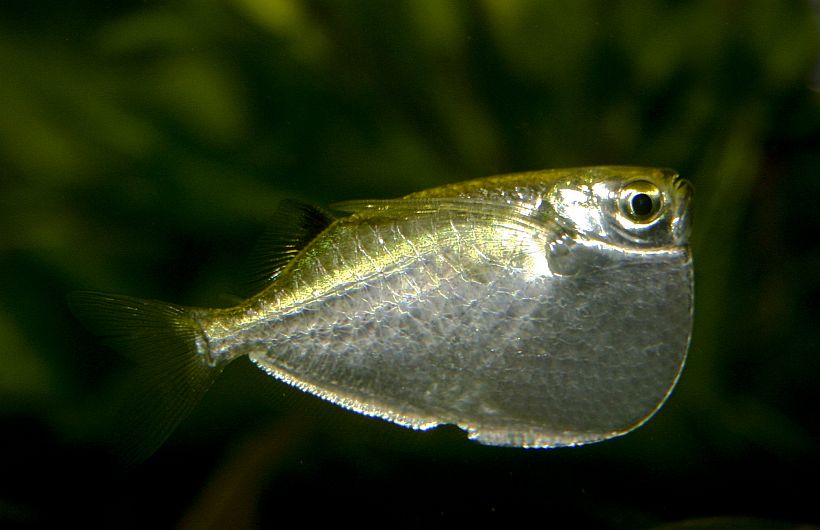
Thoracocharax stellatusSpotfin Hatchetfish
Kner, 1858
Max length70mm SL2.8in SLTank120 × 45cm48 × 18inTemp20–28°C68–82°FpH5.0–7.5T. stellatus is superficially similar to its only congener T. securis, but can immediately be identified by the presence (vs. absence) of a prominent dark spot in the dorsal-fin. It is sometimes traded as 'platinum hatchetfish'. The genus Thoracocharax was originally erected by Fowler in 1906 as a subgenus of Gasteropelecus, but was elevated to generic status by Weitzman (1960).
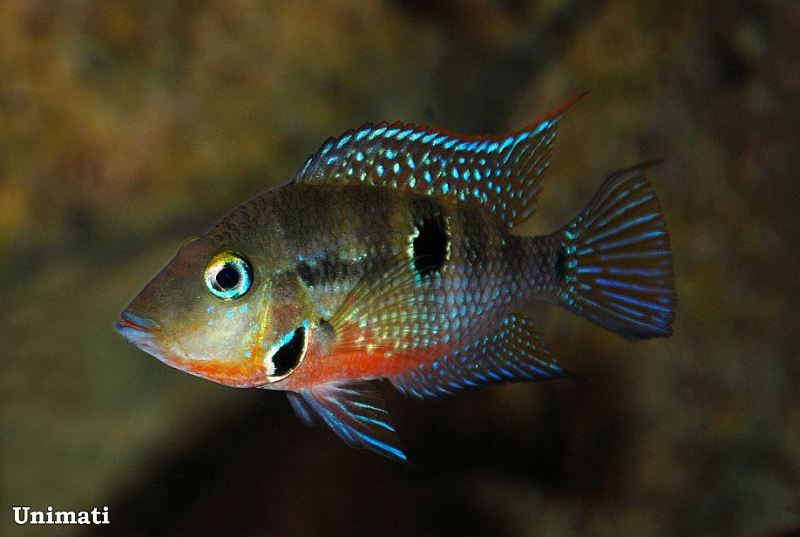
Thorichthys meekiFiremouth Cichlid
Brind, 1918
Max length120mm SL5in SLTank120 × 30cm48 × 12inTemp20–32°C68–90°FpH6.5–8.5This species has been a popular aquarium fish for a considerable period and virtually all fish traded are now raised commercially for the purpose. It is easily identified by the characteristic bright red or orange underside of the head, which is more pronounced in adults. Following Miller and Taylor (1984), the genus Thorichthys is identified...
Tramitichromis intermedius
authority not recorded
Max length160mm SL6in SLTank120 × 38cm48 × 15inTemp24–28°C75–82°FpH7.6–8.8Sand dwelling Malawian cichlid species such as this can be somewhat delicate in the aquarium. A rigorous tank maintenance schedule is recommended to keep them in top shape; with small, regular partial water changes a necessity. Also take care with feeding as discussed above. It is likely this species will eventually be assigned to a different genus, as there is some confusion surrounding Tramitichromis and it's scientific validity. The fish included in the genus differ from Lethrinops sp...
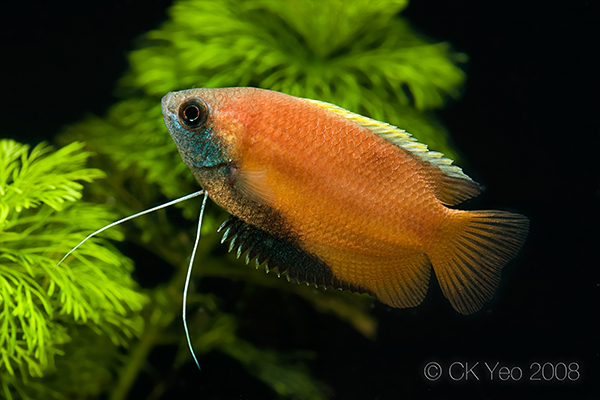
Trichogaster chunaHoney Gourami
Hamilton, 1822
Max length55mm SL2.2in SLTank60 × 30cm24 × 12inTemp22–27°C72–81°FpH6.0–7.5This species is readily available in the aquarium trade and is a good subject for those new to the hobby given its peaceable nature and relative adaptability in terms of water chemistry. It's sold under various names including A number of selectively-bred ornamental strains have also been produced including 'red', 'sunset', and 'golden', for which care is identical to the natural form.
Trichogaster labiosaThick-lipped Gourami
authority not recorded
Max length100mm SL3.9in SLTank74 × 30cm29 × 12inTemp22–27°C72–81°FpH6.0–7.5Despite its ease of keeping and peaceable nature, this species is not particularly popular in the hobby, although it is imported quite regularly. A gold or 'sunset' strain exists, in which the barred patterning is replaced by an overall orange/gold colouration. This is not a natural variation, but has been selectively bred for the trade. The female of this form is almost as colourful as the male. Like others in the suborder Anabantoidei, the species possesses an accessory breathing...
Trichogaster laliusDwarf Gourami
authority not recorded
Max length88mm SL3.5in SLTanknot recordedTemp22–27°C72–81°FpH6.0–7.5The Dwarf Gourami is one of the most ubiquitous freshwater species in the aquarium hobby, and is unarguably a beautiful fish. Several colour forms have been line-bred for the trade and have also proved popular. These include "Sunset" (also sold as "Red" or "Robin") and "Neon" varieties, although it's highly debatable whether these come close to matching the brilliance of the natural form. Unfortunately the general quality of dwarf gouramis availab...
Trichopodus microlepisMoonlight Gourami
authority not recorded
Max length150mm SL6in SLTank90 × 30cm36 × 12inTemp25–30°C77–86°FpH6.0–7.5T. microlepis is not as colourful as some other gouramis but can make a striking addition to the community tank. The modified ventral fins are considerably longer than in other gourami species. It is often used as a food fish in its native countries....
Trichopodus trichopterusThree-spot Gourami
authority not recorded
Max length150mm SL6in SLTank90 × 30cm36 × 12inTemp24–30°C75–86°FpH5.5–8.5This species is available in many different colour forms and varieties, all of which have been selectively bred for the aquarium trade. These are seen much more often than the natural form, which is the blue-grey three spotted fish. They include gold, opaline, cosby, marbled and silver forms. T. trichopterus is one of the hardiest fish commonly available in the trade and can adapt to many different water conditions. However it is recommended to the beginner with reservations regarding it's ...
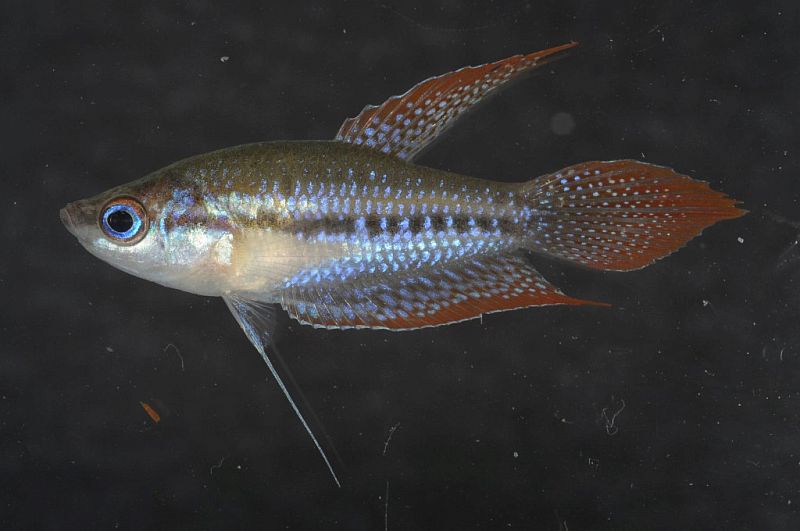
Trichopsis schalleri
Ladiges, 1962
Max length50mm SL2.0in SLTank60 × 30cm24 × 12inTemp22–28°C72–82°FpH5.0–7.5Known from the lower Mekong River basin in Laos, Thailand, Cambodia, and Vietnam, plus tributaries of the Chao Phraya watershed in central Thailand, and drainages between the Chao Phraya and Mekong in eastern Thailand. Type locality is 'Nam-Mun at Korat, 135 miles northeast of Bangkok, Thailand'.