Results for “bar”
Type a name: scientific, common, or one a species used to go by. Or narrow the catalogue with the filters.
Filters
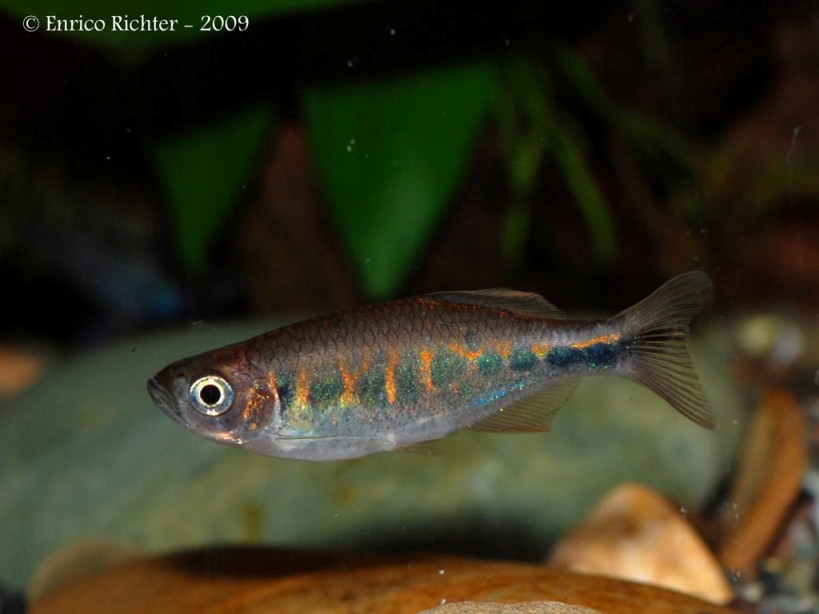
Devario pathiranaBarred 'Danio'
Kottelat & Pethiyagoda, 1990
Matched on the common name Barred 'Danio'
Max length80mm SL3.1in SLTank120 × 45cm48 × 18inTemp23–26°C73–79°FpH6.0–7.5This species is diagnosable from other members of the genus primarily by its unique colour pattern which consists of 7-11 dark blue, irregularly-shaped, parallel vertical bars on the anterior portion of each flank plus a short horizontal stripe on the caudal peduncle which extends into the central caudal fin rays. Phylogenetic analyses suggest it's most closely-related to Indian Devario spp. plus D. xyrops from the western slope of the Rakhine Yoma mountains in Myanmar (Fang et al., 2009; Fang and Kullander, 2009).
Myleus schomburgkiiBlack-barred Myleus
authority not recorded
Matched on the common name Black-barred Myleus
Max length120mm SL5in SLTank120 × 38cm48 × 15inTemp23–27°C73–81°FpH6.0–7.0Similar in care and appearance to its close relative, the Redhook (myloplus rubripinnis), myleus schomburgkii is easily distinguished by the black vertical bar on the flanks. It is also a smaller adult fish. Despite this, it is sometimes offered for sale marked as a Redhook. This fish is also variously referred to as the Black-ear Pacu, Disc Pacu and Disk Tetra....
Neolamprologus tretocephalusFive-barred Lamprologus
authority not recorded
Matched on the common name Five-barred Lamprologus
Max length150mm SL6in SLTank120 × 30cm48 × 12inTemp23–27°C73–81°FpH7.5–9.0It can be distinguished from the similar N. sexfasciatus by the presence of only five, rather than six, vertical bars on it's flanks. It is not recommended for the general Tanganyikan community due to it's aggressive nature, particularly when breeding....
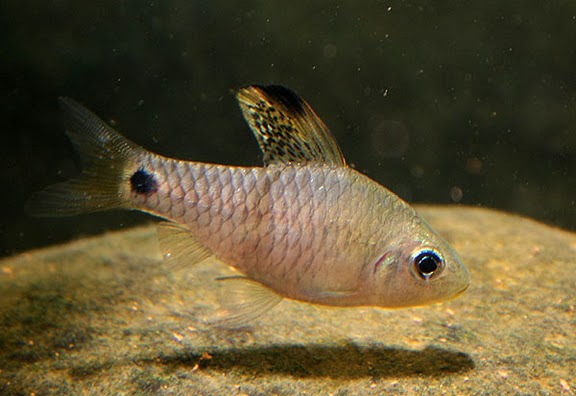
Oreichthys crenuchoidesDrape Fin Barb
Schäfer, 2009
Matched on the common name Drape Fin Barb
Max length45mm SL1.8in SLTank60 × 30cm24 × 12inTemp23–28°C73–82°FpH6.0–7.5This fish is sometimes traded as Oreichthys cosuatis, O. sp. 'high fin', O. 'umangii' (a nomen nudum that has only ever been applied to an image of a fish in the book 'Ornamental Aquarium Fish of India'; K. L.Tekriwal and A. A. Rao 1999), Puntius 'arunavii' or 'neon highfin barb'. It can be distinguished from congeners by the following combination of characters: absence of a dark marking in the anal-fin (vs. presence in other species); ½7½ scales scales between pelvic-fin origin and dorsal midline (vs. ½6½ in O. cosuatis and...
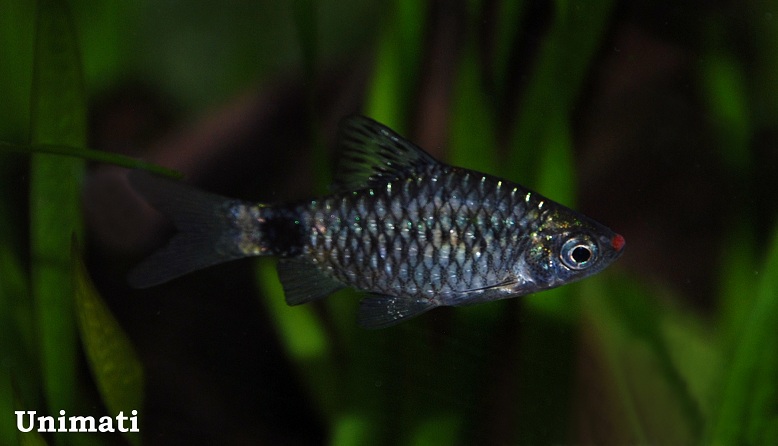
Pethia erythromycterLipstick Barb
Kullander, 2008
Matched on the common name Lipstick Barb
Max length35mm SL1.4in SLTank90 × 30cm36 × 12inTemp18–24°C64–75°FpH7.0–7.5This species first appeared in the aquarium hobby in 2006 and is sometimes traded under the name 'Tulip barb'. It was officially described by Kullander in early 2008 in a paper describing five new Puntius species from Kachin, all of which are superficially similar in possession of a dark band or blotch on the caudal peduncle. P. erythromycter can be distinguished b...
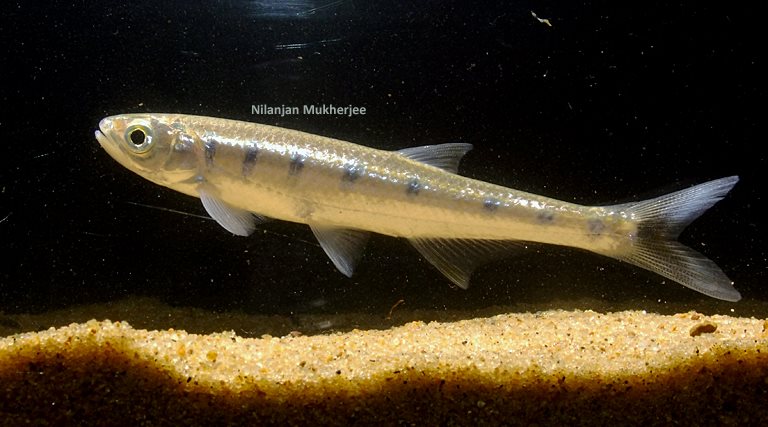
Barilius vagra
Hamilton, 1822
Matched on Barilius alburnus, a name it was formerly known by
Max length125mm SL5in SLTank150 × 60cm60 × 24inTemp18–26°C64–79°FpH6.0–7.5Barilius spp. are near-exclusive surface-feeders preying mostly on flying insects in nature with some small fishes and benthic invertebrates probably taken as well but in the aquarium they're largely unfussy and will accept most foods.
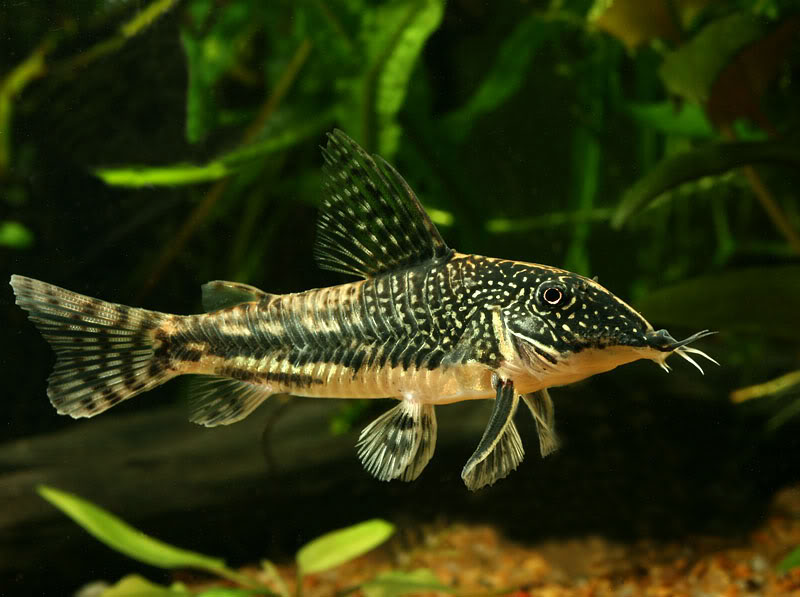
Scleromystax barbatusBanded 'Cory'
Quoy & Gaimard, 1824
Matched on Callichthys barbatus, a name it was formerly known by
Max length100mm SL3.9in SLTank120 × 45cm48 × 18inTemp16–24°C61–75°FpH5.5–7.5Scleromystax spp. are foraging omnivores, and most will accept sinking dried foods as well as small live and frozen varieties such as chironomid larvae (bloodworm), Tubifex, etc. Feeding a varied diet will ensure the fish are in optimum condition. Under no circumstances should they be expected to survive on 'left-overs' from other inhabitants of the aquarium or relied on to 'clean' the aquarium.
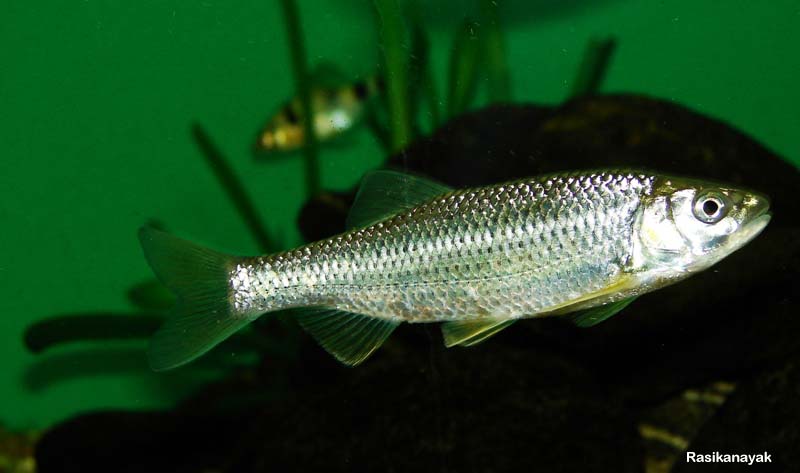
Barilius bendelisis
Hamilton, 1807
Matched on Barilius howesi, a name it was formerly known by
Max length200mm SL8in SLTank180 × 60cm72 × 24inTemp18–26°C64–79°FpH6.0–8.0Type locality is given as 'Cedawáti [Vedawati] stream, headwaters of Krishna River near Heriuru, Mysore, India', with the species currently considered to occur throughout India, Bangladesh, Nepal, and probably Bhutan. It's also been recorded in Pakistan, Myanmar, Thailand and Sri Lanka although some or all of these reports may refer to other species.
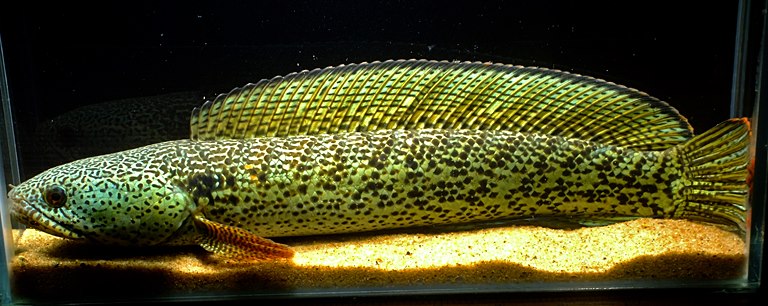
Channa barca
Hamilton, 1822
Matched on Ophiocephalus barca, a name it was formerly known by
Max length900mm SL35in SLTanknot recordedTemp10–28°C50–82°FpH6.0–8.0Has been observed to inhabit vertical burrows around the margins of wetlands which typically become dry during winter months. These burrows are most often around a metre dee...
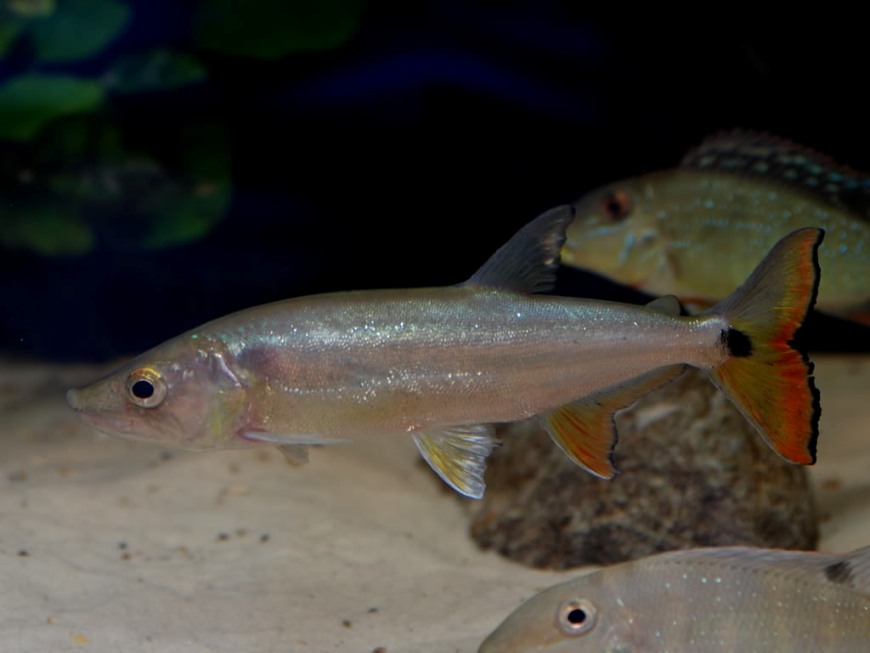
Acestrorhynchus altusRed Barracuda Tetra
Menezes, 1969
Matched on the common name Red Barracuda Tetra
Max length233mm SL9in SLTank250 × 90cm98 × 36inTemp22–28°C72–82°FpH6.0–7.5This species is not normally aggressive towards conspecifics with juveniles in particular exhibiting a marked schooling instinct. Older individuals tend to be more solitary but still group together from time-to-time, and it's best maintained in numbers of four or more. One important point to note is that acestrorhynchids are can...
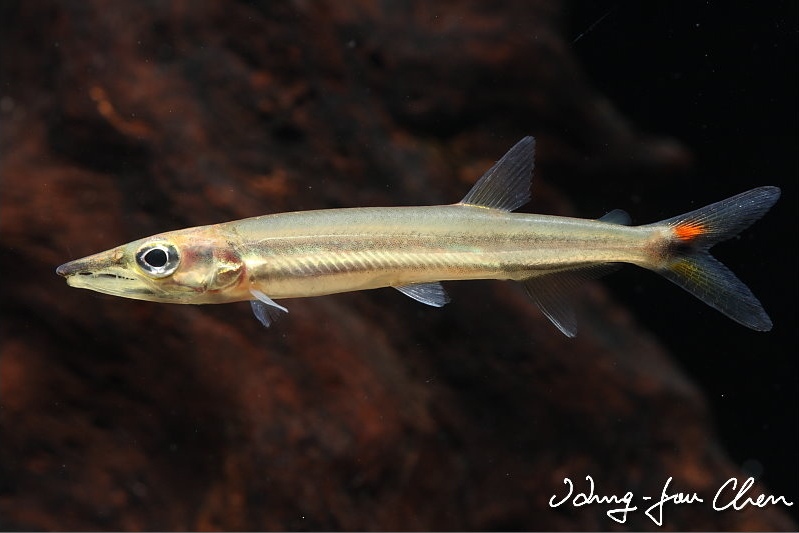
Acestrorhynchus isalineaeStriped Barracuda Tetra
Menezes & Géry, 1983
Matched on the common name Striped Barracuda Tetra
Max length105mm SL4in SLTank120 × 45cm48 × 18inTemp24–28°C75–82°FpH6.0–7.5This species is a member of the putative A. nasutus group of closely-related species within the genus alongside A. nasutus, A. maculipinna and A. isalineae. These are all characterised by possession of two dark, longitudinal stripes, one running from the tip of the snout to the base and the other from the posterior edge of the lower maxilla to the underside of the caudal peduncle.
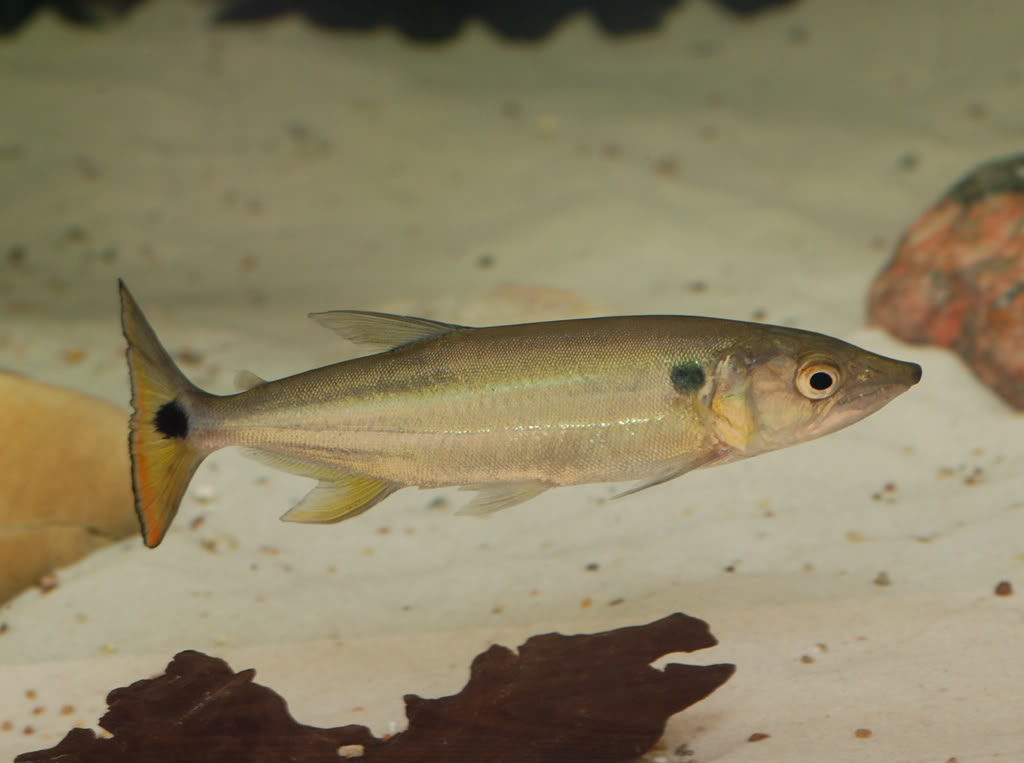
Acestrorhynchus pantaneiroPantanal Barracuda Tetra
Menezes, 1992
Matched on the common name Pantanal Barracuda Tetra
Max length240mm SL9in SLTank250 × 90cm98 × 36inTemp22–28°C72–82°FpH6.0–7.5An obligate piscivore capable of consuming surprisingly surprisingly large prey. Newly-imported specimens may refuse to accept anything but live fishes although most can be weaned onto dead alternatives once they recognise them as edible, and some even learn to accept dried foods- Like the vast majority of predatory fishes this specie...
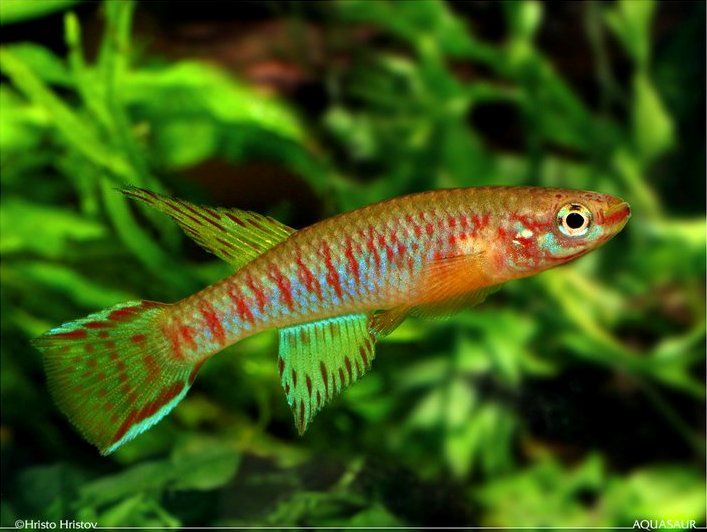
Aphyosemion elbertiRed-Barred Lyretail
Ahl, 1924
Matched on the common name Red-Barred Lyretail
Max length40mm SL1.6in SLTanknot recordedTemp18–22°C64–72°FpH6.0–7.0This species' currently accepted range stretches from eastern Nigeria (Mbam River) across central Cameroon (via the Sanaga River system of which the Mbam is a tributary) and across the border into Central African Republic (upper Mambéré basin). It was described from 'Jade Plateau, Cameroon', this apparently corresponding to the Lebo River which lies in what is now the Central African Republic and presumably forms part of the Mambéré headwaters.
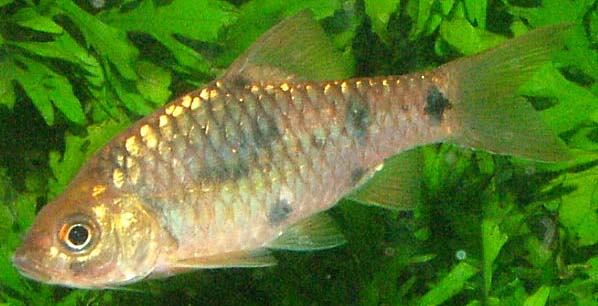
Barbodes banksi
Herre, 1940
Max length110mm SL4in SLTank120 × 45cm48 × 18inTemp22–28°C72–82°FpH6.0–7.5This species is not often seen in the aquarium hobby but occasionally exported as bycatch among shipments of other fishes. It was described as a subspecies of the closely-related 'P.' binotatus but is currently considered distinct on a tentative basis as per Ng and Tan (1999) who stated it is 'likely' that the two represent extreme colour forms of a single, variably-patterned species.
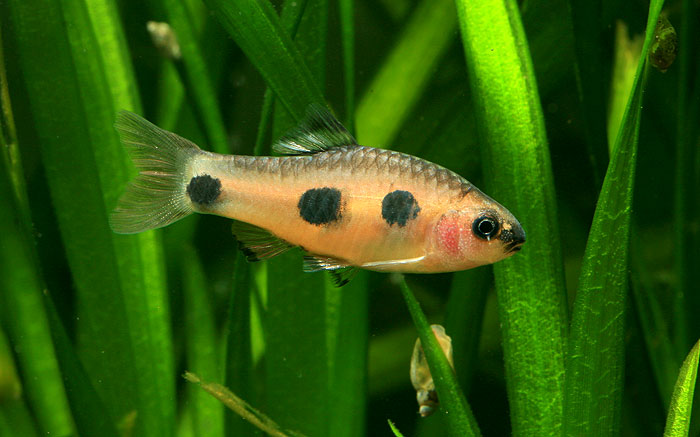
'Barbus' candens
Nichols & Griscom, 1917
Max length35mm SL1.4in SLTank45 × 30cm18 × 12inTemp17–24°C63–75°FpH5.0–7.0'B.' candens is not really suitable for most community aquaria as it has something of a shy, retiring nature and may be intimidated or outcompeted for food by larger/more boisterous tankmates. Choose similarly-sized, peaceful African species such as 'B.' jae, Aplocheilichthys spp., Ladigesia roloffi or Lepidarchus adonis. We suspect it will also do ok with many small South American characins, Otocinclus or smaller Corydoras catfish and other cyprinids like Trigonostigma or Boraras species.
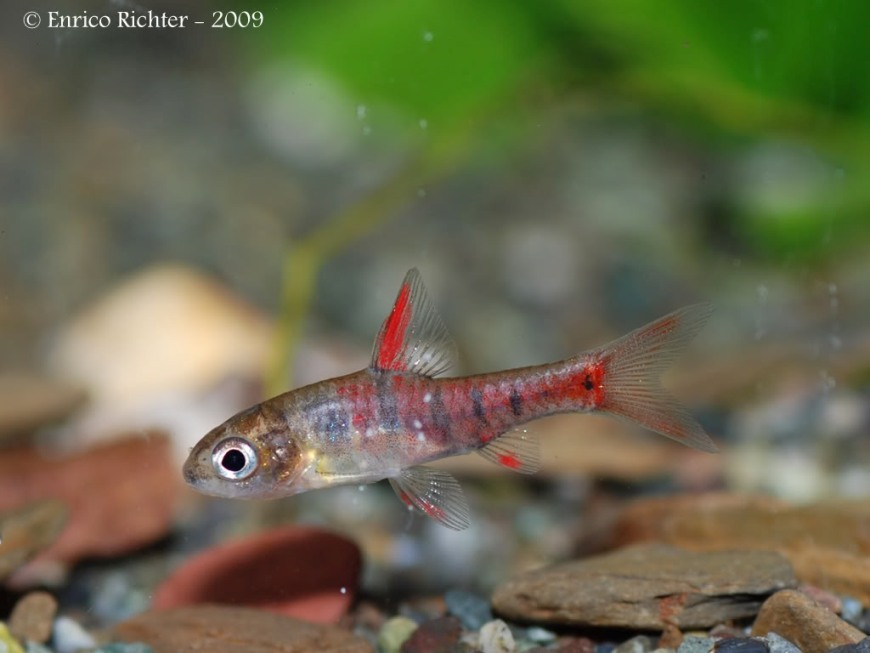
'Barbus' jae
Boulenger, 1903
Max length40mm SL1.6in SLTank45 × 30cm18 × 12inTemp17–24°C63–75°FpH5.0–6.5Although gregarious by nature it is a shoaling rather than schooling species which develops a distinct pecking order between males. It should ideally be maintained in a group of 8 or more but the tank must be of a sufficient size which will allow weaker individuals some respite from dominant conspecifics and decorated in such a way that many broken lines of sight are provided. Conversely if kept singly, in a very small group or in cramped conditions it can become withdrawn and subdominant fish may be bullied incessantly.
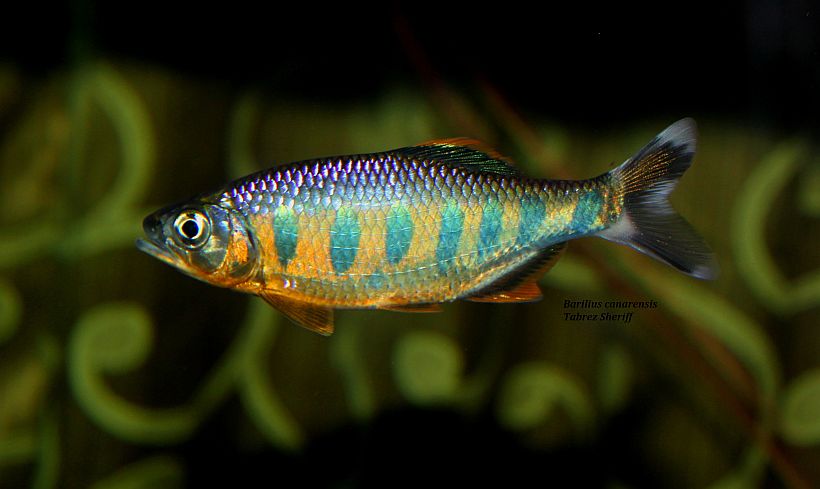
Barilius ardens
Knight, Rai, d'Souza & Vijaykrishnan, 2015
Max length105mm SL4in SLTank150 × 60cm60 × 24inTemp18–26°C64–79°FpH6.0–7.5Prior to its description this species was typically identified as the congener B. canarensis in the ornamental trade. It can be distinguished from congeners by the following combination of characters: uni...
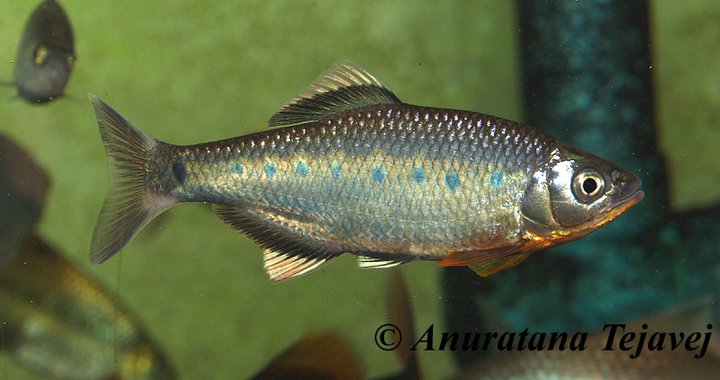
Barilius bakeri
Day, 1865
Max length130mm SL5in SLTank150 × 60cm60 × 24inTemp18–26°C64–79°FpH6.0–7.5This species is traded under several names including 'royal danio', 'blue-spotted hill trout', and 'blue-dotted mirror fish'. It can be distinguished from congeners by possessing a single row of bluish-green spots along the length of the body, white margins on the dorsal and anal fins, 37-38+1 lateral line scales, and fleshy rudi...
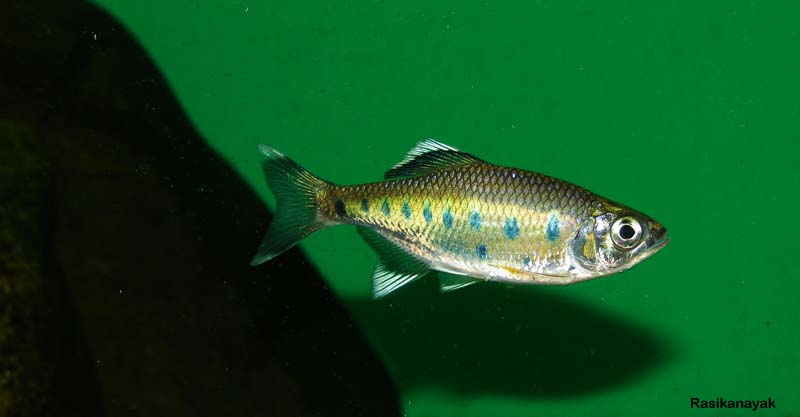
Barilius canarensis
Jerdon, 1849
Max length130mm SL5in SLTank150 × 60cm60 × 24inTemp18–26°C64–79°FpH6.0–7.5Type locality is 'Canara, southern India', which corresponds to a coastal region of approximately 300 km in length covering several districts of Karnataka and Kerala states, southwestern India. Rivers in this area drain the Western Gha...
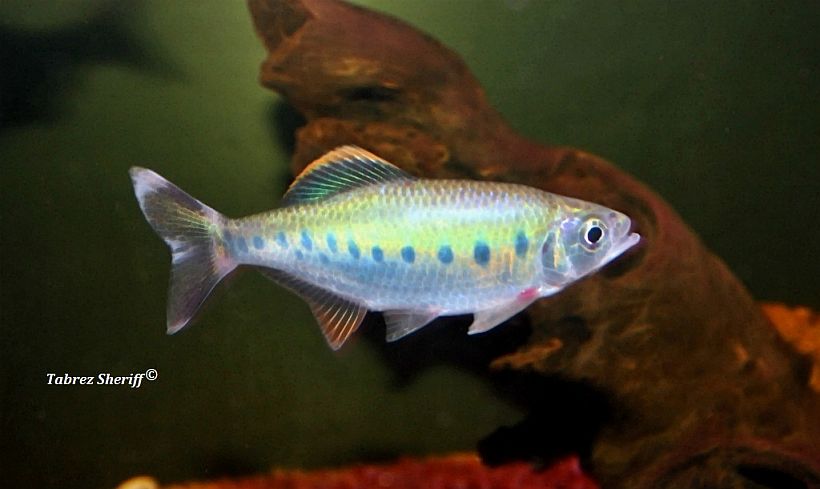
Barilius malabaricus
Jerdon, 1849
Max length105mm SL4in SLTank150 × 60cm60 × 24inTemp18–26°C64–79°FpH6.0–7.5Probably restricted to southern parts of Karnataka state and northern Kerala state in southwestern India. Following its revalidation in 2015 (see 'Notes') it is known with certainty only from the Payaswini and Vallapattanam river systems in Kerala although it is thought to occur elsewhere.