Results for “stripe”
Type a name: scientific, common, or one a species used to go by. Or narrow the catalogue with the filters.
Filters
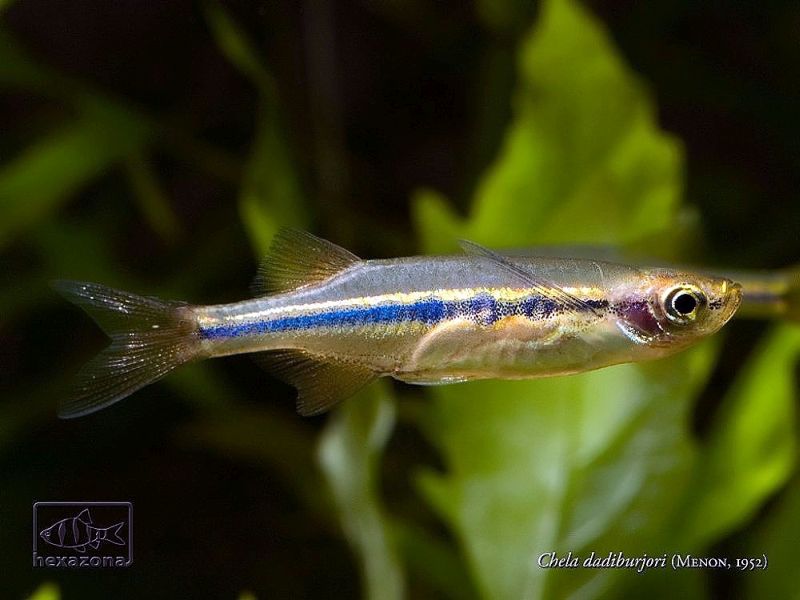
Laubuka dadiburjoriDadio
Menon, 1952
Max length30mm SL1.2in SLTank90 × 30cm36 × 12inTemp20–24°C68–75°FpH6.0–7.5It can be distinguished from other members of the genus by the following characters: lateral line absent or perforating only 2-5 scales; pharyngeal teeth hooked; body size small, not exceeding 30 mm SL; body depth less than 25 % SL; colour pattern comprising a dark bluish lateral stripe extending from the eye to the caudal peduncle, typically, but not always, forming 2-5 circular spots along its length.
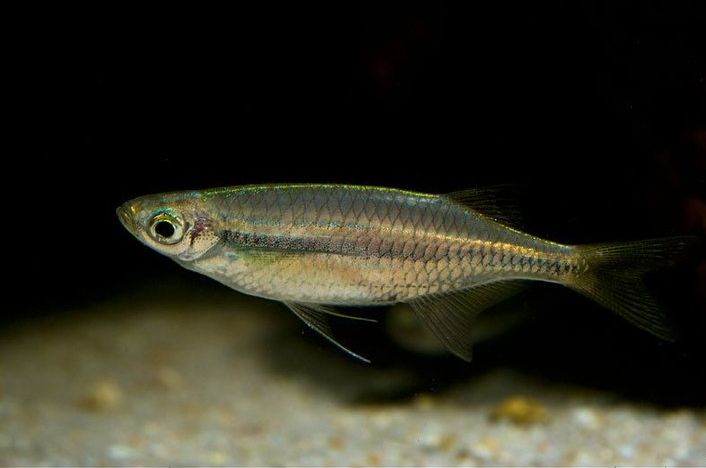
Laubuka fasciataMalabar Hatchet Chela
Silas, 1958
Max length50mm SL2.0in SLTank120 × 30cm48 × 12inTemp20–26°C68–79°FpH6.5–7.5It can be distinguished from other members of the genus by the following characters: dark longitudinal stripe on body, extending from eye to caudal peduncle; scattered tubercles present on lower jaw; 14½-16½ branched anal-fin rays; pelvic-fin long, reaching beyond anus.
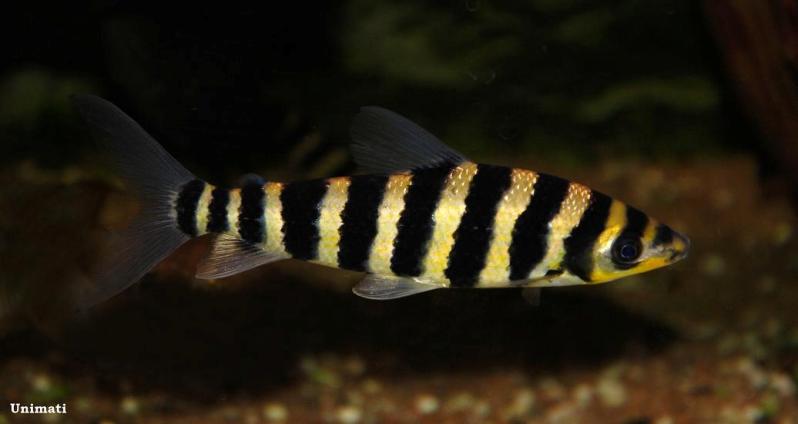
Leporinus fasciatusBanded Leporinus
Bloch, 1794
Max length270mm SL11in SLTank210 × 60cm84 × 24inTemp20–28°C68–82°FpH5.0–7.5This species is also referred to as 'black-anded leporinus', 'striped leporinus' and 'eight-banded leporinus'. Young specimens are often traded for aquaria without warning as to their potential size and requirements, and as a result it's fairly ubiquitous in public aquarium displays.
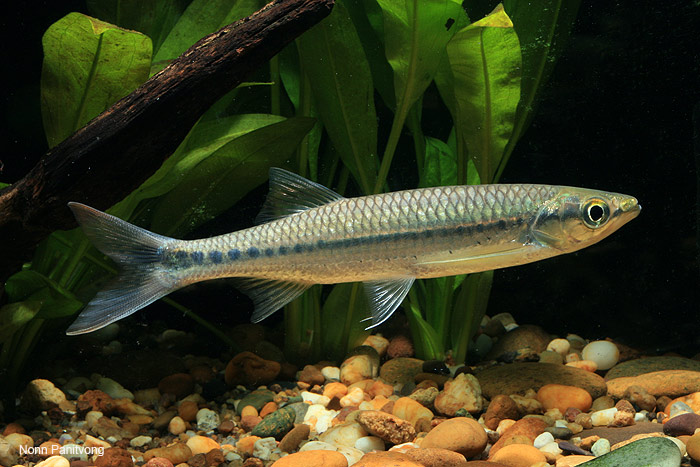
Luciosoma setigerumApollo Shark
Valenciennes, 1842
Max length220mm SL9in SLTank240 × 60cm96 × 24inTemp20–26°C68–79°FpH6.0–8.0There is a fish of unknown geographical origin which matches the majority of diagnostic features for L. setigerum with the exception that the dark lateral stripe is absent in the anterior portion of the body and is not composed of interconnected spots. It is relatively common in the aquarium trade and included here as L. cf. setigerum until a confirmed identity is established.
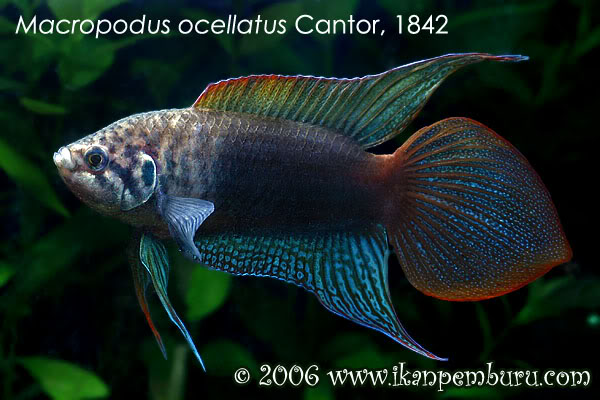
Macropodus ocellatusRoundtail Paradise Fish
Cantor, 1842
Max length80mm SL3.1in SLTank80 × 30cm31 × 12inTemp10–22°C50–72°FpH6.0–7.5M. ocellatus can be distinguished from congeners by the following combination of characters: caudal-fin rounded; eye stripe not connecting spot on posterior projection of opercle with eye; dorsal-fin rays filamentous posterior to a vertical through the posterior anal-fin rays in adults; 16-19 spinous dorsal-fin rays; 6-13 rakers on ceratobranchial of first gill arch; posterior tip or margin of body scales not darker than scales.
Melanochromis chipokae
authority not recorded
Max length120mm SL5in SLTank120 × 45cm48 × 18inTemp24–28°C75–82°FpH7.6–8.8This species belongs to the group of Melanochromis often called "Pike Auratus". These species predate on the fry of other species, although M. chipokae will also eat crustaceans and algae. Female and juvenile male M. chipokae are easily confused with M. auratus. However, it can be distinguished by its noticeably more pointed mouth, denoting the predatory nature of this species (auratus has a rounded mouth which is designed for feeding on algae). The striped patterning in the also exten...
Metynnis hypsauchenSilver Dollar
authority not recorded
Max length150mm SL6in SLTank180 × 38cm72 × 15inTemp24–28°C75–82°FpH6.0–7.0Metynnis hypsauchen is sometimes referred to as the Plain Metynnis in an effort to distinguish it from its close relation, Metynnis argenteus. Both fish are sold in the hobby under the name "Silver Dollar" and are virtually indentical in terms of appearance and care requirements. The two species can be told apart as m. hypsauchen has a black blotch located slightly above and behind each eye. This species also occurs in a striped colour form which is sometimes referred to as(m. hypsauch...
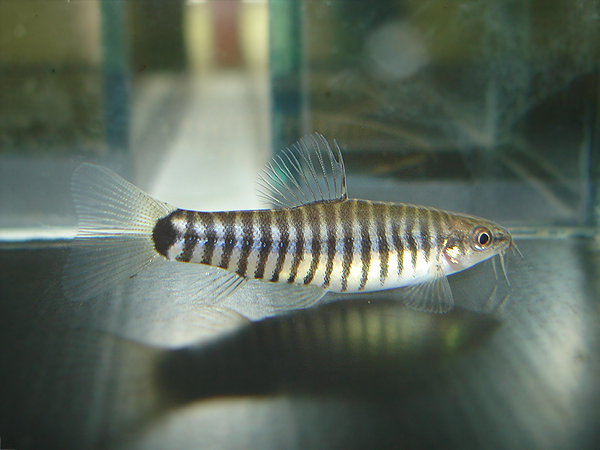
Micronemacheilus cruciatus
Rendahl, 1944
Max length40mm SL1.6in SLTank60 × 30cm24 × 12inTemp22–27°C72–81°FpH6.0–7.5This species is traded under various names including 'Vietnamese multi-banded zebra loach', 'hovering zebra loach', 'Laos pygmy multi-stripe loach', and 'banded dwarf loach'. It can be distinguished from related species by the following combination of characters: body with distinct vertical bars; 8 branched dorsal-fin rays; 3-10 pored lateral line scales; one pair of large papillae in median portion of upper lip; two pairs of large papillae in median portion of lower lip; lower posterior edge of opercle with 3-4 prominent indentations.
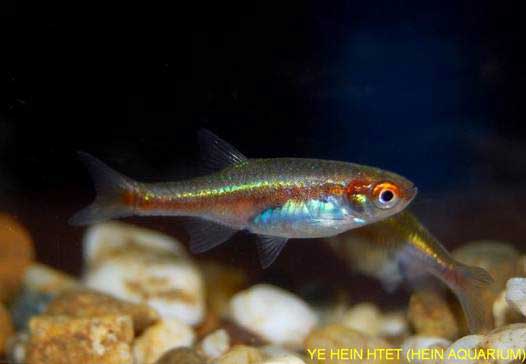
Microrasbora cf. rubescensFlame Red 'Rasbora'
authority not recorded
Max length40mm SL1.6in SLTank60 × 30cm24 × 12inTemp20–26°C68–79°FpH6.5–7.5This is possibly an undescribed species and has been marketed as 'Asian Cardinal Rasbora', 'flame red rasbora', M. sp. 'rose blue line' or M. 'thuzari' in the ornamental trade. It differs from M. rubescens by its larger adult size, possession of a greenish to bluish lateral stripe, and lesser extent of orange pigmentation on the body. It also appears to represent a distinct genetic lineage (Collins et al., 2012).
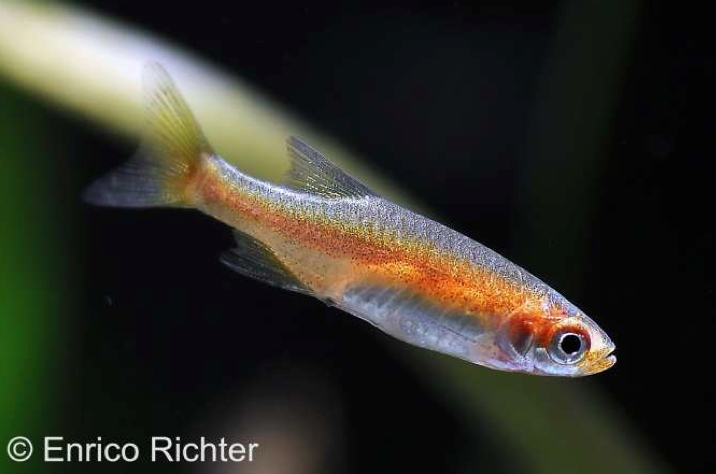
Microrasbora rubescensRed Dwarf 'Rasbora'
Annandale, 1918
Max length30mm SL1.2in SLTank60 × 30cm24 × 12inTemp20–24°C68–75°FpH6.0–8.0This species may be seen on sale under various trade names including 'red-line dwarf rasbora', 'emerald dwarf rasbora', or 'red dwarf rasbora'. A similar-looking, apparently undescribed congener has been collected near the town of Hopong, also in Shan State. It differs from M. rubescens by possessing a greenish to bluish lateral stripe plus a larger adult size, and is traded as Microrasbora cf. rubescens, M. 'thuzari', M. sp. 'rose blue line', 'Asian Cardinal Rasbora', or 'flame red rasbora'.
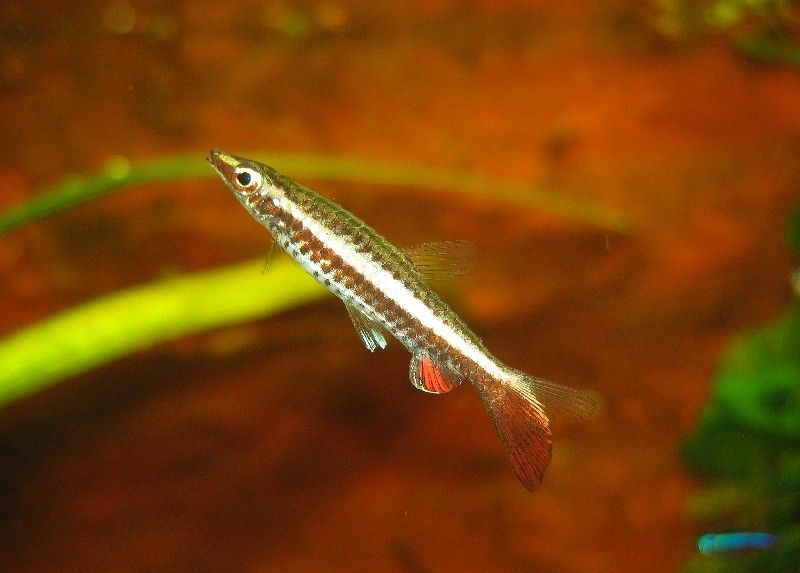
Nannostomus equesHockeystick Pencilfish
Steindachner, 1876
Max length35mm SL1.4in SLTank60 × 30cm24 × 12inTemp22–28°C72–82°FpH4.5–7.5This species has been referred to the genera Poecilobrycon and Nannobrycon in the past and in the aquarium hobby is also known as 'rocket', 'brown', 'brown-tailed', 'diptail', or 'tubemouth' pencilfish.It's a popular aquarium fish and has an interesting oblique swimming-style, a behavioural trait shared only with N. unifasciatus among congeners. In the original description the colour pattern is given by Steindachner as a brown lateral stripe exte...
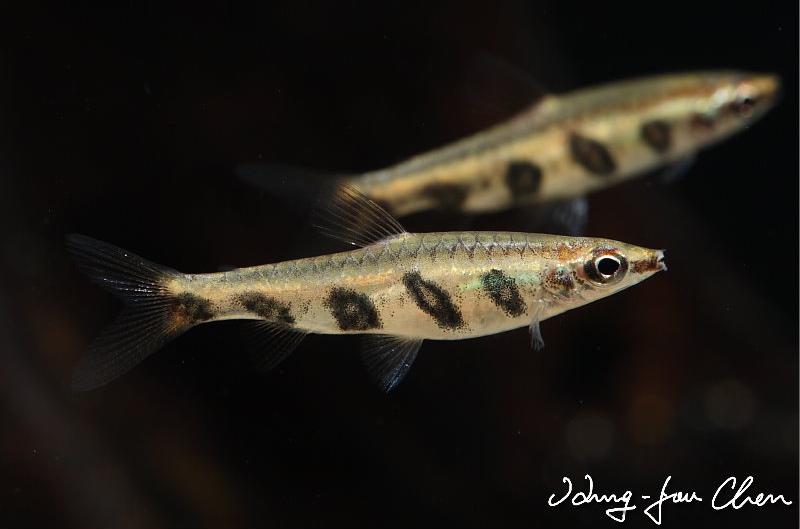
Nannostomus espeiBarred Pencilfish
Meinken, 1956
Max length30mm SL1.2in SLTank60 × 30cm24 × 12inTemp22–28°C72–82°FpH4.0–6.5This species is sometimes traded as 'Espei's', 'four-barred' or 'banded' pencilfish and is sought after in the aquarium hobby, though normally quite expensive to buy. It's most-easily identified by its unique colour pattern of 5 dark, vertically-orientated bar-like markings on each flank, this in direct contrast to the horizontal stripes seen in other congeners...
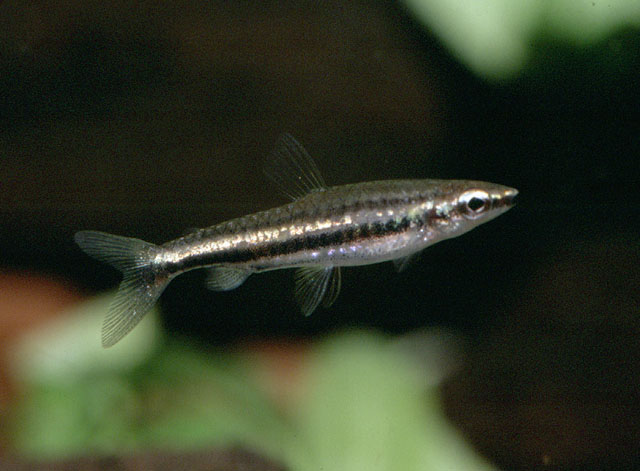
Nannostomus marilynaeGreenstripe Pencilfish
Weitzman & Cobb, 1975
Max length35mm SL1.4in SLTank60 × 30cm24 × 12inTemp21–28°C70–82°FpH4.0–6.5This species is also known as 'Marilyn's pencilfish'. It's rarely traded in numbers and more often seen as bycatch among shipments of other species, particularly Paracheirodon axelrodi. It can be identified by the following combination of characters: three dark lateral stripes (sometimes referred to as primary, secondary, and tertiary); nocturnal oblique bars relatively narrow, with the anterior bar reaching, but not extending past, the anterior base of the dorsal-fi...
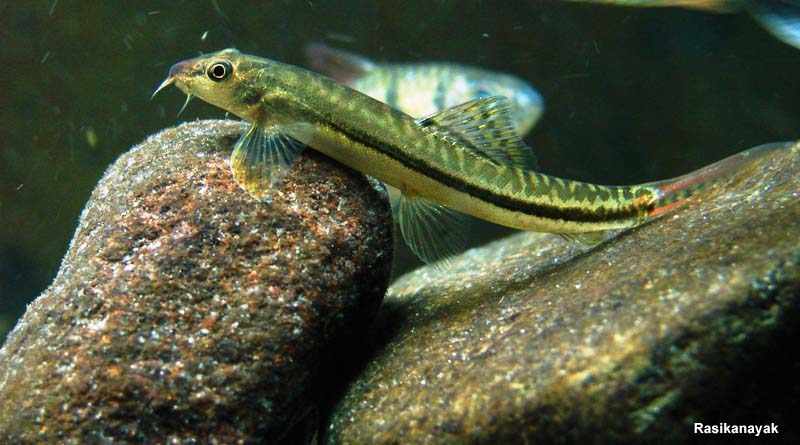
'Nemacheilus' anguilla
Annandale, 1919
Max length50mm SL2.0in SLTank60 × 30cm24 × 12inTemp20–25°C68–77°FpH6.0–7.5'N.' anguilla can be told apart from other Indian members of the genus by possessing dark flank markings which are partially or completely merged to form a lateral stripe, and an almost-complete lateral line extending to the anal-fin. Kottelat (2012) states that its generic placement requires additional study hence the genus name i...
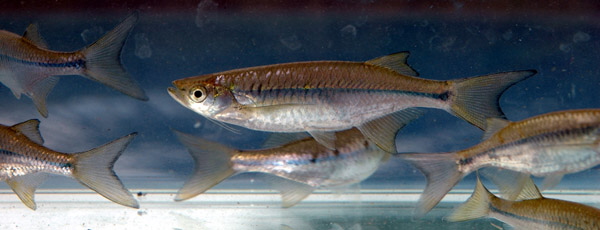
Nematabramis borneensis
Inger & Chin, 1962
Max length105mm SL4in SLTanknot recordedTempnot recordedpHnot recordedIt looks particularly similar to N. alestes with both species possessing a colour pattern comprising a dark lateral stripe on the body, but can be distinguished immediately by possessing barbels longer than the head (vs. shorter than the head in N. alestes).
Neolamprologus similis
authority not recorded
Max length45mm SL1.8in SLTanknot recordedTemp24–27°C75–81°FpH7.5–9.0N. similis is one of the less frequently seen shelldwellers in the hobby but has no less personality than its cousins. The territories it establishes are very small, usually measuring no more than 6" across, but they are defended vigorously. The tiny fish will even bite hands or fingers that invade their 'personal space'! It can be distinguished from the similar N. multifasciatus by the presence of additional barring on the head and neck and also in this species the stripes appear...
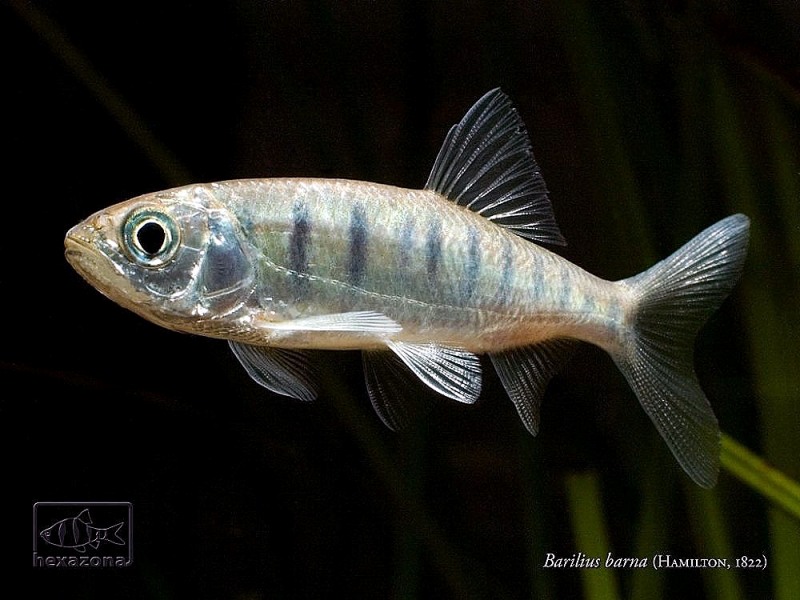
Opsarius barna
Hamilton, 1822
Max length130mm SL5in SLTank150 × 60cm60 × 24inTemp16–24°C61–75°FpH6.0–8.0This species occasionally appears in the ornamental trade, usually as 'striped hill trout' or 'banded hill trout'. It can be distinguished from congeners by the following combination of characters: lateral line complete with 40-42 scales; barbels absent; 10-13 anal-fin rays; body with 9-11 dark blue vertical bars; last dorsal-fin ray extending to caudal-fin base.
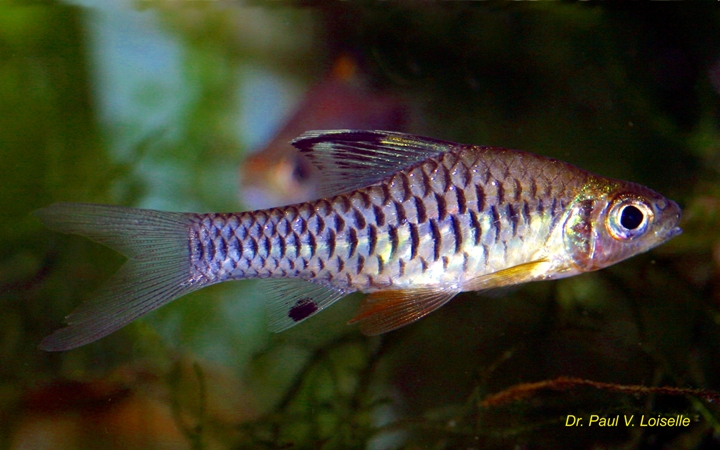
Oreichthys cosuatis
Hamilton, 1822
Max length43mm SL1.7in SLTank60 × 30cm24 × 12inTemp24–28°C75–82°FpH6.5–7.5An assortment of undescribed Oreichthys spp. from India, Myanmar and Thailand are currently traded as O. cosuatis. It can be distinguished from other described members of the genus by lacking a black blotch on the caudal peduncle, plus the following combination of characters: 2-3 perforated scales in lateral line; ½6½ between pelvic-fin origin and dorsal midline; presence of dark stripe in centre of anal-fin, forming a triangular blotch in adult individuals; dorsal-fin with whitish tip and broad, black, subdistal margin in the upper portion of the fin; 11-13 rows...
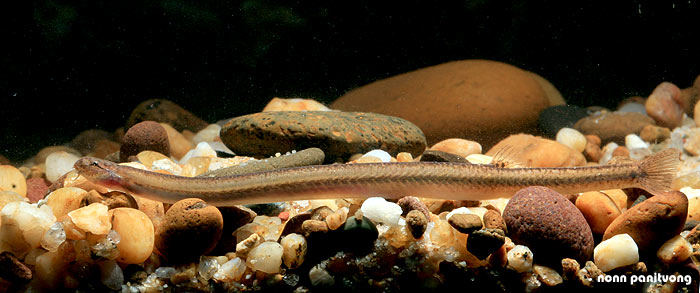
Pangio anguillaris
Vaillant, 1902
Max length120mm SL5in SLTank60 × 30cm24 × 12inTemp22–29°C72–84°FpH6.0–7.5One of a handful of Pangio spp. traded under the generic name 'eel loach'. Wild populations tend to differ in colour pattern to some extent, with some exhibiting a more intense lateral stripe while others display an irregular pattern of fine dark spots on the body, for example.
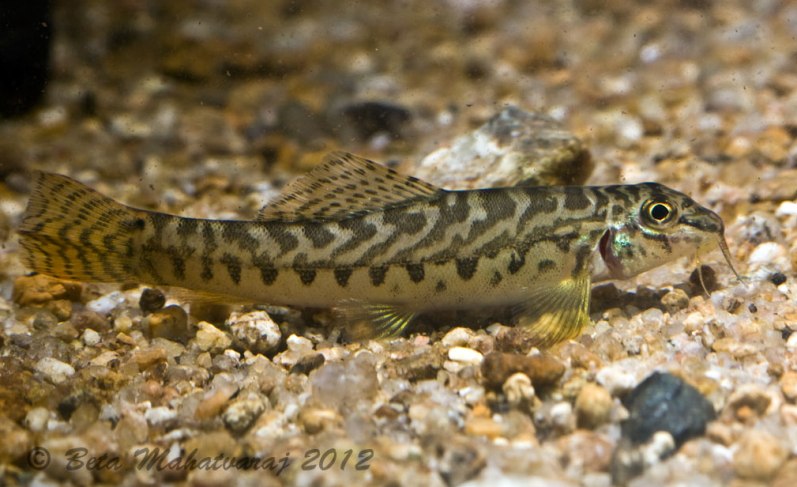
Paracanthocobitis botiaZipper Loach
Hamilton, 1822
Max length152mm SL6in SLTank75 × 30cm30 × 12inTemp21–26°C70–79°FpH6.0–7.5Traded under various names including 'mottled', 'eyepot', 'sand' and 'striped' loach. It's perhaps one of the better choices for those new to keeping nemacheilids being relatively hardy, peaceful and exhibiting some quirky behavioural traits. The characteristic ocellus, a dark marking at the top of the caudal peduncle that resembles an eye, is thought to have some function in predator distraction and is normally more intense in younger specimens.