Metynnis hypsauchen
Silver Dollar
Last revised 2012Edit this page
On this page11 sections
Quick factsEdit
Difficulty5 of 8 measures
- Space
- very large tank
- Water
- needs a steady pH
- Temp
- needs a steady temperature
- Diet
- unknown
- Temperament
- eats smaller fish
- Social
- needs to be in a group
- Compatibility
- unknown
Other demands
Each of these can raise the rating on its own, whatever the measures above say.
- Hardiness
- unknown
- Needs a very large tank
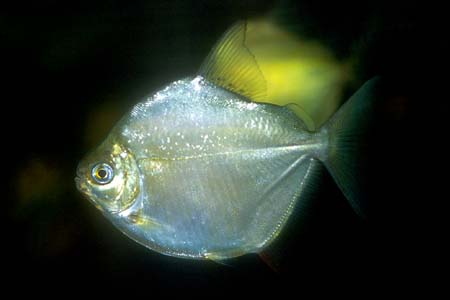
The silver dollar, Metynnis hypsauchen, is a relative of the piranhas with a patchy distribution in Guyana, Brazil, Peru and Bolivia. Sometimes called the plain metynnis, it is sold under the same name as the very similar M. argenteus and differs in the black blotch above and behind each eye. A striped form is not a distinct species. An avid plant-eater, it is best kept in a group of at least five.
Distribution
EditHabitat
Write a noteEditDensely planted tributaries
Aquarium size
Write a noteEditA group of adult fish will require a tank of at least 180 ∗ 38 ∗ 38 cm72 ∗ 15 ∗ 15 in - ~260 litres~69 US gal. Length and width are more important than height. Juvenile fish can be housed in smaller aquaria.
Maintenance
Write a noteEditSilver dollars inhabit densely planted river tributaries in the wild. The difficulty in replicating this in captivity is that the species is an avid plant-eater! Hardy plants should be chose but will still need to be replaced regularly. Artificial plants could be used as an alternative as some of the fabric and silk-type plants that are now available make convincing fakes. Silver dollars can be nervous fish, so dim lighting and areas of refuge will boost their confidence.
Water conditions
EditTemperature: 24 – 28 °C75 – 82 °F
pH: 6.0 - 7.0
Hardness: Up to 10°H
These recommendations come from this profile’s own figures. They contain affiliate links, so we may earn a commission.
Diet
Write a noteEditProvide a large amount of vegetable matter in the diet, including; courgette, cucumber, peas, spring greens and other green vegetables. Commercial foods such as algae wafers, spirulina and vegetable flake are also recommended. Silver dollars will also accept the majority of aquarium foods and will relish such treats as bloodworm and brineshrimp.
Behaviour and compatibility
Write a noteEditBest kept in groups of at least five fish. Generally peaceful community fish and can be kept with other larger peaceful species. Much smaller fish may be eaten. Silver dollars mainly occupy the middle and top areas of the aquarium, so it is a good idea to select tankmates that occupy both the bottom of the tank to add contrast. Larger peaceful catfish such as plecos and doradids would be a good choice.
Sexual dimorphism
Write a noteEditAnal fin is more elongated and colourful on the male.
Reproduction
Write a noteEditModerately difficult.
Silver dollars are group spawners, so a large breeding tank is needed. Condition the fish well prior to introduction to the breeding setup. Water conditions should be at the softer, more acidic end of this species range and the temperature should be raised to around 28 °C82 °F. Carrying out a water change with slightly warmer water may help trigger spawning. Males assume a dark colouration when ready to spawn, particularly around the anal, caudal and dorsal fins. The redness around the chest areas will also intensify. Males will court the females, pursuing them around the tank and 'shimmying' next to them. When the female is ready to breed, eggs will be released, which are then fertilised by the male.
The eggs will drop to the bottom of the tank. Silver dollars are not as likely to eat their own eggs as some fish but should still be removed when spawning is complete as it is easier to raise the fry. Eggs hatch in around three days. Once the fry have absorbed their yolk sacs, tiny foods such as infusoria should be offered initially. As the fry grow, they can be progressed to newly hatched brineshrimp and powdered foods.
As many as 2000 eggs are laid per spawning pair, so a high mortality rate is likely. It is also recommended that small and deformed fish are culled to ensure that the brood is of a manageable size and contains only healthy specimens.
Notes
EditMetynnis hypsauchen is sometimes referred to as the Plain Metynnis in an effort to distinguish it from its close relation, Metynnis argenteus. Both fish are sold in the hobby under the name "Silver Dollar" and are virtually indentical in terms of appearance and care requirements. The two species can be told apart as m. hypsauchen has a black blotch located slightly above and behind each eye. This species also occurs in a striped colour form which is sometimes referred to as(m. hypsauchen fasciatus) but is not a distinct species. In addition to these two species, the Spotted Metynnis (m. lippincottianus is also occasionally seen for sale.
Silver dollars are common and popular fish in the hobby. They are related to piranhas and indeed are often mistaken for their predatory cousins. Silver dollars form part of the metynnis genus which is closely related to both the myleus and mylossoma genera and the species are often misidentified or confused with each other.
Species images · 2
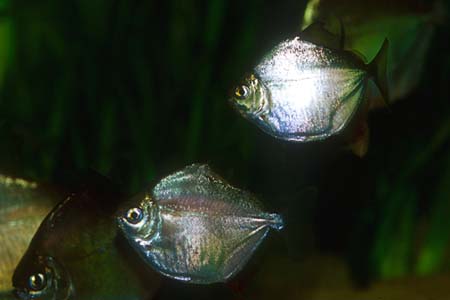
These photographs are used with each photographer’s permission.
Send a photographProfile completeness19 of 24
79% complete
Also missing: a recorded distribution, taxonomic authority, etymology.
Community
Questions about Metynnis hypsauchen?
Ask on Discord