Results for “aff.”
Type a name: scientific, common, or one a species used to go by. Or narrow the catalogue with the filters.
Filters
Gambusia affinisWestern Mosquitofish
authority not recorded
Max length40mm SL1.6in SLTanknot recordedTemp18–27°C64–81°FpH6.0–8.0For many years G. affinis was thought to be the same species as the Eastern Mosquitofish, G. holbrooki, but has since been given distinct species status. They can be distinguished by several means. In G. holbrooki the leading ray of the males' gonopodium has a serrated edge, theusually has 7 rays and males also generally have a higher degree of dark spotting on the body than G. affinis males. Male G. affinis also lack the serrated leading ray of the gonopodium and this species usually has o...
Distichodus affinisSilver Distichodus
authority not recorded
Max length200mm SL8in SLTank120 × 30cm48 × 12inTemp23–27°C73–81°FpH6.0–8.0This species has become more common in the trade in recent years, and makes an interesting addition to larger communities. It develops bright red fins as it matures. Some specimens develop a pink sheen on the underside. These variations may indicate different species, as there are several in the genus that superficially resemble D. affinis....
Melanotaenia affinisNew Guinea Rainbowfish
authority not recorded
Max length120mm SL5in SLTank120 × 30cm48 × 12inTemp20–30°C68–86°FpH6.5–8.0M. affinis was one of the first rainbowfish species to be imported for the hobby in any numbers. There are several geographical variants, three of which can be found in the hobby. The "standard" form has a large natural range and is the most commonly encountered. The "Pagwi" form has a very limited distribution, being known only from a tributary of the Sepik River in New Guinea, while the "Bluewater Creek" form has only been collected from a single location close t...
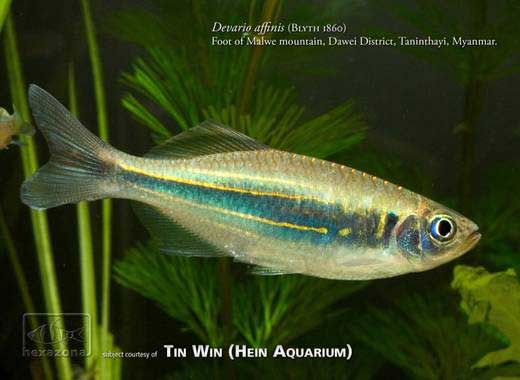
Devario affinis
Blyth, 1860
Matched on Perilampus affinis, a name it was formerly known by
Max length80mm SL3.1in SLTank120 × 45cm48 × 18inTemp20–26°C68–79°FpHnot recordedType locality is 'Tenasserim, Myanmar' which at time of description was used to refer to the portion of Myanmar lying to the south and east of the Ayeyarwaddy/Irrawaddy river delta, including present-day Kayah, Kayin, and Mon states, Bago Division, and possibly the southern Tanintharyi Region. Blyth's description paper covered fishes collected from the Sittaung River (plus a few Gangetic species) in what is currently Bago Division, but we've been unable to locate any modern records of D. affinis fro...
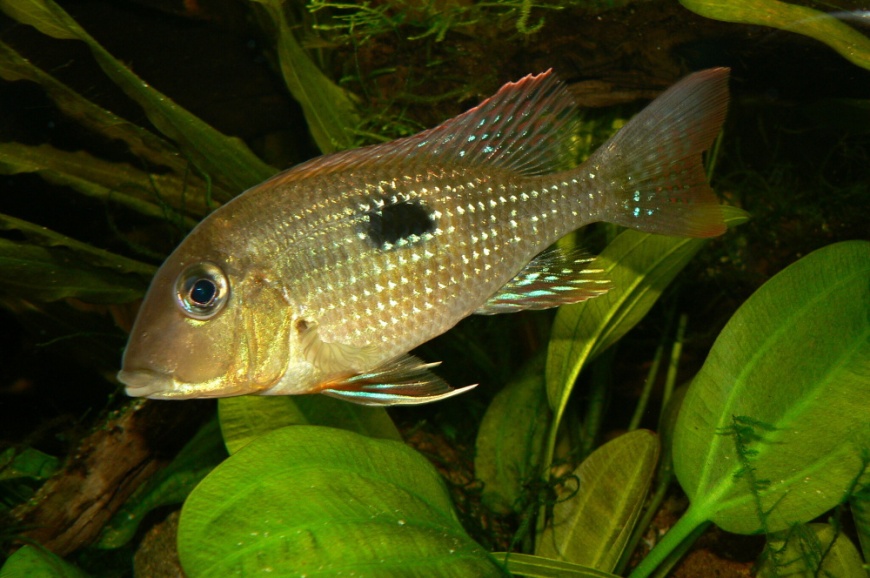
Geophagus camopiensisOiapoque Eartheater
Pellegrin, 1903
Max length200mm SL8in SLTank150 × 45cm60 × 18inTemp25–33°C77–91°FpH6.0–7.5In a study conducted on the Arataye River, the main tributary of the Approuage, this species was mostly collected from stretches of rapids with rocky substrate which were reduced to a series of pools during the dry season. Other fishes observed at the same site were Auchenipterus nuchalis, Hypostomus gymnorhynchus and Moenkhausia cf. intermedia while at other localities in the river Bryconops affinis, Myleus ternetzi, M. rhomboidalis, Moenkhausia aff. barbouri, Curimata sp. and Serrasalmus sp. were collected.
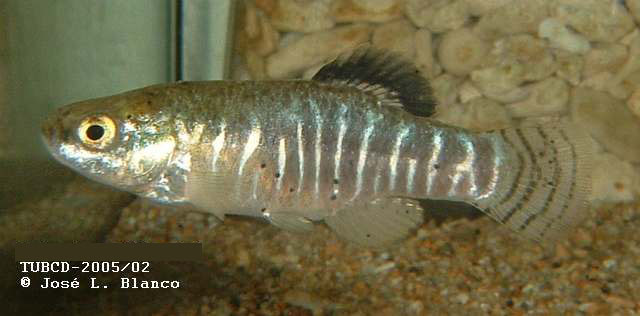
Anatolichthys villwockiSakarya Toothcarp
Hrbek & Wildekamp, 2003
Max length60mm SL2.4in SLTank120 × 30cm48 × 12inTemp2–30°C36–86°FpH6.5–8.5Prior to its description this species had been considered a form of A. anatoliae and also referred to as A. sp. aff. danfordii but collections in the early part of this century motivated new studies and resulted in its elevation to full species level. Phylogenetic analyses have shown it to represent the sister group to all other Anatolian Aphanius spp. The Anatolia region represents a centre of diversity for the genus with ten endemic species described to date. These are thought to have diverged ...
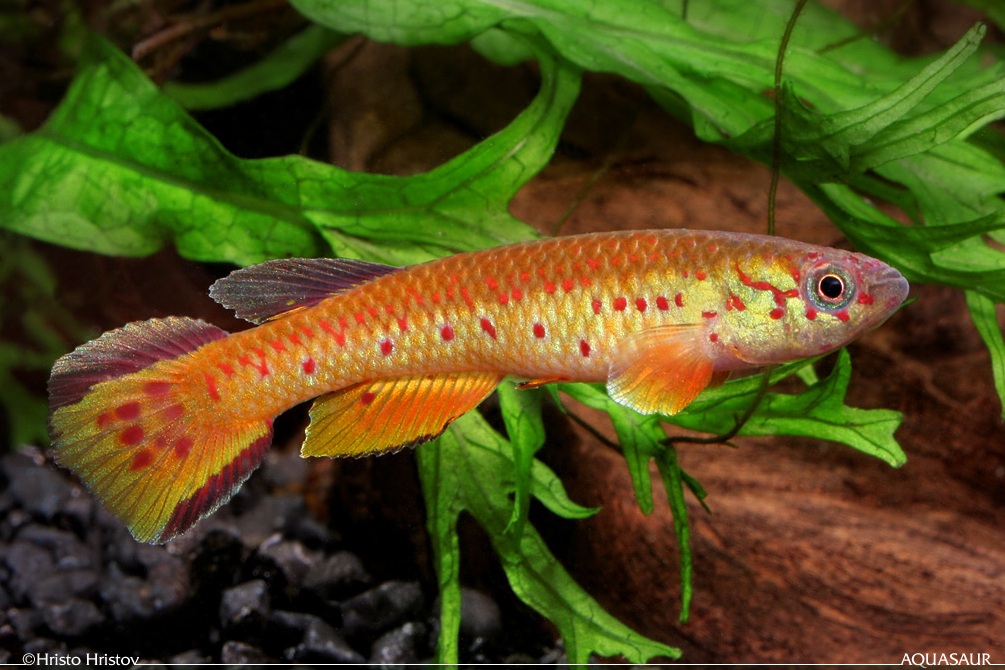
Aphyosemion congicumCongo Lyretail
Ahl, 1924
Max length45mm SL1.8in SLTanknot recordedTempnot recordedpHnot recordedThe type series was derived from a commercial shipment and this species' natural range remains unconfirmed. It may be restricted to the area between the Kwango and Gamba rivers, the latter a tributary of the former, in western Democratic Republic of Congo. The Kwango is itself a tributary of the Kasai, an affluent of the Congo.
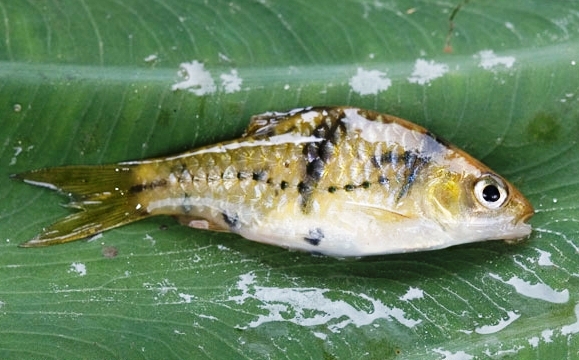
Barbodes kuchingensisFalse Spanner Barb
Herre, 1940
Max length120mm SL5in SLTank120 × 45cm48 × 18inTemp20–28°C68–82°FpH5.0–7.5This species is rarely-exported for the aquarium hobby but is available on occasion. The name 'P.' kuchingensis is frequently misapplied, however, with subadult forms of 'P.' everetti and some populations of the geographically-variable 'P.' lateristriga regularly traded as such, for example. Though closely-affiliated with and superficially very similar to...
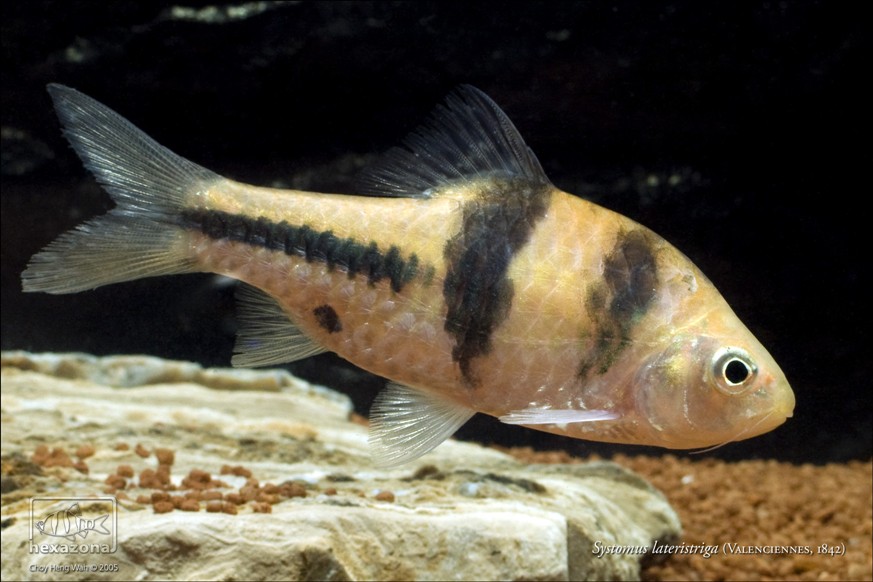
Barbodes lateristrigaSpanner Barb
Valenciennes, 1842
Max length150mm SL6in SLTank150 × 45cm60 × 18inTemp20–28°C68–82°FpH6.0–8.0This species is commonly-referred to as 'T-barb' in some countries. It's closely-affiliated with and sometimes traded as the congener B. kuchingensis but that species can be told apart by colour pattern comprising a prominent row of dark spots along the lateral line, plus a short, horizontally-orientated streak extending from the upper part of the operculum. In B. lateristriga the lateral markings usually form a solid stripe and there is no streak extending from the operculum.
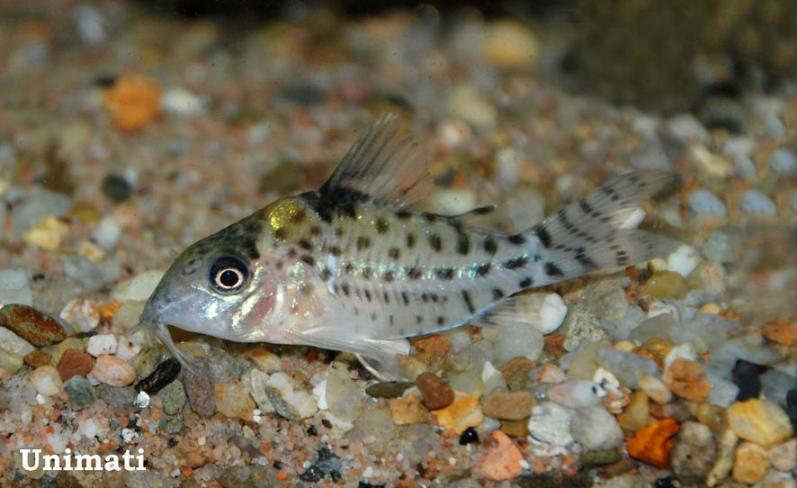
Corydoras ambiacus
Cope, 1872
Max length65mm SL2.6in SLTanknot recordedTemp21–27°C70–81°FpH6.0–8.0Described from the Río Ampiyacu, a small tributary draining into the main Amazon channel in Loreto Department, northeastern Peru, with additional records from the Yavarí (Javari), Napo, Nanay, and lower Ucayali drainage basins. All of these are Amazon tributaries, and C. ambiacus appears to occur in most or all affluents of the main Amazon channel between th...
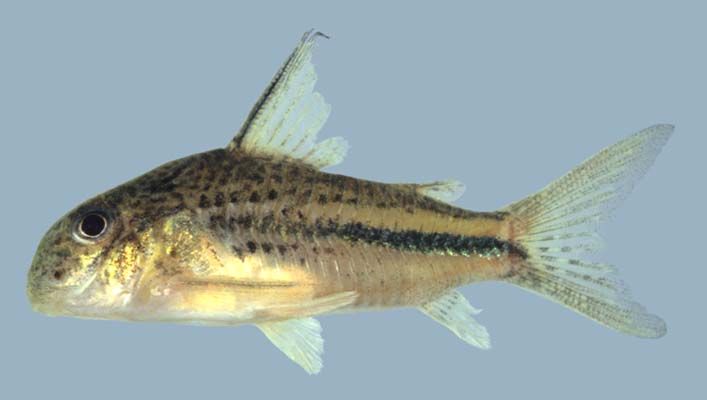
Corydoras bondiBlackstripe Cory
Gosline, 1940
Max length50mm SL2.0in SLTanknot recordedTemp20–26°C68–79°FpH6.0–7.5Type locality is 'Río Yuruari, 3 kilometers east of El Callao, 7°18'N, 61°50'W, Bolivar, Venezuela', and this species is also known from the Rupununi River drianage in Guyana and the Courantyne/Corantijn system in Suriname. The Yuruari, an affluent of the Río Cuyuni, an...
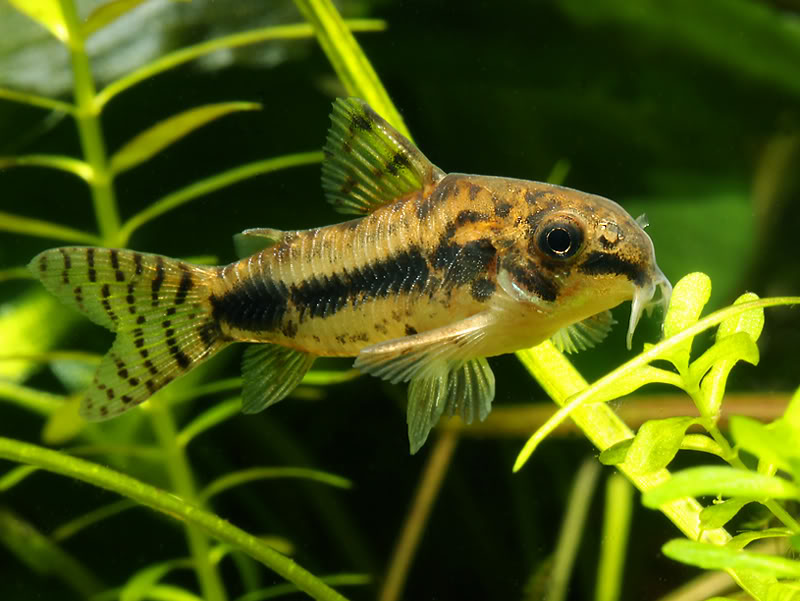
Corydoras habrosusSalt and Pepper Cory
Weitzman, 1960
Max length35mm SL1.4in SLTank60 × 30cm24 × 12inTemp20–26°C68–79°FpH5.5–7.5The majority of records derive from the Río Apure watershed in southwestern Venezuela, where C. habrosus has been collected in the states of Portuguesa, Cojedes, Barinas, Guárico, and Apure. Its distribution in Colombia is less clear but it is known with certainty from the Río Arauca and Río Casanare, the latter a tributary of the lower Río Meta, and it makes sense that it should also be found in other left bank Orinoco affluents between the Meta and Apure, which include the ríos Cinaruco and Capanaparo.
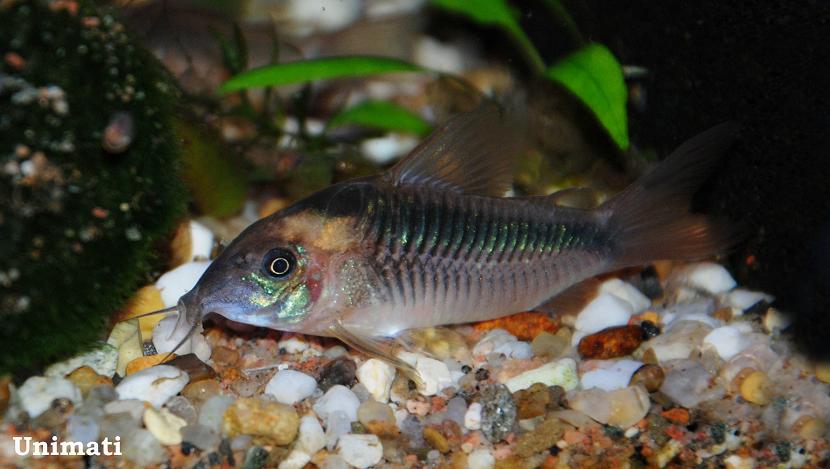
Corydoras zygatusBlack Band Cory
Eigenmann & Allen, 1942
Max length70mm SL2.8in SLTank90 × 30cm36 × 12inTemp20–26°C68–79°FpH5.5–7.5Known from the Ucayali (río Samiria), Huallaga, Santiago, and Pastaza (ríos Bobonaza and Pindo) river systems in eastern Ecuador and northern Peru. These are all tributary drainages within the middle Río Marañón watershed, a major affluent of the upper Amazon river basin. Type locality is 'Río Hallagua system, Yurimaguas...
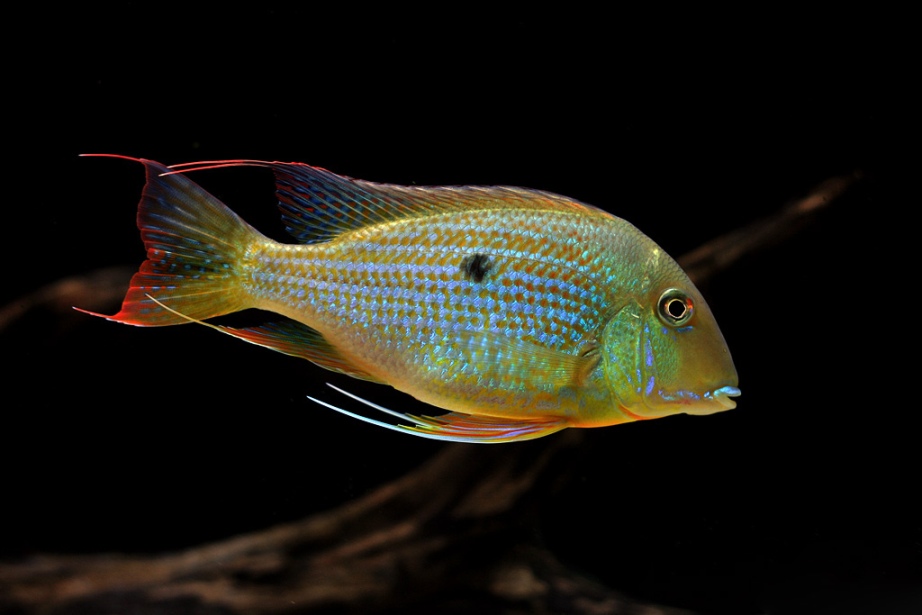
Geophagus neambi
Lucinda, Lucena & Assis, 2010
Max length200mm SL8in SLTank180 × 60cm72 × 24inTemp24–32°C75–90°FpH5.5–7.5This species was available in the hobby several years prior to being described, invariably traded as G. sp. aff. altifrons 'Tocantins', G. sp. 'Tocantins' or G. sp. 'rio Areoes'. The latter of these names refers to an Indian reserve named 'Areões' in the rio Das Mortes drainage, a tributary of the Araguaia which itself drains into the Tocantins, and the aquarium specimens in our images have been identified as G. neambi by Dr. Paulo Lucinda, co-describer of the species.
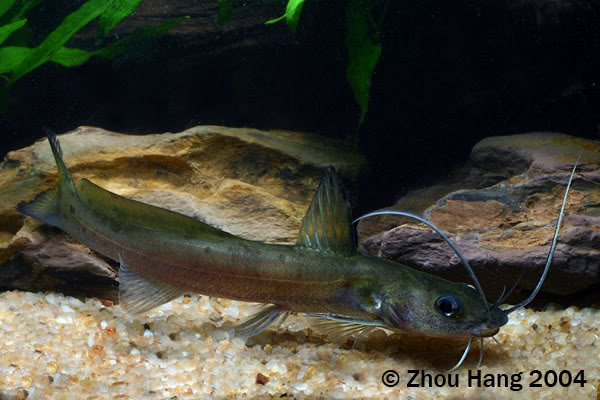
Hemibagrus macropterus
Bleeker, 1870
Max length408mm SL16in SLTanknot recordedTempnot recordedpHnot recordedThis species has been recorded from the Zhujiang (Pearl River), Changjiang (Yangtze River) and Qiantang Jiang in central and southern China. Type locality is 'Chang Jiang, China', referring to the Yangtze. It's been adversely affected by dam construction and pollution across certain parts of its range and may be locally extirpated in some cases.
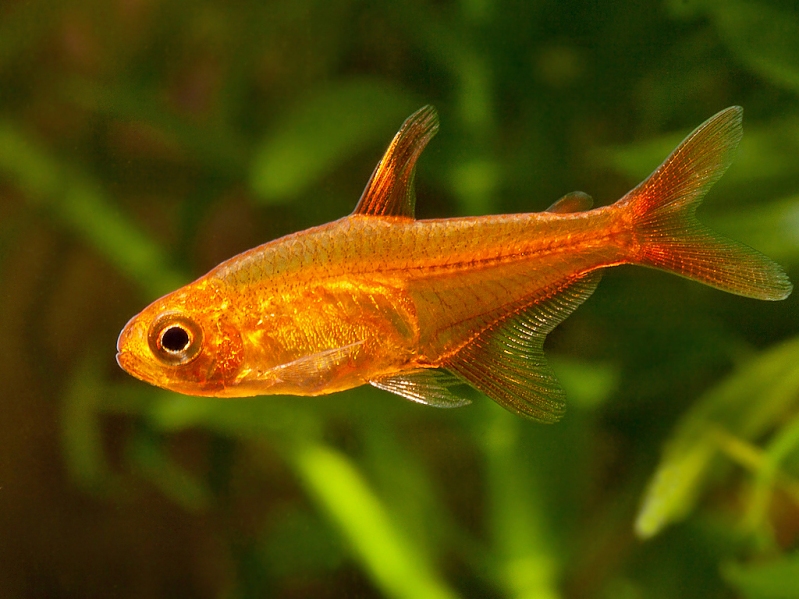
Hyphessobrycon amandaeEmber Tetra
Géry & Uj, 1987
Max length20mm SL0.8in SLTank45 × 30cm18 × 12inTemp20–28°C68–82°FpH5.0–7.0Type locality is 'Rio das Mortes, some 100 km before its confluence with the Braço Maior of the Rio Araguaia (the western border of the Isla do Bananal). State of Mato Grosso.' The das Mortes is a principal tributary of the Araguaia, itself the major affluent of the rio Tocantins within the lower Amazon basin in central and western Brazil, although the full range of H. amandae within the Araguaia system is unclear.
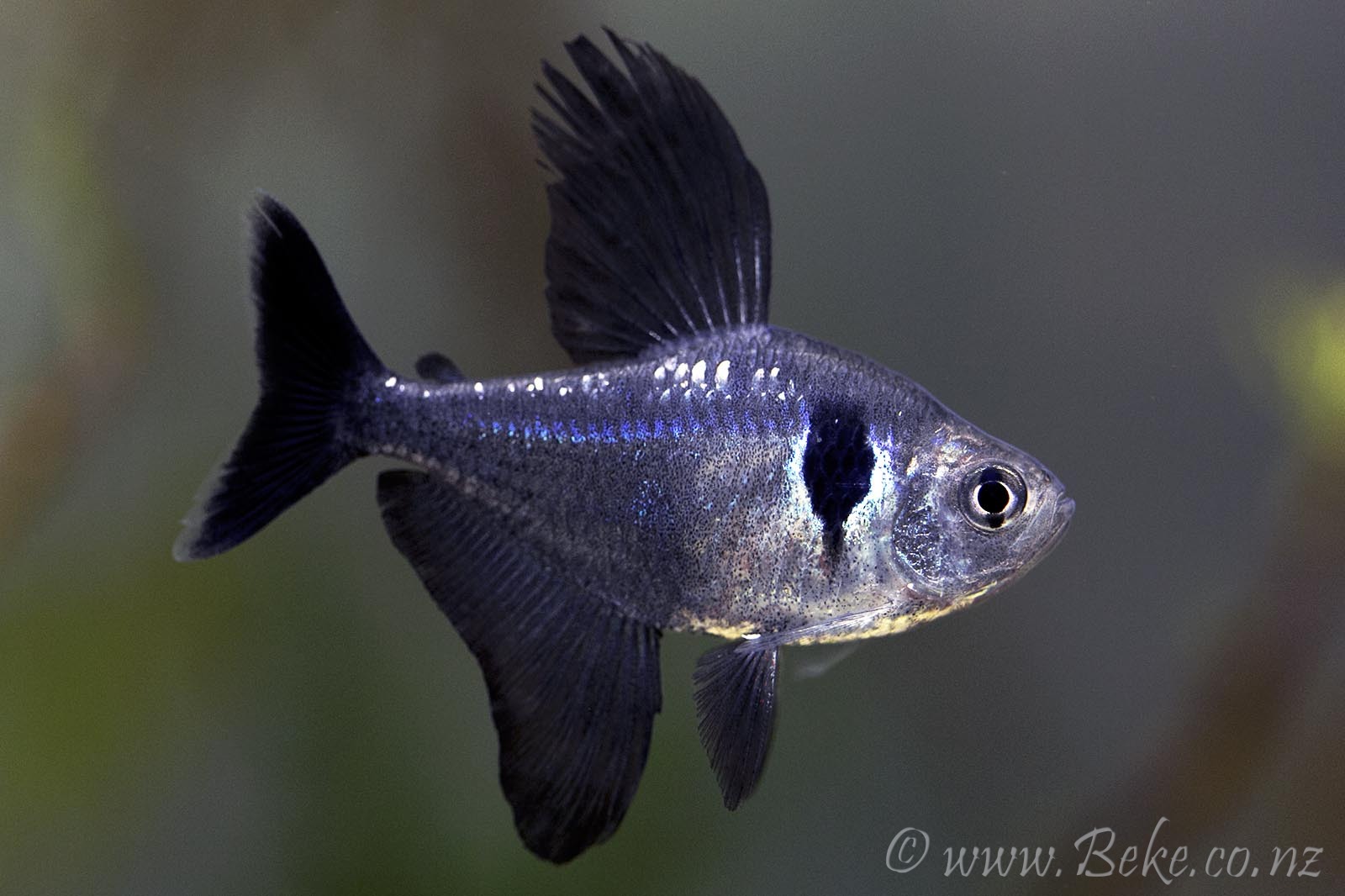
Hyphessobrycon megalopterusBlack Phantom Tetra
Eigenmann, 1915
Max length36mm SL1.4in SLTank80 × 30cm31 × 12inTemp20–28°C68–82°FpH5.0–7.0The majority of records pertain to the rio Guaporé (Río Iténez in Bolivia), the main affluent of the rio Mamoré, which drains the vast tropical wetland known as the Pantanal, and the upper rio Paraguai, which also has its headwaters in the Pantanal but flows in the opposite direction. The Guaporé and Paraguai are connected due to rising water levels during the annual wet season.
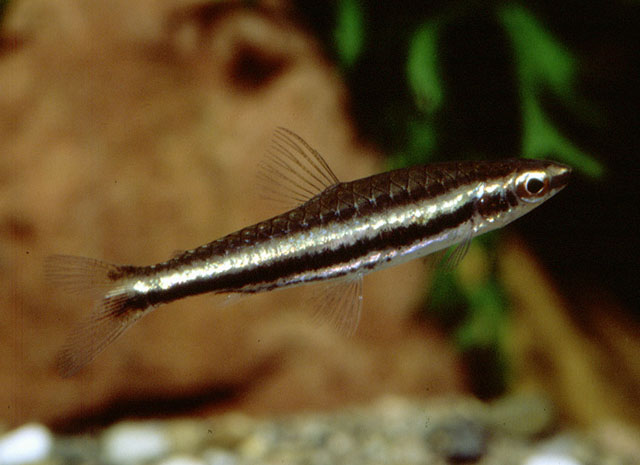
Nannostomus digrammusTwostripe Pencilfish
Fowler, 1913
Max length30mm SL1.2in SLTank45 × 30cm18 × 12inTemp22–28°C72–82°FpH5.0–7.0Native to the central Amazon basin with records existing from the Madeira, Branco, Trombetas, and Tapajós river drainages, plus the Rupununi basin in Guyana. Although an affluent of the rio Essequibo and thus not officially part of the Amazon basin, the latter is connected to the rio Takutu, a tributary of the upper rio Branco, during the annual wet season. Type locality is given by Fowler as 'Rio Madeira about 200 miles east of W. Long. 62°20', Brazil'.
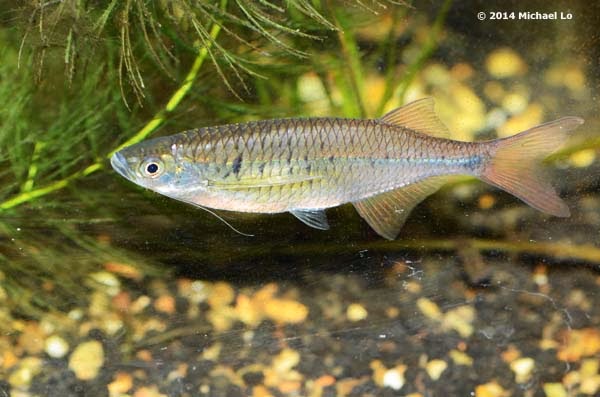
Nematabramis everetti
Boulenger, 1894
Max length105mm SL4in SLTanknot recordedTempnot recordedpHnot recordedNematabramis species are found a variety of habitat-types, from swiftly-flowing affluent streams to pools, lakes, and degraded swamps. Based on the available collection records juveniles and subadults of N. everetti display a preference for fast-moving water whereas adults are found in deeper, slower stretches of minor tributaries.
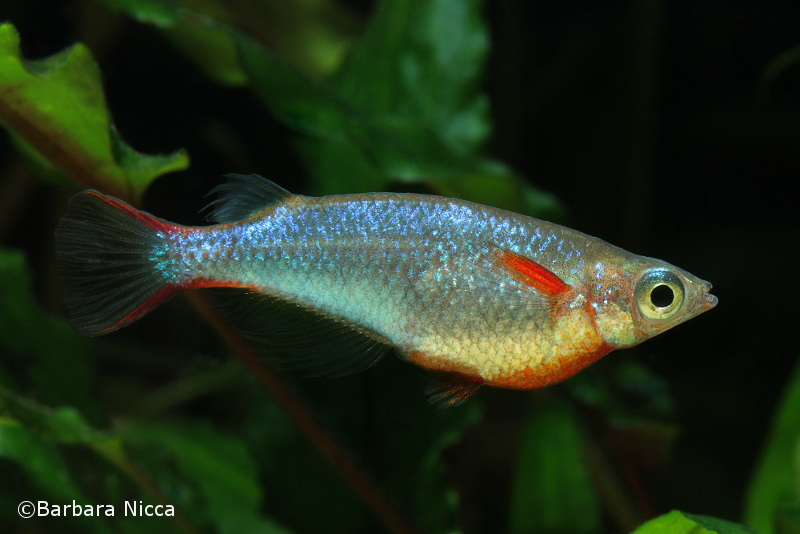
Oryzias woworaeDaisy's Ricefish
Parenti & Hadiaty, 2010
Max length30mm SL1.2in SLTank45 × 30cm18 × 12inTemp23–27°C73–81°FpH6.0–7.5The type locality is a karstic freshwater stream flowing under 80% forest cover with a mixed substrate of mud and sand plus patches of leaf litter. O. woworae was collected from a still pool around 3-4 m deep, opposite an affluent spring, where it was schooling with a species of Nomorhamphus which may turn out to be a form of N. ebrardtii but has subsequently appeared in the aquarium trad...