Results for “ortho-”
Type a name: scientific, common, or one a species used to go by. Or narrow the catalogue with the filters.
Filters
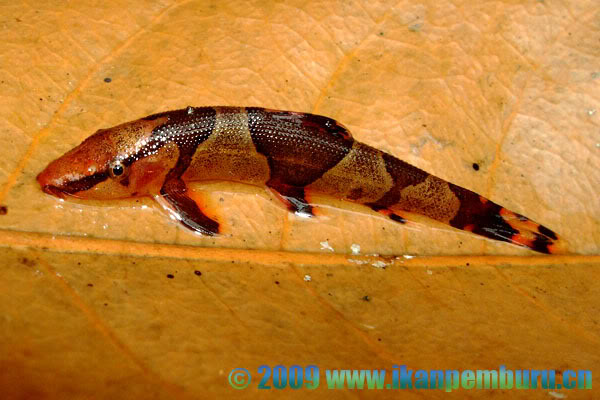
Homaloptera orthogoniataSaddle-back Loach
Vaillant, 1902
Max length95mm SL3.7in SLTank120 × 30cm48 × 12inTemp20–25.5°C68–78°FpH6.0–7.5This species appears is rare in the aquarium hobby with the majority of images both online and in the published literature instead depicting H. confuzona or H. parclitella. All three are members of the H. ocellata 'group' within the genus which currently contains H. ocellata, H. bilineata, H. confuzona, H. orthogoniata, H. ogilviei and H. parclitella. Following Tan and Ng (2005) these share possession of...
Hemiodus orthonops
authority not recorded
Max length250mm SL10in SLTank120 × 45cm48 × 18inTemp22–26°C72–79°FpH6.5–7.5Hemiodus species can be very nervous when first introduced to the aquarium, but usually settle down over time, especially if a large number are being kept together. All of them look superficially similar, but can be distinguished by differences in patterning. None are particularly common in the hobby....
Orthochromis stormsi
authority not recorded
Max length120mm SL5in SLTank120 × 30cm48 × 12inTemp22–27°C72–81°FpH6.5–7.5O. stormsi was previously classified as Schwetzochromis stormsi and is still named as such by many sources. Its swimbladder is modified, being much reduced in size. This makes the fish less buoyant and therefore less likely to be swept away by the strong currents in its natural habitat. In the aquarium it spends most of its time on the substrate, where it swims in a characteristic 'hopping' fashion. Unfortunately, it is rather rare in the hobby....
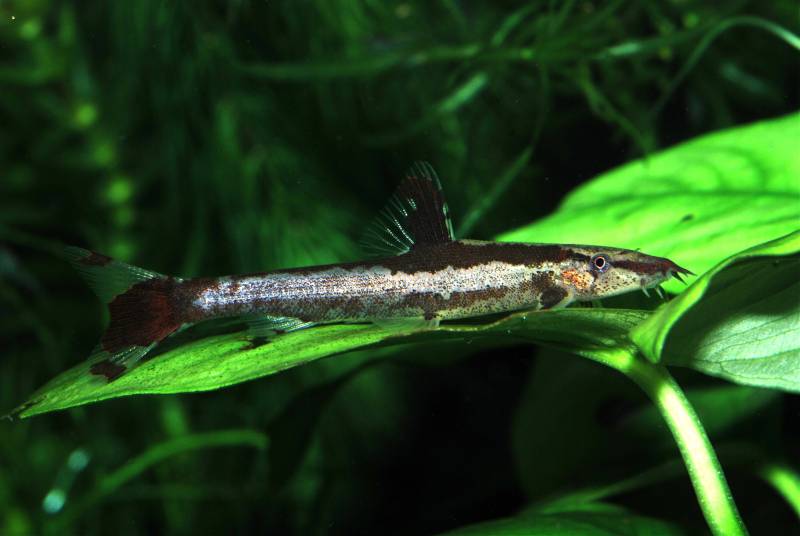
Homaloptera bilineata
Blyth, 1860
Max length100mm SL3.9in SLTank120 × 30cm48 × 12inTemp20–25.5°C68–78°FpH6.0–7.5This rarely-traded species is a member of the H. ocellata 'group' of closely-related congeners, an assemblage which currently comprises H. ocellata, H. bilineata, H. confuzona, H. orthogoniata, H. ogilviei and H. parclitella. Following Tan and Ng (2005) these share possession of a colour pattern with reddish tints and dark brown head markings, elongate head, slightly compressed body, 61-77 lateral line scales and dorsal-fin origin placed in advance of pelvic-fin origin.
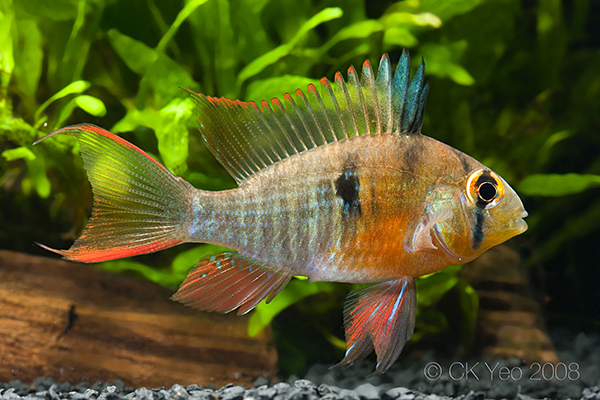
Mikrogeophagus altispinosusBolivian Ram
Haseman, 1911
Max length80mm SL3.1in SLTank90 × 45cm36 × 18inTemp24–28°C75–82°FpH6.0–7.5This species appears endemic to the upper rio Madeira basin in Bolivia and Brazil. Records exist from the Río Mamoré and Río Guaporé drainages in Bolivia (where the Guaporé is known as the Iténez) and Brazil plus the upper Río Orthon (ríos Tahuamanu and Manuripi). Type locality is 'sand-bank in the Rio Marm...