Results for “snout”
Type a name: scientific, common, or one a species used to go by. Or narrow the catalogue with the filters.
Filters
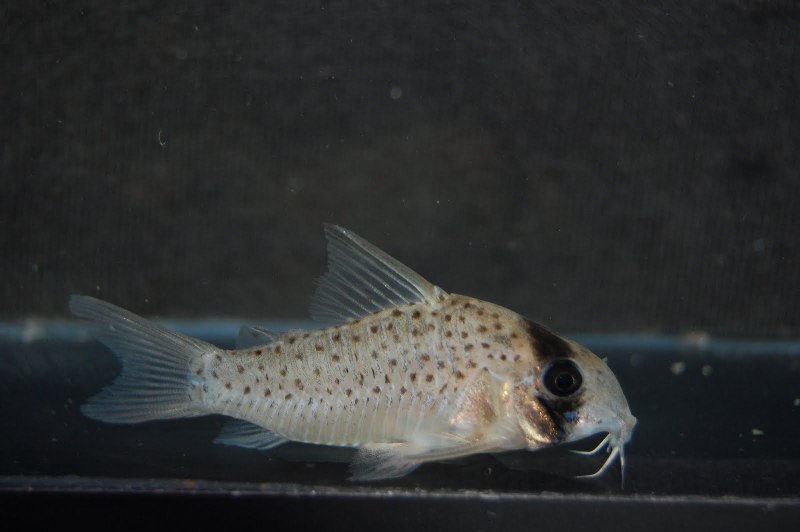
Corydoras atropersonatusFairy Cory
Weitzman & Nijssen, 1970
Max length50mm SL2.0in SLTanknot recordedTemp21–27°C70–81°FpH5.0–7.0This species is sometimes confused any of several similar-looking fishes such as C. sychri or C. sp. C097. While the former is a more elongate fish with a longer snout and quite easy to identify, C097 resembles C. atropersonatus more closely, despite being traded as C. sychri 'longnose'. Its snout is longer than that of C. atropersonatus but shorter than that of C. sychri, and the dark spots on the body tend to be more well-defined and spaced out than in the other two.
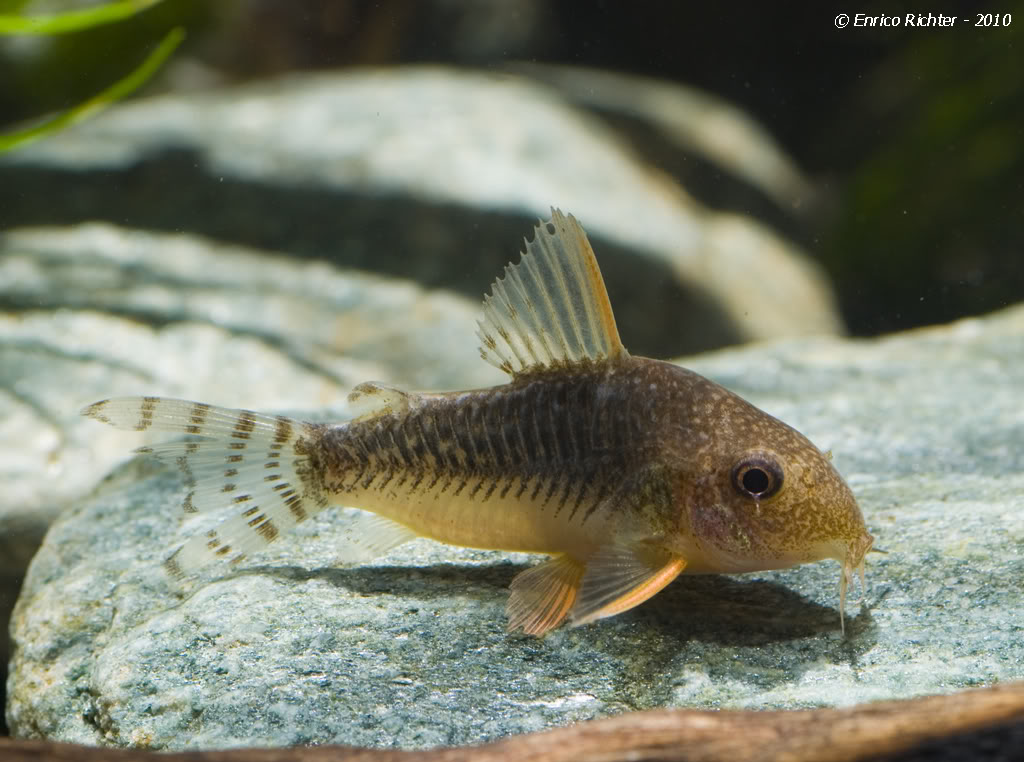
Corydoras gosseiPalespotted Cory
Nijssen, 1972
Max length55mm SL2.2in SLTank90 × 30cm36 × 12inTemp24–28°C75–82°FpH5.5–7.5The congener C. seussi, which is also native to the rio Mamoré, has a similar colour pattern but its snout is noticeably prolonged compared with that of C. gossei, plus there are some subtle differences in pigmentation. There is a third variant which has been referred to as 'CW069' in the aquarium hobby and appears to be somewhat intermediate, with a short, rounded snout as in C. gossei but a colour pattern more reminiscent of C. seussi.
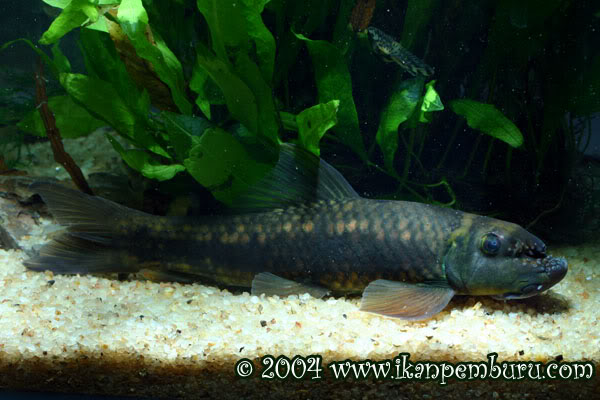
Garra bispinosa
Zhang, 2005
Max length130mm SL5in SLTanknot recordedTempnot recordedpHnot recordedG. bispinosa can be distinguished from all other congeners in Southeast Asia and China by the following combination of characters: a conspicuous, quadrate, anteriorly-directed proboscis orientated ventrally against the snout and anteriorly adorned with a single, large, uniscupid, acanthoid tubercle on the distal tip of each lobe; snout with a deep groove across its tip to form a transverse lobe; 34-35 lateral...
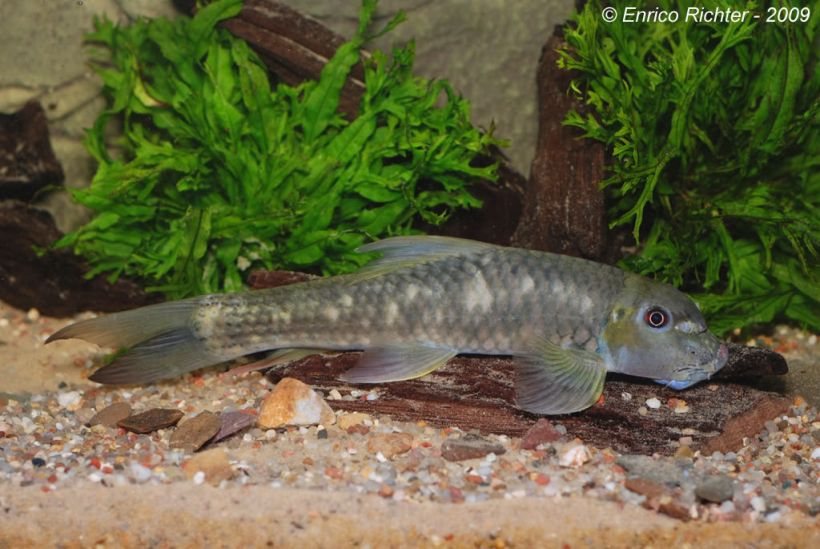
Garra salweenica
Hora & Mukerji, 1934
Max length175mm SL7in SLTanknot recordedTempnot recordedpHnot recordedG. salweenica can be distinguished from other congeners inhabiting the Salween watershed by the following combinatuion of characters: body brownish; presence of a trilobed proboscis on the snout; snout blunt; a series of black spots at the base of the central dorsal-fin rays; presence of longitudinal stripes on the posterior portion of the body; a dark marking at the tip of the upper (and lower in some specimens) caudal-fin lobe; body depth 22.4-25.3 % SL.
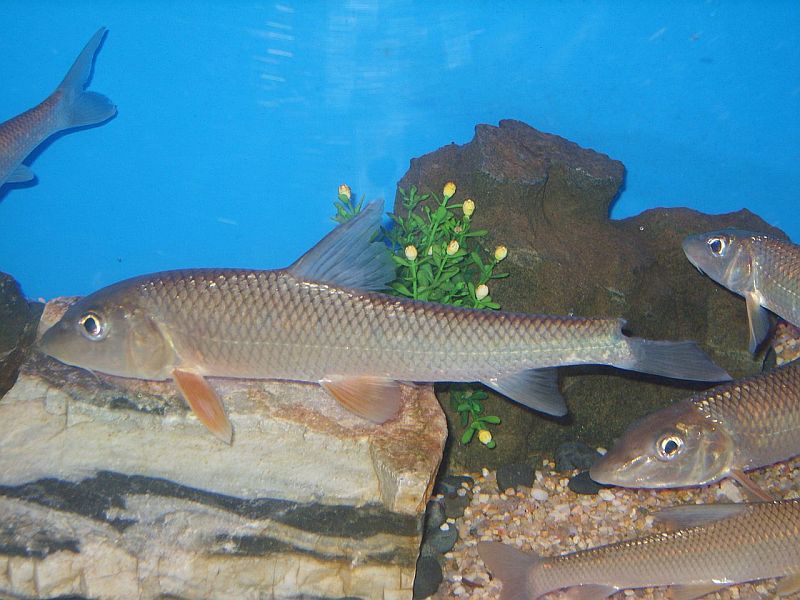
Hemibarbus labeoBarbel Steed
Pallas, 1776
Max length450mm SL18in SLTanknot recordedTempnot recordedpHnot recordedThis species can be distinguished from other members of the genus by the following combination of characters: absence of dark spots on body in adults; body elongate with slightly convex dorsal profile; head longer than body is deep; snout much longer than postorbital head length; lips well developed, lateral lobes of lower lip broad and thick with folds, median process small; barbel thickness shorter or equal to eye diameter; dorsal spine strong, ⅔ of HL; dorsal-fin origin closer to tip of snout than caudal-fin base base; 15+ gill rakers; 6½ branched anal-fin rays; posterior simple dorsal-fin rays ossified and spinous.
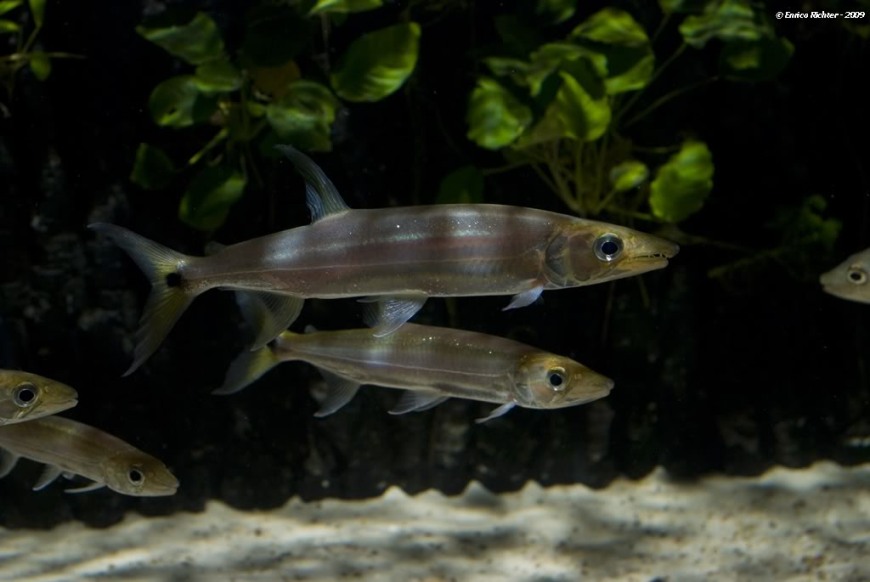
Acestrorhynchus falcirostrisBig-Eyed Cachorro
Cuvier, 1819
Max length350mm SL14in SLTank250 × 90cm98 × 36inTemp22–28°C72–82°FpH6.0–7.5This species is a member of the putative A. nasutus group of closely-related species within the genus alongside A. nasutus, A. maculipinna and A. isalineae. These are characterised by possession of two dark, longitudinal stripes, one running from the tip of the snout to the base and the other from the posterior edge of the lower maxilla to the underside of the caudal peduncle.
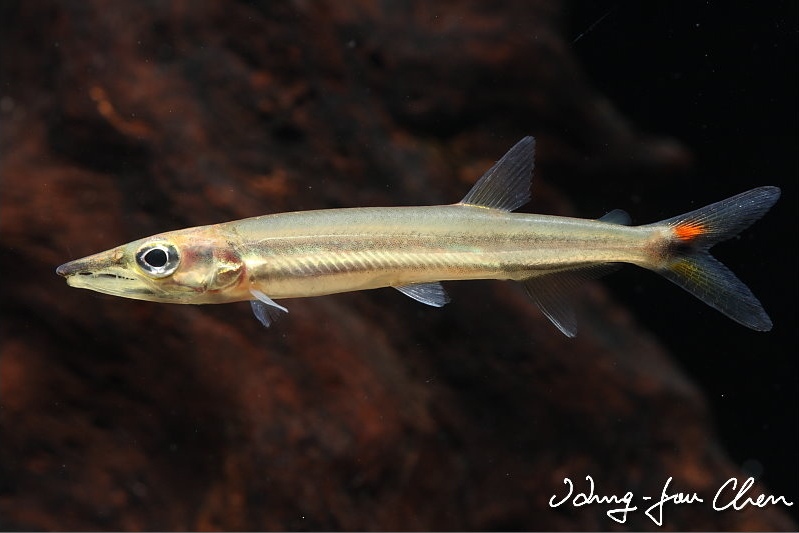
Acestrorhynchus isalineaeStriped Barracuda Tetra
Menezes & Géry, 1983
Max length105mm SL4in SLTank120 × 45cm48 × 18inTemp24–28°C75–82°FpH6.0–7.5This species is a member of the putative A. nasutus group of closely-related species within the genus alongside A. nasutus, A. maculipinna and A. isalineae. These are all characterised by possession of two dark, longitudinal stripes, one running from the tip of the snout to the base and the other from the posterior edge of the lower maxilla to the underside of the caudal peduncle.
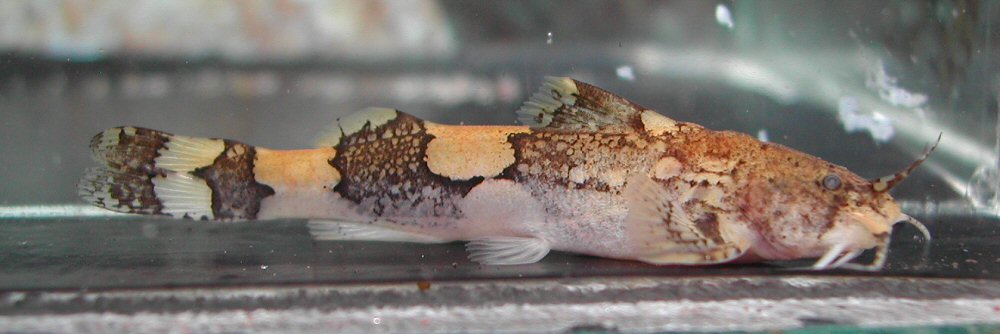
Akysis vespertinusWestern Stream Catfish
Ng, 2008
Max length35mm SL1.4in SLTank45 × 30cm18 × 12inTemp16.5–24°C62–75°FpH6.0–7.5This species is exceptionally rare in the aquarium trade and can be distinguished from congeners by the following combination of characters: snout narrow with head appearing triangular as a resul...
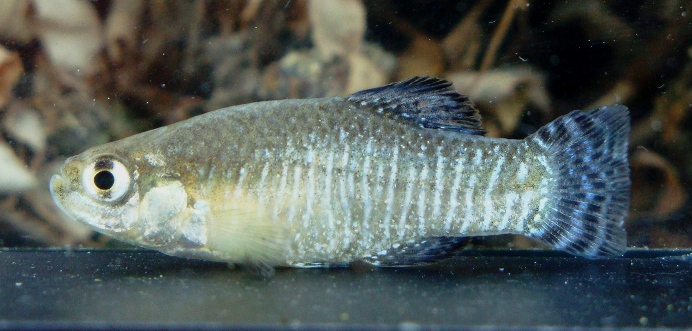
Apricaphanius baeticusBaetican Toothcarp
Doadrio, Carmona & Fernández-Delgado, 2002
Max length50mm SL2.0in SLTank120 × 30cm48 × 12inTemp2–30°C36–86°FpH7.0–9.0Prior to its description this species was considered a geographic variant of A. iberus but the 2002 paper revealed the pair to be genetically quite distinct and also highlighted some morphological differences. It is distinguished from A. iberus by possessing 8-9 (usually 8 ) branched dorsal-fin rays (vs. 8-9, sometimes 10), 9-11 branched anal-fin rays (vs. 8-9), a deeper, more elongate body shape, noticeably shorter snout, relatively thick (vs. thin) vertical bars in males and a flank patterning consisting of a few la...
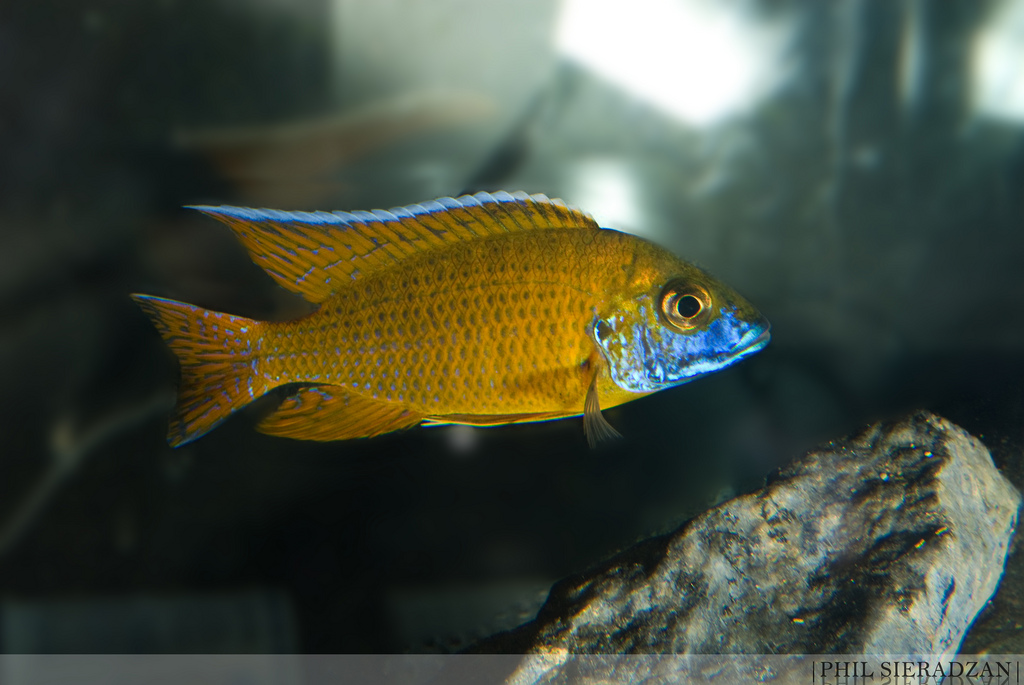
Aulonocara baenschiNew Yellow Regal Peacock
Meyer & Riehl, 1985
Max length♂ 120 · ♀ 90mm SL♂ 5 · ♀ 3.5in SLTank120 × 45cm48 × 18inTemp25–29°C77–84°FpH7.5–9.0This species may also be sold variously as 'yellow regal cichlid', 'Baensch's peacock', 'sunshine peacock' and 'Nkhomo-Benga peacock'. The easiest way to distinguish it from similar-looking congeners is to look at the profile of the snout, which is steeper and more curved than that of its congeners. Aulonocara spp. are benthophagous by nature employing a method of feeding whereby mouthfuls of substrate are taken and sifted for edible items with the remaining material expelled via the gills and mouth. They're equally-skilled at hunting as grazing, tending to hover above the substrate until tiny movements are detected, and possess enlarged sensory pores on the head which assist in this technique.
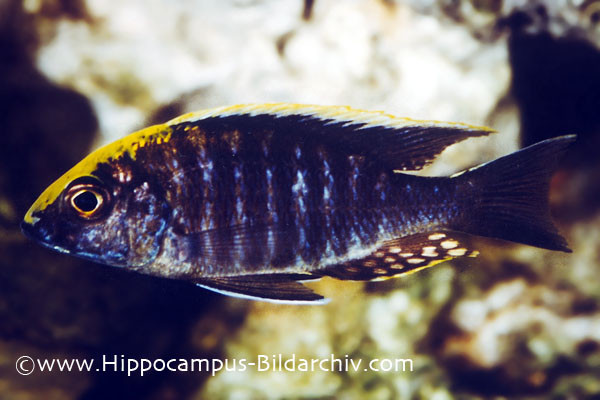
Aulonocara maylandiSulphurhead Peacock
Trewavas, 1984
Max length100mm SL3.9in SLTank120 × 30cm48 × 12inTemp25–29°C77–84°FpH7.5–9.0This species exists in two distinctive phenotypes, with male individuals from West reef and Eccles reef possessing a bright yellow stripe of colour running from the tip of the snout over the anterior portion of the dorsal surface and along the distal margin of the dorsal fin. This form is commonly referred to as 'sulphurhead' or 'sulfurhead' in the aquarium hobby. At Kande Island males exhibit a similar overall colour patterm but the dorsal stripe is whitish in colour and both males and females possess an enlarged lower pharyngeal bone. This population was described...
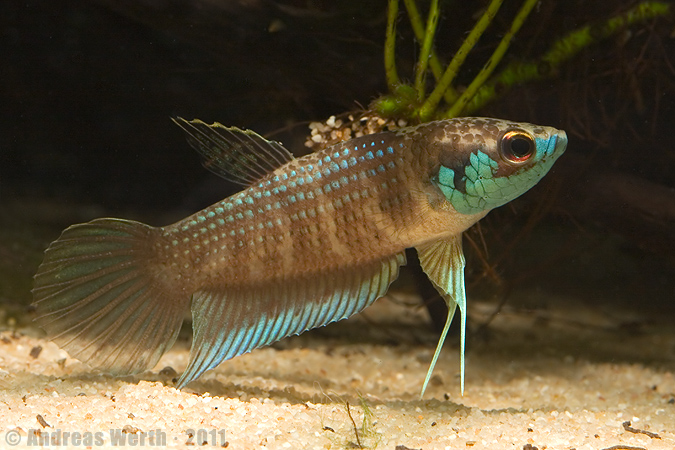
Betta kuehnei
Schindler & Schmidt, 2008
Max length60mm SL2.4in SLTank60 × 30cm24 × 12inTemp21–25°C70–77°FpH6.0–7.5It can be told apart from other members of the B. pugnax group by the following characters: caudal fin rounded in both males and females; chin bar and second postorbital stripe absent; adult males possess intensive blue or bluish-green iridescent (blackish in preservation) colouration on the sides of the head and throat extending from the snout tip to posterior edge of opercle; possession of two central body stripes, the upper extending from the pec...
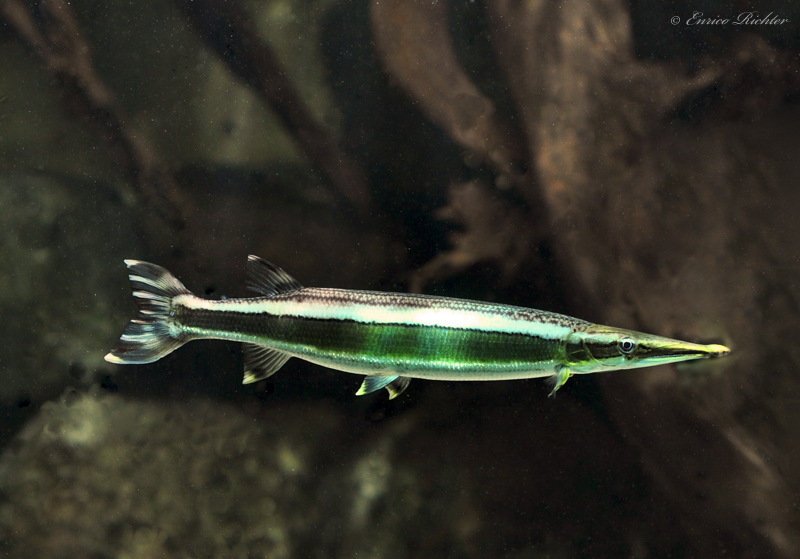
Boulengerella lateristrigaStriped Pike 'Characin'
Boulenger, 1895
Max length258mm SL10in SLTank240 × 90cm96 × 36inTemp22–28°C72–82°FpH4.0–7.0Boulengerella differs from Ctenolucia, the only other genus currently contained in the family Ctenolucidae, by a series of derived features including possession of 87-124 (vs. 45-50) lateral line scales, presence of a strongly (vs. weakly) developed fleshy appendage at the tip of the snout and absence (vs. presence) of fleshy flaps on the lower jaw. Within the order Characiformes the family Ctenoluciidae is also distinguished by a set o...
Champsochromis spilorhynchus
authority not recorded
Max length350mm SL14in SLTank180 × 60cm72 × 24inTemp24–27°C75–81°FpH7.5–8.5This species is only occasionally offered for sale, as it is difficult to collect, living a predominantly solitary lifestyle. As a result, it is much sought after by enthusiasts. It may be confused with the other species in the genus, C. caerulus, but can be distinguished by its deeper body shape and very distinctive black markings on its snout. Champsochromis have widely spaced teeth compared to some other pelagic predatory cichlids found in Lake Malawi, such as Buccochromis species....
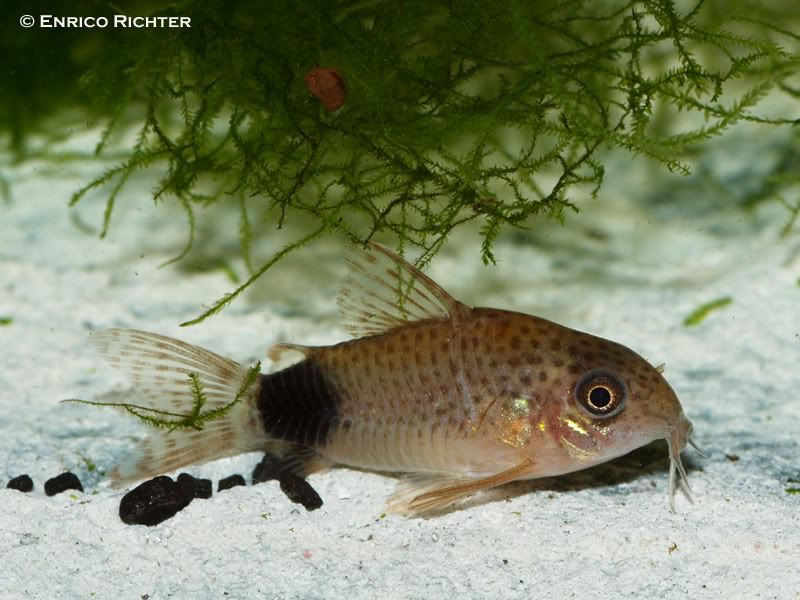
Corydoras caudimaculatusTailspot Cory
Rössel, 1961
Max length50mm SL2.0in SLTanknot recordedTemp20–26°C68–79°FpH6.0–7.0C. caudimaculatus may be confused with the congener C. similis but can be told apart by possession of a well-defined, blackish spot on the caudal peduncle vs. a 'smudged' bluish marking. C. guapore also has a comparable colour pattern but possesses a distinctly rounded snout and tends to swim above the substrate.
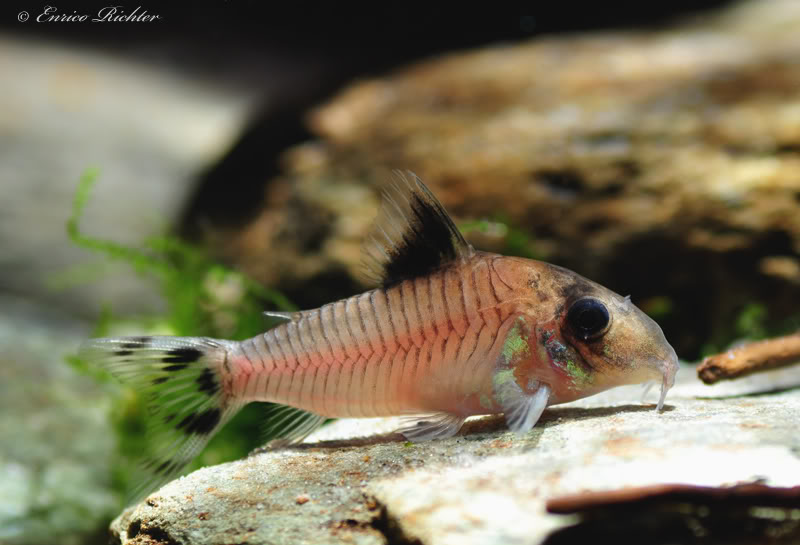
Corydoras condiscipulus
Nijssen & Isbrücker, 1980
Max length65mm SL2.6in SLTank90 × 30cm36 × 12inTemp20–26°C68–79°FpH6.0–7.5This species occurs alongside the similar-looking congener C. oiapoquensis in nature, from which it can be told apart by the following combination of characters: larger adult size; narrower body (body breadth fits 4.0-4.4 times in standard length vs. 3.4-3.8 times in C. oiapoquensis); shorter pectoral spine (3.4-3.8 times in SL vs. 2.7-3.2 times); longer snout (1.7-1.9 times in SL vs. 2.0-2.2).
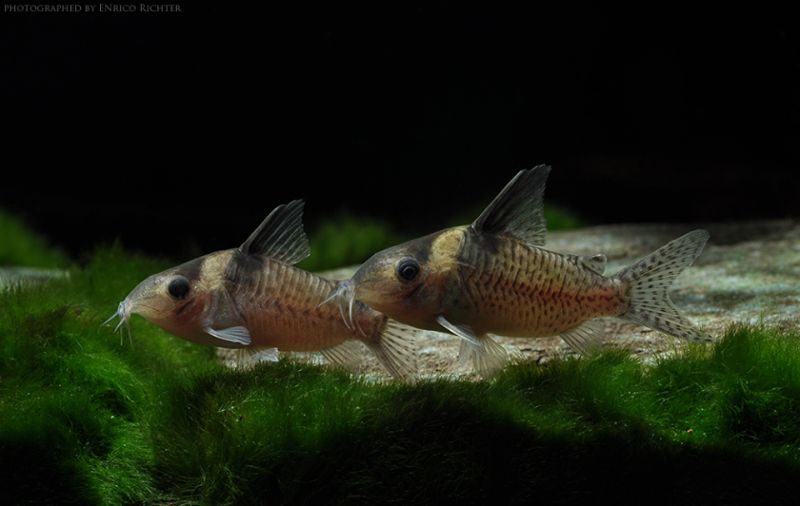
Corydoras delphax
Nijssen & Isbrücker, 1983
Max length60mm SL2.4in SLTank90 × 30cm36 × 12inTemp22–27°C72–81°FpH5.5–7.5Unfortunately, precise diagnostic characters cannot currently be provided since we’ve been unable to obtain the type description, and little has been Characters said to separate it from species such as C. ambiacus, C. agassizii, C. brevirostris, C. ephippifer, and C. melanistius include a combination of relatively elongated snout, dark spots on body fading in adults, dark anterior dorsal-fin patch extending to upper extremity of fin, and presence of spots in the caudal-fin.
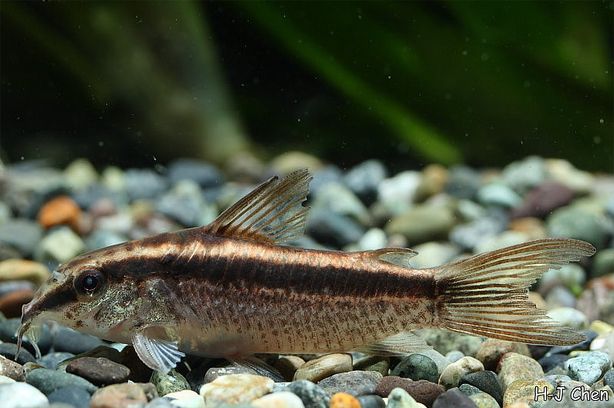
Corydoras gracilis
Nijssen & Isbrücker, 1976
Max length40mm SL1.6in SLTank60 × 30cm24 × 12inTemp20–26°C68–79°FpH5.0–7.5It can be distinguished from the majority of other Corydoras species by its distinctive colour pattern, comprising a uniform, lightish base pigmentation with a dark arched stripe extending over the upper portion of each flank, from the tip of the snout to the caudal-fin base. This is shared with a few congeners, however, including C. arcuatus, C. narcissus, and C. urucu.
Corydoras oiapoquensisFlag-tailed Panda Cory
authority not recorded
Max length55mm SL2.2in SLTank45 × 38cm18 × 15inTemp23–28°C73–82°FpH6.0–7.2This species occurs alongside a near-identical congener, C. condiscipulus in nature. In fact condiscipulus literally means 'schoolmate', as the species are often found shoaling together. The only external difference between the 2 seems to be the longer snout and wider distribution within the Rio Oyapock of condiscipulus....
Corydoras seussi
authority not recorded
Max length70mm SL2.8in SLTank60 × 38cm24 × 15inTemp22–26°C72–79°FpH6.0–7.2Very similar in appearance to C. gossei, seussi can be distinguished by its less rounded snout. It may also be referred to by its C-number, C027.