Amblyrhynchichthys micracanthus
On this page7 sections
Quick facts
Difficulty3 of 6 measures
More bars, more demanding.
- Space
- large tank
- Water
- unknown
- Temp
- unknown
- Temperament
- unknown
- Social
- shoal
- Compatibility
- community tank
Native to the Mekong River drainage in Laos (where Vientiane province represents the upper limit of its range), Thailand, Cambodia, and Vietnam, and the Tapi, Chao Phraya, and Mae Klong systems in Thailand. Type locality is '22 kilometers upstream from Phnom Penh, Tonle Sap River, Kandal Province, Cambodia'.
Etymology
Amblyrhynchichthys: from the Greek amblús (Gr. ἀμβλύς), meaning 'blunted', rhýnchos (Gr. ῥύγχος), meaning 'snout', and ichthýs (Gr. ἰχθύς), meaning 'fish', in allusion to the comparatively blunt snout in members of this genus.
micracanthus: from the Greek mikrós (Gr. μικρός), meaning 'small' and ákantha (Gr. ἄκανθα), meaning 'thorn', in reference to this species' relatively short dorsal spine when compared to the congener A. truncatus.
Distribution
Native to the Mekong River catchment in Laos (where Vientiane province represents the upper limit of its range), Thailand, Cambodia, and Vietnam, and the Tapi, Chao Phraya, and Mae Klong river systems in Thailand.
Type locality is '22 kilometers upstream from Phnom Penh, Tonle Sap River, Kandal Province, Cambodia'.
Habitat
Diet
Wild fish feed on periphyton, phytoplankton, zooplankton, and benthic algae.
These boxes carry affiliate links and we may earn a commission. What they recommend comes from each profile’s own figures, never chosen by hand or paid for.
Notes
Prior to this species' description, the genus comprised only a single species meaning older records of A. truncatus in mainland Indochina all refer to A. micracanthus.
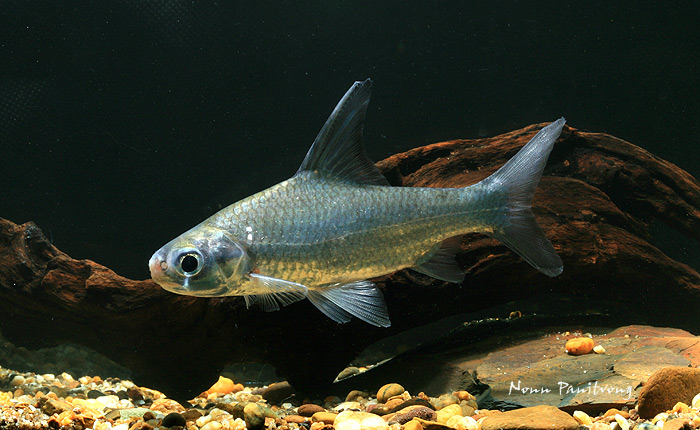
A. micracanthus can be told apart from A. truncatus by the following combination of characters: snout more truncate with a straight (vs. gently rounded in A. truncatus) lateral profile; dorsal-fin spine shorter, measuring 15.5-25.7% SL (vs. 26.7-29.9%); a smaller eye when individuals of a similar size and larger than ca. 70 mm2.8 in SL are compared, with a diameter measuring 28.7-34.9% HL (vs. 32.7-36.3%); 34-37 (vs. 39-40) gill rakers.
The genus Amblyrhynchichthys is distinguished from all other cyprinids by the following character combination: snout extremely blunt; nostrils located anteriorly; last simple dorsal-fin ray stout with serrations on the posterior edge; presence of a well-developed, hyaline eyelid.
References
- Ng, H. H. and M. Kottelat (2004). Amblyrhynchichthys micracanthus, a new species of cyprinid fish from Indochina (Cypriniformes: Cyprinidae). Revue Suisse de Zoologie 111(2), 425-432
- Kottelat, M. (2013). The fishes of the inland waters of southeast Asia: a catalogue and core bibiography of the fishes known to occur in freshwaters, mangroves and estuaries. The Raffles Bulletin of Zoology Supplement 27, 1-663
- Kottelat, M. (2001). Fishes of Laos. WHT Publications, Colombo, 1-198
- Roberts, T. R. (1989). The freshwater fishes of western Borneo (Kalimantan Barat, Indonesia). Memoirs of the California Academy of Sciences 14, 1-210
- Rainboth, W. J. (1996). FAO species identification field guide for fishery purposes. Fishes of the Cambodian Mekong. Rome, FAO, 1-265
Species images · 1
Used with the photographer’s permission. Not licensed for reuse.
One photograph on file. More would be welcome.
Distribution
Profile completeness13 of 24
54% complete
Missing: water parameters, hardness, aquarium size, a common name, temperament, aquarium notes, maintenance, water condition notes, behaviour and compatibility, sexual dimorphism, reproduction.