Anostomus ternetzi
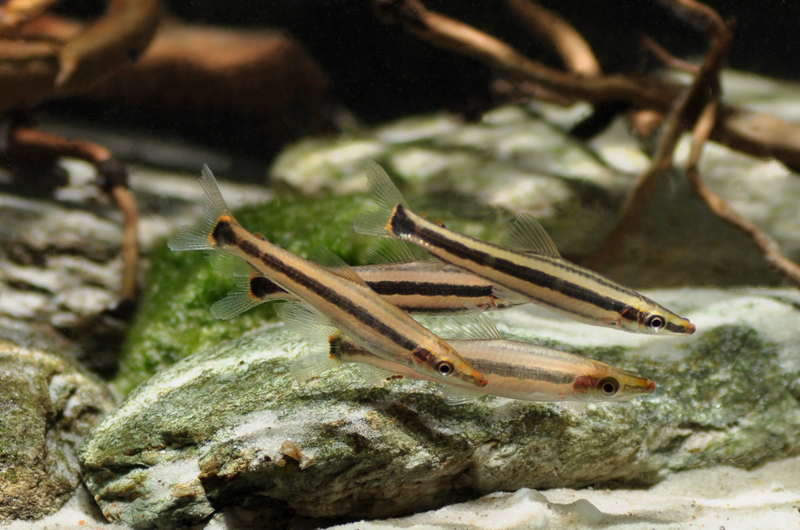
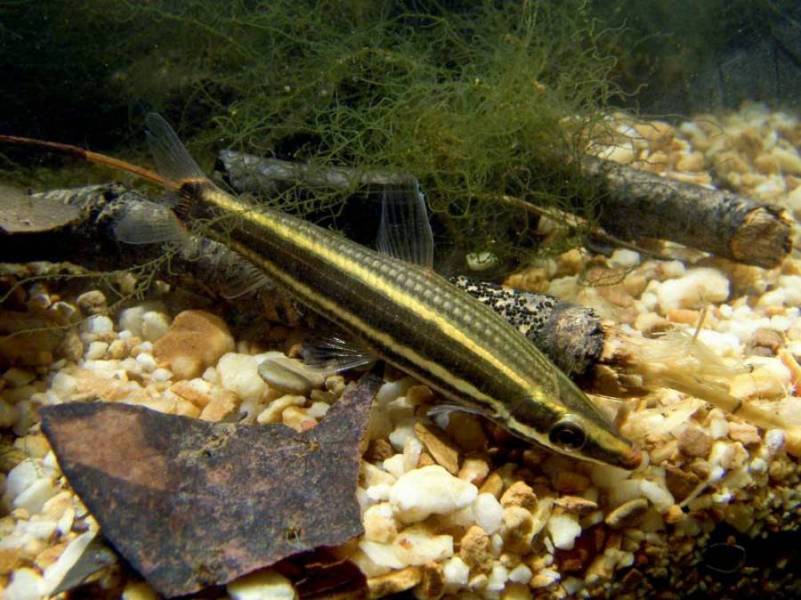
Gold-Striped Headstander · Ternetz's Anostomus · Goldstreifenkopfsteher
On this page13 sections
Quick facts
Difficulty6 of 6 measures
More bars, more demanding.
- Space
- large tank
- Water
- tap water
- Temp
- unfussy
- Temperament
- territorial
- Social
- kept alone
- Compatibility
- not a community fish
This species is widely-distributed in the Río Orinoco system in Brazil, Colombia and Venezuela plus coastal drainages in Guyana, Suriname and French Guiana including the Essequibo and Mazaruni. Type locality is 'Palital, Estado Guárico, Venezuela' which appears to correspond to a wetland called Esteros de Palital in the Aguaro-Guariquito National Park of Guárico state, northern Venezuela.
Etymology
Anostomus: from the Greek ano- (Gr. ἀνά-), meaning 'up, upward', and stóma (Gr. στόμα), meaning 'mouth', in reference to the upturned mouthparts possessed by members of this genus.
ternetzi: named for Swiss-born ichthyologist and naturalist Carl Ternetz (1870-1928), who collected the holotype.
Distribution
This species is widely-distributed in the Río Orinoco system in Brazil, Colombia and Venezuela, plus coastal river drainages in Guyana, Suriname and French Guiana including the Essequibo and Mazaruni.
Type locality is 'Palital, Estado Guárico, Venezuela', which appears to correspond to a wetland named Esteros de Palital in the Aguaro-Guariquito National Park of Guárico state, northern Venezuela.
Its distribution in Brazil is somewhat unclear, but there exist a series of patchy records from the Araguaia and Xingu river basins.
Habitat
Typically found in rocky areas at the edge of fast-flowing stretches of rivers and streams where it grazes on algae and small invertebrates.
Aquarium size
A tank with base dimensions of 120 ∗ 30 cm48 ∗ 12 in or equivalent should be the smallest considered.
Maintenance
A biotope-style set-up could consist of a sandy substrate, piles of smooth rocks and driftwood roots and branches, some of which should penetrate the water surface.
Aquatic vegetation can be included if you wish but is likely to be eaten.
Provide well-oxygenated water with a decent amount of movement and use bright lighting to encourage the growth of algae which will be grazed on by the fish.
A well-fitting cover is essential as Anostomus spp. are excellent jumpers.
Water conditions
These boxes carry affiliate links and we may earn a commission. What they recommend comes from each profile’s own figures, never chosen by hand or paid for.
Diet
Omnivorous but primarily a herbivore.
Offer small live and frozen foods as well as plenty of vegetable matter in the form of blanched spinach, lettuce, cucumber, courgette, algae wafers, etc.
Behaviour and compatibility
Although it occurs in large shoals in nature, it tends to be very quarrelsome with conspecifics if only a few individuals are kept.
It can be maintained in groups of 6 or more in larger tanks, but otherwise keep just a single specimen in a community of peaceful medium to large fishes.
Possibilities include larger characids, loricariids, doradids and peaceful cichlids, with reophilic species particularly suitable.
Sexual dimorphism
Unknown.
Reproduction
Unrecorded.
Notes
Anostomus currently contains five valid species though only A. anostomus and A. ternetzi are well-known in the aquarium hobby.
A phylogentic study by Sidlauskas and Vari (2008)[2] demonstrated the genus as recognised at the time to represent a polyphyletic lineage.
Three species, A. intermedius, A. plicatus and A. spiloclistron, were found to be more closely-related to the genera Gnathodolus, Sartor and Synaptolaemus than to other congeners and therefore placed into the new genus Petulanos, with P. plicatus as type species.
The family Anostomidae is distributed throughout much of tropical and subtropical South America from northwestern Colombia to central Argentina.
The majority of species are moderately-elongate and somewhat rounded in shape although there are some exceptions, e.g., the relatively deep-bodied Abramites.
Greater diversity is apparent in the range of oral morphology, however, and members exhibit a wide range of adaptations in dentition and jaw structure.
A number of anostomids tend to swim at an oblique 'head-down' angle which has given rise to them being referred to by the generalised vernacular term 'headstanders'.
References
- Reis, R. E., S. O. Kullander and C. J. Ferraris, Jr. (eds) (2003). Check list of the freshwater fishes of South and Central America. CLOFFSCA. EDIPUCRS, Porto Alegre, i-xi + 1-729
- Sidlauskas, B. L. and R. P. Vari (2008). Phylogenetic relationships within the South American fish family Anostomidae (Teleostei, Ostariophysi, Characiformes). Zoological Journal of the Linnean Society 154, 70–210
Species images · 2
Used with the photographer’s permission. Not licensed for reuse.