Apistogramma barlowi
A174 · Barlow's Dwarf Cichlid · Maulbrüter Zwergbuntbarsch
On this page13 sections
Quick facts
Difficulty5 of 6 measures
More bars, more demanding.
- Space
- modest tank
- Water
- soft or acidic
- Temp
- unfussy
- Temperament
- unknown
- Social
- in a pair
- Compatibility
- not a community fish
This species has been assigned the code A174 under the DATZ system, and is also known by the trade names A. sp. 'Maulbrüter/mouthbrooder', A. sp. 'Glaser' (these referring to the 'red' colour form) and A. sp. 'Hauswell' (referring to the 'white' colour form). It can be told apart from other members of the genus most eas...
Etymology
Apistogramma: etymology not explained. Presumably from the Greek ápistos (Gr. άπιστος), meaning ‘unbelieving, doubtful’, and grámma (Gr. γράμμα), meaning ‘that which is drawn or written’, in reference to the variably-developed, often rudimentary, lateral lines in member species.
barlowi: named for George W. Barlow (1929-2007), “one of the most productive and notably leading behavioral ichthyologists of the last decades”; his “comments, always constructive and mostly humorous, have influenced the work of numerous ichthyologists, including the authors of this paper”.
Distribution
Current knowledge indicates that this species may be endemic to the Ampiyacu River system, an affluent of the Amazon mainstream in northeastern Peru. The type localitymis given as 'Peru, Departamento Loreto, Province Mariscal Ramon Castilla, District Pebas, in the vicinity of El Pozo, small forest creek tributing to the río Ampiyacu-system (about 71°55'W/03°10'S)'.
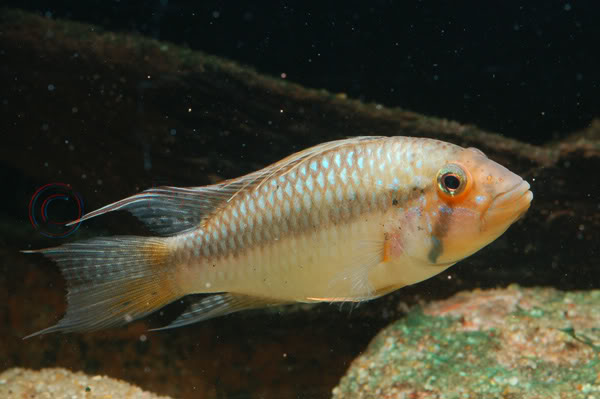
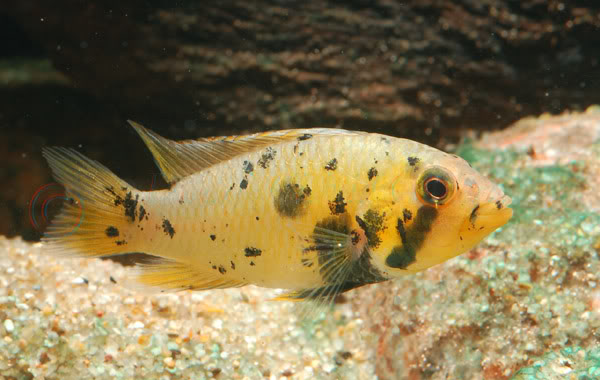
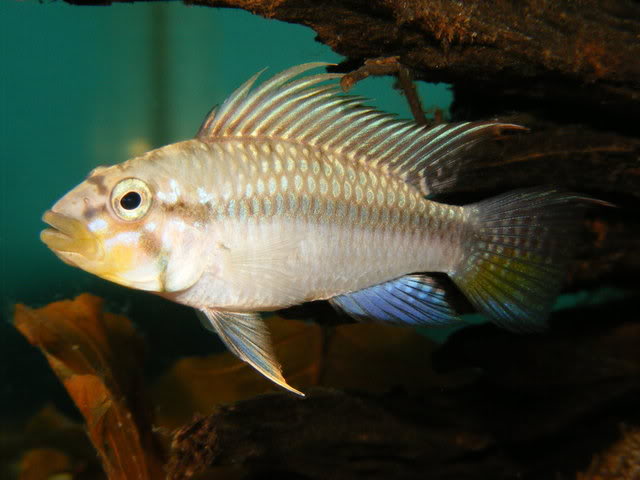
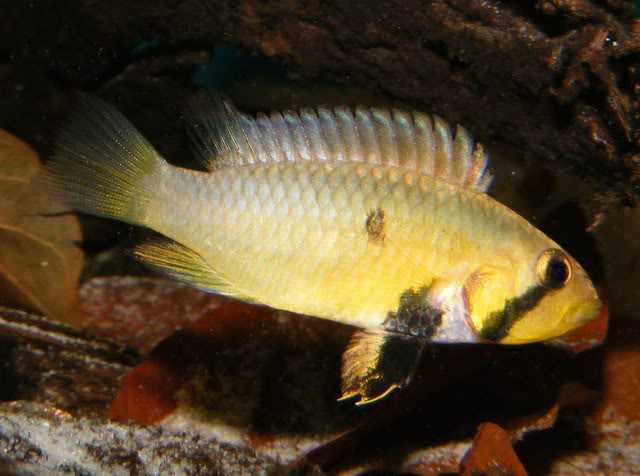
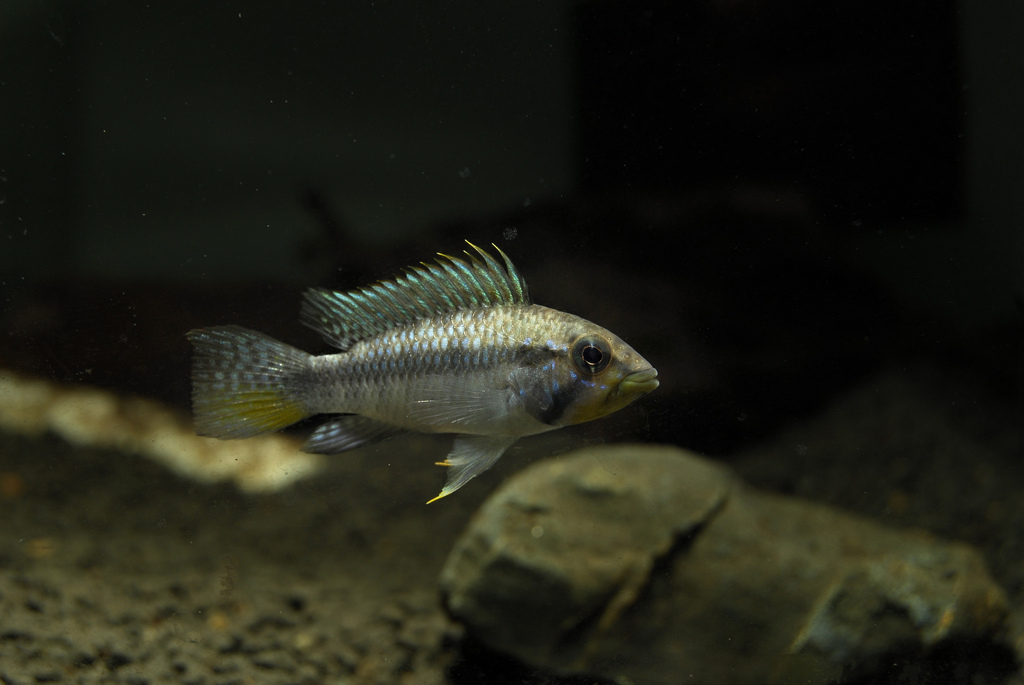
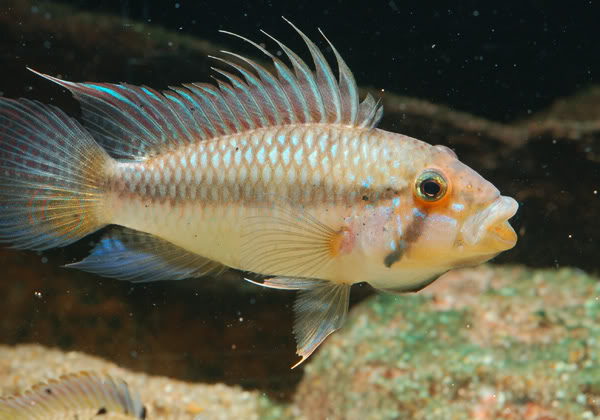
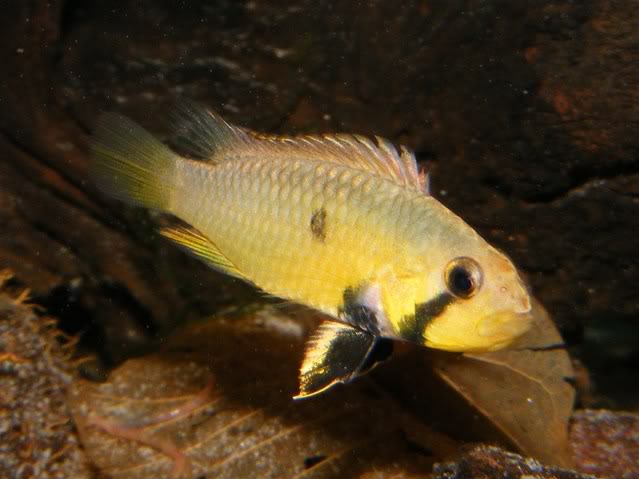
Two non-sympatric populations have been identified. One possesses red markings on the head and an overall darker colour pattern (red form), while the other lacks red markings and is generally paler (white form).
Habitat
Aparently displays a preference for cool, flowing forest streams (igarapés) containing transparent, weakly acidic to neutral water.
One such habitat reported in the description comprised a small stream around 1 metre wide and 30 cm12 in deep with a substrate composed entirely of fine white sand.
There was no aquatic vegetation or larger rocks and the water had a pH of 4.8, electrical conductivity 26 μS/cm and temperature 29 °C84 °F.
Sympatric fish species included the congener A. agassizii.
Aquarium size
Base dimensions of 60 ∗ 30 cm24 ∗ 12 in or more are just about acceptable for a single pair, though this species seems to fare better in larger aquaria.
Maintenance
Provided adequate cover and structure is available this species is unfussy with regards to décor with ceramic flowerpots, lengths of plastic piping and other artificial materials all useful additions.
A more natural-looking arrangement might consist of a soft, sandy substrate with wood roots and branches placed such a way that plenty of shady spots and caves are formed.
The addition of dried leaf litter provides additional cover and spawning sites, and brings with it the growth of beneficial microbe colonies as decomposition occurs.
These can provide a valuable secondary food source for fry, while the tannins and other chemicals released by the decaying leaves aid in simulation of natural conditions. Alder cones may also be used for the latter purpose.
Fairly dim lighting is recommended and aquatic plant species that can survive under such conditions such as Microsorum, Taxiphyllum or Cryptocoryne spp. may be added, while floating vegetation, especially Ceratopteris spp., is also useful.
Filtration need not be too strong, with an air-powered sponge filter or similar adequate.
It goes without saying that these are fishes are sensitive to fluctuating organic wastes and should never be introduced to biologically-immature aquaria.
This species also requires require acidic conditions with negligible carbonate hardness and very low general hardness so a reverse osmosis unit or other method of obtaining soft water may need to be employed, and this can be further acidified using phosphoric acid or similar if necessary.
Water conditions
These boxes carry affiliate links and we may earn a commission. What they recommend comes from each profile’s own figures, never chosen by hand or paid for.
Diet
Apistogramma spp. are chiefly carnivorous and feed mostly on benthic invertebrates in nature.
In the aquarium live and frozen foods such as Artemia, Daphnia, Moina and chironomid larvae (bloodworm) should be offered regularly although most species will also learn to accept dried alternatives with pelleted products generally preferred to flake.
Behaviour and compatibility
Best maintained alone or with small 'dither' fishes such as Nannostomus spp., and ideally should not be mixed with other Apistogramma.
Relative to some other members of the genus it's apparently quite mildly-disposed towards conspecifics.
Sexual dimorphism
Compared with females males grow larger, have an enlarged head and mouth parts, are more colourful and develop increasingly pronounced, lappet-like extensions to the dorsal-fin rays as they mature.
In males the caudal-fin is lyrate with a yellow lower lobe and hyaline blue upper lobe containing vertical rows of pale spots, while in females it is truncate and does not normally contain any markings beyond a proximal yellow flush.
Reproduction
One of only two Apistogramma spp. known to be facultative, biparental, larviphorous mouthbrooders with A. sp. 'Kelleri' the other.
This behaviour is not only remarkable for its rarity but also its plasticity.
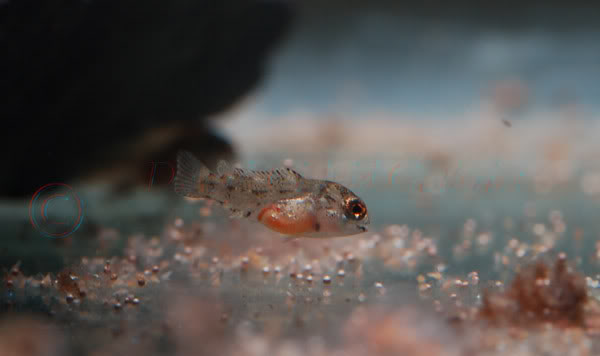
Either a single or both parents may be involved in the mouthbrooding process, or the eggs and fry may instead be maintained in a shallow pit excavated from the substrate throughout broodcare.
Selection of a precise strategy may well be influenced by environmental conditions with laboratory observations of A. barlowi recording a greater percentage of females than males mouthbrooding over substrates of fine sand, while under strong water flow it was exclusively males that did so.
Norwegian aquarist Tom Christoffersen maintained one pair of A. 'sp. Kelleri' without tankmates and another alongside a group of Nannostomus marginatus and pair of Copella vilmae with other conditions basically identical.
In the former pair the female was solely responsible for mouthbrooding, while in the latter no such behaviour was observed and the eggs were deposited into a shallow depression in the substrate where they remained until free-swimming.
Additional observations suggest that substrate size also plays a part with the adults often picking up the eggs immediately over fine sand whereas when gravel is used they tend do so after several days or not at all.
Courtship behaviour is also interesting with males constructing small sand piles as part of the ritual, possibly demonstrating the size of the mouth to rivals plus their fry-carrying capability to females.
Notes
This species has been assigned the code A174 under the DATZ system, and is also known by the trade names A. sp. 'Maulbrüter/mouthbrooder', A. sp. 'Glaser' (these referring to the 'red' colour form) and A. sp. 'Hauswell' (referring to the 'white' colour form).
It can be told apart from other members of the genus most easily by possession of 3 infraorbital pores plus the disproportionately-sized head and mouthparts with enormous jaws and hypertrophied lips in adult males.
Apistogramma is among the most speciose of South American cichlid genera with around 70 species valid at present but many more awaiting description.
In addition many species exist in two or more geographical colour forms which may or may not turn out to be distinct in the future.
Hobbyists tend to label these with collection data if available in order to avoid mixing them and the potential of hybridisation.
Member species have also been organised into a series of species lineages, complexes and groups by authors in order to better separate them.
Such lists have been augmented by fish that have appeared in the aquarium trade and are in a state of near-constant flux.
The A. barlowi complex is contained within the A. atahualpa group within the larger A. trifasciata lineage, for example.
Apistogramma and a number of related genera are often included in the putative subfamily Geophaginae.
Kullander (1998) conducted a morphology-based phylogenetic study in which the neotropical Cichlidae was divided into six subfamilies of which the Geophaginae contained 16 genera divided among three 'tribes':
Acarichthyini - Acarichthys and Guianacara.
Crenicaratini - Biotoecus, Crenicara, Dicrossus and Mazarunia.
Geophagini - Geophagus, Mikrogeophagus, 'Geophagus' brasiliensis group, 'Geophagus' steindachneri group, Gymnogeophagus, Satanoperca, Biotodoma, Apistogramma, Apistogrammoides and Taeniacara.
Later molecular studies by Farias et al. (1999, 2000, 2001) resulted in the additions of Crenicichla and Teleocichla to the Geophaginae, a result supported by López-Fernández et al. (2005) who conducted the most detailed molecular analysis of the grouping to date including 16 of the 18 genera and 30 species.
However their conclusions regarding interrelationships between genera did vary somewhat from previous hypotheses and can be summarised by the following loosely-defined groups:
- a weakly-supported sister group relationship between Acarichthys and Guianacara.
- a well-supported "Satanoperca clade" comprising Satanoperca, Apistogramma, Apistogrammoides and Taeniacara.
- a "big clade" with Geophagus, Mikrogeophagus, 'Geophagus' brasiliensis group, 'Geophagus' steindachneri group, Gymnogeophagus, Biotodoma, Crenicara and Dicrossus.
- a "crenicarine clade" with Biotoecus and Crenicichla.
No representatives of Teleocichla or Mazarunia were included in the study but the former is well-established as sister to Crenicichla while the latter has grouped closely with Dicrossus and Crenicara in earlier works.
The other main conclusions of the paper are confirmation that Geophaginae is a monophyletic group exhibiting strong signs of having undergone rapid adaptive radiation.
References
- Römer, U. and I. Hahn (2008). Apistogramma barlowi sp. n.: description of a new facultative mouth-breeding cichlid species (Teleostei: Perciformes: Geophaginae) from northern Peru. Vertebrate Zoology 58(1), 49-66
- Farias, I. P., G. Ortí, I. Sampaio, H. Schneider and A. Meyer (1999). Mitochondrial DNA phylogeny of the family Cichlidae: monophyly and fast molecular evolution of the Neotropical assemblage. Journal of Molecular Evolution 48(6), 703-711
- Farias, I. P., G. Ortí, I. Sampaio, H. Schneider and A. Meyer (2001). The cytochrome b gene as a phylogenetic marker: the limits of resolution for analyzing relationships among cichlid fishes. Journal of Molecular Evolution 53(2), 89-103
- López-Fernández, H., R. L. Honeycutt, M. L. J. Stiassny and K. O. Winemiller (2005). Morphology, molecules, and character congruence in the phylogeny of South American geophagine cichlids (Perciformes, Labroidei). Zoologica Scripta 34(6), 627-651
- Römer, U. (2006). Cichlid Atlas: v. 2 Mergus Verlag GmbH, 1-1320
- Wise, M. (2011). Apistogramma Species List By Species-Groups/Complexes. World Wide Web electronic publication, http://apisto.sites.no, Accessed on 13.02.17
Species images · 8
Used with the photographer’s permission. Not licensed for reuse.
Profile completeness21 of 24
88% complete
Missing: a recorded distribution, temperament, water condition notes.