Brachyplatystoma platynemum
Slobbering Catfish
On this page12 sections
Quick facts
Difficulty5 of 6 measures
More bars, more demanding.
- Space
- very large tank
- Water
- tap water
- Temp
- unfussy
- Temperament
- unknown
- Social
- kept alone
- Compatibility
- not a community fish
Found in a number of habitat-types, though rarely in smaller tributaries, generally preferring deeper, flowing channels through which it travels for considerable distances at certain times of year. Like other large, migratory pimelodids these movements are typically associated with nutrient-rich, white water drainages rather than nutrient-poor black waters.
Distribution
Habitat
Found in a number of habitat-types, though rarely in smaller tributaries, generally preferring deeper, flowing channels through which it travels for considerable distances at certain times of year. Like other large, migratory pimelodids these movements are typically associated with nutrient-rich, white water drainages rather than nutrient-poor black waters. When the Amazon begins to rise at the start of the wet season, freshwater is pushed into its delta and the normally brackish waters recede, allowing juveniles and sexually-immature adults of several migratory catfish species, including B. platynemum, to enter the area and feed on polychaetes, bivalves, crustaceans, and other fishes. This rich feeding ground is exploited until the sea water returns, at which point the catfishes begin to migrate upstream in massive numbers, moving up the Amazon and its tributaries. Sexually mature individuals are not normally recorded during these events so they're thought related to feeding and dispersal rather than spawning. The fish are subject to intensive capture by commercial and artisanal fishing operations during this upstream movement. Spawning occurs in often-distant headwaters and the fry are washed downstream to the delta, a process estimated to take 13-20 days in the congener B. rousseauxii. Juveniles then remain in the estuary region for around three years, entering the delta to feed when conditions permit. They then move into the lower and middle Amazon where they may remain for a further year as they continue to feed and grow. Following this period of growth schools of adults begin to form and make their way into headwaters in order to spawn. There is no single spawning ground for a given species, rather there appear to exist distinct populations in different watersheds, and there exists evidence to suggest that individuals may return to the particular tributary in which they were born to spawn. Study of B. rousseauxii has revealed that sexually mature adults are found only in the western Amazon, with no mature individual ever recorded east of Manaus despite the intensive commercial fishery operating there. The total distance covered by some populations during migration from the delta was as much as 5500 km, making it the longest known in any freshwater fish species. Sexually-mature adults of B. platynemum have been observed in the upper rio Madeira basin, some 3000 km from the estuary.
Aquarium size
Suitable only for public aquaria plus a very small minority of private aquarists and as such we offer no recommended aquarium size.
Maintenance
The choice of décor is as much down to personal preference as anything else though a carefully-aquascaped, planted set-up is obviously out of the question. A sandy substrate with some large chunks of driftwood, or a completely bare arrangement are perhaps the most-favoured options in privately-owned aquaria, but provided water quality is maintained and lighting not too bright this species is relatively unfussy. An enormous, reliable filter system and rigorous maintenance regime should be considered mandatory.
Water conditions
Diet
Almost entirely piscivorous preying on loricariids and other bottom-dwelling fishes in nature but most specimens readily adapt to dead alternatives such as prawn/shrimp, mussel, squid, whitebait, strips of larger white fish, etc., in aquaria. Adults require just a single meal per week at most.
Behaviour and compatibility
Only keep with species large enough to avoid predation.
Sexual dimorphism
Unknown.
Reproduction
Unrecorded in captivity.
Notes
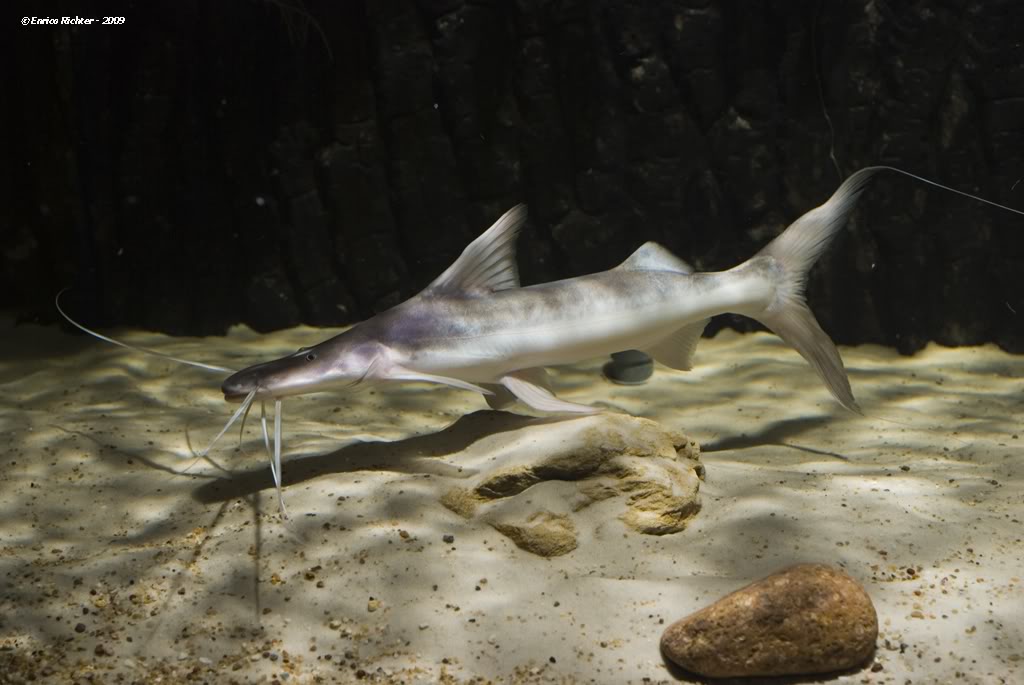
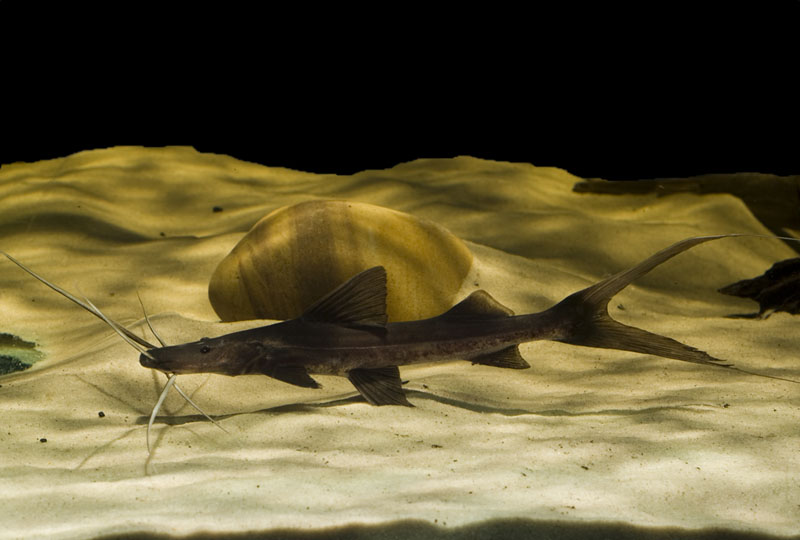
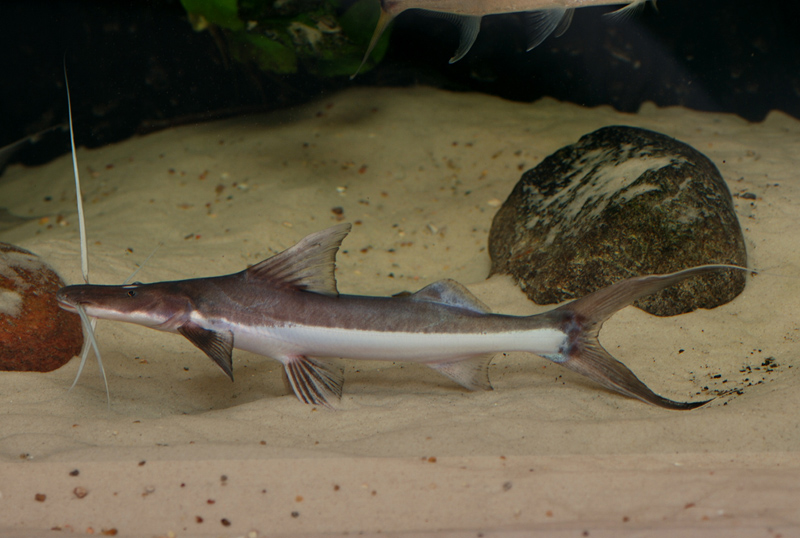
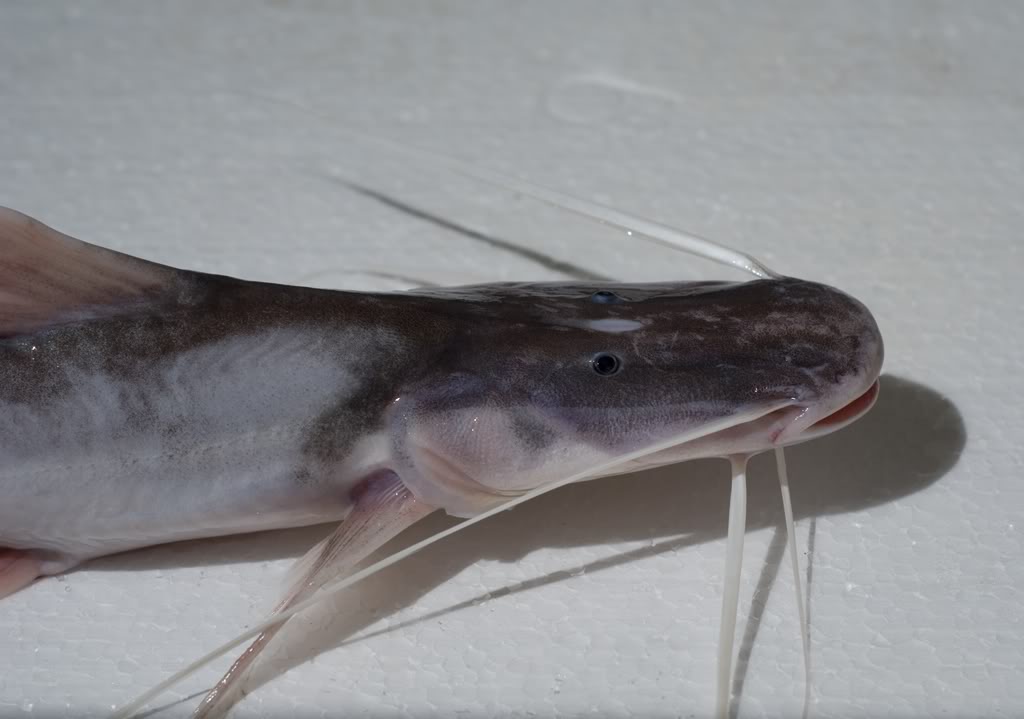
This species was referred to the genus Goslinia for a number of years, but is currently included in Brachyplatystoma based on a pair of synapomorphies shared by members (see below). The peculiar vernacular name is derived from the relatively thick barbels which give the impression that the fish is drooling. It can be distinguished from congeners by the following external characters: colour pattern in both adults and juveniles strongly but gradually countershaded along flanks, dorsum medium to light grey or brown, no spots or stripes; caudal-fin in adults deeply-forked with narrow lobes which are equal in length, filaments retained in adults; eye diameter fits more than 10 times in length of snout; maxillary barbels very broad, flat, and reaching dorsal-fin origin in adults; caudal peduncle compressed with greater depth than width; origin of adipose-fin anterior to origin of anal-fin; base length of adipose-fin approximately 1.3 times that of anal-fin; adipose-fin height approximately three times its length; opercle triangular; 17-19 anal-fin rays. Brachyplatystoma spp. are distinguished from all other catfishes by two synapomorphies. The first comprises several morphological characters relating to the skull, specifically that the mandibular suspensorium (that which connects the lower jaw bone to the skull) is greatly expanded mediodorsally to form a large plate approaching the parasphenoid bone, with the hyomandibula and metapterygoid similarly enlarged. The second is the presence of an elongate filament formed from a single, unbranched simple ray on both caudal fin lobes in juveniles and subadults. These become shorter or are lost in adult specimens of B. vaillantii, B. filamentosum, B. rousseauxii, and B. capapretum but retained in B. juruense, B. platynemum and B. tigrinum.
References
- Ferraris, C. J., Jr. (2007). Checklist of catfishes, recent and fossil (Osteichthyes: Siluriformes), and catalogue of siluriform primary types. Zootaxa 1418, 1-628
- Lundberg, J. G. and A. Akama (2005). Brachyplatystoma capapretum: a new species of goliath catfish from the Amazon basin, with a reclassification of allied catfishes. Copeia 2005(3), 492-516
- M. Petrere Jr., R. B. Barthem, E. A. Córdoba and B. Corrales Gómez (2004). Review of the large catfish fisheries in the upper Amazon and the stock depletion of piraíba (Brachyplatystoma filamentosum Lichtenstein). Reviews in Fish Biology and Fisheries 14, 403-414
- Barthem, R. B., M. C. L. de Brito Ribeiro, and M. Petrere Jr. (1991). Life Strategies of some Long-Distance Migratory Catfish in Relation to Hydroelectric Dams in the Amazon Basin. Biological Conservation 55, 339-345
- Batista, J. S. and J. A. Alves-Gomes (2006). Phylogeography of Brachyplatystoma rousseauxii (Siluriformes - Pimelodidae) in the Amazon Basin offers preliminary evidence for the first case of “homing” for an Amazonian migratory catfish. Genetics and Molecular Research 5(4), 723-740
Species images · 4
Used with the photographer’s permission. Not licensed for reuse.