Channa sp. 'fire and ice'
On this page11 sections
Quick facts
Difficulty6 of 6 measures
More bars, more demanding.
- Space
- large tank
- Water
- tap water
- Temp
- unfussy
- Temperament
- species tank
- Social
- in a pair
- Compatibility
- not a community fish
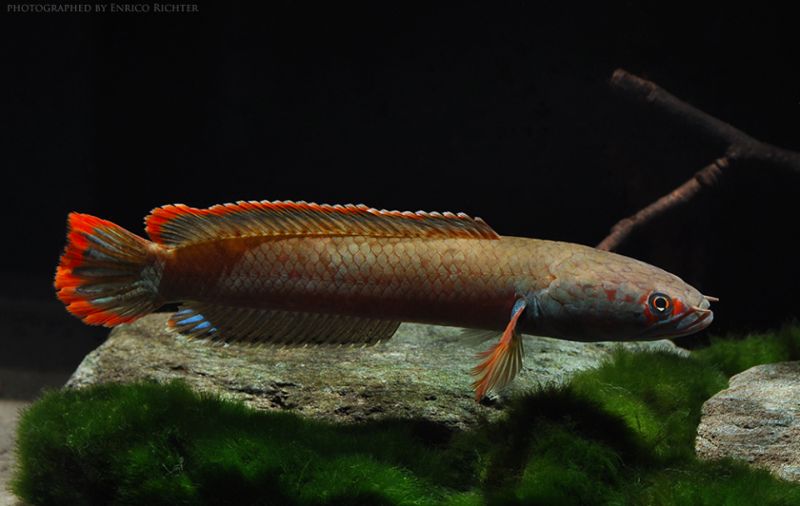
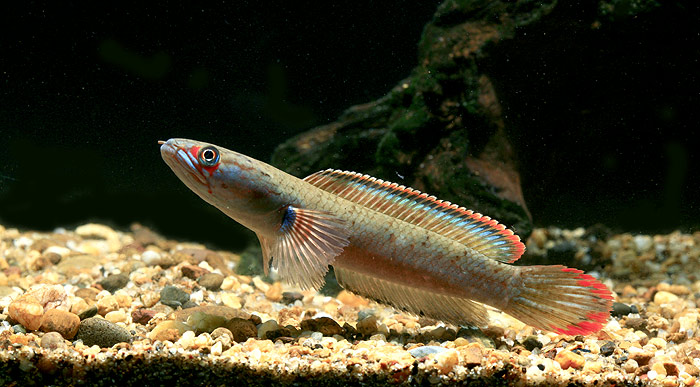
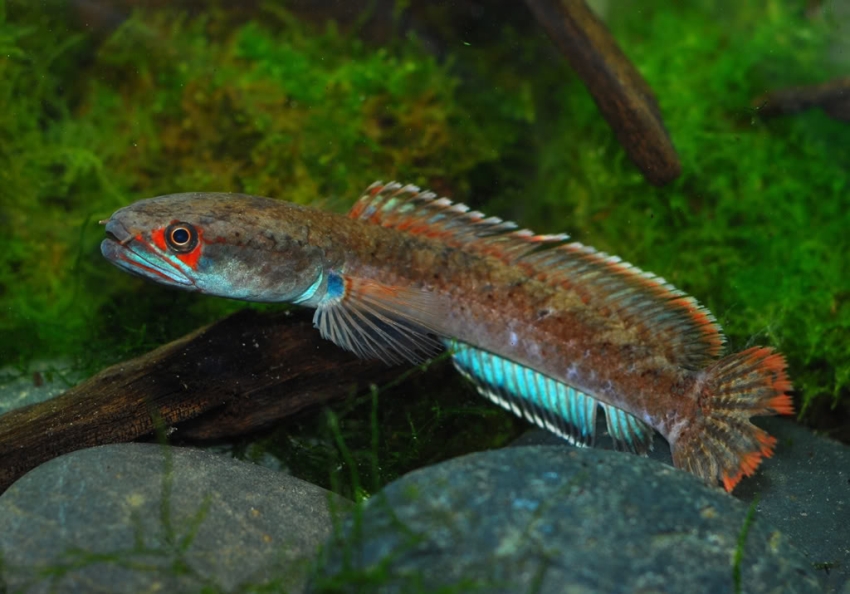
This unidentified species first appeared in the aquarium trade during 2009. It's easily told apart from similar-looking congeners by the patches of vivid red pigmentation surrounding the eye and sides of the mouth plus the thick, reddish, marginal band in the caudal-fin.
Etymology
Channa: from the Latin channe, used to refer to an unspecified species of sea perch.
Distribution
Aquarium size
An aquarium with base measuring at least 120 ∗ 30 cm48 ∗ 12 in is recommended for a single pair, with larger quarters needed for a group.
Water depth is less important but should not be less than 30 cm.
Maintenance
Like most smaller Channa species it prefers a dimly-lit aquarium with plenty of cover in the form of live plants, driftwood branches, terracotta pipes, plant pots, etc., arranged to form a network of nooks, crannies, and shaded spots.
Surface vegetation such as Ceratopteris spp. is also appreciated and makes the fish less inclined to conceal themselves.
It's essential to use a tightly-fitting cover since Channa spp. are notorious for their ability to escape, and a gap should be left between this and the water surface as they require access to a layer of humid air.
Water conditions
These boxes carry affiliate links and we may earn a commission. What they recommend comes from each profile’s own figures, never chosen by hand or paid for.
Diet
An obligate predator feeding mostly on smaller fishes and insects in nature but in most cases adapting well to dead alternatives in captivity.
Some specimens even accept dried foods although these should never form the staple diet.
Young fish can be offered chironomid larvae (bloodworm), small earthworms, chopped prawn and suchlike while adults will accept strips of fish flesh, whole prawns/shrimp, mussels, live river shrimp, larger earthworms, etc.
This species should not be fed mammalian or avian meat such as beef heart or chicken since some of the lipids contained in these cannot be properly metabolised by the fish and may cause excess fat deposits and even organ degeneration.
Similarly there is no benefit in the use of 'feeder' fish such as livebearers or small goldfish which carry with them the risk of parasite or disease introduction and at any rate tend not have a high nutritional value unless properly conditioned beforehand.
Behaviour and compatibility
Best-maintained in a species-specific aquarium.
Young specimens can be maintained together but usually begin to display highly aggressive behaviour towards one another as they become sexually mature.
If a pair forms they are usually peaceful towards one another but hostile to other conspecifics.
Reproduction
This species is a paternal mouthbrooder which has been bred in captivity.
Notes
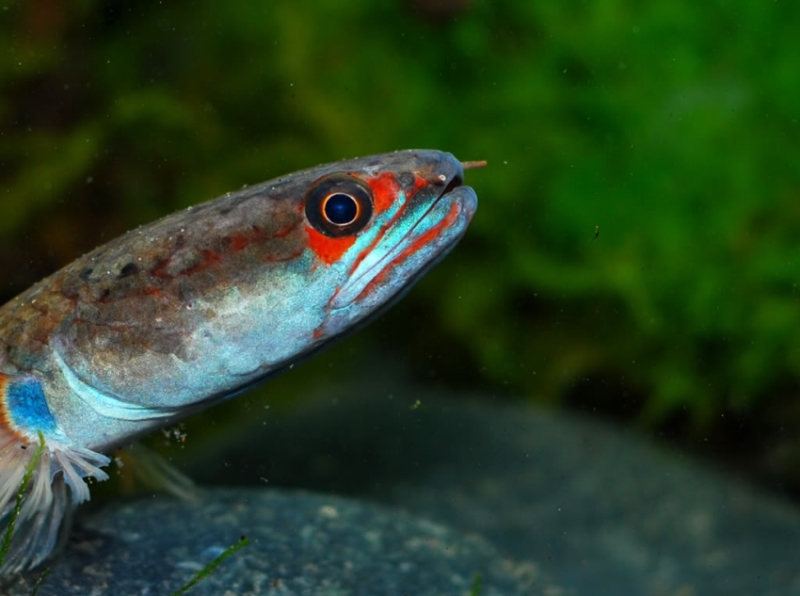
This unidentified species first appeared in the aquarium trade during 2009 and the name 'fire and ice' is derived from the red (fire) and blue (ice) colour pattern on the head.
It can easily be told apart from similar-looking congeners by the patches of vivid red pigmentation surrounding the eye and sides of the mouth plus the thick, reddish, marginal band in the caudal-fin.
It's also been traded under the alternative names C. sp. 'cherry' and C. 'cf. burmanicus fire red', with the latter name also having been applied to a different unidentified Channa species from Myanmar which is more commonly known as C. sp. 'red fin' or C. sp. 'Burmese red rim rainbow'.
Members of the family Channidae are commonly referred to as 'snakeheads' due to possession of large scales on the head of most species which are reminiscent of the epidermal scales (cephalic plates) on the heads of snakes.
There currently exist over 30 valid species but diversity within the group is likely to prove significantly greater.
All Channa spp. possess supplementary breathing apparatus in the form of paired suprabranchial chambers located behind and above the gills, although these are not labyrinthic but lined with respiratory epithelium.
These chambers allow the fish to breathe atmospheric air and survive in hypoxic conditions or even out of the water for a considerable period of time, and in aquaria they are often seen rising to the surface to take gulps of air.
References
- Brede, N. and P. Antler (2009). Schlangenkopffische—Die Gattungen Channa und Parachanna. Natur und Tier Verlag, Münster, 62 pp.
Species images · 4
Used with the photographer’s permission. Not licensed for reuse.