Cyprinodon variegatus
Sheepshead 'Minnow'
Formerly Esox ovinus Mitchill, 1815 · Lebias rhomboidalis Valenciennes, 1821 · Cyprinodon gibbosus Baird & Girard, 1853 · Cyprinodon baconi Breder, 1932 · Cyprinodon hubbsi Carr, 1936
On this page7 sections
Quick facts
Difficulty3 of 6 measures
More bars, more demanding.
- Space
- modest tank
- Water
- unknown
- Temp
- unknown
- Temperament
- unknown
- Social
- shoal
- Compatibility
- not a community fish
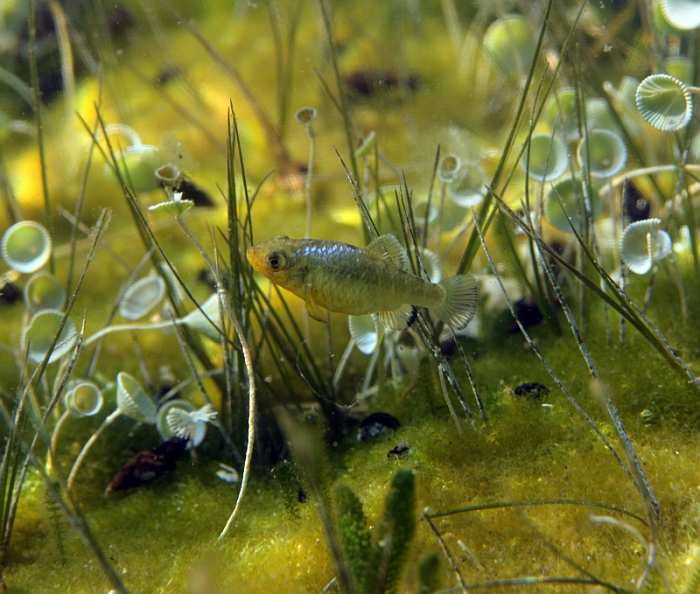
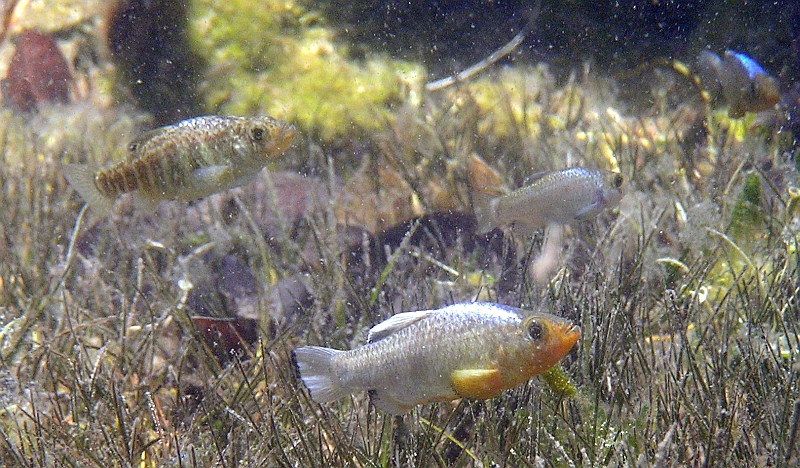
Tends to be most common in brackish to hypersaline environments such as coastal salt marshes, lagoons and estuaries. On San Salvador Island, Bahamas, it appears to be the parent of a species group occurring in sympatry and exploiting diverse but specific resources with some spectacular morphological adaptations.
Etymology
Cyprinodon: from the Ancient Greek κυπρῖνος (kuprinos), meaning 'carp', and ὀδούς (odous), meaning 'tooth'.
variegatus: from the Latin variegatus, meaning 'variegated'.
Distribution
Type locality is given as 'Carolinas, U.S.A.', but this species has a huge distribution extending southwards from Massachuttsets state, northeastern U.S.A. along the Atlantic coast as far as northeastern Mexico, the Bahamas and Antilles, with a handful of records from northeastern South America (Venezuela).
Habitat
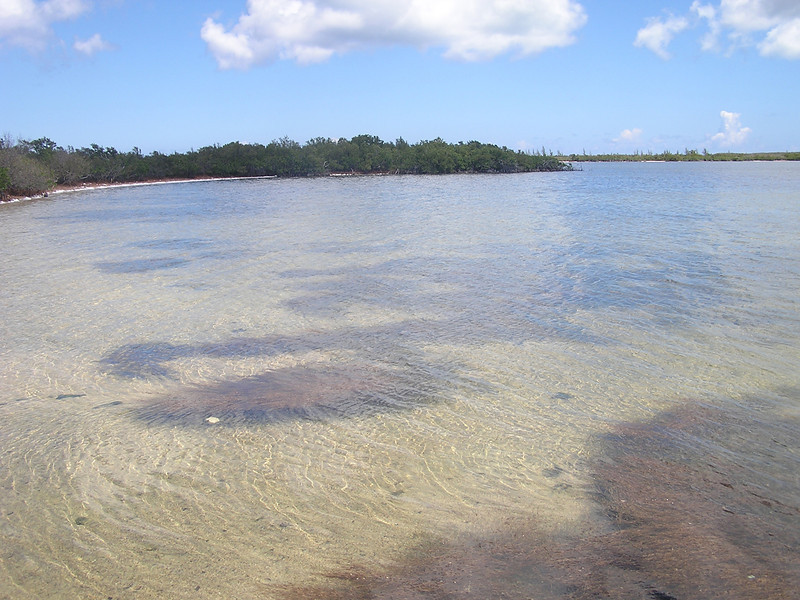
Tends to be most common in brackish to hypersaline environments such as coastal salt marshes, lagoons and estuaries.
On San Salvador Island, Bahamas, it appears to be the parent of a species group occurring in sympatry and exploiting diverse but specific resources with some spectacular morphological adaptations. Click here for more details.
Aquarium size
An aquarium with base dimensions of 60 ∗ 30 cm24 ∗ 12 in or equivalent is just about acceptable for a single pair but like most members of the family Cyprinodontidae this species does best when maintained as a group in a larger tank or container.
Maintenance
Need not be too complicated so long as there are plenty of broken lines-of-sight.
Provide plenty of cover in the form of aquatic plants, wool mops, etc., and if using filtration air-powered, sponge-type units are best as these will not harm eggs or fry.
Lighting is unimportant but can be used if you wish, and growth of filamentous algae should be encouraged if possible.
References
- Martin, C. H. and P. C. Wainwright (2013). Remarkable Species Flock of Cyprinodon Pupfishes Endemic to San Salvador Island, Bahamas. Bulletin of the Peabody Museum of Natural History 54(2), 231-240
- Martin, C. H. and P. C. Wainwright (2013). Multiple Fitness Peaks on the Adaptive Landscape Drive Adaptive Radiation in the Wild. Science 339(6116), 208-211
- Martin, C. H. and P. C. Wainwright (2011). Trophic novelty is linked to extremes rates of morphological diversification in two adaptive radiations of Cyprinodon pupfishes. Evolution 65(8), 2197-2212
Species images · 3
Used with the photographer’s permission. Not licensed for reuse.
Distribution
Profile completeness15 of 24
63% complete
Missing: water parameters, hardness, temperament, water condition notes, diet, behaviour and compatibility, sexual dimorphism, reproduction, notes.