Garra imberba
Formerly Discognathus pingi Tchang, 1929 · Garra pingi Tchang, 1929 · Garra alticorpora Chu & Cui, 1987
On this page6 sections
Quick facts
Difficulty3 of 6 measures
More bars, more demanding.
- Space
- large tank
- Water
- unknown
- Temp
- unknown
- Temperament
- unknown
- Social
- shoal
- Compatibility
- community tank
This species can be distinguished from congeners inhabiting the Red River basin in Yunnan province, China, by the following combination of characters: no barbels; 46-52 lateral line scales; 16 circumpeduncular scales; pharyngeal teeth in 3 rows, 2.4.5-5.4.2; snout rounded, no secondary rostrum, no longitudinal...
Etymology
Garra: vernacular Gangetic name for a particular species of “sand-digger,” which Francis Buchanan-Hamilton applied as a generic name for bottom-dwelling cyprinids “with no affinity to another genus”.
imberba: from the Latin im-, meaning not', and berbis, meaning 'bearded', in reference to this species' lack of barbels.
Distribution
Native to the upper Yangtze River (Jinshajiang), upper Mekong River (Lancangjiang) and upper Red River (Yuanjiang) basins in southern China and the upper Red River in Vietnam. Records from the Salween system are a result of confusion with the similarly-named congener G. imberbis (Vinciguerra, 1890).
Type locality is 'Min River, Kiating [Loshan], western Szechuan, China'.
Habitat
Tends to inhabit swiftly-flowing sections of headwaters and tributaries rather than larger, lowland river channels. The most favourable habitats contain clear, oxygen-saturated water which, allied with the sun, facilitates the development of a rich biofilm carpeting submerged surfaces.
Notes
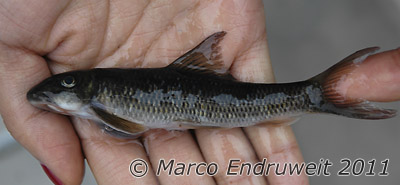
This species can be distinguished from congeners inhabiting the Red River basin in Yunnan province, China, by the following combination of characters: no barbels; 46-52 lateral line scales; 16 circumpeduncular scales; pharyngeal teeth in 3 rows, 2.4.5-5.4.2; snout rounded, no secondary rostrum, no longitudinal groove in front of nostrils; anus close to pelvic-fin base.
The genus Garra is a particularly enigmatic grouping with new taxa described on a regular basis, while many of the existing ones may represent cases of misidentification or synonyms of other species. Some of the revisions have also been called into question, which has added further confusion. A full generic review would be ideal but is unlikely to materialise given the extensive distribution of its members which range from southern China across much of southeast Asia, India and the Middle East as far as north/central Africa.
Instead a number of less-extensive works published in recent years have resulted in a gradual, but continuing, improvement in knowledge, and it remains possible that the genus will be broken up into smaller taxa since the current assemblage is almost certainly polyphyletic.
Garra species are usually included in the subfamily Labeoninae/Cyprininae or tribe Labeonini (name varies with author) which by recent thinking is further divided into four subtribes; Labeoina, Garraina, Osteochilina, and Semilabeoina (Yang et al., 2012)[9]. The putatively monophyletic Garraina comprises a number of genetic lineages including Garra sensu stricto (which also includes Horalabiosa, Phreatichthys and possibly other genera), a small clade comprising Garra cambodgiensis and G. fascicauda (thus rendering Garra polyphyletic), Paracrossocheilus, and Gonorhynchus (which includes Akrokolioplax).
Two Garra species, G. imberba and G. micropulvinus, are placed in the Semilabeoina assemblage, and the generic name Ageneiogarra Garman, 1912 has been suggested for them, although this does not appear to have been widely followed (e.g. Kottelat, 2013). In addition, some genera which were previously considered to be close relatives of Garra species such as Discogobio, Discocheilus and Placocheilus, are now also placed in this subtribe.
All genera currently included in Garraina possess a lower lip modified to form a mental adhesive disc, allowing the fish to cling to surfaces in turbulent conditions. In most species the upper lip is almost entirely reduced and both the upper and lower jaw margins are keratinised, i.e., horny, and used to scrape food items from the substrate.
Garra species are distinguished from other Garraina members by the first two pectoral-fin rays usually being thickened, fleshy and unbranched, possession of 10-11 dorsal-fin rays, and a combination of internal characters. Some species have evolved particular environmental specialisms such as highly reduced eyes in hypogean forms or the ability to survive in thermal springs.
References
- Garman, S. (1912). Pisces. In: Some Chinese vertebrates. Memoirs of the Museum of Comparative Zoology v. 40 (pt 4), 111-123
- Kottelat, M. (2013). The fishes of the inland waters of southeast Asia: a catalogue and core bibiography of the fishes known to occur in freshwaters, mangroves and estuaries. The Raffles Bulletin of Zoology Supplement 27, 1-663
- Li, F.-L., W. Zhou and Q. Fu (2008). Garra findolabium, a new species of cyprinid fish (Teleostei: Cypriniformes) from the Red River drainage in Yunnan, China. Zootaxa 1743, 62-68
- Zhou, W., X.-F. Pan and M. Kottelat (2005). Species of Garra and Discogobio (Teleostei: Cyprinidae) in Yuanjiang (Upper Red River) drainage of Yunnan Province, China with description of a new species. Zoological Studies 44(4), 445-453
- Kottelat, M. (1998). Fishes of the Nam Theun and Xe Bangfai basins, Laos, with diagnoses of twenty-two new species (Teleostei: Cyprinidae, Balitoridae, Cobitidae, Coiidae and Odontobutidae). Ichthyological Exploration of Freshwaters 9(1), 1-128
- Chen, Z.-M., S. Zhao and J.-X. Yang (2009). A new species of the genus Garra from Nujiang River Basin, Yunnnan, China (Telesotei: Cyprinidae). Zoological Research 30(4), 438-444
- Zhang, E. (2005). Phylogenetic relationships of labeonine cyprinids of the disc-bearing group (Pisces: Teleostei). Zoological Studies 44(1), 130-143
- Stiassny, M. L. J. and A. Getahun (2007). An overview of labeonin relationships and the phylogenetic placement of the Afro-Asian genus Garra Hamilton, 1922 (Teleostei: Cyprinidae), with the description of five new species of Garra from Ethiopia, and a key to all African species. Zoological Journal of the Linnean Society 150(1), 41-83
- Yang, L., M. Arunachalam, T. Sado, B. A. Levin, A. S. Golubtsov, J. Freyhof, J. P. Friel, W-J. Chen, M. V. Hirt, R. Manickam, M. K. Agnew, A. M. Simons, K. Saitoh, M. Miya, R. L. Mayden, and S. He (2012). Molecular phylogeny of the cyprinid tribe Labeonini (Teleostei: Cypriniformes). Molecular Phylogenetics and Evolution 65(2), 362-379
Species images · 1
Used with the photographer’s permission. Not licensed for reuse.
One photograph on file. More would be welcome.
Distribution
Profile completeness12 of 24
50% complete
Missing: water parameters, hardness, aquarium size, a common name, temperament, aquarium notes, maintenance, water condition notes, diet, behaviour and compatibility, sexual dimorphism, reproduction.