Gymnostomus lobatus
Formerly Henicorhynchus lobatus Smith, 1945
On this page6 sections
Quick facts
Difficulty3 of 6 measures
More bars, more demanding.
- Space
- large tank
- Water
- unknown
- Temp
- unknown
- Temperament
- unknown
- Social
- shoal
- Compatibility
- community tank
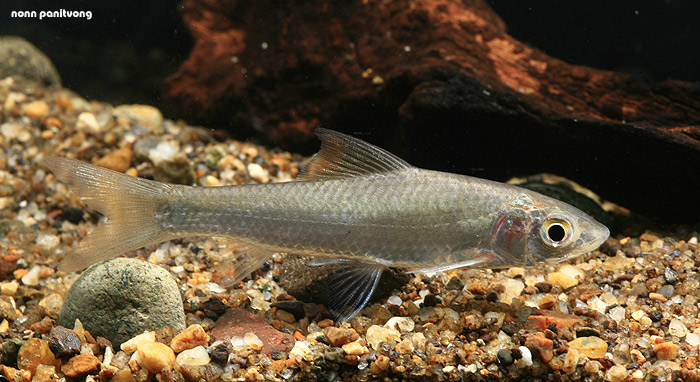
G. lobatus can be distinguished from congeners by the following combination of characters: possession of 32-33 + 2-3 lateral line scales; 5½ scale rows between lateral line and base of dorsal-fin; body relatively slender, depth fits 3.7-4.0 times in SL; snout often projecting strongly; body plain silver in colour.
Etymology
Gymnostomus: from the Ancient Greek γυμνός (gumnós), meaning 'naked', and στόμα (stóma), meaning 'mouth', presumably in reference to the lack of barbels in this genus.
lobatus: from the Latin lobatus, meaning 'having lobes', in reference to the "deep median incision in the rostral flap dividing it into two lobes".
Distribution
Recorded from the middle to lower Mekong River basin in Laos, Thailand, and Cambodia, plus the Chao Phraya and Mae Klong watersheds in central and western Thailand.
Type locality is 'Thailand: Chiang Rai Province: Mekok River near Chiang Rai'.
Habitat
This species is considered to be one of the most abundant species in the massive seasonal migrations of cyprinid fishes that occur in the mainstream Mekong river in December to February and May to July. Otherwise, it has been recorded in rivers and streams of all sizes down to around 2-3 m in width, with slow to rapid flow, and is known to enter inundated forests during the wet season.
Notes
G. lobatus can be distinguished from congeners by the following combination of characters: possession of 32-33 lateral line scales; 5½ scale rows between lateral line and base of dorsal-fin; body relatively slender, depth fits 3.7-4.0 times in SL; snout often projecting strongly; body plain silver in colour with no dark marking on caudal peduncle.
Species currently included in Gymnostomus have previously been placed in a variety of genera including Henicorhynchus, Cirrhinus, Bangana, and Labeo in the last few decades alone. However, Gymnostomus is a senior subjective synonym of Henicorhynchus, thus rendering the latter invalid, while Gymnostomus is easily distinguished from Cirrhinus by possession of 8-9 (vs. 10-15) branched dorsal-fin rays.
Some confusion remains, however, since a recent phylogenetic study (Yang et al., 2012) considered Henicorhynchus to be valid, and members were not recovered in the same evolutionary lineage as Indian Gymnostomus species, suggesting that they are not closely related. It is unclear whether further taxonomic changes will be required in the future in order to reflect this disparity, but here on SF we currently follow Kottelat (2013) since it was published more recently and has been widely accepted, thus Henicorhynchus is a synonym of Gymnostomus.
Gymnostomus species are considered members of the tribe Labeonini within the putative cyprinid subfamily Cyprininae or simply the subfamily Labeoninae (name varies with author). According to the most recent phylogenetic research, this grouping is further divided into four subtribes; Labeoina, Garraina, Osteochilina, and Semilabeoina (Yang et al., 2012). Among these, Gymnostomus is included in the Labeoina alongside Labeo, Bangana sensu stricto (which includes the genus Nukta), Cirrhinus sensu stricto, Cirrhinus microlepis (which is of a different genetic lineage to other Cirrhinus species), and Incisilabeo. As noted above, however, this refers only to the Indian species of Gymnostomus, with the Southeast Asian species placed in the Osteochilina assemblage.
Some Gymnostomus species are common in mainstream rivers at certain times of year and extremely important in local fisheries during these periods.
References
- Smith, H. M. (1945). The Fresh-Water Fishes of Siam, Or Thailand. Bulletin of the United States National Museum 188, i-xi + 1-622
- Kottelat, M. (2013). The fishes of the inland waters of southeast Asia: a catalogue and core bibiography of the fishes known to occur in freshwaters, mangroves and estuaries. The Raffles Bulletin of Zoology Supplement 27, 1-663
- Kottelat, M. (2003). Nomenclatural status of Crossocheilus burmanicus, C. horai and C. multirastellatus (Osteichthyes: Cyprinidae). Raffles Bulletin of Zoology 51(2), 399-401
- Kottelat, M. (2001). Fishes of Laos. WHT Publications, Colombo, 1-198
- Rainboth, W. J. (1996). FAO species identification field guide for fishery purposes. Fishes of the Cambodian Mekong. Rome, FAO, 1-265
- Roberts, T. R. (1997). Systematic revision of the tropical Asian labeoin cyprinid fish genus Cirrhinus, with descriptions of new species and biological observations on C. lobatus. Natural History Bulletin of the Siam Society 45(2), 171-203
- Yang, L., M. Arunachalam, T. Sado, B. A. Levin, A. S. Golubtsov, J. Freyhof, J. P. Friel, W-J. Chen, M. V. Hirt, R. Manickam, M. K. Agnew, A. M. Simons, K. Saitoh, M. Miya, R. L. Mayden, and S. He (2012). Molecular phylogeny of the cyprinid tribe Labeonini (Teleostei: Cypriniformes). Molecular Phylogenetics and Evolution 65(2), 362-379
Species images · 4
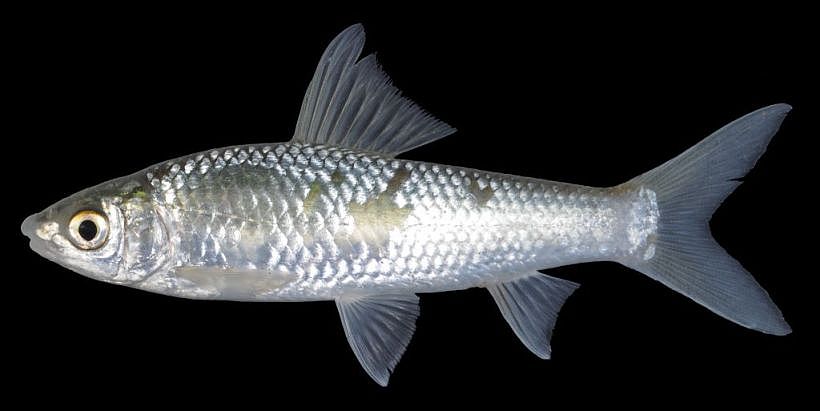
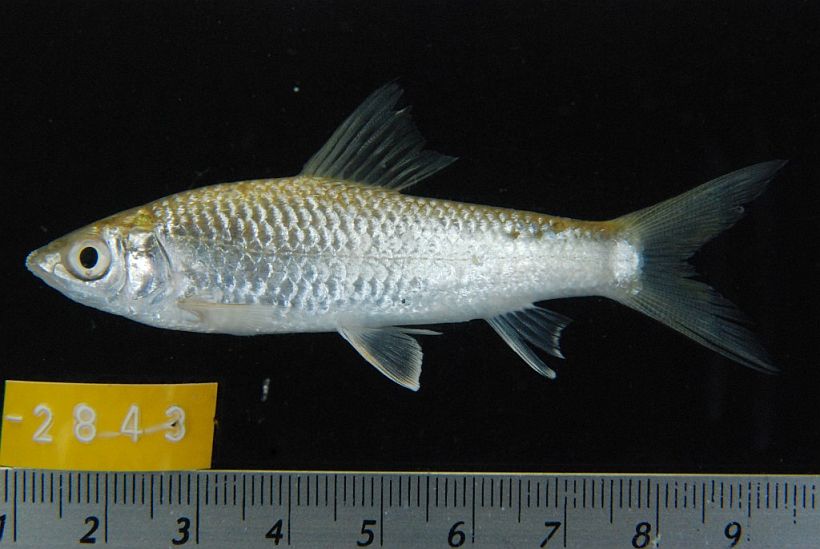
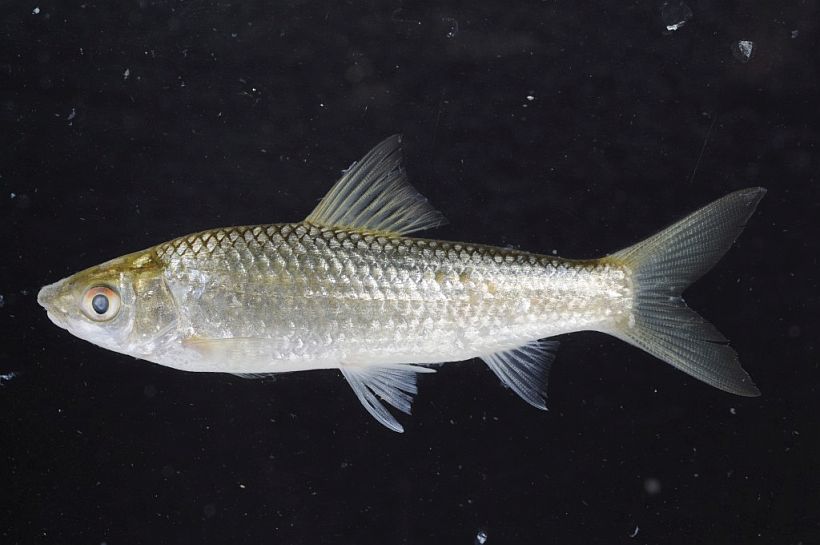
Used with the photographer’s permission. Not licensed for reuse.
Distribution
Profile completeness12 of 24
50% complete
Missing: water parameters, hardness, aquarium size, a common name, temperament, aquarium notes, maintenance, water condition notes, diet, behaviour and compatibility, sexual dimorphism, reproduction.