Hyphessobrycon auca
On this page6 sections
Quick facts
Difficulty3 of 6 measures
More bars, more demanding.
- Space
- any tank
- Water
- unknown
- Temp
- unknown
- Temperament
- unknown
- Social
- shoal
- Compatibility
- community tank
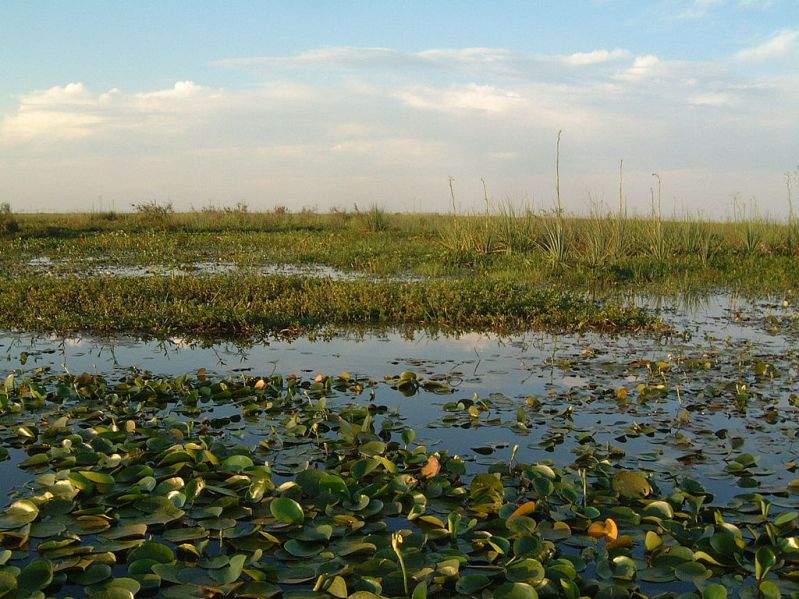
The two ponds where H. auca was collected were located on a sand bar deposited by the nearby Paraná river during the Pleistocene. At time of collection the substrates were composed of sand with submerged vegetation dominated by Egeria najas plus floating Eichhornia in marginal areas.
Etymology
Hyphessobrycon: from the Ancient Greek υπελάσσων (hyphesson), meaning 'of lesser stature', and used as a prefix in this case, plus the generic name Brycon.
auca: a Mapuche (indigenous inhabitants of south-central Chile and southwestern Argentina) meaning 'rebel'.
Distribution
Known only from two ponds within the Esteros del Iberá wetlands in Corrientes province, northern Argentina.
Type locality is 'pond in San Juán Poriahú farm (27°41'53" S-57°12'17" W').'
Habitat
The Esteros del Iberá form the second largest wetlands in the world after the Pantanal in Brazil and are home to an enormous number of plant and animal species.
The two ponds where H. auca was collected were located on a sand bar deposited by the nearby Paraná river during the Pleistocene.
At time of collection the substrates were composed of sand with submerged vegetation dominated by Egeria najas plus floating Eichhornia in marginal areas.
The pools were rain-fed and contained mildly acidic (pH 5.6-6.8), soft (hardness 2-5 mg CaCo3 l-1) and transparent water with low conductivity (11.6-20.8 µS cm-1).
Sympatric fish species included Acestrorhynchus pantaneiro, Aphyocharax rathbuni, Characidium spp., Hyphessobrycon eques, Serrapinnus kriegi, Apistogramma borelli, A. commbrae, Gymnogeophagus balzanii, Laetacara dorsigera and Phalloceros caudimaculatus.
Notes
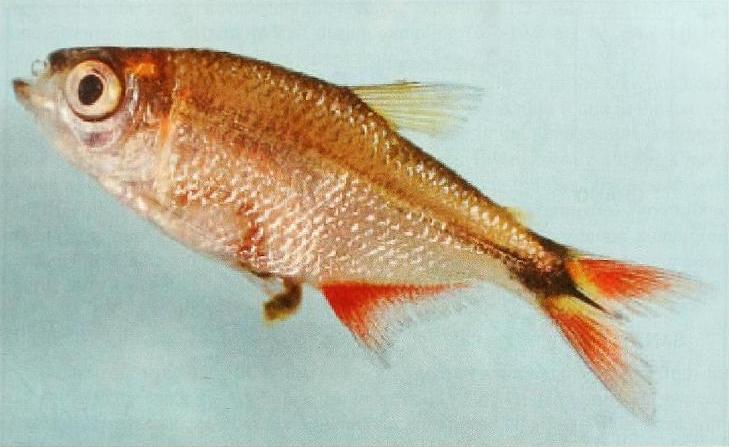
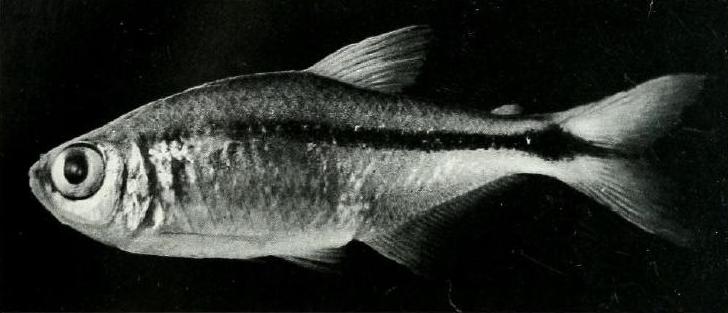
H. auca appears very similar to the congener H. anisitsi but can be told apart by possessing a single maxillary tooth always with 5 cusps (vs. 3-5 cusps in H. anisitsi), dentary depth 40.7-47.6 % of dentary length (vs. 50.0-53.3 %), and possessing small hooks on the dorsal, caudal and pectoral fins in males (vs. lacking hooks on these fins in males).
References
- Almirón, A. E., J. R. Casciotta, J. A. Bechara and F. J. Ruíz Díaz (2004). A new species of Hyphessobrycon (Characiformes, Characidae) from the Esteros del Iberá wetlands, Argentina. Revue Suisse de Zoologie 111(3), 673-682
Species images · 3
Used with the photographer’s permission. Not licensed for reuse.