Laetacara thayeri
Formerly Acara thayeri Steindachner, 1875
On this page9 sections
Quick facts
Difficulty5 of 6 measures
More bars, more demanding.
- Space
- modest tank
- Water
- tap water
- Temp
- unfussy
- Temperament
- unknown
- Social
- in a pair
- Compatibility
- community tank
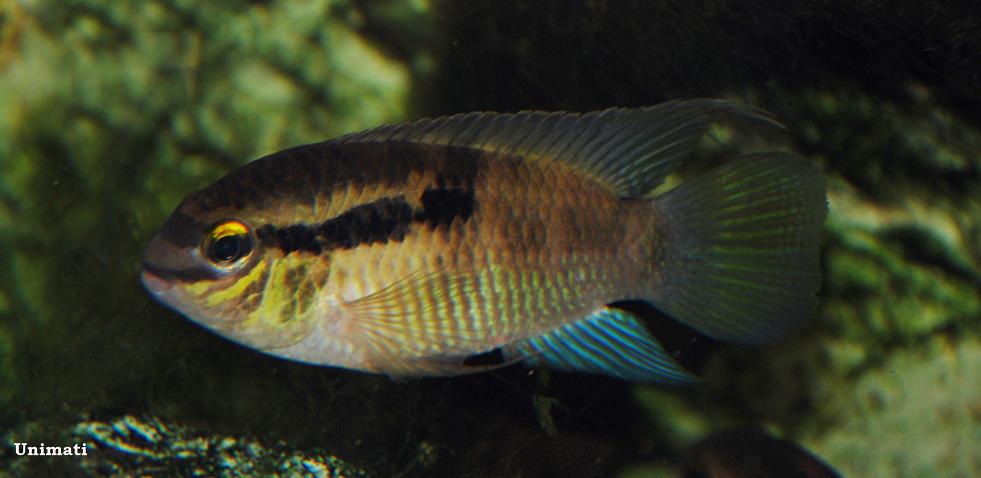
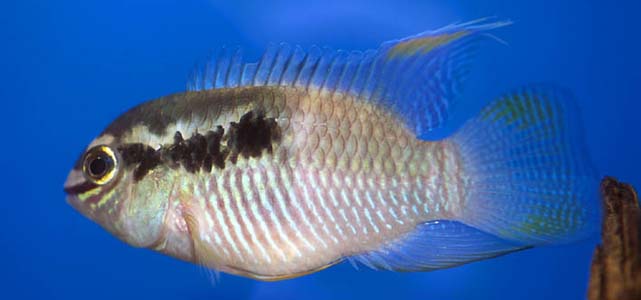
This species is relatively rare in the aquarium trade. It can be differentiated from all congeners by a combination of possessing ctenoid (vs. cycloid) scales on the sides of the head plus lacking a dark spot at the caudal-fin base.
Water conditions
Etymology
Laetacara: from the Latin laetus, meaning 'happy', and acará, a vernacular term used for cichlids in certain parts of South America, in reference to patterning around the mouth and snout which give members of this genus a 'smiling' appearance.
thayeri: named for Boston banker Nathaniel Thayer (1769-1840), chief financier of Louis Agassiz' famed fish collecting trip to Brazil in 1865-66 which became known as the 'Thayer Expediiton'.
Distribution
Native to the middle and upper Amazon basins in western Brazil and northern Peru with records existing from the ríos Tigre, Ucayali, Yavarí (Javary) and Amazon basins in Peru, and the Solimões, Amazon and lower rio Negro in Brazil with the rio Trombetas considered to represent its downstream limit.
Type locality is given as 'Codajas, Lake Hyanuary at Manaus, Lake Maximo at Alenquer'.
Diet
Wild fish are probably foragers feeding on algae, organic detritus, small insects, worms, crustaceans, and other zooplankton.
In the aquarium it's easily-fed but the best condition and colours offer regular meals of small live and frozen foods such as bloodworm, Daphnia, and Artemia, alongside good quality dried flakes and granules, at least some of which should include additional plant or algal content.
These boxes carry affiliate links and we may earn a commission. What they recommend comes from each profile’s own figures, never chosen by hand or paid for.
Sexual dimorphism
Males grow larger than females and develop more-extended dorsal, anal and caudal fins as they mature.
Reproduction
Biparental substrate spawner.
Notes
This species is relatively rare in the aquarium trade.
The genus Laetacara currently contains seven valid species and L. thayeri can be differentiated from all congeners by a combination of possessing ctenoid (vs. cycloid) scales on the sides of the head plus lacking a dark spot at the caudal-fin base.
References
- Ottoni, F. P. and W. J. E. M. Costa (2009). Description of a new species of Laetacara Kullander, 1986 from central Brazil and re-description of Laetacara dorsigera (Heckel, 1840) (Labroidei: Cichlidae: Cichlasomatinae). Vertebrate Zoology 59(1), 41-48
- Ottoni, F. P., P. H. N Bragança, P. F. Amorim and C. S. Gama (2012). A new species of Laetacara from the northern Brazil coastal floodplains (Teleostei: Cichlidae). Vertebrate Zoology 62(2), 181-188
- Staeck, W. and I. Schindler (2007). Description of Laetacara fulvipinnis sp. n. (Teleostei: Perciformes: Cichlidae) from the upper drainages of the rio Orinoco and rio Negro in Venezuela. Vertebrate Zoology 51(1), 63-71
Species images · 2
Used with the photographer’s permission. Not licensed for reuse.