Leporinus copelandii
On this page10 sections
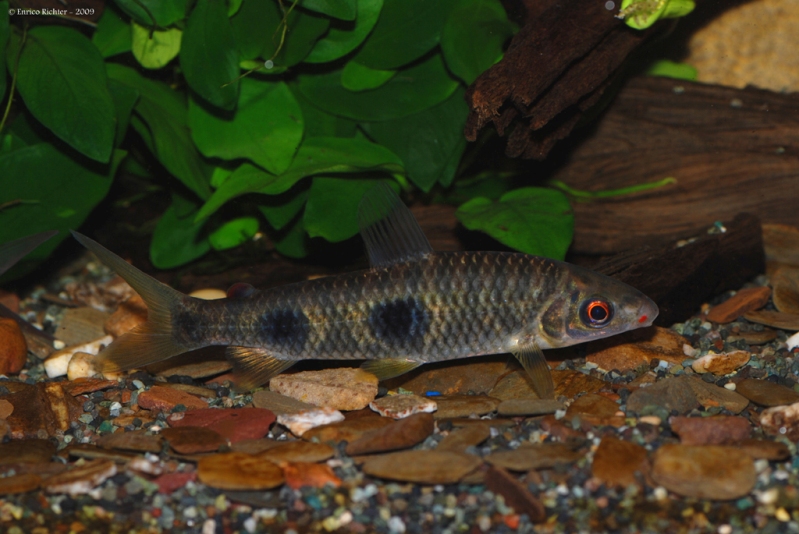
Quick facts
Difficulty5 of 6 measures
More bars, more demanding.
- Space
- very large tank
- Water
- tap water
- Temp
- unfussy
- Temperament
- unknown
- Social
- shoal
- Compatibility
- not a community fish
Type locality is giev as 'Rio Parahyba and tributaries at Mendez; Juiz de Fora; River Doce; River São Matheos; Rio Jequitinhonha; Rio Quenda at Santa Cruz', all of which pertain to localities within the Paraíba do Sul and Doce river systems in Minas Gerais, Espírito Santo, rio de Janeiro and São Paulo states, southeastern Brazil.
Etymology
Leporinus: from the Latin lepus, meaning 'hare', and the suffix -inus, meaning 'of or pertaining to', in reference to the enlarged pair of symphyseal teeth possessed by certain members of the genus.
copelandii: named for Professor Herbert E. Copeland.
Distribution
Type locality is giev as 'Rio Parahyba and tributaries at Mendez; Juiz de Fora; River Doce; River São Matheos; Rio Jequitinhonha; Rio Quenda at Santa Cruz', all of which pertain to localities within the Paraíba do Sul and Doce river systems in Minas Gerais, Espírito Santo, rio de Janeiro and São Paulo states, southeastern Brazil.
Aquarium size
An aquarium with base dimensions of 180 ∗ 60 cm72 ∗ 24 in or equivalent should be the smallest considered.
Maintenance
Décor is relatively unimportant and maintenance simple provided sufficient space is available and oxygenation adequate.
A natural-style arrangement could consist of a sandy substrate with some leaf litter plus large driftwood branches and twisted roots and perhaps some floating vegetation.
Water quality is of the utmost importance and this species should never be introduced to a biologically immature aquarium.
A well-fitting cover is also essential as anostomids are prodigious jumpers.
Water conditions
These boxes carry affiliate links and we may earn a commission. What they recommend comes from each profile’s own figures, never chosen by hand or paid for.
Diet
Reproduction
Unrecorded.
Notes
Leporinus is among the more diverse genera in the order Characiformes with around 90 valid species, and a phylogentic study by Sidlauskas and Vari (2008)[2] demonstrated it to represent a polyphyletic lineage.
Four species (H. despaxi, H. megalepis, H. mormyrops and H. pachycheilus) were thus placed into the revalidated genus Hypomasticus which had originally been proposed by Borodin (1929).
The remaining species of Leporinus, except for L. gomesi, formed a clade alongside Abramites, and this grouping was itself placed in a large polytomy alongside the genera Anostomoides, Anostomus, Gnathodolus, Laemolyta, Petulanos, Pseudanos, Rhytiodus, Sartor, Schizodon and Synaptolaemus.
In particular there was an overall lack of a resolution of relationships within Leporinus, and the authors suggested that molecular analysis is likely to be needed to fully resolve the relationships between them.
The family Anostomidae is distributed throughout much of tropical and subtropical South America from northwestern Colombia to central Argentina.
The majority of species are moderately-elongate and somewhat rounded in shape although there are some exceptions, e.g., the relatively deep-bodied Abramites.
Greater diversity is apparent in the range of oral morphology, however, and members exhibit a wide range of adaptations in dentition and jaw structure.
A number of anostomids tend to swim at an oblique 'head-down' angle which has given rise to them being referred to by the generalised vernacular term 'headstanders'.
References
- Reis, R. E., S. O. Kullander and C. J. Ferraris, Jr. (eds) (2003). Check list of the freshwater fishes of South and Central America. CLOFFSCA. EDIPUCRS, Porto Alegre, i-xi + 1-729
- Sidlauskas, B. L. and R. P. Vari (2008). Phylogenetic relationships within the South American fish family Anostomidae (Teleostei, Ostariophysi, Characiformes). Zoological Journal of the Linnean Society 154, 70–210
Species images · 2
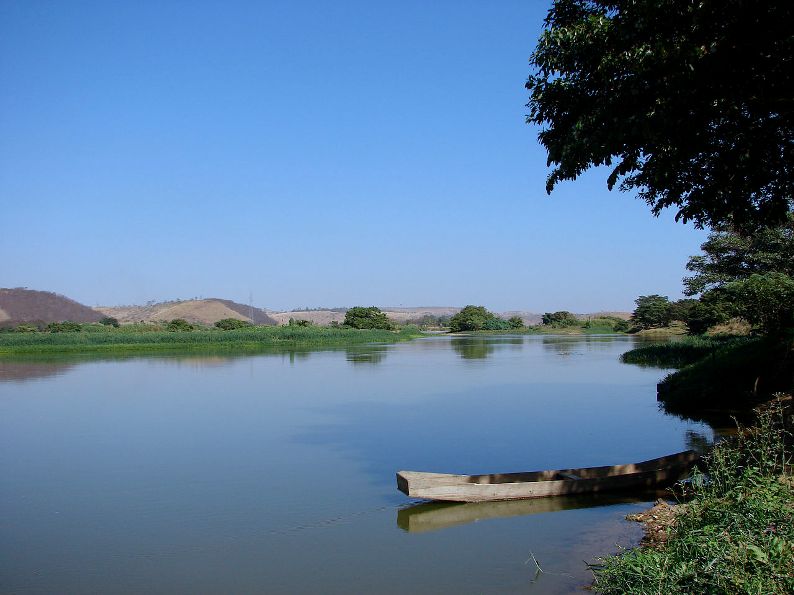
Used with the photographer’s permission. Not licensed for reuse.
Distribution
Profile completeness18 of 24
75% complete
Missing: a common name, temperament, habitat, water condition notes, behaviour and compatibility, sexual dimorphism.