Maylandia greshakei
Red Top Ice Blue Zebra
Last revised 2026Edit this page
On this page11 sections
Quick factsEdit
Difficulty4 of 8 measures
- Space
- large tank
- Water
- flexible
- Temp
- needs a steady temperature
- Diet
- unknown
- Temperament
- territorial
- Social
- unknown
- Compatibility
- unknown
Other demands
Each of these can raise the rating on its own, whatever the measures above say.
- Hardiness
- unknown
The red top ice blue zebra, Maylandia greshakei, is an mbuna endemic to Lake Malawi, found only around Makokola in the southeast of the lake. It inhabits the upper parts of rocky reefs next to open water, leaving the reef to feed on phytoplankton. Formerly Pseudotropheus greshakei and Metriaclima greshakei, it is still named as either of these by many sources. Aggressive and territorial, it can be combined with other mbuna but not with peaceful species such as peacocks or utaka.
Distribution
EditHabitat
Write a noteEditIt inhabits the upper parts of rocky reefs, usually adjacent to areas of open water, in which it leaves the reef to feed on phytoplankton.
Aquarium size
Write a noteEdit90 ∗ 45 ∗ 38 cm36 ∗ 18 ∗ 15 in - ~154 litres~41 US gal.
Maintenance
Write a noteEditMuch of the aquarium should contain piles of rocks, arranged to form caves with small areas of open water between. A sandy substrate is best and the water should be well oxygenated. Plants should not be used as they will be eaten.
Water conditions
EditTemperature: 24 – 28 °C75 – 82 °F
pH: 7.6-8.8
Hardness: 10-25°H
These recommendations come from this profile’s own figures. They contain affiliate links, so we may earn a commission.
Diet
Write a noteEditIt will accept most foods offered but vegetable matter in the form of spirulina flakes, blanched spinach etc. should form a large proportion of the diet. This can be supplemented with live and frozen varieties.
Behaviour and compatibility
Write a noteEditAggressive and territorial. It should not be kept with peace loving species, such as Peacocks or Utaka, but it can be combined with other Mbuna. The tank should be overcrowded to reduce aggression and territory formation. It is very aggressive towards others of the same species and the presence of heterospecifics helps to dissipate this. Several females should be kept per male in order to reduce harassment by the male.
Sexual dimorphism
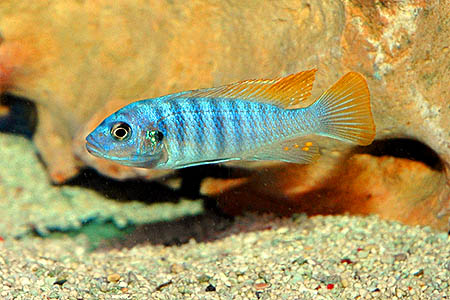
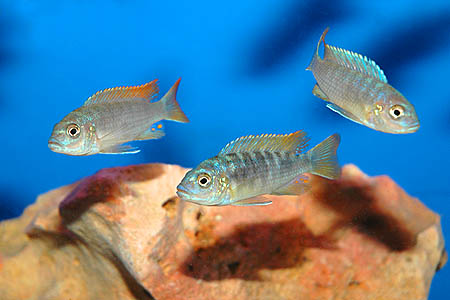
Write a noteEditMales are far more colourful than females.
Reproduction
Write a noteEditPossible. Maternal mouthbrooder. It should be spawned in a species tank in a harem of one male and at least 3 females. A 48" aquarium is a good size and should be furnished as suggested above, along with some flat stones and areas of open substrate to act as potential spawning sites. The pH should be around 8.2-8.5 and the temperature 25 – 26.5 °C77 – 80 °F. The fish should be conditioned with plenty of live and frozen foods.
The male fish will clean and then display around his chosen spawning site, showing intense colour, and attempt to entice females to mate with him. He can be quite aggressive in his pursuits and it is in order to dissipate this aggression, that this species should be spawned in a harem. When a female is willing, she will approach the spawning site and lay her eggs there, after which she picks them up in her mouth. The male fish has egg-shaped spots on his anal and the female is attracted to these. When she tries to add them to the brood in her mouth she actually recieves sperm from the male, thus fertilising the eggs.
The female may carry the eggs for up to 3 or 4 weeks before releasing the free swimming fry. She will not eat during this period and can be easily spotted by her distended mouth. If a female is overly stressed she may spit out the brood prematurely or eat them, so care must be taken if you decide to move the fish in order to avoid fry predation. It is also worth noting that if a female is away from the colony for too long she may lose her position in the pecking order of the group. We recommend waiting as long as possible before moving a female unless she is being harassed. Some breeders artificially strip the fry from the mother's mouth at the 2 week stage and raise them from that point as this usually results in a larger number of fry.
The fry are large enough to take brine shrimp nauplii from birth.
Notes
EditThis species was formerly classified as Pseudotropheus greshakei and Metriaclima greshakei and is still named as either of these by many sources. The genus name Maylandia is now used to describe all former members of the 'zebra' group of Pseudotropheus.
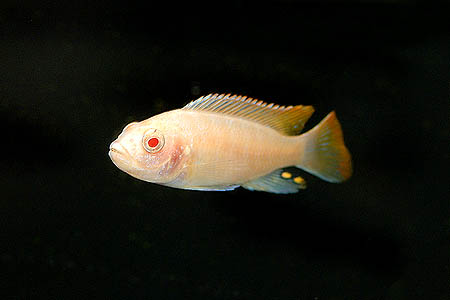
An albino form of this species exists in aquaria and is occasionally available.
Species images · 3
These photographs are used with each photographer’s permission.
Send a photographDistribution
Profile completeness19 of 24
79% complete
Also missing: taxonomic authority, etymology.
Community
Questions about Maylandia greshakei?
Ask on Discord