Metzia formosae
Formerly Rasborinus formosae Oshima, 1920 · Ishikauia hainanensis Nichols & Pope, 1927 · Metzia fanlingensis Lin, 1939 · Rasborinus yaii Harada, 1943
On this page7 sections
Quick facts
Difficulty3 of 6 measures
More bars, more demanding.
- Space
- modest tank
- Water
- unknown
- Temp
- unknown
- Temperament
- unknown
- Social
- shoal
- Compatibility
- community tank
Although it is included in the genus Metzia this grouping remains somewhat unresolved in terms of taxonomy and it may contain more than a single genetic lineage. For example, members share a number of characters with the genera Ischikauia Jordan and Snyder 1900, Hemiculterella Warpachowski 1887, and several species of Anabarilius Cockerell 1923, including a bipartite gas bladder, a non-spinous dorsal-fin ray, and a sharp ventral keel between the pelvic-fin insertion and anus.
Etymology
Distribution
Known from northern Taiwan, Hainan Island, Hong Kong, the Pearl River (Zhu Jiang) basin in Guangxi and Guangdong provinces of southern China, and the Red River watershed in Yunnan province, China, and northern Vietnam. It may also occur in Laos.
Type locality is 'small pond near Manka, Taihoku, Taiwan'.
Habitat
Inhabits slow-moving to still habitats, typically containing clear to turbid water and abundant aquatic or riparian vegetation, including streams and other minor tributaries, rice paddies, marginal ditches, and canals.
Typical sympatric species include the congener Metzia lineata, Barbodes semifasciolatus, Rasbora steineri, and Macropodus opercularis.
Sexual dimorphism
Sexually mature females tend to be deeper-bodied than males.
Notes
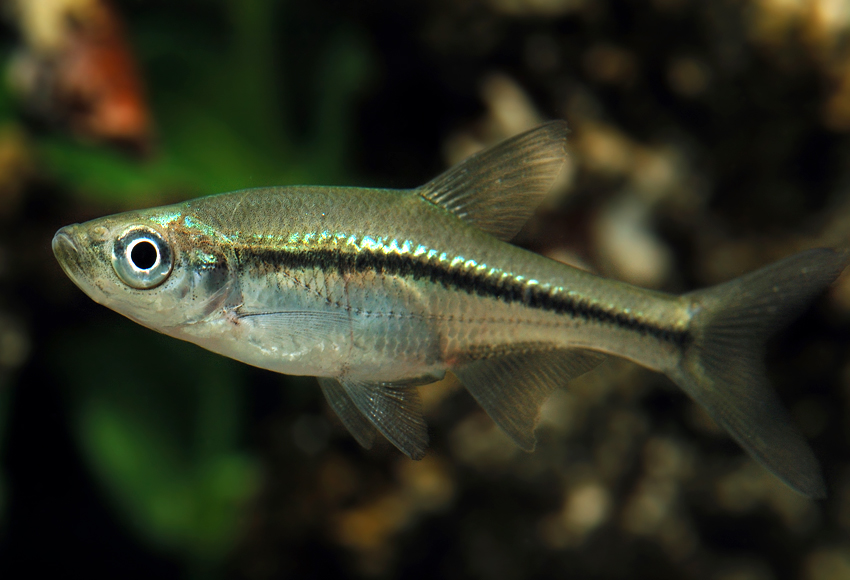
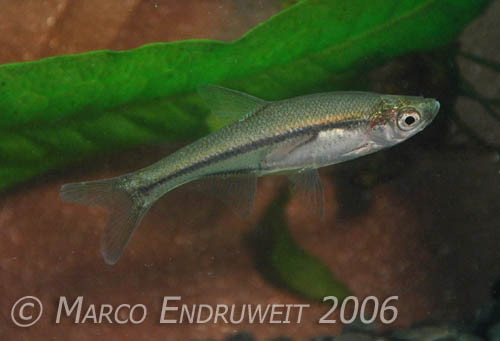
This species can be distinguished from congeners by the following combination of characters: mouth superior; 43-44 lateral line scales; colour pattern comprising a longitudinal black stripe on the flank, extending from the posterior extremity of the gill opening to the caudal-fin base.
Although it is included in the genus Metzia this grouping remains somewhat unresolved in terms of taxonomy and it may contain more than a single genetic lineage. For example, members share a number of characters with the genera Ischikauia Jordan and Snyder 1900, Hemiculterella Warpachowski 1887, and several species of Anabarilius Cockerell 1923, including a bipartite gas bladder, a non-spinous dorsal-fin ray, and a sharp ventral keel between the pelvic-fin insertion and anus.
Metzia was also recovered together with the genus Hemigrammocypris in a phylogenetic study published in 2010, thus rendering it paraphyletic. In addition, M. formosae and M. longinasus differ from most other members of the genus in mouth position (upturned vs. terminal in putative congeners) and number of lateral line scales (43–48 vs. 35-39), and M. bounthobi differs from all congeners in number of branched anal-fin rays (18-20 vs. 10-18) and lateral line scales (49-55 vs. 35-48).
The current concept of Metzia can be diagnosed as follows: body compressed; abdomen with a sharp ventral keel between pelvic-fin insertion and anus; no barbels; no symphysal projection on the lower jaw fitting into a depression on upper jaw; lateral line complete, curved ventrally anterior to pelvic-fin insertion, running parallel with ventral profile and extending through centre of caudal peduncle above anal-fin base; gas bladder bipartite, posterior chamber with a rounded distal extremity; last simple dorsal-fin ray not spinous, origin closer to caudal-fin base than tip of snout or posterior to a vertical through pelvic-fin insertion; 10-20 branched anal-fin rays; 35-55 lateral-line scales.
References
- Ho, H.-C. and K.-T. Shao (2011). Annotated checklist and type catalog of fish genera and species described from Taiwan. Zootaxa 2957, 1-74
- Kottelat, M. (2013). The fishes of the inland waters of southeast Asia: a catalogue and core bibiography of the fishes known to occur in freshwaters, mangroves and estuaries. The Raffles Bulletin of Zoology Supplement 27, 1-663
- Shibukawa, K., P. Phousavanh, K. Phongsa and A. Iwata (2012). A new species of Metzia (Cypriniformes: Cyprinidae) from northern Laos. Zootaxa 3586, 264-271
- Gan, X., J.-H. Lan and E. Zhang (2009). Metzia longinasus, a new cyprinid species (Teleostei: Cypriniformes) from the Pearl River drainage in Guangxi Province, South China. Ichthyological Research 56(1), 55-61
- Kottelat, M. (2001). Freshwater fishes of northern Vietnam. A preliminary check-list of the fishes known or expected to occur in northern Vietnam with comments on systematics and nomenclature. Environment and Social Development Unit, East Asia and Pacific Region. The World Bank, i-iii + 1-123 + 1-18
- Tang, K. L., M. K. Agnew, W. J. Chen., M. V. Hirt, T. Sado, L. M. Schneider, J. Freyhof, Z. Sulaiman, E. Swartz, C. Vidthayanon, M. Miya, K. Saitoh, A. M. Simons, R. M. Wood and R. L. Mayden (2010). Systematics of the subfamily Danioninae (Teleostei: Cypriniformes: Cyprinidae). Molecular Phylogenetics and Evolution 57(1), 189-214
- Oshima, M. (1920). Notes on freshwater fishes of Formosa, with descriptions of new genera and species. Proceedings of the Academy of Natural Sciences of Philadelphia v. 72, 120-135
- Chen, I-S, and Y-C Chang (2005). A Photographic Guide to the Inland-water Fishes of Taiwan: Vol. 1 Cypriniformes. The Sueichan Press, i-xx + 1-284
Species images · 2
Used with the photographer’s permission. Not licensed for reuse.