Nannostomus harrisoni
Blackstripe Pencilfish
Formerly Archicheir minutus Eigenmann, 1909 · Poeciliobrycon harrisoni Eigenmann, 1909
On this page13 sections
Quick facts
Difficulty6 of 6 measures
More bars, more demanding.
- Space
- modest tank
- Water
- tap water
- Temp
- unfussy
- Temperament
- peaceful
- Social
- shoal
- Compatibility
- community tank
This species is quite rare in the aquarium hobby and is not often available in numbers, more often being exported as bycatch among shipments of the congener N. eques. Following Weitzman and Cobb (1975) it can be diagnosed by the following combin...
Etymology
Nannostomus: from the Latin nannus, meaning 'small', and Greek stoma, meaning 'mouth', in reference to the small mouthparts of member species.
harrisoni: named for J. B. Harrison, government geologist, Georgetown, British Guiana who assisted the expedition to British Guiana of the Indiana University and the Carnegie Museum on which this species was discovered.
Distribution
Habitat
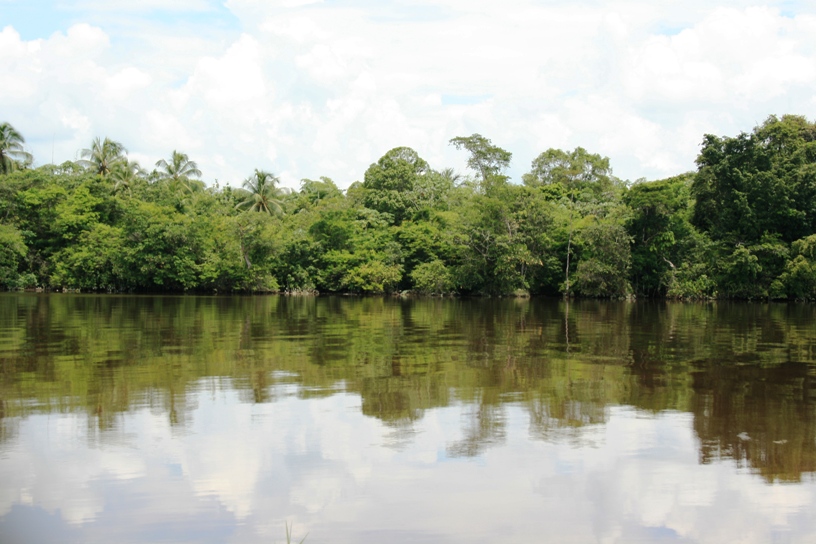
Inhabits sluggish tributaries, small rivers, and swampy zones, especially in areas where aquatic vegetation grows densely or with submerged woody structures and leaf litter.
It's often found in areas of flooded forest and floodplain lakes.
Aquarium size
Base dimensions of at least 60 ∗ 30 cm24 ∗ 12 in or equivalent are required.
Maintenance
Should ideally be kept in a heavily-planted set-up, preferably with a dark substrate and some patches of floating vegetation around which the fish will tend to congregate, bodies angled towards the surface.
Driftwood branches and dried leaf litter can also be added, the latter in particular driving establishment of microbe colonies as decomposition occurs.
Such microorganisms can provide a valuable secondary food source for fry, whilst the tannins and other chemicals released by the decaying leaves are also thought beneficial.
Use gentle filtration; an air-powered sponge-style unit should prove adequate in most cases though a degree of flow is acceptable.
Water conditions
These boxes carry affiliate links and we may earn a commission. What they recommend comes from each profile’s own figures, never chosen by hand or paid for.
Diet
A micropredator feeding on tiny invertebrates and other zooplankton in nature.
In the aquarium it will accept dried foods of a suitable size but should also be offered daily meals of small live and frozen fare such as Artemia nauplii, Moina, grindal worm, etc.
Behaviour and compatibility
Very peaceful but does not make an ideal community fish due to its small size and rather timid nature.
In a community it's best kept with similarly-sized, peaceful characids and smaller callichthyid or loricariid catfishes.
It also makes an ideal dither fish for Apistogramma spp. and other dwarf cichlids since it tends to inhabit the middle-to-upper regions of the tank, and does not actively predate fry.
It's very much a gregarious animal so buy as many as possible, ideally 10 or more, as when kept in larger groups any aggression is spread between individuals plus the fish are bolder and exhibit more natural behaviour.
Unlike some relatives rival males rarely spar or do each other harm in any way.
Sexual dimorphism
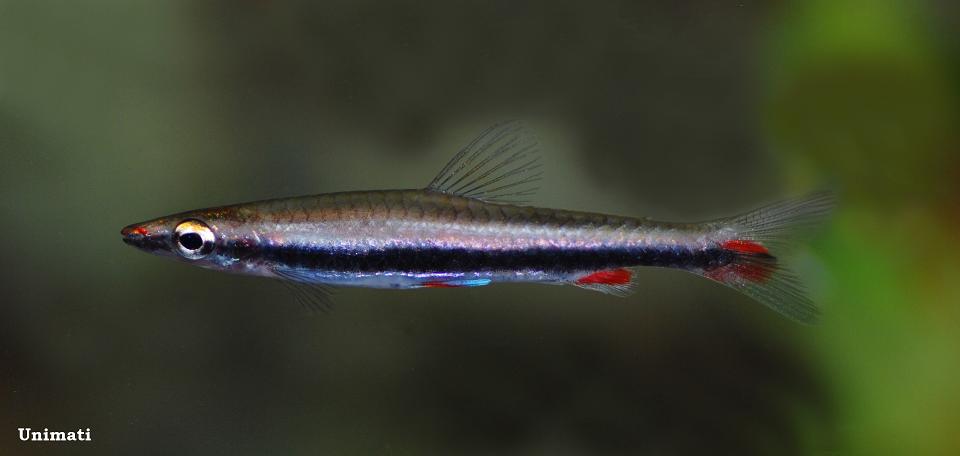
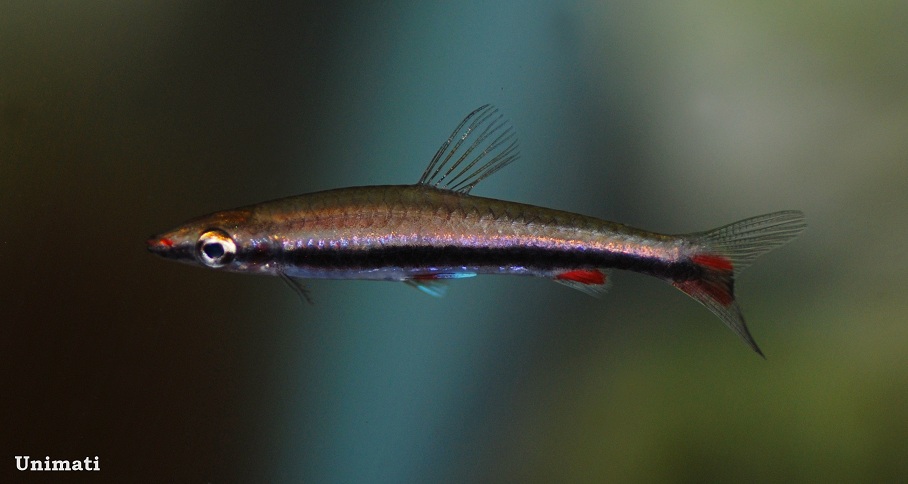
Mature males possess red pigmentation in the pelvic, anal, and caudal fins, while in females the pelvic and anal fins are hyaline and the caudal-fin pigmention paler.
Males are normally slimmer than females, especially when the latter are gravid.
Reproduction
Has been achieved in aquaria, albeit rarely, and in a densely-planted, mature aquarium it's possible that small numbers of fry may start to appear without intervention.
However if you want to increase the yield of fry a slightly more controlled approach is required.
The adult group can still be conditioned together but one or more smaller containers should also be set up and filled with aged water.
Fill much of the available space with fine wool mops, Taxiphyllum or other fine-leaved aquatic plant.
Neither lighting nor filtration is necessary although you can install a small air-powered sponge filter if you prefer.
When the adult fish are well-conditioned a single pair or group comprising one or two males and several females can then be introduced to each container, though it's worth noting that the more individuals involved the greater the risk of egg predation, plus males may distract each other from females if there's more than one in the tank.
The adults can be removed after 2-3 days and the first fry should be visible a day or two later. Initial food should be Paramecium or a proprietary dry food of sufficiently small (5-50 micron) grade, introducing Artemia nauplii, microworm, etc., once the fry are large enough to accept them.
In memory of late expert fish-breeder Alan P. Vaissiere who assisted extensively with this section.
Notes
This species is quite rare in the aquarium hobby and is not often available in numbers, more often being exported as bycatch among shipments of the congener N. eques.
Following Weitzman and Cobb (1975)[3] it can be diagnosed by the following combination of characters: two lateral stripes of which the midbody one is well-developed and upper poorly-developed; nocturnal oblique bands present; adipose fin always present; snout fits in eye 0.9-1 times, i.e., they're almost the same width; 38-39 vertebrae (the most in tne genus); anal-fin of male not elongate, not reaching base of caudal-fin; 19 caudal-fin rays.
Don't worry if your fish look different when you switch on the aquarium lights after dark or in the morning as like most Nannostomus species it assumes a cryptic, vertically-barred colour pattern at night.
This diurnal rhythm has been show to occur in blind specimens, suggesting it's an automatic response that the fish cannot control.
The family Lebiasinidae is included in the order Characiformes and sometimes split into the nominal subfamilies Lebiasininae and Pyrrhulininae, though there has not been a major review of the grouping in recent times.
All lebiasinid genera possess a relatively long, elongate body shape with 17-33 scales in the lateral series and laterosensory canal system absent or reduced to 7 scales or less.
Some species have an adipose fin while others do not, and the anal-fin has a relatively short base of 13 scales or less.
In the majority of members males have an enlarged or otherwise well-developed anal-fin used in courtship and spawning.
The frontal/parietal fontanelle is always absent, the cheek well-covered by the orbital and opercular bones, the supraoccipital crest is absent, and the scales of the dorsal body begin over the parietal bones.
Characiformes is among the most diverse orders of freshwater fishes currently including close to 2000 valid species distributed among 19 families.
This tremendous taxonomical and morphological diversity has historically impaired the ability of researchers to resolve their genetic relationships with many genera remaining incertae sedis.
A further limiting factor has been that in many cases exhaustive study of these on an individual basis is the only way to resolve such problems.
Modern molecular phylogenetic techniques have allowed some headway, though, and a research paper by Calcagnotto et al. published in 2005 revealed some interesting hypotheses.
Their results suggest that Lebiasinidae forms a trans-atlantic, monophyletic clade alongside the families Ctenoluciidae and Hepsetidae, this clade further forming a sister group to Alestidae.
Others such as Oliveira et al. (2011) have concluded that the family Erythrinidae is also closely-related to this grouping with Hepsetidae and Alestidae more distant.
References
- Oliveira, C. A., G. S. Avellino, K. T. Abe, T. C. Mariguela, R. C. Benine, G. Orti, R. P. Vari, and R. M. Corrêa e Castro (2011). Phylogenetic relationships within the speciose family Characidae (Teleostei: Ostariophysi: Characiformes) based on multilocus analysis and extensive ingroup sampling. BMC Evolutionary Biology 11(1), 275-300
- Calcagnotto, D., S. A. Schaefer, and R. DeSalle (2005). Relationships among characiform fishes inferred from analysis of nuclear and mitochondrial gene sequences. Molecular Phylogenetics and Evolution 36(1), 135-153
- Weitzman, S. H. and J. S. Cobb (1975). A revision of the South American fishes of the genus Nannostomus Günther (family Lebiasinidae). Smithsonian Contributions to Zoology 186, i-iii + 1-36
- Weitzman, S. H. (1966). Review of South American characid fishes of subtribe Nannostomina. Proceedings of the United States National Museum v. 119 (no. 3538), 1-56
- Eigenmann, C. H. (1909). Reports on the expedition to British Guiana of the Indiana University and the Carnegie Museum, 1908. Report no. 1. Some new genera and species of fishes from British Guiana. Annals of the Carnegie Museum 6(1), 4-54
Species images · 3
Used with the photographer’s permission. Not licensed for reuse.