Peckoltia sp.
L038
On this page11 sections
Quick facts
Difficulty6 of 6 measures
More bars, more demanding.
- Space
- large tank
- Water
- tap water
- Temp
- unfussy
- Temperament
- territorial
- Social
- shoal
- Compatibility
- community tank
Wild specimens are probably omnivorous foragers but with a preference for aquatic invertebrates and suchlike. In the aquarium it does best when offered a varied diet comprising sinking dried foods, frozen Daphnia, mosquito larvae, chironomid larvae (bloodworm), and prawn/shrimp, for, example, plus some fresh fruit, parboiled potato, etc.
Etymology
Peckoltia: named for German botanist and pharmacist Gustavo Peckolt who was born in Brazil, became a member of the Natural History Commission of Rondon, and published important books about Brazilian plants in the late 1800s alongside his father Theodor.
Distribution
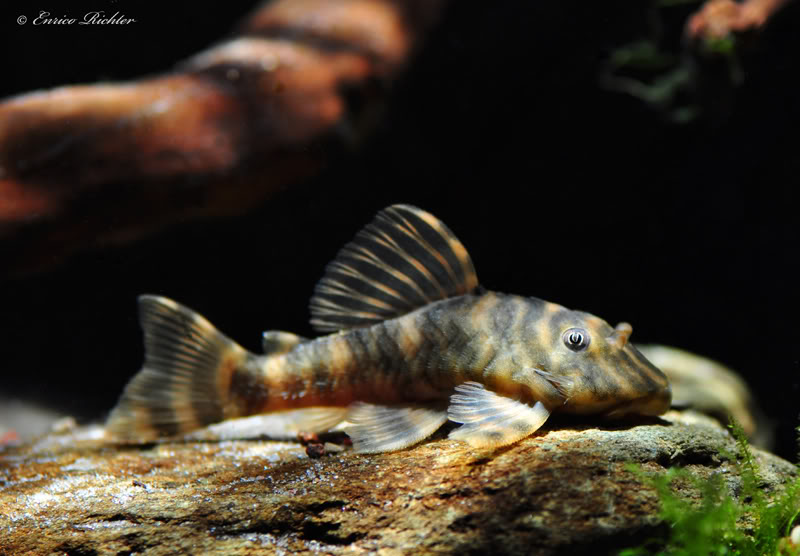
This unidentified species is collected in the vicinity of Mocajuba on the lower rio Tocantins in Pará state, Brazil.
Aquarium size
An aquarium with base dimensions of 120 ∗ 30 cm48 ∗ 12 in or equivalent should be the smallest considered.
Maintenance
Not difficult to maintain under the correct conditions; we strongly recommend keeping it in a tank designed to simulate a flowing stream with a substrate of variably-sized rocks, sand, fine gravel, and some water-worn boulders.
This can be further furnished with driftwood branches, terracotta pipes, plant pots, etc., arranged to form a network of nooks, crannies, and shaded spots, thus providing broken lines of sight.
Water conditions
These boxes carry affiliate links and we may earn a commission. What they recommend comes from each profile’s own figures, never chosen by hand or paid for.
Diet
Wild specimens are probably omnivorous foragers but with a preference for aquatic invertebrates and suchlike.
In the aquarium it does best when offered a varied diet comprising sinking dried foods, frozen Daphnia, mosquito larvae, chironomid larvae (bloodworm), and prawn/shrimp, for, example, plus some fresh fruit, parboiled potato, etc.
Home-made foods using a mixture of natural ingredients bound with gelatin are very useful since they can be tailored to contain fresh vegetables, Spirulina and meatier ingredients.
Behaviour and compatibility
Relatively peaceful but territorial with conspecifics and similarly-shaped species.
Sexual dimorphism
Adult males possess a series of odontodes on the rear portion of the body, pectoral fins and opercle.
Reproduction
Cave-spawner with the male responsible for brood care.
References
- Stawikowski, R., A. Werner and I. Seidel (2004). DATZ Special: L-Numbers. DATZ, 1-132
Species images · 1
Used with the photographer’s permission. Not licensed for reuse.
One photograph on file. More would be welcome.