Scleropages inscriptus
On this page7 sections
Quick facts
Difficulty3 of 6 measures
More bars, more demanding.
- Space
- very large tank
- Water
- unknown
- Temp
- unknown
- Temperament
- unknown
- Social
- kept alone
- Compatibility
- not a community fish
This species' distribution is unclear although individuals from the aquarium trade are said to have been collected in the Tenasserim river basin in Tananthayi Region, southern Myanmar. Type locality is 'supposedly from Tananthayi district, Tananthayi River basin, obtained dead from aquarium fish vendor at Meik'.
Etymology
Scleropages: from the Ancient Greek σκληρός (skleros), meaning 'hard', and pages (Latin derivation?), meaning 'leaves', perhaps in reference to the large body scales.
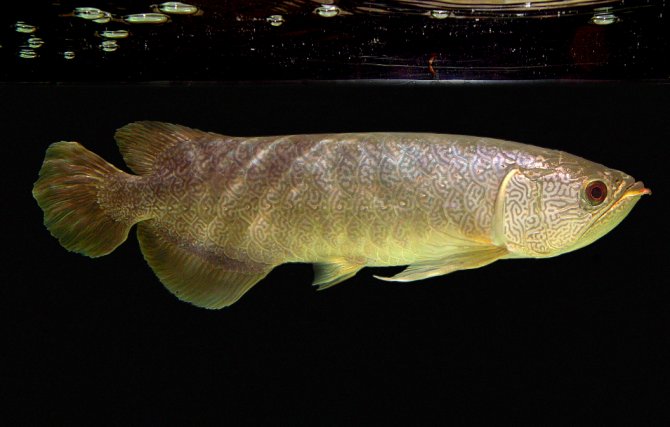
inscriptus: from the Latin inscriptus, meaning 'inscribed', in reference to the distinctive markings on the scales and facial bones.
Distribution
This species' distribution is unclear although individuals from the aquarium trade are said to have been collected in the Tenasserim river basin in Tananthayi Region, southern Myanmar.
Type locality is 'supposedly from Tananthayi district, Tananthayi River basin, obtained dead from aquarium fish vendor at Meik'.
Aquarium size
Suitable only for public installations or the very largest private aquaria.
Diet
Probably an obligate predator feeding on smaller fishes, crustaceans and other invertebrates in nature but should adapt well to dead alternatives in captivity.
Young fish can be offered chironomid larvae (bloodworm), small earthworms, chopped prawn and suchlike while adults will accept strips of fish flesh, whole prawns/shrimp, mussels, live river shrimp, larger earthworms, etc., as well as dried pellets although the latter should not form the staple diet.
This species should not be fed mammalian or avian meat such as beef heart or chicken since some of the lipids contained in these cannot be properly metabolised by the fish and may cause excess fat deposits and even organ degeneration.
Similarly there is no benefit in the use of 'feeder' fish such as livebearers or small goldfish which carry with them the risk of parasite or disease introduction and at any rate tend not have a high nutritional value unless properly conditioned beforehand.
These boxes carry affiliate links and we may earn a commission. What they recommend comes from each profile’s own figures, never chosen by hand or paid for.
Notes
This species differs from other members of the genus in possessing distinctive angulated linear markings on the dermal bones of the circumorbital and opercular series, on the sides of the head and flanks.
References
- Roberts, T. R. (2012). Scleropages inscriptus, a new fish species from the Tananthayi or Tenasserim River basin, Malay Peninsula of Myanmar (Osteoglossidae: Osteoglossiformes). Aqua 18(2), 113-118
- Kottelat, M. (2013). The fishes of the inland waters of southeast Asia: a catalogue and core bibliography of the fishes known to occur in freshwaters, mangroves and estuaries. The Raffles Bulletin of Zoology Supplement 27, 1-663
Species images · 1
Used with the photographer’s permission. Not licensed for reuse.
One photograph on file. More would be welcome.
Distribution
Profile completeness13 of 24
54% complete
Missing: water parameters, hardness, aquarium size, a common name, temperament, habitat, maintenance, water condition notes, behaviour and compatibility, sexual dimorphism, reproduction.