Every species
Every freshwater profile, A–Z.
Filters
Pseudotropheus socolofiPowder Blue Cichlid
authority not recorded
Max length115mm SL5in SLTank90 × 45cm36 × 18inTemp24–28°C75–82°FpH7.6–8.8This common mbuna also goes by the names "Eduard's mbuna" and "Pindani". It is one of the most popular Rift Lake cichlids in the hobby due to its striking colouration and somewhat peaceful nature (for a mbuna). Wild fish can now be quite difficult to find, as the vast majority of specimens offered for sale are tank-bred. An albino form exists in aquaria and has achieved a fair degree of popularity. A highly recommended beginner's mbuna....
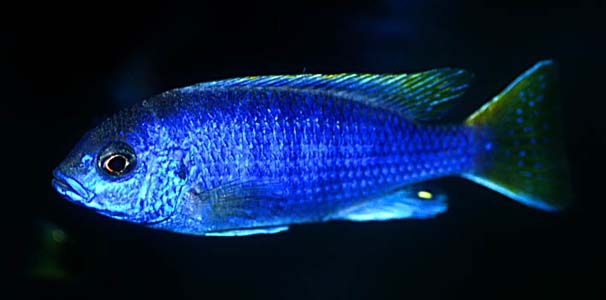
Pseudotropheus sp. 'acei'
authority not recorded
Max length125mm SL5in SLTanknot recordedTemp24–28°C75–82°FpH7.6–8.8This is an excellent beginner's species as it is relatively peaceful and easily bred. Despite being undescribed to science it is widely available in the hobby. It is sometimes sold as Gephyrochromis acei. Several colour forms are available, including "yellow tail acei" and "white tail acei". None of these should be kept together in aquaria to prevent hybridisation. In nature it feeds specifically on algae and other organisms growing on submerged wood, and is the only ...
Pseudotropheus tropheops tropheops
authority not recorded
Max length200mm SL8in SLTank120 × 38cm48 × 15inTemp24–28°C75–82°FpH7.6–8.8This species has a confusing taxonomic past. There are currently 3 subspecies, Pseudotropheus tropheops tropheops, P. t. romandi and P. t. gracilior. P. macrophthalmus and P. microstoma were also once considered as subspecies of tropheops, but are now classed as distinct species. Furthermore, it is likely that the current subspecies and their various colour forms (of which there are many) will be themselves reclassifed into the currently invalid genus Tropheops! Incidentally, none of the subspec...
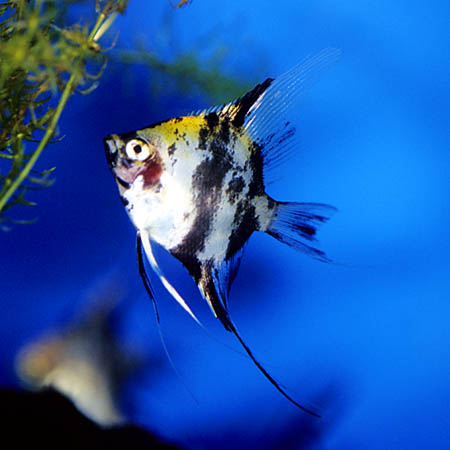
Pterophyllum "scalare"Angelfish
authority not recorded
Max length150mm SL6in SLTank100 × 40cm39 × 16inTemp24–30°C75–86°FpH6.0–7.4A well known and popular aquarium fish. Angels are available in a number of colour forms including black, gold and koi strains, in addition to the standard silver. It is worth remembering that although angels are generally peaceful, they are still cichilds so some aggression should be expected from time to time.
Pterophyllum altumAltum Angel
authority not recorded
Max length178mm SL7in SLTanknot recordedTemp28–32°C82–90°FpH4.8–6.2Altum Angels are a lot less common in the trade than their well known (arguably the best known tropical fish) relatives Pterophyllum Scalare, the common Angelfish. However, they are still available from some of the better tropical fish suppliers. They are a challenge to keep - they share all of their relatives' difficulties (susceptible to hole-in-the-head disease, very weak to nitrate buildups, extremely prone to stress-related diseases, commonly eat their own spawns etc.) and have a fe...
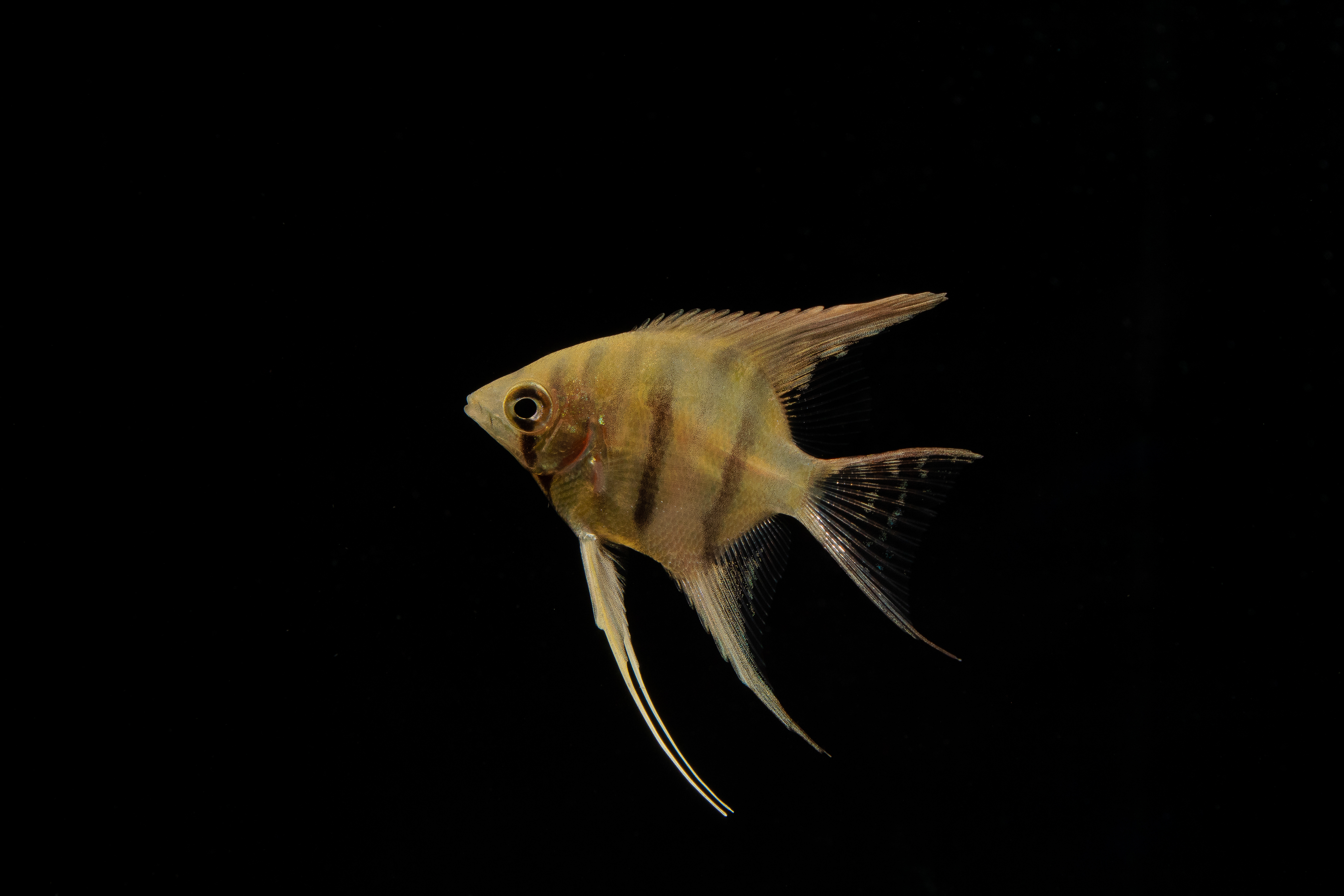
Pterophyllum leopoldiRoman Nose Angelfish
Gosse, 1963
Max length100mm SL3.9in SLTank90 × 30cm36 × 12inTemp22–29°C72–84°FpH5.0–7.0Pterophyllum leopoldi can be differentiated from other members of the genus by the presence of up to 11 vertical stripes on the body, though often only the 3 largest, boldest stripes can be seen. This species also shows a dark patch over the operculum. In adult specimens, a red/maroon hue over the back and fins is characteristic of the species, leading some to believe the most colourful natural form Angelfish. The name-sake roman nose possessed by the fish is also very distinctive and used as a meristic feature.
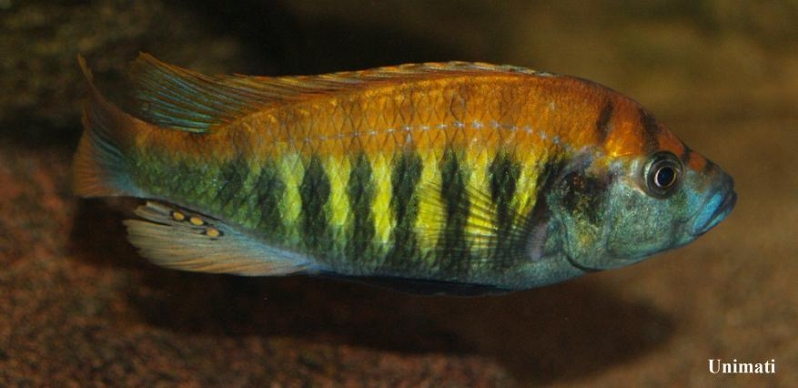
Pundamilia nyererei
Witte-Maas & Witte, 1985
Max length80mm SL3.1in SLTank120 × 45cm48 × 18inTemp23–27°C73–81°FpH7.0–8.5Endemic to Lake Victoria which has a shoreline divided between Kenya, Uganda and Tanzania, although P. nyererei has been recorded only in the southern part of the lake belonging entirely to Tanzania. Type locality is 'Mwanza Gulf, Tanzania, Lake Vic...
Pungu maclareni
authority not recorded
Max length100mm SL3.9in SLTank75 × 30cm30 × 12inTemp28–30°C82–86°FpH7.5–8.5This is currently the only described species in the genus Pungu. Because of it's its tiny natural range, habitat destruction due to excess water removal (the nearby town of Kumba relies on the lake for it's water supply), deforestation, the introduction of non-native species and overfishing, it is considered to be critically endangered and all efforts at captive breeding are to be encouraged. It is correspondingly rare in the hobby, and we suggest purchasing some only if you intend to ...
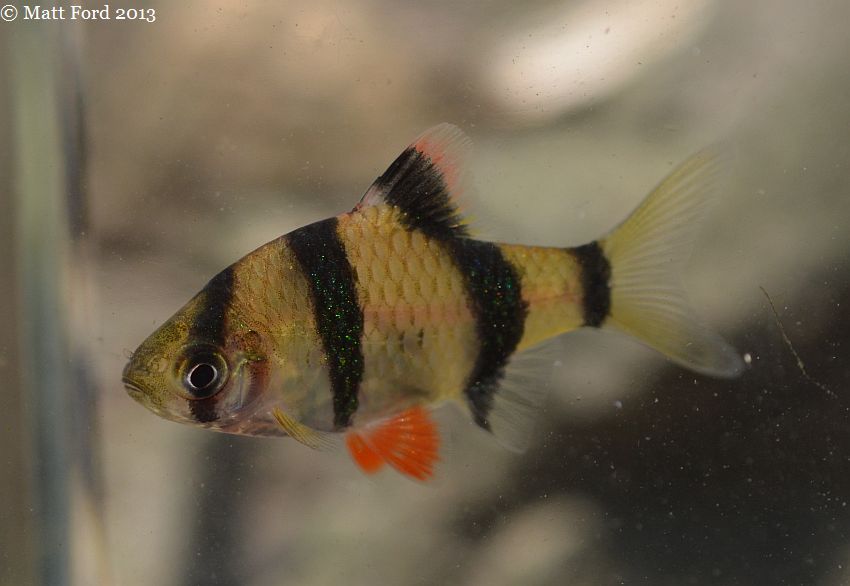
Puntigrus anchisporus
Vaillant, 1902
Max length60mm SL2.4in SLTank80 × 30cm31 × 12inTemp20–26°C68–79°FpH5.5–7.0This species occasionally appears in the aquarium hobby, but the trade is largely reliant on commercially-produced 'tiger barbs' of questionable origin. It is distinguished from congeners by the following combination of characters: lateral line complete; 14 circumpeduncular scales; 21-23+2 scales in the lateral row; dorsal-fin black with red outer band; pelvic fins red.
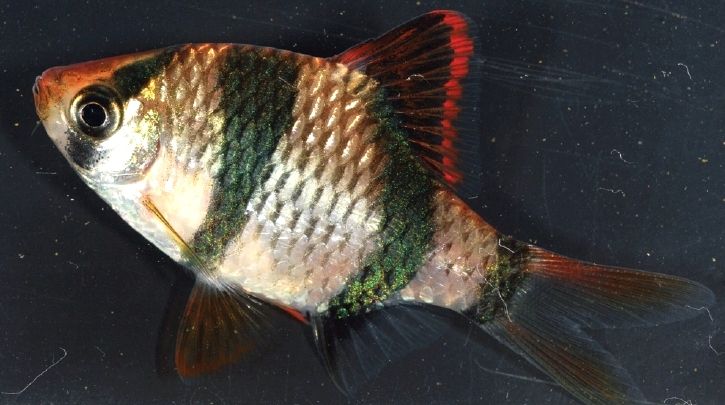
Puntigrus navjotsodhii
Tan, 2012
Max length48mm SL1.9in SLTanknot recordedTempnot recordedpHnot recordedThe type series was collected from a small clear-water stream with a pH of 6.0, forming a series of riffles and deeper pools, with a maximum width of 5 metres and depth ranging from 10 cm to 1 metre. The substrate was composed of sand gravel and rocks, with some leaf litter and overhanging marginal vegetation.
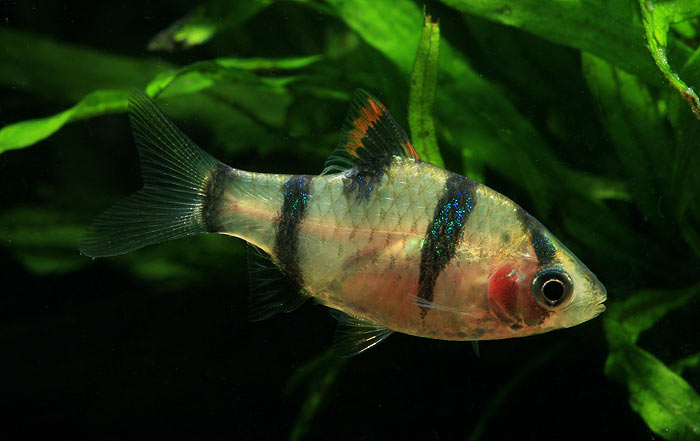
Puntigrus partipentazona
Fowler, 1934
Max length40mm SL1.6in SLTank80 × 30cm31 × 12inTemp20–26°C68–79°FpH5.0–7.0Recorded from numerous river basins in Vietnam, Cambodia, Laos, Thailand, and Peninsular Malaysia, including the Mekong, Chao Phraya, Mae Khlong, Chanthaburi, Tapi, Golok, Terengganu, Pahang, Endau, and Muar. Type locality is 'Kratt, southeastern Siam', which corresponds to modern-day Trat Province, Thailand.
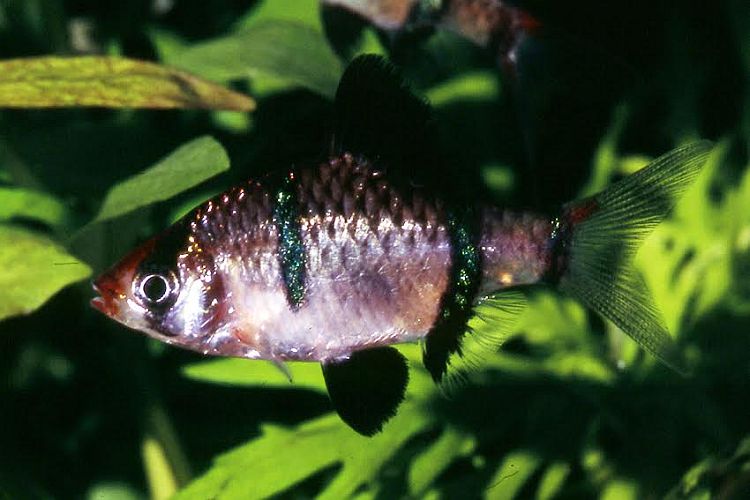
Puntigrus pulcher
Rendahl, 1922
Max length60mm SL2.4in SLTank80 × 30cm31 × 12inTemp20–26°C68–79°FpH5.0–7.5This species occasionally appears in the aquarium hobby, but the trade is largely reliant on commercially-produced 'tiger barbs' of questionable origin. It was considered a synonym of P. anchisporus for a number of decades following Alfred (1963), but revalidated by Kottelat and Tan (2011).
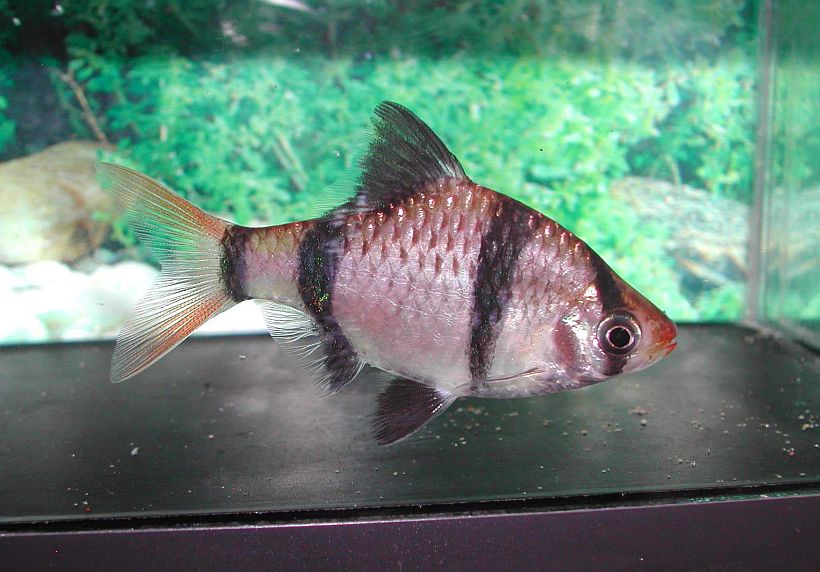
Puntigrus tetrazonaTiger Barb
Bleeker, 1855
Max length60mm SL2.4in SLTank80 × 30cm31 × 12inTemp20–26°C68–79°FpH5.0–8.0P. tetrazona is traditionally considered to be among the most ubiquitous species available in the aquarium trade. Wild examples are rarely traded, however, and there exists ongoing confusion as to the identity of the commercially-produced 'aquarium' tiger barb. A number of selectively-bred, ornamental strains are available. The albino, 'green' (aka 'moss'), and 'golden' (leucistic) variants are particularly pop...
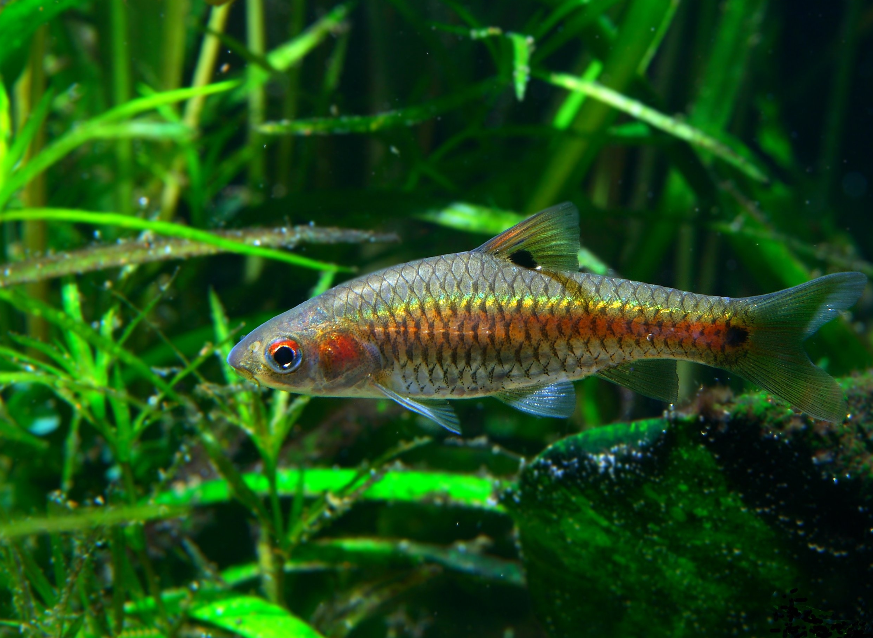
Puntius bimaculatusTwo-spotted Barb
Bleeker, 1863
Max length50mm SL2.0in SLTank60 × 30cm24 × 12inTemp18–24°C64–75°FpH6.0–7.5Generally very peaceful making it an ideal resident of the well-researched community tank. As it places no special demands in terms of water chemistry it can be combined with many of the most popular fish in the hobby including other small cyprinids as well as tetras, livebearers, rainbowfishes, anabantoids, catfishes and loaches. It's a schooling species by nature, and at least 6-10 specimens should be purchased. Maintaining it in such...
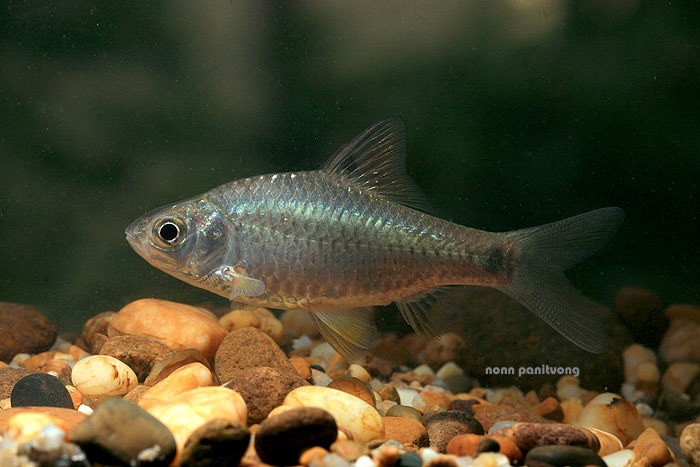
Puntius cholaSwamp Barb
Hamilton, 1822
Max length130mm SL5in SLTank120 × 45cm48 × 18inTemp18–26°C64–79°FpH5.5–8.0P. chola was retained in Puntius sensu stricto, of which members are defined by the following combination of characters: adult size usually less than 120 mm SL; maxillary barbels absent or present; rostral barbels absent; 3-4 unbranched and 8 branched dorsal-fin rays; 3 unbranched and 5 branched anal-fin rays; last unbranched dorsal-fin ray weak or strong and unserrated; lateral line complete with 22-28 pored body scales...
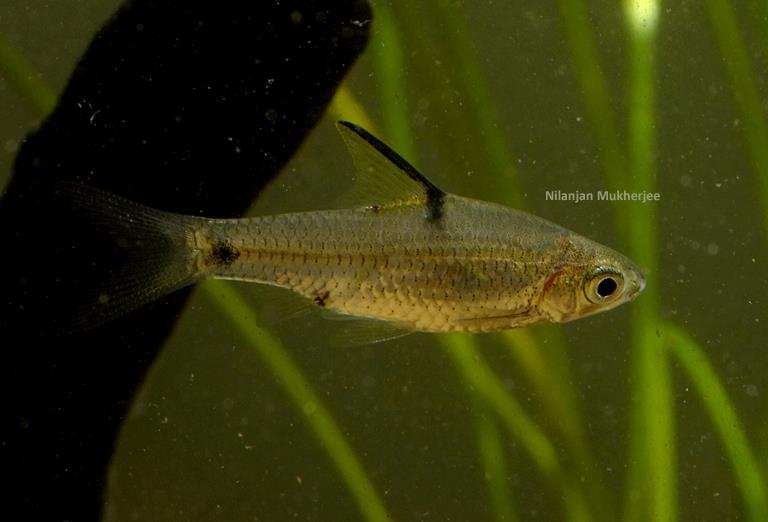
'Puntius' guganioGlass Barb
Hamilton, 1822
Max length65mm SL2.6in SLTank75 × 30cm30 × 12inTemp18–26°C64–79°FpH6.0–7.5Probably a micropredator feeding on small insects, worms, crustaceans and other zooplankton in nature. In the aquarium it should accept dried foods of a suitable size but should not be fed these exclusively. Daily meals of small live and frozen fare such as Daphnia, Artemia, Moina, etc., along with good quality flakes and granules will result in the best colouration and encourage the fish to come into breeding condition.
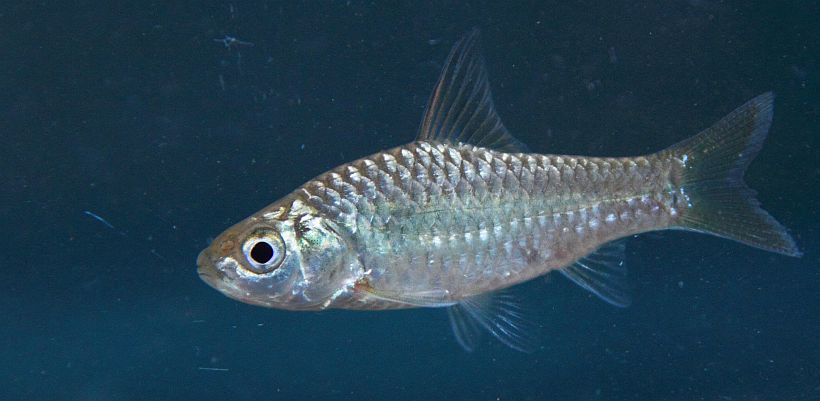
Puntius kamalikaKami's Barb
Silva, Maduwage & Pethiyagoda, 2008
Max length75mm SL3.0in SLTank120 × 30cm48 × 12inTemp20–27°C68–81°FpHnot recordedPrior to its description P. kamalika was referred to as P. amphibius, a putatively valid species probably restricted to western India. It differs from all congeners in the following combination of characters: 4½/1/2½ scales in a transverse line between the mid-dorsal...
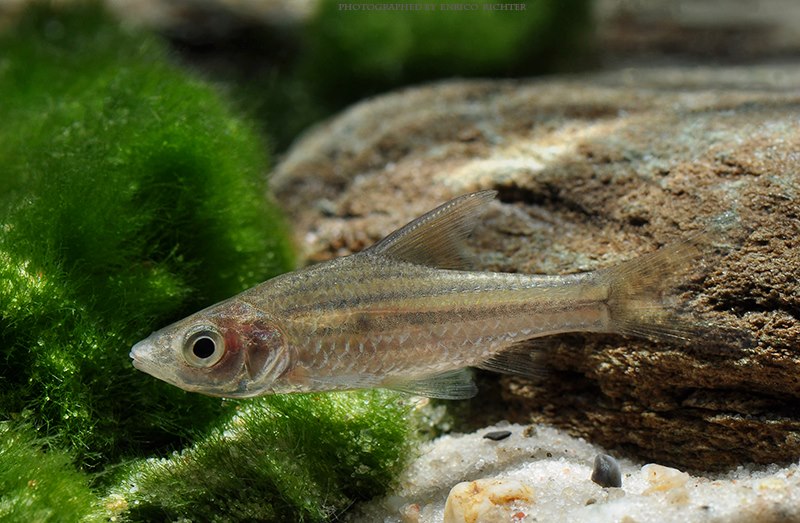
'Puntius' lineatusLined Barb
Duncker, 1904
Max length55mm SL2.2in SLTank80 × 30cm31 × 12inTemp20–26°C68–79°FpH4.0–7.0One of four similar-looking, laterally-striped 'Puntius' spp. native to Southeastern Asia alongside 'P.' gemellus, 'P.' johorensis, and 'P.' trifasciatus. Of these 'P.' lineatus is most often confused with 'P.' johorensis by virtue of the fact that these two seem most common in the aquarium trade. Telling them apart is relatively simple since 'P.' lineatus has 0 - 1 pairs of barbels (vs. 2 pairs in the other three species), juv...
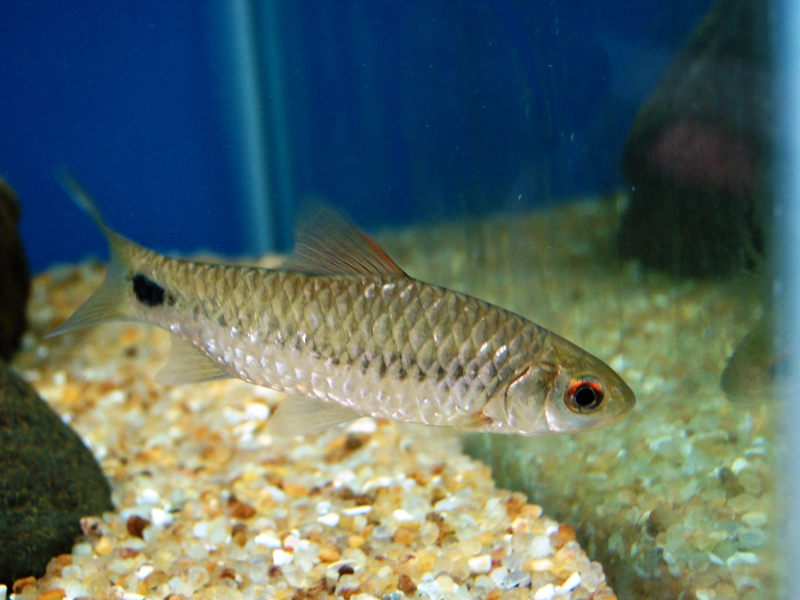
Puntius mahecola
Valenciennes, 1844
Max length75mm SL3.0in SLTank90 × 30cm36 × 12inTemp18–24°C64–75°FpH6.0–7.5This species has a chaotic taxonomic history with certain issues still to be resolved. While the name P. mahecola was misapplied to members of the genus Dawkinsia for over a century the fish itself has been widely misidentified as the congener P. amphibius (Valenciennes 1842). Its identity was partially resolved by Pethiyagoda and Kottelat (2005b) who demonstrated that though valid P. mahecola is not a Dawkinsia spp. but rather a smaller, relatively plain species with a single dark blotc...
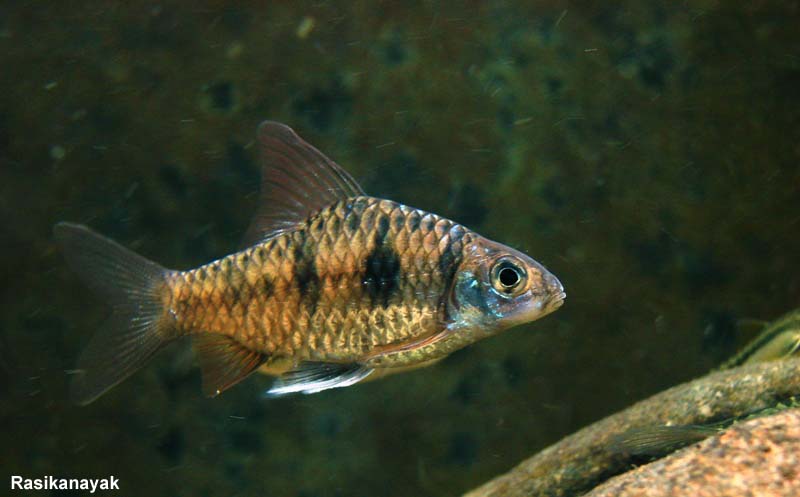
Puntius sahyadriensisMaharaja Barb
Silas, 1953
Max length65mm SL2.6in SLTank80 × 30cm31 × 12inTemp18–24°C64–75°FpH6.0–7.8The hill streams in which this fish can be found are generally shaded by the forest canopy and dense marginal vegetation. Substrates are typically composed of boulders, smaller stones, sand or gravel with submerged tree roots around the margins and quieter areas in which fallen branches and leaf litter collect. Other fish species occurring in the Tunga...