Results for “aquarium”
Type a name: scientific, common, or one a species used to go by. Or narrow the catalogue with the filters.
Filters
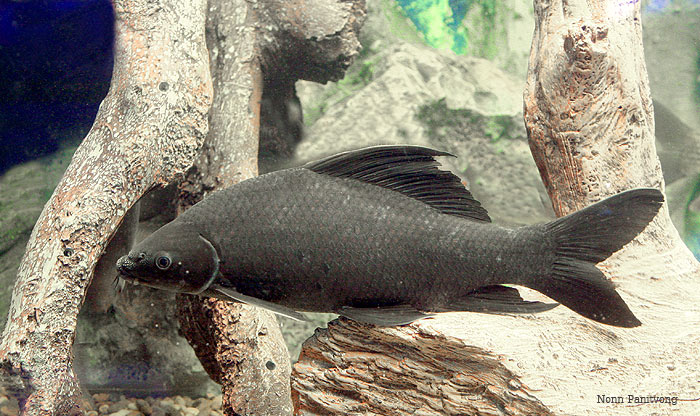
Labeo chrysophekadionBlack Shark
Bleeker, 1849
Max length600mm SL24in SLTanknot recordedTemp20–26°C68–79°FpH6.0–8.0L. chrysophekadion is also known as 'black sharkminnow'. It continues to be available in the ornamental trade despite its patent unsuitability for the home aquarium, and an albino form has been selectively bred for the purpose. It can be distinguished from other members of the genus by the following combination...
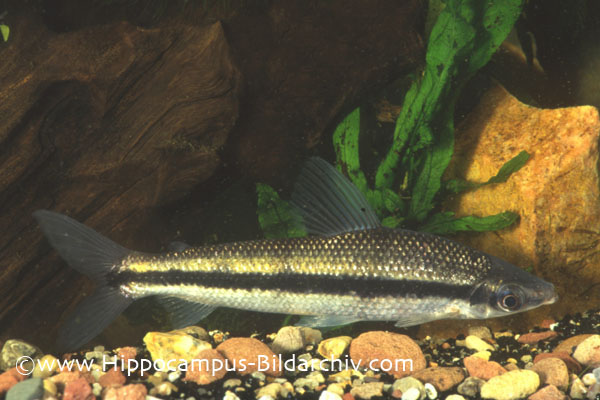
Laemolyta taeniataStriped Headstander
Kner, 1858
Max length288mm SL11in SLTank120 × 60cm48 × 24inTemp20–28°C68–82°FpH4.0–7.5L. taeniata is the largest-growing and second most widely-distributed member of the genus although it's a rarely-seen in the aquarium trade. It can be distinguished from all congeners since it uniquely possesses 5 lateral scale rows between the lateral line and dorsal-fin origin (vs. 4 or 6–8 in the remaining species).
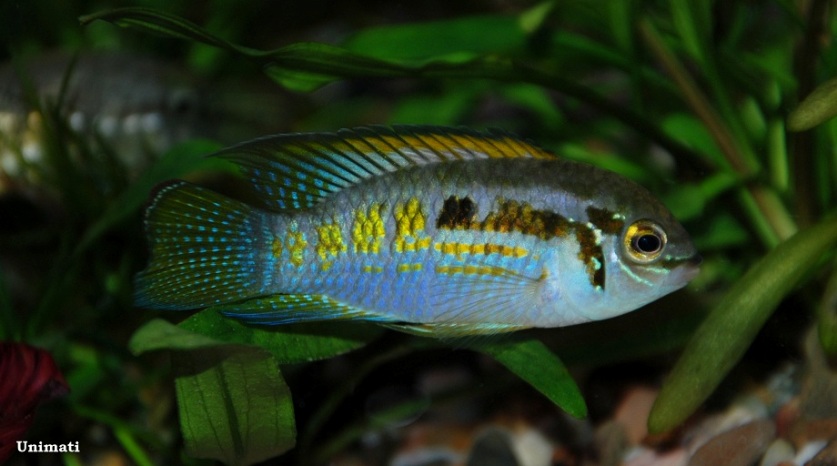
Laetacara araguaiae
Ottoni & Costa, 2009
Max length35mm SL1.4in SLTanknot recordedTempnot recordedpHnot recordedThis species was known as L. sp. 'Buckelkopf' in the aquarium hobby prior to publication of its official description. It's distinguished from all congeners by possessing 7-8 dorsal-fin rays (vs. 9–10 in L. dorsigera, L. fulvipinnis and L. thayeri, 8–9 in L. curviceps and L. flamannellus, and 9–11 in L. flavilabris).
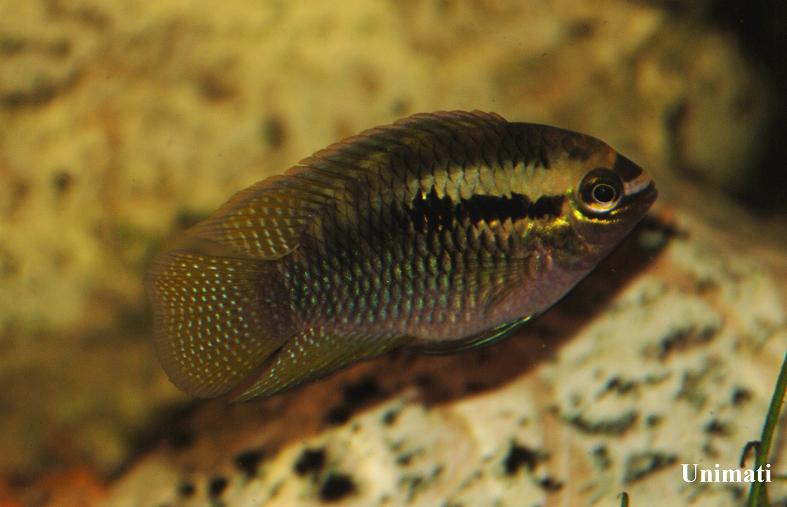
Laetacara dorsigeraRedbreast Acara
Heckel, 1840
Max length37mm SL1.5in SLTanknot recordedTemp20–28°C68–82°FpH5.0–7.5Wild fish are probably foragers feeding on algae, organic detritus, small insects, worms, crustaceans, and other zooplankton. In the aquarium it's easily-fed but the best condition and colours offer regular meals of small live and frozen foods such as bloodworm, Daphnia, and Artemia, alongside good quality dried flakes and granules, at least some of which should include additional plant or algal content.
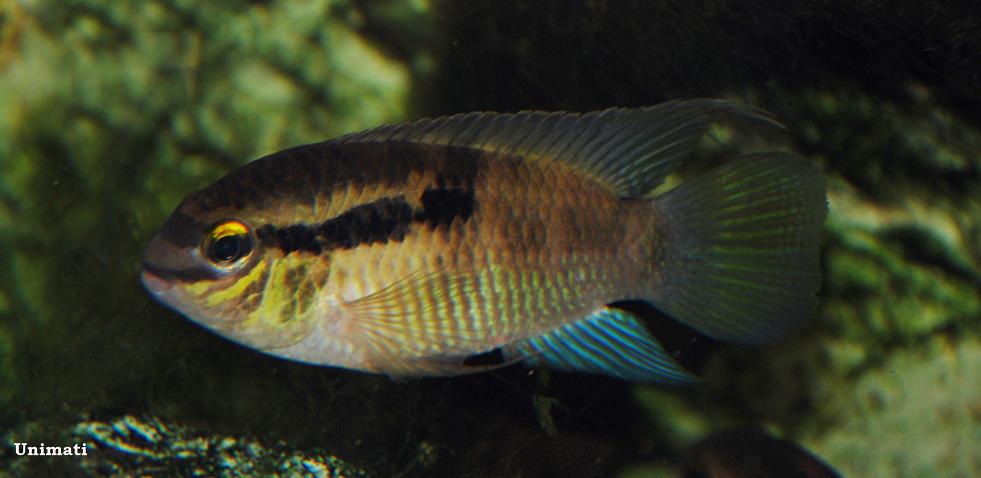
Laetacara thayeri
Steindachner, 1875
Max length65mm SL2.6in SLTanknot recordedTemp20–28°C68–82°FpH4.5–7.5This species is relatively rare in the aquarium trade. It can be differentiated from all congeners by a combination of possessing ctenoid (vs. cycloid) scales on the sides of the head plus lacking a dark spot at the caudal-fin base.
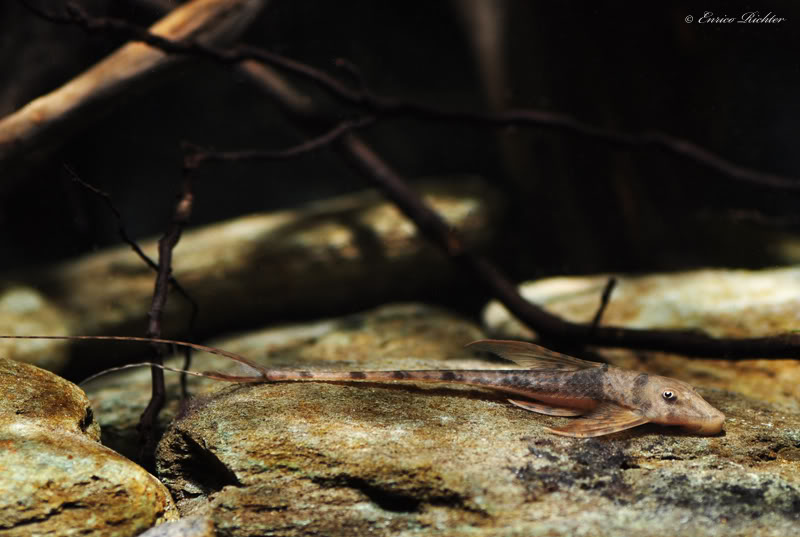
Lamontichthys filamentosusSturgeon Catfish
La Monte, 1935
Max length167mm SL7in SLTank120 × 45cm48 × 18inTemp22–30°C72–86°FpH5.5–7.5This species is relatively common in the aquarium hobby but is not easy to maintain and recommended only for experienced aquarists. It can be told apart from all congeners by specimens larger than 60 mm SL possessing an extended pectoral-fin spine forming an extremely long filament that may be more than four times the length of the first branched pectoral-fin ray (vs. not possessing such a filament in other species of Lamontichthys).
Lamprologus congoensisCongo Lamprologus
authority not recorded
Max length150mm SL6in SLTank120 × 30cm48 × 12inTemp23–25°C73–77°FpH6.0–7.5An interesting species which resembles the popular Steatocranus species, both physically and in lifestyle. It has several physiological adaptations to allow it to live in rapids and fast-moving waters. The body is very streamlined, with strong pectoral fins. The swimbladder is also modified, being much reduced in size. This makes the fish less buoyant and thus less likely to be swept away by strong currents. In the aquarium it spends most of its time on the substrate, where it swims in a comical...
Lamprologus lemairiiLemaire's Lamprologus
authority not recorded
Max length250mm SL10in SLTank120 × 45cm48 × 18inTemp23–27°C73–81°FpH7.5–9.0A highly piscivorous, predatory species unsuited to the general aquarium. It is an ambush predator in nature, often being seen hanging motionless around rocky structures or on the floor of the lake. It is a sedentary species and does not move around a lot. This is a behavioural adaptation known as thanatosis, or 'playing dead'. This strategy is usually used as a defensive means in other animals, but in L. lemairii it is adapted for offensive means. The fish has a mottled colour pattern...
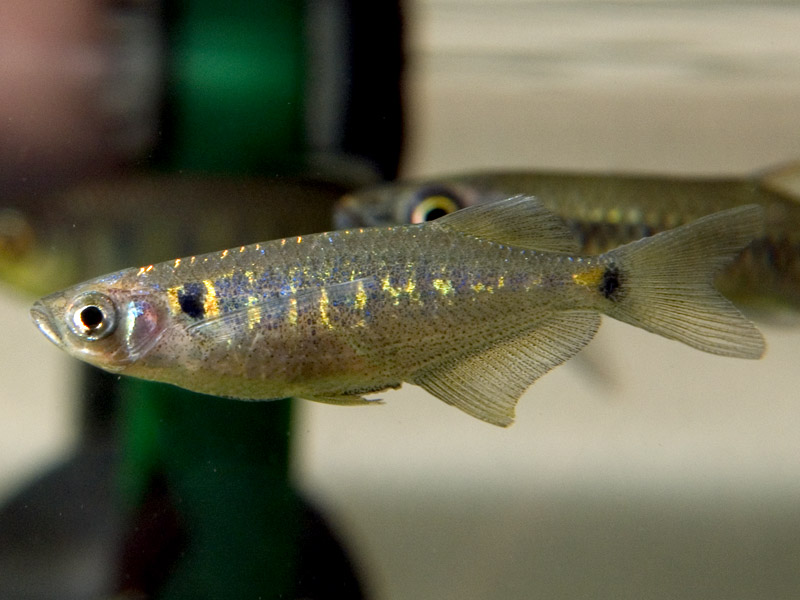
Laubuka laubucaIndian Glass Barb
Hamilton, 1822
Max length60mm SL2.4in SLTank120 × 30cm48 × 12inTemp18–24°C64–75°FpH6.0–8.0Probably endemic to northern India, Bangladesh, and Nepal. Records from Sri Lanka, southern India, Myanmar, Thailand, Laos, Cambodia, Vietnam, Malaysia, and Indonesia appear to represent other species. Given the distribution of L. siamensis, it seems likely that many of the fish entering the aquarium trade are this species and not L. laubuca. The two species can be distinguished b...
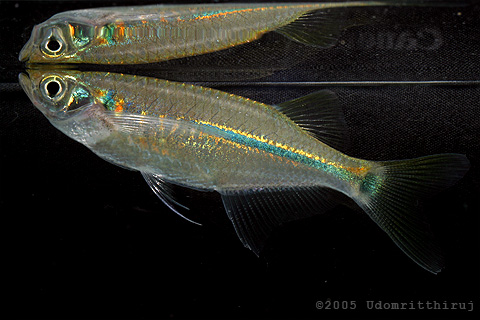
Laubuka siamensis
Fowler, 1939
Max length60mm SL2.4in SLTank120 × 30cm48 × 12inTemp20–28°C68–82°FpH6.0–7.5Considered synonymous with the congener L. laubuca for a number of years, thus reports of that species from anywhere in Indochina actually refer to the current concept of L. siamensis. Given the distribution of L. siamensis, it seems likely that many of the fish entering the aquarium trade are also this species and not L. laubuca. The two species can be distinguished by...
Leiarius longibarbisMarbled Pim
authority not recorded
Max length800mm SL31in SLTank300 × 90cm118 × 36inTemp21–26°C70–79°FpH5.8–7.4It's debatable as to whether this species should be considered an aquarium subject at all, given its eventual size. All too often, juveniles are sold without adequate information regarding their long term care. These cats can and will attain something close to their maximum size in captivity, and will do so quite quickly. The myth that they will only grow to match the size of the tank they're kept in is just that. It's also worth noting that species such as this can live for well ...
Leiarius pictusSailfin Pim
authority not recorded
Max length600mm SL24in SLTank240 × 90cm96 × 36inTemp22–26°C72–79°FpH6.2–7.6Also known as the painted, saddle or marbled sailfin catfish, it's debatable as to whether this species should be considered an aquarium subject at all given its eventual size. All too often, juveniles are sold without adequate information regarding their long term care. These cats can and will attain something close to their maximum size in captivity, and will do so quite quickly. The myth that they will only grow to match the size of the tank they're kept in is just that. It's a...
Lepidosiren paradoxaSouth American Lungfish
authority not recorded
Max length1250mm SL49in SLTank240 × 90cm96 × 36inTemp24–28°C75–82°FpH6.0–8.0Lungfish are among the most intriguing of "oddball" aquarium species, being able to survive in extreme conditions. They are very ancient fish, having remained virtually unchanged for millions of years. This is the only species known from South America, and is the sole representative of its genus. Most hail from Africa, with a single species native to Australia. They belong to the class Sarcopterygii (lobe-finned fishes), members of which are actually more closely related to terrestrial...
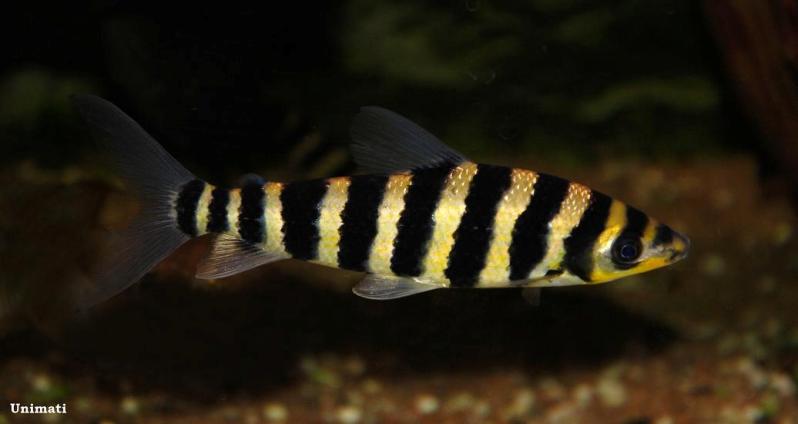
Leporinus fasciatusBanded Leporinus
Bloch, 1794
Max length270mm SL11in SLTank210 × 60cm84 × 24inTemp20–28°C68–82°FpH5.0–7.5This species is also referred to as 'black-anded leporinus', 'striped leporinus' and 'eight-banded leporinus'. Young specimens are often traded for aquaria without warning as to their potential size and requirements, and as a result it's fairly ubiquitous in public aquarium displays.
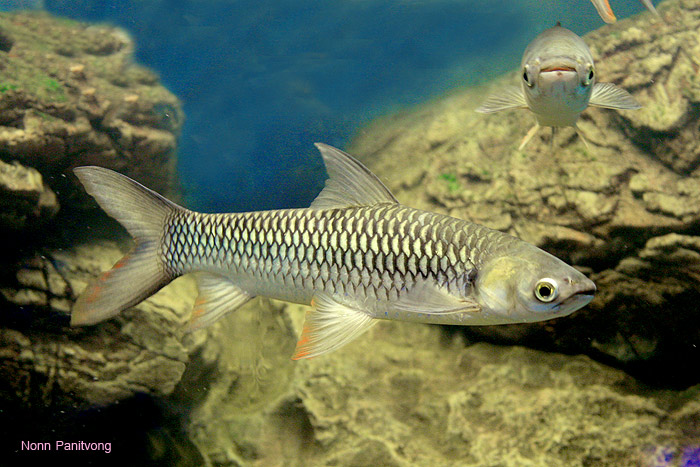
Leptobarbus rubripinnaRed-finned Cigar Shark
Fowler, 1937
Max length1000mm SL39in SLTanknot recordedTemp20–26°C68–79°FpH6.0–8.0This species was referred to as its congener Leptobarbus hoevenii for a number of decades and continues to be misidentified as such in the aquarium hobby, with both species traded under the same name. It is a popular sport fish in its native countries and is wholly unsuitable for private aquaria. Unfortunately it is...
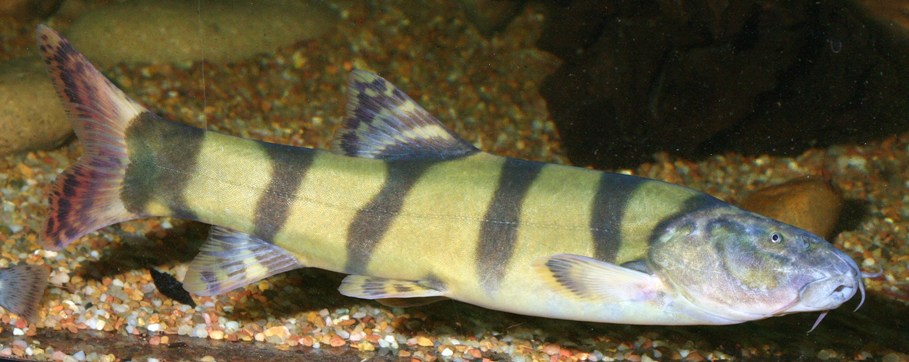
Leptobotia elongataImperial Flower Loach
Bleeker, 1870
Max length500mm SL20in SLTank360 × 90cm142 × 36inTemp15.5–21°C60–70°FpH6.5–7.5This species is rare in the aquarium trade, increasingly so in nature and as a result prohibitively expensive when available. Given its adult size and probable longevity this is therefore a species for the specialist possessing the necessary time, money and dedication to house it long term.
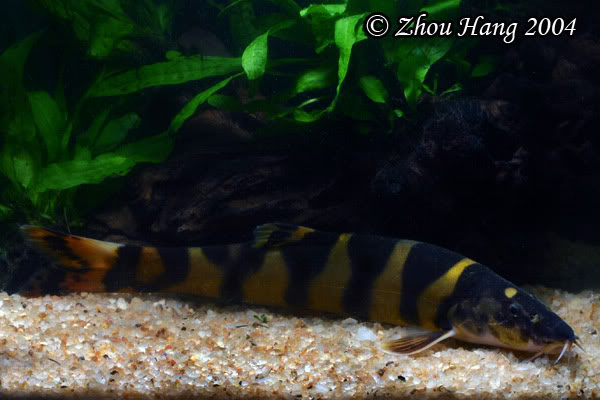
Leptobotia pellegrini
Fang, 1936
Max length200mm SL8in SLTank120 × 45cm48 × 18inTemp20–24°C68–75°FpH6.5–8.0Described from Sichuan province, southwestern China (presumably the upper Yangzte River, aka Chang Jiang, drainage) and also known from parts of the Pearl River (Zhu Jiang) basin in Guangxi Autonomous Region. The latter area is one of the most populous and industrialised in China meaning much of the main river channel is now highly polluted. Its relatively wide distribution probably explains why it's commoner in the aquarium hobby than the similar-looking...
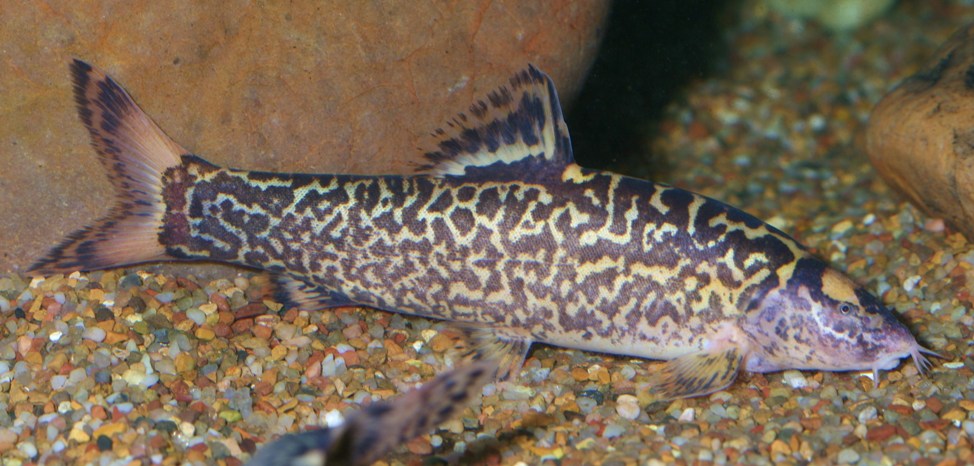
Leptobotia taeniops
Sauvage, 1878
Max length150mm SL6in SLTank120 × 45cm48 × 18inTemp15.5–21°C60–70°FpH6.5–7.5L. taeniops is almost unheard of in the aquarium trade although we know of one or two private collectors maintaining it. It was previously included in the related genus Parabotia. L. elongata is the type species of the genus but according to current thinking there exi...
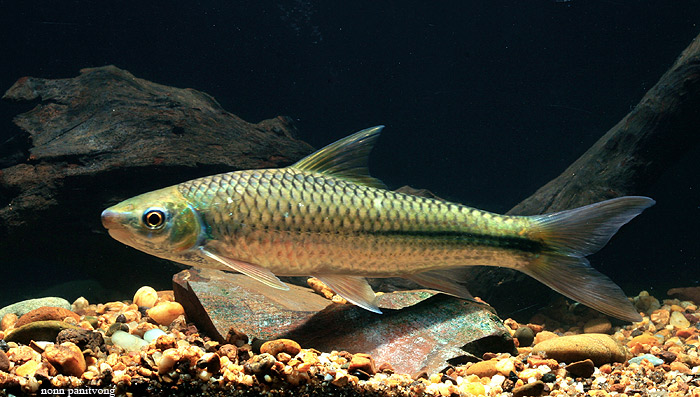
Lobocheilos melanotaenia
Fowler, 1935
Max length200mm SL8in SLTank180 × 60cm72 × 24inTemp20–26°C68–79°FpH6.0–8.0The majority of Lobocheilos species are endemic to the Greater Sunda Islands of Borneo, Sumatra, and Java, and are uncommon in the aquarium trade, but the widespread Indochinese taxa L. melanotaenia and L. rhabdoura are available on a sporadic basis. L. melanotaenia can be distinguished from L. rhabdoura by the following comb...
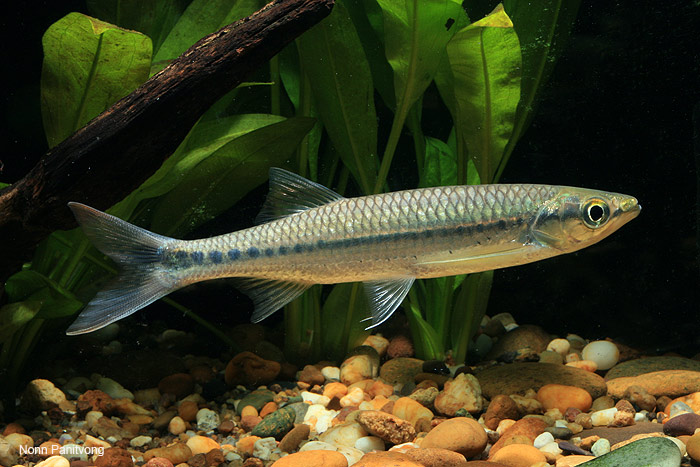
Luciosoma setigerumApollo Shark
Valenciennes, 1842
Max length220mm SL9in SLTank240 × 60cm96 × 24inTemp20–26°C68–79°FpH6.0–8.0There is a fish of unknown geographical origin which matches the majority of diagnostic features for L. setigerum with the exception that the dark lateral stripe is absent in the anterior portion of the body and is not composed of interconnected spots. It is relatively common in the aquarium trade and included here as L. cf. setigerum until a confirmed identity is established.