Results for “lateral line”
Type a name: scientific, common, or one a species used to go by. Or narrow the catalogue with the filters.
Filters
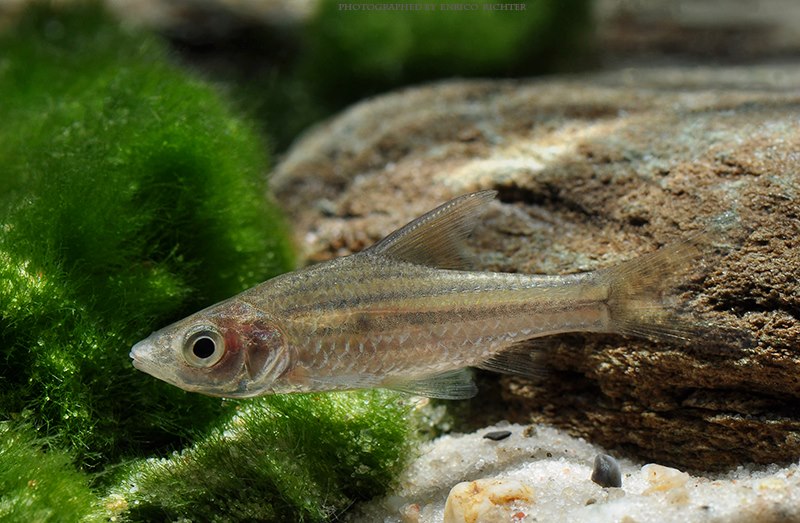
'Puntius' lineatusLined Barb
Duncker, 1904
Max length55mm SL2.2in SLTank80 × 30cm31 × 12inTemp20–26°C68–79°FpH4.0–7.0One of four similar-looking, laterally-striped 'Puntius' spp. native to Southeastern Asia alongside 'P.' gemellus, 'P.' johorensis, and 'P.' trifasciatus. Of these 'P.' lineatus is most often confused with 'P.' johorensis by virtue of the fact that these two seem most common in the aquarium trade. Telling them apart is relatively simple since 'P.' lineatus has 0 - 1 pairs of barbels (vs. 2 pairs in the other three species), juv...
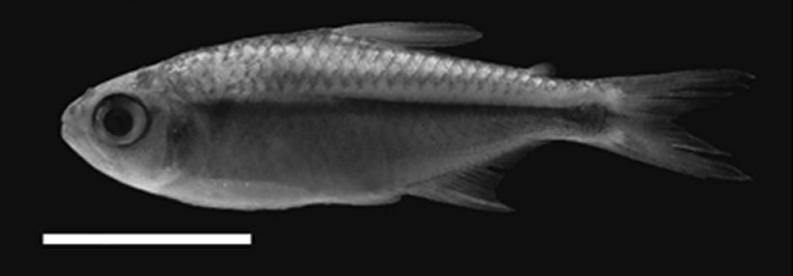
Hyphessobrycon acaciae
García-Alzate, Román-Valencia & Prada-Pedreros, 2010
Max length30mm SL1.2in SLTanknot recordedTempnot recordedpHnot recordedIt differs from H. paucilepis by possessing 30-31 scales in the lateral row (vs. 28-29), 3 scales between the lateral line and anal-fin (vs. 4), 10 predorsal scales (vs. 9), ii, 9 dorsal-fin rays (vs. iii, 8), 4 maxillary teeth (vs. 1), and the distance between the dorsal-fi...
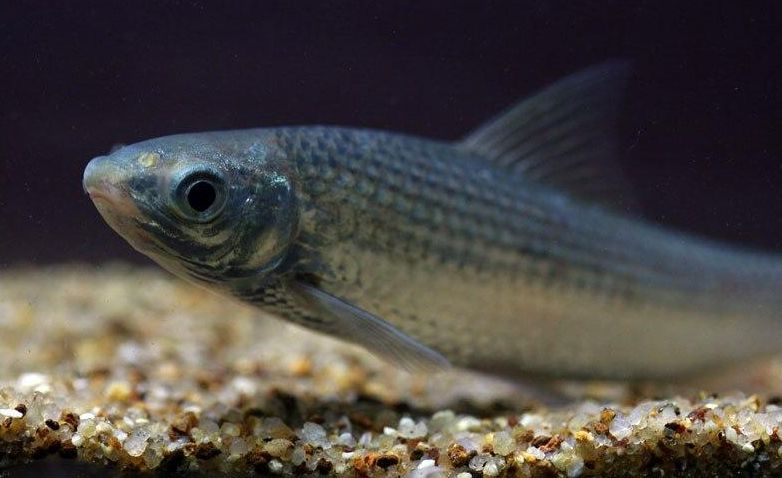
Gymnostomus ariza
Hamilton, 1807
Max length300mm SL12in SLTanknot recordedTempnot recordedpHnot recordedFollowing Roberts (1997) G. ariza can be diagnosed by the following combination of characters: body with variably intense thin stripes dustributed mostly above the lateral line; larger individuals sometimes with a broad midlateral stripe; 32-35 lateral scales; 7-8/1/5-6 transverse scale rows; 8-9 branched dorsal-fin rays 8-9; 22-24+ 11-12=34(4), 35 (3) vertebrae; live colour pattern variable, overall dull dirty white to greyish, silvery or yellow.
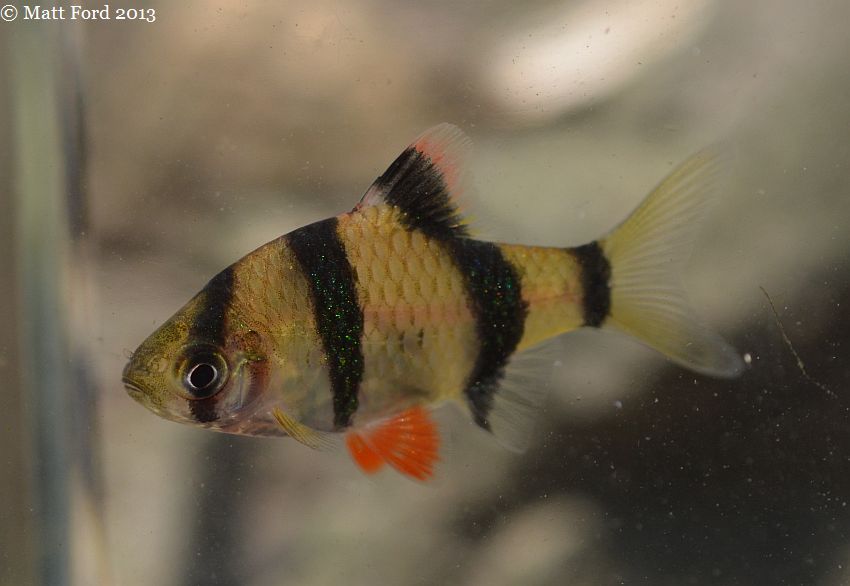
Puntigrus anchisporus
Vaillant, 1902
Max length60mm SL2.4in SLTank80 × 30cm31 × 12inTemp20–26°C68–79°FpH5.5–7.0This species occasionally appears in the aquarium hobby, but the trade is largely reliant on commercially-produced 'tiger barbs' of questionable origin. It is distinguished from congeners by the following combination of characters: lateral line complete; 14 circumpeduncular scales; 21-23+2 scales in the lateral row; dorsal-fin black with red outer band; pelvic fins red.
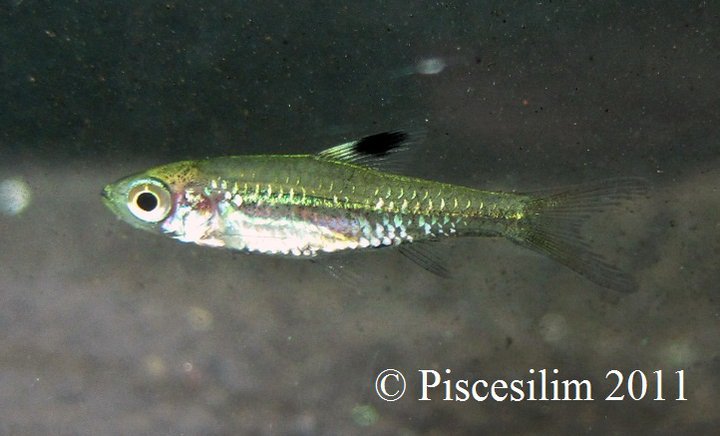
Brevibora cheeya
Liao & Tan, 2011
Max length55mm SL2.2in SLTank80 × 30cm31 × 12inTemp20–25°C68–77°FpH4.0–7.0This species is very rare in the trade and is normally imported only as bycatch among shipments of other fishes. It can be told apart from its well-known congener B. dorsiocellata by a combination of characters as follows: lateral line complete (25-30 pored scales vs. 4-9); more scales in the lateral row (29-32 vs. 25-27); larger adult siz...
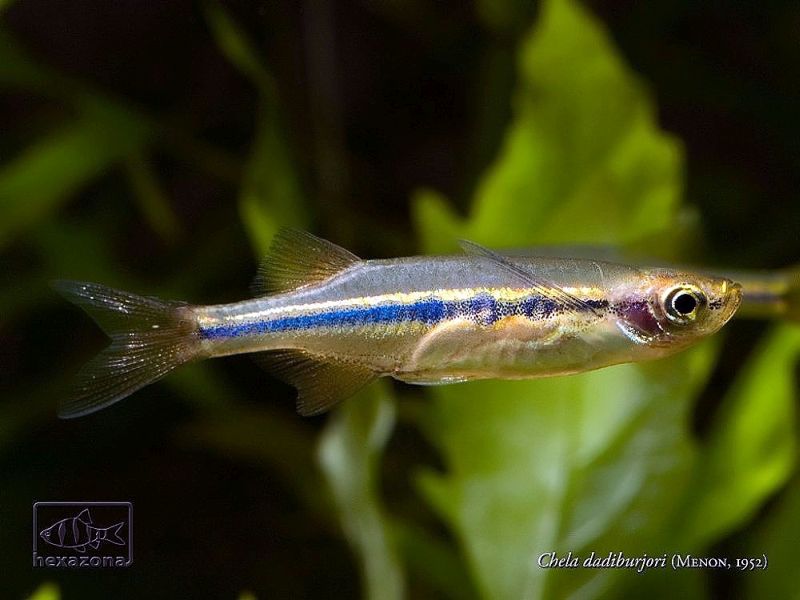
Laubuka dadiburjoriDadio
Menon, 1952
Max length30mm SL1.2in SLTank90 × 30cm36 × 12inTemp20–24°C68–75°FpH6.0–7.5It can be distinguished from other members of the genus by the following characters: lateral line absent or perforating only 2-5 scales; pharyngeal teeth hooked; body size small, not exceeding 30 mm SL; body depth less than 25 % SL; colour pattern comprising a dark bluish lateral stripe extending from the eye to the caudal peduncle, typically, but not always, forming 2-5 circular spots along its length.
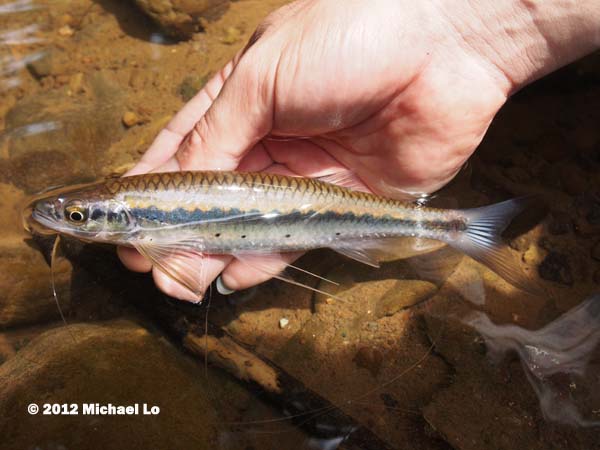
Luciosoma pellegrinii
Popta, 1905
Max length170mm SL7in SLTanknot recordedTempnot recordedpHnot recordedThe five species which currently comprise Luciosoma can be distinguished by elements of colour pattern. Popta described the colour pattern of L. pellegrinii as follows: body colour olive dorsally, with dark-edged scales, yellow ventrally; a lateral series of dark spots on the flank forming a midlateral band which extends onto the opercle but not the head; 4-8 blackish-brown, distinctly-separate spots on the lateral line; fins yellow; dorsal and anal fins with a blackish-brown band; anterior half of some pectoral-fin rays blackish-brown...
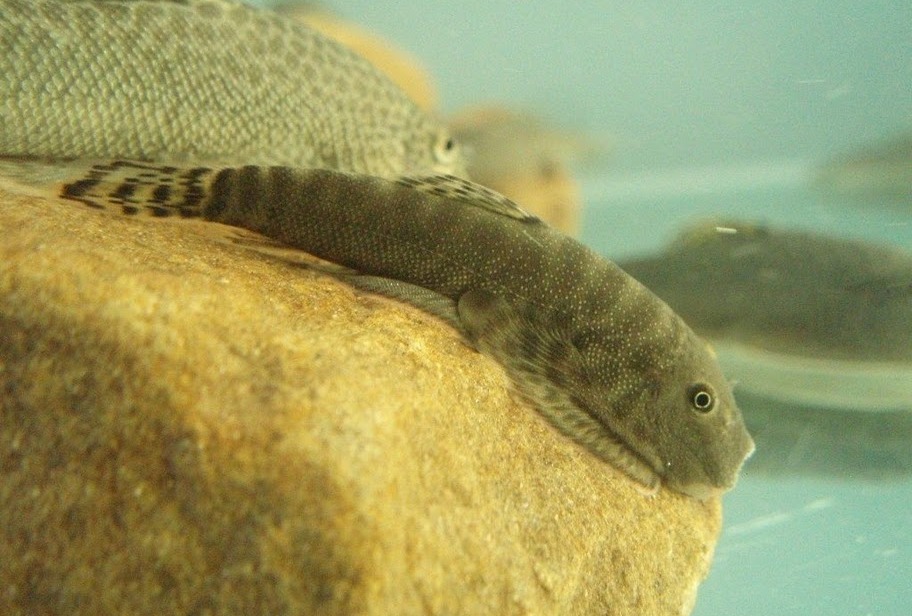
Gastromyzon cornusaccus
Tan, 2006
Max length50mm SL2.0in SLTank75 × 30cm30 × 12inTemp20–24°C68–75°FpH6.0–8.0G. cornusaccus can be distinguished from congeners by the following combination of characters: secondary rostrum present; incomplete postoral pouch present reduced to pockets located posterior to mouth corners; sublacrymal groove present and visible when viewed laterally; juveniles with thick, cream-coloured bars and blotches on body, adults uniformly-coloured; head dorsum plain; subopercular groove absent; gill slit vertical; snout truncate when viewed dorsally; no scales on abdomen; 55-61 lateral line scale...
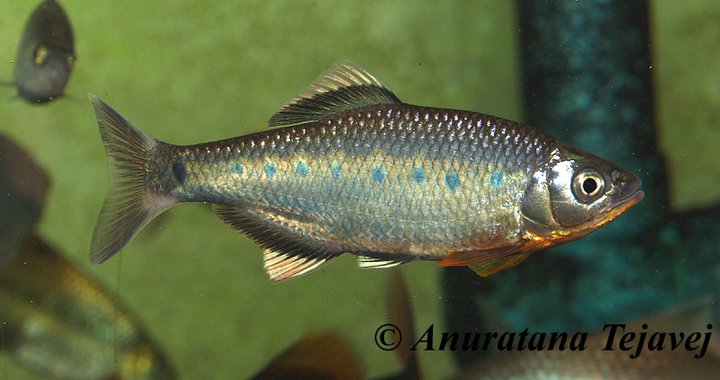
Barilius bakeri
Day, 1865
Max length130mm SL5in SLTank150 × 60cm60 × 24inTemp18–26°C64–79°FpH6.0–7.5This species is traded under several names including 'royal danio', 'blue-spotted hill trout', and 'blue-dotted mirror fish'. It can be distinguished from congeners by possessing a single row of bluish-green spots along the length of the body, white margins on the dorsal and anal fins, 37-38+1 lateral line scales, and fleshy rudi...
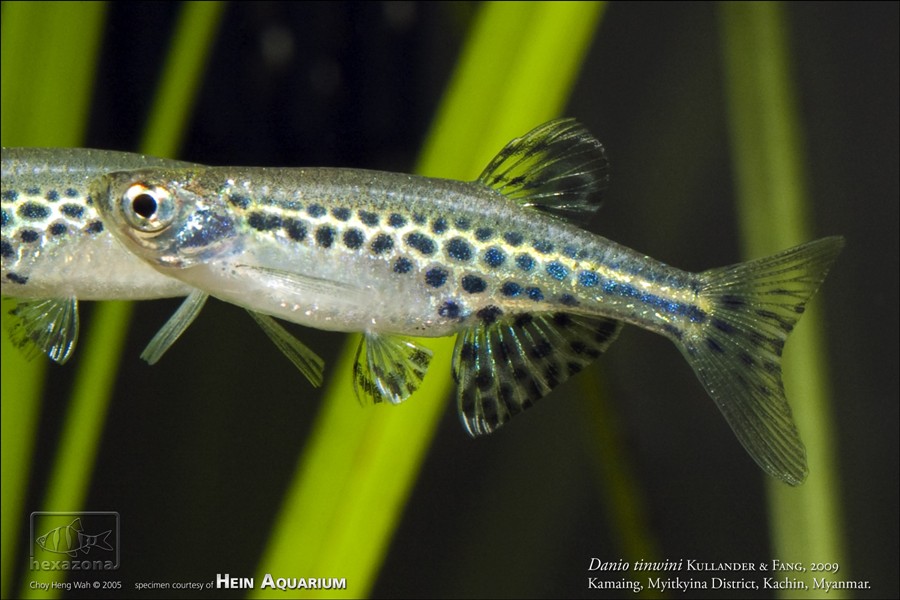
Brachydanio tinwiniGold Ring 'Danio'
Kullander & Fang, 2009
Max length30mm SL1.2in SLTank45 × 30cm18 × 12inTemp18–26°C64–79°FpH6.5–7.5Adult size is comparable to B. nigrofasciata, and in the description paper the authors hypothesise that the two are closely-related given they share other features such as similar barbel length (plus some additional merisitic counts), absent lateral line and spotted pelvic fins. The two are easy to tell apart, however, since in B. tinwini the P+1 stripe is composed of a series of spots (vs. solid), it possesses an indistinct P+2 str...
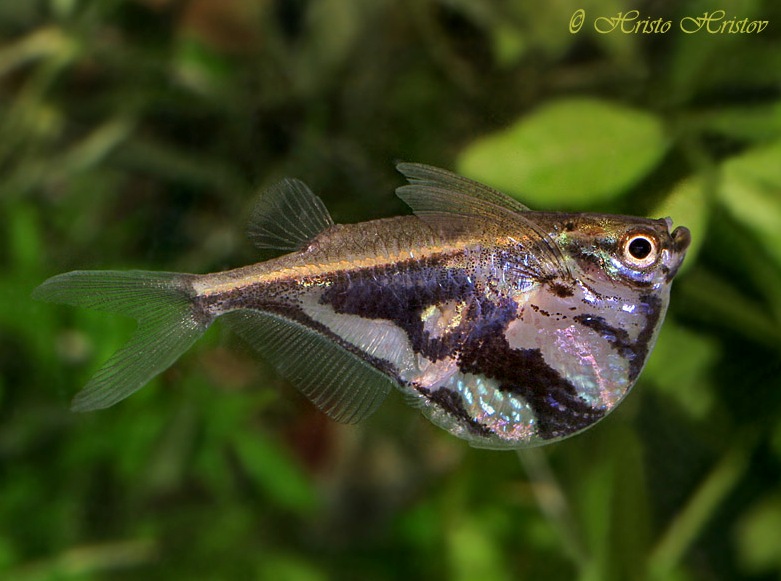
Carnegiella strigataMarbled Hatchetfish
Günther, 1864
Max length35mm SL1.4in SLTank75 × 30cm30 × 12inTemp20–28°C68–82°FpH4.0–7.0C. strigata is an enduringly popular species in the aquarium hobby but is not bred on a commercial basis with all fish offered for sale collected in the wild. It can be told apart from other members of the genus by its larger adult size and dark, marbled colour pattern appearing as a series of dark and light stripes running diagonally across the body below the lateral line. This colour pattern is variable and popul...
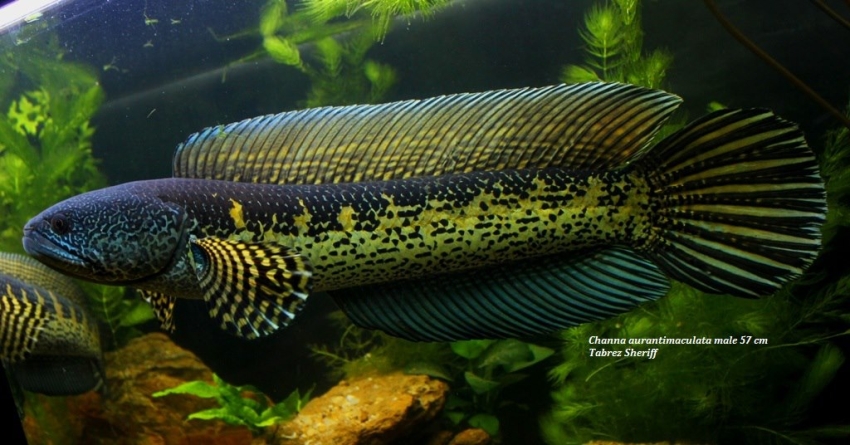
Channa aurantimaculataOrange-spotted Snakehead
Musikasinthorn, 2000
Max length400mm SL16in SLTank150 × 60cm60 × 24inTemp10–28°C50–82°FpH6.0–8.0This species is also traded as 'golden cobra snakehead' and is available in the aquarium trade on a regular basis. It can be distinguished from other Channa species by the following combination of characters: 51-54 lateral line scales; 45-47 dorsal-fin rays; 28-30 anal-fin rays; 8-12 cheek scales; 50-52 total verte...
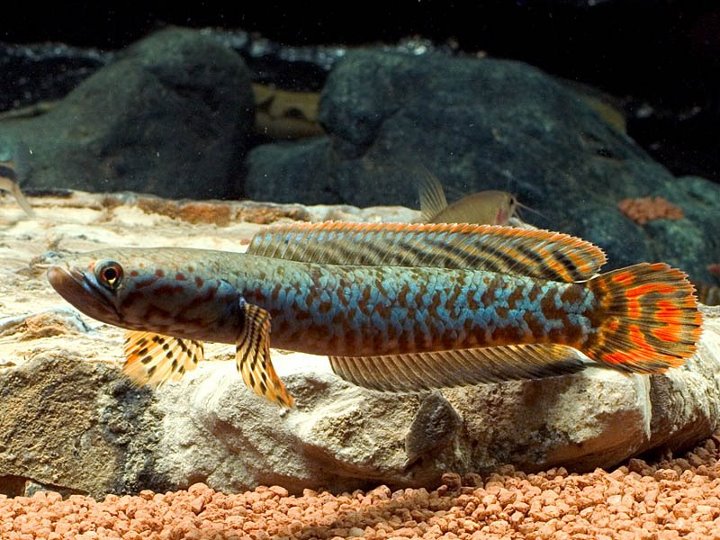
Channa bleheriRainbow snakehead
Vierke, 1991
Max length170mm SL7in SLTank120 × 30cm48 × 12inTemp14–28°C57–82°FpH6.0–8.0C. bleheri is a popular aquarium fish though it remains unclear whether collection for the ornamentaol trade is having a detrimental effect on wild populations (see 'Habitat'). It's one of several genus members to lack pelvic fins and can be further distinguished from other Channa species by the following combination of characters: sides of lower jaw with one large cycloid scale; lateral line complete with 46-50 scales; 14 pectoral-fin rays; 25 anal-fin rays; 4-11 irregular reddish orange markings on the caudal-fin
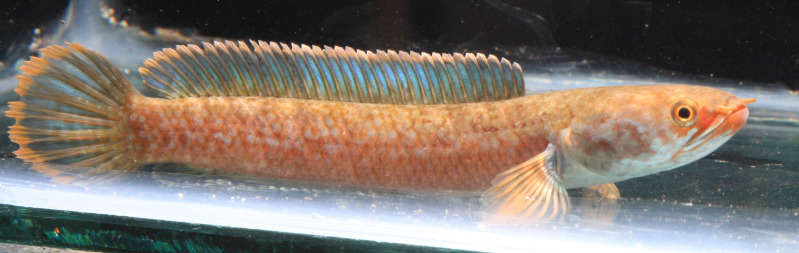
Channa burmanica
Chaudhuri, 1919
Max length200mm SL8in SLTank120 × 45cm48 × 18inTemp10–22°C50–72°FpH6.0–8.0It's one of several genus members to lack pelvic fins and following Chaudhuri (1919) also has 51 lateral line scales, 38 dorsal-fin rays, 28 anal-fin rays, 12 caudal-fin rays, 15 predorsal scales, pectoral-fins with alternating dark and light bands, and white-tipped dorsal...
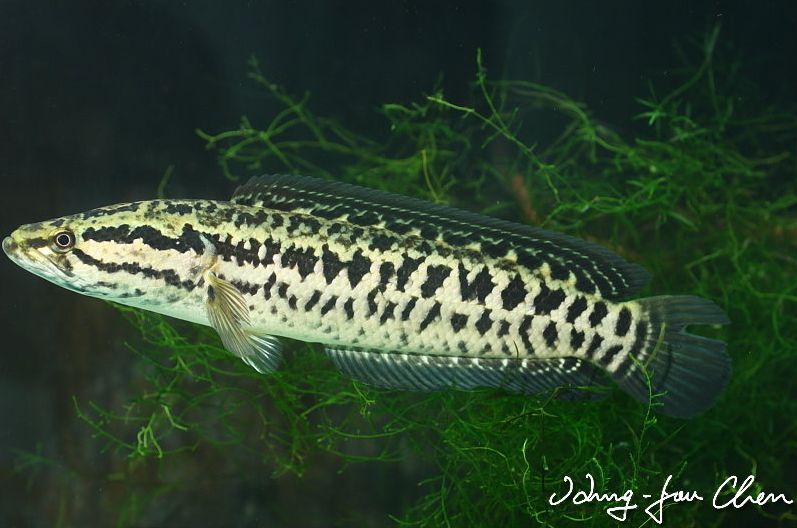
Channa maculataBlotched Snakehead
Lacepède, 1801
Max length300mm SL12in SLTanknot recordedTempnot recordedpHnot recordedThis species is frequently confused with C. argus but can be distinguished by the following characters: dorsal-fin rays 38-45 (vs. 47-50 in C. argus); anal fin rays 26-29 (vs. 31-36); lateral line scales 50-56 (vs. 60-66); 2-3 rounded blotches on caudal peduncle (vs. no blotches on caudal peduncle). It is widely-distributed in Pacific coastal drainages of southeastern China (e.g. the Yangtze, Minjiang, Hangjiang River, and Pearl (Nanjiu...
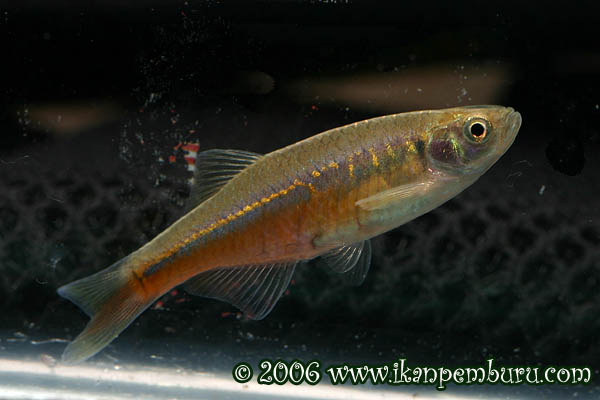
Devario chrysotaeniatus
Chu, 1981
Max length75mm SL3.0in SLTank120 × 30cm48 × 12inTemp23–26°C73–79°FpH6.0–7.0This species is poorly known and first appeared in the hobby during 2005 but has rarely been seen since, probably because its natural waters lie outside the range of most commercial collectors. It can be distinguished by a combination of characters including: lateral line complete; infraorbital process absent; two pairs of short barbels; 8-9 branched dorsal fin rays; 12-13 branched anal fin rays; P stripe originating above pelvic fin and extending to en...
Dianema longibarbisPorthole Catfish
authority not recorded
Max length100mm SL3.9in SLTank90 × 38cm36 × 15inTemp24–28°C75–82°FpH5.5–7.5So named because of the row of spots running along the lateral line, the porthole cat is a good community species. Newly imported fish tend to be a little delicate and are susceptible to disease. This is at least in part because all specimens sold for the trade are wild caught. Once acclimatised, it usually proves very hardy and can be exceptionally long-lived for a fish of this size, having the potential to survive for over 10 years....
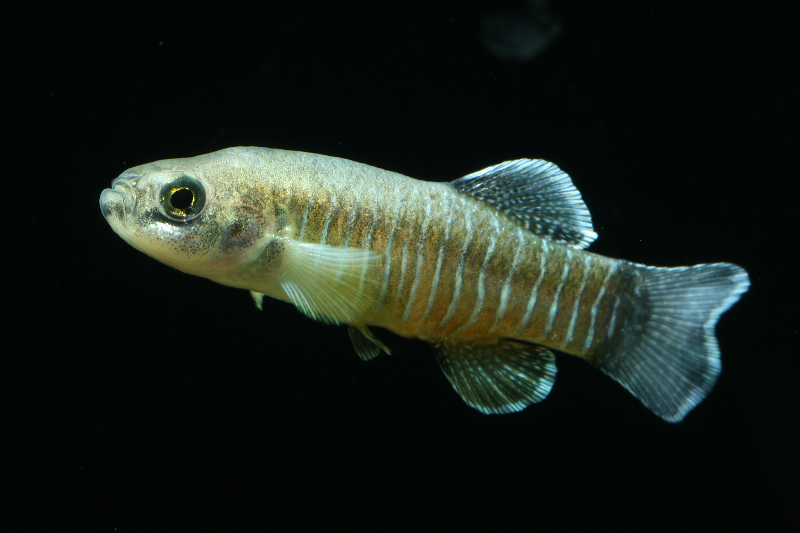
Esmaeilius arakensisArak Toothcarp
Teimori, Esmaeili, Gholami, Zarei, & Reichenbacher, 2012
Max length35mm SL1.4in SLTank120 × 30cm48 × 12inTemp8–32°C46–90°FpH7.0–8.5This species was available in the aquarium hobby for a number of years prior to publication of the official description and was generally referred to as A. sp. 'Namak' or A. sp. 'Namak River'. It can be distinguished from other members of the genus by the following combination of characters: 10–12 anal-fin rays; 28–32 lateral line scales, 10–13 caudal peduncle scales; 8–10 gill rakers; 12–19, commonly 1...
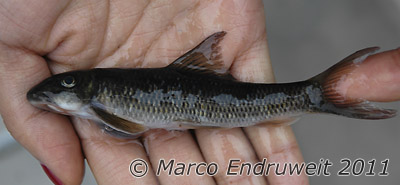
Garra imberba
Garman, 1912
Max length120mm SL5in SLTanknot recordedTempnot recordedpHnot recordedThis species can be distinguished from congeners inhabiting the Red River basin in Yunnan province, China, by the following combination of characters: no barbels; 46-52 lateral line scales; 16 circumpeduncular scales; pharyngeal teeth in 3 rows, 2.4.5-5.4.2; snout rounded, no secondary rostrum, no longitudinal...
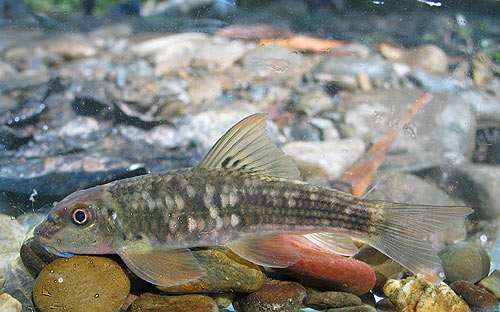
Garra notata
Blyth, 1860
Max length120mm SL5in SLTanknot recordedTempnot recordedpHnot recordedG. notata is one of a number of congeners to lack both a transverse groove and a proboscis on the snout. It also possesses 33-34 lateral line scales and a series of dark spots at the base of the dorsal-fin rays, and lacks scales on the lower portion of the body and abdomen. The genus Garra is a particularly enigmatic grouping with new taxa...