Results for “várzea”
Type a name: scientific, common, or one a species used to go by. Or narrow the catalogue with the filters.
Filters
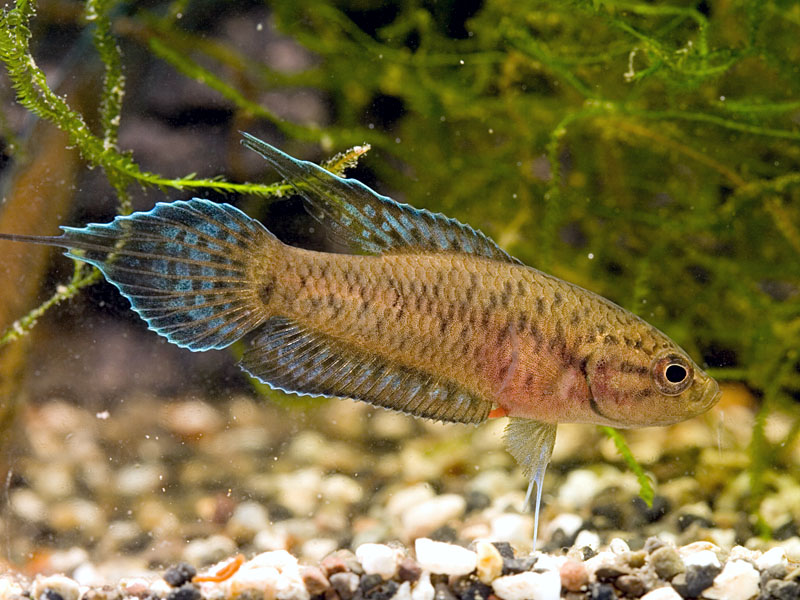
Malpulutta kretseriOrnate Paradisefish
Deraniyagala, 1937
Max length50mm SL2.0in SLTank40 × 20cm16 × 8inTemp16–22°C61–72°FpH5.0–7.5This species is also referred to as 'Kretser's paradisefish' and 'spotted gourami'. There exist three colour forms, two of which exhibit a greater degree of reddish or violet pigmentation in the fins, respectively. The third is more bluish and was described as M. kretseri minor by Deraniyagala (1958).
Marosatherina ladigesiCelebes Rainbowfish
authority not recorded
Max length80mm SL3.1in SLTank76 × 30cm30 × 12inTemp22–28°C72–82°FpH7.0–8.0For many years, this species was included in the genus Telmatherina, and is still listed as such in much of the avilable literature. In fact it's now the only species in the recently erected genus Marosatherina. Unfortunately, it has been overfished for the aquarium trade in its native waters and is listed as 'vulnerable' on the IUCN red list of threatened species. Thankfully, it's now being mass-produced on fish farms in both the Far East and Eastern Europe, meaning that few...
Mchenga flavimanus
authority not recorded
Max length120mm SL5in SLTank120 × 45cm48 × 18inTemp25–29°C77–84°FpH7.5–8.5The genus Mchenga was erected in 2006 by Stauffer and Konings and currently numbers half a dozen species, all of which are previous members of Copadichromis. The reclassification was based on various morphological and behavioural traits, including habitat preference and breeding strategy. Together with Copadichromis, Mchenga spp. form an exclusive group of Malawian cichlids commonly referred to as "Utaka" (prounounced "ooh-taw-kuh"). They're specialised to a pelagic l...
Megalodoras uranoscopusGiant Raphael Catfish
authority not recorded
Max length700mm SL28in SLTank240 × 120cm96 × 48inTemp21.1–25°C70–77°FpHnot recordedThis species is also known by the vernacular name "ripsaw catfish" (U.S.) and was often referred to by the scientific name M. irwini, now considered a junior synonym of M. uranoscopus, in older literature. Within the family Doradidae the genus Megalodoras is considered most closely-related to Lithodoras, Centrodoras and Platydoras, respectively. Members of the family Doradidae can be distinguished from all other Siluriformes by possession of a unique infranuchal scute, a dermal bon...
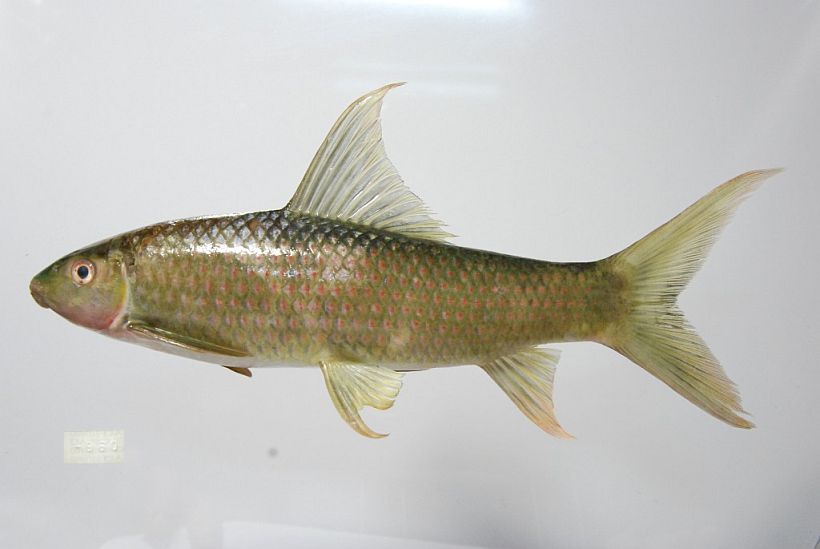
Mekongina erythrospila
Fowler, 1937
Max length450mm SL18in SLTanknot recordedTemp20–26°C68–79°FpH6.0–8.0Endemic to the middle and lower Mekong River system in Laos, Thailand, Cambodia, and Vietnam. Its known range extends from Chiang Rai province, Thailand in the north to Kratie province, Cambodia in the south, and it occurs in several important tributary systems including the Sesan, Srepok, and Tonlé Sap. Type locality is 'Mekong River at Kemarat, Thailand'.
Melanochromis cyaneorhabdos
authority not recorded
Max length100mm SL3.9in SLTank90 × 45cm36 × 18inTemp24–28°C75–82°FpH7.6–8.8M. cyaneorhabdos was formerly known as M. "maingano", after a village located on the shore off which it is found. It can be distinguished from the similar M. johanni by the overall blueish colouration of dominant males, as opposed to the more black patterning of johanni. It is sometimes incorrectly sold as "electric blue" johanni. Do not keep it with other Melanochromis species as they may hybridise....
Melanotaenia affinisNew Guinea Rainbowfish
authority not recorded
Max length120mm SL5in SLTank120 × 30cm48 × 12inTemp20–30°C68–86°FpH6.5–8.0M. affinis was one of the first rainbowfish species to be imported for the hobby in any numbers. There are several geographical variants, three of which can be found in the hobby. The "standard" form has a large natural range and is the most commonly encountered. The "Pagwi" form has a very limited distribution, being known only from a tributary of the Sepik River in New Guinea, while the "Bluewater Creek" form has only been collected from a single location close t...
Melanotaenia australisWestern rainbowfish
authority not recorded
Max length120mm SL5in SLTank120 × 30cm48 × 12inTemp22–27°C72–81°FpH6.5–8.0This species was formerly classified as part of the Melanotaenia splendida complex, but more recent research into the genetics of the species has shown that not only is M. australis genetically dissimilar to the splendida group, but also that there are 2 clear lineages within australis This may yet result in another official member of the genus. M. australis exhibits a wide variation in colour and patterning depending on locality, and is probably the commonest rainbowfish species in Australi...
Melanotaenia boesemaniBoeseman's rainbowfish
authority not recorded
Max length110mm SL4in SLTank120 × 30cm48 × 12inTemp27–30°C81–86°FpH7.0–8.0This uniquely-patterned species is one of the most popular rainbowfish in the hobby and can be found swimming in most dealers' tanks. However, virtually all these fish are mass-produced on fish farms in the Far East and Eastern Europe. M. boesmani is actually quite rare in nature, and is on the IUCN red list of endangered species. Unfortunately this is one species on which the aquarium trade has had a massively detrimental effect, with an estimated one million fish a year being collected to...
Melanotaenia lacustrisLake Kutubu Rainbowfish
authority not recorded
Max length120mm SL5in SLTank120 × 30cm48 × 12inTemp20–25°C68–77°FpH7.0–9.0Unfortunately the prisitine environment form where this fish comes is being threatened by overfishing (much of it for the aquarium trade) and industry, with an oil development being built at one end of the lake during the 1990s. M. lacustris has therefore been given "vulnerable" status on the IUCN red list. The lake was designated a Wetland of International Importance in 1998, as both it and the Kikori Basin where it lies contain some of the earth's greatest biodiversity in terms ...
Melanotaenia maccullochiDwarf Rainbowfish
authority not recorded
Max length70mm SL2.8in SLTank60 × 30cm24 × 12inTemp20–30°C68–86°FpH5.5–8.0There are a few geographical variants of this species available, which differ in colour, patterning and less commonly, size. These should not be mixed in aquaria, as they may hybridise. The differences are so apparent between some of these forms that they may well turn out to be different species in the future....
Melanotaenia splendida inornataCheckered Rainbowfish
authority not recorded
Max length150mm SL6in SLTank120 × 30cm48 × 12inTemp26–33°C79–91°FpH6.5–8.0There are currently 4 described subspecies of Melanotaenia splendida. The principle differences are generally in colour, pattern and fin counts, although even these vary depending on the locality of the fish. The different forms and subspecies should not be mixed in the aquarium, as they may hybridise. Adult specimens are rarely seen for sale, and it's the much drabber juvenile fish that are almost always offered in dealers tanks. However, exercise some patience (even on a good diet, full c...
Melanotaenia splendida rubrostriataRed-striped Rainbowfish
authority not recorded
Max length125mm SL5in SLTank120 × 30cm48 × 12inTemp24–30°C75–86°FpHnot recordedThere are currently 4 described subspecies of Melanotaenia splendida, of which this species is one of the most colourful. The principle differences are generally in colour, pattern and fin counts, although even these vary depending on the locality of the fish. The different forms and subspecies should not be mixed in the aquarium, as they may hybridise. Adult specimens are rarely seen for sale, and it's the much drabber juvenile fish that are almost always offered in dealers tanks. However,...
Melanotaenia trifasciataBanded Rainbowfish
authority not recorded
Max length150mm SL6in SLTank120 × 30cm48 × 12inTemp24–33°C75–91°FpH6.5–8.0M. trifasciata exhibits a wide variation in colour and patterning depending on locality, and it's very important that the different morphs are not mixed in the aquarium, as they will hybridise freely. These different forms are often distinguished by the addition of the name of collection locality being added to the scientific name of the fish. It's thought that several species may in fact be in evidence here, and a reclassification will probably occur at some point As with many othe...
Metynnis argenteus
authority not recorded
Max length150mm SL6in SLTank180 × 38cm72 × 15inTemp24–28°C75–82°FpH6.0–7.0Metynnis argenteus is very similar to another member of the genus, Metynnis hypsauchen and both fish are sold in the hobby under the name "Silver Dollar". The latter species is sometimes referred to as the Plain Metynnis in an effort to distinguish it from its close relation. They are virtually indentical in terms of appearance and care requirements. The two species can be told apart as m. hypsauchen has a black blotch located slightly above and behind each eye. In addition to these tw...
Metynnis hypsauchenSilver Dollar
authority not recorded
Max length150mm SL6in SLTank180 × 38cm72 × 15inTemp24–28°C75–82°FpH6.0–7.0Metynnis hypsauchen is sometimes referred to as the Plain Metynnis in an effort to distinguish it from its close relation, Metynnis argenteus. Both fish are sold in the hobby under the name "Silver Dollar" and are virtually indentical in terms of appearance and care requirements. The two species can be told apart as m. hypsauchen has a black blotch located slightly above and behind each eye. This species also occurs in a striped colour form which is sometimes referred to as(m. hypsauch...
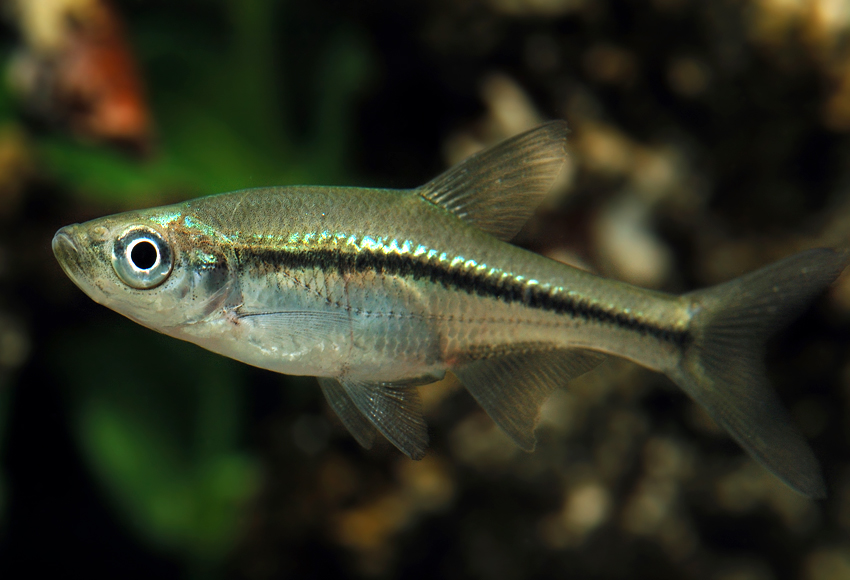
Metzia formosae
Oshima, 1920
Max length75mm SL3.0in SLTanknot recordedTempnot recordedpHnot recordedAlthough it is included in the genus Metzia this grouping remains somewhat unresolved in terms of taxonomy and it may contain more than a single genetic lineage. For example, members share a number of characters with the genera Ischikauia Jordan and Snyder 1900, Hemiculterella Warpachowski 1887, and several species of Anabarilius Cockerell 1923, including a bipartite gas bladder, a non-spinous dorsal-fin ray, and a sharp ventral keel between the pelvic-fin insertion and anus.
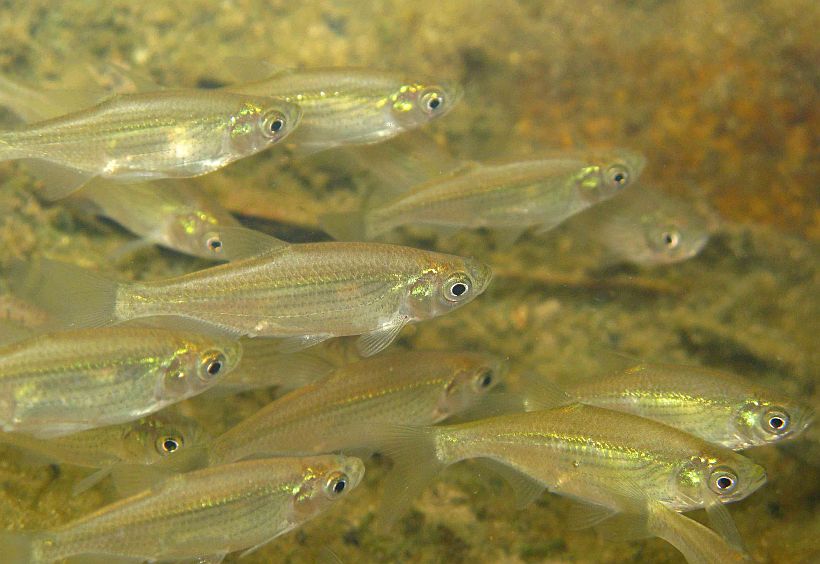
Metzia lineata
Pellegrin, 1907
Max length100mm SL3.9in SLTanknot recordedTempnot recordedpHnot recordedPopulations from the upper Pearl River (Nanpan Jiang basin) differ in several morphological characters from those inhabiting Guangdong, Guangxi, and Guizhou Provinces, and Hainan Island. Those from Vietnam also seem to be different (Gan et al., 2009), the implication being that there may be several species currently included under the name M. lineata.
Microctenopoma ansorgiiOrnate ctenopoma
authority not recorded
Max length70mm SL2.8in SLTanknot recordedTemp20–27°C68–81°FpH5.5–7.5This is the most colourful of the African anabantoids and is much sought after by hobbyists. A male in full breeding dress is truly a sight to behold. In nature it can be found in small streams, inhabiting areas of dense vegetation close to the riverbanks. It is difficult to collect a lot of fish from these habitats and so M. ansorgei is relatively rare in the hobby. These fish can be difficult to acclimatise but once settled are very hardy and can live up to 5 years in the aquarium....
Microctenopoma fasciolatumBanded ctenopoma
authority not recorded
Max length80mm SL3.1in SLTank75 × 30cm30 × 12inTemp24–28°C75–82°FpH6.5–7.5M. fasciolatum is found in clear water with lots of surface and overhanging vegetation in nature.