Results for “species”
Type a name: scientific, common, or one a species used to go by. Or narrow the catalogue with the filters.
Filters
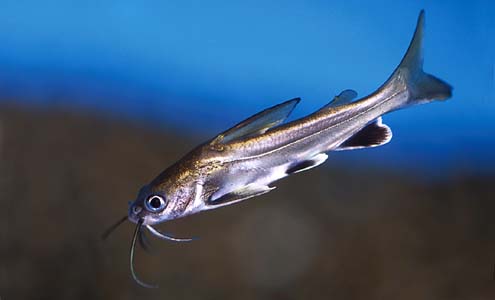
Ariopsis seemanniColombian Shark Catfish
Günther, 1864
Max length350mm SL14in SLTank240 × 60cm96 × 24inTemp22–26°C72–79°FpH6.8–8.5This species is not recommended to those lacking the facilities to house it for life. Sadly it's all too often seen for sale as an attractive, silvery 2-3" juvenile, supposedly suitable for the general freshwater community tank. To make matters worse, it is also usually given an 'alluring' name such as 'black-finned' or 'silvertip' shark catfish. The fate of the majority of these specimens is in all likelihood a depressing one.
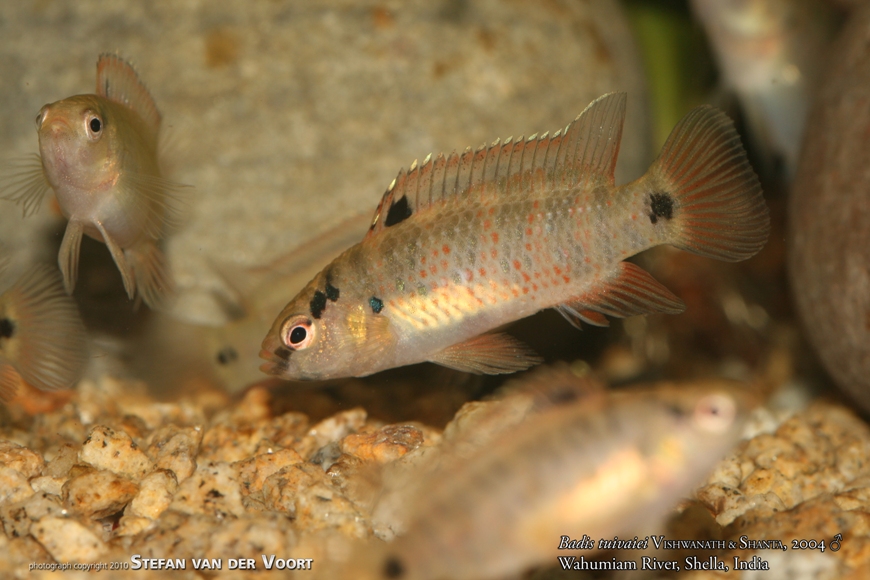
Badis tuivaiei
Vishwanath & Shanta, 2004
Max length85mm SL3.3in SLTank60 × 30cm24 × 12inTemp20–24°C68–75°FpH6.5–7.5This fish has yet to appear in the aquatic trade and only been exported in extremely limited numbers to date. Specimens collected from the Wahumiam River close to the settlement of Shella Bholaganj by Peter Cottle and Andrew Rao in 2006 were initially considered an undescribed species and referred to as B. sp.'Wahumiam River' or B. sp. 'terracotta', but later found to match B. tuivaiei in terms of morphology, meristics, etc. (S. van der Voort, pers. comm.).
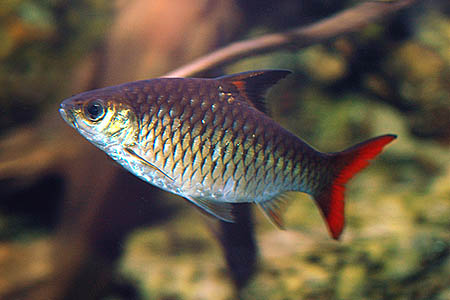
'Barbus' guiraliAfrican Blackfin Barb
Thominot, 1886
Max length155mm SL6in SLTank150 × 45cm60 × 18inTemp22–26°C72–79°FpH5.5–6.5A stylish-looking but rare barb in the hobby and unfortunately little information is available regarding its captive care. Forum member Andy Rushworth has kept a lone individal and told us it was a perfect aquarium inhabitant in terms of behaviour and maintenance. He also mentioned that the fish he had looked exactly like the specimen in our images but that he has seen at least one batch of what appeared to be a different species imported under the same na...
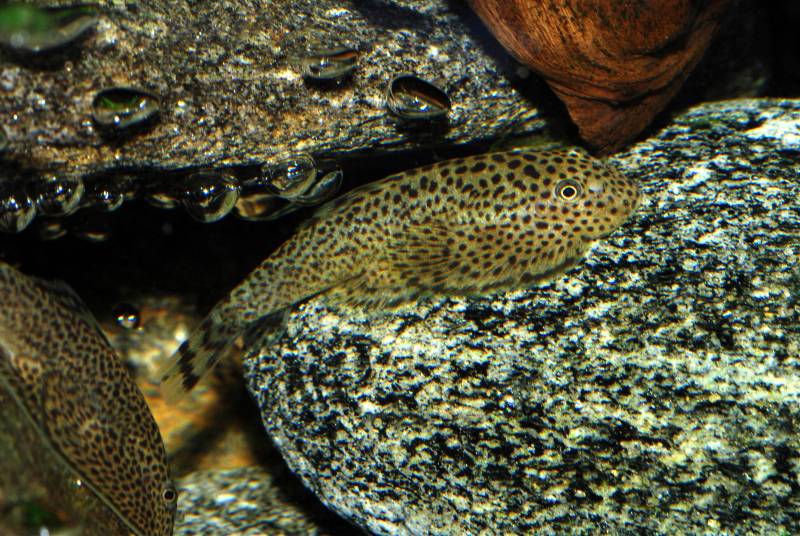
Beaufortia kweichowensisButterfly Loach
Fang, 1931
Max length75mm SL3.0in SLTank60 × 30cm24 × 12inTemp16–24°C61–75°FpH6.5–8.0This species is one of several traded variously as 'butterfly loach', 'butterfly plec', 'Hong Kong plec(o)', 'Chinese hillstream loach' or simply 'hill stream loach'. In many countries it's the most common balitorid in the shops but is also often found in mixed shipments containing members of other genera. Like all balitorids it's an obligate bottom-dweller with specialised morphology adapted to life in fast-flowing water. The paire...
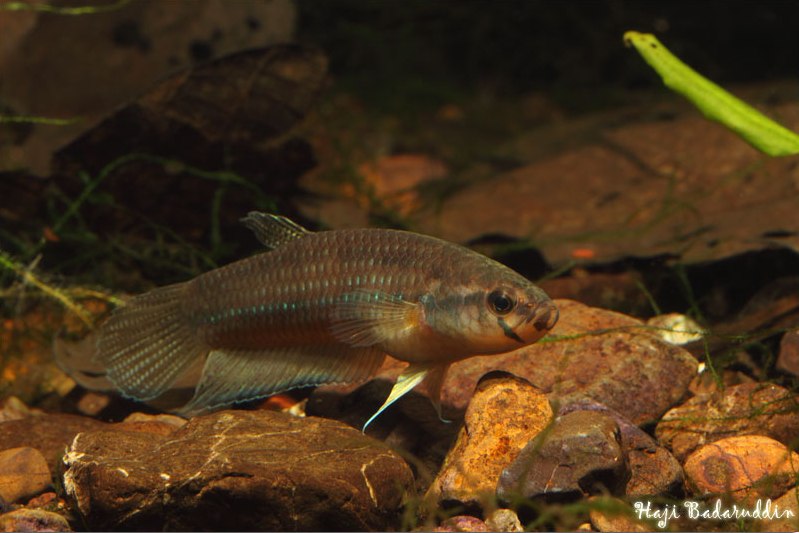
Betta antoni
Tan & Ng, 2006
Max length50mm SL2.0in SLTank60 × 30cm24 × 12inTemp22–27°C72–81°FpH5.5–7.0The genus Betta is the most speciose within the family Osphronemidae with almost 70 recognised members and looks set to grow further with new ones continuing to be described on a regular basis since the turn of the century. Member species have successfully adapted to inhabit a variety of ecological niches from stagnant ditches to flowing hill streams including some extreme environments such as highly acidic peat swamp forests.
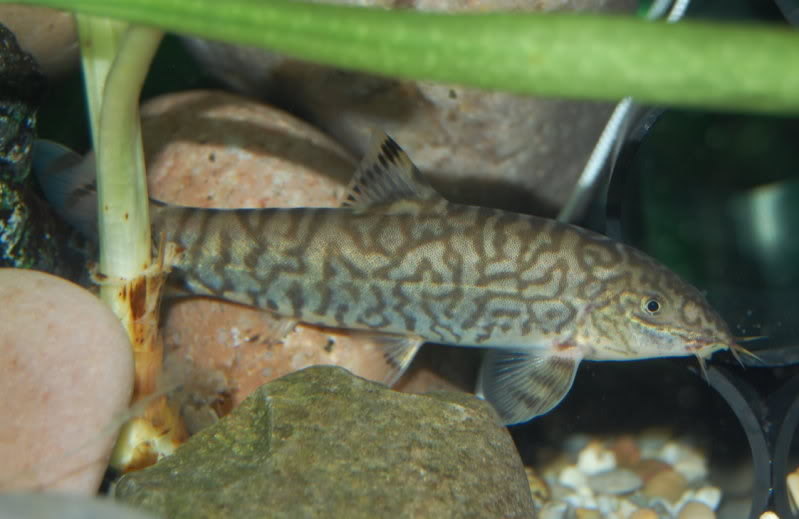
Botia almorhaeYo-Yo Loach
Gray, 1831
Max length160mm SL6in SLTank120 × 45cm48 × 18inTemp19–27.5°C66–82°FpH6.0–7.5The physical appearance of B. almorhae sensu stricto is something of a mystery. No pictures of live specimens appear in any scientific publications we've read and we've been unable to find a certified image of one anywhere meaning it's possibly never been seen in the aquarium trade. Instead the most commonly available members of the nominal species grouping seem to be B. lohachata, B. sp. 'Kosi' and B. sp. 'Teesta' (see individual notes below), plus the assorted hybrids that have appeared since the turn of the century (Grant, 2007).
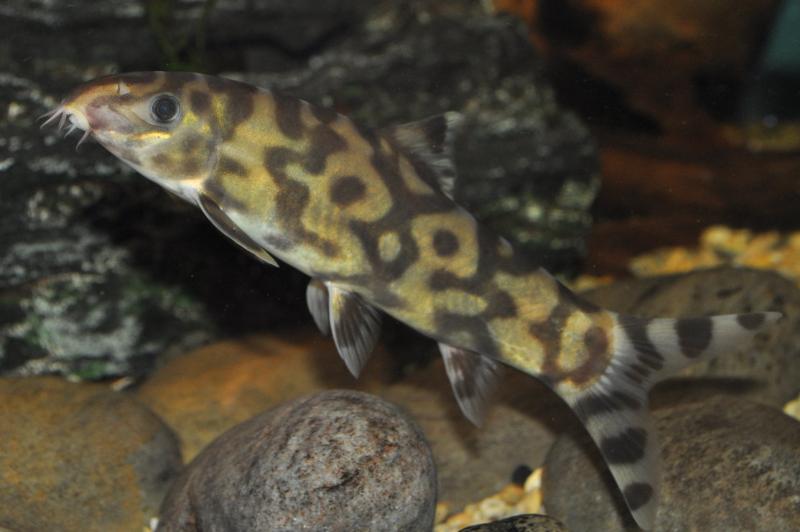
Botia histrionica
Blyth, 1860
Max length130mm SL5in SLTank120 × 45cm48 × 18inTemp22–28°C72–82°FpH6.0–7.5Adult patterning of the different geographical forms can vary considerably though young specimens all possess 5 solid dark bars on each flank and are often confused with those species exhibiting a similar juvenile pattern, particularly B. kubotai. However the horizontal dark bars on the flanks in B. kubotai typically split at quite a young age and/or develop horizontally-orientated 'peaks' whereas those in B. histrionica remain solid for longer and the central bar usually has a pale spot at the top so forms a 'y' shape.
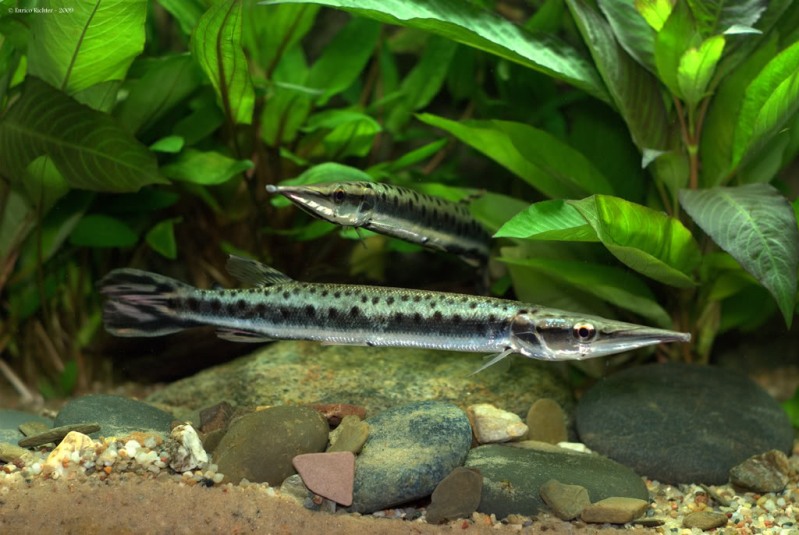
Boulengerella maculata
Valenciennes, 1850
Max length329mm SL13in SLTank240 × 90cm96 × 36inTemp22–28°C72–82°FpH5.0–7.5Both species also possesses a broader dark midlateral stripe on the body which tends to be more well-defined in B. lateristriga than in B. maculata. Colour pattern in B. maculata varies considerably with some specimens noticeably paler than others, for example, and the the broad midlateral stripe usually less intense in such individuals. This does not app...
Chalceus macrolepidotusPink-tailed Chalceus
authority not recorded
Max length250mm SL10in SLTank120 × 45cm48 × 18inTemp23–28°C73–82°FpH6.0–7.5This species can look quite stunning when cared for properly. It can sometimes be a little delicate when initially imported, as it has very large scales which tend to fall off during transport. Once acclimatised, it usually proves fairly hardy. There are reports of aquarium specimens surviving for over fifteen years in well-maintained conditions....
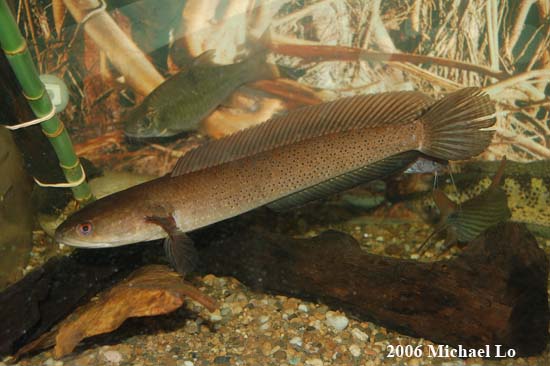
Channa baramensisBaram Snakehead
Steindachner, 1901
Max length220mm SL9in SLTank120 × 45cm48 × 18inTemp22–28°C72–82°FpHnot recordedThis species was considered a synonym of Channa melasoma for a number of years prior to its revalidation by Ng. et al. (1996). Specimens larger than around 120 mm SL can be distinguished by possession of a black spot in the centre of numerous body scales and a barred caudal-fin pattern, characters which are missing in both C. melasoma and the similar-looking C. cyanospilos.
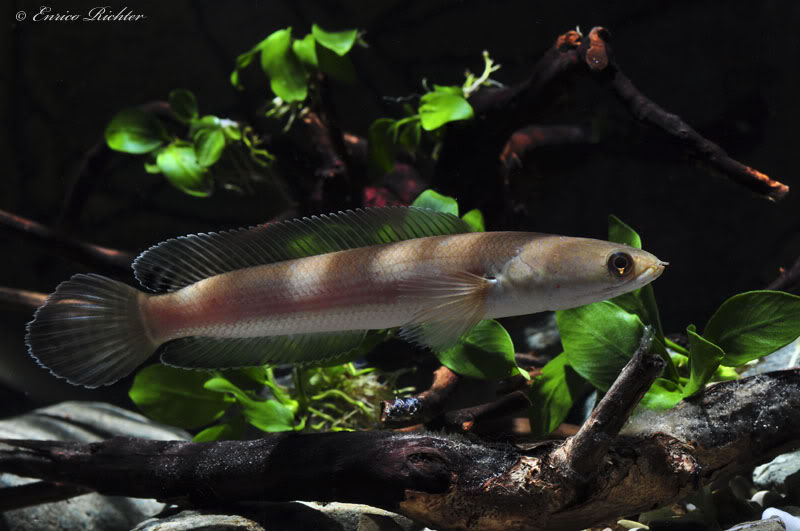
Channa melasomaBlack Snakehead
Bleeker, 1851
Max length300mm SL12in SLTank120 × 45cm48 × 18inTemp22–32°C72–90°FpH4.0–7.0This species can be told apart from the similar-looking congener C. baramensis (once considered synonymous with C. melasoma) by absence (vs. presence) of a black spot in the centre of numerous body scales and absence (vs. presence in specimens larger than 120 mm SL) of a barred caudal-fin pattern.
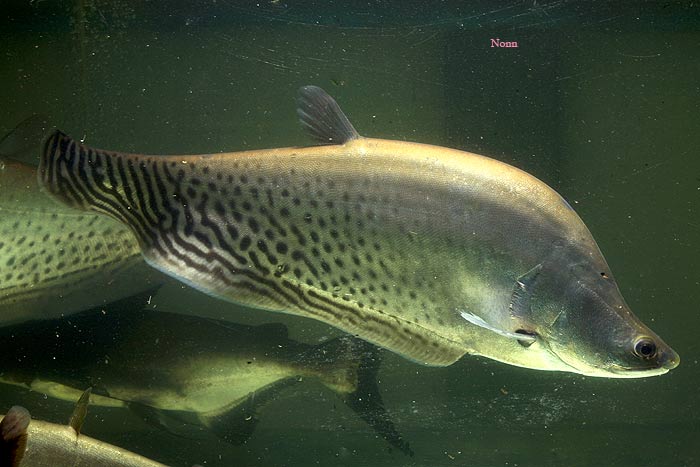
Chitala blanciRoyal Featherback
d'Aubenton, 1965
Max length1200mm SL47in SLTanknot recordedTemp20–28°C68–82°FpH6.0–8.0This species is also referred to as 'royal knifefish' in the aquarium trade but arguably has no place in the ornamental hobby given its adult size and specialised requirements. It can be distinguished from congeners by presence of many small, dark spots on the anterior portion of the body which merge to form oblique, irregular stripes extending onto the anal and caudal fins posteriorly.
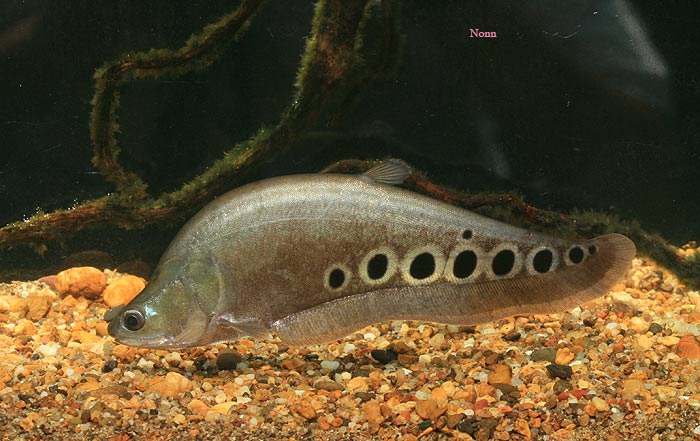
Chitala ornataClown Featherback
Gray, 1831
Max length1000mm SL39in SLTanknot recordedTemp20–28°C68–82°FpH6.0–8.0This species is also referred to as 'clown knifefish' in the aquarium trade. It arguably has no place in the ornamental hobby given its adult size and specialised requirements but remains inexplicably popular and an albino form has even been line-bred for the purpose. It can be distinguished from all congeners by presence of one or more rows of large ocellated spots above the base of the anal-fin, but...
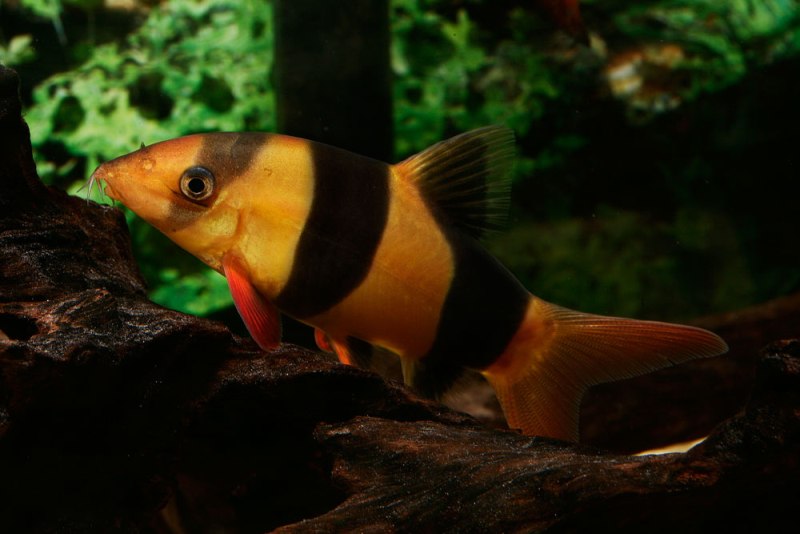
Chromobotia macracanthusClown Loach
Bleeker, 1852
Max length400mm SL16in SLTank180 × 60cm72 × 24inTemp24–30°C75–86°FpH5.0–7.0This species is arguably one of the most misunderstood in the hobby since it's wholly unsuitable for smaller aquaria despite its ubiquitous availability. Most retailers sell it without providing what should be considered essential information regarding long-term care and most specimens undoubtedly fail to reach their potential in captivity. The purchase of a group is also a considerable investment given that if properly cared for typical life span is in excess...
Cichlasoma urophthalmusMayan Cichlid
authority not recorded
Max length400mm SL16in SLTank210 × 60cm84 × 24inTemp20–30°C68–86°FpH7.0–8.0A hardy and robust fish that can tolerate and breed in full marine conditions. The Mayan cichlid is also referred to as the Mexican Mojarra and is occasionally offered for sale in the UK, or can be obtained through specialist cichlid dealers. This species is regarded as a potential pest fish in the USA due to its tolerance of a wide range of conditions and the threat it could pose to native fauna....
Clarias batrachusWalking Catfish
authority not recorded
Max length1000mm SL39in SLTank210 × 120cm84 × 48inTemp20–26°C68–79°FpH5.5–8.0An incredibly hardy species, the walking catfish is tolerant of a very wide range of water chemistry and temperature. It can also survive in oxygen-depleted conditions due to its ability to breathe atmospheric air. In fact, it is thought that the fish can literally drown if deprived access to the water surface for long enough. The common name is derived from its natural ability to move across land using its stiff pectoral spines, provided it stays damp. It has special mucous-producing pores ...
Copadichromis azureus
authority not recorded
Max length160mm SL6in SLTank150 × 45cm60 × 18inTemp26–28°C79–82°FpH7.5–8.5Together with the recently erected genus Mchenga, Copadichromis species form an exclusive group of Malawian cichlids commonly referred to as "Utaka" (prounounced "ooh-taw-kuh"). They're specialised to a pelagic lifestyle, and can be found living in huge numbers throughout much of Lake Malawi. Some tend to remain in the proximity of underwater reefs or rocky shorelines, while others occur mainly in more featureless, sandy habitats. Here they face the oncoming current, us...
Copadichromis borleyi
authority not recorded
Max length200mm SL8in SLTank150 × 45cm60 × 18inTemp25–29°C77–84°FpH7.5–8.5Together with the recently erected genus Mchenga, Copadichromis species form an exclusive group of Malawian cichlids commonly referred to as "Utaka" (prounounced "ooh-taw-kuh"). They're specialised to a pelagic lifestyle, and can be found living in huge numbers throughout much of Lake Malawi. Some tend to remain in the proximity of underwater reefs or rocky shorelines, while others occur mainly in more featureless, sandy habitats. Here they face the oncoming current, usi...
Copadichromis chrysonotus
authority not recorded
Max length160mm SL6in SLTank150 × 45cm60 × 18inTemp25–29°C77–84°FpH7.5–8.5Together with the recently erected genus Mchenga, Copadichromis species form an exclusive group of Malawian cichlids commonly referred to as "Utaka" (prounounced "ooh-taw-kuh"). They're specialised to a pelagic lifestyle, and can be found living in huge numbers throughout much of Lake Malawi. Some tend to remain in the proximity of underwater reefs or rocky shorelines, while others occur mainly in more featureless, sandy habitats. Here they face the oncoming current, usi...
Copadichromis ilesi
authority not recorded
Max length175mm SL7in SLTank150 × 45cm60 × 18inTemp25–29°C77–84°FpH7.5–8.5Together with the recently erected genus Mchenga, Copadichromis species form an exclusive group of Malawian cichlids commonly referred to as "Utaka" (prounounced "ooh-taw-kuh"). They're specialised to a pelagic lifestyle, and can be found living in huge numbers throughout much of Lake Malawi. Some tend to remain in the proximity of underwater reefs or rocky shorelines, while others occur mainly in more featureless, sandy habitats. Here they face the oncoming current, usi...