Results for “congener”
Type a name: scientific, common, or one a species used to go by. Or narrow the catalogue with the filters.
Filters
Liosomadoras morrowiFalse Jaguar Catfish
authority not recorded
Max length150mm SL6in SLTank120 × 30cm48 × 12inTemp20–25°C68–77°FpH6.0–7.0Often confused with its congener L. oncinus, the false jaguar cat can be distinguished by its less attractive, duller patterning. It's a good bottom dweller for the larger community....
Liosomadoras oncinusJaguar Catfish
authority not recorded
Max length250mm SL10in SLTank120 × 45cm48 × 18inTemp20–28°C68–82°FpH4.8–7.2Often confused with its congener, L. morrowi, the jaguar cat can be distinguished by its more attractive, brighter patterning and larger adult size. It's an ideal and good looking bottom dweller for the larger community. Previously considered a member of the Doradidae, due to the opercular spines, it has now been reclassified. It occurs over a wide range in nature, hence its apparent tolerance to wildly different water chemistry. In reality, its requirements are determined by collection loc...
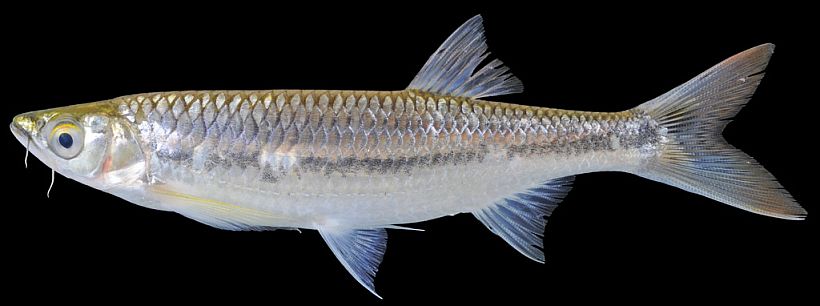
Luciosoma bleekeri
Steindachner, 1878
Max length210mm SL8in SLTank240 × 60cm96 × 24inTemp20–26°C68–79°FpH6.0–8.0L. bleekeri is most-easily distinguished from the congener L. setigerum, with which it is frequently confused, by absence (vs. presence) of a series of black spots on the lateral line scales.
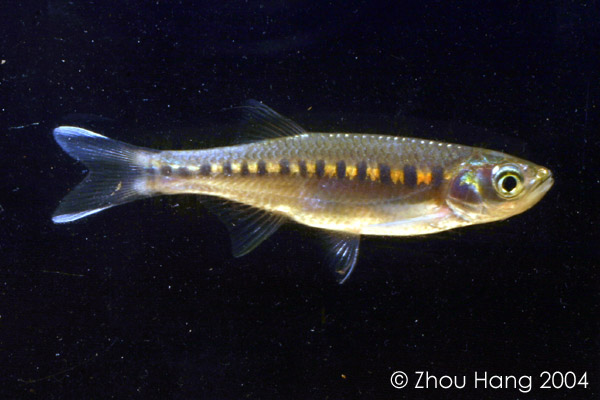
Luciosoma spilopleura
Bleeker, 1855
Max length82mm SL3.2in SLTanknot recordedTempnot recordedpHnot recordedThis species is poorly known in general and is not present in the ornamental trade, although its name is widely misapplied to other Luciosoma species. Its congeners are mostly marketed as 'apollo shark', 'shark minnow', or similar, and often labelled with incorrect scientific names. Identification of the fish pictured here is based on Bleeker (1855, 1860) and Roberts (1989), plus drawings by Bleeker, thus...
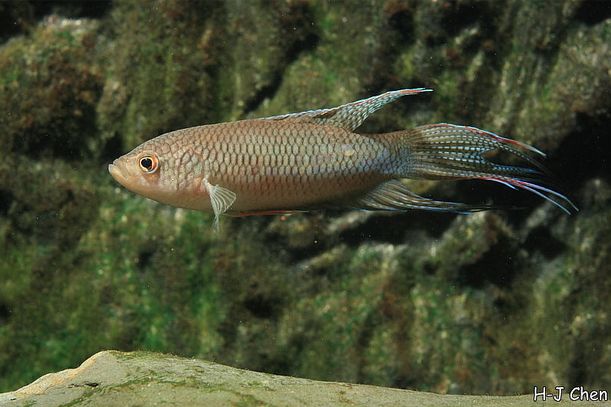
Macropodus erythropterus
Freyhof & Herder, 2002
Max length80mm SL3.1in SLTank80 × 30cm31 × 12inTemp20–30°C68–86°FpH6.0–8.0This species is frequently mistaken for the similar-looking congener M. spechti Schreitmüller 1936, which is easily-identified by the absence of reddish pigmentation in the dorsal, anal, and caudal fins. There has been some debate as to whether these two represent the same taxon, however, with Winstanley and Clements (2008) proposing that M. erythropterus be considered a synonym of M. spechti because they were unable to separate the two species by morphological characters, and specimens with red pigmentation on the unpaired fins were coll...
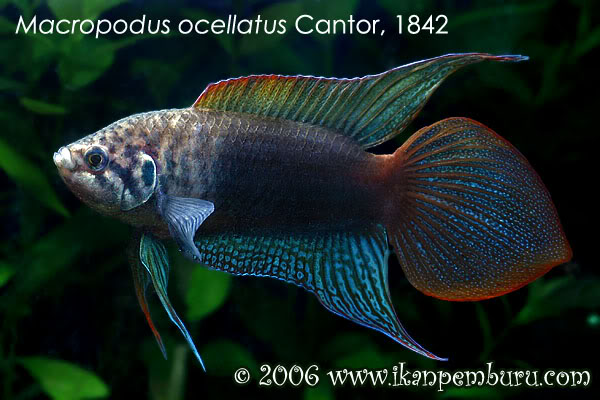
Macropodus ocellatusRoundtail Paradise Fish
Cantor, 1842
Max length80mm SL3.1in SLTank80 × 30cm31 × 12inTemp10–22°C50–72°FpH6.0–7.5M. ocellatus can be distinguished from congeners by the following combination of characters: caudal-fin rounded; eye stripe not connecting spot on posterior projection of opercle with eye; dorsal-fin rays filamentous posterior to a vertical through the posterior anal-fin rays in adults; 16-19 spinous dorsal-fin rays; 6-13 rakers on ceratobranchial of first gill arch; posterior tip or margin of body scales not darker than scales.
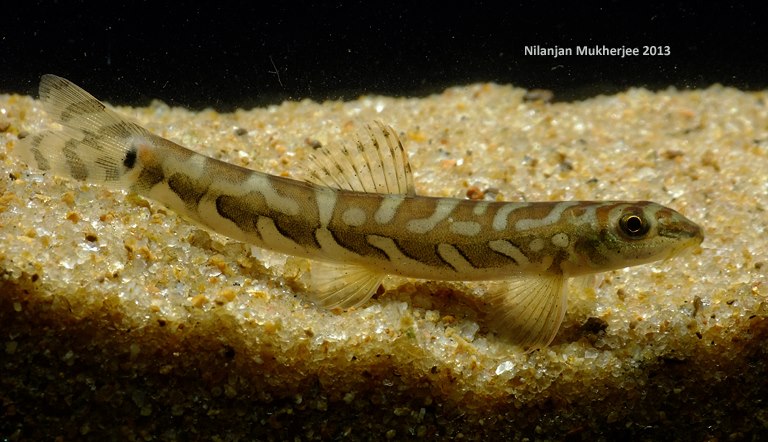
Mesonoemacheilus triangularisZodiac Loach
Day, 1865
Max length60mm SL2.4in SLTank75 × 30cm30 × 12inTemp18–25.5°C64–78°FpH6.0–7.5This species is also referred to by the alternative vernacular name 'Batik loach' and is the most-commonly traded member of the genus at present. It's easily-distinguished from congeners by body patterning which comprises a series of pale, oblique saddle-like markings edged in black and running along the dorsal surface, plus a similar set of bars originating from the otherwise plain ventral surface.
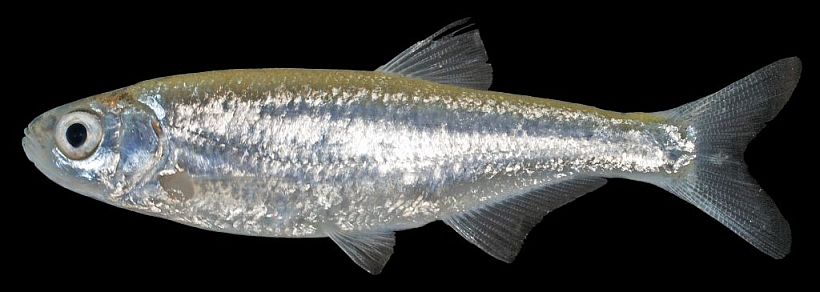
Metzia bounthobi
Shibukawa, Phousavanh, Phongsa & Iwata, 2012
Max length61mm SL2.4in SLTanknot recordedTempnot recordedpHnot recordedThis species can be distinguished from congeners by the following combination of characters: 18–20 (vs. 10-18) branched anal-fin rays; 49–55 (vs. 35-48) lateral-line scale rows; 33–36 (vs. 15-20) predorsal sca...
Micronema bleekeriBleeker's Sheatfish
authority not recorded
Max length600mm SL24in SLTank180 × 60cm72 × 24inTemp22–27°C72–81°FpH6.0–7.0An irregular import, this species is often confused with some of its congeners. It makes an interesting addition to a community of larger fish.
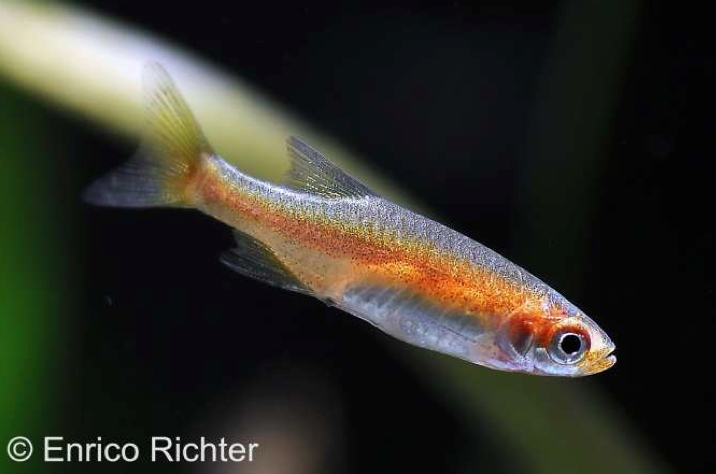
Microrasbora rubescensRed Dwarf 'Rasbora'
Annandale, 1918
Max length30mm SL1.2in SLTank60 × 30cm24 × 12inTemp20–24°C68–75°FpH6.0–8.0This species may be seen on sale under various trade names including 'red-line dwarf rasbora', 'emerald dwarf rasbora', or 'red dwarf rasbora'. A similar-looking, apparently undescribed congener has been collected near the town of Hopong, also in Shan State. It differs from M. rubescens by possessing a greenish to bluish lateral stripe plus a larger adult size, and is traded as Microrasbora cf. rubescens, M. 'thuzari', M. sp. 'rose blue line', 'Asian Cardinal Rasbora', or 'flame red rasbora'.
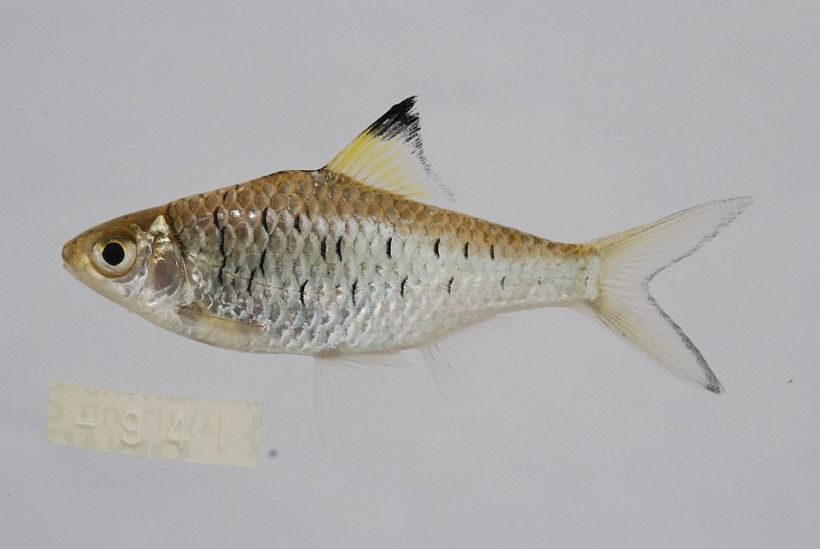
Mystacoleucus atridorsalis
Fowler, 1937
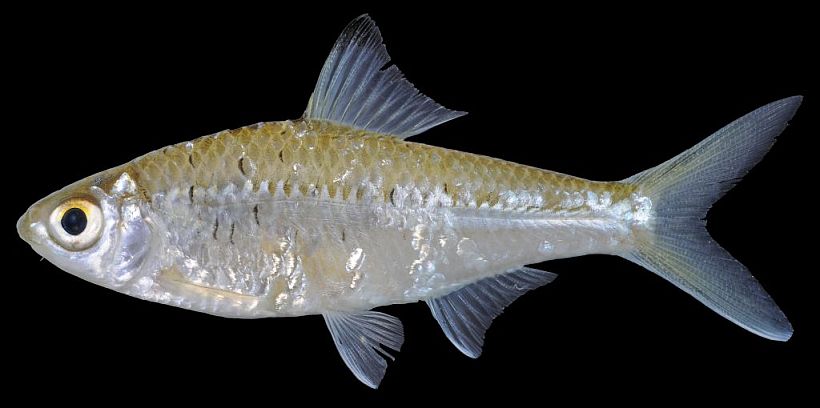
Max length80mm SL3.1in SLTanknot recordedTempnot recordedpHnot recordedThis species can be distinguished from congeners by the following combination of characters: body depth fits 2.5-2.7 times in SL; 28-31 +2-3 lateral line scales; 14-16 circumpeduncular scale rows; 5-5½ scale rows between the lateral line and dorsal-fin origin; a triangular distal blotch on the dorsal-fin; a few body scales with crescent-shaped black edges; a thin dark margin on the dorsal-fin, posterior to the distal blotch; a dark posterior margin on the caudal-fin; normally a single pair of rudimentary barbels present.
Mystacoleucus lepturus
Huang, 1979
Max length95mm SL3.7in SLTanknot recordedTempnot recordedpHnot recordedThis species can be distinguished from congeners by the following combination of characters: body relatively slender, depth fitting 3.4-3.8 times in SL; 32-33 + 2 lateral line scales; 14 circumpeduncular scale rows; presence of a single pair of barbels; black distal margin on dorsal-fin; numerous body scales with dark, crescent-shaped markings.
Mystus mysticetus
authority not recorded
Max length130mm SL5in SLTank120 × 30cm48 × 12inTemp22–27°C72–81°FpH6.0–7.0Apparently this species is often seen living and feeding with a congener, M. multiradiatus in large shoals. It is the only species of Mystus to possess laterally positioned eyes, all the others having their eyes in a dorsolateral position. It is an ideal peaceful catfish for larger communities and as with many other bagrids, is in our opinion somewhat underrated in the hobby....
Nannostomus beckfordiGolden Pencilfish
Günther, 1872
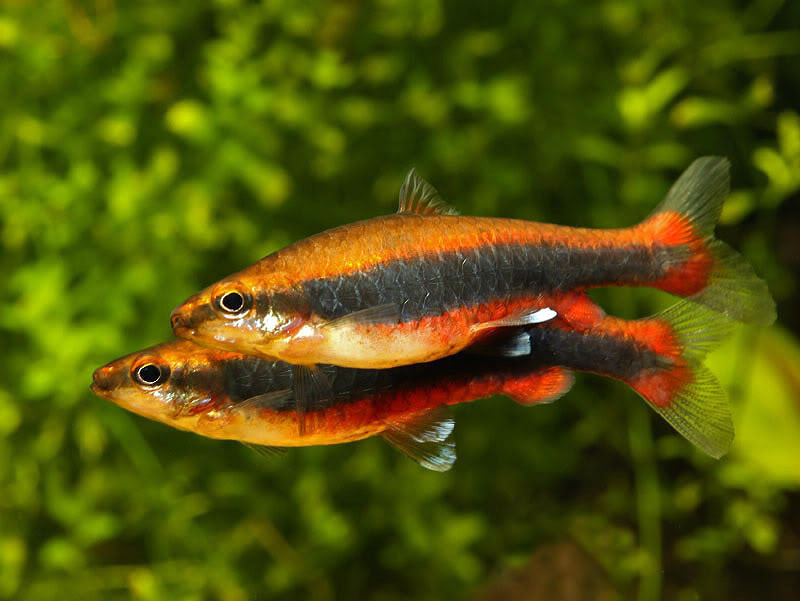
Max length65mm SL2.6in SLTank45 × 30cm18 × 12inTemp21–27°C70–81°FpH5.0–8.0This is the type species of the genus, fairly ubiquitous in the aquarium trade, and represents an excellent choice for the newcomer to fishkeeping since it's less demanding than most congeners. It's sometimes referred to as 'Beckford's pencil fish' or 'brown pencilfish'. Don't worry if your fish look different when you switch on the aquarium lights after dark or in the morning as like most Nannostomus species it assumes a cryptic, vertically-barred colour pattern at ni...
Nannostomus equesHockeystick Pencilfish
Steindachner, 1876
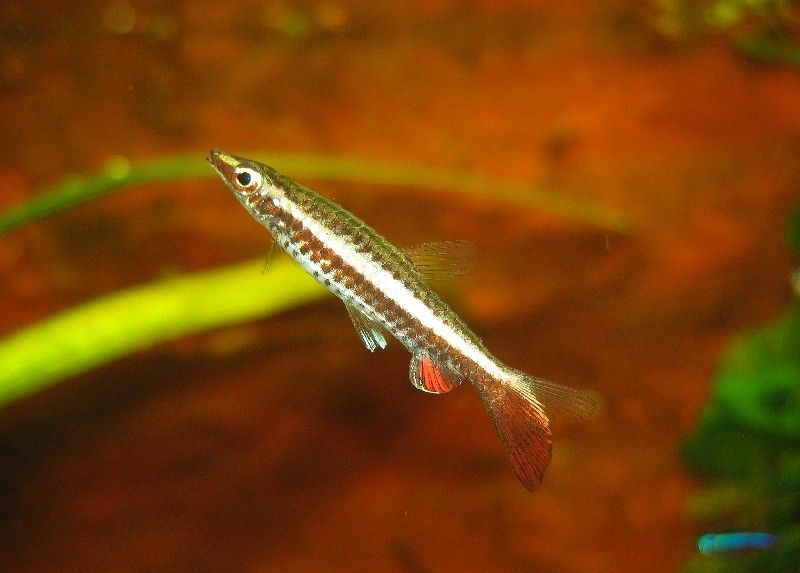
Max length35mm SL1.4in SLTank60 × 30cm24 × 12inTemp22–28°C72–82°FpH4.5–7.5This species has been referred to the genera Poecilobrycon and Nannobrycon in the past and in the aquarium hobby is also known as 'rocket', 'brown', 'brown-tailed', 'diptail', or 'tubemouth' pencilfish.It's a popular aquarium fish and has an interesting oblique swimming-style, a behavioural trait shared only with N. unifasciatus among congeners. In the original description the colour pattern is given by Steindachner as a brown lateral stripe exte...
Nannostomus espeiBarred Pencilfish
Meinken, 1956
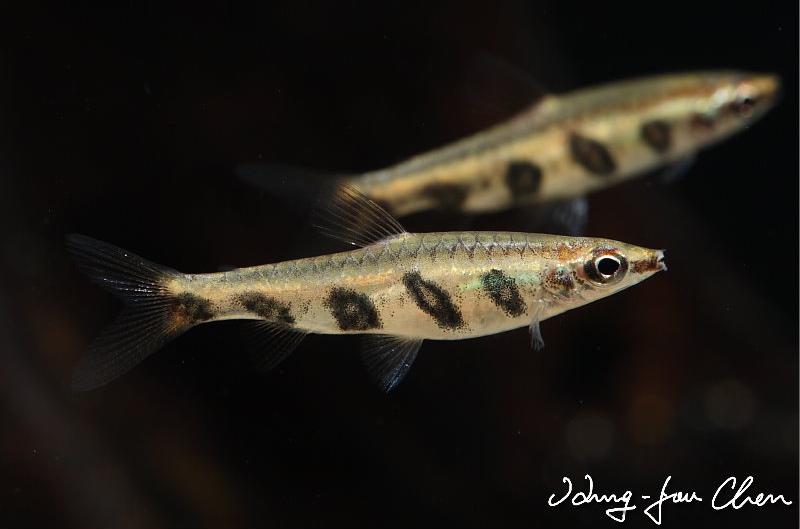
Max length30mm SL1.2in SLTank60 × 30cm24 × 12inTemp22–28°C72–82°FpH4.0–6.5This species is sometimes traded as 'Espei's', 'four-barred' or 'banded' pencilfish and is sought after in the aquarium hobby, though normally quite expensive to buy. It's most-easily identified by its unique colour pattern of 5 dark, vertically-orientated bar-like markings on each flank, this in direct contrast to the horizontal stripes seen in other congeners...
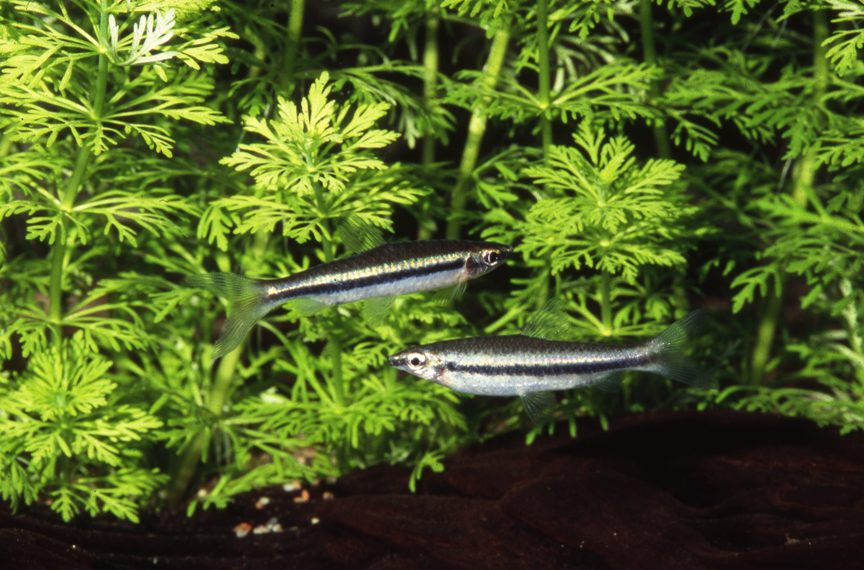
Nannostomus grandis
Zarske, 2011
Max length46mm SL1.8in SLTank60 × 30cm24 × 12inTemp22–28°C72–82°FpH5.0–7.0This species is poorly-known in the aquarium hobby but is sometimes exported as bycatch among shipments of other species, especially Nannostomus beckfordi to which it appears quite similar. The easiest way to tell the two apart is that N. grandis lacks pale white or bluish tips to the ventral fins. It can be further distinguished from all congeners by the following combination of characters: body size up to 46.2 mm, the largest in the genus; bo...
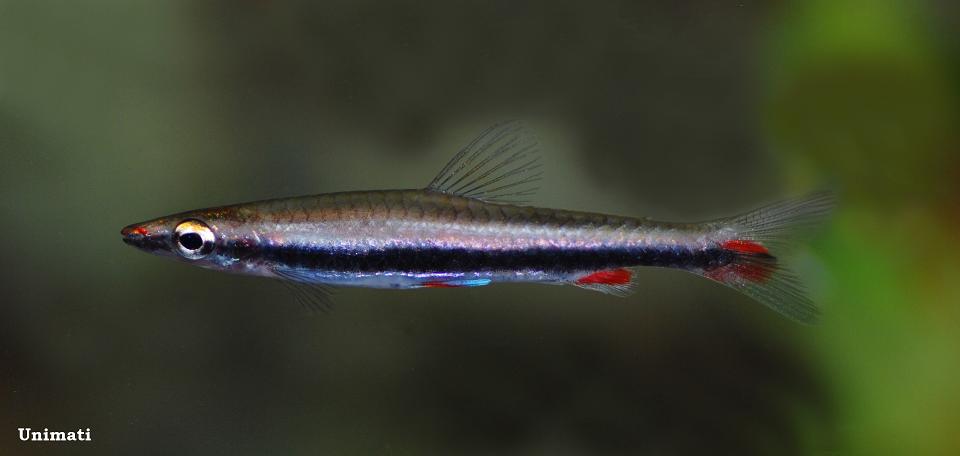
Nannostomus harrisoniBlackstripe Pencilfish
Eigenmann, 1909
Max length45mm SL1.8in SLTank60 × 30cm24 × 12inTemp22–28°C72–82°FpH5.0–7.0This species is quite rare in the aquarium hobby and is not often available in numbers, more often being exported as bycatch among shipments of the congener N. eques. Following Weitzman and Cobb (1975) it can be diagnosed by the following combin...
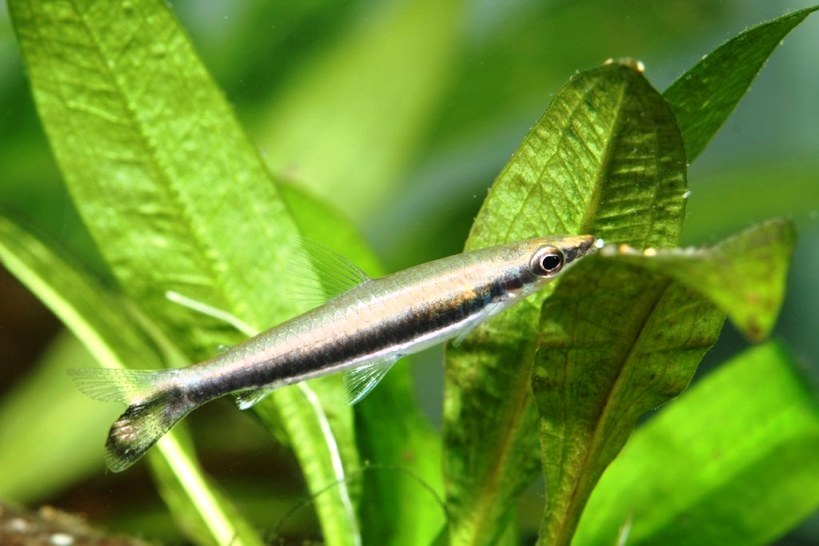
Nannostomus unifasciatusOne-lined Pencilfish
Steindachner, 1876
Max length40mm SL1.6in SLTank75 × 30cm30 × 12inTemp23–28°C73–82°FpH4.0–7.0This species has been referred to the genera Poecilobrycon and Nannobrycon in the past and in the aquarium hobby is also known as 'oneline' or 'red fin' pencilfish. It's a popular aquarium fish and has an interesting oblique swimming-style, a behavioural trait shared only with N. eques among congeners. The most recent diagnosis of the species appears to be that giv...
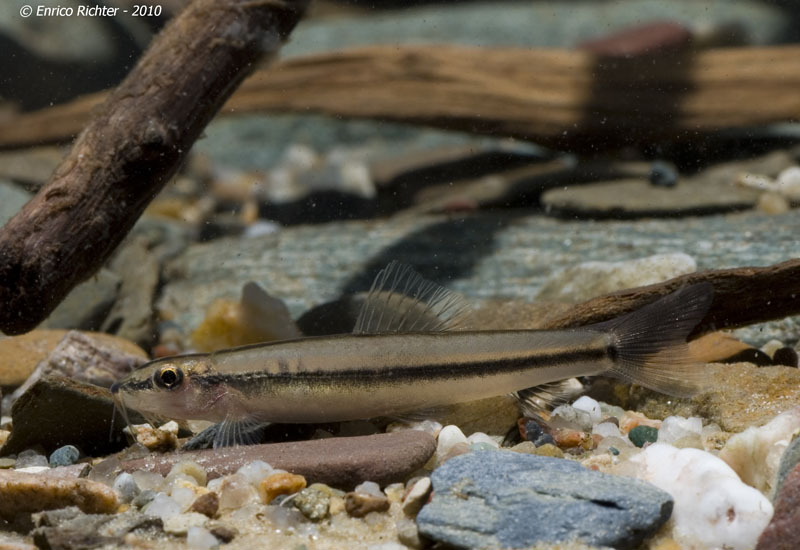
Nemacheilus binotatus
Smith, 1933
Max length45mm SL1.8in SLTank60 × 30cm24 × 12inTemp23–26°C73–79°FpH6.0–7.5N. binotatus is distinguished from similar-looking congeners such as N. longistriatus and N. ornatus by its unique body patterning consisting very simply of two dark stripes, one running along the dorsal surface and the other from the tip of the snout, through the eye and along the flank. There are usually 1-3 small, vertically-orientated spots extending above the lateral stripe between the pectoral-fin and dorsal fins. These are su...