Nemacheilus binotatus
On this page13 sections
Quick facts
Difficulty6 of 6 measures
More bars, more demanding.
- Space
- modest tank
- Water
- tap water
- Temp
- steady heat
- Temperament
- peaceful
- Social
- shoal
- Compatibility
- community tank
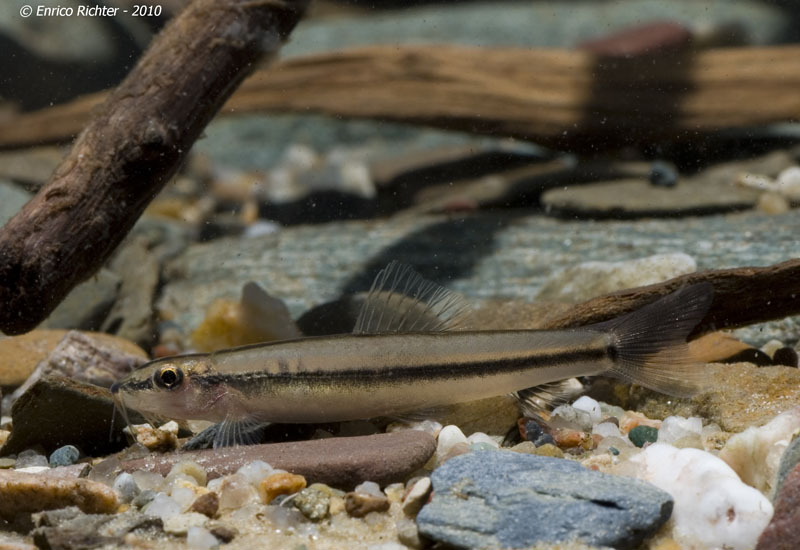
N. binotatus is distinguished from similar-looking congeners such as N. longistriatus and N. ornatus by its unique body patterning consisting very simply of two dark stripes, one running along the dorsal surface and the other from the tip of the snout, through the eye and along the flank. There are usually 1-3 small, vertically-orientated spots extending above the lateral stripe between the pectoral-fin and dorsal fins. These are su...
Etymology
Nemacheilus: from the Greek nēma, meaning 'thread' or 'filament' and cheilos, meaning 'lip' in reference to the furrowed lip in members of this genus.
binotatus: from the Latin bi, meaning 'two', and notatus, meaning 'marked', in reference to the colour pattern of this species, comprising two dark longitudinal stripes.
Distribution
Known only from the Mae Klong and Chao Phraya river systems, western and central Thailand.
Type locality is 'Mekhan, tributary of Meping, southwest of Doi Sutep, northern Thailand', which corresponds to a mountain normally spelled 'Doi Suthep' in Chiang Mai province.
Habitat
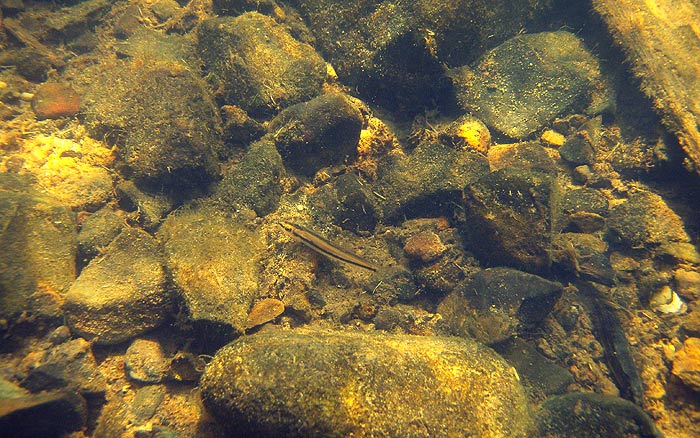
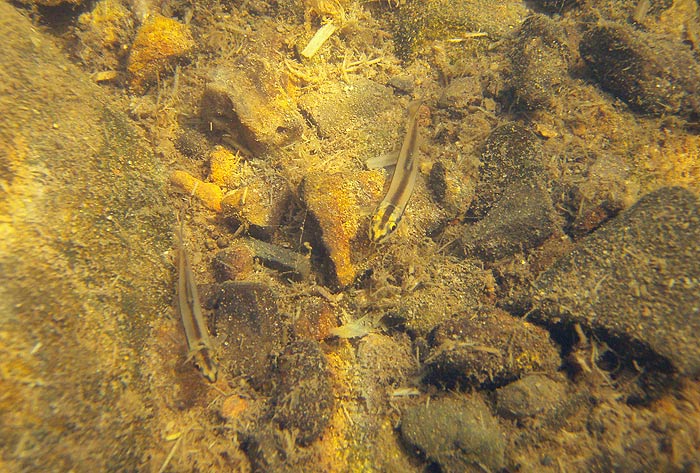
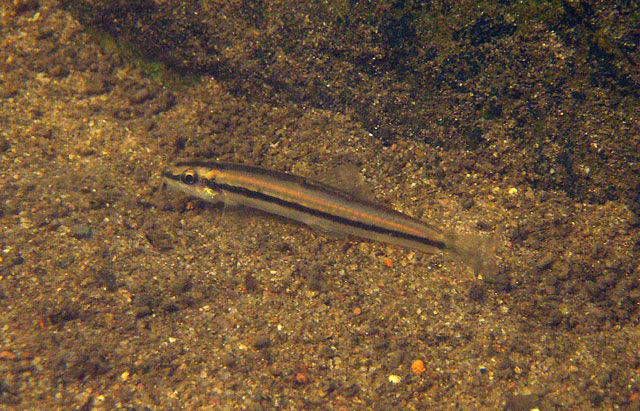
Most commonly found in shallow (<1 m deep), flowing stretches of streams with substrates of sand, gravel, small rocks and organic detritus such as leaf litter.
In the Yom river, a Chao Phraya tributary, it can be found living alongside Acantopsis and Acanthopsoides spp., Homaloptera smithi and Crossocheilus reticulatus.
In another tributary of the Chao Phraya, the Taeng river, it was collected in a slow-moving stream modified by irrigation work with Schistura geisleri, S. desmotes, Tuberoschistura baenzigeri, Homalopteroides smithi, Homaloptera sexmaculata, Lepidocephalichthys hasselti, Acantopsis sp., Acanthopsoides gracilis, Pangio anguillaris, Puntius orphoides, Mystacoleucus marginatus, Barilius koratensis, Rasbora aurotaenia, Garra cambodgiensis, Glyptothorax laosensis, G. lampris, Trichopodus trichopterus, Trichopsis vittata and Dermogenys pusillus.
At another habitat along the main channel of the Ping river, upper Chao Phraya basin, the current was strong, water shallow (< 70 cm28 in deep) and substrate rocky with patches of algae and Cryptocoryne balansae.
Sympatric fish species included Schistura desmotes, S. gesileri, S. waltoni, S. spilota, Homalopteroides smithi, Homaloptera sexmaculata, Mastacembelus armatus, Rhinogobius chiengmaiensis and Monotrete cochinchinensis.
At the latter pair of localities N. binotatus was observed to exist in close-knit groups of 10-20 individuals which swam several inches above the substrate in deeper water, apparently congregating around large rocks.
These were also seen to form aggregations with young Garra cambodgiensis which have a similar colour pattern (Kottelat, 1990)[3].
Aquarium size
A tank with a base measuring 60 ∗ 30 cm24 ∗ 12 in or more is recommended.
Maintenance
Not difficult to maintain under the correct conditions; we strongly recommend keeping it in a tank designed to resemble a flowing stream or river with a substrate of variably-sized rocks, sand, fine gravel, and some water-worn boulders.
This can be further furnished with driftwood branches arranged to form a network of nooks, crannies, and shaded spots, thus providing broken lines of sight. While the majority of aquatic plants will fail to thrive in such surroundings hardy types such as Microsorum, Bolbitis, or Anubias spp. can be grown attached to the décor.
Though torrent-like conditions are unnecessary it does best if there is a high proportion of dissolved oxygen and some water movement in the tank meaning power filter(s), additional powerhead(s), or airstone(s) should be employed as necessary.
Like many fishes that naturally inhabit running water it's intolerant to accumulation of organic pollutants and requires spotless water in order to thrive, meaning weekly water changes of 30-50% tank volume should be considered routine.
Water conditions
Temperature: 23 – 26 °C73 – 79 °F
pH: Prefers weakly acidic to neutral water within the range 6.0 – 7.5.
Hardness: 2 – 12 dGH
These boxes carry affiliate links and we may earn a commission. What they recommend comes from each profile’s own figures, never chosen by hand or paid for.
Diet
Nemacheilus species are omnivorous although the bulk of their diet consists of small insects, worms, crustaceans and other zooplankton with only relatively small amounts of plant matter consumed, mostly via the stomach contents of prey items.
In the aquarium they will accept dried foods of a suitable size but should not be fed these exclusively. Daily meals of small live and frozen fare such as Daphnia, Artemia, bloodworm, etc., will result in the best colouration and condition.
Behaviour and compatibility
Fishes which inhabit similar biotopes in nature constitute the best options, especially peaceful, open water-dwelling cyprinids since the presence of one or two schools can make a visible difference to the confidence of this naturally reclusive loach.
Other possibilities include rheophilic loaches from genera such as Gastromyzon, Pseudogastromyzon, Beaufortia, and Sewellia, plus benthic cyprinids like Crossocheilus and Garra species.
Some similarly-shaped relatives such as other Nemacheilus, Acanthocobitis, and Schistura spp. are excessively territorial or otherwise aggressive, although a combination may work in larger aquaria.
This species is peaceful with conspecifics and seems to appreciate being maintained in a group so the purchase of four or more specimens is highly recommended.
Sexual dimorphism
Males possess a suborbital flap, and the first five branched pectoral-fin rays are thickened with up to six rows of tubercules on the upper surface.
Adult females are likely to be slightly larger and heavier-bodied than males.
Reproduction
Unknown in aquaria.
Notes
N. binotatus is distinguished from similar-looking congeners such as N. longistriatus and N. ornatus by its unique colour pattern consisting very simply of two dark stripes, one running along the dorsal surface and the other from the tip of the snout, through the eye and along the flank.
There are usually 1-3 small, vertically-orientated spots extending above the lateral stripe between the pectoral-fin and dorsal fins. These are surrounded by lighter pigmentation forming an ocellus-like marking similar to that exhibited by N. ornatus.
Following Kottelat (1990) the genus Nemacheilus is characterised by a combination of characters as follows: elongate body; complete lateral line; presence of enlarged scales above and below the lateral line in some species; caudal-fin forked to deeply forked with enlarged upper lobe; large eye; small, strongly arched mouth; lips usually thin; usually no median interruption in upper lip; upper jaw with processus dentiformis (a tooth-like projection); no median notch in lower jaw; long barbels; males usually with suborbital flap, pectoral-fin rays 2-6 thickened and with rows of tubercules.
The family Nemacheilidae is widely-distributed across most of Eurasia with the Indian subcontinent, Southeast Asia and China representing particular centres of species diversity.
References
- Bănărescu, P. M. and T. T. Nalbant (1995). A generical classification of Nemacheilinae with description of two new genera (Teleostei: Cypriniformes: Cobitidae). Travaux du Museum d'Histoire Naturelle 'Grigore Antipa' 35, 429-495
- Freyhof, J. and D. V. Serov (2001). Nemacheiline loaches from Central Vietnam with descriptions of a new genus and 14 new species (Cypriniformes: Balitoridae). Ichthyological Exploration of Freshwaters 12(2), 133-191
- Kottelat, M. (1990). Indochinese nemacheilines. A revision of nemacheiline loaches (Pisces: Cypriniformes) of Thailand, Burma, Laos, Cambodia and southern Viet Nam. Verlag Dr. Friedrich Pfeil, München, Germany, 1-262
- Šlechtová, V., J. Bohlen and H. H. Tan (2007). Families of Cobitoidea (Teleostei; Cypriniformes) as revealed from nuclear genetic data and the position of the mysterious genera Barbucca, Psilorhynchus, Serpenticobitis and Vaillantella. Molecular Phylogenetics and Evolution 44(3), 1358-1365
- Tang, Q., H. Liu, R. Mayden and B. Xiong (2006). Comparison of evolutionary rates in the mitochondrial DNA cytochrome b gene and control region and their implications for phylogeny of the Cobitoidea (Teleostei: Cypriniformes). Molecular Phylogenetics and Evolution 39(2), 347-357
- Kottelat, M. (2012). Conspectus cobitidum: an inventory of the loaches of the world (Teleostei: Cypriniformes: Cobitoidei). Raffles Bulletin of Zoology Supplement 26, 1-199
- Kottelat, M. (2013). The fishes of the inland waters of southeast Asia: a catalogue and core bibiography of the fishes known to occur in freshwaters, mangroves and estuaries. The Raffles Bulletin of Zoology Supplement 27, 1-663
Species images · 4
Used with the photographer’s permission. Not licensed for reuse.
Distribution
Profile completeness23 of 24
96% complete
Missing: a common name.