Hobbyist group · Cypriniformes
Loaches
Loaches spans 7 families.
- Species
- 213
- Families
- 7
- Genera
- 52
- Photographed
- 210 of 213
- Difficulty rated
- 211 of 213
Families in this group
Where they come fromnative records only
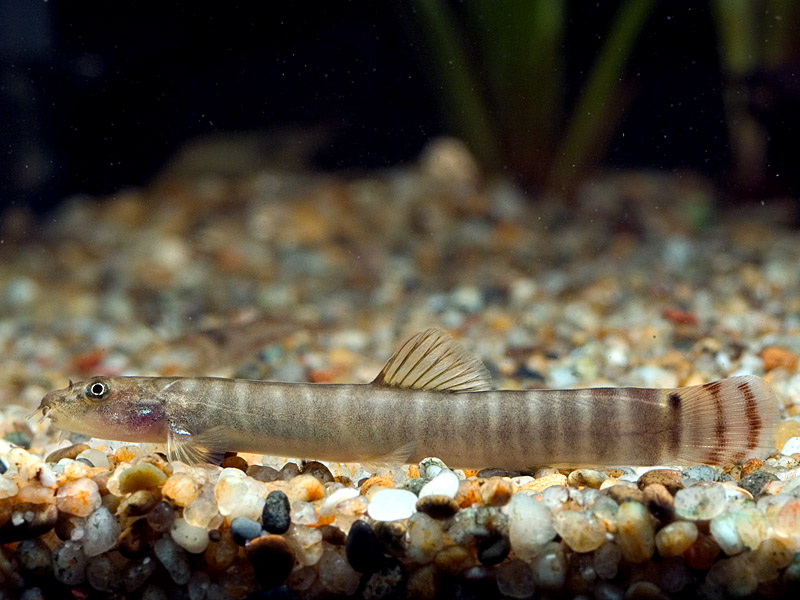
Aborichthys sp. 'AR01'
Nemacheilidae · authority not recorded
This fish is usually traded as A. elongatus but that species appears endemic to higher altitude waters of the Brahmaputra drainage in Darjeeling District which borders Jalpaiguri to the north east. These flow down from the Sivalik Hills whereas the Raidak I originates in Bhutan. Only three species of Aborichthys have been officially described to date meaning this is likely to represent an undescribed species. It was pictured in Tekriwal and Rao (1999) under the name 'A. bijulensis' but...
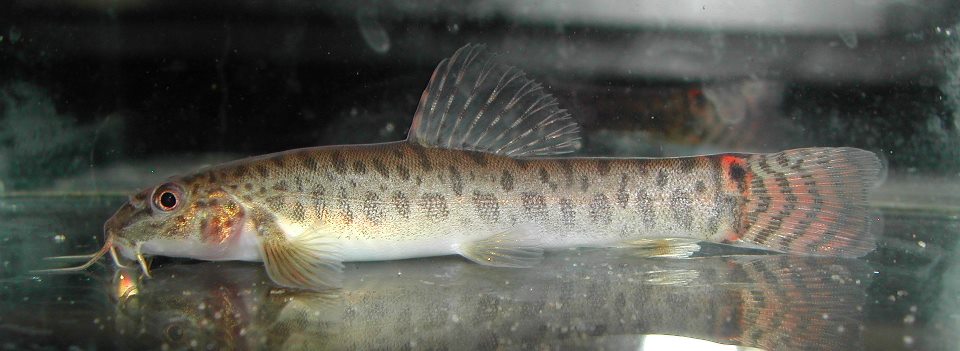
Acanthocobitis sinuata
Nemacheilidae · Day, 1870
A. sinuata is currently considered a synonym of A. mooreh by most authorities. This appears attributable to a lack of recent study since the two differ in distribution plu...
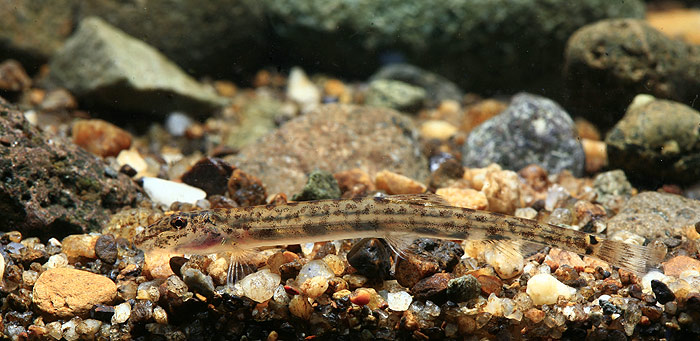
Acanthopsoides molobrion
Cobitidae · Siebert, 1991
Acanthopsoides spp. are most closely related to the horse-faced loaches of the genus Acantopsis with which they often co-occur in nature, and thus commonly referred to as 'dwarf horse-face loaches'. The genus currently comprises five species of which four were described by Siebert (1991); these were discovered in existing museum holdings...
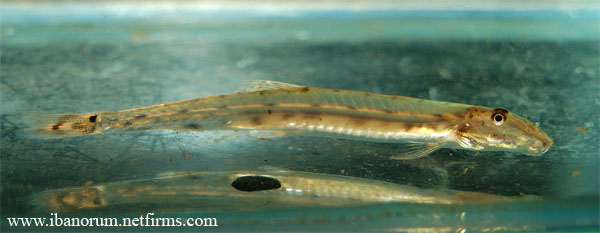
Acanthopsoides robertsi
Cobitidae · Siebert, 1991
Acanthopsoides spp. are most closely related to the horse-faced loaches of the genus Acantopsis with which they often co-occur in nature, and thus commonly referred to as 'dwarf horse-face loaches'. Most are very difficult to tell apart but A. robertsi is quite easily identified since it's the only...
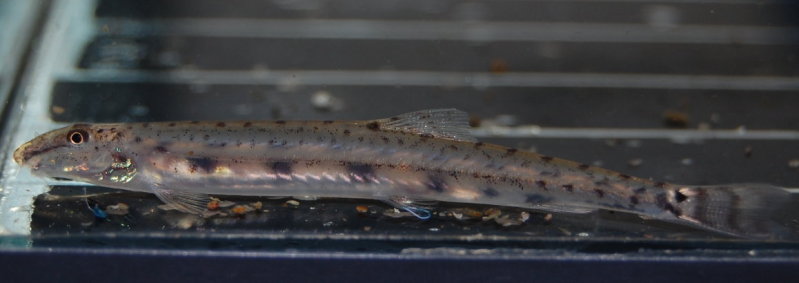
Acanthopsoides sp. 'A01'
Cobitidae · authority not recorded
Acanthopsoides spp. are most closely related to the horse-faced loaches of the genus Acantopsis with which they often co-occur in nature, and thus commonly referred to as 'dwarf horse-face loaches'.
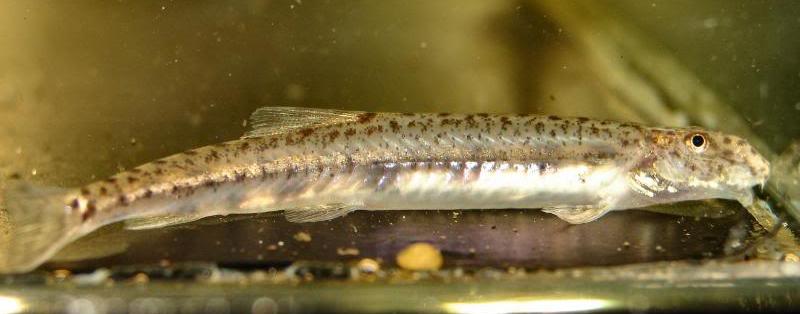
Acanthopsoides sp. 'A02'
Cobitidae · authority not recorded
Acanthopsoides spp. are most closely related to the horse-faced loaches of the genus Acantopsis with which they often co-occur in nature, and thus commonly referred to as 'dwarf horse-face loaches'. The genus currently comprises five species of which four were described by Siebert (1991);...
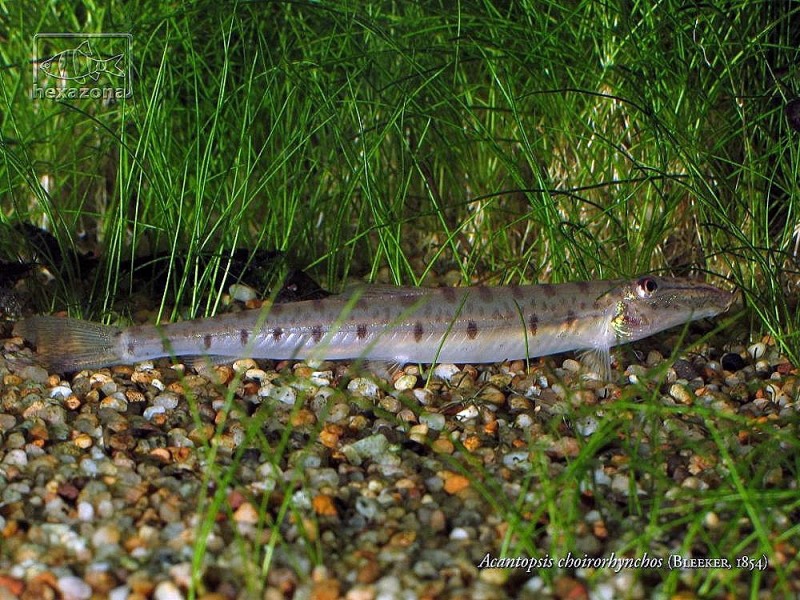
Acantopsis dialuzonaHorseface Loach
Cobitidae · van Hasselt, 1823
Juveniles of this 'species' (probably a group of species - see 'distribution') are traded in large numbers but it's still uncommon to see adult specimens in the hobby suggesting their needs are not catered for often enough. This is a shame as when maintained properly they're hardy, long-lived and interesting aquarium residents. Other trade names include 'long-nosed' and 'banana' loach. Please note although certain that more than one species is being tr...
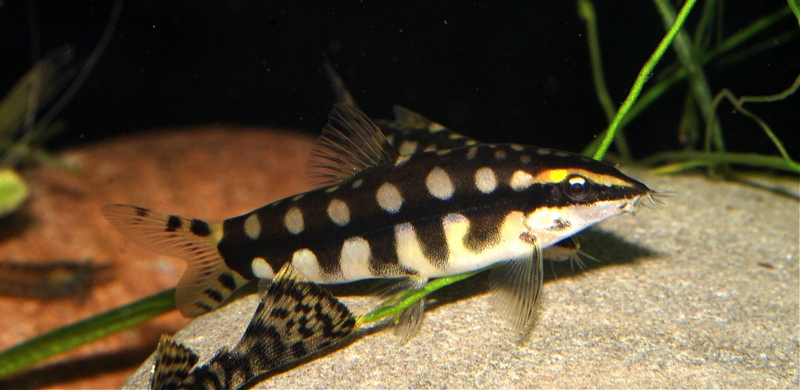
Ambastaia sidthimunkiDwarf Chain Loach
Botiidae · Klausewitz, 1959
This species was lost to the hobby for several years prior to the turn of the century and when commercially-produced stock first came onto the market prices were very high. It's now readily available, though, and while never particularly cheap is considerably less expensive.
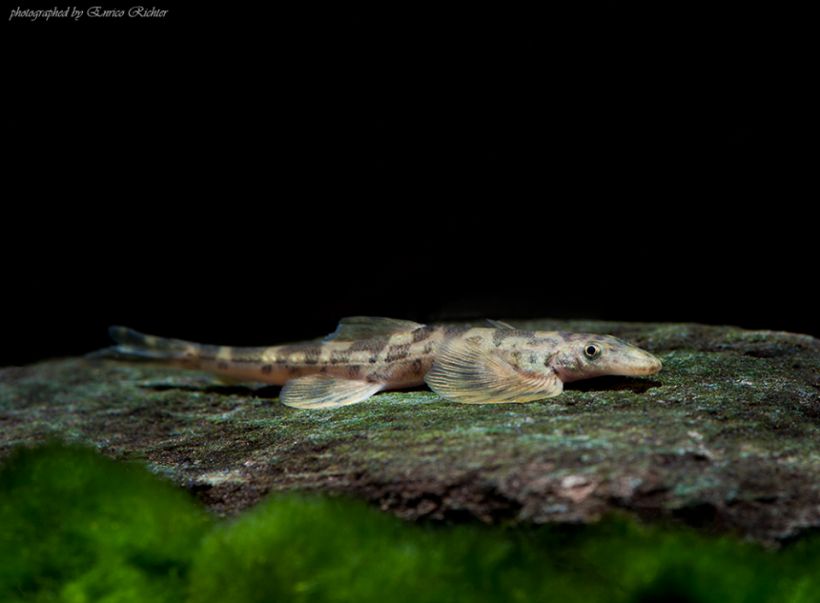
Annamia normaniVietnamese Giraffe Loach
Gastromyzontidae · Hora, 1931
Traditionally considered to be a micropredator feeding on insect larvae and suchlike (Rainboth, 1996), but a study by Herder and Freyhof (2006) revealed adult A. normani inhabiting the Duc My River in central Vietnam to be specialised grazers of cyanobacteria. In rapids the latter form hard encrustations on rock surfaces from which adults are able to bite chunks.
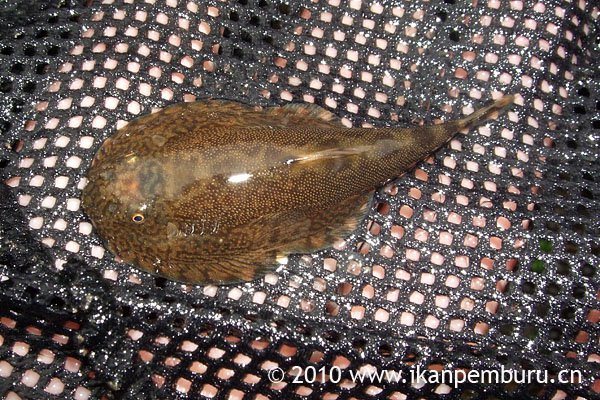
Beaufortia cyclica
Gastromyzontidae · Chen, 1980
Known only from a handful of localities within the Xi River (Xi Jiang) drainage in Guangxi Zhuang Autonomous Region, southern China plus the Tuoniang river system in Funing County, southeastern Yunnan province. Type locality is 'West River, Longzhow Xian, Guangxi Province, China'.
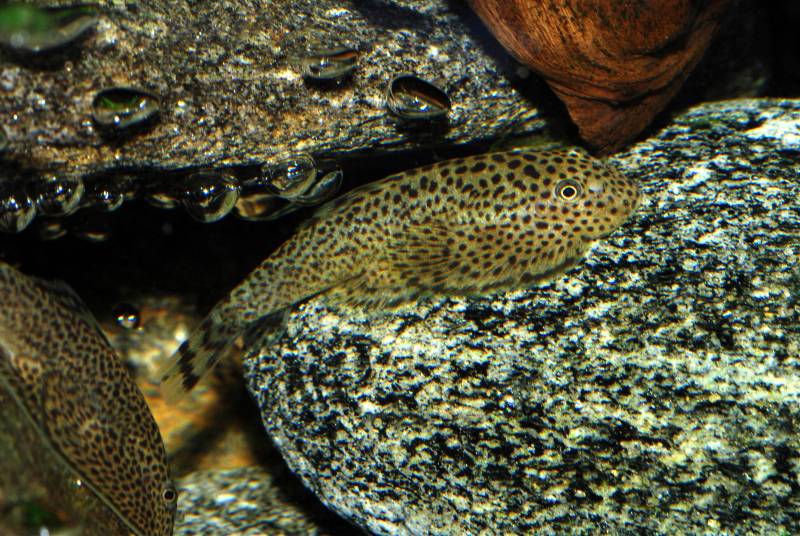
Beaufortia kweichowensisButterfly Loach
Gastromyzontidae · Fang, 1931
This species is one of several traded variously as 'butterfly loach', 'butterfly plec', 'Hong Kong plec(o)', 'Chinese hillstream loach' or simply 'hill stream loach'. In many countries it's the most common balitorid in the shops but is also often found in mixed shipments containing members of other genera. Like all balitorids it's an obligate bottom-dweller with specialised morphology adapted to life in fast-flowing water. The paire...
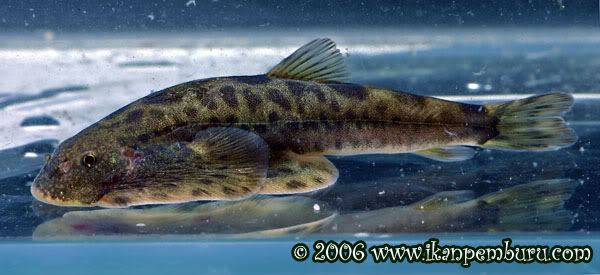
Beaufortia szechuanensis
Gastromyzontidae · Fang, 1930
At time of writing there exist 18 recognised members of the genus though only B. kweichowensis is well-known in the trade with B. szechuanensis unlikely to have been exported. According to Chen, Huang and Yang (2009) it can be distinguished from similar congeners by the following suite of characters: 1 branched and 17-20 simple pectoral-fin rays...
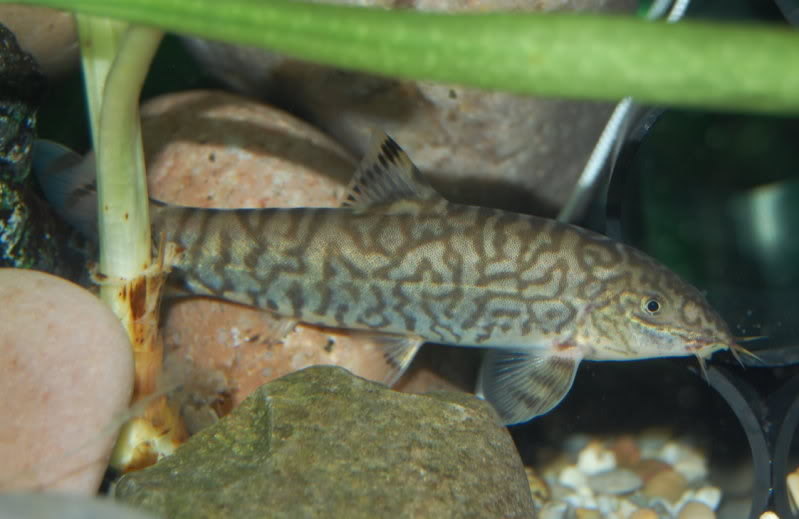
Botia almorhaeYo-Yo Loach
Botiidae · Gray, 1831
The physical appearance of B. almorhae sensu stricto is something of a mystery. No pictures of live specimens appear in any scientific publications we've read and we've been unable to find a certified image of one anywhere meaning it's possibly never been seen in the aquarium trade. Instead the most commonly available members of the nominal species grouping seem to be B. lohachata, B. sp. 'Kosi' and B. sp. 'Teesta' (see individual notes below), plus the assorted hybrids that have appeared since the turn of the century (Grant, 2007).
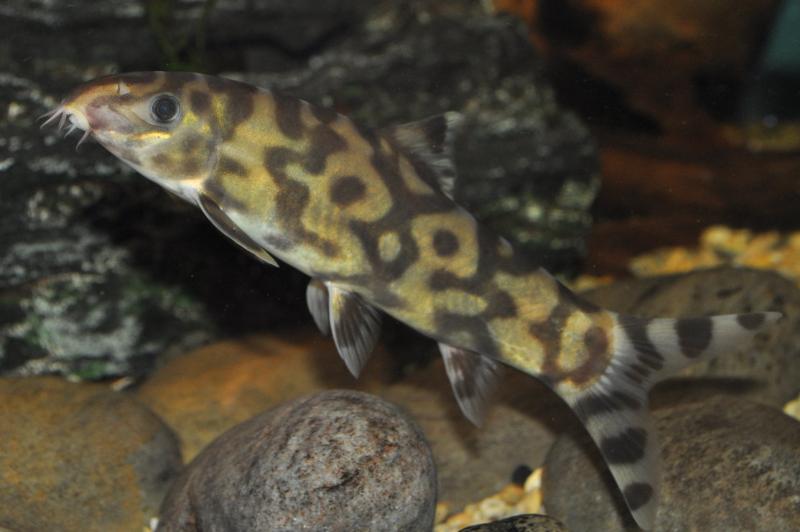
Botia histrionica
Botiidae · Blyth, 1860
Adult patterning of the different geographical forms can vary considerably though young specimens all possess 5 solid dark bars on each flank and are often confused with those species exhibiting a similar juvenile pattern, particularly B. kubotai. However the horizontal dark bars on the flanks in B. kubotai typically split at quite a young age and/or develop horizontally-orientated 'peaks' whereas those in B. histrionica remain solid for longer and the central bar usually has a pale spot at the top so forms a 'y' shape.
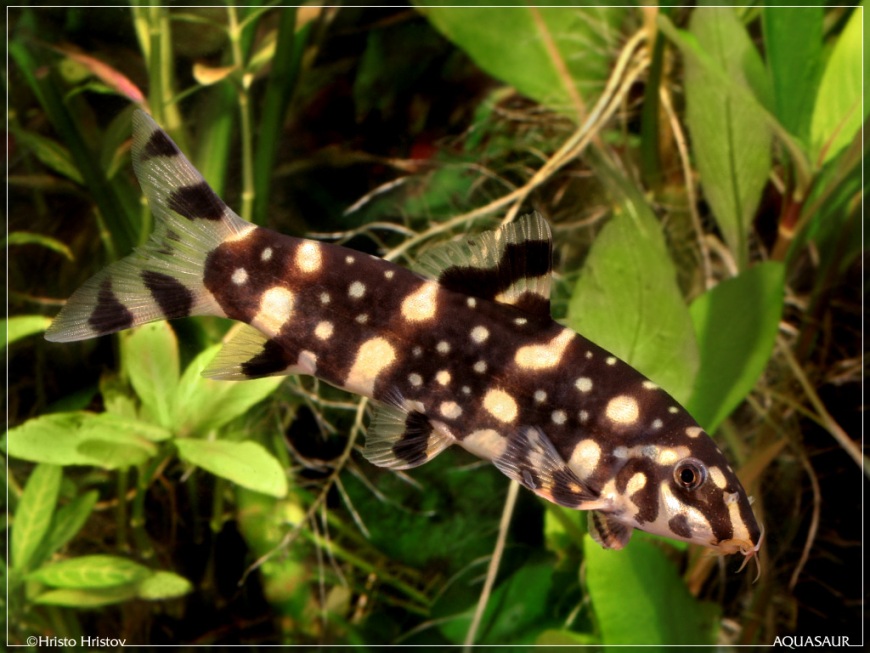
Botia kubotaiPolka-Dot Loach
Botiidae · Kottelat, 2004
Appears to be endemic to headwaters of the Salween River basin around the border between Myanmar and Thailand. The type specimens were collected from the Megathat Chaung (Megathat stream) in the upper Ataran (known as the Kasat in Thai) River basin, Kayin/Karen State, Myanmar and another population was later discovered in the Hanthayaw River (Suriya in Thai), Tak Province, Thailand.
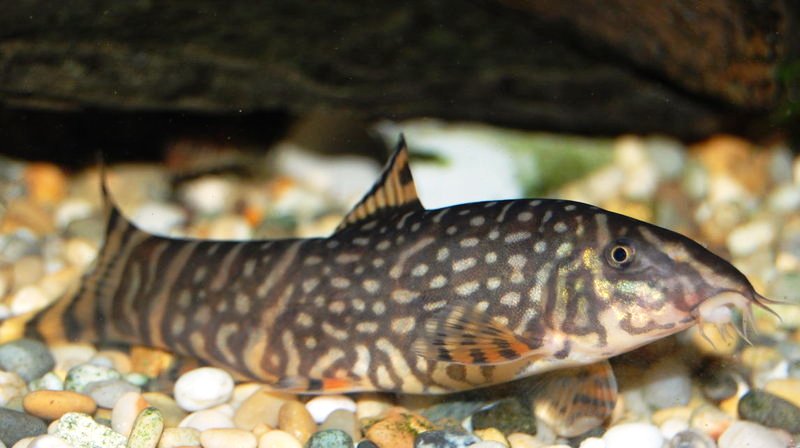
Botia rostrata
Botiidae · Günther, 1868
Within the nominal species grouping suggested by Grant (2007) almost all B. rostrata sold in the hobby are B. sp. 'upper Brahmaputra' with B. rostrata sensu stricto rarely, if ever, available. Trade names include 'Gangetic loach', 'twin-banded loach' and 'ladder loach'. The defining characters of the group are "Pattern consisiting of 8-10 black to dark brown body bars that exhibit pale and numerous spots in juveniles, and in adults the bars can anast...
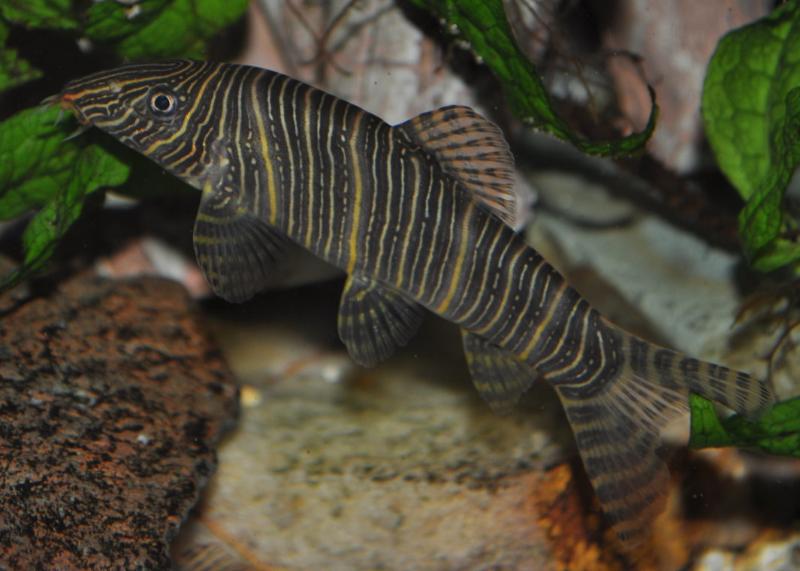
Botia striataZebra Loach
Botiidae · Narayan Rao, 1920
In a survey of fish diversity in the Bhadra River (which joins the Tunga to form the Tungabhadra) it was recorded alongside numerous other species including Puntius chola, Balitora mysorensis, and Mystus armatus. Dry season water paramaters were temperature 69.8°F/21°C, pH 7.0, hardness ~ 2.5°. The substrate was composed of bedrock, boulders, cobbles, gravel, sand and leaf litter in descending order of abundance with a maximum depth of around...
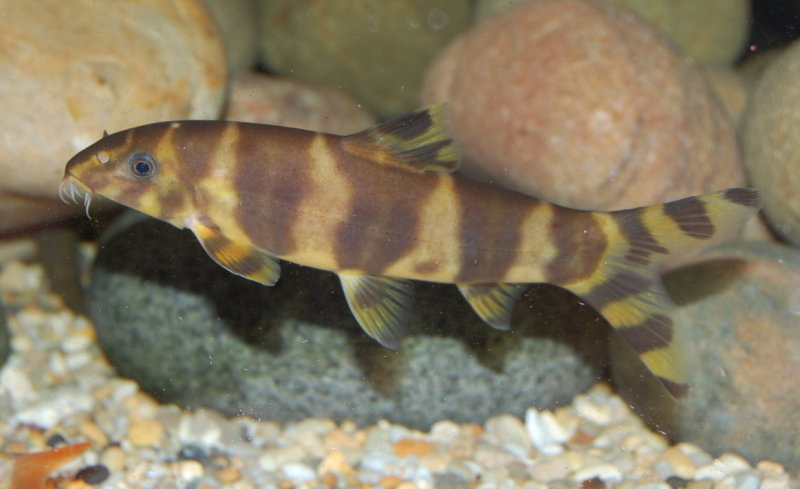
Botia udomritthirujiEmperor Botia
Botiidae · Ng, 2007
Known only from the Tanintharyi River drainage in Tanintharyi (previously Tenasserim) Division, southern Myanmar. Tanintharyi lies on the Kra Isthmus and the river bisects the central zone north-to-south before emptying into the Andaman Sea at Mergui/Myeik. This area is not easy to access for fish collectors due to occasional conflict between the Myanma...
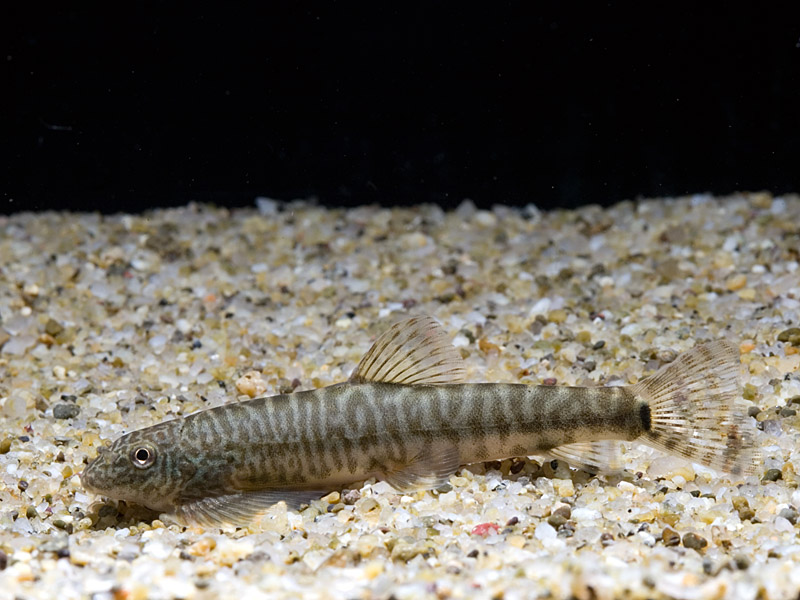
Erromyzon sinensis
Gastromyzontidae · Chen, 1980
E. sinensis was initially included in the genus Protomyzon where it remained until 2004 when Kottelat found sufficient geographical and morphological differences between members of the group inhabiting the island of Borneo and those from mainland East/South East Asia to warrant their separation. The genus Erromyzon was erected to accommodate the mainland fishes and there are currently three...
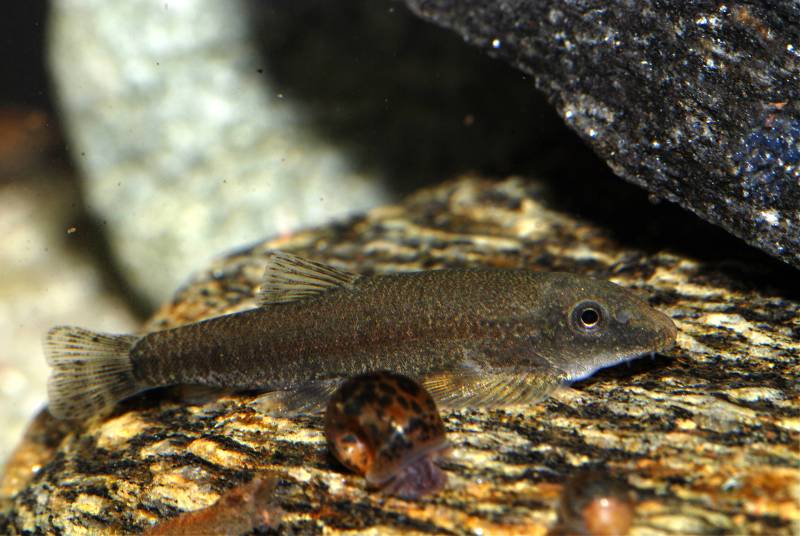
Erromyzon sp. 'ER01'
Gastromyzontidae · authority not recorded
Erromyzon spp. are obligate dwellers of shallow, fast-flowing, highly-oxygenated headwaters/minor tributaries characterised by stretches of riffles and runs broken up by pools or cascades in some cases. Substrates are normally composed of smaller rocks, sand and gravel with jumbles of boulders, and while riparian/stream-side vegetation and patches of submerged leaf litter are common features aquatic plants aren't usually present.
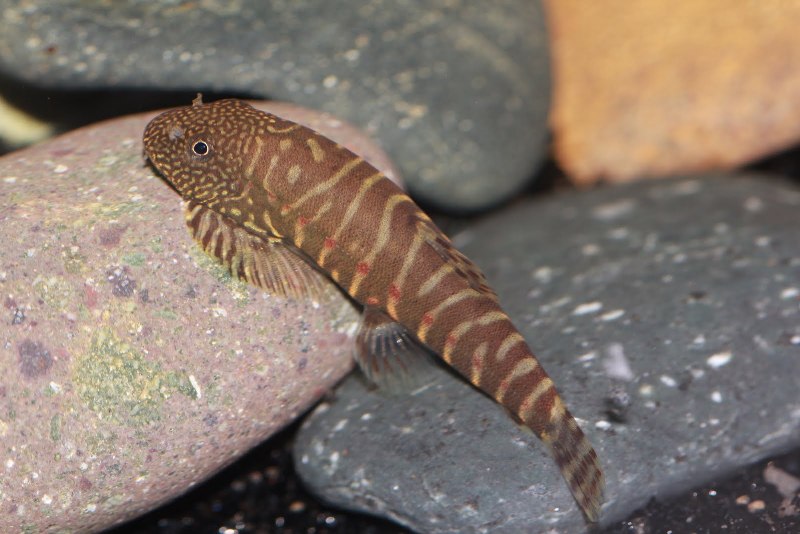
Erromyzon sp. 'ER02'
Gastromyzontidae · authority not recorded
This fish remains in need of identification, and we've chosen to list unidentified members of the genus using an 'ER' numbering system in the absence of definitive information. It's quite easy to distinguish from congeners since it's the only species known to possess a colour pattern comprising a dark base colour and series of thin, paler vertical bars on the body and similarly-coloured spots on the head.
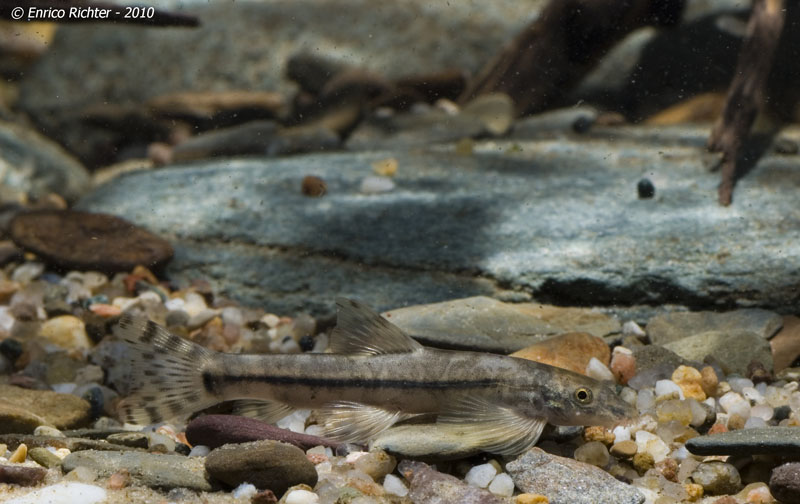
Formosania lacustrisTasseled-mouth Loach
Gastromyzontidae · Steindachner, 1908
An obligate dwellers of swiftly-flowing streams and headwaters containing clear, oxygen-saturated water. It inhabits riffles and runs and according to studies shows a preference for shallower zones. Substrates are generally composed of gravel, rocks, boulders or bedrock carpeted with a rich biofilm formed by algae and other micro-organisms. Aquatic plants are uncommon and while riparian/streamside vegetation may be present...
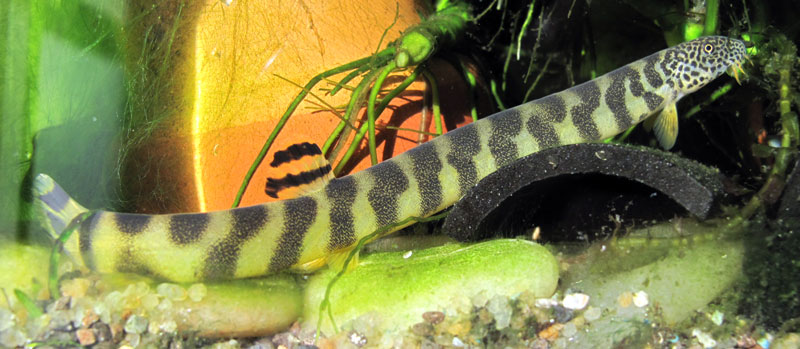
Kichulchoia multifasciata
Cobitidae · Wakiya & Mori, 1929
It's most easily told apart from K. brevifasciata, its only congener, by body patterning consisting of dark, vertical bars running along the dorso-ventral part of the body (vs. dark bars running alongside the midventral part of the body), lips with wrinkled surfaces (vs. smooth) and barbels short (vs. long).
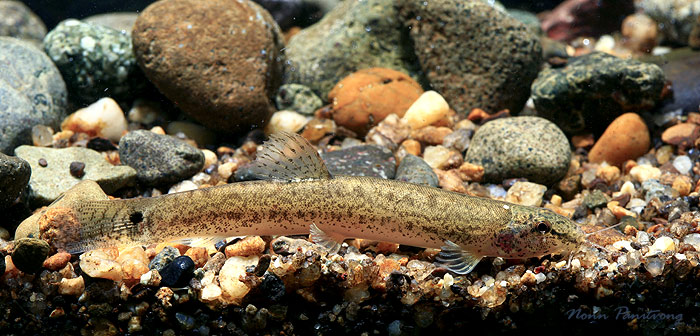
Lepidocephalichthys berdmorei
Cobitidae · Blyth, 1860
This is one of the most frequently-traded members of the genus and is an excellent choice for those new to keeping loaches. It's distinguishable from congeners by a combination of characters including: relatively large adult size (to at least 80 mm SL); rounded/truncate caud...
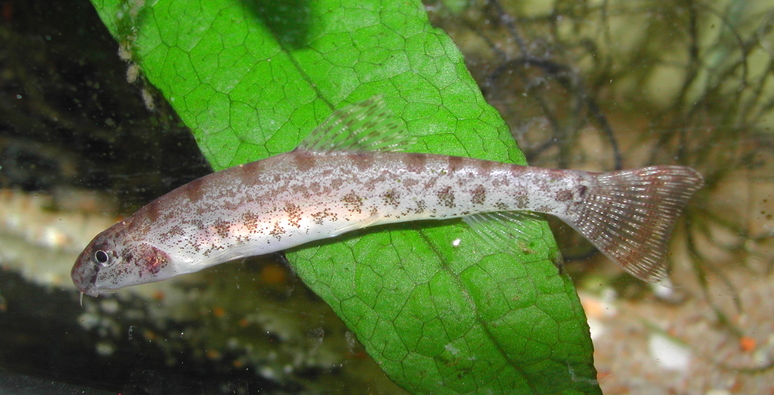
Lepidocephalichthys goalparensis
Cobitidae · Pillai & Yazdani, 1976
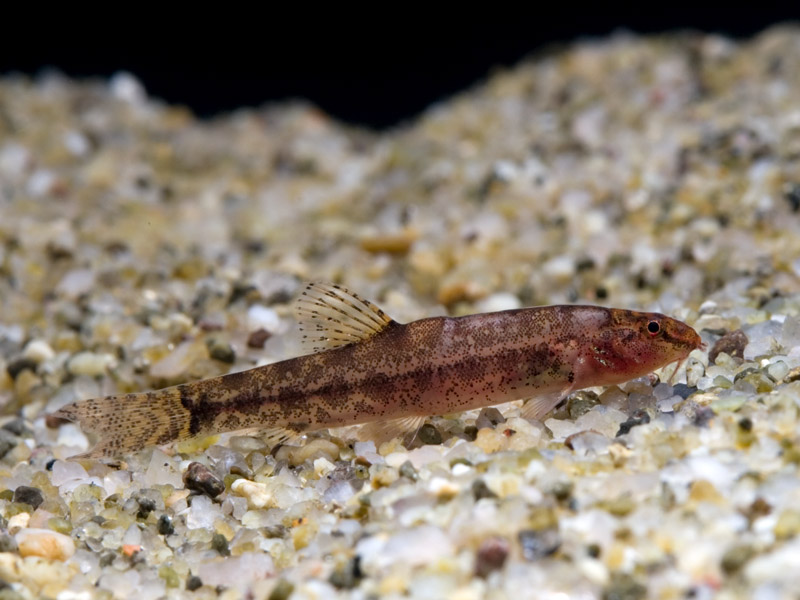
This species is almost unheard of in the hobby with the specimen pictured above the only one we're aware of. It was imported into the United Kingdom in late 2011 as bycatch among a shipment of mastacembelid eels from northern India, and the identification was subsequently confirmed by Justin Havird, senior author of the most recent revision of the genus.
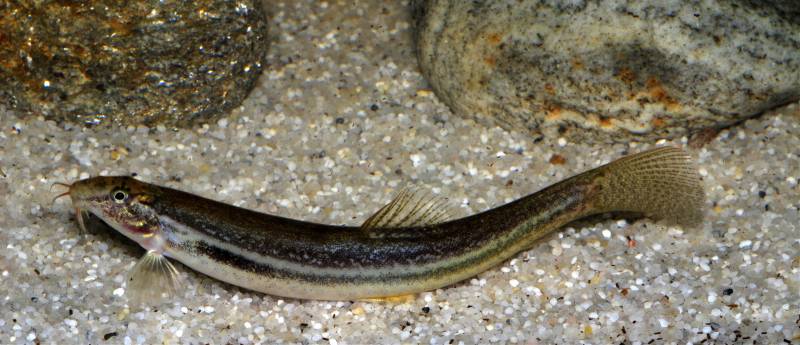
Lepidocephalichthys guntea
Cobitidae · Hamilton, 1822
This is one of the most frequently-traded members of the group and is an excellent choice for those new to keeping loaches. It's distinguishable from congeners by a combination of characters including: rounded/truncate caudal-fin; a scaleless patch on top of the head; relatively large adult size; flanks with spotted patterning in females and a solid...
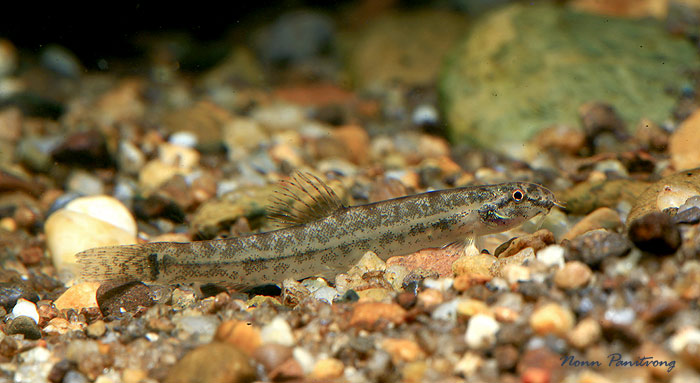
Lepidocephalichthys hasselti
Cobitidae · Valenciennes, 1846
At one locality close to Ban Na Hwai, Chiang Mai Province, Thailand L. hasselti was collected from a shallow (<0.5 m) pool in a swampy zone between forest and rice fields. The substrate was of mud, there was no aquatic vegetation and it was being used as drinking water by local animals, with the only effluent connected to a 'small creek'. Other species found there were Physoschistura pseudobrunneana, Rasbora hobelmani and Systomus cf. orphoides.
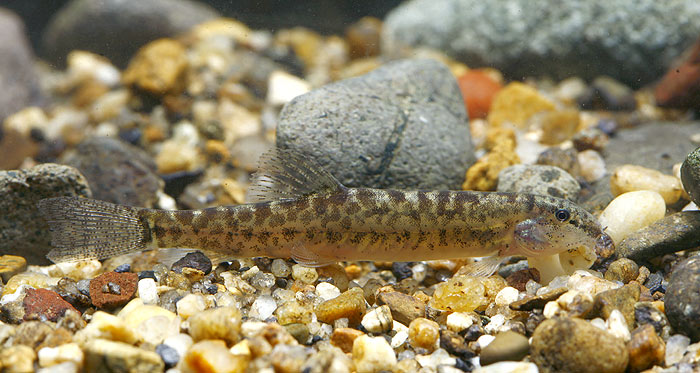
Lepidocephalichthys kranos
Cobitidae · Havird & Page, 2010
The family Cobitidae, often referred to as 'true' loaches, is widely-distributed across most of Eurasia with the Indian subcontinent, Southeast Asia and China representing particular centres of species diversity. Phylogenetic analyses by Tang et al. (2006), Šlechtová et al. (2007) and Šlechtová et a...
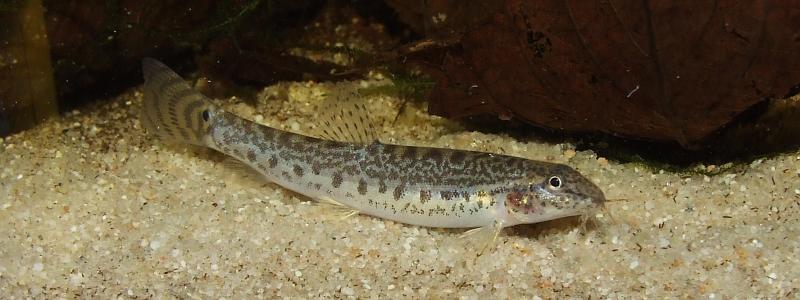
Lepidocephalichthys thermalis
Cobitidae · Valenciennes, 1846
This species is available sporadically and makes an excellent choice for those new to keeping loaches. It's distinguishable from congeners by a combination of characters including: truncate/rounded caudal-fin; no scales on top of head; dark, squarish spots o...
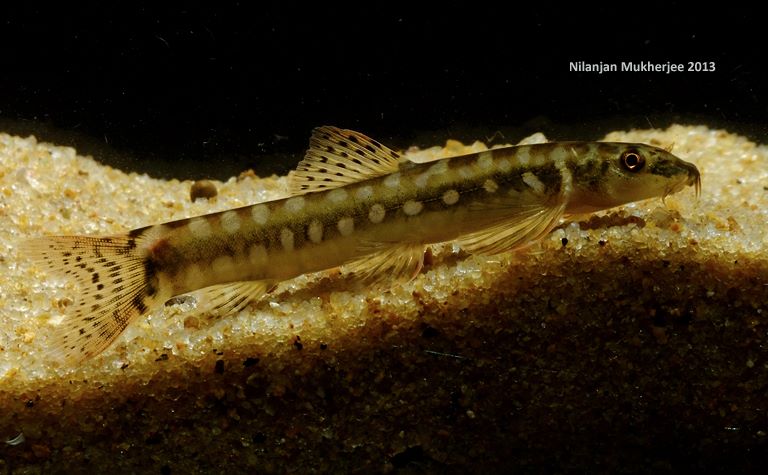
Mesonoemacheilus guentheri
Nemacheilidae · Day, 1867
However, according to the identification key of Rema Devi and Indra (2002), the two can be distinguished by a combination of factors as follows: body spots rounded in shape (vs. 'Y' or 'V' shaped in M. herrei); caudal peduncle relatively long (vs. relatively short); anal-fin not reaching base of caudal-fin (vs. anal-fin reaching base of caudal-fin); caudal peduncle with a dark band (vs. caudal peduncle with a dark spot); sub...
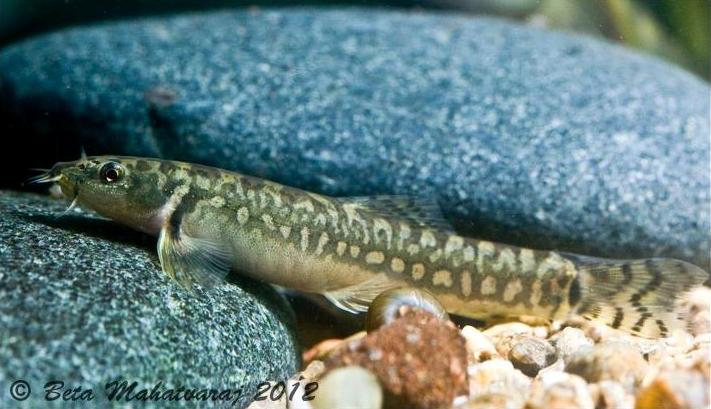
Mesonoemacheilus herrei
Nemacheilidae · Nalbant & Bãnãrescu, 1982
It's unclear if this species has ever been exported for the aquarium hobby outside of India but there may be a chance of finding the occasional specimen mixed in with shipments of M. guentheri or M. triangularis. It was earlier considered synonymous and may still be confused with M. guentheri since both species share similar body patterning consisting of rows of yellowish, dark-edged spots.
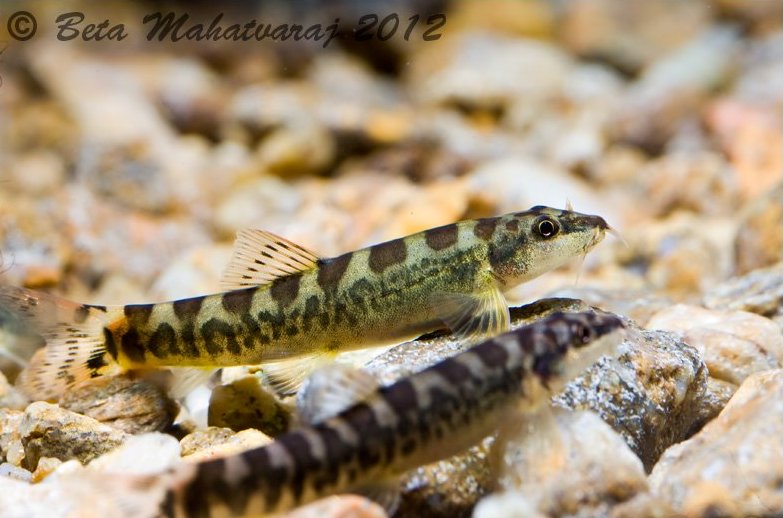
Mesonoemacheilus petrubanarescui
Nemacheilidae · Menon, 1984
Type locality is 'Netravati River, Dharmasthala, Karnataka State, India', with the species subsequently recorded from the Kabini (aka Kabani) River basin and it may be endemic to these two drainages. While the Netraviti flows through Karnataka in its entirety before emptying into the Arabian Sea just south of the city of Mangalore, th...
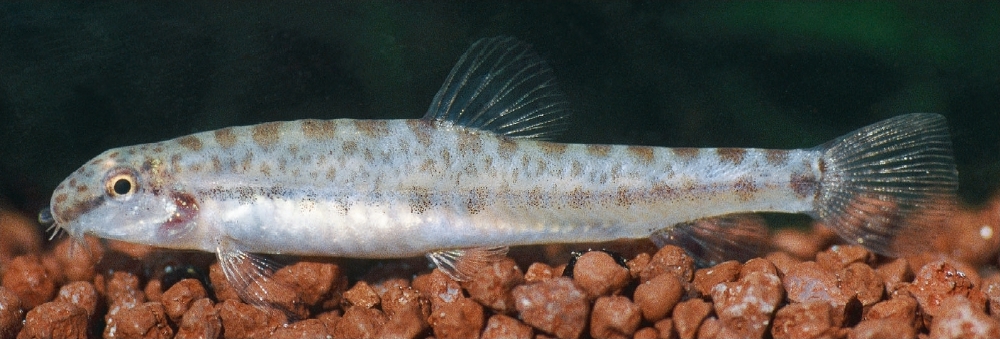
Microcobitis misgurnoides
Cobitidae · Rendahl, 1944
This species was initially described as a member of Cobitis and remained as such for over 60 years until being redescribed in the new genus Microcobitis by Bohlen and Harant (2011). It can be separated from Cobitis species by a number of char...
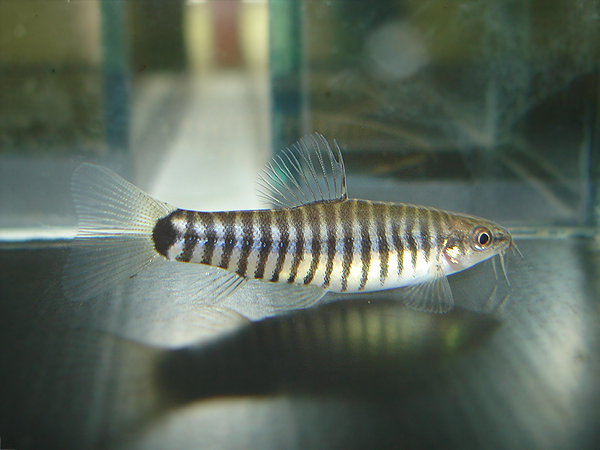
Micronemacheilus cruciatus
Nemacheilidae · Rendahl, 1944
This species is traded under various names including 'Vietnamese multi-banded zebra loach', 'hovering zebra loach', 'Laos pygmy multi-stripe loach', and 'banded dwarf loach'. It can be distinguished from related species by the following combination of characters: body with distinct vertical bars; 8 branched dorsal-fin rays; 3-10 pored lateral line scales; one pair of large papillae in median portion of upper lip; two pairs of large papillae in median portion of lower lip; lower posterior edge of opercle with 3-4 prominent indentations.
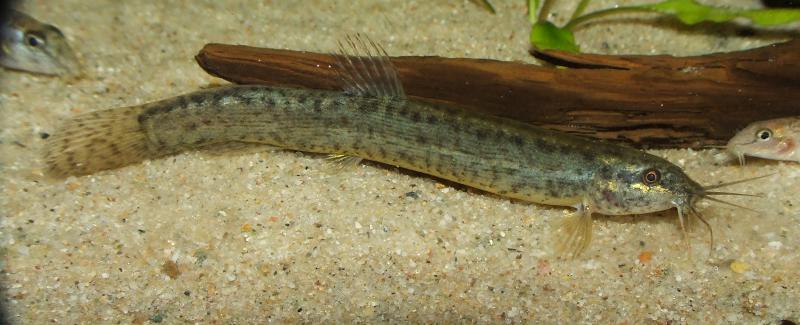
Misgurnus dabryanusLarge-scaled Loach
Cobitidae · Dabry de Thiersant, 1872
It's actually sold in the aquarium hobby on a regular basis but almost always labelled as or mixed in with Misgurnus anguillicaudatus and is thus poorly documented. Although quite simi...
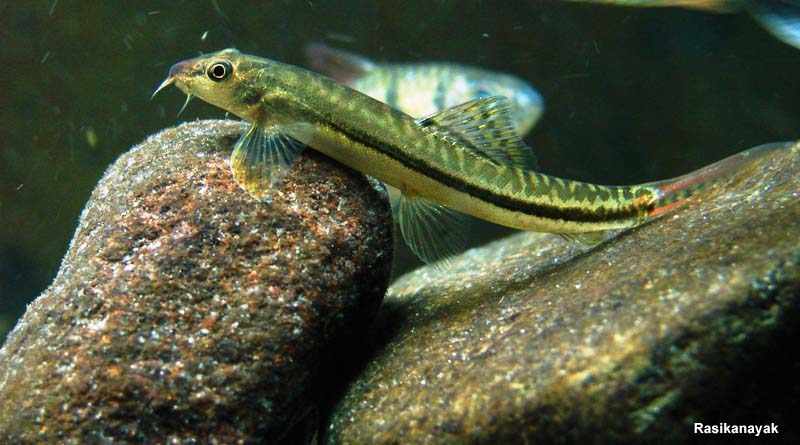
'Nemacheilus' anguilla
Nemacheilidae · Annandale, 1919
'N.' anguilla can be told apart from other Indian members of the genus by possessing dark flank markings which are partially or completely merged to form a lateral stripe, and an almost-complete lateral line extending to the anal-fin. Kottelat (2012) states that its generic placement requires additional study hence the genus name i...
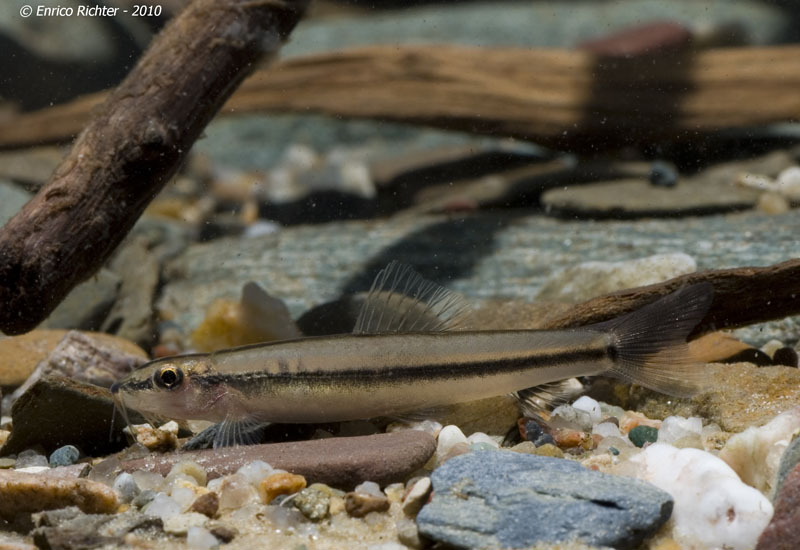
Nemacheilus binotatus
Nemacheilidae · Smith, 1933
N. binotatus is distinguished from similar-looking congeners such as N. longistriatus and N. ornatus by its unique body patterning consisting very simply of two dark stripes, one running along the dorsal surface and the other from the tip of the snout, through the eye and along the flank. There are usually 1-3 small, vertically-orientated spots extending above the lateral stripe between the pectoral-fin and dorsal fins. These are su...
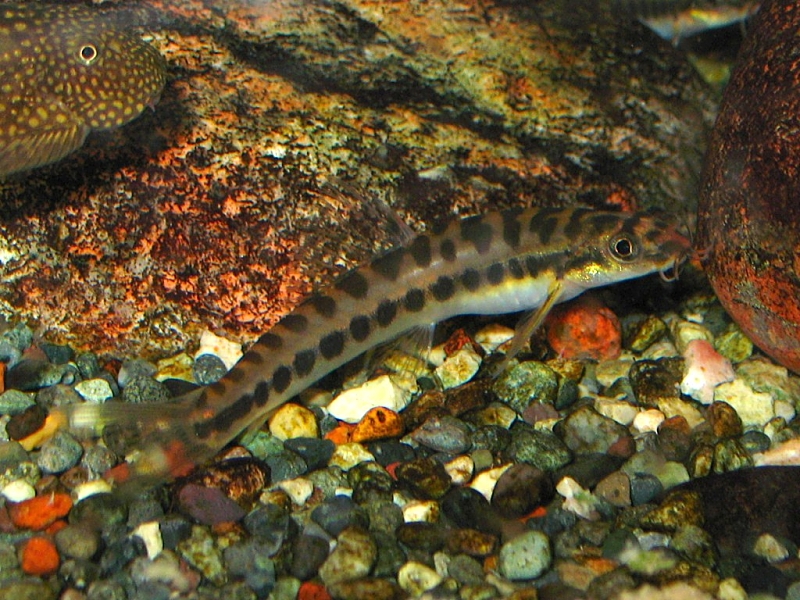
Nemacheilus masyaeArrow Loach
Nemacheilidae · Smith, 1933
This species was originally named Nemacheilus masyae but following ICZN rules the spelling was later corrected to N. masyai because it's named after a man. It can be distinguished from the majority of congeners by body patterning comprising 14-18 short, dark vertical bars on each flank, 12-17 saddle-like markings running along the dorsal surface, a dark spot on the caudal peduncle at the termination of the lateral line and a dark blotch in the lower half of the first few dorsal-fin rays.
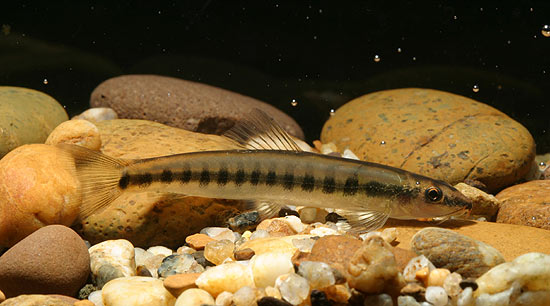
Nemacheilus ornatus
Nemacheilidae · Kottelat, 1990
This species is distinguished from similar-looking congeners such as N. longistriatus and N. ornatus by its unique colour pattern consisting of a black lateral body stripe with 9-16 vertically-orientated blotches extending along it both above and below, plus an irregular stripe running along the dorsal surface. The anterior lateral blotch is surrounded by lighter pigment, forming an ocellus similar to that seen in N. binotatus.
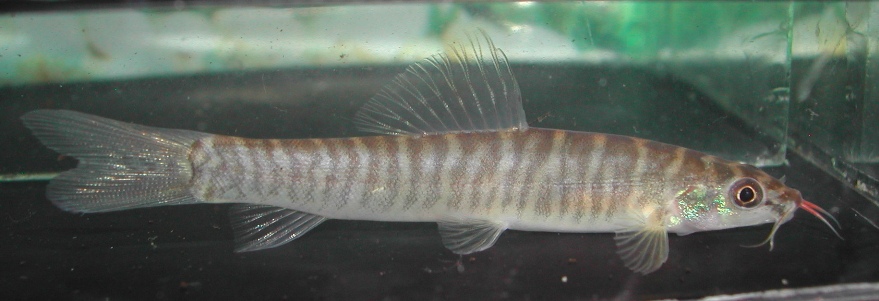
Nemacheilus platiceps
Nemacheilidae · Kottelat, 1990
This species is only traded occasionally. It's distinguished from congeners by a combination of characters including: 12-16 dark, irregular, vertical bars on body, usually split vertically; lips without furrows; inco...
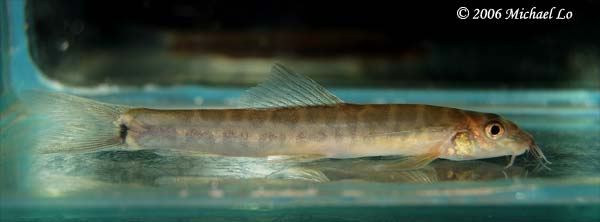
Nemacheilus saravacensis
Nemacheilidae · Boulenger, 1894
Images depict clear, tea-coloured forest streams with dense marginal vegetation and substrates of sand and/or small rocks and pebbles. It's also known from environments with sandy substrate and organic debris in the form of submerged roots/branches and le...
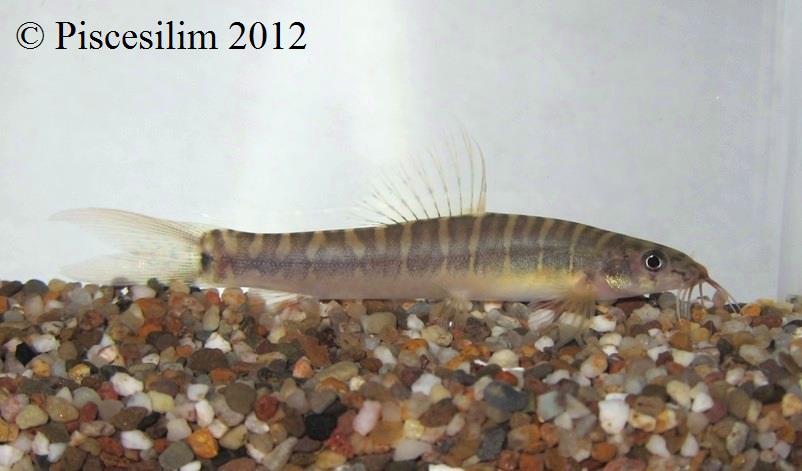
Nemacheilus selangoricus
Nemacheilidae · Duncker, 1904
N. selangoricus is most similar to N. spiniferus since it possesses acuminate scales above and below the lateral line on the caudal peduncle, a feature not shared with any other congener. It can however be distinguished by the following characters: presence of 8-12 very regular dark bars on flanks (vs. 10-13 irregularly-shaped bars in N. spiniferus), 3-5 times...
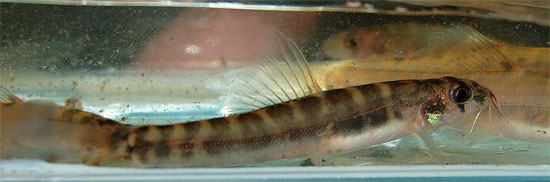
Nemacheilus spiniferus
Nemacheilidae · Kottelat, 1984
It's a member of the N. selangoricus group of species within the genus, an assemblage first recognised by Hadiaty and Kottelat (2009) and characterised by possession of two rows of horizontally-arran...
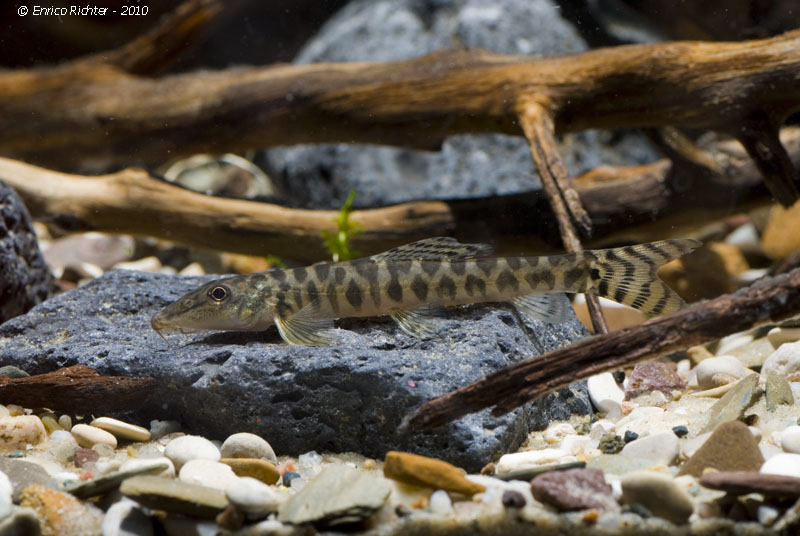
Nemachilichthys rueppelli
Nemacheilidae · Sykes, 1839
This species is frequently misidentified as Nemachilichthys rueppelli (Sykes, 1839) but that species was described from close to Pune in Maharashtra state, well over 500 km north of Shimoga. Further, in his description of N. rueppeli Sykes states that the body colour is 'greenish yellow' and 'the lateral line marked with short dark bars'. Narayan Rao described the colour pattern of...
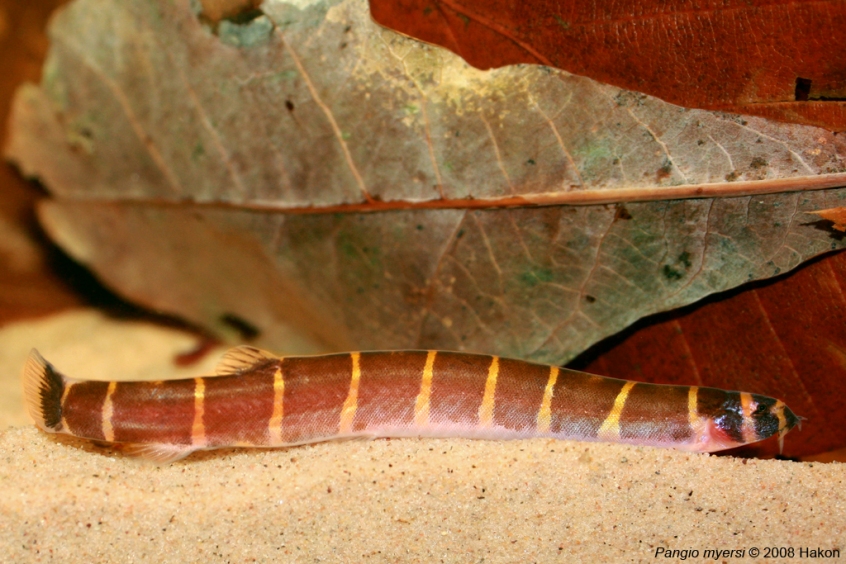
Pangio myersiGiant Kuhli Loach
Cobitidae · Harry, 1949
It's included in the P. kuhlii group of closely-related species and can be distinguished from other members by the following combination of characters: 8-11 very broad, quadrangular, regular dark body bars; orange base body colour; caudal-fin either entirely black or with a large black blotch at the base and a submarginal dark bar or row of spots. The latter feature can be useful in identifying young or newly-imported, undernourished specimens which can...
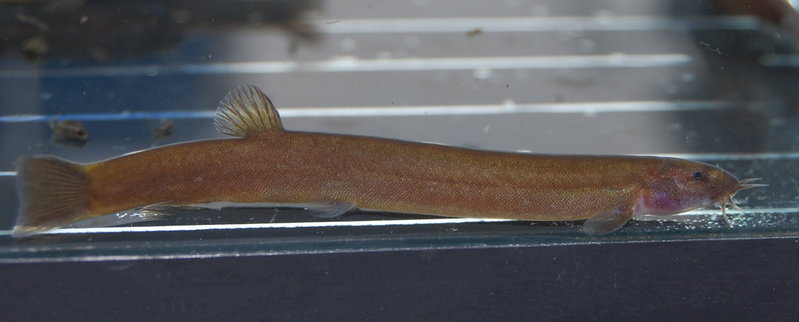
Pangio oblongaBlack Kuhli Loach
Cobitidae · Valenciennes, 1846
Described from close to the city of Bogor, Jawa Barat (West Java) province on the island of Java, Indonesia, but currently considered widespread with recorded occurrences on Java, Sumatra, Borneo and mainland Peninsular Malaysia. Some populations exhibit lighter...
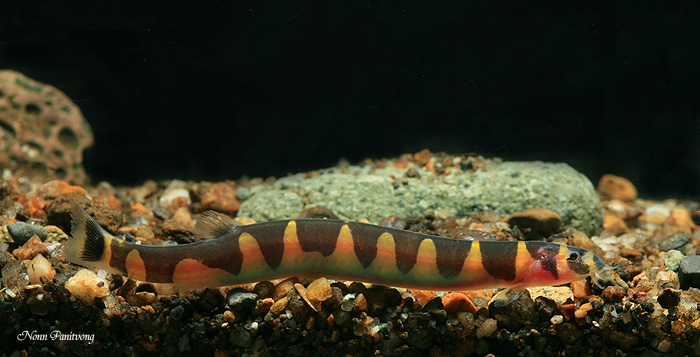
Pangio semicincta'Kuhli' Loach
Cobitidae · Fraser-Brunner, 1940
This species is among the most frequently-misidentified in the hobby, almost always being traded as P. kuhlii. However the latter is currently considered endemic to Java, from where commercial collections are almost unheard of, and has possibly never been seen in aquaria.
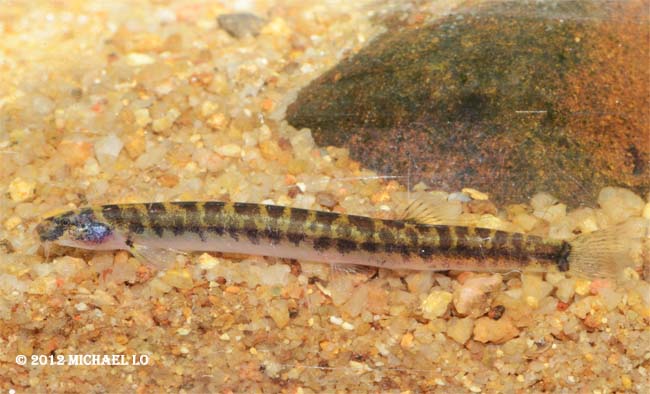
Pangio shelfordii
Cobitidae · Popta, 1903
Patterning is highly variable depending both within and between populations and the species may comprise an assemblage containing a number of taxa (Kottelat and Lim, 1993; Tan and Kottelat, 2009). For example, those from Singapore and Johor possessing intricate mottling on the dorsal surface while individuals from Terengganu have a series of saddle-like markings either alternating or connecting with the midlateral markings.
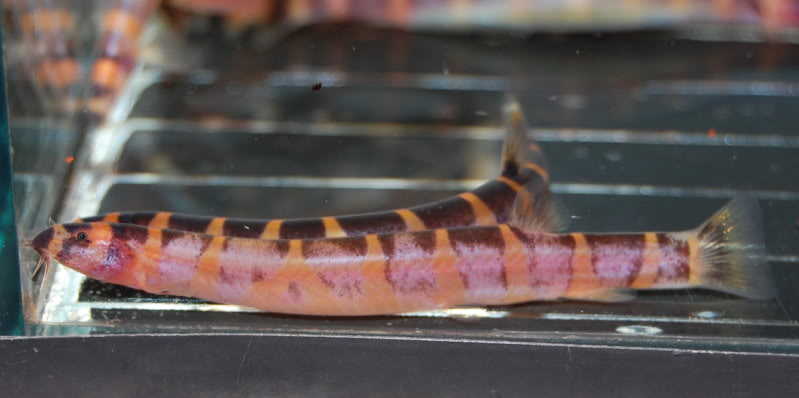
Pangio sp. 'PAN01'
Cobitidae · authority not recorded
The fish in our images above were imported together don't correspond to any of the described species of Pangio though they can be assigned to the P. kuhlii species group with a degree of certainty. Unfortunately the live appearance of P. kuhlii itself is a mystery to aquarists since it's currently considered endemic to Java and may have never been seen in the hobby.
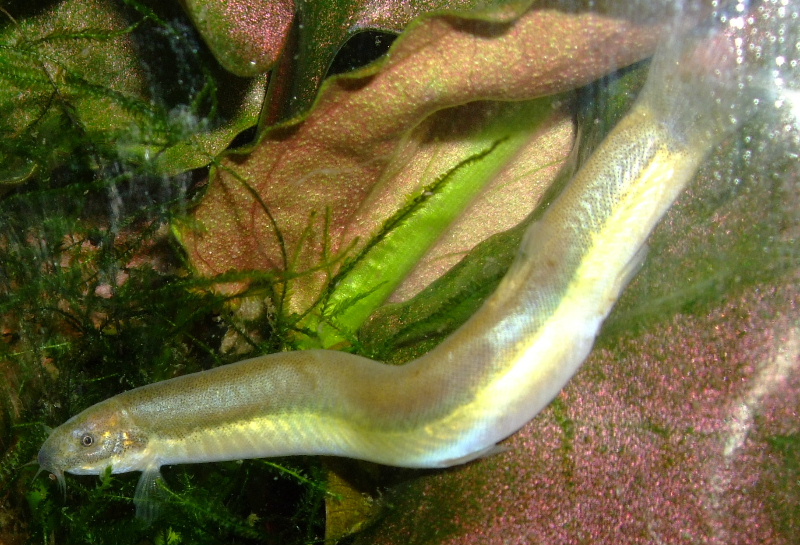
Pangio sp. 'PAN02'
Cobitidae · authority not recorded
The fish in our images don't correspond to any of the described members of the genus but can be assigned to the P. oblonga species group with a degree of certainty. It's apparently exported as a contaminant among shipments of a uniformly brown-coloured fish with unpublished genetic analyses suggesting the two might be variants of the same species (J. Bohlen, pers. comm.). Among congeners it may be related to P. alcoides Kottela...
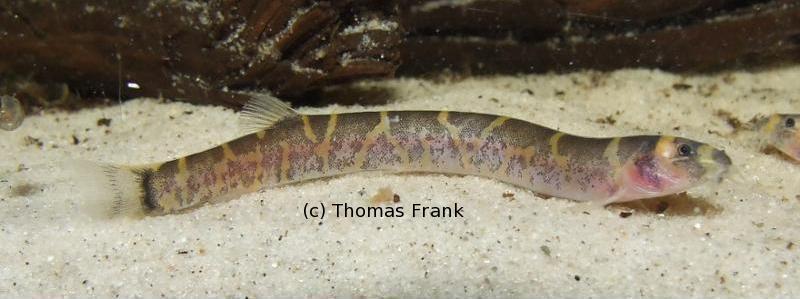
Pangio sp. 'PAN03'
Cobitidae · authority not recorded
Pangio species are often generically referred to as 'kuhli' or 'coolie' loaches in the aquarium hobby, the latter a variation of the former which was itself derived from the surname of German naturalist Heinrich Kuhl (1797-1821). Ichthyo...
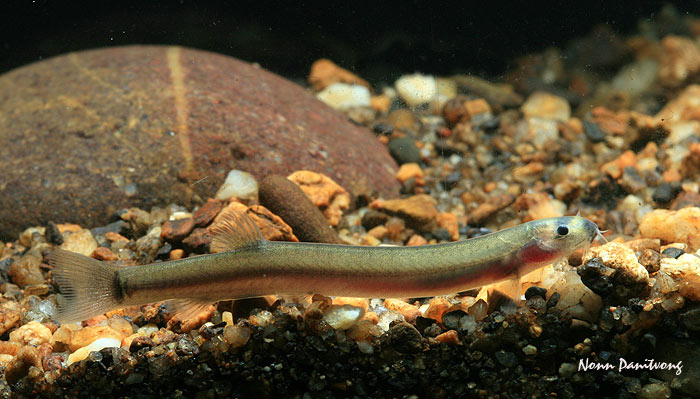
Pangio sp. 'PAN04'Panda Loach
Cobitidae · authority not recorded
This unidentified species has been traded since the mid-00s and appears to be a member of the P. khulii-oblonga species group as per Bohlen et al. (2011). There are two similar-looking forms; one has a darker body, dark pigmentation in the pectoral fins and barbels and a blue sheen on the head, while the...
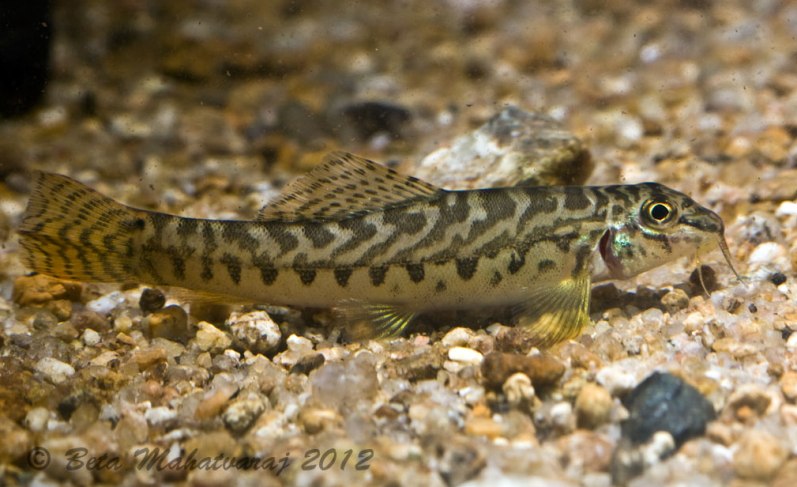
Paracanthocobitis botiaZipper Loach
Nemacheilidae · Hamilton, 1822
Traded under various names including 'mottled', 'eyepot', 'sand' and 'striped' loach. It's perhaps one of the better choices for those new to keeping nemacheilids being relatively hardy, peaceful and exhibiting some quirky behavioural traits. The characteristic ocellus, a dark marking at the top of the caudal peduncle that resembles an eye, is thought to have some function in predator distraction and is normally more intense in younger specimens.
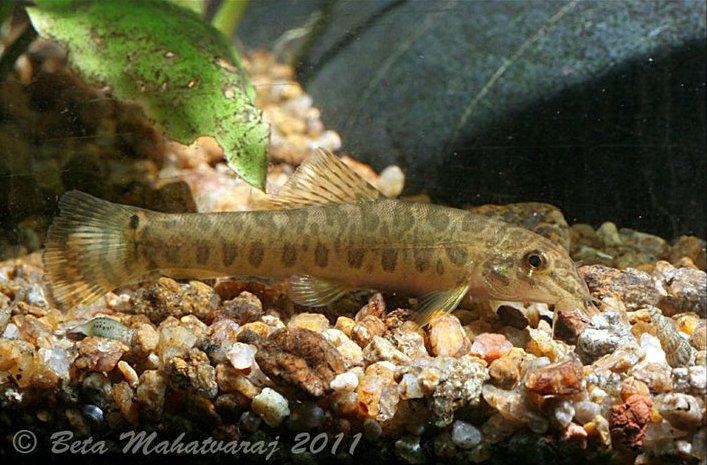
Paracanthocobitis mooreh
Nemacheilidae · Sykes, 1839
This species is still considered a member of the genus Nemacheilus by some sources, but it was reclassified and placed in Acanthocobitis by Grant (2008). Acanthocobitis sinuata, generally considered a junior synonym of A. mooreh (Kottelat, 2012b), also appears distinct and differs in geographical distribution plus number of dorsal-fin rays (2-3/9-10 in A. mooreh vs. 2/8-9 in A. sinuata) and some aspects of colour pattern.
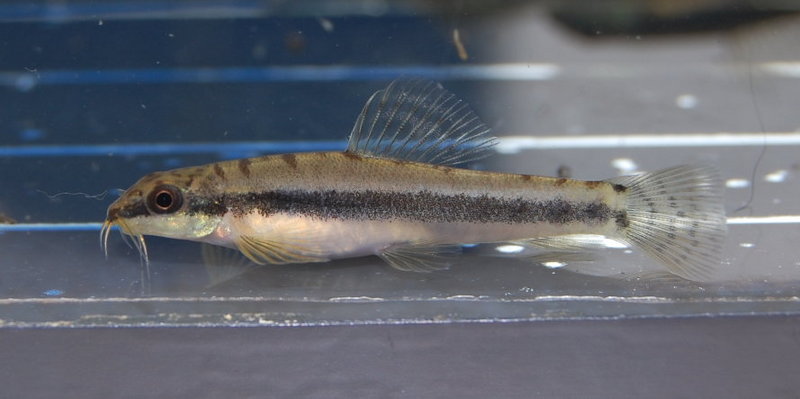
Paracanthocobitis zonalternans
Nemacheilidae · Blyth, 1860
According to Kottelat (1990) the chief distinguishing characters for the genus are: possession of 9-18½ branched dorsal-fin rays; colour pattern without black basal caudal bar, but with an ocellus at upper base of caudal-fin; upper lip with or without several rows of papillae; lower lip with a broad median interruption and a widened, papillated pad on each side.
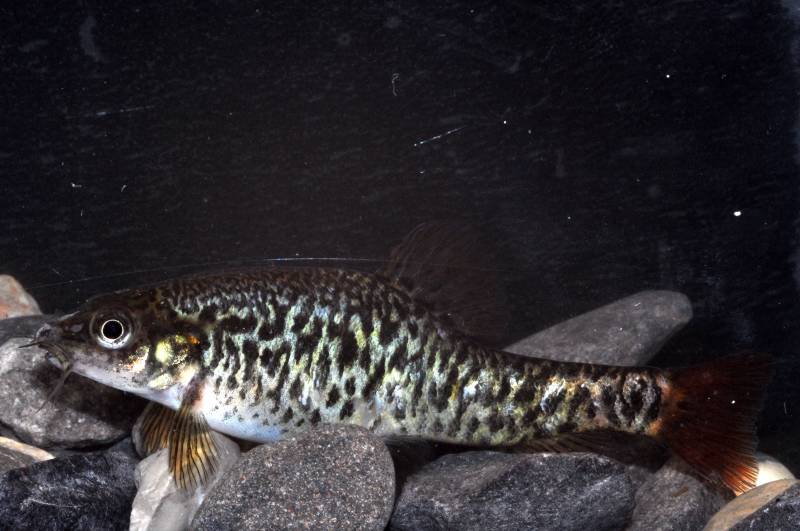
Petruichthys brevisInle Loach
Nemacheilidae · Boulenger, 1893
This species is sometimes traded as 'Lake Inle red-tailed loach' and was formerly included in the genus Yunnanilus, a diverse assemblage of which the majority of members are endemic to the Yunnan plateau in Yunnan province, southern China.
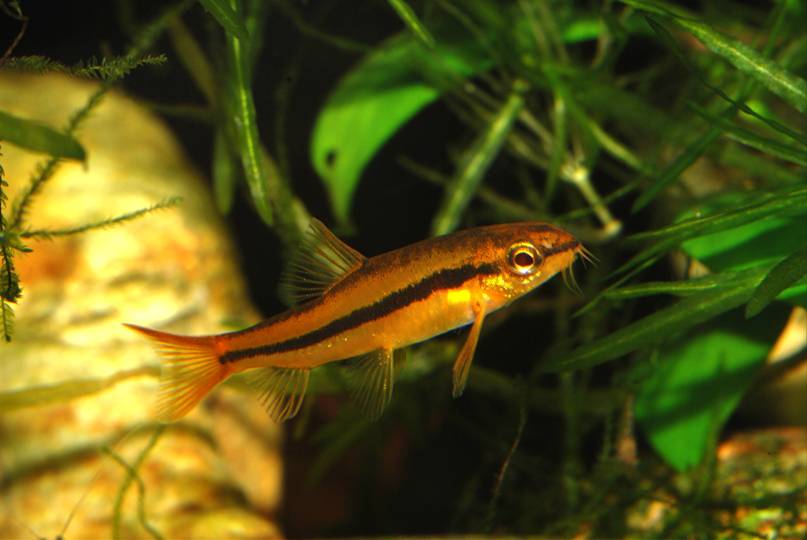
Petruichthys sp. 'rosy'Rosy Loach
Nemacheilidae · authority not recorded
This species continues to be referred to by the fictitious scientific name 'Tuberoschistura arakensis' but actually appears to be an undescribed Yunnanilus sp. and is also sometimes traded as Y. sp. 'orange' or 'Burmese pink loach' but appears to be a member of the genus Petruichthys as per Kottelat (2012). There exist more than 30 described Yunnanilus spp., the...
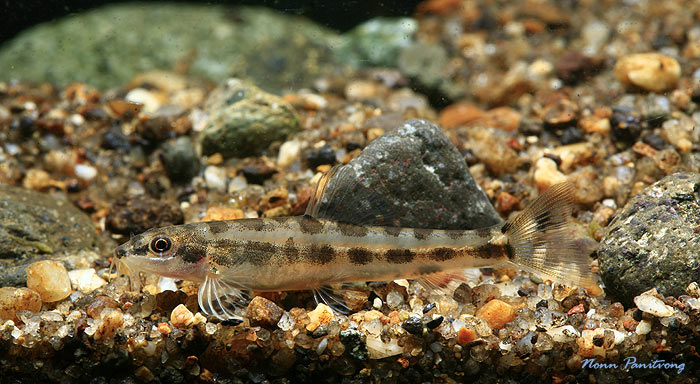
Schistura geisleri
Nemacheilidae · Kottelat, 1990
Fishes which inhabit similar biotopes in nature constitute the best options, especially peaceful, open water-dwelling cyprinids since the presence of one or two schools can make a visible difference to the confidence of this naturally reclusive loach.
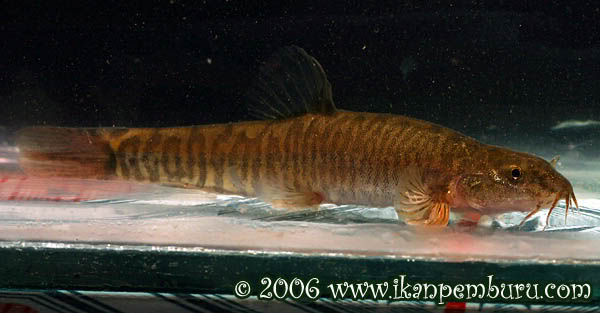
Schistura polytaenia
Nemacheilidae · Zhu, 1982
Schistura species are omnivorous although the bulk of their diet consists of small insects, worms, crustaceans and other zooplankton with only relatively small amounts of plant matter consumed, mostly via the stomach contents of prey items. In the aquarium they will acc...
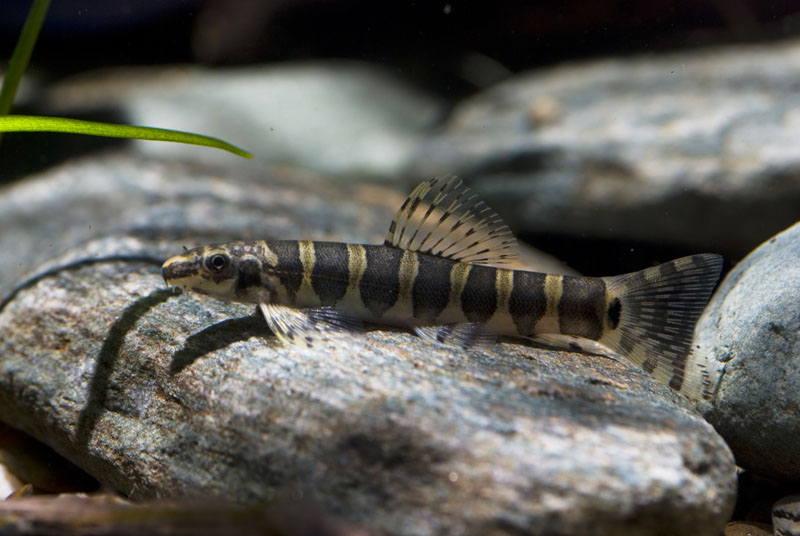
Serpenticobitis octozona
Serpenticobitidae · Roberts, 1997
This species exhibits some interesting behaviour including a degree of social interaction plus the ability to cling to vertical or overhanging surfaces. It's sometimes sold under the name 'serpent loach'. The genus currently contains just three members all of which are known only from the Mekong basin. S. octozona is the type species and separated from the others mainly by body patterning which consists of 7-8 dark bars on each flank, these extending the full depth of the body and much wider than the pale interspaces between.
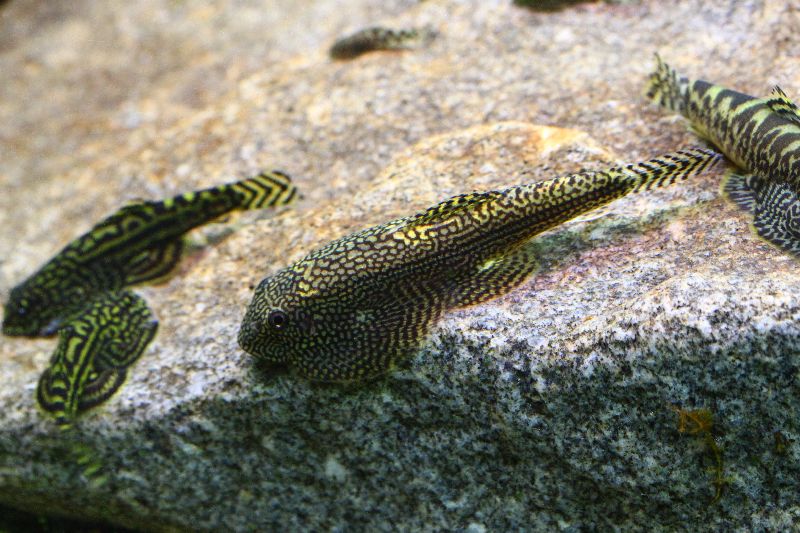
Sewellia albisuera
Gastromyzontidae · Freyhof, 2003
It's been suggested that these two may represent the same species but this appears not to be the case. When describing S. albisuera Freyhof (2003) used a series of specimens collected in 2000 plus some larger, spotted fish which had been collected in 1999 and preserved in New York. Although he noticed differences in dorsal patterning between the two series these weren't considered sufficient to s...
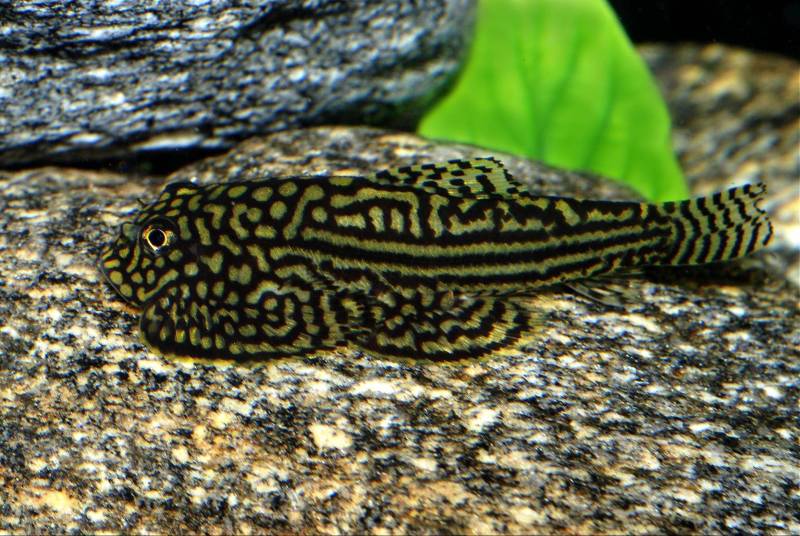
Sewellia lineolataTiger Hillstream Loach
Gastromyzontidae · Valenciennes, 1846
S. lineolata was first recorded by Diard over 150 years prior to its 'rediscovery' in the early-1990s. It became available to the aquarium trade in the mid-2000s and swiftly established itself as one of the more popular balitorids in the hobby due to its attractive body markings and ease of breeding. It's also sold under the names 'reticulated hillstream loach', 'Vietnamese hillstream loach' and 'gold ring butterfly sucker'. It's difficult to...
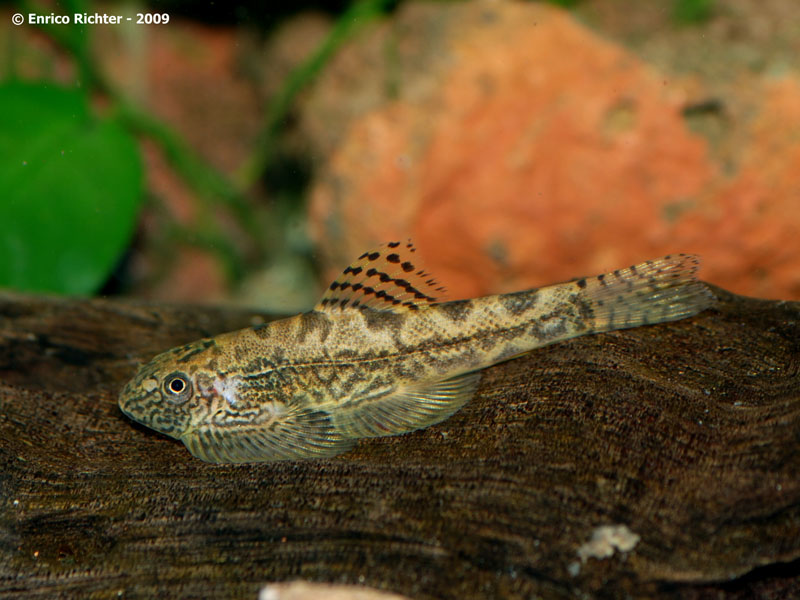
Sewellia sp. 'SEW02'
Gastromyzontidae · authority not recorded
This species first became available in early 2009 and was initially identified as S. breviventralis (Freyhof and Serov, 2000) because there is a clear space between the pelvic and anal fins and body patterning is vaguely similar to that species, and also appears quite similar to S. elongata (Roberts, 1998) and S. sp. 'SEW03'. It does not fully match the original descriptions of either, however, and therefore remains in need of identification.
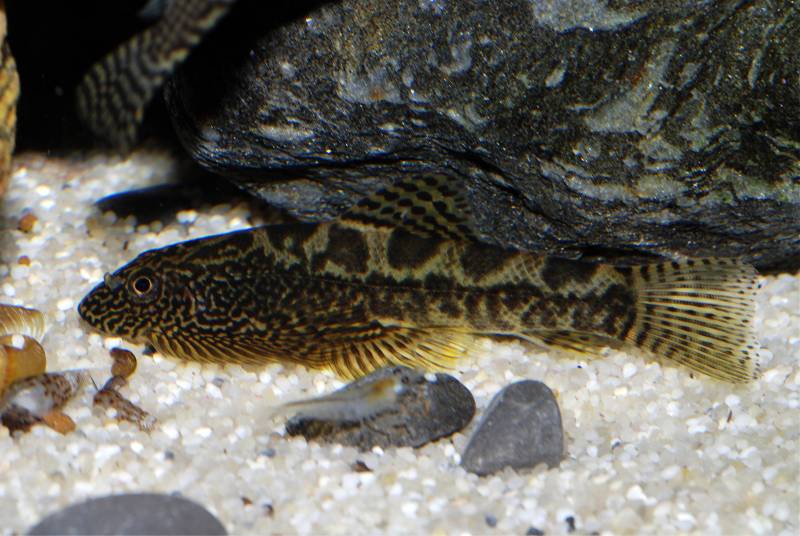
Sewellia sp. 'SEW03'
Gastromyzontidae · authority not recorded
This fish first became available in early 2009 and was initially identified as S. breviventralis (Freyhof and Serov, 2000). However it cannot be that species because there is no discernible gap between pelvic and anal fins, which also discounts the possibility of it being S. elongata (Roberts, 1998). It therefore remains unidentified and is often imported in mixed batches with S. sp. 'SEW02', which it also resembles closely.
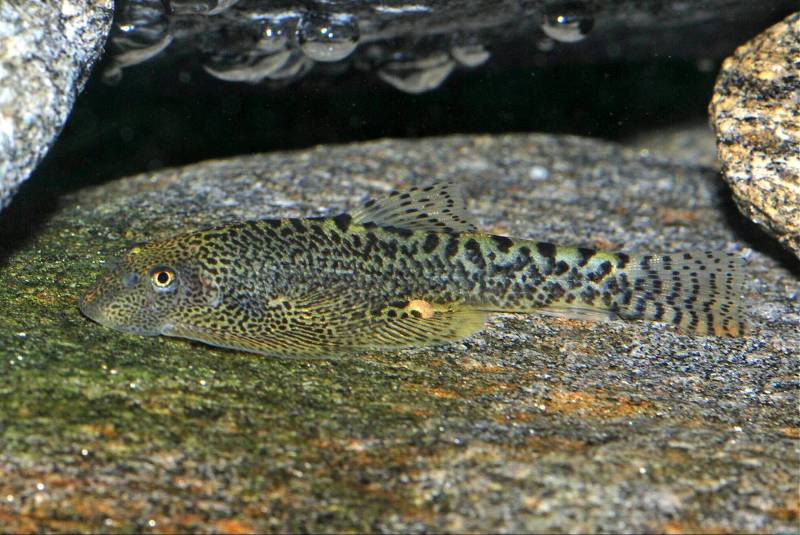
Sewellia sp. 'SEW04'
Gastromyzontidae · authority not recorded
This fish has thus far only been imported among shipments of S. sp. 'SEW02' and S. sp. 'SEW03'. It doesn't appear to correspond to any known member of the genus and may be undescribed. Prior to the mid-1990s S. lineolata was the only species in the genus but an upturn in surveys of fresh water fauna in Vietnam and Laos has resulted in the discovery of various new taxa, several of which remain undescribed.
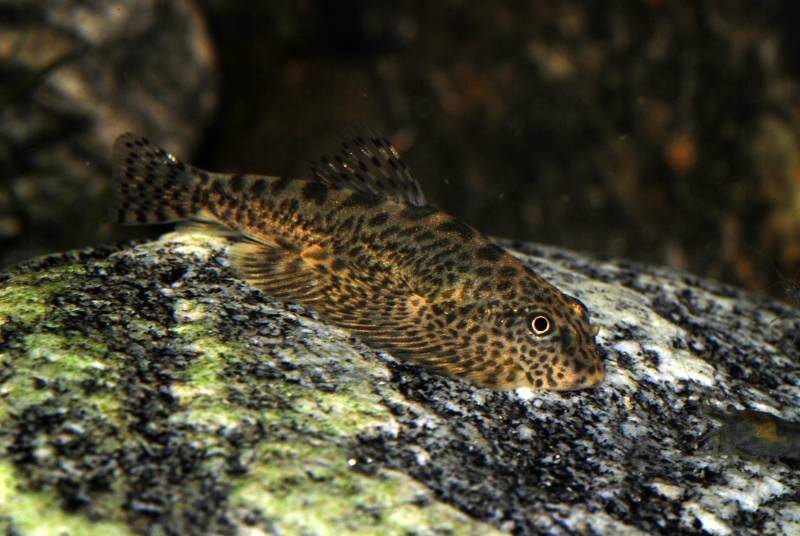
Sewellia speciosa
Gastromyzontidae · Roberts, 1998
This species first became available in early 2010 and sometimes appears on trade lists under the vernacular names 'Laos sucker' or 'Laos Sakura sucker'. It's distinguishable from other members of the genus by the following combination of characters: body spotted and without stripes; no concentric bands on paired fins; origin of pelvic-fin below origin of dorsal-fin; origin of pectoral-fin posterior to corner of mouth; pelvic fin reaching origin of anal fin; small elevated ...
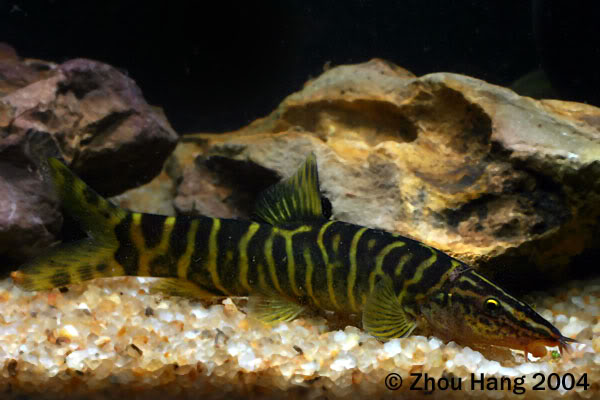
Sinibotia pulchraGolden Zebra Loach
Botiidae · Wu, 1939
This species is also sold under the vernacular names 'golden Chinese loach' and '12-banded Chinese loach'. Along with S. robusta it's the most commonly-traded member of the genus, and the two are often imported in mixed batches, presumably because they occur and are thus collected together in nature. Like most congeners it has a highly flexible, sinuous body which makes it very interesting to observe. S. pulchra can be differentiated from...
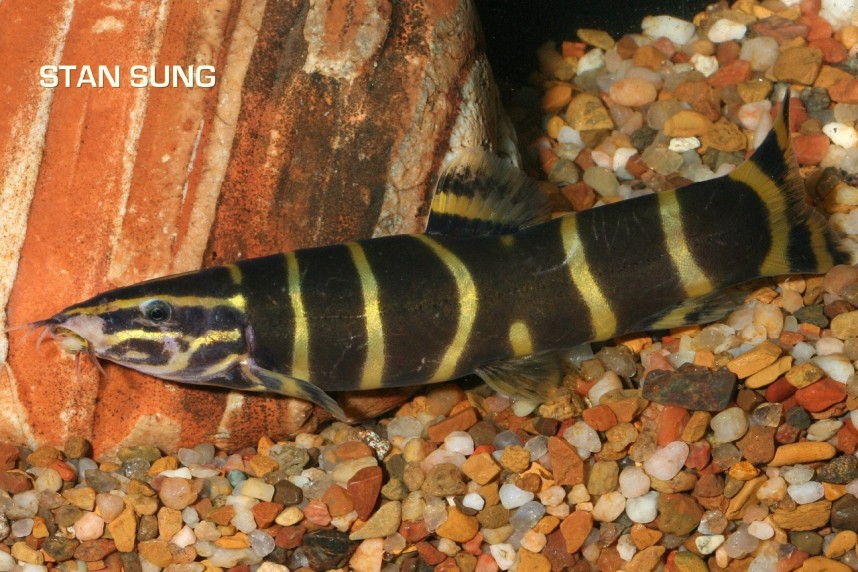
Sinibotia reevesae
Botiidae · Chang, 1944
This species not often seen in the aquarium trade and is apparently rare in its natural waters, with the occasional individual imported as bycatch in shipments of S. pulchra or S. robusta, or by private collectors. Like others in the genus it has a highly flexible, sinuous body which makes it very interesting to observe. It's told apart from congeners by the following combination of chara...
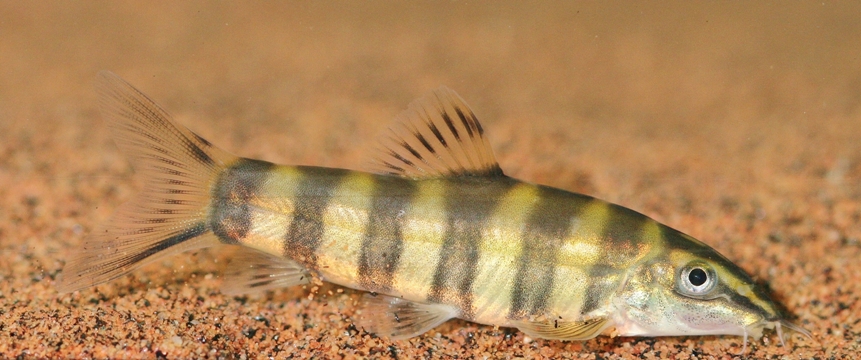
Sinibotia robustaKansu Loach
Botiidae · Wu, 1939
This species is also sold under the vernacular names 'golden Chinese loach' and '12-banded Chinese loach'. Along with S. pulchra it's the most commonly-traded member of the genus, and the two are often imported in mixed batches, presumably because they occur and are thus collected together in nature.
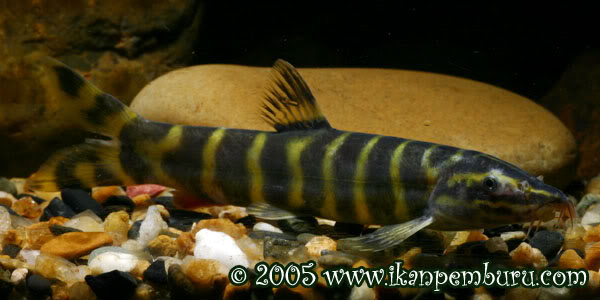
Sinibotia superciliaris
Botiidae · Günther, 1892
This species is rarely-seen in the trade due to a relative lack of commercial exports from the middle Yangtze basin. It looks very similar to S. pulchra but can be told apart by the fact it lacks irregular, brownish markings and spots on the side of the head (vs. present in S. pulchra), and like most congeners it has a highly flexible, sinuous body which makes it very interesting to observe.
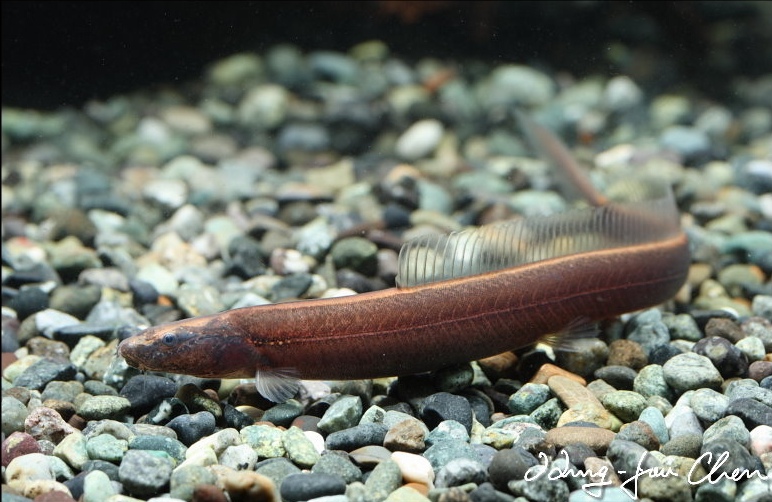
Vaillantella maassiFork-tailed Loach
Vaillantellidae · Weber & de Beaufort, 1912
This species is traded under various names including 'chocolate scissor-tailed loach', chocolate long-finned loach', 'red line cobra loach', 'spiny eel loach' and 'dragon loach'. It's apparently difficult to find in its natural habitats and thus time-consuming to collect, meaning it's rarely traded in numbers, sought after by enthusiasts and tends to carry a relatively high price tag when available. The genus currently contains just three...
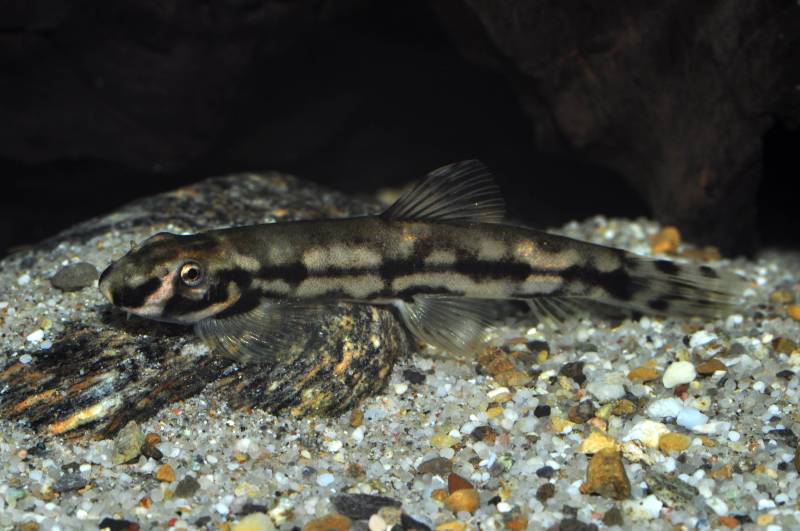
Yaoshania pachychilusPanda Loach
Balitoridae · Chen, 1980
Juvenile specimens were first exported for the aquarium hobby during 2009 and have since been available on a sporadic basis with prices generally reflecting its rarity and, hopefully, number of specimens being collected. The striking black-and-white-striped juvenile colour pattern inspired the vernacular name although it's sometimes labelled as 'panda goby' rather than 'panda loach'.
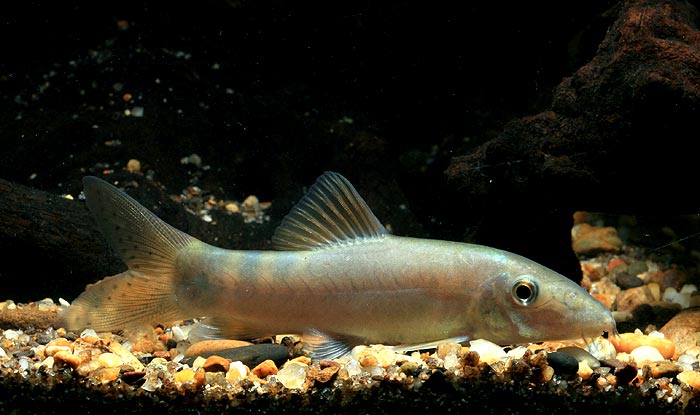
Yasuhikotakia caudipunctataSpeckle-tailed Loach
Botiidae · Taki & Doi, 1995
This specie is relatively rare in the aquarium trade and much sought after by enthusiasts as a result. It looks relatively similar to Y. splendida but can be told apart from it, and indeed all other members of the genus, by the following combination of characters: possession of 8 branched dorsal-fin rays; 32-33 vertebrae; one or two small, brownish, vertically-orientated markings on the dorsal part of the body posterior to the dorsal fi...
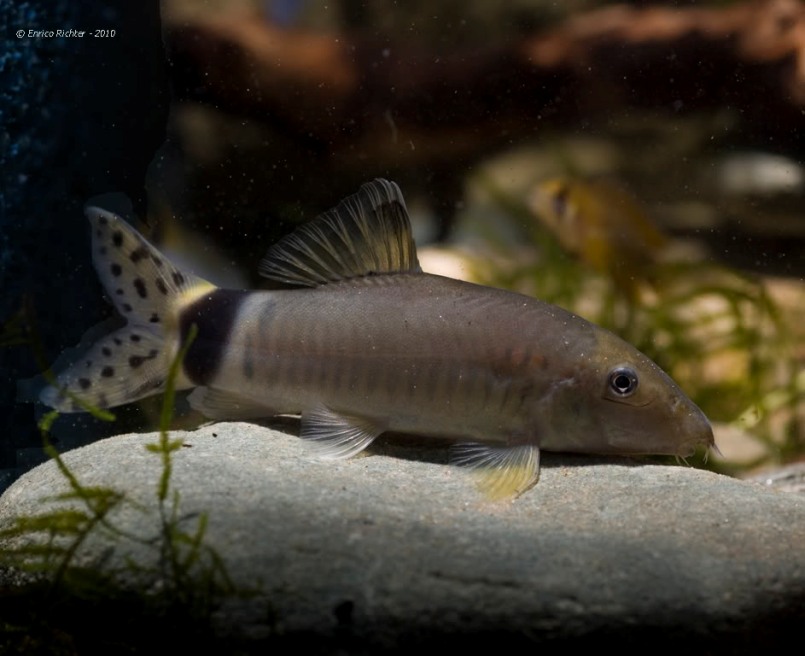
Yasuhikotakia splendida
Botiidae · Roberts, 1995
This species first appeared in the trade during 2009 with prices initially variable but in the main prohibitively expensive, and it remains expensive when available. We've seen it on sale under various names including 'jaguar loach', 'splendid loach' and 'yellow-tail polka dot loach'. It appears superficially similar to Y. caudipunctata, Y. longidorsalis and Y. morleti but can be distinguished from all by a combination of characters of which the most immedia...
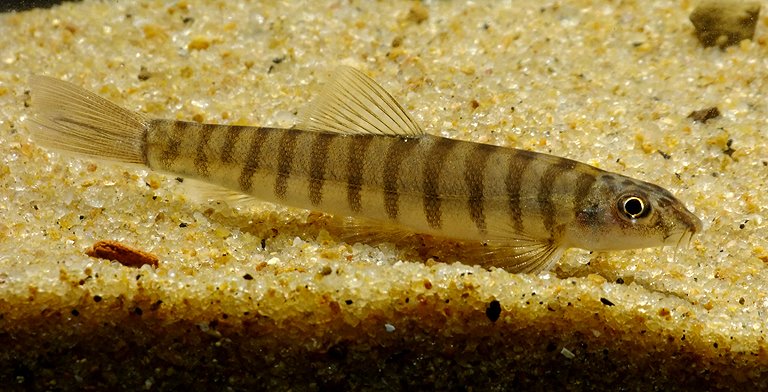
Schistura sp. 1Ring Loach
Nemacheilidae · authority not recorded
The identity of this fish is somewhat unclear although it's available in the aquarium trade on an occasional basis. It's been considered to represent various species including Schistura beavani, S. montana and S. himachalensis but there exi...
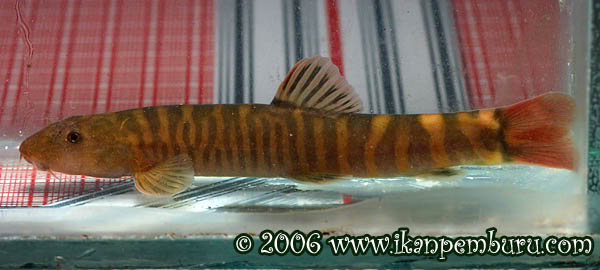
Schistura yingjiangensis
Nemacheilidae · Zhu, 1982
Following Kottelat (1990) the genus Nemacheilus is characterised by a combination of characters as follows: elongate body; complete lateral line; presence of enlarged scales above and below the lateral line in some species; caudal-fin forked to deeply forked with enlarged upp...
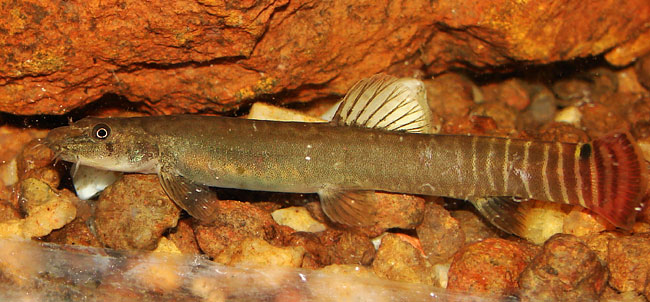
Aborichthys elongatusRed-Tailed Squirrel Loach
Nemacheilidae · Hora, 1921
This species may be seen listed as a member of Nemacheilus or the nomen nudum Noemacheilus in older literature and is sometimes sold as 'red tailed, striped sand loach' or 'red tailed squirrel loach'. Only two other Aborichthys have been described to...
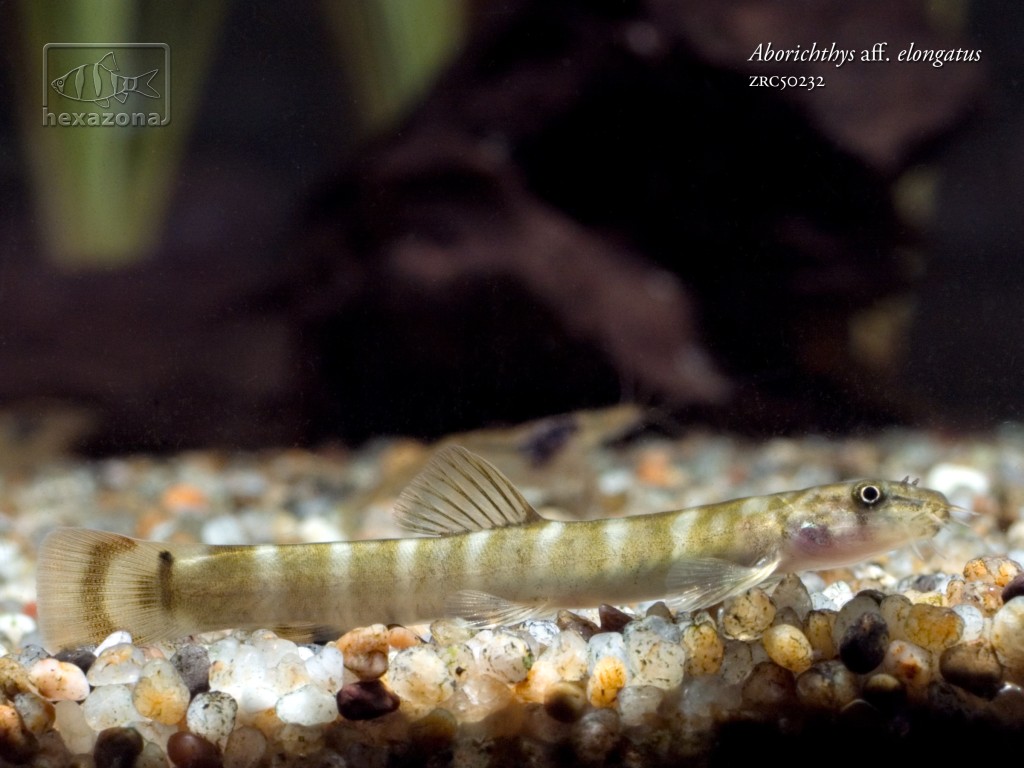
Aborichthys sp. 'AR02'
Nemacheilidae · authority not recorded
This fish occasionally turns up as a contaminant in shipments of A. sp. 'AR01'. The latter is usually traded as A. elongatus but that species appears endemic to higher altitude waters of the Brahmaputra drainage in Darjeeling District which borders Jalpaiguri to the north east. These flow down from the Sivalik Hills whereas the Raidak I originates in Bhutan. Only three species of Aborichthys have been officially described to date meaning this is likely to represent an undescribed speci...
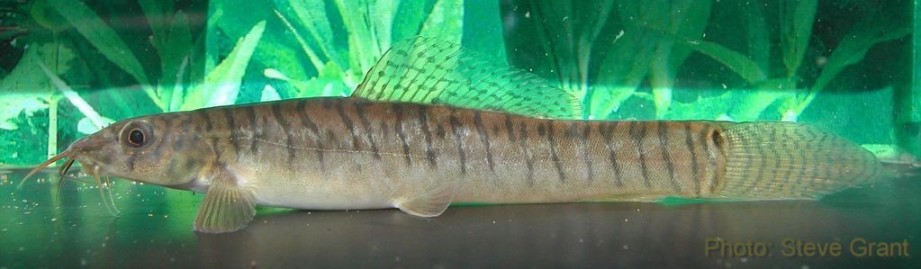
Acanthocobitis pavonaceaPeacock Loach
Nemacheilidae · McClelland, 1839
This species isn't common in the trade but occasional specimens may be found among shipments of wild caught fishes from northeast India, and it's sometimes seen on sale as 'pan...
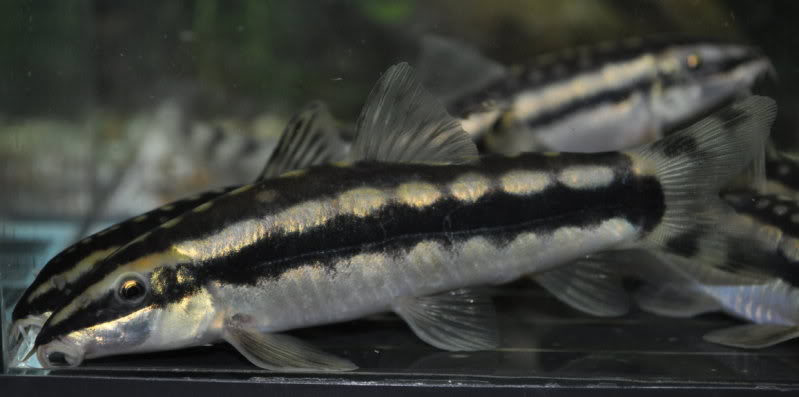
Ambastaia nigrolineataBlack-Lined Loach
Botiidae · Kottelat & Chu, 1987
This specie is relatively rare in the aquarium trade and much sought after by enthusiasts as a result. It looks relatively similar to A. sidthimunki but according to the original description by Kottelat and Chu (1987) can be told apart by colour patterning which uniquely consists of a solid da...
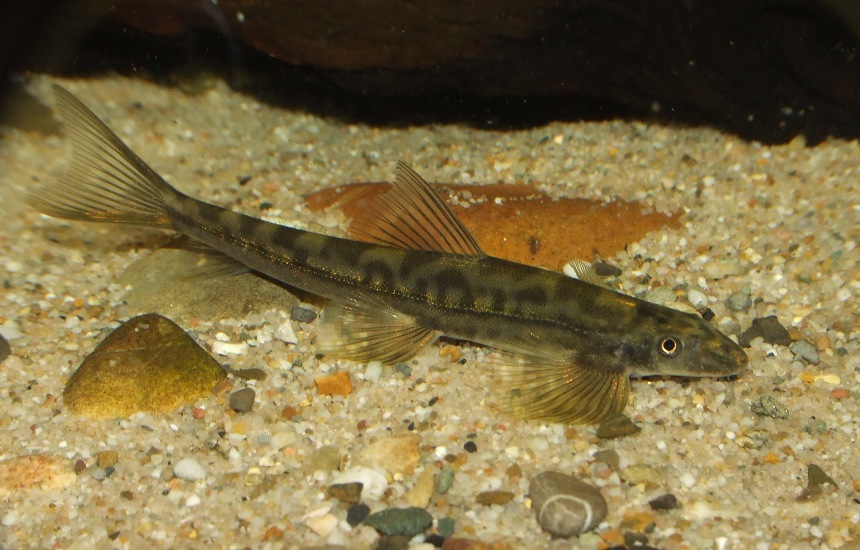
Annamia cf. thuathienensis
Gastromyzontidae · Nguyen, 2005
Annamia spp. may be confused with related genera such as those of the genus Balitoropsis. They can be identified by their more depressed body shape, elongate lower caudal-fin lobe, and the presence of a single unbranched ray in the pectoral and pelvic fins. At least one undescribed member of the genus is thought to exist.
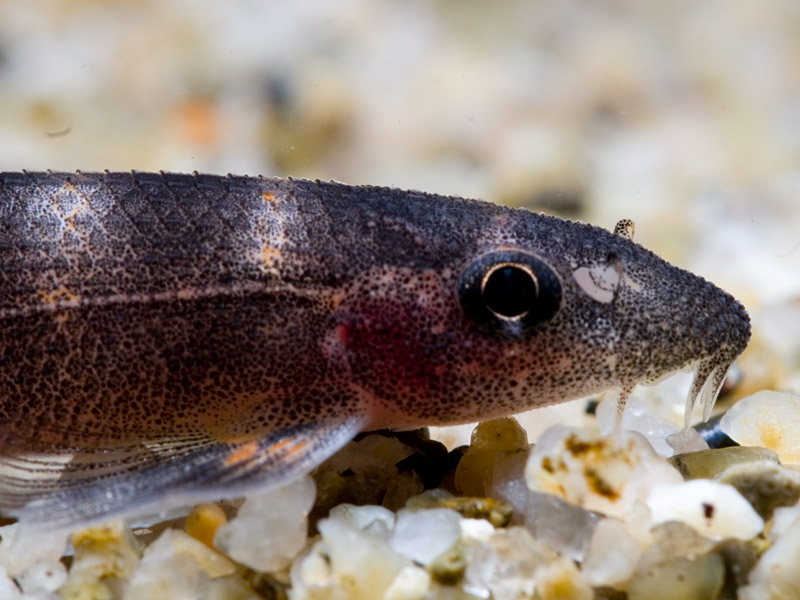
Balitoropsis zollingeri
Balitoridae · Bleeker, 1853
An obligate dweller of swiftly-flowing streams and headwaters containing clear, oxygen-saturated water. It often inhabits riffles and runs and is likely to show a preference for shallower zones. Substrates are generally composed of gravel, rocks, boulders or bedrock carpeted with a rich biofilm formed by algae and other micro-organisms. Juveniles are often found in slower-moving stretches with gravel substrate and submerged tree roots. In both cases patches of aquatic plants are only occasionally pres...
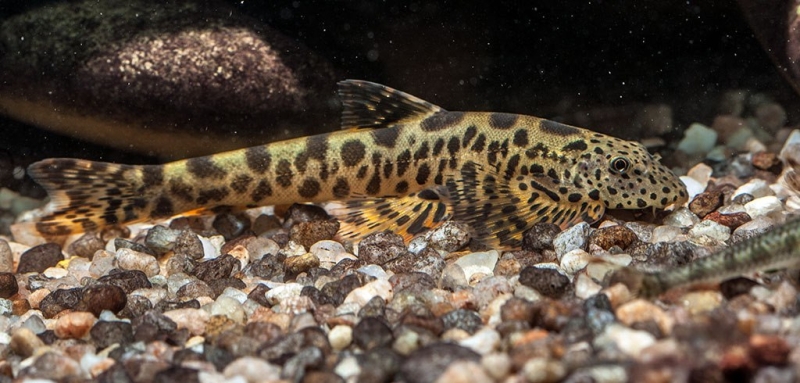
Bhavania australis
Balitoridae · Jerdon, 1849
An obligate dweller of shallow, fast-flowing, highly-oxygenated headwaters and minor tributaries characterised by stretches of riffles and runs broken up by pools or cascades in some cases. Substrates are normally composed of smaller rocks, sand and gravel with jumbles of boulders, and whil...
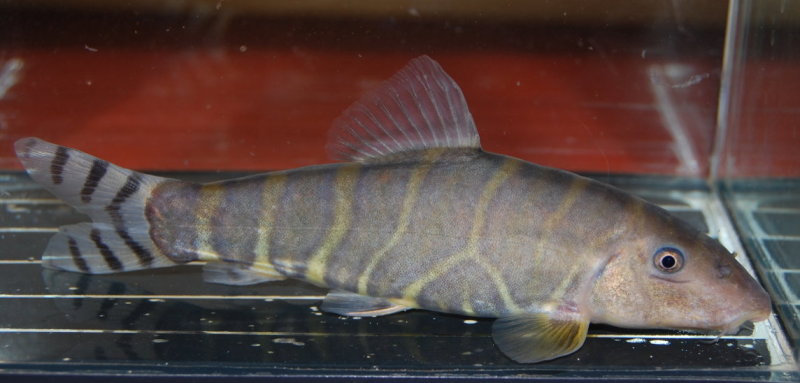
Botia darioBengal Loach
Botiidae · Hamilton, 1822
Following Grant (2007) this species is included in the B. dario complex of closely-related species within the genus alongside B. striata. They're characterised by body patterning consisting of a base yellow to golden colour with 7-9 blue, green, grey or black body bars usually with thinner, lighter bars between. In some individuals the...
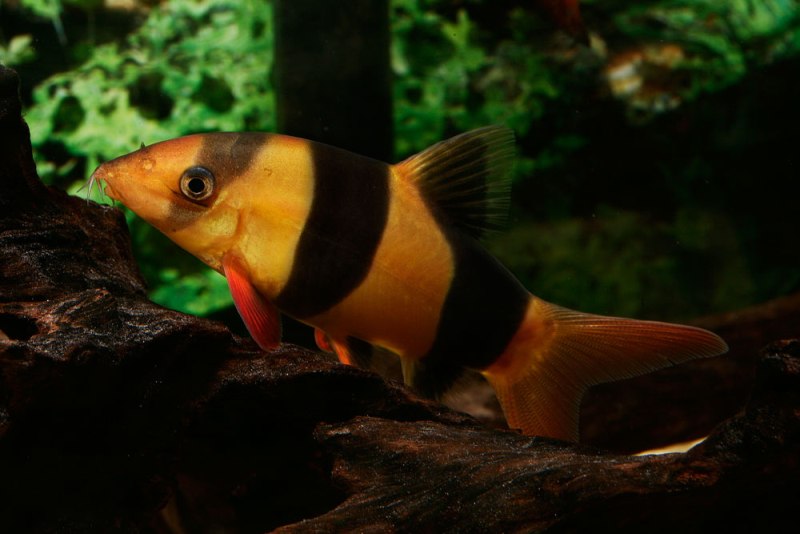
Chromobotia macracanthusClown Loach
Botiidae · Bleeker, 1852
This species is arguably one of the most misunderstood in the hobby since it's wholly unsuitable for smaller aquaria despite its ubiquitous availability. Most retailers sell it without providing what should be considered essential information regarding long-term care and most specimens undoubtedly fail to reach their potential in captivity. The purchase of a group is also a considerable investment given that if properly cared for typical life span is in excess...
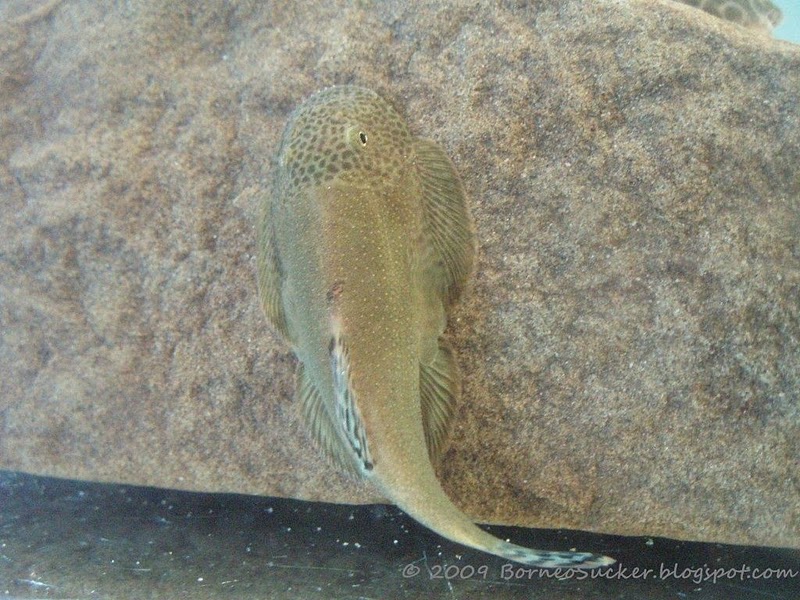
Gastromyzon aeroides
Gastromyzontidae · Tan & Sulaiman, 2006
Field observations have revealed that individuals almost always position themselves facing into the flow, either along the sides, behind or under rocks, their specialised morphology (see 'Notes') allowing them to feed and maintain position without being swept away. Not many fishes have been able to successfully colonise this narrow ecological niche, but syntopic species in nature include Gastromyzon extrorsus (Petagas River), G. introrsus, G. lepidogaster (Pad...
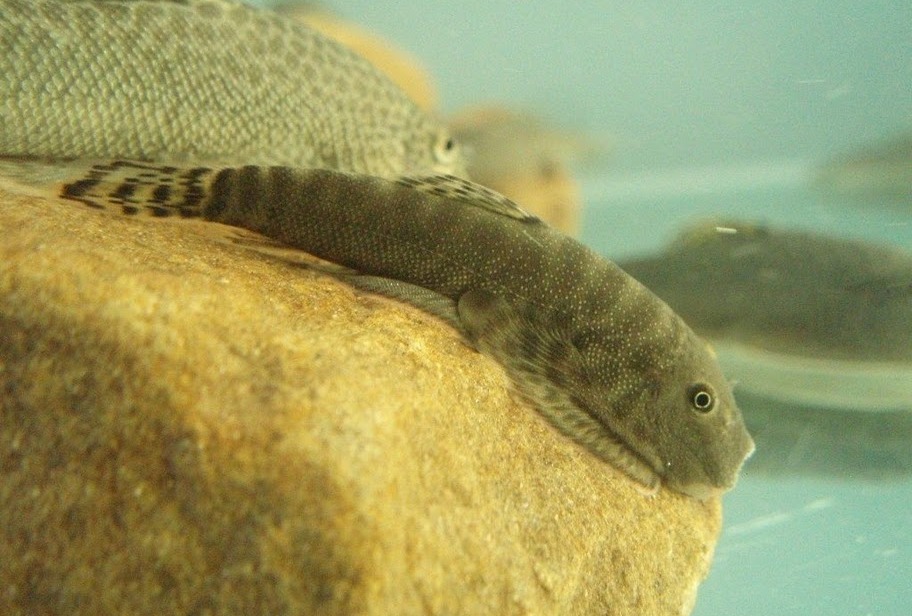
Gastromyzon cornusaccus
Gastromyzontidae · Tan, 2006
G. cornusaccus can be distinguished from congeners by the following combination of characters: secondary rostrum present; incomplete postoral pouch present reduced to pockets located posterior to mouth corners; sublacrymal groove present and visible when viewed laterally; juveniles with thick, cream-coloured bars and blotches on body, adults uniformly-coloured; head dorsum plain; subopercular groove absent; gill slit vertical; snout truncate when viewed dorsally; no scales on abdomen; 55-61 lateral line scale...
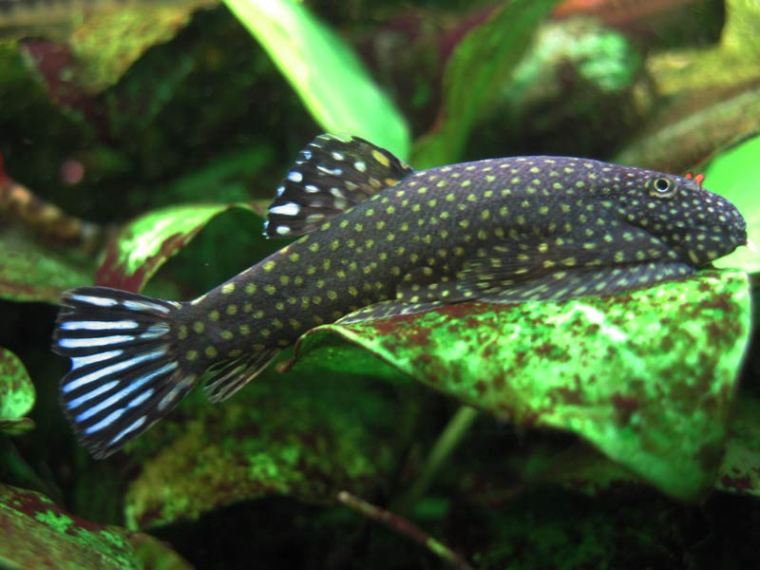
Gastromyzon ctenocephalus
Gastromyzontidae · Roberts, 1982
One of the more commonly-traded members of the genus and often found in mixed shipments which may contain other Gastromyzon spp. or related fishes like Beaufortia kweichowensis, these often labelled collectively as 'Borneo sucker', 'Hong Kong pleco', 'butterfly loach', etc. It's sometimes misidentified as G. punctulatus, a species not currently traded which possesses yellow finnage and a lighter-coloured, less-intensely spotted body.
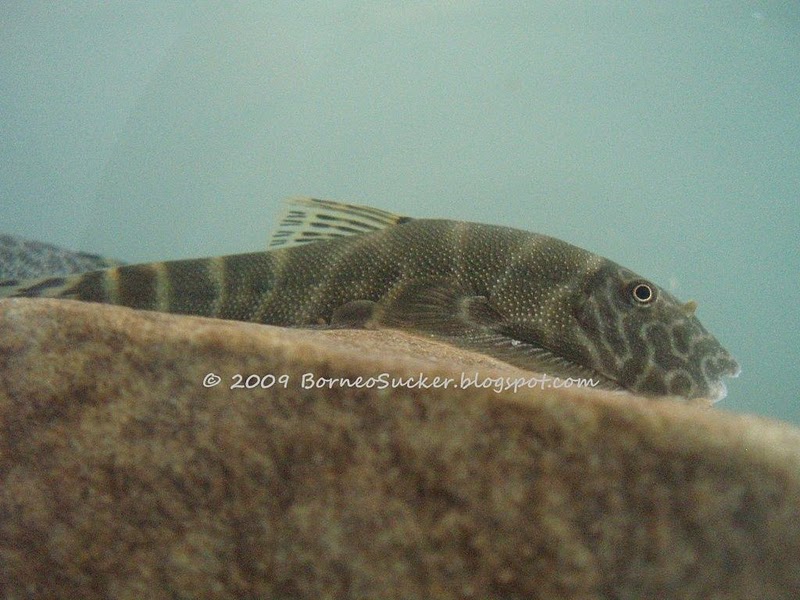
Gastromyzon extrorsus
Gastromyzontidae · Tan, 2006
This species has probably not been seen in the aquarium trade yet but has been maintained by a few private collectors. It can be distinguished from congeners by the following combination of characters: secondary rostrum present; complete postoral pouch present; body colour brown with up to 9 thin gold stripes; head dorsum dark brown with gold reticulate pattern; subopercular groove absent; gill slit vertical; sublacrymal groove present; sno...
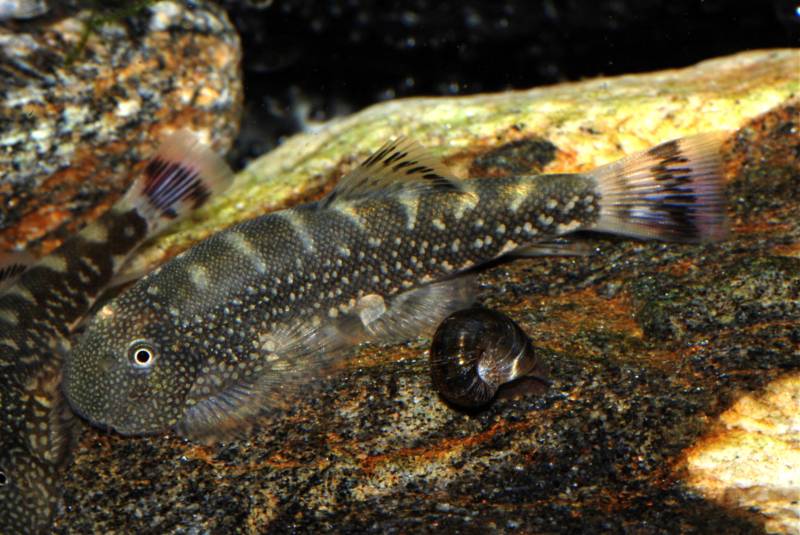
Gastromyzon farragus
Gastromyzontidae · Tan & Leh, 2006
In fact G. farragus and G. ocellatus represent one of 12 pairs of cryptospecies to be found in the genus, differing in subtle aspects of patterning. Cryptospecies are defined as morphologically similar, but reproductively isolated species which in fishes often inhabit adjacent river basins but in some cases occur sympatrically. The phenomenon may be a result of parallel evolution, and is not normally considered to represent an early stage of speciation.
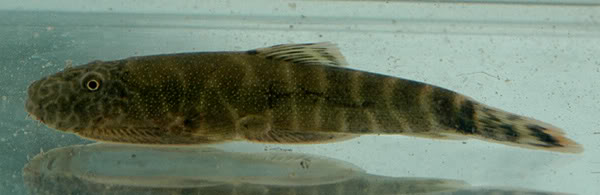
Gastromyzon introrsus
Gastromyzontidae · Tan, 2006
The type locality was a fast-flowing, shallow (50 - 80 cm deep) river between 5-10 metres in width with a substrate of gravel and large rocks. PH was measured at 7.7 and the habitat was unshaded with on...
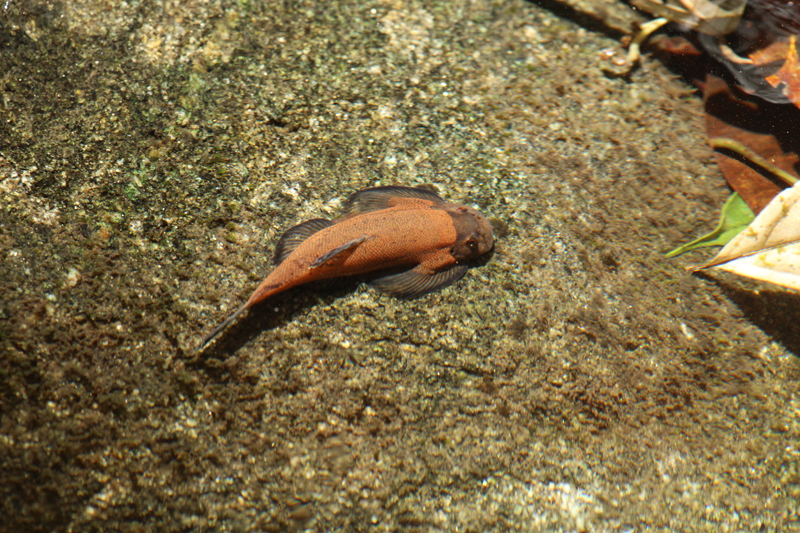
Gastromyzon lepidogaster
Gastromyzontidae · Roberts, 1982
This species is variable in terms of colour. Large adults may be bright green, orange or barred but are apparently capable of changing from barred to plain in just a few seconds. These different forms have been recorded in the same natural habitats, and some individuals also possess prominent nuptial tubercules covering much of the body.
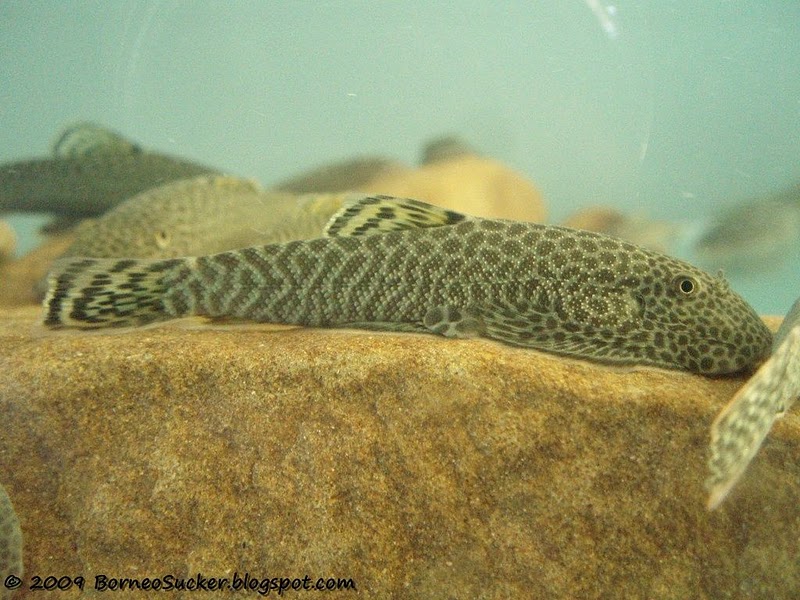
Gastromyzon monticola
Gastromyzontidae · Vaillant, 1889
Field observations have revealed that individuals almost always position themselves facing into the flow, either along the sides, behind or under rocks, their specialised morphology (see 'notes') allowing them to feed and maintain position without being swept away. In nature G. monticola occurs sympatrically alongside Garra borneensis, Osteochilus ingeri, Gastromyzon auronigrus, G. cornusaccus, Nemacheilus olivaceus,...
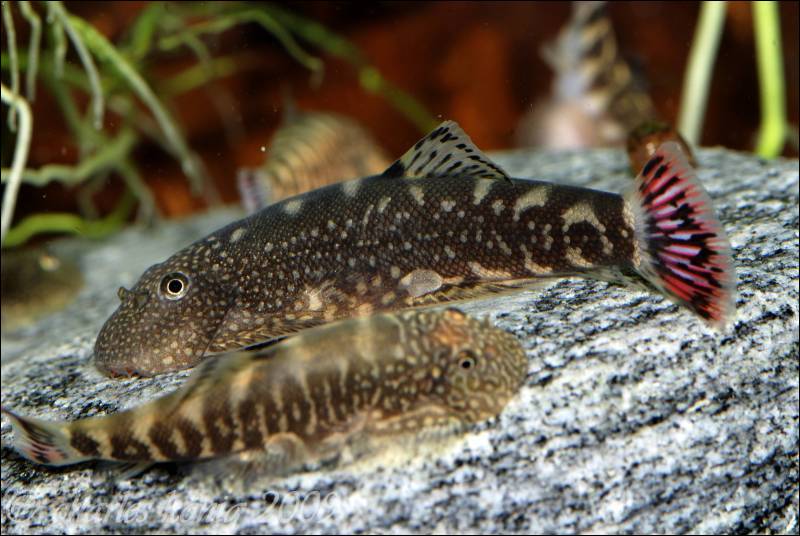
Gastromyzon ocellatus
Gastromyzontidae · Tan & Ng, 2004
Some individuals do appear very similar to G. farragus, with noticeable spotting on the head, but can usually still be told apart by examining the caudal-fin which tends to contain only a single thick, dark vertical bar in G. farragus whereas in G. ocellatus there are more often two bars, one thick, one thinner. Intermediate forms do exist though meaning identification is sometimes tricky.
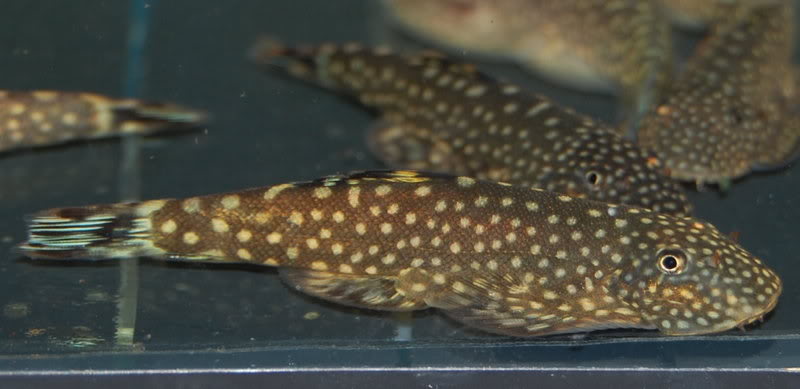
Gastromyzon scitulus
Gastromyzontidae · Tan & Leh, 2006
It can be distinguished from congeners by the following combination of characters: gill slit angular; presence of subopercular groove, running continuous to origin of pectoral-fin; body black with numerous, small, evenly-spaced light brown spots; head dorsum black with numerous cream spots; pectoral and pelvic fins with cream spots; caudal-fin with iridescen...
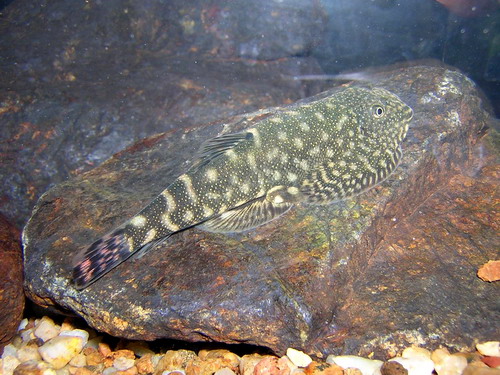
Gastromyzon sp. 'SK01'
Gastromyzontidae · authority not recorded
This undescribed species has probably not been seen in the aquarium trade yet but is occasionally maintained private collectors. The 'SK' numbering system used here refers to 'South Kalimantan', home to several unidentified members of the genus. Gastromyzon spp. are placed into various 'species groups' (artificial assemblages of species which may or may not be monophyletic) for ease of reference, and based on colour and patterning G. sp. 'SK01' appears similar to members of the G. ridens group which also includes G. crenastus, G. stellatus and G. zebrinus.
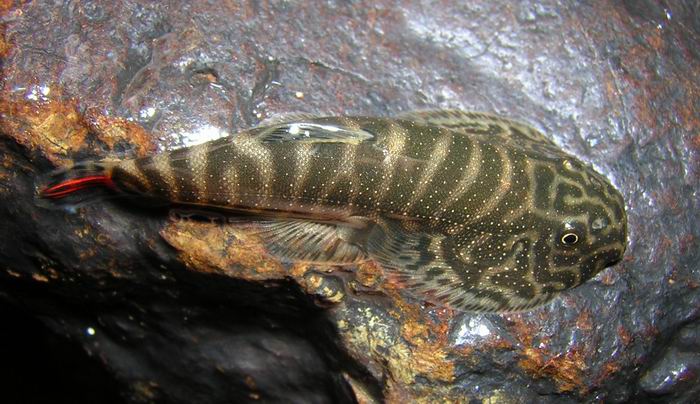
Gastromyzon sp. 'SK02'
Gastromyzontidae · authority not recorded
Known only from headwaters of the Sungai (river) Amandit, a tributary of the larger Barito basin in the Meratus mountain range, Kalimantan Selatan (South Kalimantan) province, Indonesian Borneo. There currently exist 36 officially-described members of the genus, all of which are endemic to the island with over half restricted to a single river basin or sub-basin.
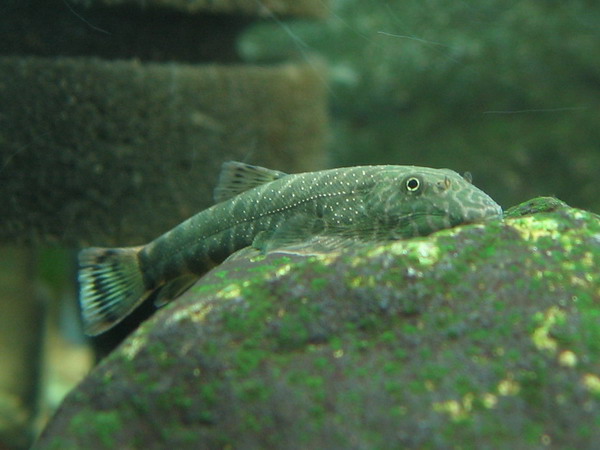
Gastromyzon sp. 'SK03'
Gastromyzontidae · authority not recorded
Gastromyzon spp. are obligate dwellers of swift, shallow streams containing clear, oxygen-saturated water and have been recorded from sea level to 1350 m amsl throughout hill regions of Borneo. They typically inhabit riffles and runs and are often found above or below cascades and waterfalls. Substrates are generally composed of gravel, rocks, boulders or bedrock carpeted with a rich biofilm formed by algae and other micro-organisms.
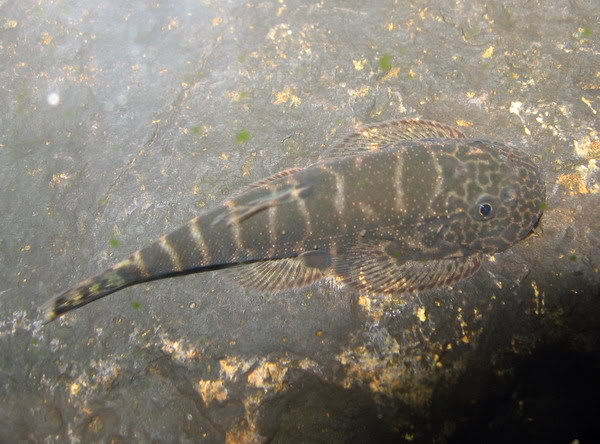
Gastromyzon sp. 'SK04'
Gastromyzontidae · authority not recorded
For long-term success it's best to provide a mature aquarium with a plentiful supply of algae-covered rocks and other surfaces. If unable to grow sufficient algae in the main tank or you have a community containing numerous herbivorous fishes which consume what's available quickly it may be necessary to maintain a separate tank in which to grow algae on rocks and switch them with those in the main tank on a cyclical basis.
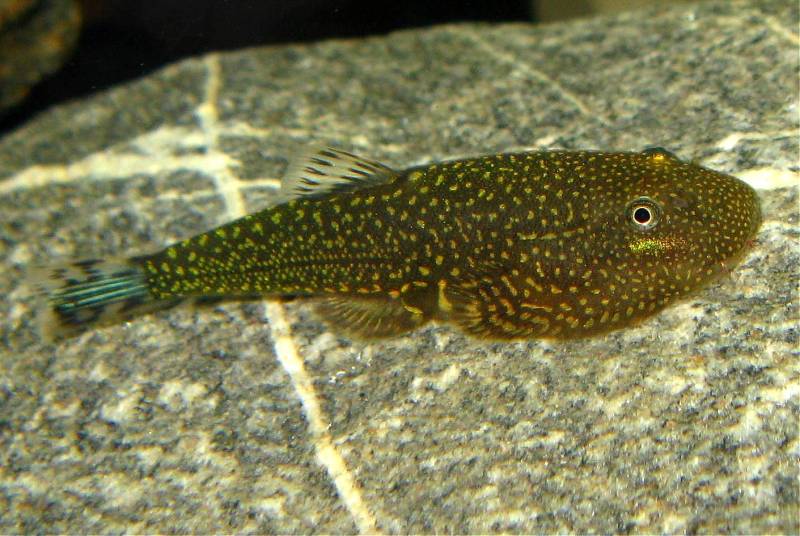
Gastromyzon stellatus
Gastromyzontidae · Tan, 2006
One of the more commonly-traded members of the genus and often found in mixed shipments which may contain other Gastromyzon spp. or related fishes like Beaufortia kweichowensis. These are typically labelled 'Borneo sucker', 'Hong Kong pleco', 'butterfly loach', etc. regardless of species. It's sometimes misidentified as G. punctulatus, a species not currently traded which possesses yellow finnage and a lighter-coloured, less-intensely spo...
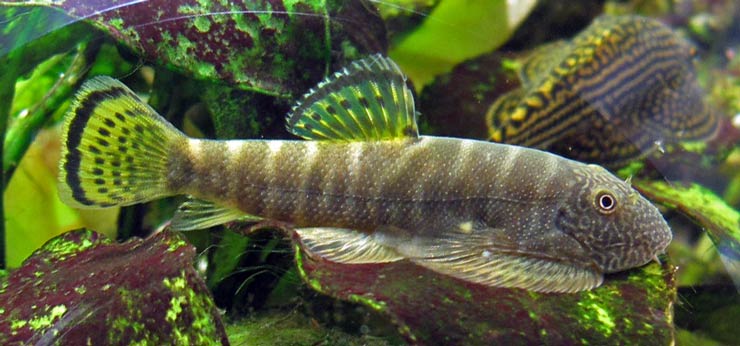
Gastromyzon viriosus
Gastromyzontidae · Tan, 2006
Many loaches from the families Nemacheilidae, Balitoridae and Gastromyzontidae are also suitable but research your choices before purchase in order to be sure as some are excessively aggressive or otherwise competitive. Gastromyzon spp. tend to exist in lo...
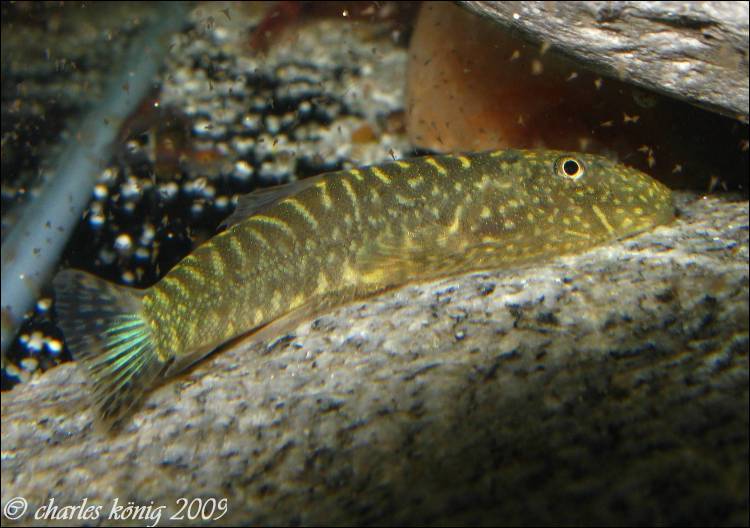
Gastromyzon zebrinus
Gastromyzontidae · Tan, 2006
Much of the natural diet is likely to be composed of benthic algae plus associated micro-organisms which are rasped from solid surfaces. In captivity it will accept good-quality dried foods and meatier items like live or frozen bloodworm but may suffer internal problems if the diet contains excessive protein. Home-made foods usi...
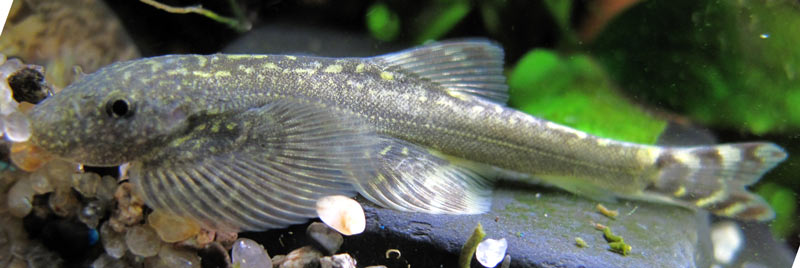
Hemimyzon formosanus
Balitoridae · Boulenger, 1894
Current knowledge suggests that H. formosanus is the most widely-distributed and following Chen and Fang (2009) it can be distinguished by the following suite of characters: 3+7 dorsal-fin rays; 10-12 pectoral-fin rays (modally 11) +9-11 (modally 10)...
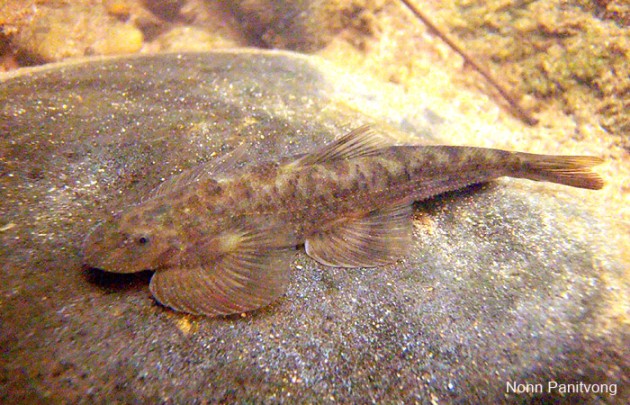
Hemimyzon nanensis
Balitoridae · Doi & Kottelat, 1998
Most importantly the water must be clean and well-oxygenated so we suggest the use of an over-sized filter as a minimum requirement. Turnover should ideally be 10-15 times per hour so additional powerheads, airstones, etc. should also be employed as necessary. Base substr...
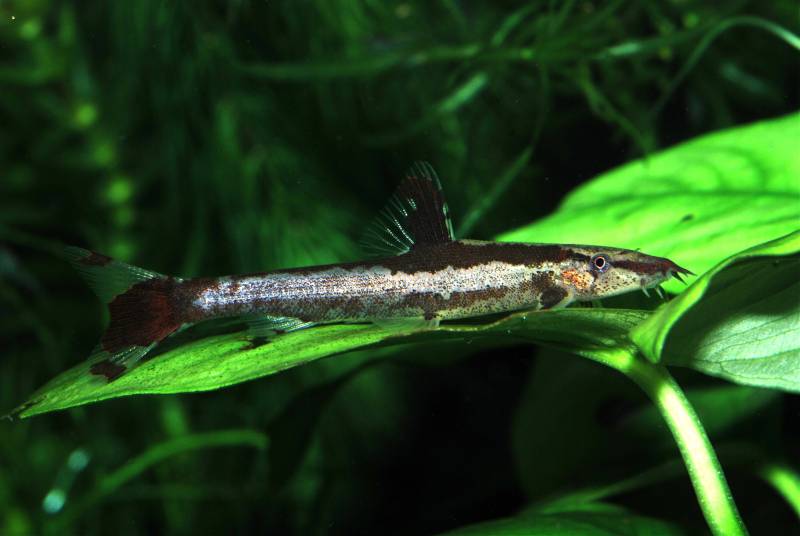
Homaloptera bilineata
Balitoridae · Blyth, 1860
This rarely-traded species is a member of the H. ocellata 'group' of closely-related congeners, an assemblage which currently comprises H. ocellata, H. bilineata, H. confuzona, H. orthogoniata, H. ogilviei and H. parclitella. Following Tan and Ng (2005) these share possession of a colour pattern with reddish tints and dark brown head markings, elongate head, slightly compressed body, 61-77 lateral line scales and dorsal-fin origin placed in advance of pelvic-fin origin.
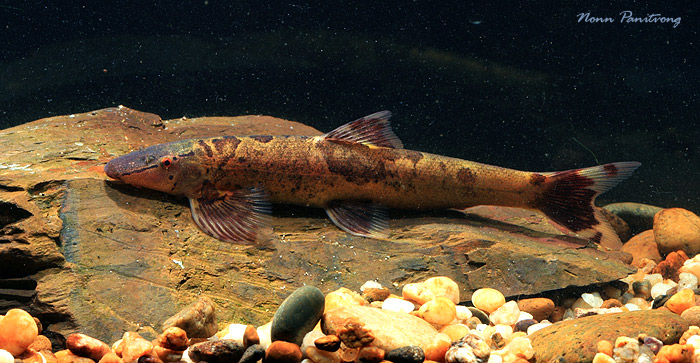
Homaloptera confuzona
Balitoridae · Kottelat, 2000
Most records pertain to the Mekong River basin downstream of the Khone waterfalls in Laos and Cambodia, but this species is also known from some smaller river drainages in southern Thailand, including parts of the Mae Klong system. Type locality is 'Khlong Fit at Ban Kraduk Chang, road 3157 from Trat to borai, about 2-3 kilometers after junction w...
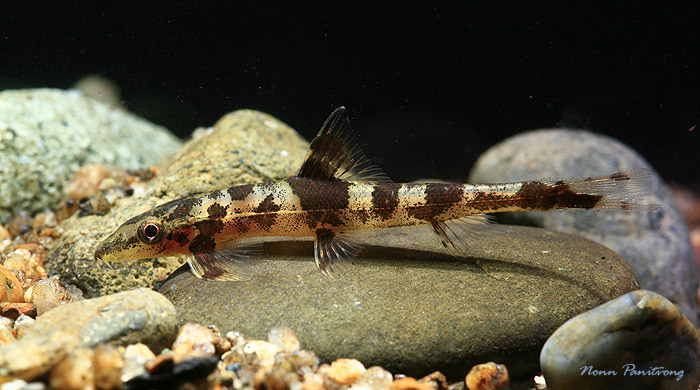
Homaloptera ogilviei
Balitoridae · Alfred, 1967
The reason that the paired fins are orientated vertically, as opposed to horizontally in other members of the genus, is unclear but Roberts (1989) suggest it may be an adaptation to this species' ecology, in that it displays a preference for submerged vegetation or woody structures as opposed to rocky environments. They're certainly adapted for a rea...
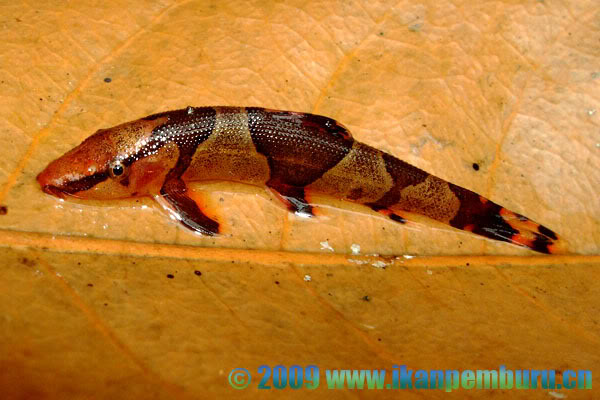
Homaloptera orthogoniataSaddle-back Loach
Balitoridae · Vaillant, 1902
This species appears is rare in the aquarium hobby with the majority of images both online and in the published literature instead depicting H. confuzona or H. parclitella. All three are members of the H. ocellata 'group' within the genus which currently contains H. ocellata, H. bilineata, H. confuzona, H. orthogoniata, H. ogilviei and H. parclitella. Following Tan and Ng (2005) these share possession of...
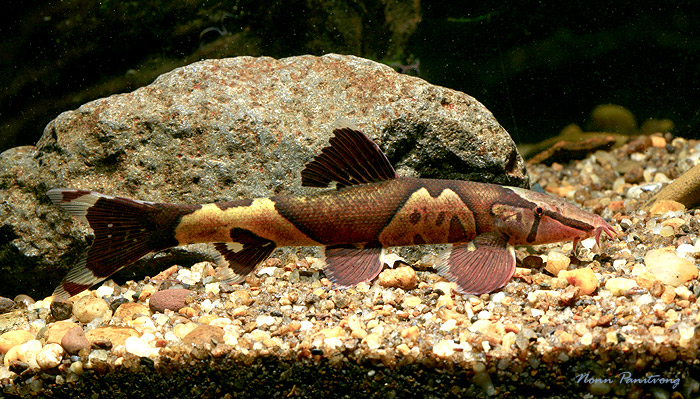
Homaloptera parclitella
Balitoridae · Tan & Ng, 2005
The water at the type locality is described as 'clear and fast-flowing over a rocky substratum'. H. parclitella was observed in shallow water among the rocks, and sympatric species included Garra cambodgiensis, Neolissochilus soroides, Poropuntius smedleyi, 'Puntius' binotatus, Homaloptera nebulosa and Amblyceps mangois.
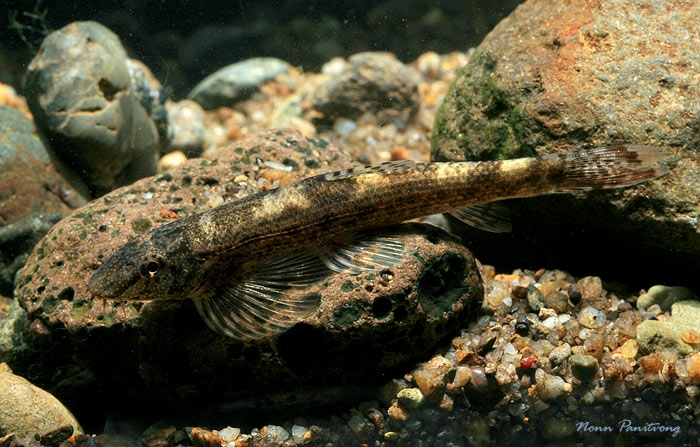
Homalopteroides modestus
Balitoridae · Vinciguerra, 1890
Homalopteroides spp. are specialised micropredators feeding on small crustaceans, insect larvae and other invertebrates. In captivity some sinking dried foods may be accepted but regular meals of live or frozen Daphnia, Artemia, bloodworm, etc., are essential for the maintenance of good health.
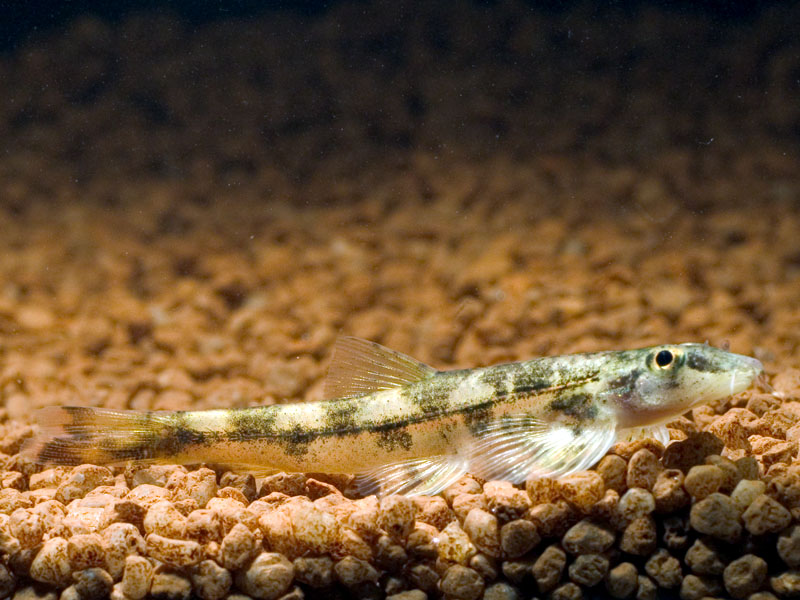
Homalopteroides nebulosus
Balitoridae · Alfred, 1969
The genus Homalopteroides was revalidated by Randall and Page (2012) and is told apart from the related Homaloptera by the following character combination: dorsal-fin origin above pelvic-fin; ≤ 60 lateral-line scales; ≤ 30 predorsal scales; oral morphology consisting of two thin and widely separated rostral barbels on each side of the mouth, thin crescent-shaped lips, the absence of any structure such as a mental pad or lobes between the lateral portions of the lower lip, and a chin that extends anterior to the lateral portions of the lower lip.
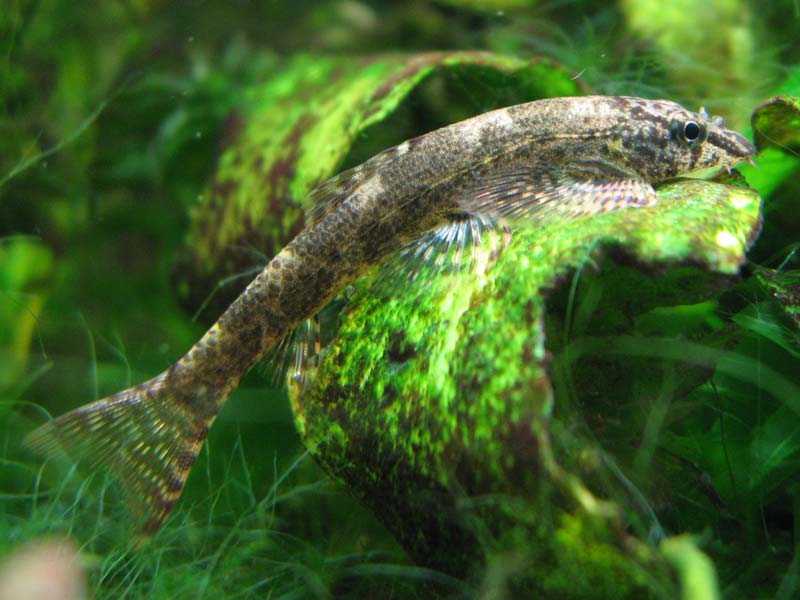
Homalopteroides smithi
Balitoridae · Hora, 1932
Described from close to the village of Ban Khiri Wong, Nakhon Si Thammarat Province, southern (peninsular) Thailand but since recorded throughout much of the country, including the Chao Phraya and Mekong river systems. It's also known from Peninsular Malaysia and parts of the Mekong basin in Laos, Cambodia and Vietnam. Rainboth (1996) considered it 'probably the commonest member of the genus in the Mekong' and in a 2008 study of balitorid habitats in centra...
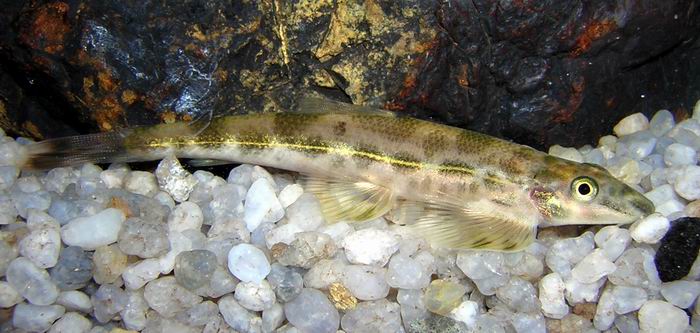
Homalopteroides stephensoni
Balitoridae · Hora, 1932
Tan (2009) redescribed H. stephensoni and it possesses the following unique character set: sub-inferior mouth with thin barbels; five principle, 12-13 secondary pectoral fin rays (usually 12); scaleless belly; pattern of keeled scales on anterior, dorsal portion of body consisting of a single central keel in the posterior third of each scale; 43-50 lateral line...
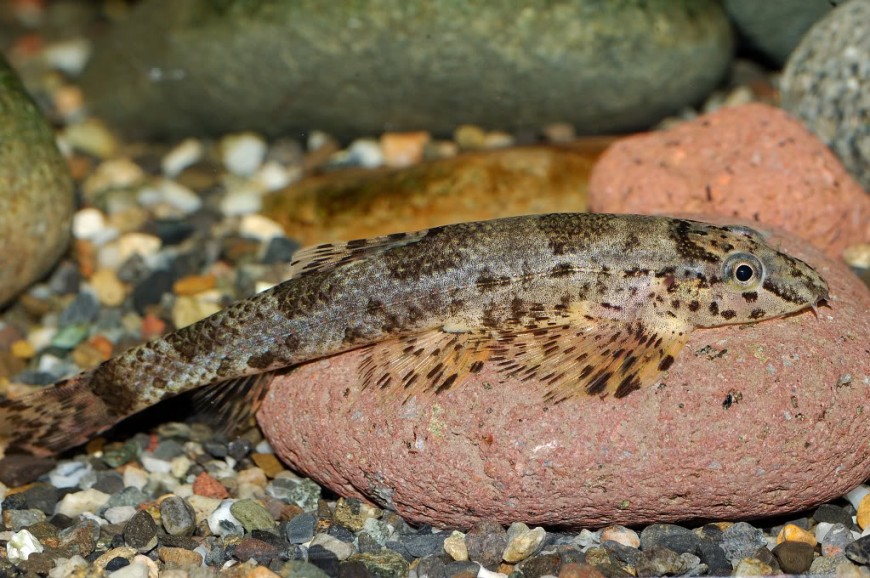
Homalopteroides tweediei
Balitoridae · Herre, 1940
Described from Kota Tinggi district, Johor state, Peninsular Malaysia but since recorded throughout much of the country as well as parts of the the Mekong river system in Thailand, Laos, Cambodia and Vietnam plus the Kapuas and several other river basins in Kalimantan Barat (West Kalimantan) province, Indonesian Borneo. In the Kahang River, part of the Endau drainage in Jo...
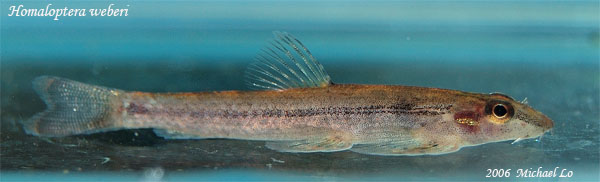
Homalopteroides weberi
Balitoridae · Hora, 1932
An obligate dweller of swiftly-flowing streams and headwaters containing clear, oxygen-saturated water. It often inhabits riffles and runs and is likely to display a preference for shallower zon...
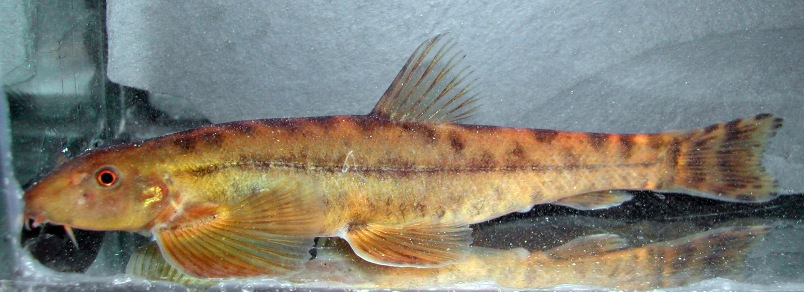
Homalopterula gymnogaster
Balitoridae · Bleeker, 1853
Type locality is given as 'Lake Meninju, Sumatra, Indonesia', currently known as Danau (lake) Maninjau, but conceivably the fish may have been obtained from the outflowing Antokan river rather on its western side than the lake itself.
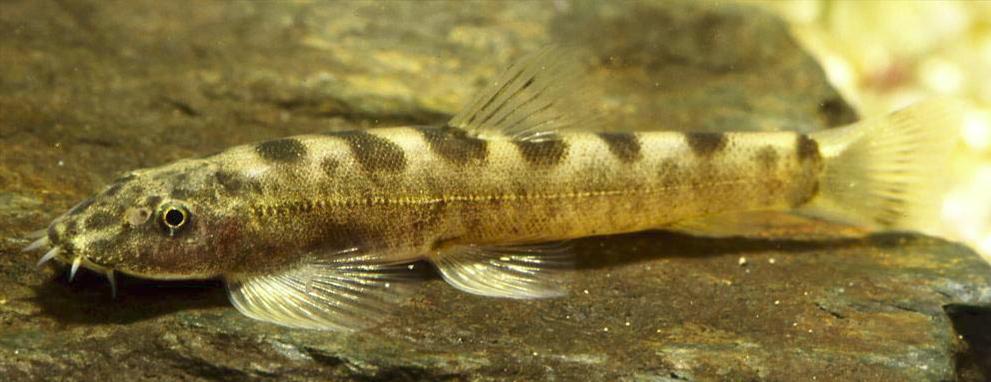
Homalopterula ripleyi
Balitoridae · Fowler, 1940
Fowler (1940) described this species as the unique member of his new genus Homalopterula on the basis of a single specimen, separated from related genera by the curved shape of the jaws, truncate caudal-fin and scaleless ventral surface.
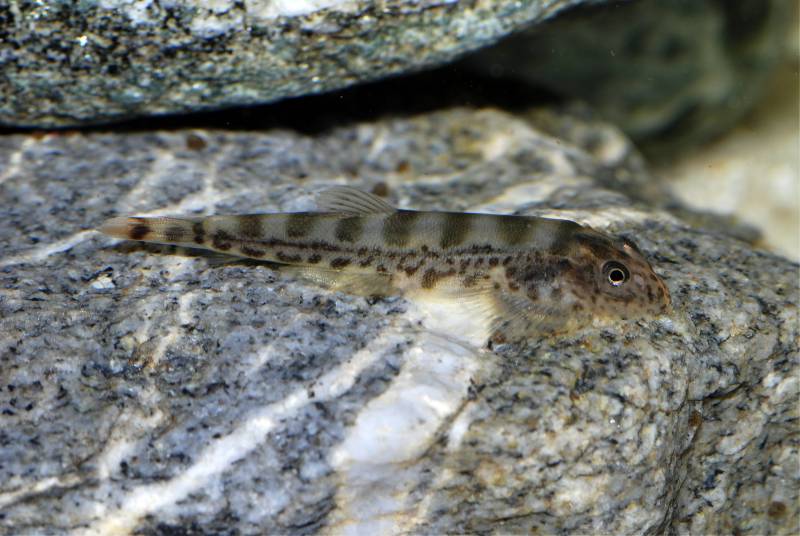
Hypergastromyzon humilis
Gastromyzontidae · Roberts, 1989
The differences in pelvic-fin structure and gill openings led Roberts to redefine the genus when describing H. eubranchus, whereas Tan (2006) expressed doubts that the two are even congeneric but was unable to reach a definitive conclusion in the absence of fresh material. At any rate both species can be easily differentiated from Gastromyzon and Neogastromyzon spp. by observing the mo...
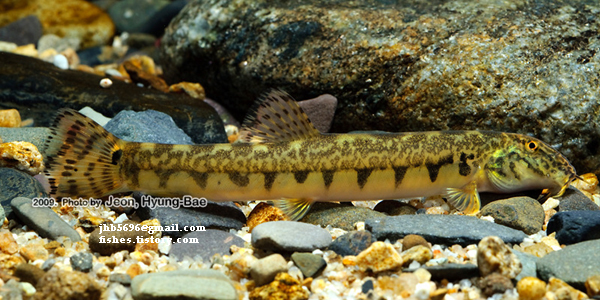
Iksookimia hugowolfeldi
Cobitidae · Nalbant, 1993
It appears that I. hugowolfeldi, I. longicorpus and I. yongdokensis form a biogeographic lineage distinct from I. koreensis and I. pumila, with the former group distributed to the south of the Taebaek and Noryeong moutnain ranges and the latter to the west. This is further evidenced by the fact that the lamina circularis in males of the southern gro...
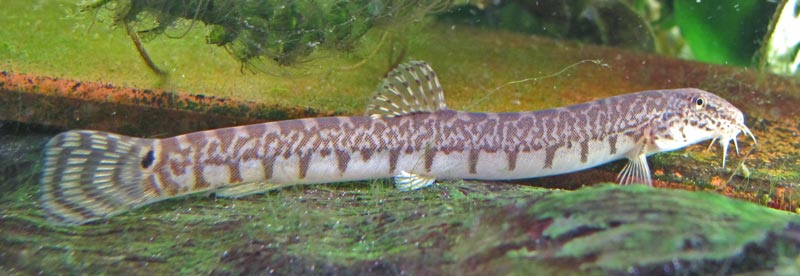
Iksookimia koreensis
Cobitidae · Kim, 1975
Among them it's most similar to I. pumila which was initially described as a subspecies but is now considered distinct. The two are most easily-separated by colour pattern; I. koreensis has 10 or...
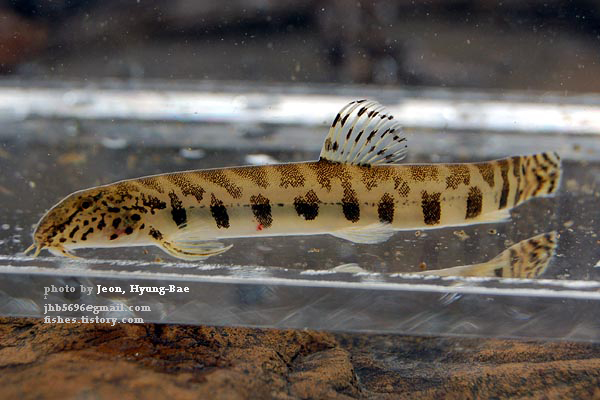
Iksookimia pumila
Cobitidae · Kim & Lee, 1987
All Iksookimia species are endemic to Korea, and I. pumila is known only from the Baek River drainage in south-western Korea where its presence has been undermined at some localities due to construction of a dam in the middle reaches of the river during the late 1990s. Type locality is 'Paikchon stream at Sangso-myon, Puan-gun, Chollabuk-do, South Korea'. The reservoir formed by the dam has also be...
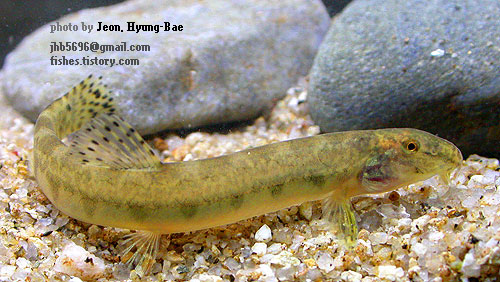
Iksookimia yongdokensis
Cobitidae · Kim & Park, 1997
Among them it's most similar to I. longicorpus and I. hugowolfeldi but can be distinguished by the following combination of characters: body patterning consisting of 9-13 dark vertical bars along the flanks plus a small dark spot at the base of the upper caudal-fin lobe; no black blotch or markings posterior to the operculum; reduced lamina circularis in males; interorbital width measures 14.7-17.8% o...
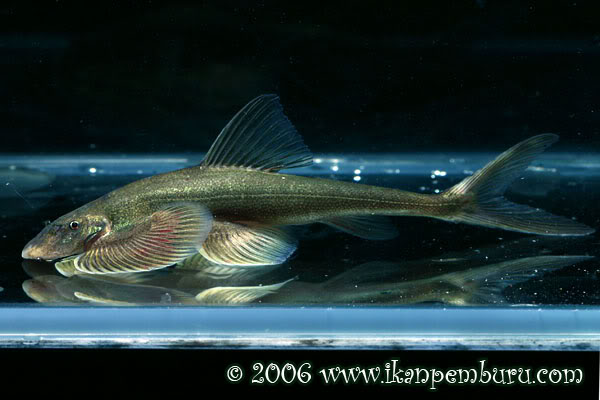
Jinshaia sinensis
Balitoridae · Sauvage & Dabry de Thiersant, 1874
This species may not yet have been seen in the aquarium trade outside its native country but has been maintained by a few private collectors. There are currently three species recognised in the genus, all endemic to the Yangtze river drainage, and they're separated from other balitorids by a combination of characters including: relatively long, deeply-forked caudal-fin; roun...
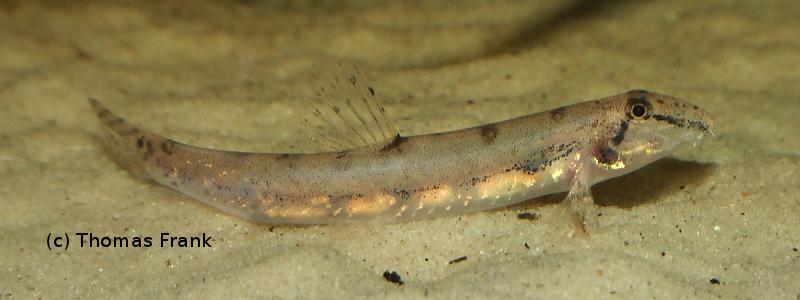
Kottelatlimia hipporhynchos
Cobitidae · Kottelat & Tan, 2008
This species differs from congeners in the presence of papillae covering the mouthparts (lips, barbels, and lobes) which are absent in other species. It's also the largest species in the genus and the serrae on the second pectoral fin rays in males form a broa...
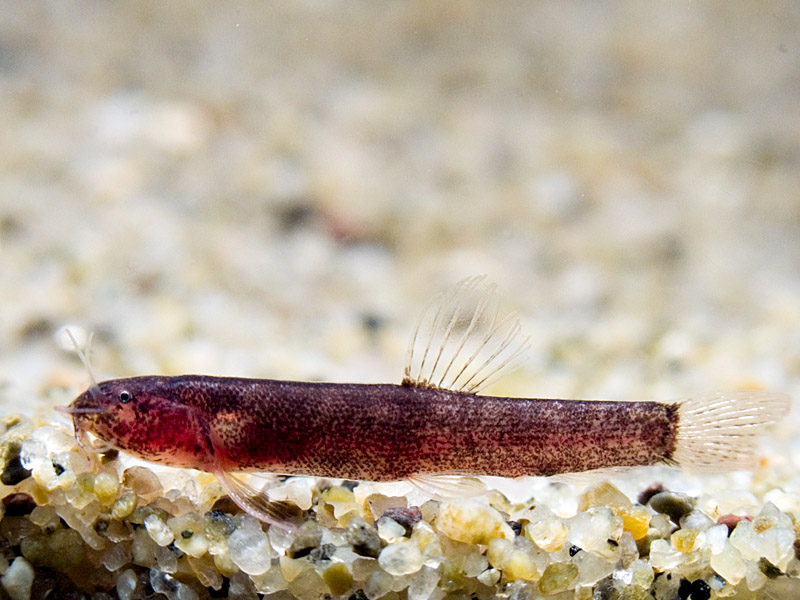
Kottelatlimia katik
Cobitidae · Kottelat & Lim, 1992
We're unaware of this species having yet appeared in the aquarium trade although a few private collectors have experience with it. Among congeners it uniquely possesses a simple suborbital spine and further differs from K. pristes by: smaller adult size (13.5 mm SL vs. 40); presence of a long nasal barbel (vs. absence); anatomy of the modified second pectoral ray in males (6-7 fine, narrow serrae vs. 8-11 pointed, anteriorly-orientated serrae). In K. hipporhynchos the serrae on the second pectoral ray in males form a broad, contiguous blade-like structure but other differences are the same as for K. pristes.
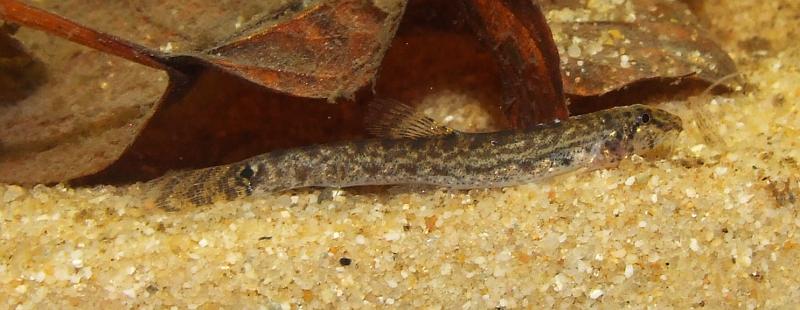
Kottelatlimia pristes
Cobitidae · Roberts, 1989
The genus Kottelatlimia was erected by Nalbant (1994) to accommodate K. katik which had previously been assigned to Lepidocephalichthys but differs in various aspects noted earlier by Kottelat and Lim (1992) including: relatively small adult size; scaleless...
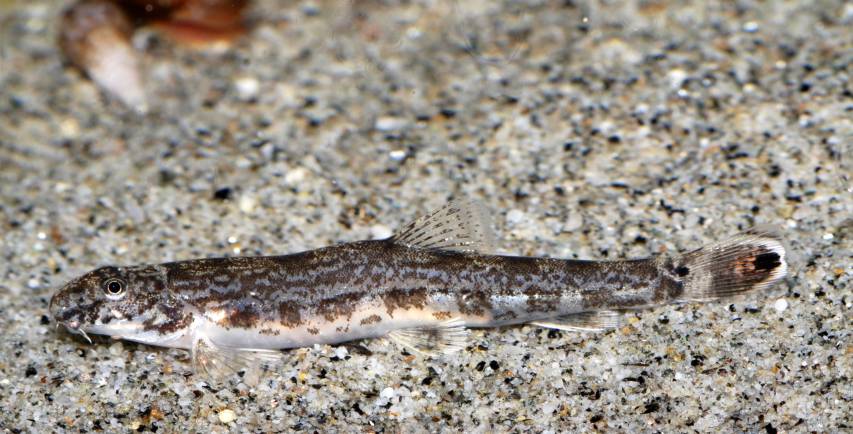
Lepidocephalichthys annandalei
Cobitidae · Chaudhuri, 1912
Sand-dwelling loaches from the families Botiidae, Cobitidae and Nemacheilidae are also suitable but proper research is essential as some can be excessively territorial or otherwise aggressive. A community based around fishes from its natural waters could include species such as Badis badis,...
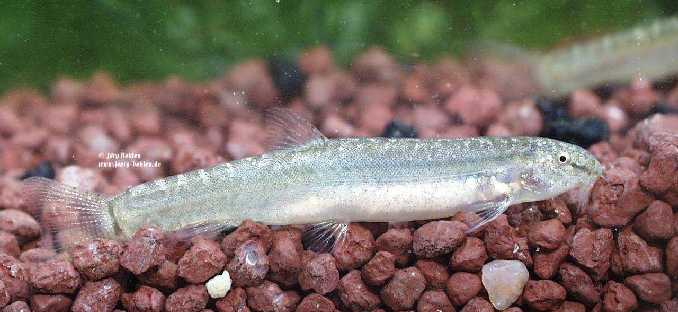
Lepidocephalichthys cf. irrorataLoktak Loach
Cobitidae · Hora, 1921
This species is not traded often but may occasionally be exported as bycatch among shipments of other species. It can be distinguished from congeners by the following combination of characters: presence of large, exposed scales on top of head; dorsal-fin origin posterior to pelvic-fin origin; moderate to small size (to 29 mm SL); caudal-fin emarginate and with dark reticulations; caudal-fin lobes with dark, elongated spots along upper and lower edges.
Lepidocephalichthys furcatus
Cobitidae · de Beaufort, 1933
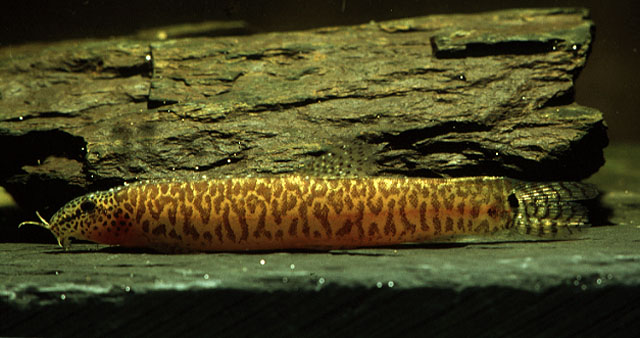
This species is not traded often but is occasionally available as bycatch among shipments of other species. It can be told apart from congeners most easily by the prominent, dorsally-orientated, roughly semi-circular lamina circularis in males, a feature unique within the genus. Other distinguishing characters include a combination of: forked caudal-fin; relatively small adult size; dark <-shaped mark at the base of the caudal-fin; a black spot at the base of branched caudal-fin rays 3-5.
Lepidocephalichthys jonklaasi
Cobitidae · Deraniyagala, 1956
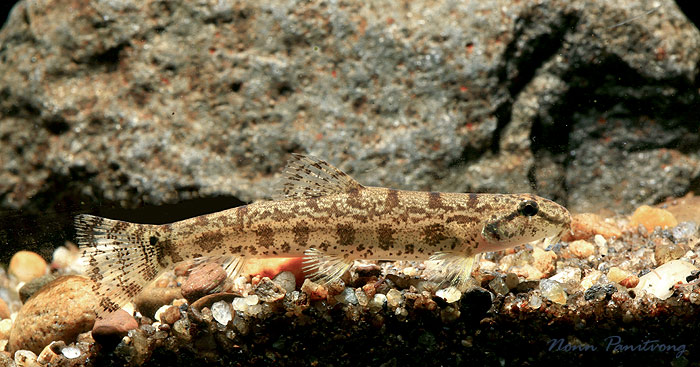
Endemic to Sri Lanka with type locality 'shaded pools of mountain streams at Akuressa, Southern Province, Sri Lanka, elevation 500 meters'. It's known from at least five localities, all of which are located in restricted to Sri Lanka's 'wet zone' in the southwest of the island, with records exis...
Lepidocephalichthys micropogon
Cobitidae · Blyth, 1860
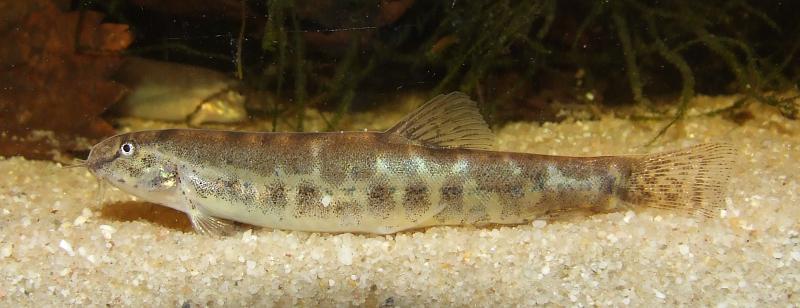
According to Kottelat (2012) L. manipurensis Arunkumar, 2000, which was described from Moreh, Manipur state, northeastern India, close to the border with Myanmar, is a syonym of L. micropogon. Havird and Page (2010) differentiate the two based on caudal-fin patterning, predorsal length and ver...
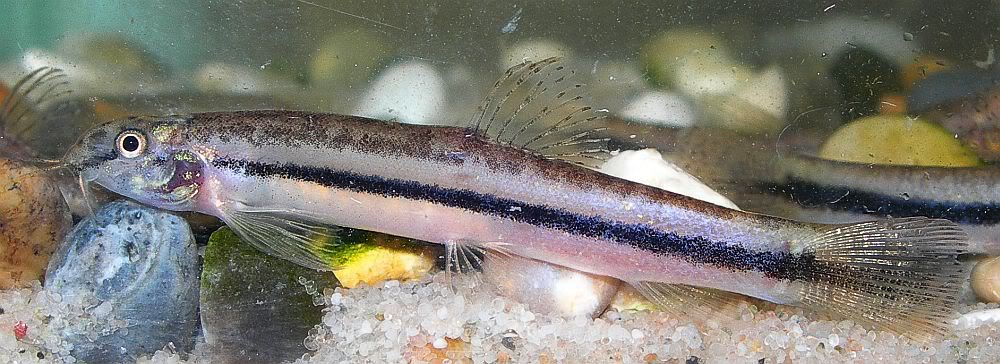
Lepidocephalichthys sp. 'LE1'Vietnamese Marbled Hog-faced Loach
Cobitidae · authority not recorded
This fish has only been traded on a handful of occasions to date. It's been referred to as Lepidocephalichthys cf. hasselti and Lepidocephalus cf. thermalis but appears to be an undescribed member of the former genus. Following a...
Lepidocephalichthys sp. 'LE2'
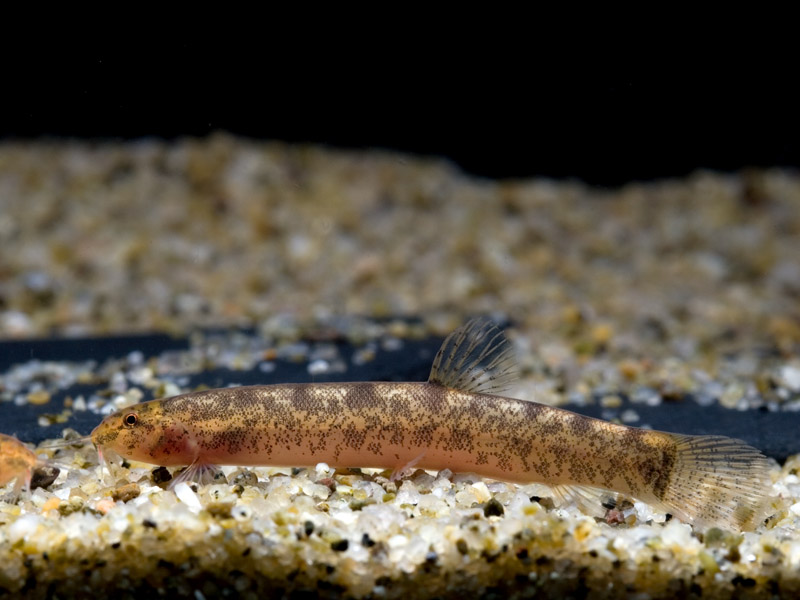
Cobitidae · authority not recorded
This fish may only have been exported for aquaria on a single occasion to date. It exhibits characters reminiscent of both L. alkaia and L. guntea, and has been referred to as L. cf. guntea) but is most likely an undescribed species (Havird, pers. comm.).
Lepidocephalichthys tomaculum
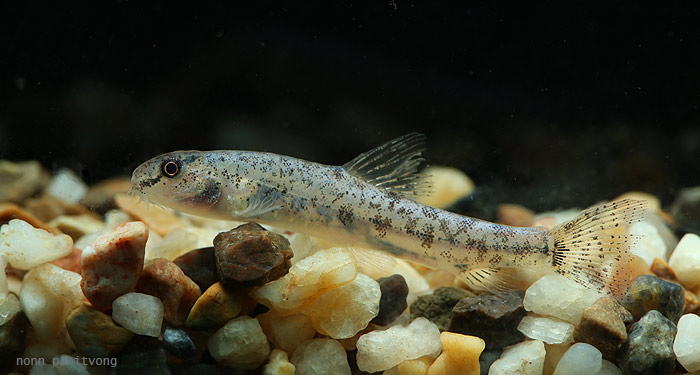
Cobitidae · Kottelat & Lim, 1992
This species is not traded often but may be available occasionally bycatch among shipments of other species. It can be told apart from congeners most easily by the following combination of characters: truncate caudal-fin; scaleless patch on top of head; caudal-fin with reticulated patterning, sometimes appearing as a series of thin vertical bars; body reddish brown with darker markings; 3-7 predorsal and 3-6 postdorsal thin, transverse dark bars running across the dorsal surface; relatively deep...
Lepidocephalichthys zeppelini
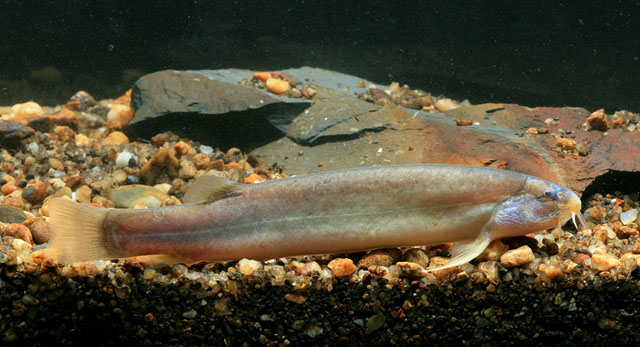
Cobitidae · Havird & Tangjitjaroen, 2010
The type locality consisted of remnant ephemeral pools in otherwise dry agricultural land, and many adults were collected from such habitats. Other species present included the congener L. hasselti plus members of Anabas, 'Puntius', Rasbora, Channa, and Hampala.
Lepidocephalus macrochir
Cobitidae · Bleeker, 1854
The distribution records for this species are somewhat confusing. It was described from the confluence of the Lamatang and Enim rivers, Palambang Province, Sumatra and has since been recorded from Thailand (Chao Phraya River), Peninsular Malaysia (Pahang River) plus the islands of Java (Solo River) and Borneo (Kapuas and Barito rivers).
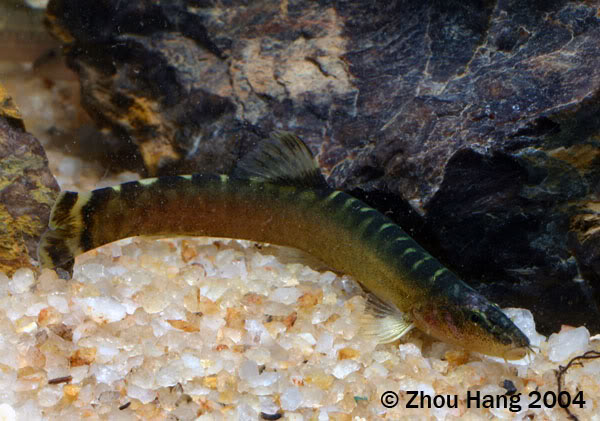
Leptobotia guilinensis
Botiidae · Chen, 1980
L. elongata is the type species of the genus but according to current knowledge there exist 13 members in total, all of which are endemic to China and northern Vietnam. They're diagnosable by the following shared characters: possession of a simple (non-bifurcated), short sub-ocular spine not extending beyond the posterior edge of the eye; a laterally-compressed body; relatively deep caudal peduncle; pelvic fins reaching origin of anal-fin; anus below base of dorsal-fin and equidistant between pelvic and anal-fin origins.
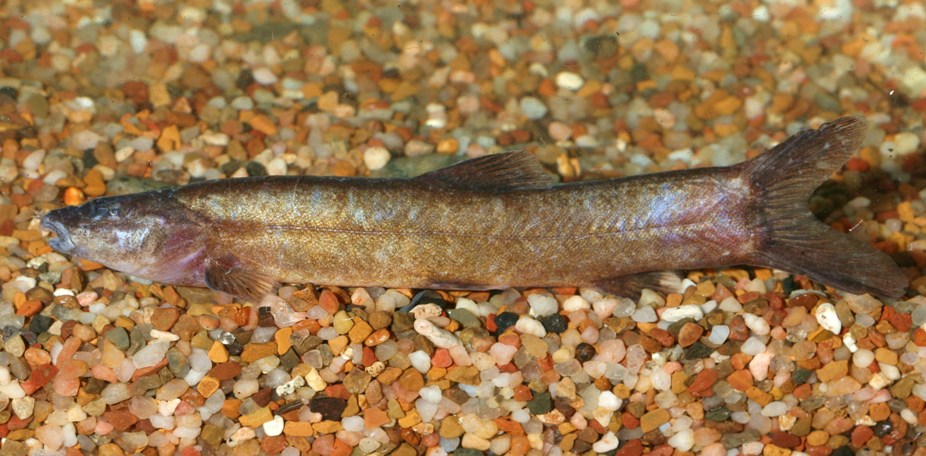
Leptobotia microphthalma
Botiidae · Fu & Ye, 1983
Superficially similar to L. tientainensis but according to the formal description can be separated by a combination of characters including: more deeply-forked caudal-fin (shortest central rays fit 2.6-2.9 times in the outer rays vs. 1.7-2.5 times); significantly smaller eye (fits 26 times in head length vs. 10 times); caudal-fin with 1-2 dark bands at lateral edges v...
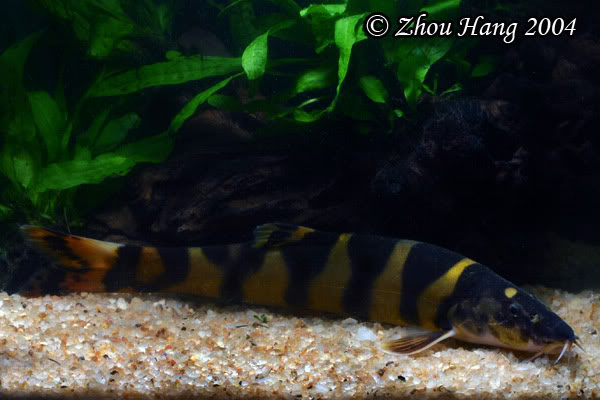
Leptobotia pellegrini
Botiidae · Fang, 1936
Described from Sichuan province, southwestern China (presumably the upper Yangzte River, aka Chang Jiang, drainage) and also known from parts of the Pearl River (Zhu Jiang) basin in Guangxi Autonomous Region. The latter area is one of the most populous and industrialised in China meaning much of the main river channel is now highly polluted. Its relatively wide distribution probably explains why it's commoner in the aquarium hobby than the similar-looking...
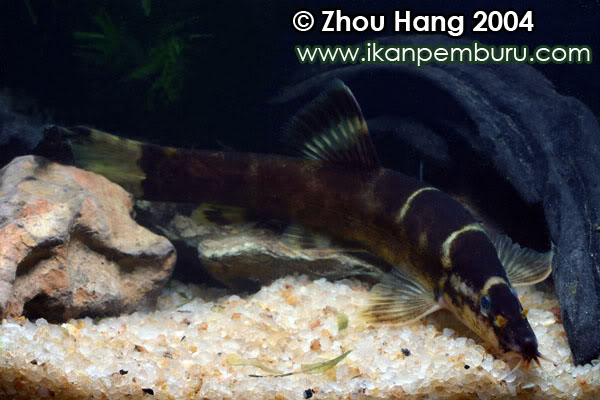
Leptobotia rubrilabris
Botiidae · Dabry de Thiersant, 1872
Should be kept in a set-up designed to resemble a flowing stream with a substrate of variably-sized rocks, gravel and some water-worn boulders. This can be further furnished with driftwood roots and branches arranged to form some shaded spots while lengths of PVC piping or similar can be used to provide additional cover. Although most plant species will fail to thrive in such surroundings hardy genera such as Microsorum, Bolbitis or Anubias spp. can be grown attached to the décor and bright lighting will promote the growth of aufwuchs.
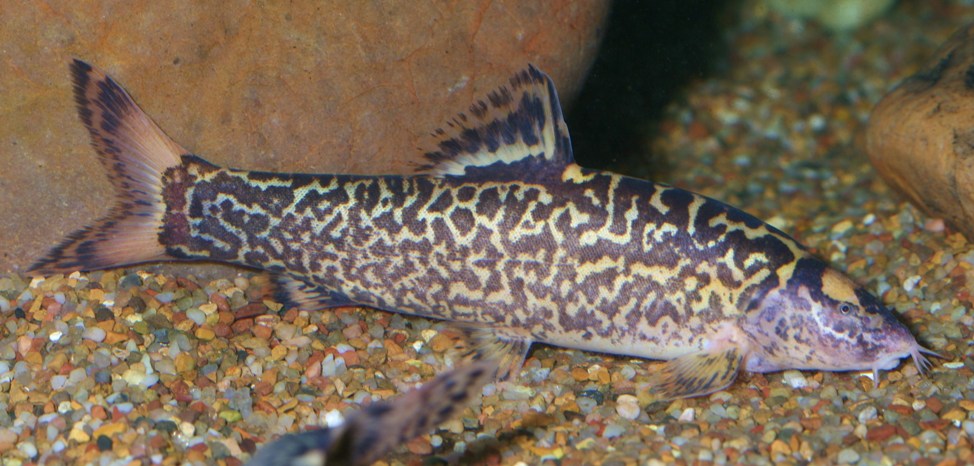
Leptobotia taeniops
Botiidae · Sauvage, 1878
L. taeniops is almost unheard of in the aquarium trade although we know of one or two private collectors maintaining it. It was previously included in the related genus Parabotia. L. elongata is the type species of the genus but according to current thinking there exi...
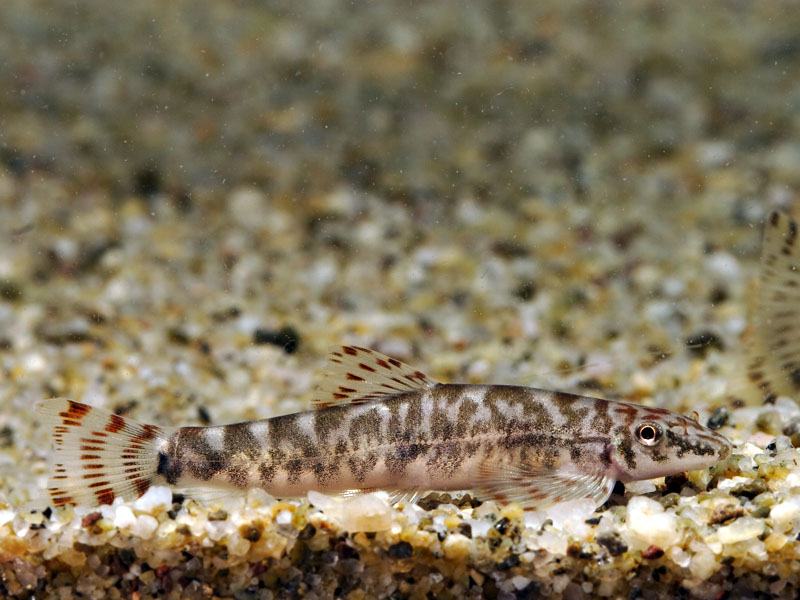
Liniparhomaloptera disparisBroken-band Hillstream Loach
Gastromyzontidae · Lin, 1934
L. disparis is sometimes available as bycatch among shipments of other species such as Rhinogobius duospilus but also appears on trade lists under the fictitious scientific name 'Homaloptera hoffmani'. It can be told apart from similar-looking members of the genus Formosania by its noticeably shorter barbels and from Vanmanenia spp. by the fact that the rostral fold is not lobed and the mouth is relatively small (25% head width. In addition the lower lip in Liniparhomaloptera is not divided and has a flat, papillated edge.
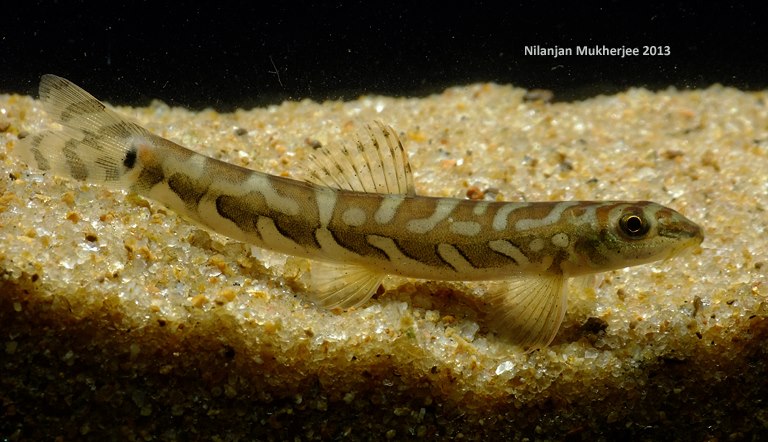
Mesonoemacheilus triangularisZodiac Loach
Nemacheilidae · Day, 1865
This species is also referred to by the alternative vernacular name 'Batik loach' and is the most-commonly traded member of the genus at present. It's easily-distinguished from congeners by body patterning which comprises a series of pale, oblique saddle-like markings edged in black and running along the dorsal surface, plus a similar set of bars originating from the otherwise plain ventral surface.
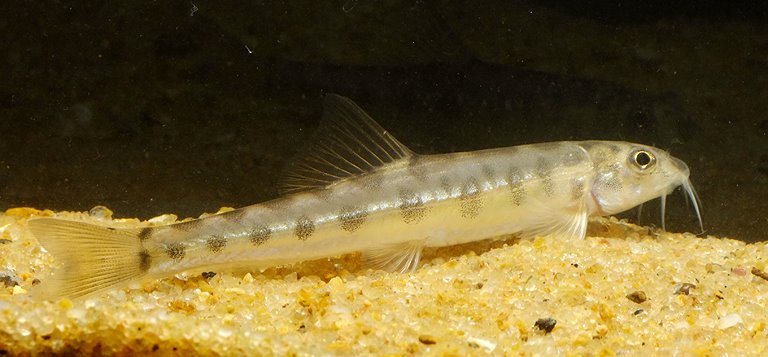
'Nemacheilus' corica
Nemacheilidae · Hamilton, 1822
This species has been widely regarded as a member of the genus Nemacheilus since the late 1970s with the vast majority of subsequent authors considering it as such, although in the aquarium hobby it's more commonly referred to Schistura.
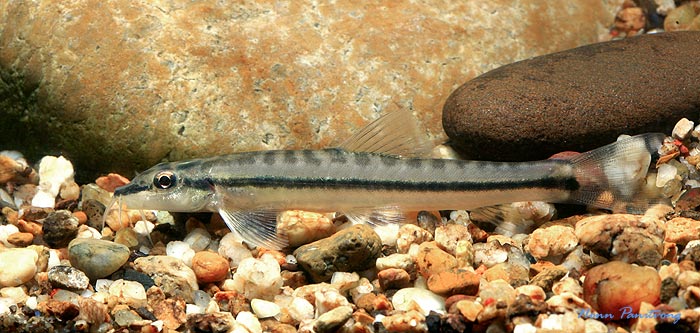
Nemacheilus longistriatusLaos Blackline Torpedo Loach
Nemacheilidae · Kottelat, 1990
Fishes which inhabit similar biotopes in nature constitute the best options, especially peaceful, open water-dwelling cyprinids since the presence of one or two schools can make a visible difference to the confidence of this naturally reclusive loach. Other possibilities include rheoph...
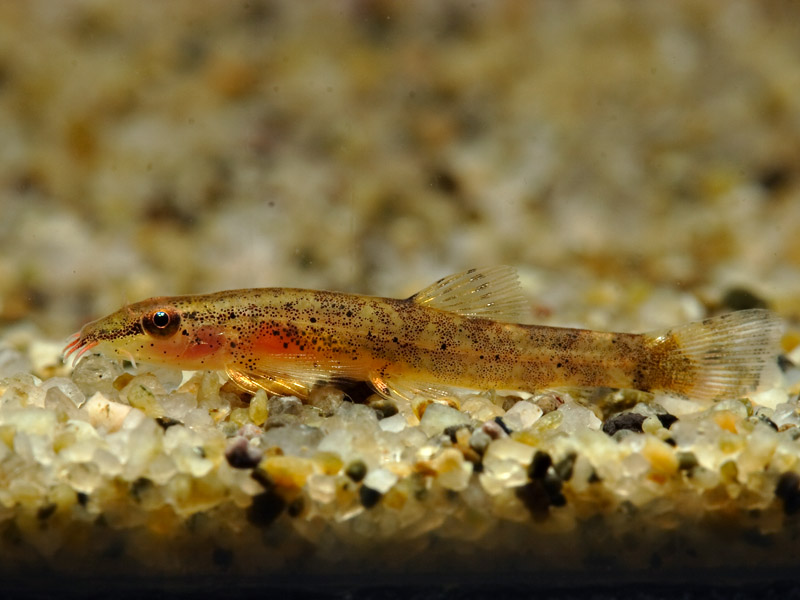
Neohomaloptera johorensis
Balitoridae · Herre, 1944
We're unsure if this species has ever been traded on a commercial basis though we know of several private collectors who've maintained it. It's difficult to confuse with any other balitorid due to the small adult size and distinctive orange to reddish-brown body colouration, and was originally described as a subgenus by Herre (1944) before Silas (1953) raised it to full genus status. It was later syonymised with Homaloptera by Alfred (1969) but has been generally accepted as a distinct, valid genus since Roberts (1989).
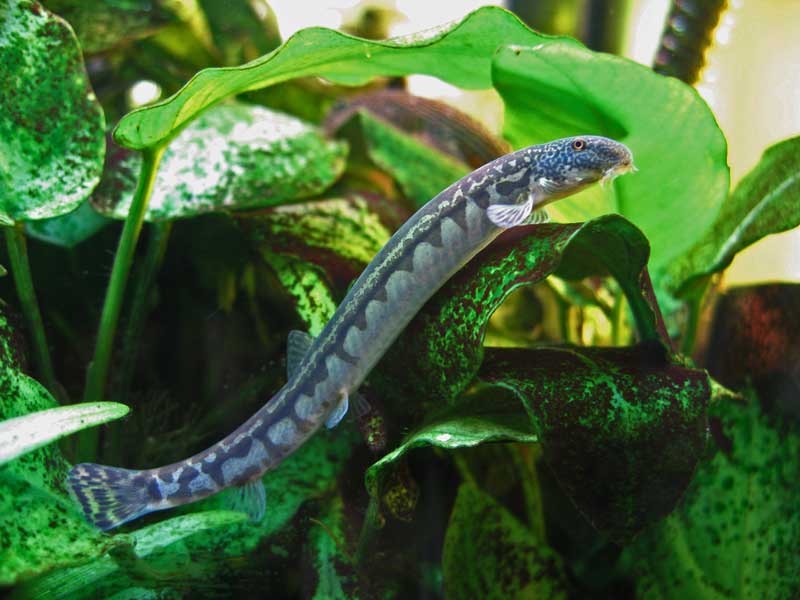
Niwaëlla delicataAjime Loach
Cobitidae · Niwa, 1937
During winter months N. delicata retreats to streams or underflows where it remains dormant between October and April (Kano, 2000) before emerging to spawn. Other species living alongside it in nature include Rhinogobius flumineus, Cottus pollux and Phoxinus spp. Niwaëlla is closely related to Cobitis and N. delicata, also the type species, was described as C. delicata (Niwa, 1937). The combination of characters used to tell it...
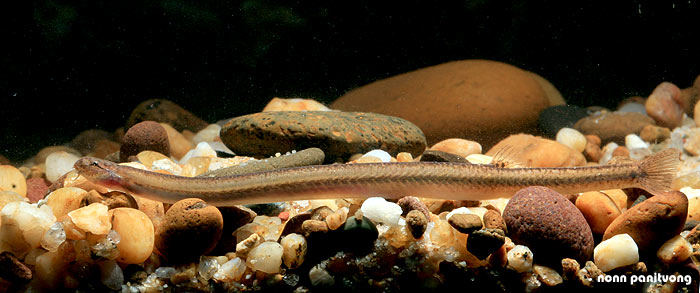
Pangio anguillaris
Cobitidae · Vaillant, 1902
One of a handful of Pangio spp. traded under the generic name 'eel loach'. Wild populations tend to differ in colour pattern to some extent, with some exhibiting a more intense lateral stripe while others display an irregular pattern of fine dark spots on the body, for example.
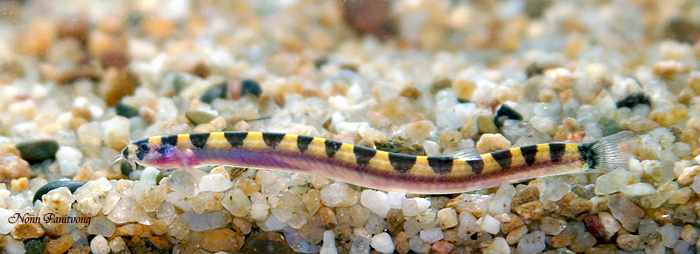
Pangio cuneovirgata
Cobitidae · Raut, 1957
Infrequently encountered in the aquarium trade, most often as bycatch among shipments of similar-looking congeners. It's included in the P. kuhlii group of closely-related species within the genus, and can be distinguished from other members by...
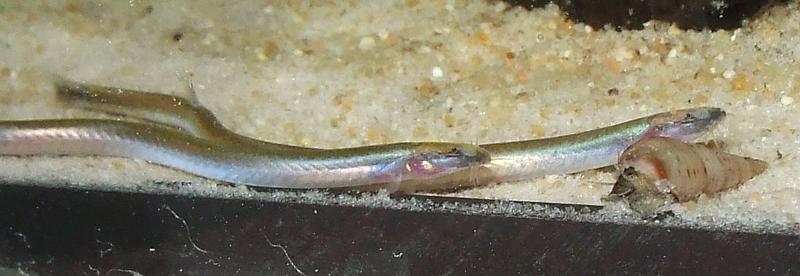
Pangio doriae
Cobitidae · Perugia, 1892
One of a handful of Pangio spp. traded under the generic name 'eel loach', though it's most commonly available as bycatch among shipments of other fishes. Some authors have suggested it may be synonymous with P. anguillaris bu...
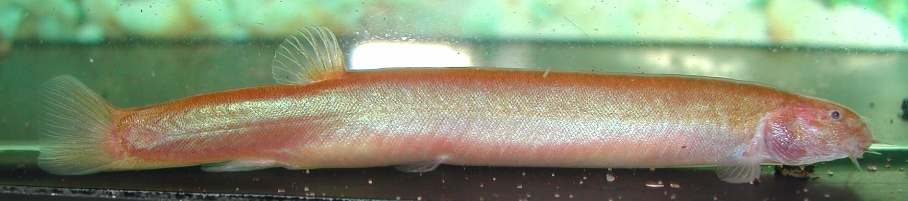
Pangio filinaris
Cobitidae · Kottelat & Lim, 1993
It's included in the P. kuhlii-oblonga group of closely-related species within the genus as per Bohlen et al. (2011) and can be...
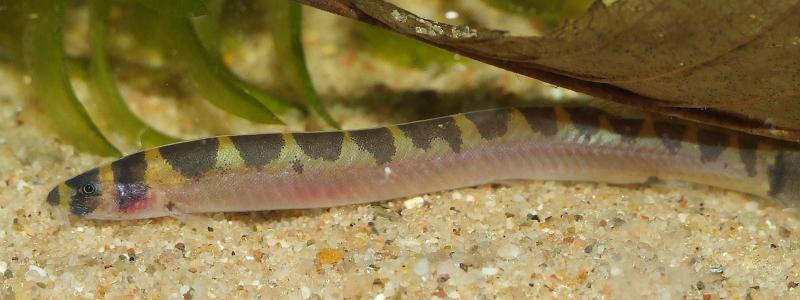
Pangio malayana
Cobitidae · Tweedie, 1956
Originally known only from Johor and Pahang states, Peninsular Malaysia but since recorded from the Batang Hari river drainage, Sumatra and the Kapuas system, Kalimantan Barat (West Kalimantan) province, Indonesian Borneo. Type locality is 'Tahan River, Pahang, Malaysia'.
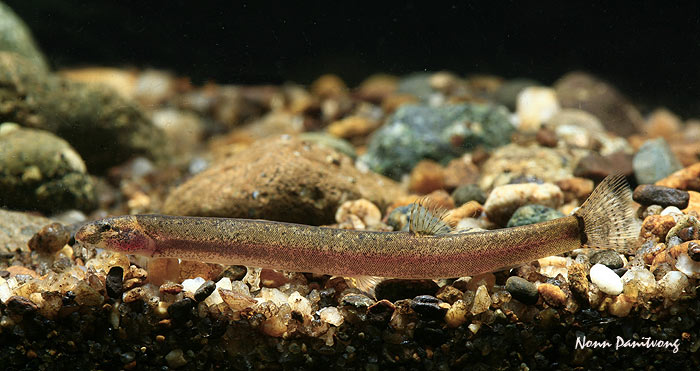
Pangio piperata
Cobitidae · Kottelat & Lim, 1993
Some Sumatran and Bornean populations of the highly variable P. shelfordii superficially resemble P. piperata which can cause issues with identification as the two often occur together. In general however the body patterning in P. piperata is than that of P. shelfordii and they differ in vertebral counts (mode 47 vs. 50, respectively).
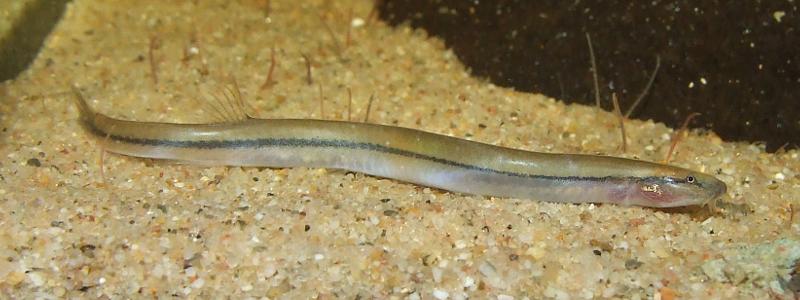
Pangio sp. 'PAN05'
Cobitidae · authority not recorded
Unclear but usually imported for the aquarium trade alongside P. anguillaris which according to current knowledge has an irregular distribution including Laos, Cambodia, Vietnam, Thailand, Peninsular Malaysia, and the Greater Sunda Islands of Sumatra and Borneo.
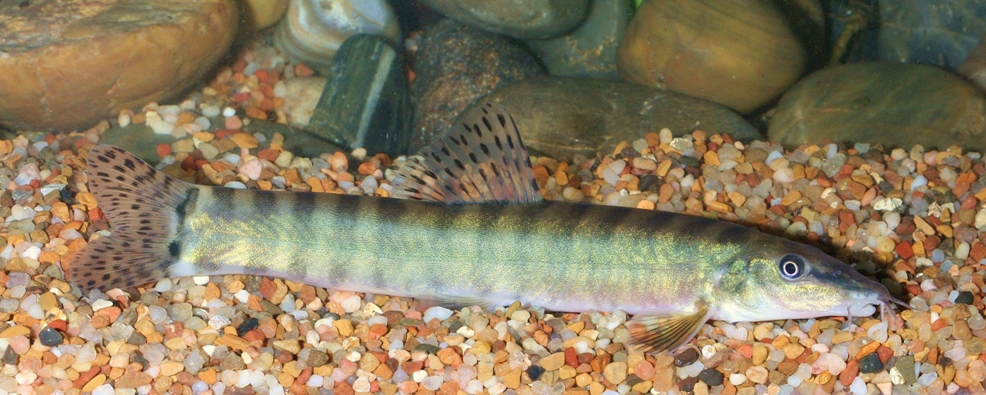
Parabotia bimaculata
Botiidae · Chen, 1980
Type locality is the town of Luxian, located north of Luzhou city, Sichuan province, southwest China. Luxian lies on the Laixi River, one of several tributaries converging with the main Yangtze river channel near Luzhou and forming part of the latter's upper drainage basin. The full extent o...
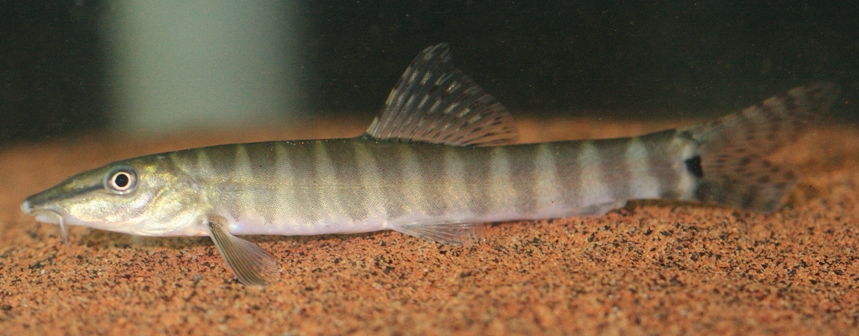
Parabotia fasciata
Botiidae · Dabry de Thiersant, 1872
P. fasciata is rarely seen in the trade and is typically available only as bycatch among shipments of Sinibotia spp., particularly S. robusta. According to current classification numerous species from several genera are considered synonymous with it.
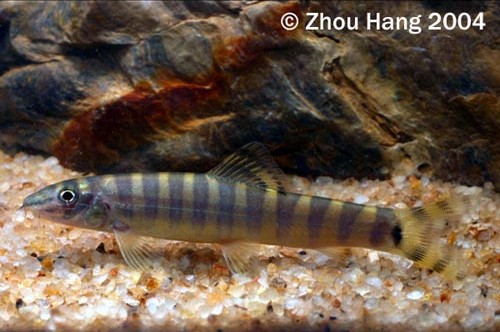
Parabotia lijiangensis
Botiidae · Chen, 1980
It's told apart from congeners by a combination of characters as follows: large scales present on body and sides of head; caudal fin deeply forked with subequal lobes; 10-13 dark, vertical bars on the body; a dark, ocellated spot in the centre of the caudal-fin base; two bars on top of head, dorsal-fin with two rows of greyish spots; caudal-fin lobes with 3-4 dark bands on each; anal-fin with one indistinct band and another, more distinct, submarginal band; ventral fins with two indistinct bands.
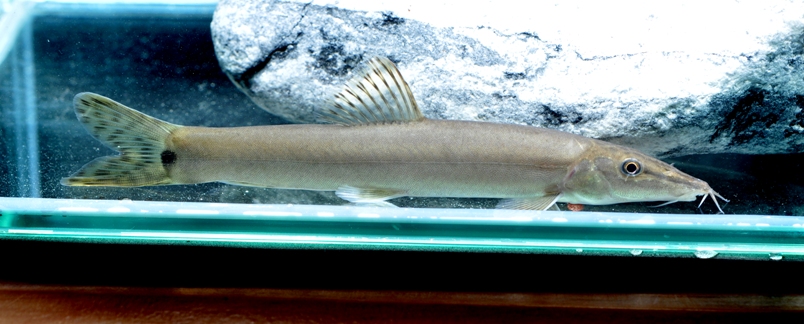
Parabotia sp. 'PB01'
Botiidae · authority not recorded
The name of this fish is unclear with the fact that diagnoses for several members of this genus do not appear to exist in the English language making identification even trickier. It's not common in the aquarium trade, either.
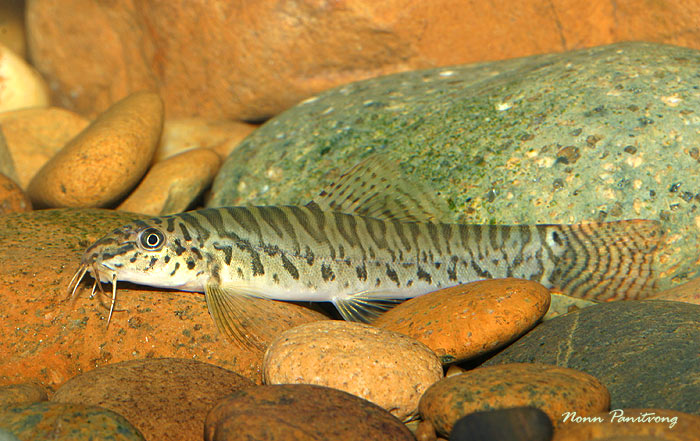
Paracanthocobitis pictilisCherry-fin Loach
Nemacheilidae · Kottelat, 2012
Prior to description this species was considered to represent, and traded as, A. rubidipinnis, but that species is apparently endemic to the lower Irrawaddy basin in Myanmar and unknown in the aquarium hobby. Male individuals of A. pictilis, A. botia and A. mandalaysensis possess a suborbital slit rather than suborbital flap which immediately distinguishes...
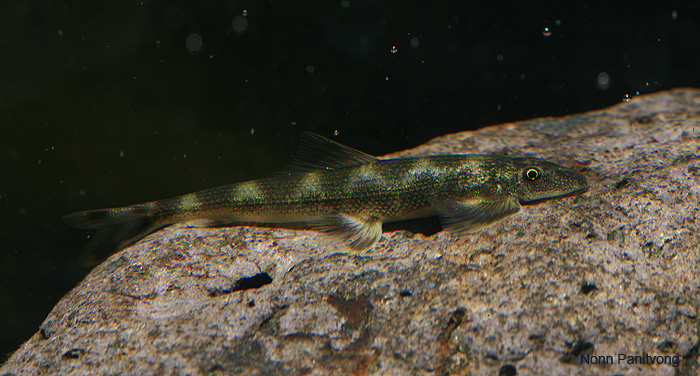
Pseudohomaloptera leonardi
Balitoridae · Hora, 1941
Type locality is given as 'Kuala Tahan, Pahang (King George V National Park)' which corresponds to the village of Kuala Tahan in Pahang state, central Peninsular Malaysia. The settlement is located at the confluence of the Tahan and Tembiling Rivers which form part of the Pahang river basin, while the national park was re...
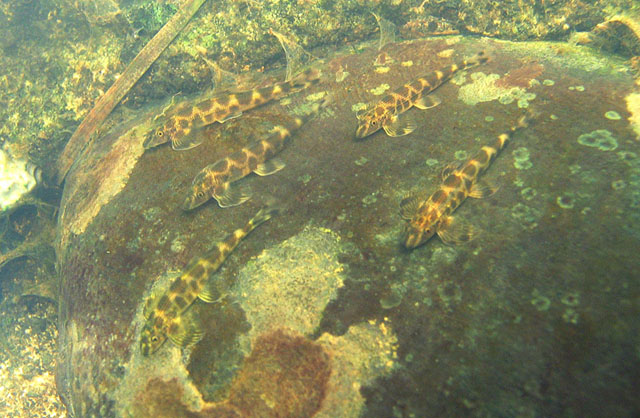
Pseudohomaloptera sexmaculata
Balitoridae · Fowler, 1934
H. sexmaculata is very similar to H. leonardi but can be told apart since it possesses 2 simple and 12-14 branched pectoral-fin rays (versus 6 simple and 11 branched rays). Both of these species are sometimes misidentified as H. yunnanensis which has 7 simple and 12 branched pectoral-fin rays.
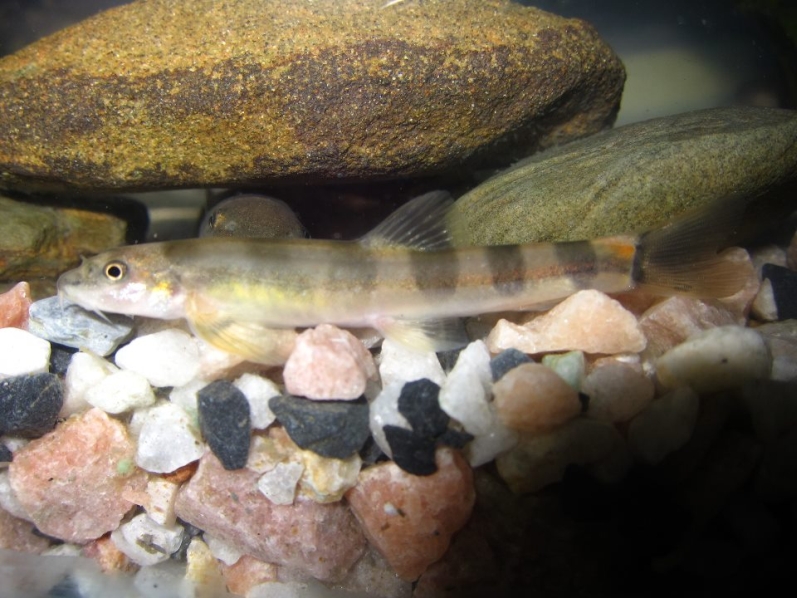
Schistura aizawlensis
Nemacheilidae · Lalramliana, 2012
Type locality is 'India: Mizoram: Muthi River, a tributary of Tuirial River in vicinity of Zemabawk, Aizawl, 23°44' 54" N 92°45'27" E', and to date this species is known only from the Muthi system. The Muthi is an affluent of the Tuirial River which is itself a tributary of the Barak watershed. The Barak is one of the great rivers of southern Assam and forms part of the Surma-Meghna River System.
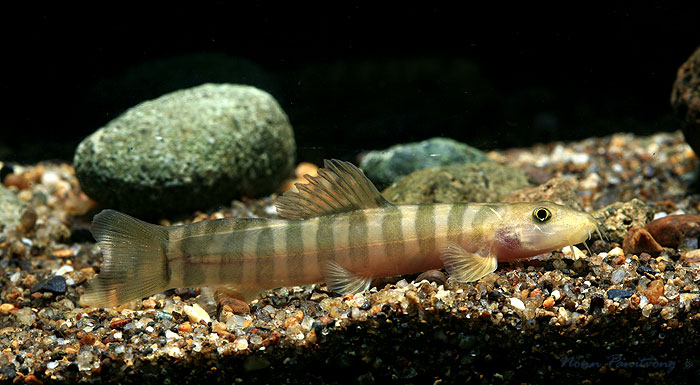
Schistura alticrista
Nemacheilidae · Kottelat, 1990
This species is very rare in the aquarium trade but available on occasion. It has 8-9 darkish body bars which usually split vertically as the fish mature, and like some conspecifics possesses a prominent dorsal adipose crest on the caudal peduncle. Schistura is the most species-rich genus among...
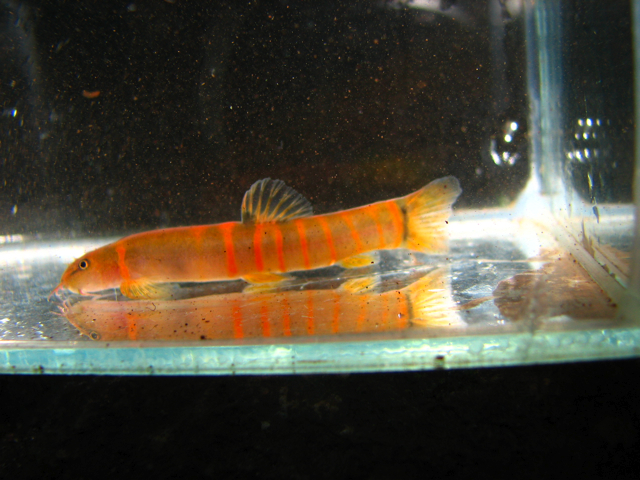
Schistura aurantiaca
Nemacheilidae · Plongsesthee, Page & Beamish, 2011
During collections of the type series stream width was found to vary seasonally but was never wider than 9.1 metres. Water depth was 10-40 cm, flow rate 20-70 cm/s−1, and substrates comprised small to medium-sized rocks. Water temperature was seasonally variable but always within the range 20-26°C/68-78.8°F, pH was 6.5-7.9, oxygen 7.4-8.5 mg/l−1, ammonia, nitrate and total iron were 0.01, < 0.03 and < 0.5 mg/l−1, respectively, and alkalinity was aro...
Schistura balteataSumo Loach
Nemacheilidae · Rendahl, 1948
This species is quite uncommon in the aquarium hobby although its name is sometimes used in reference to the similar-looking, apparently undescribed congener S. cf. balteata, and both are also traded as 'sumo loach', 'tri-banded sumo loach', and 'orange saddle-back loach'. Following Kottelat (1990) it's diagnosed by the following combination of characters: unique colour pattern consisting of two da...
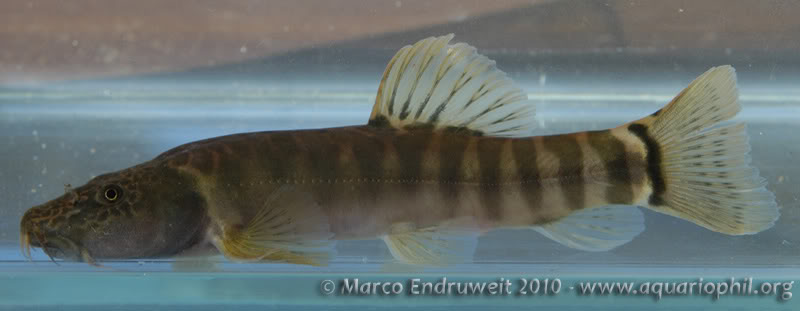
Schistura callichroma
Nemacheilidae · Zhu & Wang, 1985
Type locality is given as 'Babianjiang River, 24°20'N, 100°10'E, Jingdong County, Yunnan Province, China'. The Babianjiang joins the Mengyejiang River to form the Langmajiang River, a tributary of the Lixianjiang (Black River) within the Red River basin.
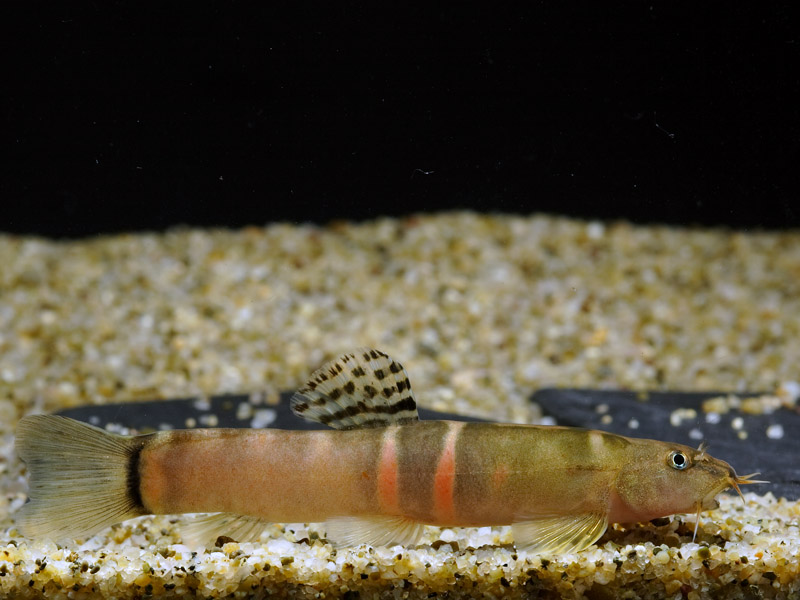
Schistura cf. balteataSumo Loach II
Nemacheilidae · authority not recorded
This apparently undescribed species has been available in the hobby since around 2006 and has been traded under several trade names of which others include 'tri-band sumo loach' and 'chubby loach'. The name 'Sumo II' is now in wide use to distinguish it from the real S. balteata since both have been traded as 'Sumo loach'...
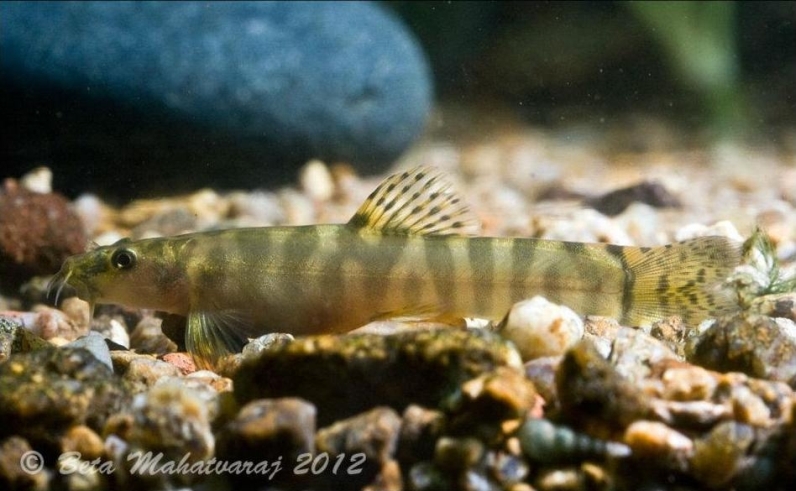
Schistura denisonii
Nemacheilidae · Day, 1867
This species is feisty and largely unsuitable for the general community aquarium. This is not to say it must be kept alone, rather that tankmates must be selected with care and proper research. Slow-moving or long-finned species should certainly be omitted because they're likely to struggle with the necessary level of water movement and may end up with nipped fins.
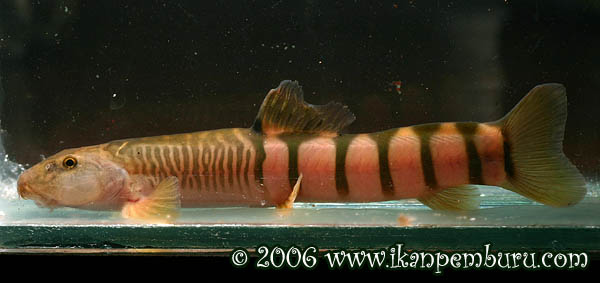
Schistura disparizona
Nemacheilidae · Zhou & Kottelat, 2005
Can be told apart from congeners by its colour pattern which consists of 8-11 closely-set, narrow dark bars in the anterior part of the body and 5 wider bars in the posterior part. It also possesses prominent dorsal and ventral adipose crests on the caudal peduncle and 9½ branched dorsal-fin rays.
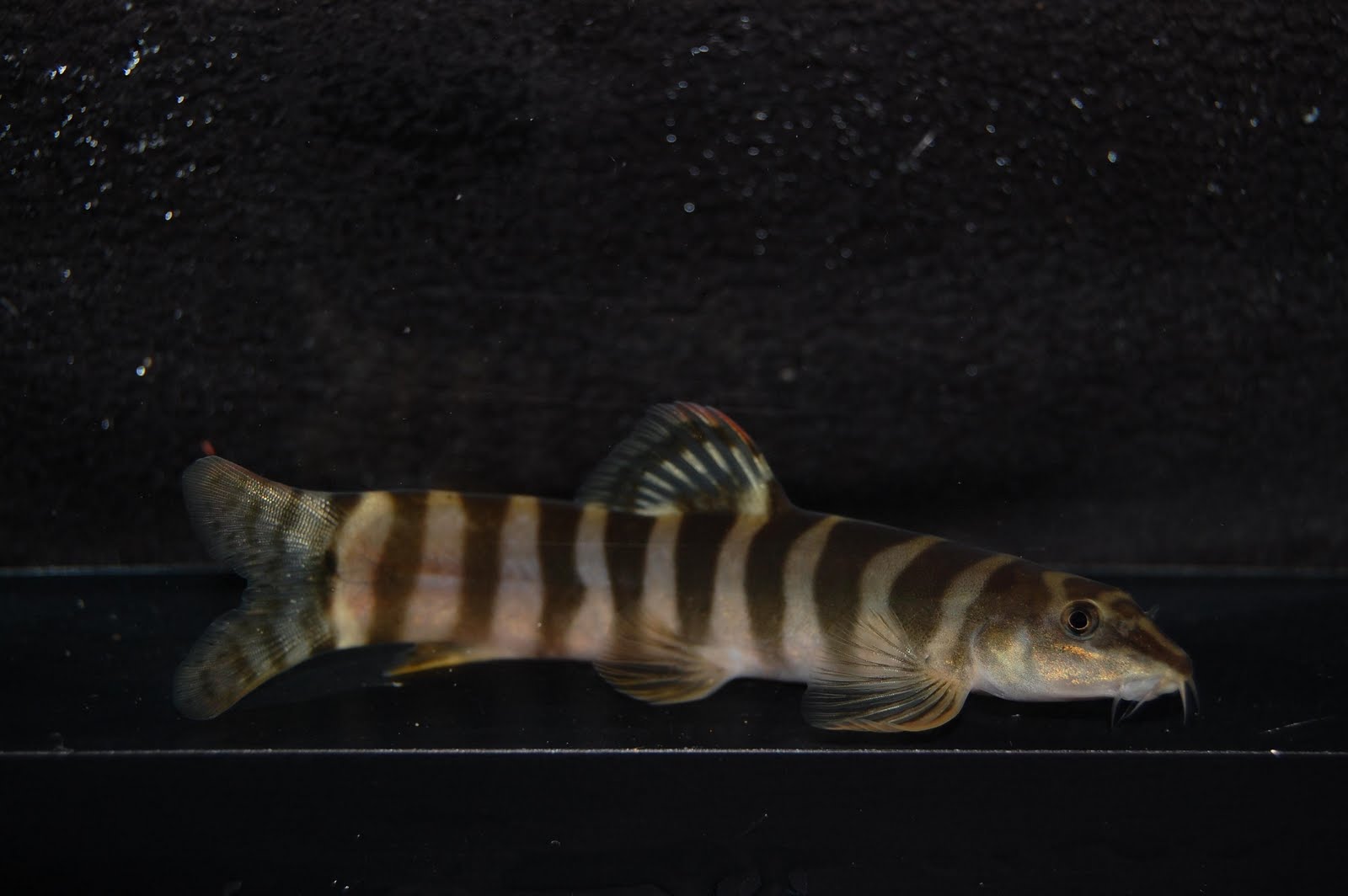
Schistura hypsiuraSuper Convict Loach
Nemacheilidae · Bohlen, Ŝlechtová & Udomritthiruj, 2014
It can be distinguished from congeners by the following combination of characters: caudal peduncle deep, ≥ the deepest part of the remainder of the body; no dorsal or ventral skin crests along the caudal peduncle; caudal-fin deeply forked, the outermost principal rays in the upper and lower lobes more than twice the length of the innermost: suborbital flap in males present; a well-developed suborbital groove in females; 6–8 very regular bars along the flank.
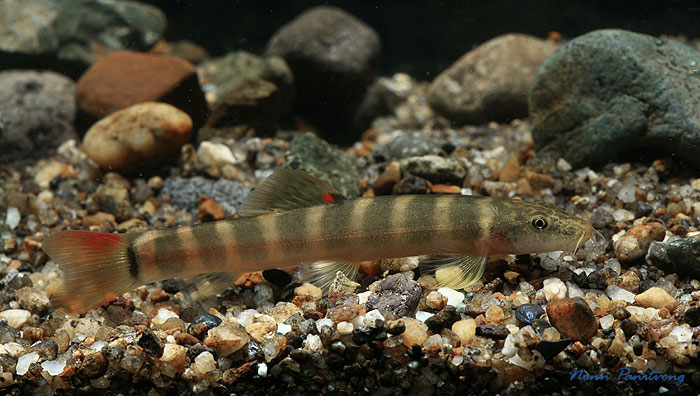
Schistura kengtungensis
Nemacheilidae · Fowler, 1936
This species is distributed in the middle Mekong River basin in north and northeastern Thailand, Myanmar and Xishuangbanna Dai Autonomous Prefecture, Yunnan province, southern China, and is also known from the Nam Beng, Nam Tha and Nam Yuoan drainages in Laos. Type locality is 'Laun We (Loi Mw...
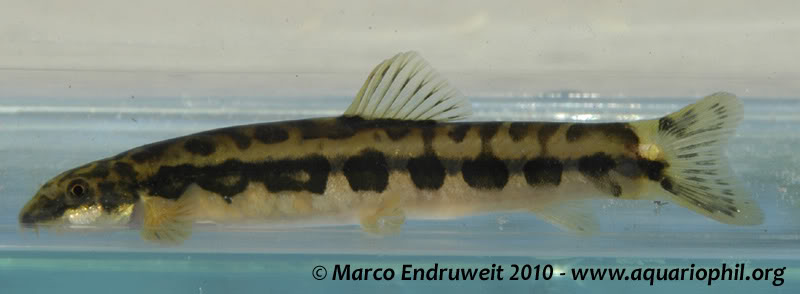
Schistura kloetzliae
Nemacheilidae · Kottelat, 2000
Appears restricted to highly-oxygenated, fast-flowing riffles of small-to-medium sized streams. These typically contain clear water with substrates of gravel, rocks, boulders, and bedrock with no aquatic plants.
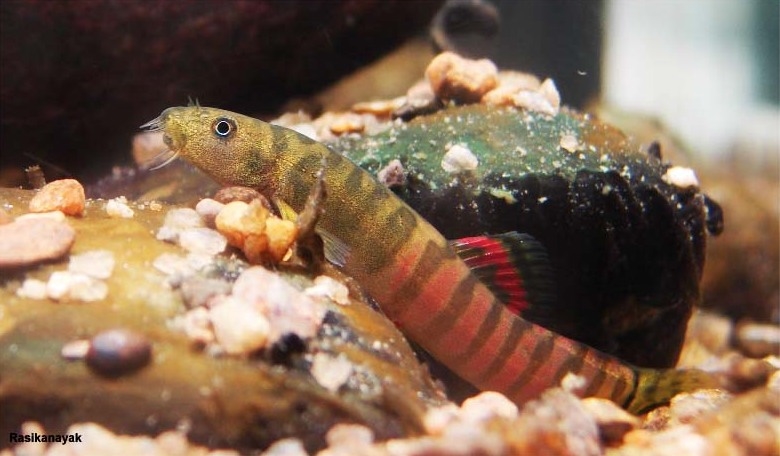
Schistura kodaguensis
Nemacheilidae · Menon, 1987
This species is not a well-known aquarium fish but is maintained by a number of Indian enthusiasts. It can be told apart from related species by the following combination of characters as per Sreekantha et al. (2006): pectoral-fin rays 10; absence of black spot at base of dorsal-fin; presence of rows of spots on caudal-fin; lateral line incomplete; caudal-fin slightly emarginate; 11-14 vertical bars on the body.
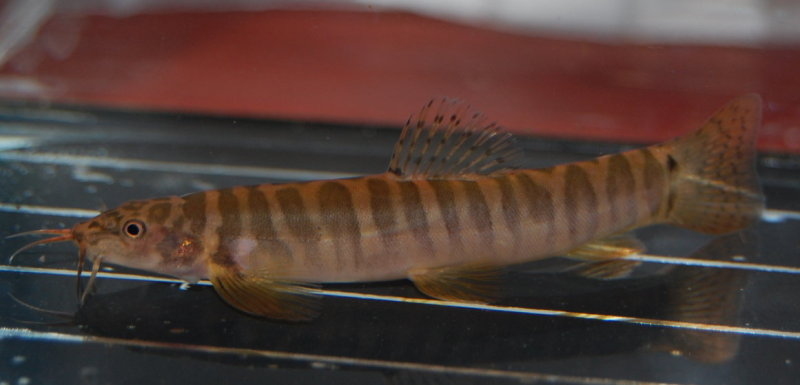
Schistura kohchangensisOrnate Tiger Sand Loach
Nemacheilidae · Smith, 1933
On Koh Chang one habitat consisted of a stream flowing from the waterfall Nam Tok Mai Yom which empties into the Gulf of Thailand after less than 1 km. The stream was dry in its lower reaches and had a substrate of boulders and pebbles. Sympatric fi...
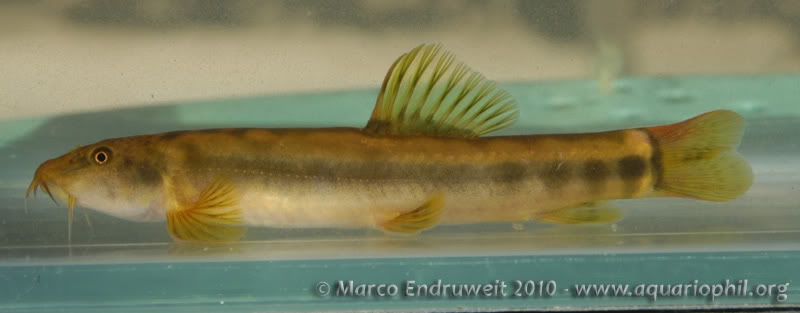
Schistura laterivittata
Nemacheilidae · Zhu & Wang, 1985
It's been considered a synonym of Schistura caudofurca (Mai, 1978) by the majority of recent authors following Kottelat (2001) but this appears to be a case of misidentification since the two species exhibit several notable differences based on their respective descriptions (Endruweit, 2010).
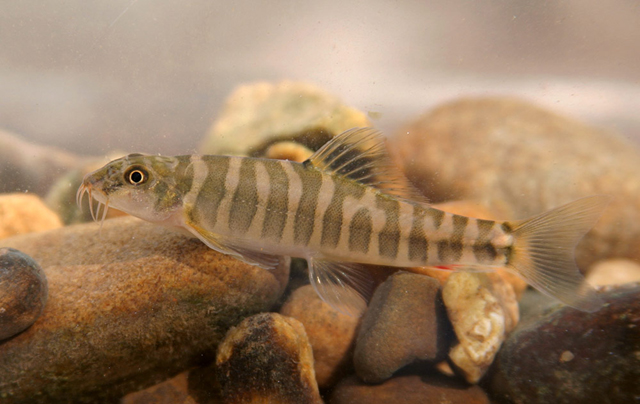
Schistura maepaiensis
Nemacheilidae · Kottelat, 1990
The type locality originally consisted of a shallow (0.5 - 1.5 m deep) stream with a substrate of rocks and boulders and flow varying from 'moderate to swift'. When the holotype was collected there in 1980 sympatric species included Acanthocobitis zonalternans, Puntius orphoides, Pethia ticto, Raiamas guttatus, Barilius barnoides, Mystacoleucus argenteus and Mastacembelus armatus plus unidentified members of Crossocheilus an...
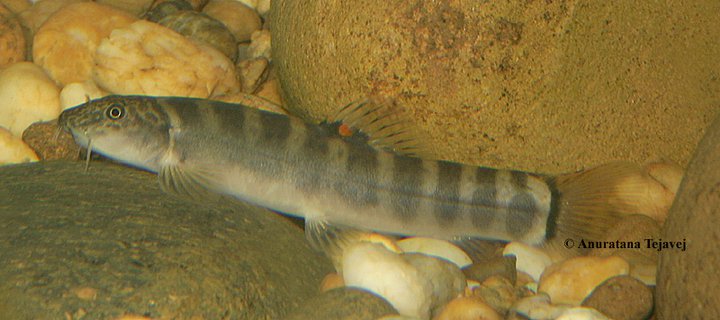
Schistura nicholsi
Nemacheilidae · Smith, 1933
This species is sometimes traded for aquaria but its name also appears to have been widely misapplied to other fishes. It can be identified via the following combination of characters: presence of 8-10 quite regular dark bars...
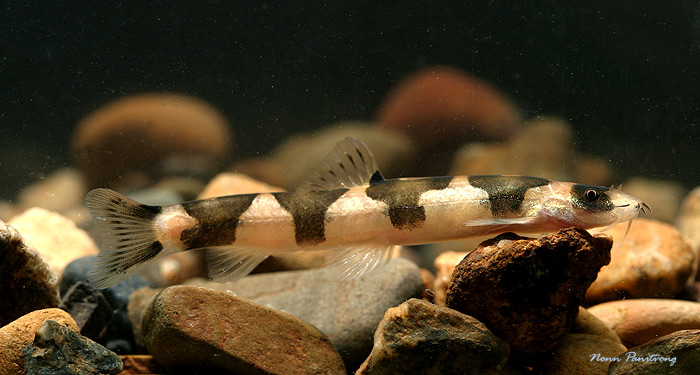
Schistura pridiiMini Dragon Loach
Nemacheilidae · Vidthayanon, 2003
Endemic to a handful of tributary streams within the upper Chao Phraya river system in northern Thailand. Six populations are known to date, with the majority lying inside the Doi Chiang Dao Wildlife Sanctuary. Some of its habitats are under threat by over-grazing, deforestation, deliberate forest fires, and collection for the aquarium trade.
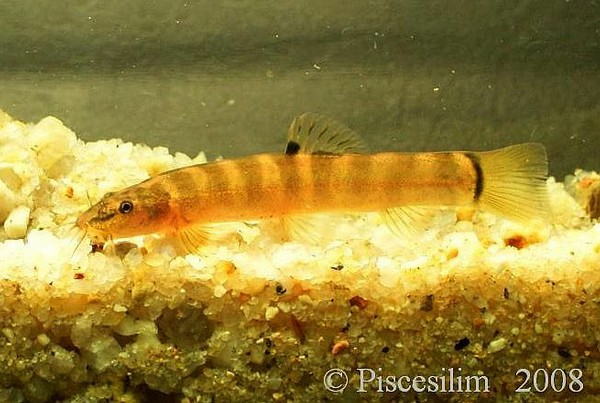
Schistura robertsi
Nemacheilidae · Kottelat, 1990
Should not prove difficult to maintain under the correct conditions. We strongly recommend keeping it in a tank designed to resemble a flowing stream or river with a substrate of variably-sized rocks, sand, fine gravel, and some water-worn boulders. This can be further furnished wit...
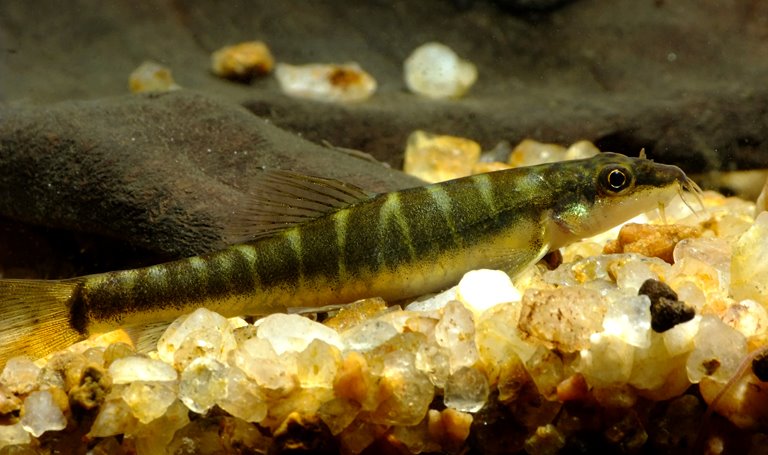
Schistura savonaHalf-banded Loach
Nemacheilidae · Hamilton, 1822
This species is seen in the aquarium trade on a relatively frequent basis and is sometimes sold as 'bicolor loach' in the United States. It can be distinguished from congeners by its unique colour pattern comprising 9-10 thin, yellowish bars on a dark background in the upper part of the body, and plain whitish colouration in the lower portion.
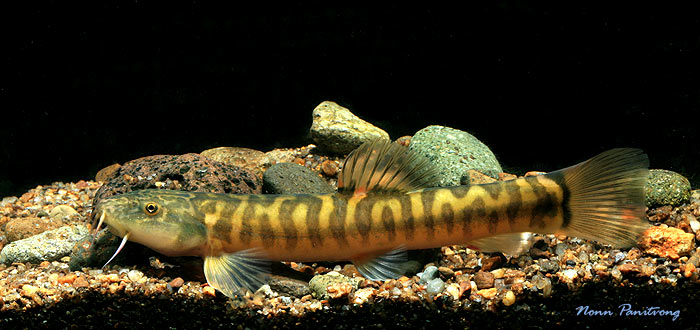
Schistura schultzi
Nemacheilidae · Smith, 1945
There appears to be some discrepancy between Smith's original description and Kottelat (1990) in that Smith states the fish is a member of a group of species lacking an ocellus at the upper caudal-fin base, whereas Kottelat mentions the presence of 'a black spot at upper extremity of caudal-fin base, surrounded by a whitish area'.
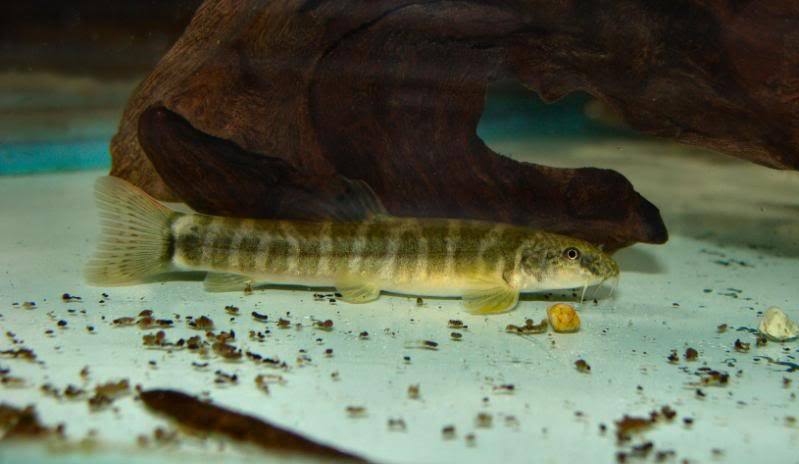
Schistura sp. 2Laos Redtail Loach
Nemacheilidae · authority not recorded
The identity of this fish is unclear but it has been traded as S. sp. 'Laos redtail'. Schistura is the most species-rich genus among nemacheilid loaches with some 190 members and it continues to grow with over 100 having been described since 1990. It may repre...
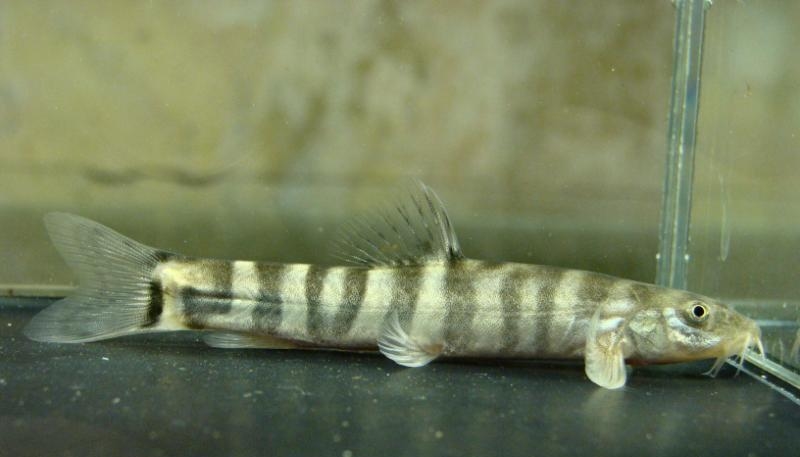
Schistura sp. 3
Nemacheilidae · authority not recorded
The identity of this fish is unclear but it has been traded as Schistura scaturigina M'Clelland, 1839 but does not appear to be that species based on its original description plus Vishwanath and Laisram (2001). The latter describe S. scaturigina as possessing a yellowish-white body with 12 transverse, triangu...
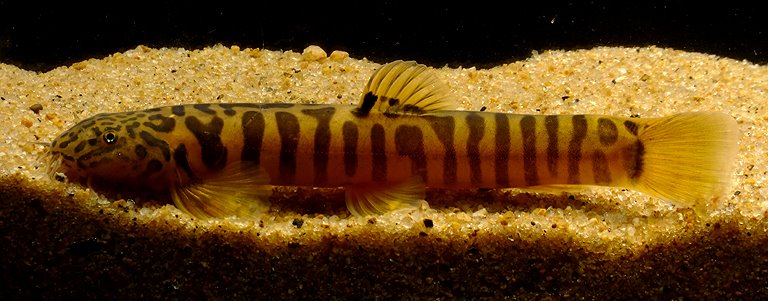
Schistura sp. 4Grizzled Loach
Nemacheilidae · authority not recorded
This species has been collected for the aquarium hobby, albeit in small numbers at time of writing, but its identity is unclear. Though obtained from close to the type local...
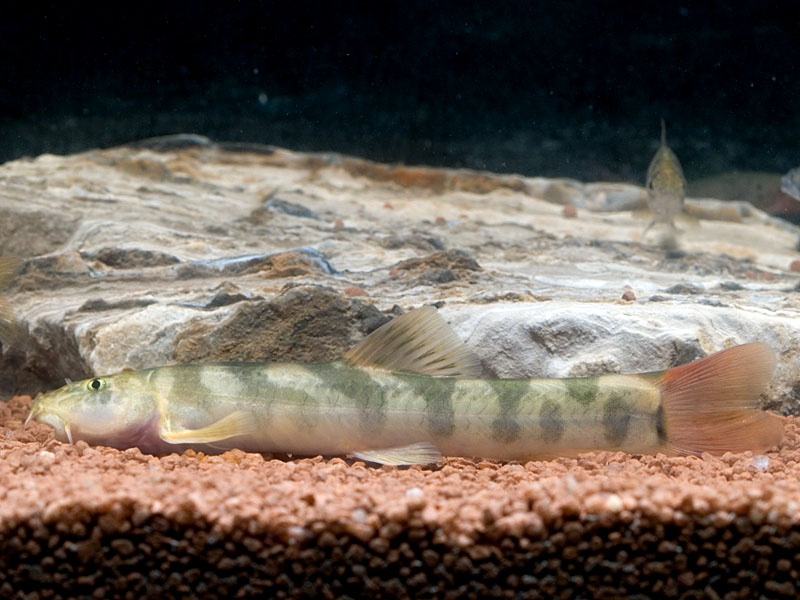
Schistura spilota
Nemacheilidae · Fowler, 1934
Not a commonly species in the aquarium hobby but sporadically available in shipments of wild fishes from Thailand. Following Kottelat (1990) it's a member of a group of species possessing a complete or near-complete lateral line, 8 ½ branched dorsal-fin rays, 17 branched caudal-fin rays and lacking sexual dimorphism (the latter is not strictly true - see above). Its colour pattern is quite distinctive, howe...
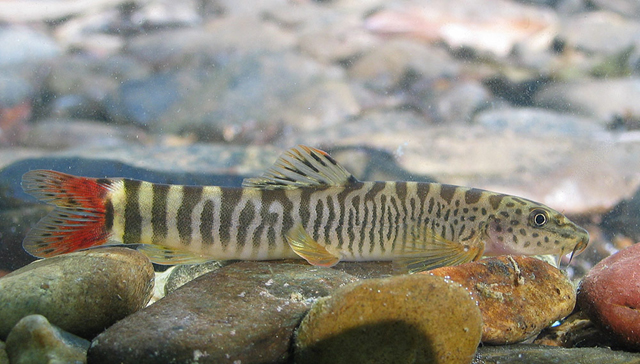
Schistura vinciguerrae
Nemacheilidae · Hora, 1935
This species is traded on a fairly regular basis and is similar in appearance to some congeners, most notably S. bella, S. mahnerti, S. multifasciata, S. poculi, S. reticulata, S. longa, S. conirostris and S. udomritthiruji. This assemblage has been referred to as the Schistura multifasciata 'group', and members share a...
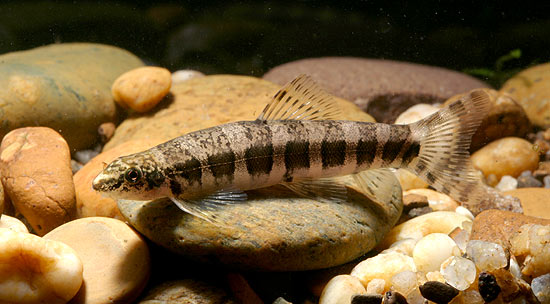
Serpenticobitis zonata
Serpenticobitidae · Kottelat, 1998
Fish sold under the name S. zonata are sporadically available in the aquarium trade but the majority appear to be the congener S. octozona. The genus currently contains just three members all of which are known only from the Mekong basin. S. octozona is the type species and separ...
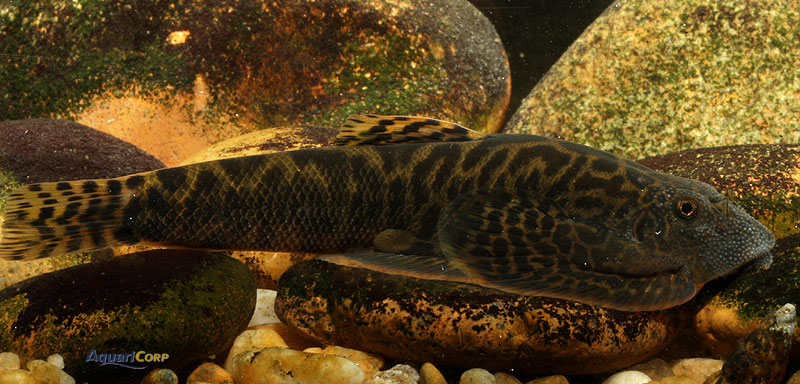
Sewellia elongata
Gastromyzontidae · Roberts, 1998
This species appeared in the trade during 2010 and its identity has been confirmed to us by Thai exporter and aquarist Kamphol Udomritthiruj who collects it from the Se Kong system for the aquarium hobby. To date only subadult specimens have reached the western market.
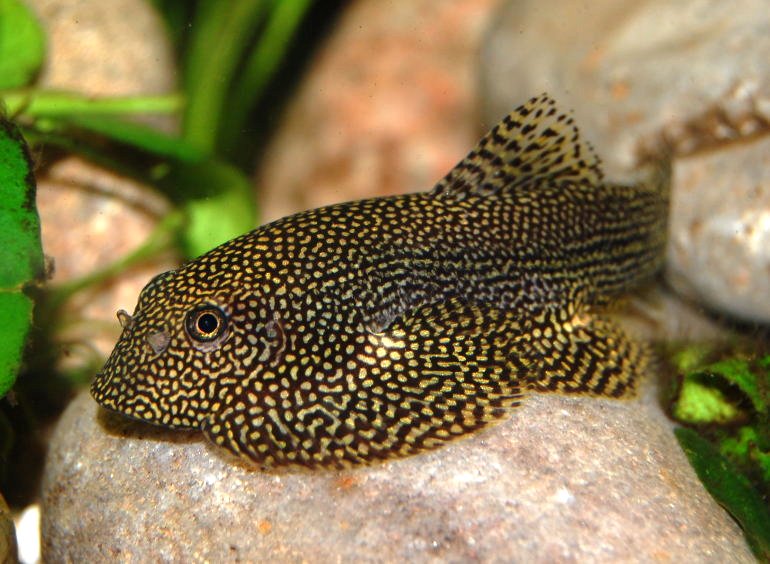
Sewellia sp. 'SEW01'Spotted Butterfly Loach
Gastromyzontidae · authority not recorded
This is one of the more readily-available members of the genus and popularly referred to as S. sp. 'spotted' or S. sp. 'special'. It's superficially similar in appearance to S. albisuera but in that species body patterning consists of a network of irregular dark lines forming a complicated series of reticulations vs. many small, light spots on a dark background in S. sp. 'SEW01'. It's been suggested that these two may represent the same species but this...
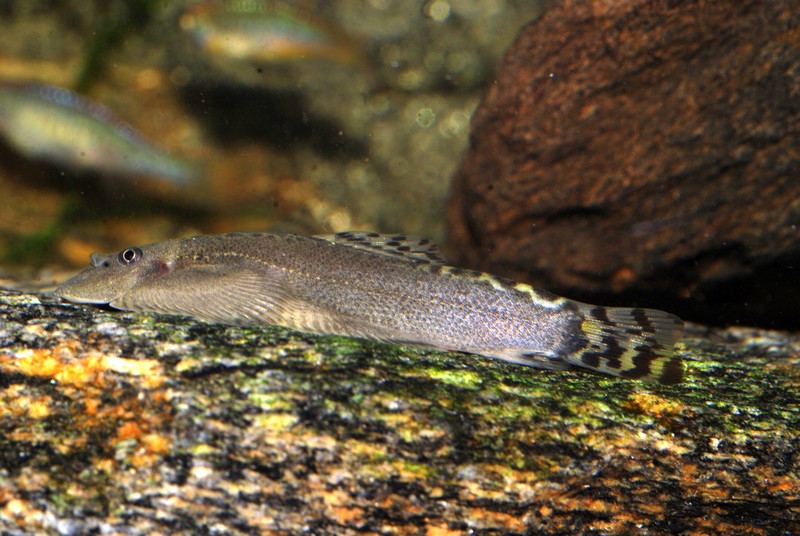
Sinogastromyzon puliensis
Balitoridae · Liang, 1974
This species is a relatively recent addition to the hobby but considering the number of specimens allowed to be collected for scientific research is highly restricted by the Taiwanese Council for Agriculture it seems odd that it's become available at all. Indeed it appears that those in the trade are collected and exported on an illegal basis (T-Y Liao, pers. comm.)...
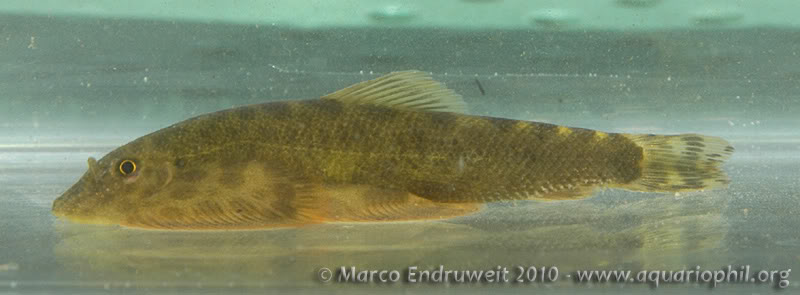
Sinogastromyzon tonkinensis
Balitoridae · Pellegrin & Chevey, 1935
At the type locality of the congener S. lixianjiangensis sympatric species included Balitora kwangsiensis, Glyptothorax quadriocellatus, Garra orientalis, Hemibagrus pluriradtus, Poropuntius huangchieni, Pseudecheneis paviei,...
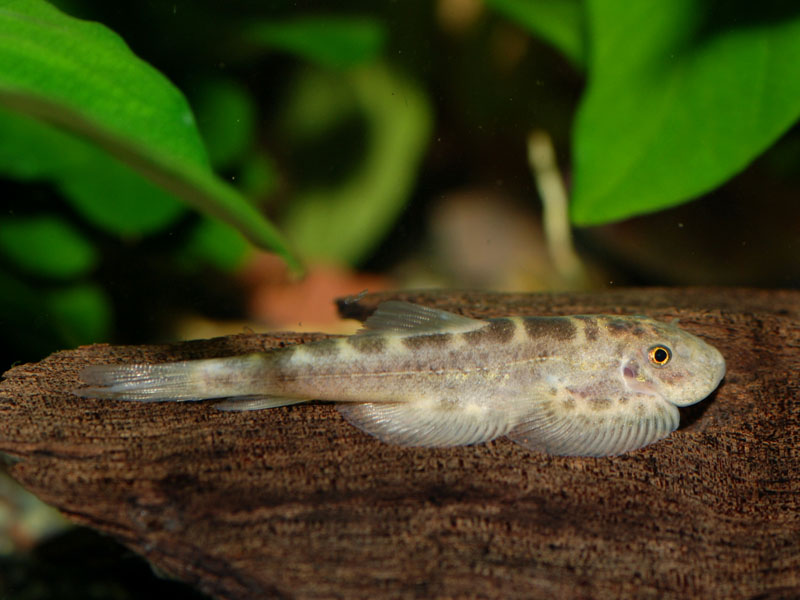
Sinogastromyzon wui
Balitoridae · Fang, 1930
This species is probably the most common member of the genus in the aquarium trade but still not often exported in numbers. Instead it's more often found in mixed shipments of other wild-collected fishes from southern China, particularly Beaufortia or Pseudogastromyzon spp. It may appear superficially simi...
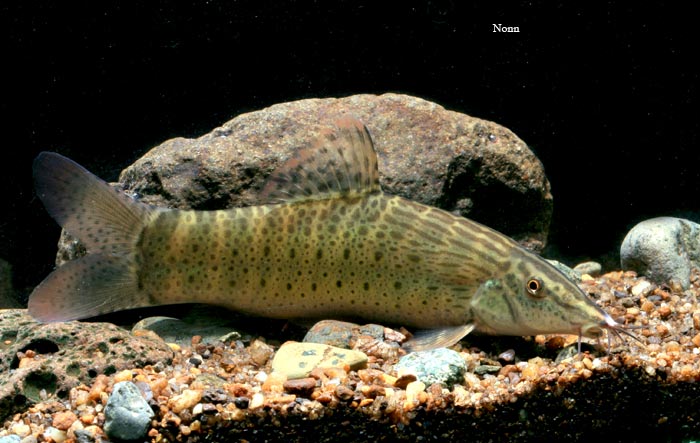
Syncrossus beaufortiChameleon Loach
Botiidae · Smith, 1931
This species is very similar in appearance to S. berdmorei which is native to India and Myanmar, and has been widely mislabelled under that name in older aquarium literature. The two can appear identical on first glance but there are some notable differences, most obviously possession of 9-10 branchedrays in S. beauforti vs. 11-14 in S. bermorei, and the fact that even young specimens of S. beauforti exhibit laterally-orientated rows of small, dark markings running across the ...
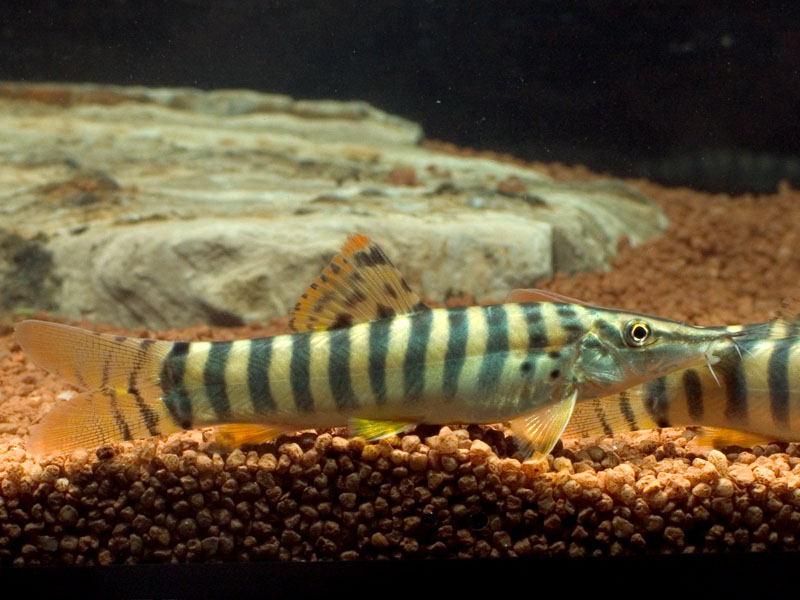
Syncrossus berdmoreiRedfin Tiger Loach
Botiidae · Blyth, 1860
Interestingly some observations suggest that the character of the highest-ranked, or alpha, fish appears to affect that of the whole group though it must be said that scientific studies of botiid loach behaviour are virtually non-existent. It certainly seems that they display a degree of 'personality' with some specimens being naturally bolder/more aggressive than others. The alpha is normally the largest specimen within the group and often female. Sound also appears to be an important factor in communication since these loaches are able...
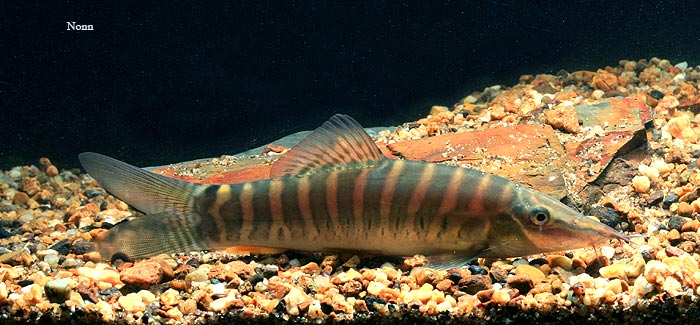
Syncrossus helodesBanded Tiger Loach
Botiidae · Sauvage, 1876
This species is sometimes confused with S. hymenophysa, native to the Greater Sunda Islands and Peninsular Malaysia, but differs in several ways, the most immediately identifiable of which are possession of small, irregular, dark markings in the lower half of the body and lack of a dark spot in the dorsal-fin. It also has 10-12 vertical body bars...
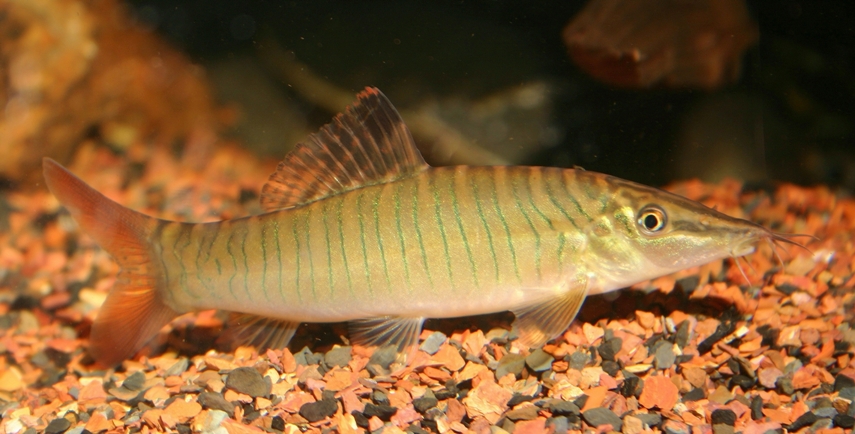
Syncrossus hymenophysaGreen Tiger Loach
Botiidae · Bleeker, 1852
Described from close to the city of Palembang, therefore presumably the Musi River basin, South Sumatra province, Sumatra, Indonesia, and since recorded from elsewhere on Sumatra plus the Malaysian state of Sarawak and Indonesian province West Kalimantan on Borneo.
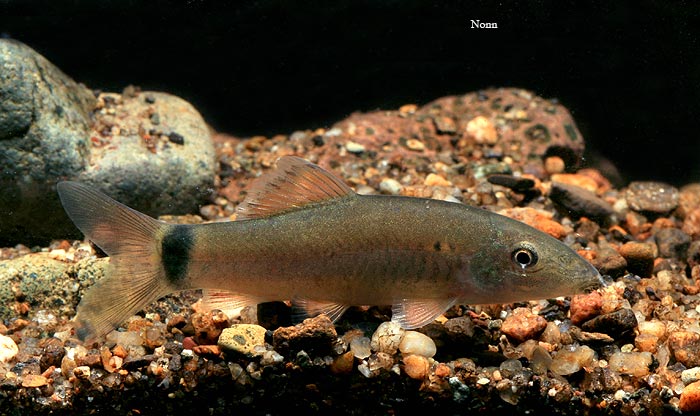
Yasuhikotakia eosSun Loach
Botiidae · Taki, 1972
Y. eos isn't as commonly-traded as it once was but is still available occasionally. It's difficult to confuse with any other member of the genus due to its colour pattern consisting of yellow to reddish brown base body colour (can appear greyish in some specimens, especially post-import or when introduced to a new aquarium) with a metallic green/blue golden sheen and large darkish marking on either side of the caudal peduncle. The fins can be yellowish to reddish, and the dorsal and c...
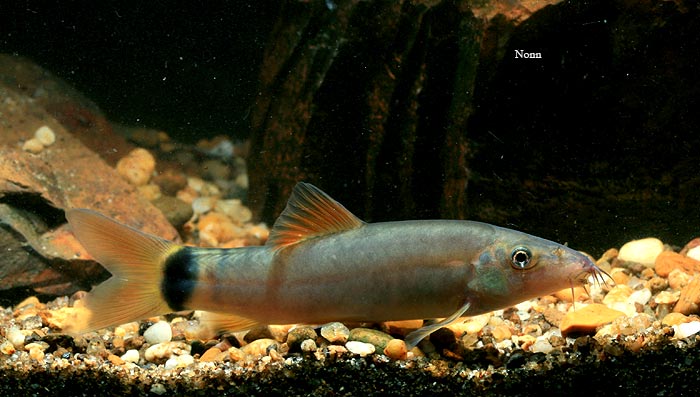
Yasuhikotakia leconteiSilver Loach
Botiidae · Fowler, 1937
This species is sometimes confused with Y. modesta though in reality the two are readily distinguishable from one another by body shape since Y. lecontei is a slimmer, more elongate fish. Further, in Y. lecontei the overall body colouration is usually brownish with a gold/green sheen and the dark markings...
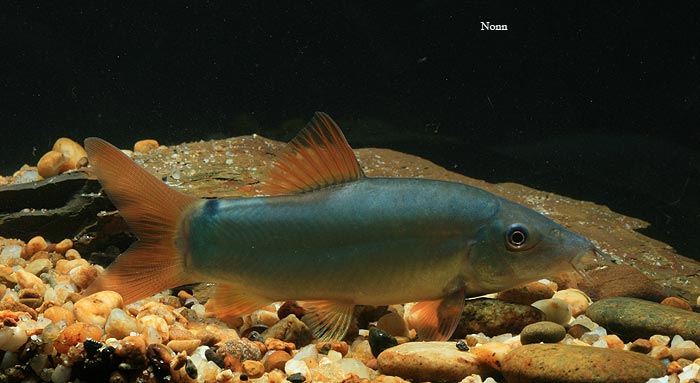
Yasuhikotakia modestaRedtail Loach
Botiidae · Bleeker, 1864
This species is one of the more commonly-encountered botiids in the hobby and is also sold as 'blue', 'orange-finned', or 'red-finned' botia/loach. It's sometimes subject to artificial colouring with bright blue or purple dyes and we strongly recommend you do not purchase such fish (they're illegal in several countries).
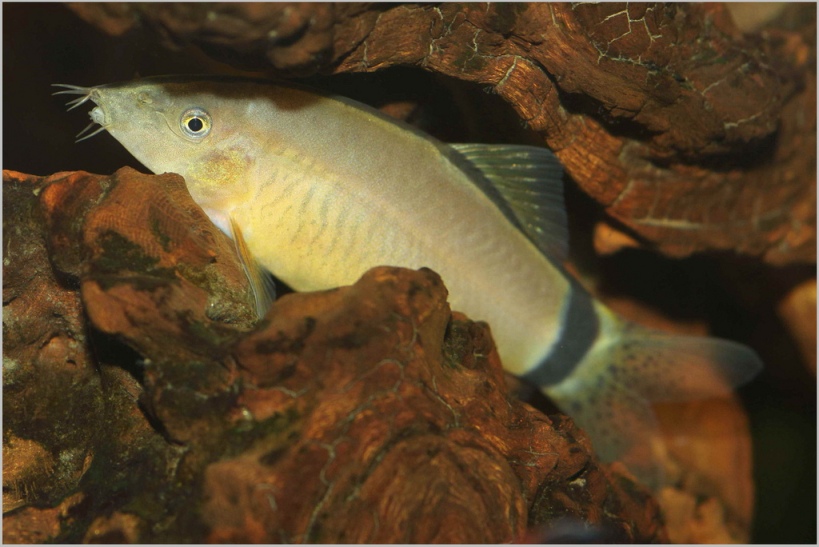
Yasuhikotakia morletiSkunk Loach
Botiidae · Tirant, 1855
This species is common in the hobby and also sold as 'skunk botia' or 'Hora's loach', the latter in reference to Botia horae Smith, 1931, currently considered a synonym of Y. morleti. It's similar in appearance to the rarely-seen Y. longidorsalis but can be told apart by the fact it has a dark stripe running over the dorsal surface (this giving rise to the vernacular name 'skunk loach') which is lacking in its relative. The two can be further separated...
Pseudogastromyzon laticeps
Balitoridae · authority not recorded
It appears that this species has not yet appeared in the western hobby, probably because commercial fish collections don't normally take place in its native waters although the goby Rhinogobius zhoui has been available occasionally. We're unable to provide details of distinguishing characters since no diagnostic key to the genus exists in English at time of writing, but based on the images available it does appear to possess reddish dorsal and caudal fins. The specimens pictured were i...
Pseudogastromyzon myersi
Balitoridae · authority not recorded
This species is traded under various vernacular names including 'Chinese hillstream loach', 'Chinese butterfly plec' and 'Hong Kong Otocinclus. It's the commonest member of the genus in the hobby but has been frequently misidentified as the congener P. cheni in the past with the two often said to be indistinguishable in terms of colour pattern. Some sources additionally suggest the sole defining external character to be that in P. cheni the distance between the resp...
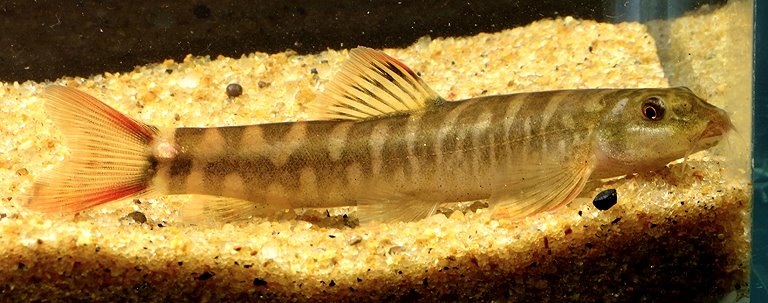
Schistura sp. 6
Nemacheilidae · authority not recorded
This fish was collected for the aquarium trade during 2012 but its identity has not yet been established. The fish in our images were obtained at an unspecified locality in the Garo Hills, these for...
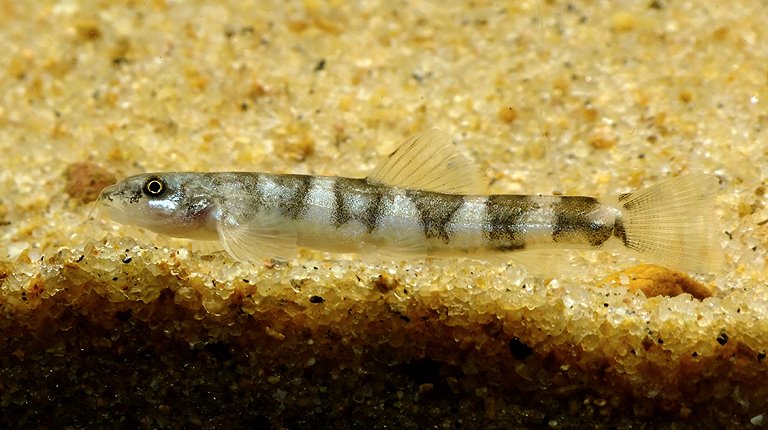
Schistura devdeviSaddleback Loach
Nemacheilidae · Hora, 1935
Type locality is 'Eastern Himalayas; small streams below Darjeeling and Sikkim, India', and this species is only known with certainty from upland parts of Assam, Sikkim, Arunachal Pradesh and West Bengal states in northern India. Records from Nepal apparently require confirmation while it may also occur in Bhutan.
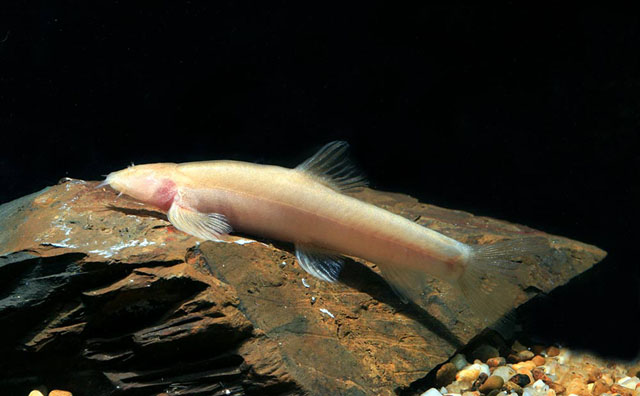
Nemacheilus troglocataractus
Nemacheilidae · Kottelat & Géry, 1989
Known only from a single cave system (Tham Sai Yok Noi) near the town of Nam Tok Sai Yok Noi, Sai Yok district, Kanchanaburi Province, Thailand. The headwater stream running through the cave is part of the Khwae Noi river basin, itself a tributary of the upper Mae Klong system. 621 metres of the cave system has repor...
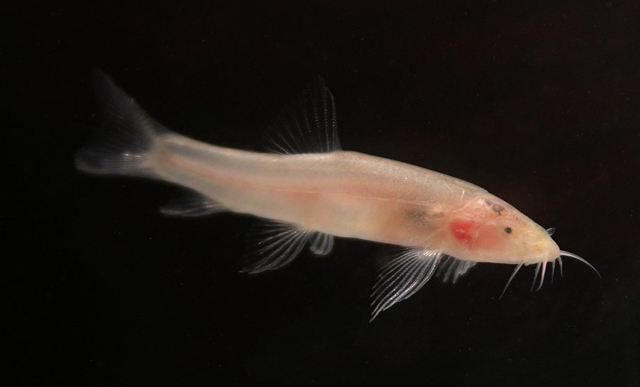
Schistura deansmarti
Nemacheilidae · Vidthayanon & Kottelat, 2003
Type locality is 'Tham [=cave] Phra Sai Ngam, about 200 meters from entrance, Thung Salaeng Luang National Park, Phitsanulok Province, Thailand, 16°37'22"N, 100°39'47"E', and this species is endemic to the Tham Phra Sai Ngam cave system. Tham Phra Sai Ngam is a limestone cave system about 1.7 km long and containing a subterranean stre...
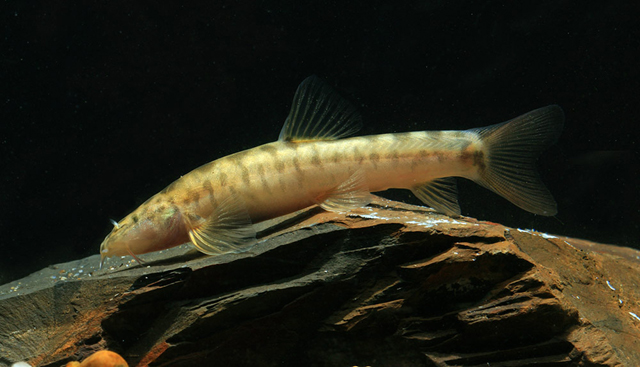
Schistura jarutanini
Nemacheilidae · Kottelat, 1990
This species' conservation status clearly precludes its suitability as an aquarium fish so it's included here for reasons of interest only. It's protected by Thai national law and illegal to remove from its habitat. Species exhibiting morphological, physiological or behavioral adaptations to a subterranean existence are often referred to as troglomorphic.
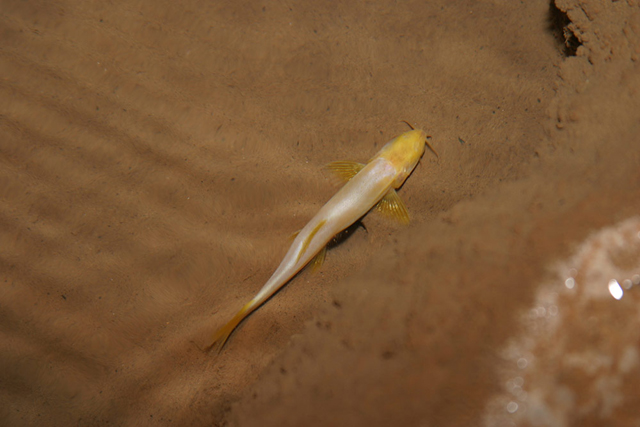
Schistura oedipus
Nemacheilidae · Kottelat, 1988
It's known from five caves in total, the others being Tham Huet, Tham Ban Louk Kow Larm, Tham Nong Pha Cham, and Tham Mae Lana. Streams flowing from these caves drain into the Nam Lang and Nam Khong rivers of the Salween drainage system, and the two easternmost caves, Tham Huet and Tham Nong Pha Cham, are both tributaries of the former.
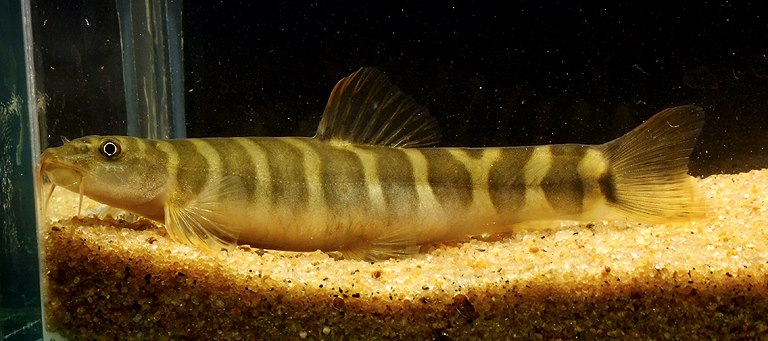
Schistura sp. 7
Nemacheilidae · authority not recorded
This fish was collected for the aquarium trade during 2012 but its identity has not yet been established. Schistura is the most species-rich genus among nemacheilid loaches with some 190 members and it continues to grow with over 100 having be...
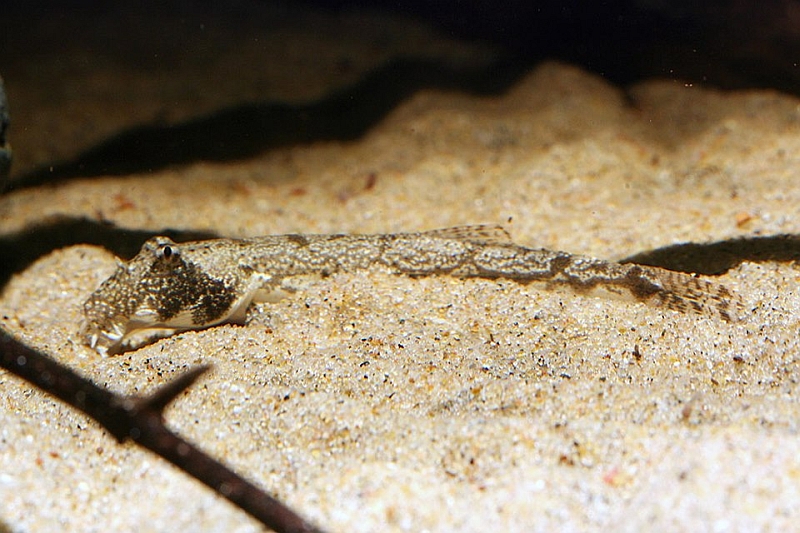
Canthophrys gongotaMoose-faced Loach
Cobitidae · Hamilton, 1822
Mostly known from slow-moving, relatively shallow tributaries and minor rivers with substrates of mud, sand or gravel. Aquatic plants are only occasionally present but riparian vegetation apparently grows thickly at some localities. In the Schutunga River, part of the Mansai River drinage which is itself a tributary of the Brahmaputra in West Bengal state, In...
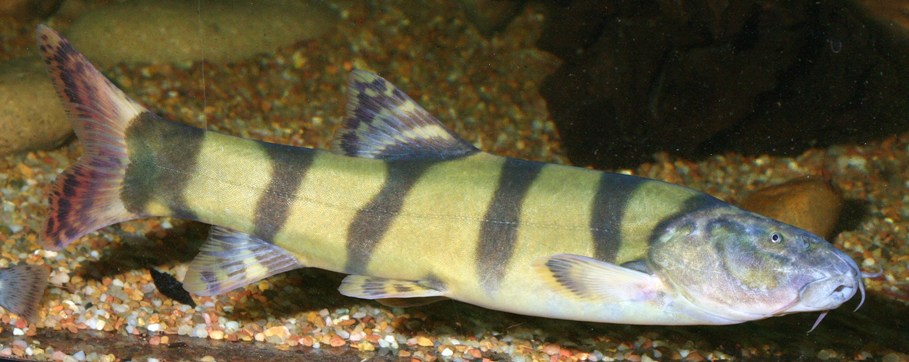
Leptobotia elongataImperial Flower Loach
Botiidae · Bleeker, 1870
This species is rare in the aquarium trade, increasingly so in nature and as a result prohibitively expensive when available. Given its adult size and probable longevity this is therefore a species for the specialist possessing the necessary time, money and dedication to house it long term.
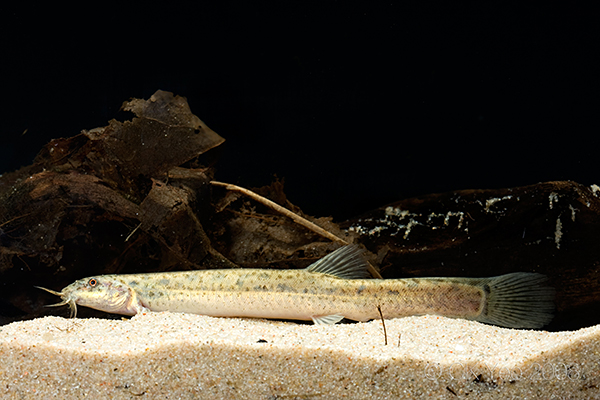
Misgurnus anguillicaudatusOriental Weather Loach
Cobitidae · authority not recorded
An exceptionally hardy and adaptable species tolerant of a wide range of physiological variables and flexible of diet, factors which have allowed it to become established as an alien species around the globe. Its high reproductive potential and low vulnerability to predation have made it a cause for concern to conservation scientists although as yet there remains no proof of it exerting a negative effect on native fishes in countries outside its natural range.
Vanmanenia hainanensis
Balitoridae · authority not recorded
Vanmanenia hainanensis