Leptobotia rubrilabris
Formerly Parabotia rubrilabris Dabry de Thiersant, 1872 · Botia pratti Günther, 1892 · Botia fangi Tchang, 1930
On this page12 sections
Quick facts
Difficulty5 of 6 measures
More bars, more demanding.
- Space
- large tank
- Water
- mild adjustment
- Temp
- steady heat
- Temperament
- unknown
- Social
- shoal
- Compatibility
- not a community fish
Should be kept in a set-up designed to resemble a flowing stream with a substrate of variably-sized rocks, gravel and some water-worn boulders. This can be further furnished with driftwood roots and branches arranged to form some shaded spots while lengths of PVC piping or similar can be used to provide additional cover. Although most plant species will fail to thrive in such surroundings hardy genera such as Microsorum, Bolbitis or Anubias spp. can be grown attached to the décor and bright lighting will promote the growth of aufwuchs.
Distribution
Native to middle and upper sections of the Yangtze River (aka Chiang Jiang), China with most of the available records pertaining to Sichuan and Hunan provinces, with type locality given as 'Chang Jiang (Yangtze River), China'.
Much of the Yangtze has now been degraded by human activity including dam construction with resultant pollution and habitat loss. A similar but unidentified fish was recorded from the Lo River drainage, northern Vietnam by Kottelat (2001).
Habitat
Predominantly a riverine loach favouring clear, well-oxygenated, running water with substrates of rocks and/or gravel and often present in bedrock and boulder-filled headwater streams but also found in larger, turbid river channels.
As a result of damming and other human interferences it may now inhabit some lakes and reservoirs though is unlikely to be breeding in such environments.
Aquarium size
A footprint of at least 120 ∗ 45 cm48 ∗ 18 in is recommended.
Maintenance
Should be kept in a set-up designed to resemble a flowing stream with a substrate of variably-sized rocks, gravel and some water-worn boulders.
This can be further furnished with driftwood roots and branches arranged to form some shaded spots while lengths of PVC piping or similar can be used to provide additional cover.
Although most plant species will fail to thrive in such surroundings hardy genera such as Microsorum, Bolbitis or Anubias spp. can be grown attached to the décor and bright lighting will promote the growth of aufwuchs.
Like many fishes that naturally inhabit running waters it's intolerant to the accumulation of organic wastes and requires spotless water at all times in order to thrive.
It also does best if there is a high level of dissolved oxygen and a decent level of water movement in the tank so external filters, powerheads, etc., should be employed in order to obtain the desired effect.
As stable water conditions are obligatory for its well-being this fish should never be added to biologically-immature aquaria.
Water conditions
Temperature: 15.5 – 21 °C60 – 70 °F should be adequate for general maintenance and be aware that in warmer climates a means of chilling the water may be necessary during the summer months.
pH: 6.5 – 7.5
Hardness: 5 – 20 dGH
These boxes carry affiliate links and we may earn a commission. What they recommend comes from each profile’s own figures, never chosen by hand or paid for.
Diet
Likely to be a benthic predator hunting insects, crustaceans and smaller fishes in nature.
Captive specimens should therefore be offered a varied diet comprising live or frozen bloodworm, Tubifex, chopped shellfish/earthworms and good quality, sinking dried foods.
Behaviour and compatibility
Unlikely to prove aggressive but don't keep it with much smaller fishes as they may be intimidated by its size and sometimes very active behaviour.
Slow-moving, long-finned species such as ornamental bettas, guppies and many cichlids should also be avoided. More suitable tankmates are peaceful but robust open water-dwelling cyprinids.
In terms of other bottom-dwellers this species should do well alongside most Botia spp., and some cobitid, nemacheilid, and balitorid loaches are also possibilities as are members of Epalzeorhynchos, Crossocheilus and Garra plus many catfishes.
As always, thorough research prior to selecting a community of fishes is the best way to avoid problems.
Leptobotia spp. are sociable animals forming apparently complex social hierarchies meaning 3-4 specimens should be the minimum purchase.
When kept singly they can become withdrawn or aggressive towards similarly-shaped fishes, and if only a pair or trio are purchased the dominant individual may stress the other(s) to the extent that they stop feeding.
Sexual dimorphism
Unknown but presumably females will be heavier-bodied once sexually mature.
Reproduction
Unrecorded in aquaria.
Notes
This species may well have never been exported for the hobby with fish labelled as such typically Sinibotia pulchra or other related species.
L. elongata is the type species of the genus but according to current thinking there exist 13 members in total, all of which are endemic to China and northern Vietnam. They're primarily characterised by the following characters: possession of a simple (non-bifurcated), short sub-ocular spine not extending beyond the posterior edge of the eye; a laterally-compressed body; relatively deep caudal peduncle; pelvic fins reaching origin of anal-fin; anus below base of dorsal-fin and equidistant between pelvic and anal-fin origins.
Modern studies have resulted in various changes to the taxonomy of both the family Botiidae and its constituent genera although Leptobotia has been mostly unaffected.
Botiidae has been widely considered a genetically distinct grouping since Nalbant (2002), having previously been considered a subfamily (Botiinae) of the family Cobitidae. Nalbant also moved some previous members of Botia into the new genus Yasuhikotakia based on a number of morphological characters.
Later Kottelat (2004) made further modifications to the taxonomy, raising Chromobotia for B. macracanthus and confirming that species previously included in the genus Hymenophysa should instead be referred to Syncrossus.
The former alteration was based on colour pattern plus some morphological characters and the latter because Hymenophysa not only represents a spelling mistake (McClelland's original spelling was Hymenphysa) but is a junior synonym of Botia.
More recently Kottelat (2012) erected the genus Ambastaia to accommodate A.nigrolineata and A. sidthimunki, two former members of both Botia and Yasuhikotakia.
As a result of these works the family Botiidae is thus divided into two tribes within which Botia appears to be the most basal lineage:
Tribe Leptobotiini - Leptobotia, Parabotia, Sinibotia.
Tribe Botiini - Ambastaia, Botia, Chromobotia, Syncrossus, Yasuhikotakia.
Phylogenetic studies by Tang et al. (2005) and Šlechtová et al. (2006) have largely confirmed this system to be correct although the latter disagreed with the placement of Sinibotia, finding it to be more closely related to the tribe Botiini.
Ambastaia nigrolineata and A. sidthimunki were found to be more closely-related to both Sinibotia and Syncrossus than Yasuhikotakia, despite being considered members of the latter at the time. Šlechtová et al. also proposed the use of subfamily names under the following system:
Subfamily Leptobotiinae - Leptobotia, Parabotia.
Subfamily Botiinae - Botia, Chromobotia, Sinibotia, Syncrossus, Yasuhikotakia.
Within these Botia appears to be the basal, i.e., most ancient, lineage and in a more-detailed phylogenetic analysis Šlechtová et al. (2007) confirmed the validity of the family Botiidae with the genera listed above as members rather then being grouped into subfamilies. This more recent, simpler system is the one we currently follow here on SF.
Leptobotia spp. also possess sharp, motile, sub-ocular spines which are normally concealed within a pouch of skin but erected when an individual is stressed, e.g., if removed from the water. Care is therefore necessary as these can become entangled in aquarium nets and those of larger specimens can break human skin.
Botiids are also susceptible to a condition commonly referred to as 'skinny disease' and characterised by a loss of weight. This is especially common in newly-imported specimens and is thought to be caused by a species of the flagellate genus Spironucleus.
It's treatable although the recommended medication varies depending on country. Hobbyists in the UK tend to use the antibiotic Levamisole and those in the United States Fenbendazole (aka Panacur).
References
- Chen, J.-X. (1980). A study on the classification of the botoid fishes of China. Zoological Research 1(1), 3-26
- Kottelat, M. (2004). Botia kubotai, a new species of loach (Teleostei: Cobitidae) from the ataran River basin (Myanmar), with comments on botiinae nomenclature and diagnosis of a new genus. Zootaxa 401, 1-18
- Nalbant, T. T. (2002). Sixty million years of evolution. Part one: family Botiidae (Pisces: Ostariophysi: Cobitoidea). Travaux du Museum d'Histoire Naturelle 'Grigore Antipa' 44, 309-333
- Nalbant, T. T. (2004). Hymenphysa, Hymenophysa, Syncrossus, Chromobotia and other problems in the systematics of Botiidae. A reply to Maurice Kottelat. Travaux du Museum d'Histoire Naturelle 'Grigore Antipa' 47, 269-277
- Naseka, A. M. and N. G. Bogutskaya (2004). Molecular phylogeny of the Southeast Asian freshwater fish family Botiidae (Teleostei: Cobitoidea) and the origin of polyploidy in their evolution. Molecular Phylogenetics and Evolution 39(2), 529-541
- Tang, Q., B. Xiong, X. Yang and H. Liu (2005). Phylogeny of the East Asian botiine loaches (Cypriniformes, Botiidae) inferred from mitochondrial cytochrome b gene sequences. Hydrobiologia 544(1), 249-258
- Kottelat, M. (2012). Conspectus cobitidum: an inventory of the loaches of the world (Teleostei: Cypriniformes: Cobitoidei). Raffles Bulletin of Zoology Supplement 26, 1-199
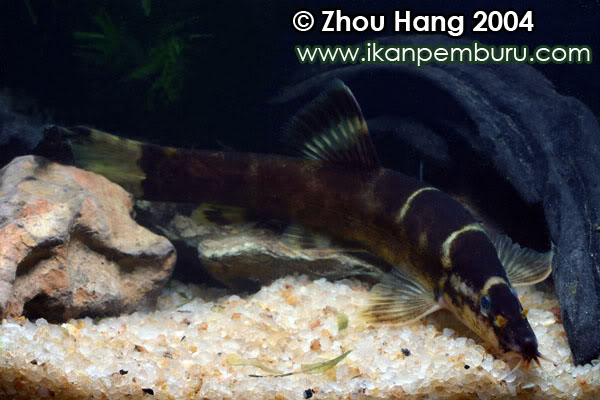
Species images · 1
Used with the photographer’s permission. Not licensed for reuse.
One photograph on file. More would be welcome.