Acanthopsoides molobrion
On this page13 sections
Quick facts
Difficulty6 of 6 measures
More bars, more demanding.
- Space
- modest tank
- Water
- tap water
- Temp
- steady heat
- Temperament
- peaceful
- Social
- shoal
- Compatibility
- community tank
Acanthopsoides spp. are most closely related to the horse-faced loaches of the genus Acantopsis with which they often co-occur in nature, and thus commonly referred to as 'dwarf horse-face loaches'. The genus currently comprises five species of which four were described by Siebert (1991); these were discovered in existing museum holdings...
Etymology
Acanthopsoides: from the currently invalid generic name Acanthopsis, used here as a prefix, and Greek eí̄dos (Gr. εἶδος), meaning 'form, shape'.
molobrion: from the Greek molóbrion (Gr. μολόβριον), meaning 'piglet of wild swine', in reference to this species' small size and its similar appearance to the species Acantopsis choirorhynchos (= Acantopsis dialuzona).
Distribution
Type locality is 'Bo River (= Sungai Boh), Mahakam River basin, Kalimantan Timur, Indonesia', a tributary of the Mahakam river system in East Kalimantan province, Indonesia (Borneo) and this species is distributed throughout much of the island including parts of Sarawak state, Malaysia.
It's also been recorded in Peninsular Malaysia with the Maenam Tapi river in Surat Thani province, southern (peninsular) Thailand representing the northern limit of its known range.
In the Kapuas River basin, Kalimantan Barat (West Kalimantan) province it occurs sympatrically with the congener A. robertsi.
Habitat
Acanthopsoides spp. are near-exclusive inhabitants of flowing, clear water river channels with substrates of sand, fine gravel or mud where they occur in groups of varying size depending on species.
Aquarium size
A tank with a base measuring 60 ∗ 30 cm24 ∗ 12 in or more is recommended.
Maintenance
Not difficult to keep but must be provided with a soft, sandy substrate since some of its time will be spent completely buried, or with only eyes protruding.
When coarser gravel is used it may become stressed or damage itself trying to dig, and feeding behaviour can be inhibited.
Other décor can include water-worn rocks and driftwood branches and tree roots arranged to form plenty of hiding places and shaded spots - add these prior to the substrate to prevent them being toppled by digging activity.
Lighting can be quite dim unless you intend to grow plants and a few handfuls of leaf litter would complement the natural effect.
As this species hails from sluggish waters high flow rates are best avoided although a degree of oxygenation is recommended.
Ensure that small specimens are unable to enter filter intakes and cover the tank well as most loaches do jump at times, especially when first introduced.
Water conditions
These boxes carry affiliate links and we may earn a commission. What they recommend comes from each profile’s own figures, never chosen by hand or paid for.
Diet
Acanthopsoides spp. typically sift mouthfuls of substrate through the gills from which insect larvae, small crustaceans and suchlike are extracted.
Offer a varied diet containing sinking dried foods plus live and frozen Artemia, Tubifex, Daphnia, bloodworm, etc.
Behaviour and compatibility
Acanthopsoides are peaceful with both one another and other fishes and there exist no reports of them harming tankmates.
The latter should include peaceful fishes that inhabit the upper part of the water column, especially small, schooling cyprinids.
The presence of these should also make it less timid as the absence of fishes in the upper water column is often used as a signifier for approaching danger in nature.
Sand-dwelling loaches from the families Botiidae, Cobitidae and Nemacheilidae are also worth considering but proper research is essential as some can be excessively territorial or otherwise aggressive.
A community based around species from its natural waters could include Rasbora sarawakensis, R. borapetensis, R. einthovenii, Pangio shelfordii and P. semicincta.
It's highly gregarious so best kept in a group of six or more.
Sexual dimorphism
In mature males the pectoral fins are enlarged with an extended, thickened second ray which has small breeding tubercules on the branched section.
Adult females are typically heavier-bodied and a little larger then males.
Reproduction
Has not been bred in aquaria but SF member Mark Duffill has had success with A. sp. 'A01'.
He recovered a couple of fry from a small tank with a mixed sand and fine gravel substrate in which an adult pair had been the sole occupants.
As far as we know this is the only documented spawning of any member of the genus in aquaria.
Notes
Acanthopsoides spp. are most closely related to the horse-faced loaches of the genus Acantopsis with which they often co-occur in nature, and thus commonly referred to as 'dwarf horse-faced loaches'.
The genus currently comprises five species of which four were described by Siebert (1991); these were discovered in existing museum holdings and it's possible that if detailed studies (including new collections) are conducted there may turn out to be others.
Several have appeared in the aquatic trade but proven very tricky to identify.
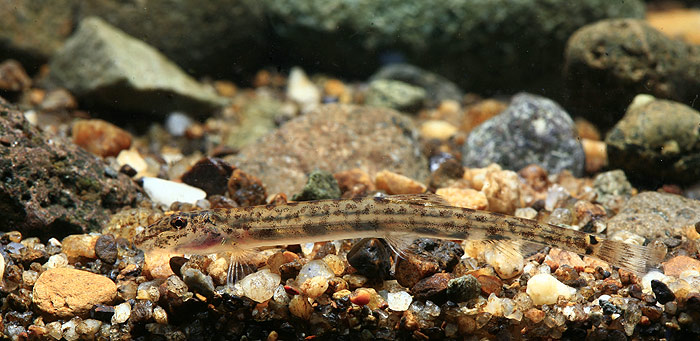
Diagnostic characters for A. molobrion include 10-15 mid-dorsal markings (usually 13 or less) and three bands in the caudal-fin. It also has a relatively small eye which fits into the head around 6 times and the snout usually fits into the head less than 2.5 times.
Roberts (1996) recommended that A. hapalias be synonymised with A. molobrion given that Siebert only separated the two on the basis of geography with reported differences in head shape inconclusive because no adult specimens were used in the description.
This does not appear to have been widely followed with A. hapalias still apparently valid.
Siebert gave the defining characters of the genus as: body terete; peduncle slender; head scaleless, head length approximately 20% of SL; eye small, 5.2 to 7.2 in head, placed high on head; snout length moderate, 2 to 2.5 in head (usually greater than 2.2 in head, eye usually in anterior half of head); suborbital spine bifid, reaches posteriorly to beneath at least anterior margin of eye; infraorbital lateral line canal present; lateral line usually incomplete (very rarely complete in A. delphax; males with first branched pectoral-fin ray thickened and elongated; dorsal-fin with 7 branched fin-rays (exceptionally individuals with 8), dorsal origin slightly postmedian along SL, inserted slightly before to over pelvic-fin origin; caudal-fin symmetrical and emarginate.
Similar-looking genera such as Acantopsis and Somileptes have 8 or more branched dorsal rays.
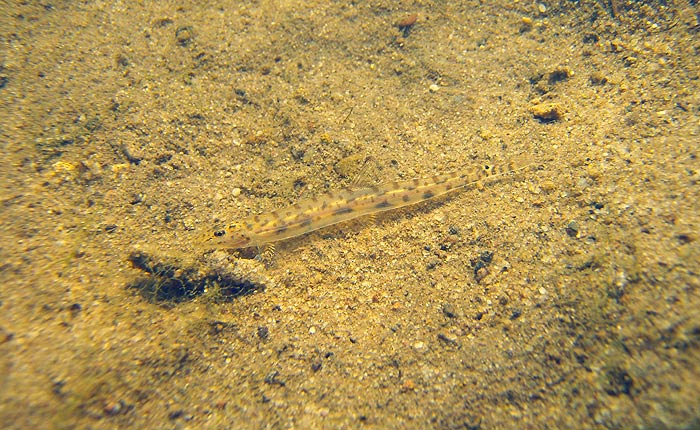
Acanthopsoides spp. also possess a basic shared patterning consisting of a mid-dorsal row of blotches extending from the snout tip to base of caudal peduncle and a mid-lateral row from snout to caudal-fin.
The number and size of these blotches varies both between and within species but can be used as a basic identification guide.
There are also chromatophores in the fins which in the caudal form bands and vary in number and/or shape between species.
A dark spot at the top of the base of the upper caudal-fin lobe is present in all species and surrounded by a patch of lighter colour in some, while an additional marking at the base of the lower lobe is present only in some species.
The family Cobitidae, often referred to as 'true' loaches, is widely-distributed across most of Eurasia with the Indian subcontinent, Southeast Asia and China representing particular centres of species diversity.
Phylogenetic analyses by Tang et al. (2006), Šlechtová et al. (2007) and Šlechtová et al. (2008) revealed that the group constitutes a separate genetic lineage to the family Botiidae (the two were previously grouped together under Cobitidae as subfamilies Cobitinae and Botiinae).
In the 2008 study Acanthopsoides was found to constitute a monophyletic lineage alongside Acantopsis and Kottelatlimia, A. robertsi affiliating very closely with the latter genus in one test.
All cobitids possess sharp, motile, sub-ocular spines which are normally concealed within a pouch of skin but erected when an individual is stressed, e.g. if removed from the water. Care is therefore necessary as these can become entangled in aquarium nets and with larger species even break human skin.
References
- Rainboth, W. J. (1996). Fishes of the Cambodian Mekong. FAO Species Identification Field Guide for Fishery Purposes. FAO, Rome, 1-265
- Siebert, D. J. (1991). Revision of Acanthopsoides Fowler, 1934 (Cypriniformes: Cobitidae), with the description of new species. Japanese Journal of Ichthyology 38 (2), 97-114
- Šlechtová, V., J. Bohlen and H. H. Tan (2007). Families of Cobitoidea (Teleostei; Cypriniformes) as revealed from nuclear genetic data and the position of the mysterious genera Barbucca, Psilorhynchus, Serpenticobitis and Vaillantella. Molecular Phylogenetics and Evolution 44(3), 1358-1365
- Tang, Q., H. Liu, R. Mayden and B. Xiong (2006). Comparison of evolutionary rates in the mitochondrial DNA cytochrome b gene and control region and their implications for phylogeny of the Cobitoidea (Teleostei: Cypriniformes). Molecular Phylogenetics and Evolution 39(2), 347-357
- Šlechtová, V., J. Bohlen and A. Perdices (2008). Molecular phylogeny of the freshwater fish family Cobitidae (Cypriniformes: Teleostei): delimitation of genera, mitochondrial introgression and evolution of sexual dimorphism. Molecular Phylogenetics and Evolution 47(2), 812-831
- Kottelat, M. (2012). Conspectus cobitidum: an inventory of the loaches of the world (Teleostei: Cypriniformes: Cobitoidei). Raffles Bulletin of Zoology Supplement 26, 1-199
- Fowler, H. W. (1934). Zoological results of the third De Schauensee Siamese Expedition, Part I.--Fishes. Proceedings of the Academy of Natural Sciences of Philadelphia 86, 67-163
Species images · 2
Used with the photographer’s permission. Not licensed for reuse.