Region · Indonesia, Malaysia, Brunei
Borneo
Borneo crosses 3 countries, and its fishes do not recognise the border.
- Species
- 164
- Countries
- 3
- Photographed
- 164 of 164
- Difficulty rated
- 164 of 164
Split acrossfrom the record that named both
A further 18 carry Borneo without naming a country, so they are on this page and on none of those.
Countries hereone fauna, more than one flag
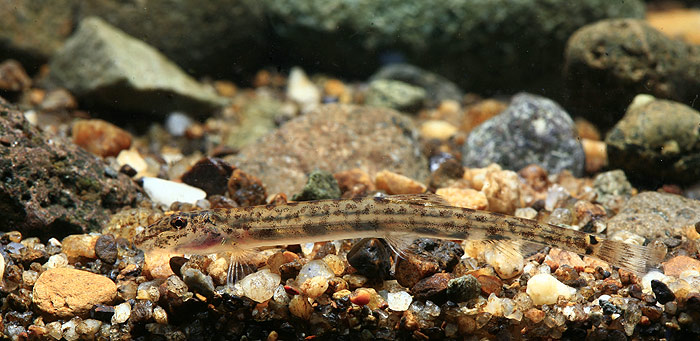
Acanthopsoides molobrion
Cobitidae · Siebert, 1991
Acanthopsoides spp. are most closely related to the horse-faced loaches of the genus Acantopsis with which they often co-occur in nature, and thus commonly referred to as 'dwarf horse-face loaches'. The genus currently comprises five species of which four were described by Siebert (1991); these were discovered in existing museum holdings...
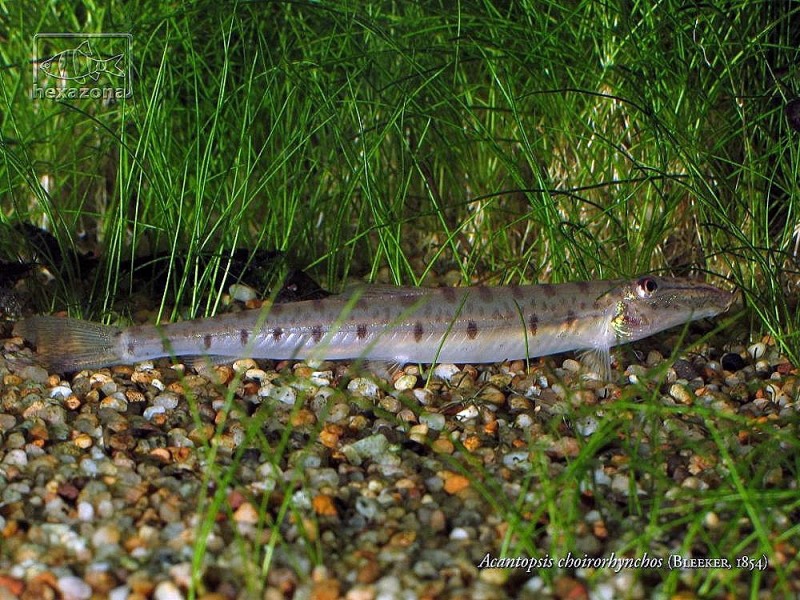
Acantopsis dialuzonaHorseface Loach
Cobitidae · van Hasselt, 1823
Juveniles of this 'species' (probably a group of species - see 'distribution') are traded in large numbers but it's still uncommon to see adult specimens in the hobby suggesting their needs are not catered for often enough. This is a shame as when maintained properly they're hardy, long-lived and interesting aquarium residents. Other trade names include 'long-nosed' and 'banana' loach. Please note although certain that more than one species is being tr...
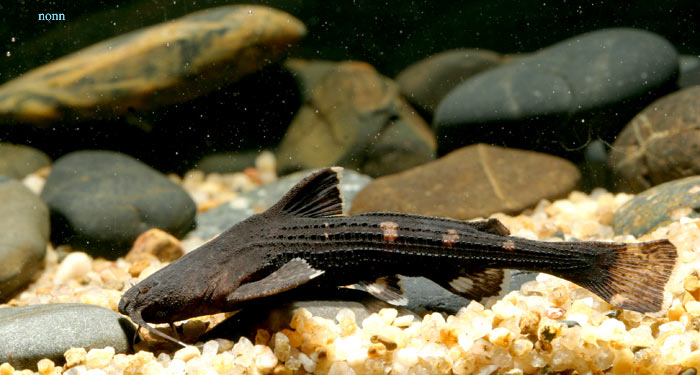
Acrochordonichthys rugosusAsian Banjo Catfish
Akysidae · Bleeker, 1846
This is the most commonly-encountered representative of the genus in the aquatic trade though is by no means common. As in other members of the genus body colouration is highly variable, even among individuals collected from a single locality, although a few useful regularities have been observed which can be used to distinguish certain species. This is thought related to the fact that Acrochordonichthys spp. periodically shed their skins and appear paler post-moulting. A. rugosus lends its ...
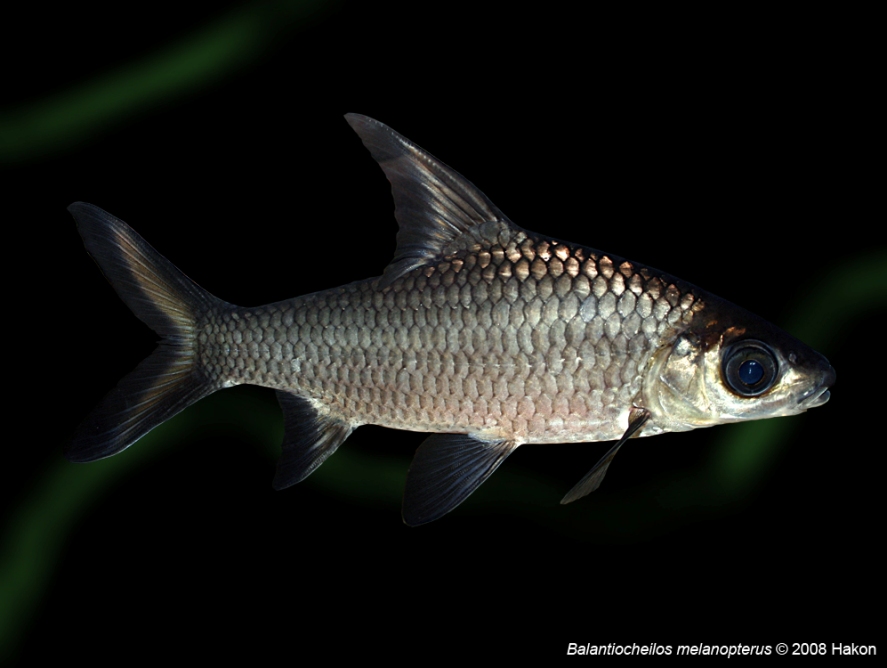
Balantiocheilos melanopterusSilver Shark
Cyprinidae · Bleeker, 1850
May also be seen on sale under the trade names 'Bala shark' or 'tricolor shark minnow' and perhaps among the most commonly-encountered ornamental fish species. It is unfortunate that the vast majority of those traded are juveniles and tend to come supplied with little to no information provided regarding their potential size and requirements, a fairly ironic situation given the apparently precarious status of wild populations.
Balitoropsis zollingeri
Balitoridae · Bleeker, 1853
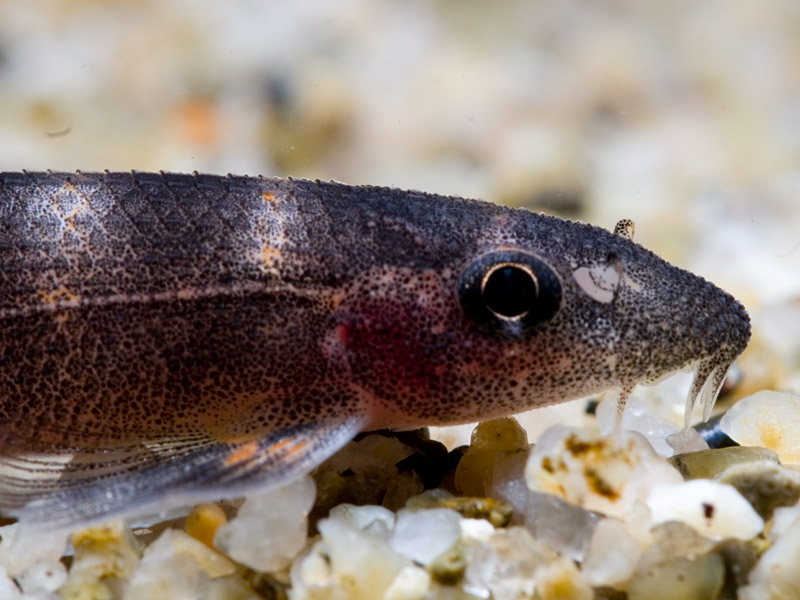
An obligate dweller of swiftly-flowing streams and headwaters containing clear, oxygen-saturated water. It often inhabits riffles and runs and is likely to show a preference for shallower zones. Substrates are generally composed of gravel, rocks, boulders or bedrock carpeted with a rich biofilm formed by algae and other micro-organisms. Juveniles are often found in slower-moving stretches with gravel substrate and submerged tree roots. In both cases patches of aquatic plants are only occasionally pres...
Barbodes banksi
Cyprinidae · Herre, 1940
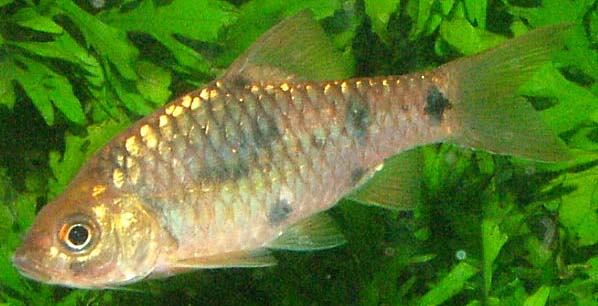
This species is not often seen in the aquarium hobby but occasionally exported as bycatch among shipments of other fishes. It was described as a subspecies of the closely-related 'P.' binotatus but is currently considered distinct on a tentative basis as per Ng and Tan (1999) who stated it is 'likely' that the two represent extreme colour forms of a single, variably-patterned species.
Barbodes binotatusSpotted Barb
Cyprinidae · Valenciennes, 1842
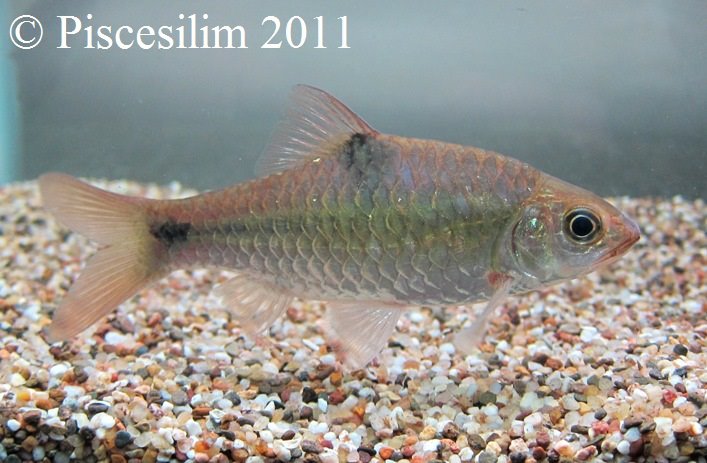
This species is so ubiquitous across its natural range that it's often referred to simply as 'common barb'. Basic adult colour pattern consists of a small, dark spot at the base of the dorsal-fin origin and another on the caudal peduncle but overall appearance varies somewhat depending on origin, with the anterior dark spot enlarged ventrally forming a bar or posterior spot extending into the caudal-fin, for example. The spots may also appear darker or lighter in some individuals.
Barbodes everetti
Cyprinidae · Boulenger, 1894
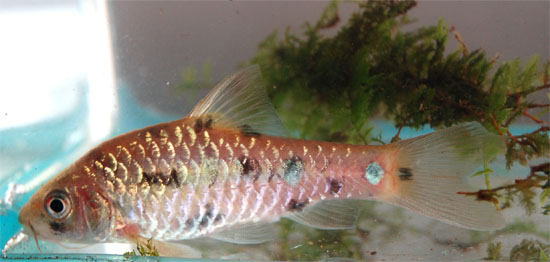
This species is uncommon in the aquarium hobby, although the scientific name is widely misapplied to Barbodes dunckeri, a similar-looking species native to Peninsular Malaysia and Singapore commonly referred to as 'clown barb' and labelled as B. everetti in the majority of available literature. The two are quite easy to tell apart, with B. everetti an overall less...
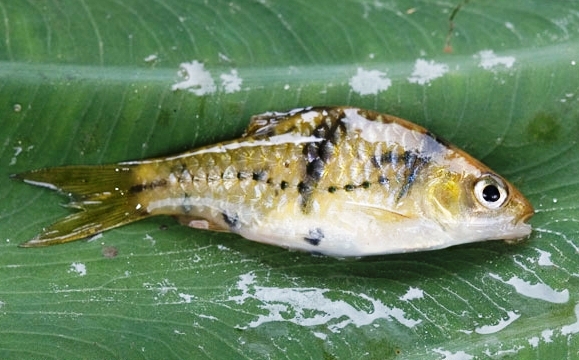
Barbodes kuchingensisFalse Spanner Barb
Cyprinidae · Herre, 1940
This species is rarely-exported for the aquarium hobby but is available on occasion. The name 'P.' kuchingensis is frequently misapplied, however, with subadult forms of 'P.' everetti and some populations of the geographically-variable 'P.' lateristriga regularly traded as such, for example. Though closely-affiliated with and superficially very similar to...
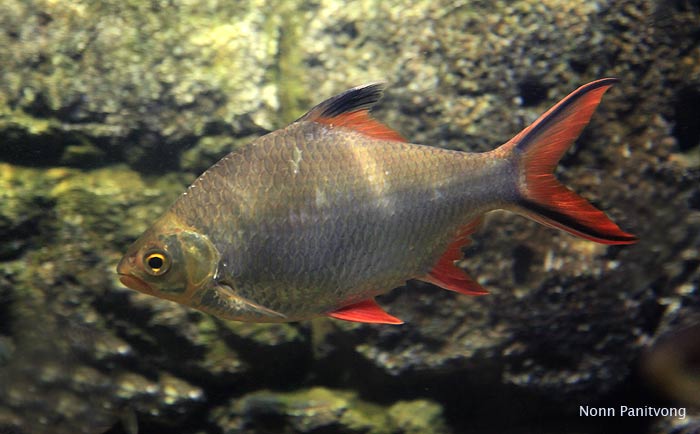
Barbonymus schwanefeldiiTinfoil barb
Cyprinidae · Bleeker, 1854
This is one of two species traded under the vernacular name 'tinfoil barb', the other being the less well-known congener B. altus. Despite this it appears that B. altus is just as widely available as B. schwanefeldii and in many cases is seen on sale more regularly. Unfortunately both are usually offered at a small size (usually around 50 - 75 mm) with little to no information regarding the eventual size of the fish.
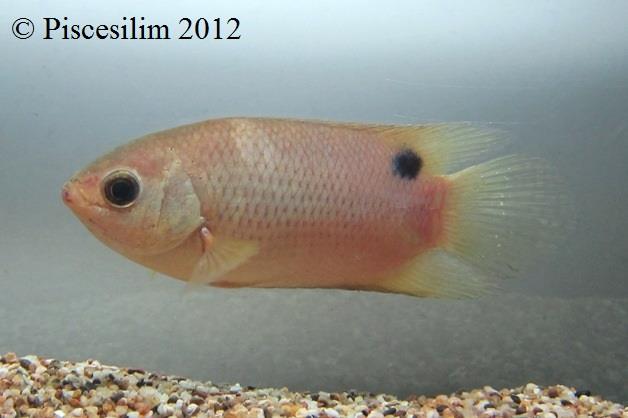
Belontia hasseltiJava Combtail
Osphronemidae · Cuvier, 1831
This species is also referred to by the vernacular name 'Malay combtail'. In terms of external characters it differs most obviously from its only congener, B. signata by its overal brownish grey (vs. reddish) body colouration and presence of a mosaic-type patterning in the unpaired fins (vs. absence). The position of relatedness of the genus Belontia with respect to other anabantoids remains somewhat...
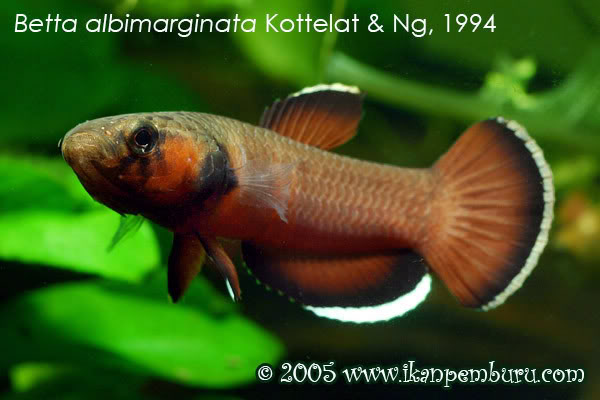
Betta albimarginata
Osphronemidae · Kottelat & Ng, 1994
Additonally, fin patterning in B. albimarginata, except the pectoral fins, consists of a broad white distal band, broad dark submarginal band with sharp outer margin and less sharp inner margin, and a plain red inner portion, while in B. channoides the dorsal fin is almost entirely red with only a thin white distal band and the dark submarginal band in the caudal fin does not extend into the uppermost portion of the fin. Base body colouration tends towards a brick-red shade in displaying male B. albimarginata, scarlet in B. channoides (pers. obv.).
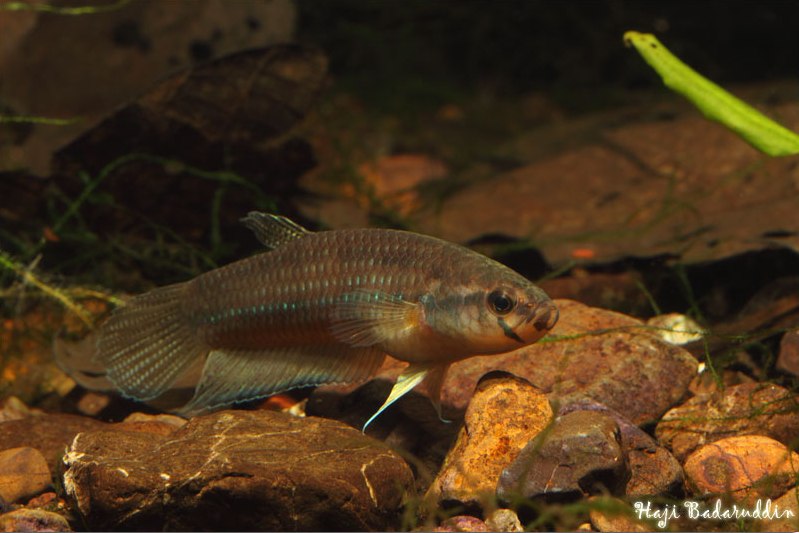
Betta antoni
Osphronemidae · Tan & Ng, 2006
The genus Betta is the most speciose within the family Osphronemidae with almost 70 recognised members and looks set to grow further with new ones continuing to be described on a regular basis since the turn of the century. Member species have successfully adapted to inhabit a variety of ecological niches from stagnant ditches to flowing hill streams including some extreme environments such as highly acidic peat swamp forests.
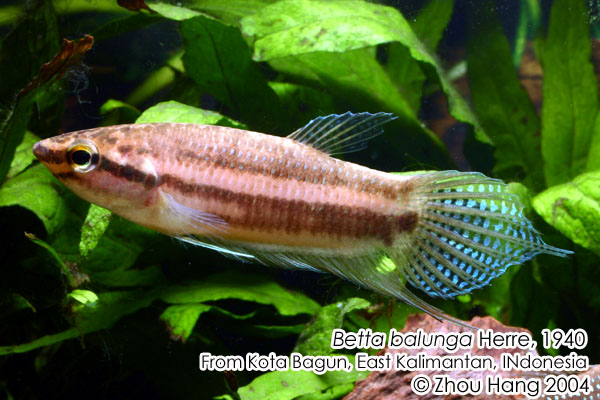
Betta balunga
Osphronemidae · Herre, 1940
Likely to prey on insects and other small invertebrates/zooplankton in nature. Captive fish will normally accept dried products once they're recognised as edible, but should be offered plenty of small live or frozen foods such as Daphnia, Artemia or bloodworm regularly to ensure development of optimal colour and condition. Small insects such as crickets or Drosophila fru...
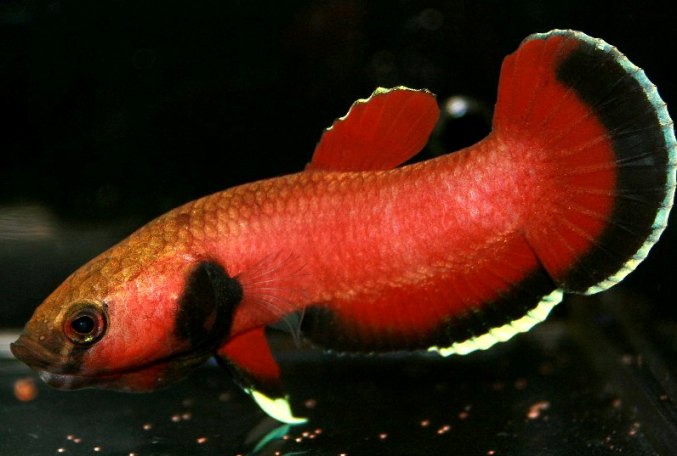
Betta channoidesSnakehead Betta
Osphronemidae · Kottelat & Ng, 1994
B. channoides and B. albimarginata together comprise the Betta albimarginata group/complex of closely-related species within the genus, these differing from all other members of the genus in colour pattern and by possession of 9-12 anal-fin spines (vs. 0-4). They look very similar to one another but differ in the following characters: anal fin spines 9-11 in B. albimarginata vs. 12 in B. channoides; anal fin rays 21-23 vs. 23-25; lateral scale rows 26-27 vs. 27.5-28; trans...
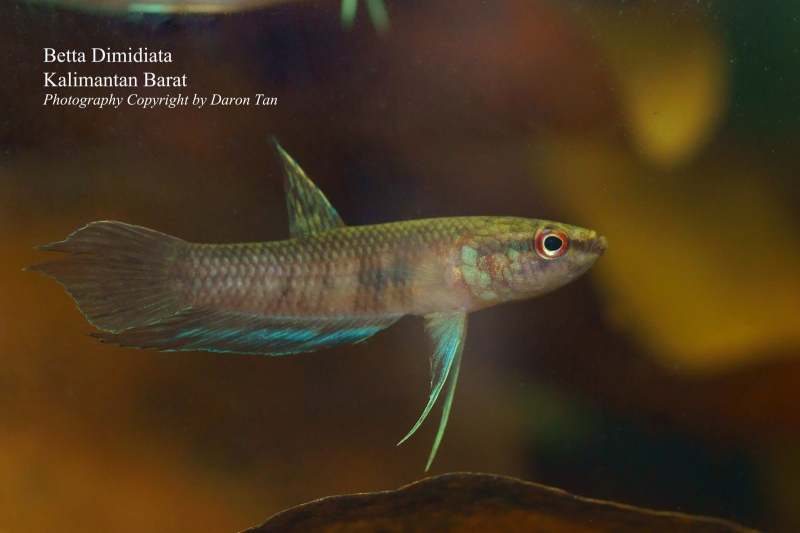
Betta dimidiata
Osphronemidae · Roberts, 1989
This species is often confused with B. krataios in the aquarium trade, the latter having been known as B. sp. 'Kapuas' prior to description. The two can easily be told apart as the caudal-fin is rounded in B. krataios but spade-shaped and in adults, highly-extended in B. dimidiata. Together these two comprise the B. dimidiata group of closely-related species within the gen...
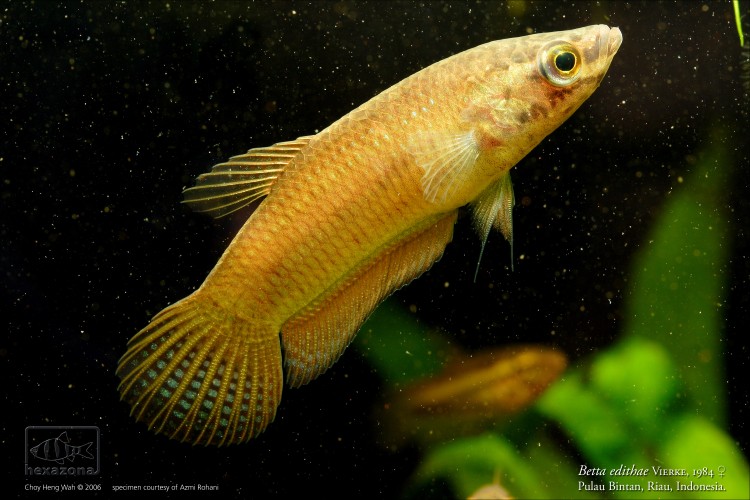
Betta edithae
Osphronemidae · Vierke, 1984
This species is the only member of the B. edithae group within the genus, and separated from all other Betta spp. by the fact that the branchiostegal membrane and posterior portion of the opercle are opaque or translucent. The original diagnosis by Vierke also states that it has relatively small eyes and short fins with a typical pattern of partial barring.
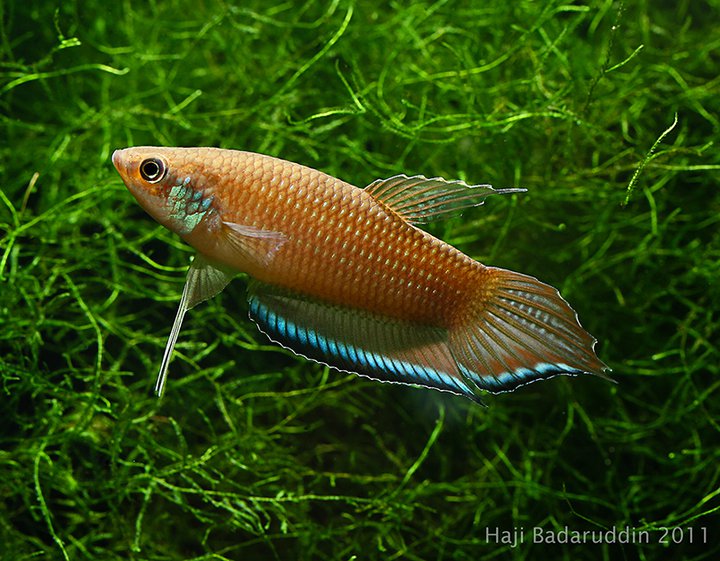
Betta enisae
Osphronemidae · Kottelat, 1995
This species is included in the B. pugnax complex of closely-related species within the genus, an assemblage of which members are notoriously difficult to tell apart from one another, but which can be characterised collectively by the following set of shared characters: relatively large head measuring 28-40% SL; live colouration usually brown with green or blue iridescent spots; male with similarly-coloured scales on opercle, sometimes extending to abdomen; juveniles and females usually brown with two central body stripes and a dark marking on the caudal peduncle; anal-fin in mature specimens pointed and often elongated; caudal-fin lanceolate.
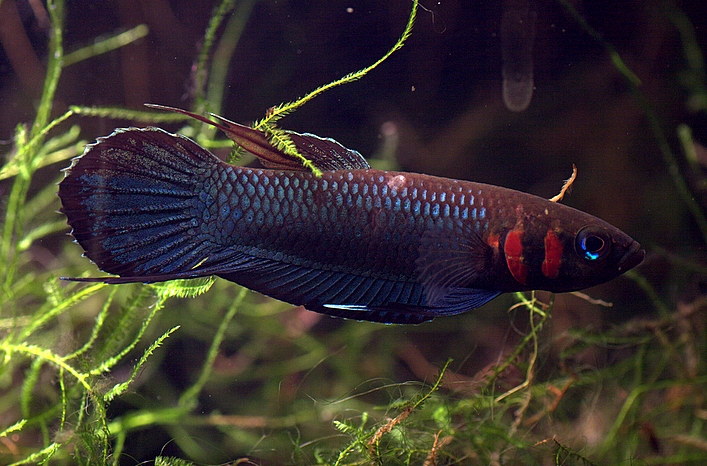
Betta foerschi
Osphronemidae · Vierke, 1979
This species lends its name to the Betta foerschi group of closely-related species within the genus, of which members share the following set of characters: possession of iridescent blue or green unpaired fins; rays and interradial membranes in unpaired fins not contrasting; dorsal fin with thin, bright white distal band; opercle with two, reddish-yellow, vertical bars. Members are regarded as being closely-related to bubble nesting Betta specie...
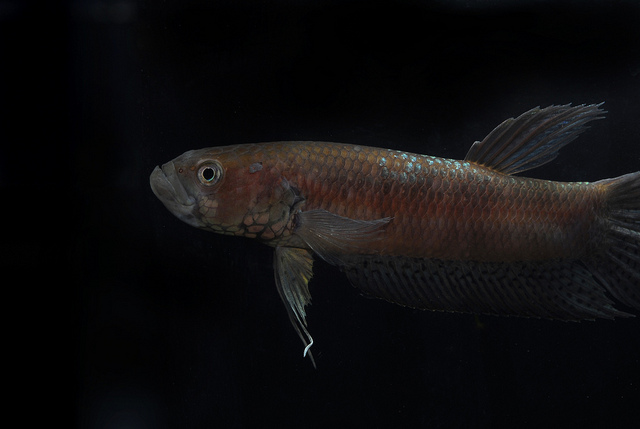
Betta gladiator
Osphronemidae · Tan & Ng, 2005
Presumed endemic to the geographically-isolated Maliau basin, a roughly circular plateau enclosed by hills in Sabah state, Malaysia, Borneo. The Maliau River is part of the much larger Kinabantangan watershed, Malaysia's second longest river. The type series was collected from heath forest alongside 'Puntius' sealei and Hemibagrus cf. baramensis in acidic water with a pH of 4.2-4.8. Adult individuals were spaced around a metre apa...
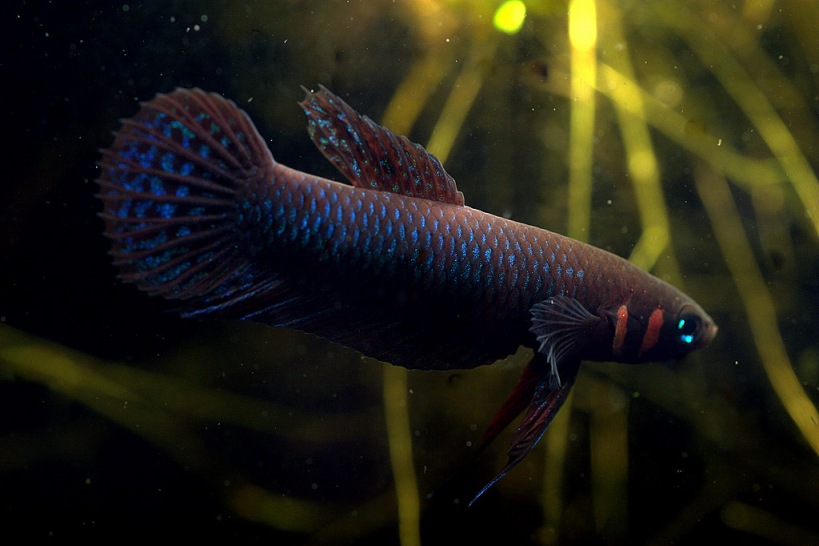
Betta hendra
Osphronemidae · Schindler & Linke, 2013
This appears to be an undescribed species, and has only been available to the aquarium hobby in limited numbers to date. The rather long-winded trade name derives from the fact that it was initially marketed as two different species, i.e., B. sp. 'Sengalang' and B. sp. 'Palangka'. The spelling of the latter was later corrected but the fish may still be seen with either or both names attached. It looks very similar to fis...
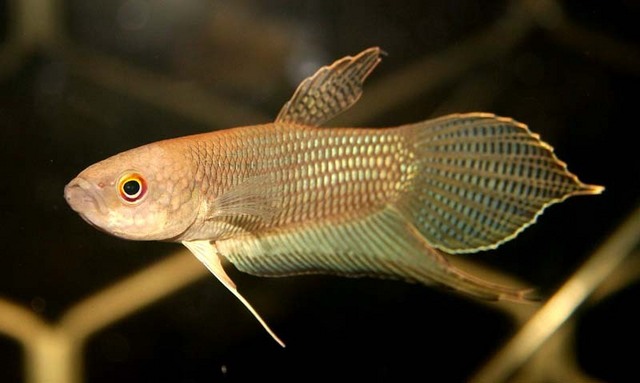
Betta ibanorum
Osphronemidae · Tan & Ng, 2004
B. ibanorum is uncommon in the hobby and is apparently more frequently fished for food than the aquarium trade. It's included in the Betta akarensis group/complex of closely-related species within the genus, of which members share the following set of characters: possession of pre-orbital and post-orbital stripes (the post-orbital stripe is faint or interrupted in some species); chin bar present; caudal-fin lance...
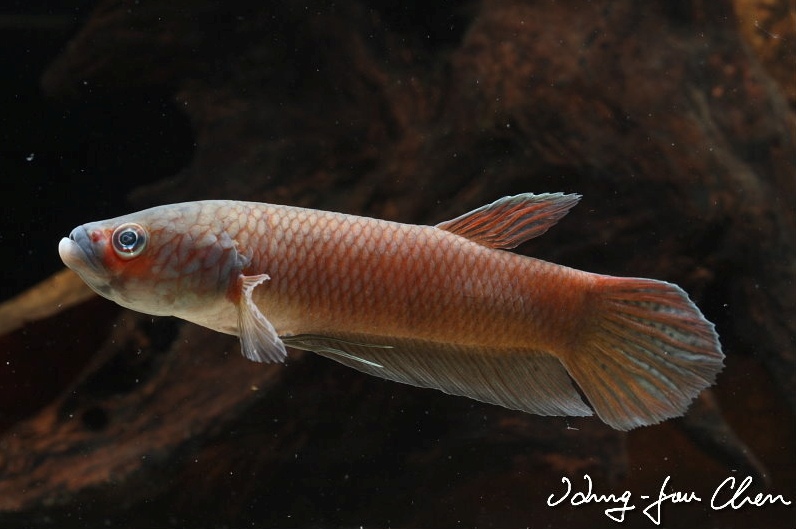
Betta ideii
Osphronemidae · Tan & Ng, 2006
Prior to official description this species was traded as B. sp. 'Laut'. It's included in the Betta unimaculata complex of closely-related species within the genus, , of which members share the following set of characters: body long and slender with depth at dorsal fin origin 18-25 % SL; head large and blunt with width 19-24 % SL; long maxilla and lower lip with distance from tip of lower jaw to posterior end of maxilla 27-54 % HL; caudal-fin rounded in sha...
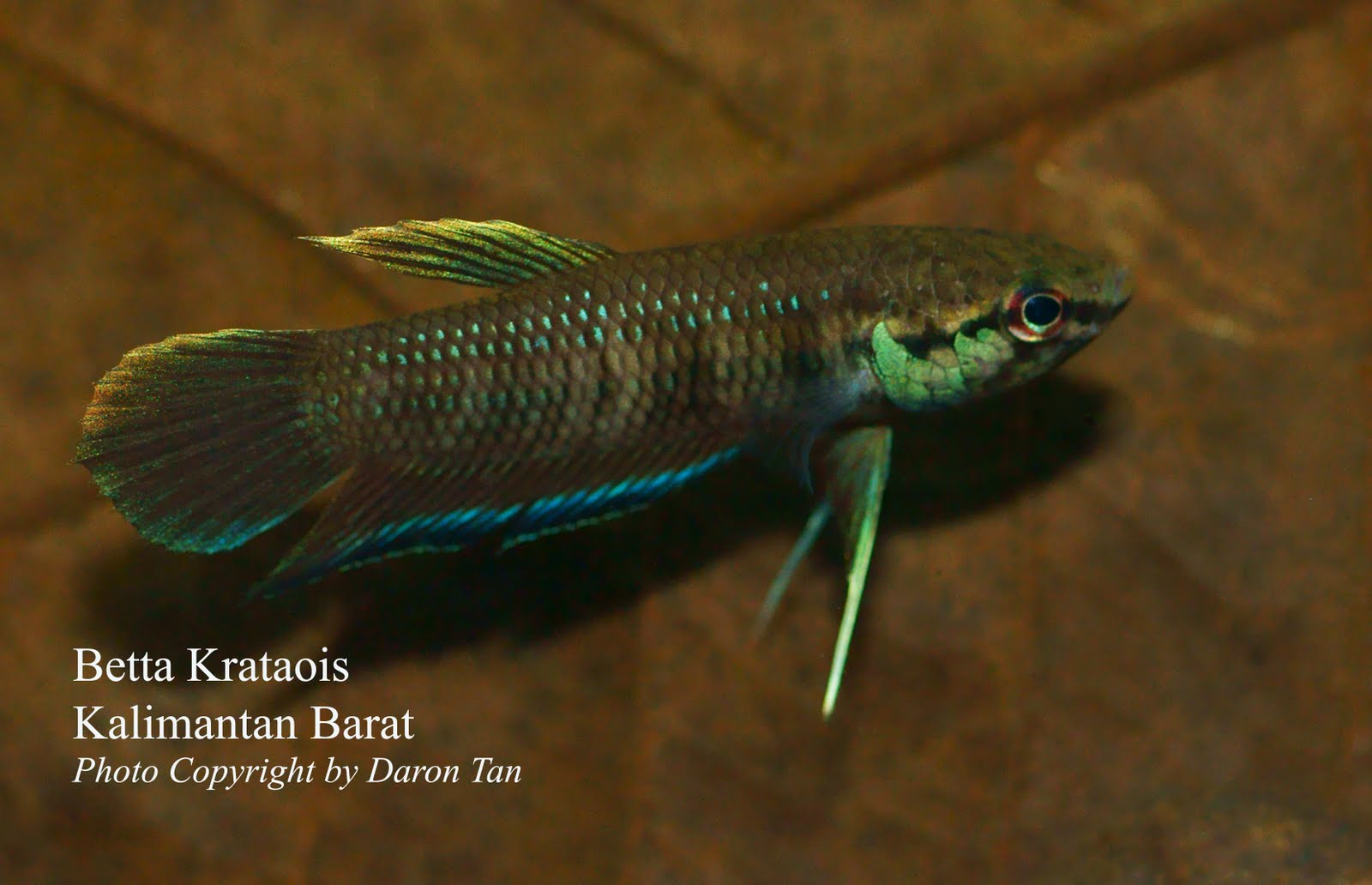
Betta krataios
Osphronemidae · Tan & Ng, 2006
This species was traded as B. sp. 'Kapuas' prior to its formal description and continues to be mislabelled B. dimidiata. The two can easily be told apart as the caudal-fin is rounded in B. krataios but spade-shaped and in adults, highly-extended in B. dimidiata. Together these two comprise the B. dimidiata group/complex of closely-related species within the genus, members of which can be characterised b...
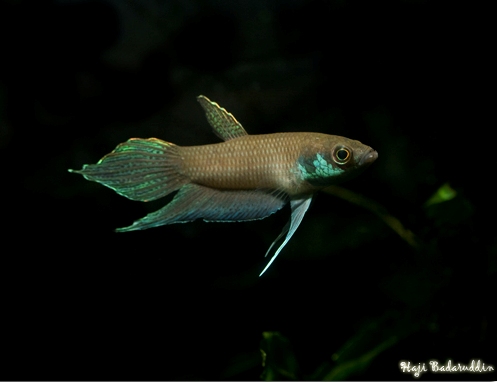
Betta lehi
Osphronemidae · Tan & Ng, 2005
It can be told apart from other members of the B. pugnax group by the following characters: chin bar absent; prsence of transverse bars in the dorsal-fin; no transverse bars in caudal-fin; green iridescent scales present on opercle and body; anal fin with iridescent, light blue distal band; a pair black markings below the postorbital stripe on the opercle of females and juveniles; anal-fin rays 25-29 (mode 28); lateral scales 28-30 (mode 29); postdorsal scales 10-11 (mode 12); pelvic-fin length 34.8-50.6% SL; head length 33.4-36.8% SL; inter-orbital width 31.7-37.4% HL.
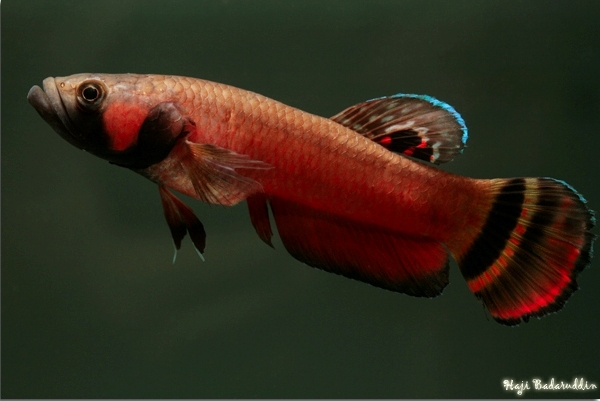
Betta macrostomaBrunei Beauty
Osphronemidae · Regan, 1910
B. macrostoma is included in the Betta unimaculata complex of closely-related species within the genus, of which members share the following set of characters: body long and slender with depth at dorsal fin origin 18-25 % SL; head large and blunt with width 19-24 % SL; long maxilla and lower lip with distance from tip of lower jaw to posterior end of maxilla 27-54 % HL; caudal-fin rounded in shape, occasionally with elongated median rays; pelvic-fin short and filamentous; dorsal and anal fins relatively pointed.
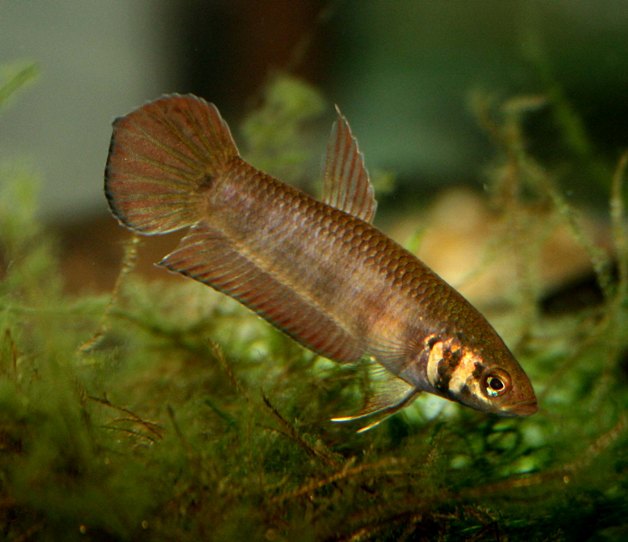
Betta mandor
Osphronemidae · Tan & Ng, 2006
This species was known as B. sp. 'Mandor' or B. sp. 'ninja' prior to official description. It belongs to the Betta foerschi group/complex of closely-related species within the genus, of which members share the following set of characters: possession of iridescent blue or green unpaired fins; rays and interradial membranes in unpaired fins not contrasting; dorsal fin with thin, bright white distal band; opercle with two, reddish-yellow, vertical bars. Members are regarded as being closely-related to bubble-nesting Betta species since they share exhibit certain similarities in morp...
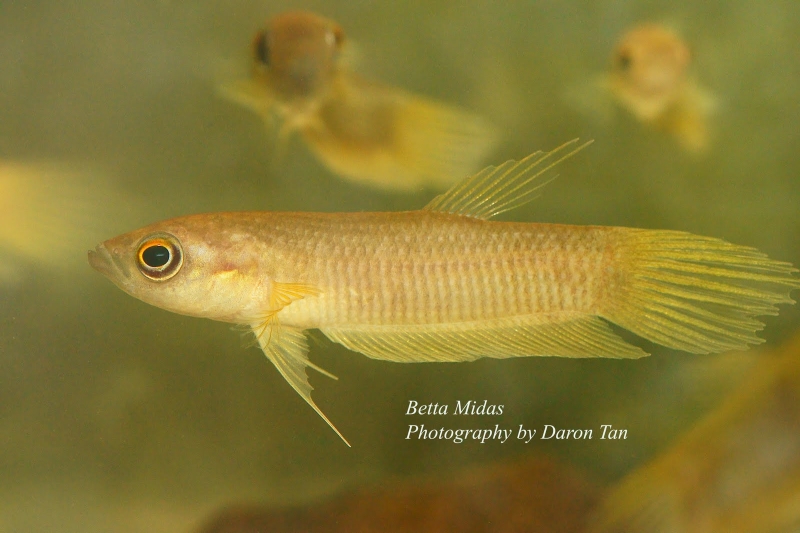
Betta midas
Osphronemidae · Tan, 2009
Not recommended for the standard community set-up for reasons already touched upon. It's requirements and disposition mean it's best kept alone or with very peaceful species since much bigger or more vigorous fishes are likely to intimidate and outcompete it. Some small cyprinids and loaches that inhabit similar environments in nature are compat...
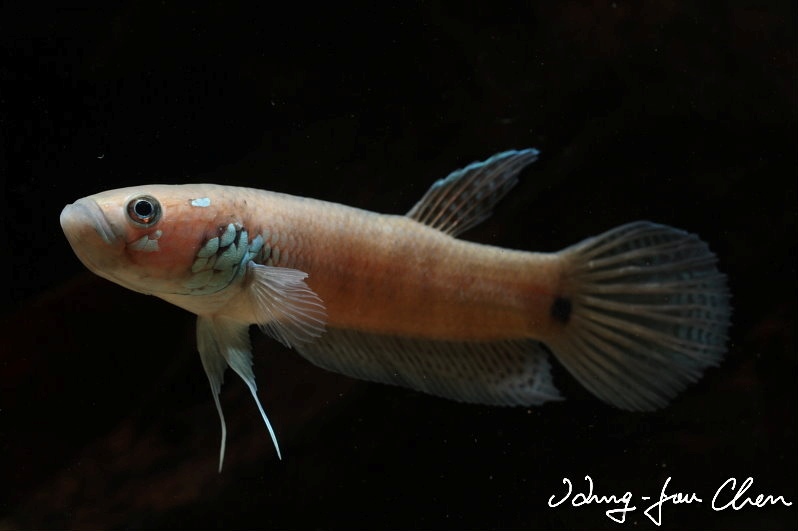
Betta ocellata
Osphronemidae · de Beaufort, 1933
This species is included in the Betta unimaculata complex of closely-related species within the genus, of which members share the following set of characters: body long and slender with depth at dorsal fin origin 18-25 % SL; head large and blunt with width 19-24 % SL; long maxilla and lower lip with distance from tip of lower jaw to posterior end of maxilla 27-54 % HL; caudal-fin rounded in shape, occasionally with elongated median rays; pelvic-fin short and filamentous; dorsal and anal fins relatively pointed.
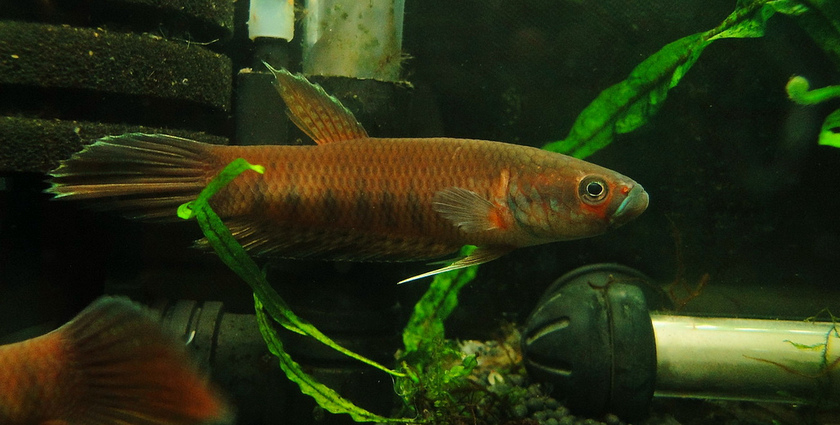
Betta patoti
Osphronemidae · Weber & de Beaufort, 1922
This species is included in the Betta unimaculata complex of closely-related species within the genus, of which members share the following set of characters: body long and slender with depth at dorsal fin origin 18-25 % SL; head large and blunt with width 19-24 % SL; long maxilla and lower lip with distance from tip of lower jaw to poste...
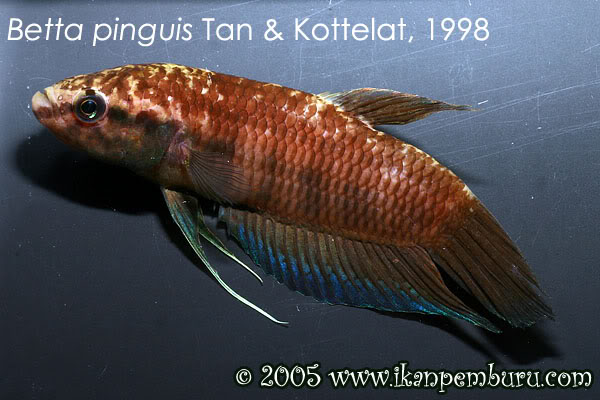
Betta pinguis
Osphronemidae · Tan & Kottelat, 1998
B. pinguis is included in the Betta akarensis group/complex of closely-related species within the genus, of which members share the following set of characters: possession of pre-orbital and post-orbital stripes (the post-orbital stripe is faint or interrupted in some species); chin bar present; caudal-fin lanceolate with highly extended median rays in mature males; caudal fin usually with transverse bars; greenish or bluish iridescent scales on body of males in some species; opercle without iridescent scales except in juveniles.
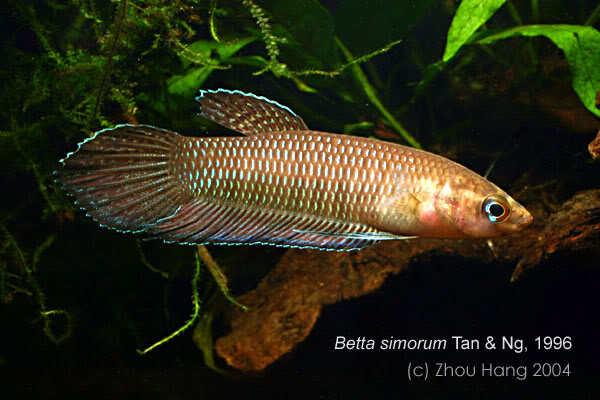
Betta simorum
Osphronemidae · Tan & Ng, 1996
This species is included in the B. bellica group/complex of closely-related species within the genus, an assemblage of which members share the following set of characters: long and slender body with dorsal and ventral margins almost parallel; body depth 23-28 % SL; 30-33 anal-fin rays; 11-13 dorsal-fin rays; 32-34 total vertebrae; body dark brown in colour with iridescent green markings on each individual scale.
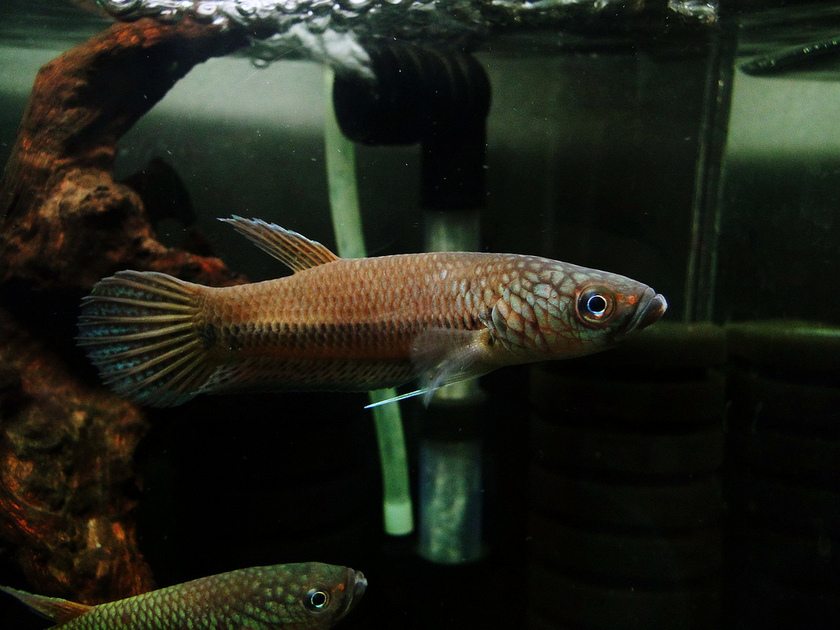
Betta sp. 'Antuta/Bulungan'
Osphronemidae · authority not recorded
This hypothetically-undescribed species appears to be a member of the Betta unimaculata complex of closely-related species within the genus, of which members share the following set of characters: body long and slender with depth at dorsal fin origin 18-25 % SL; head large and blunt with width 19-24 % SL; long maxilla and lower lip with distance from tip of lower jaw to posterior end of maxilla 27-54 % HL; caudal-fin rounded in shape, occasionally with elongated median rays; pelvic-fin short and filamentous; dorsal and anal fins relatively pointed.
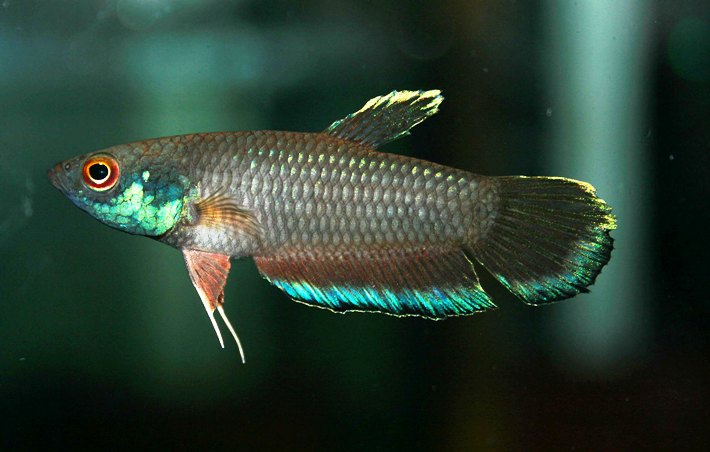
Betta taeniata
Osphronemidae · Regan, 1910
At one locality close to Serian, Sarawak, the habitat comprised a swiftly-flowing, clear hill stream with a substrate of quartz gravel and variably-sized rocks. The pH was 7.0 and there was no aquatic vegetation. The stream was approximately 10 metres across at its widest point and between 5-80 cm deep. B. taeniata was found in sluggish stretches among submerged tree roots, leaf litter, or overhanging riparian vegetation.
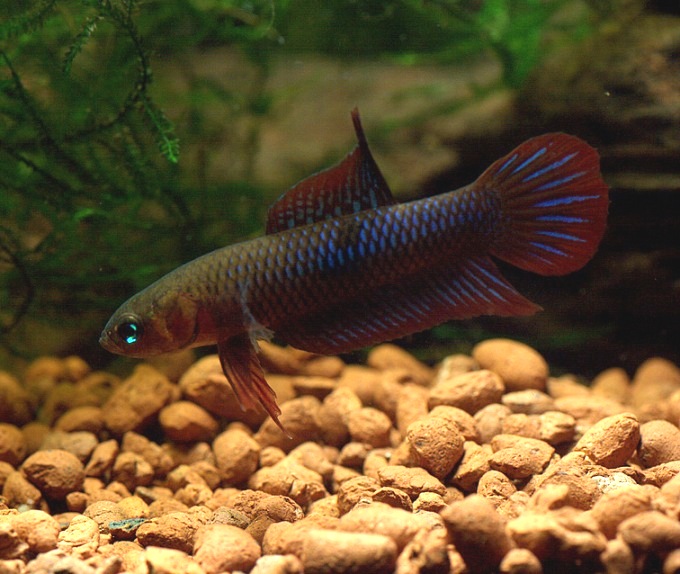
Betta uberis
Osphronemidae · Tan & Ng, 2006
The majority of records pertain to an area sandwiched between the lower Arut and Kumai rivers, south of the towns of Pangkalan Bun and Kumai in Kalimantan Tengah (Central Kalimantan) province, Borneo, Indonesia. Addditional collections have taken place in the Sampit river basin to the east, and several hundred kilometres further north in Sukadana district Kalimantan Barat (West Kalimantan) province. Type locality is 'Indonesia: Borneo: Kalimantan Tengah: Arut basin: Pankalanbun', with the specimens having been obtained from the aquarium trade.
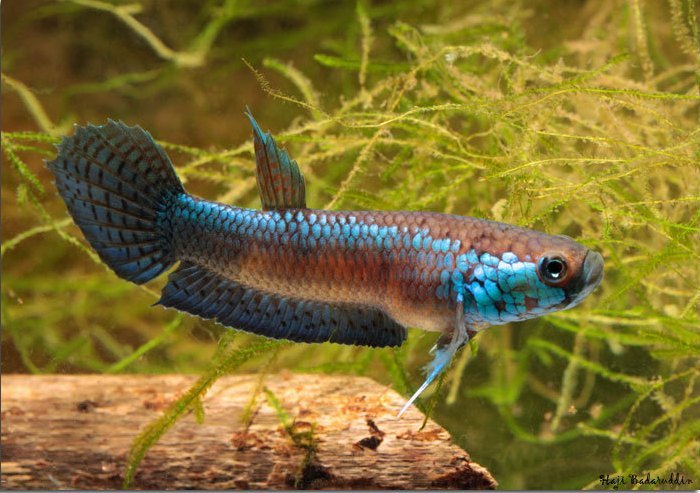
Betta unimaculata
Osphronemidae · Popta, 1905
This species is included in the Betta unimaculata complex of closely-related species within the genus, of which members share the following set of characters: body long and slender with depth at dorsal fin origin 18-25 % SL; head large and blunt with width 19-24 % SL; long maxilla and lower lip with distance from tip of lower jaw to posterior end of maxilla 27-54 % HL; caudal-fin rounded in shape, occasionally with elongated median rays; pelvic-fin short and filamentous; dorsal and anal fins relatively pointed.
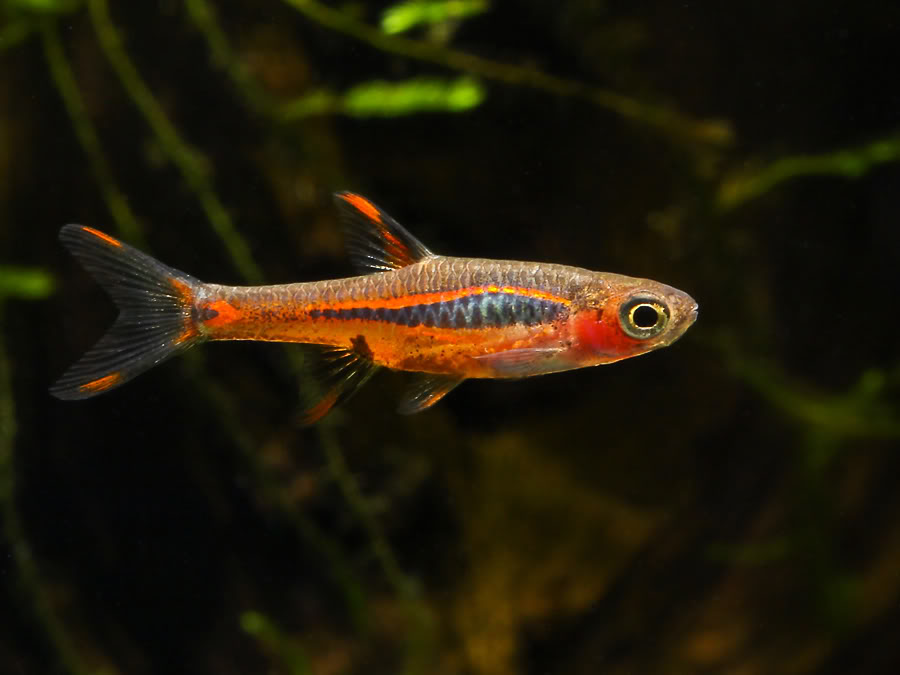
Boraras brigittaeMosquito Rasbora
Cyprinidae · Vogt, 1978
Appears to be endemic to southwestern Borneo though occurence records are scant. Type locality is 'Bandjarmasin', a port town in the Indonesian province of Kalimantan Selatan (South Kalimantan), and following Kottelat (1991) it's range extends westwards as far as the Jelai Bila river basin, near the town of Sukamara, where it's said to occur sympatrically with the congener B. merah. Boraras was erected in 1993 in order to separa...
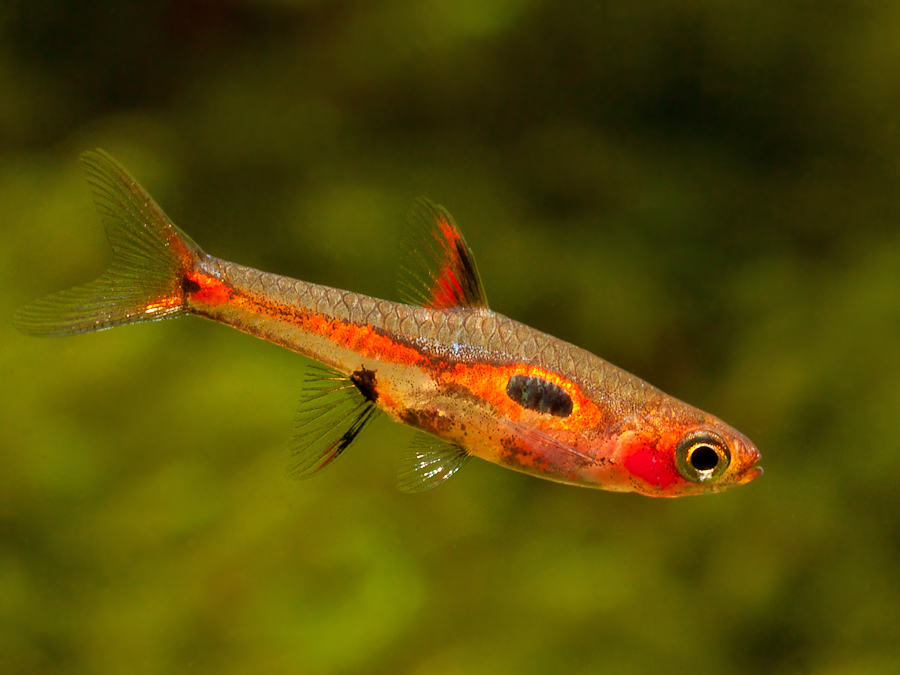
Boraras merah
Cyprinidae · Kottelat, 1991
Appears endemic to southern Borneo. The type specimens were collected from the Jelai Bila river basin at Nataik Sedawak, presumably a settlement of some kind, near the town of Sukamara in the Indonesian province of Kalimantan Tengah (Central Kalimantan). Its range extends westwards from the Jelai Bila watershed whereas that of the congener B. brigittae, with which it may occur sympatrically there (see 'Notes'), extends east.
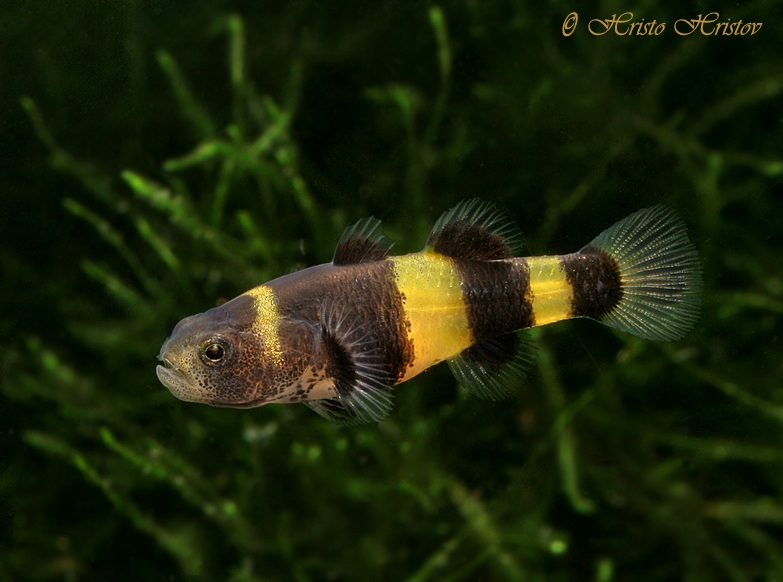
Brachygobius doriaeBumblebee Goby
Gobiidae · Günther, 1868
This species is among the more frequently-traded members of the genus, although confusion regarding its identification and natural distribution is commonplace and it's often misidentified as B. nunus or B. xanthozonus. It can be diagnosed as follows: <30 lateral scales; one black band on head, three on body; first black band on body overlapping first dorsal fin to the extent that almost all fin, except a narrow margin, is black, and beginning opposite centre of opercle...
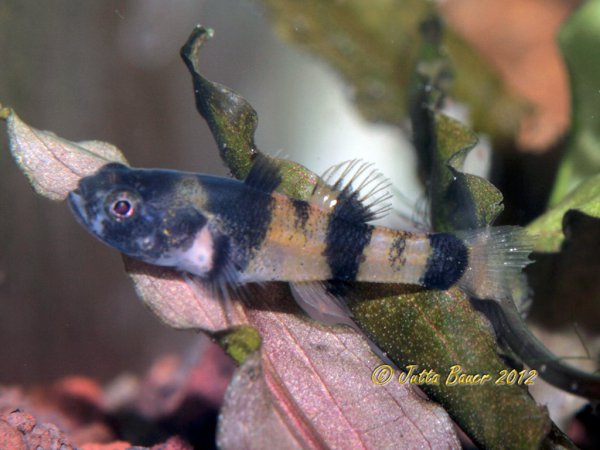
Brachygobius sabanusSabanus Bumblebee Goby
Gobiidae · Inger, 1958
B. sabanus is very similar to B. doriae and these two are easily confused. However in B. doriae most of the first-dorsal-fin and two-thirds of the pectoral-fin are black while in B. sabanus the last one or two rays of the first dorsal-fin are colourless and less than half of the pectoral-fin is black. In addition there are usually smaller dark 'saddles' betw...
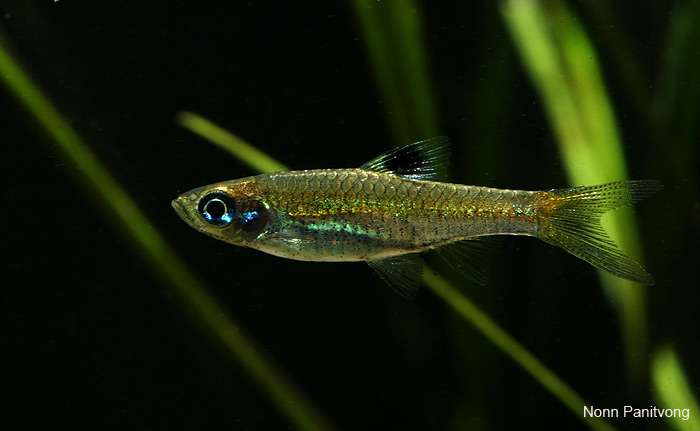
Brevibora dorsiocellataEyespot Rasbora
Cyprinidae · Duncker, 1904
B. dorsiocellata is sometimes traded as 'green-eyed', 'emerald-eyed' or 'hi-spot' rasbora. There appear to exist several geographical forms of the species at least two of which have been seen in the trade. The most common is the rather plain-coloured fish that is produced commercially in large numbers and has gained popularity due to the bright green/blue reflective patch in the lower part of the eye.
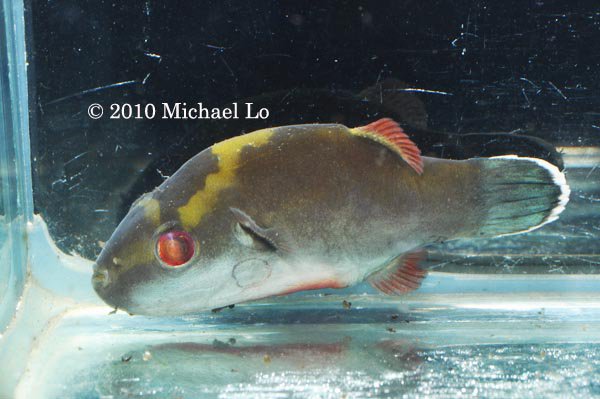
Carinotetraodon borneensis
Tetraodontidae · Regan, 1903
This species is relatively uncommon in the aquarium hobby but is available on occasion, sometimes mixed in among shipments of the congener C. salivator. These two can be told apart by the fact that C. salivator possesses a series of distinct dark bars on the head and body in both sexes, a colour pattern unique within the genus. It is also similar t...
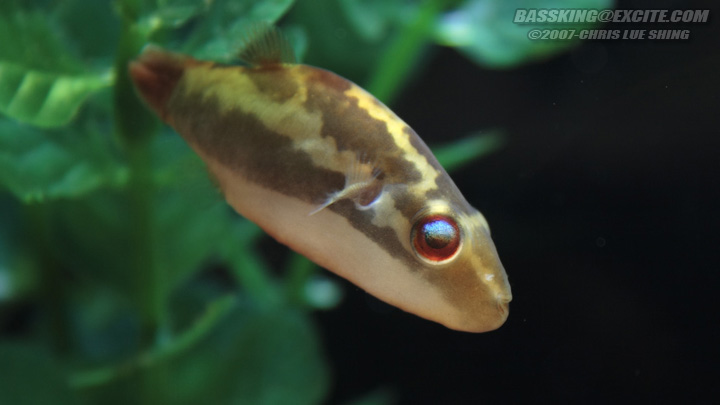
Carinotetraodon irrubescoRed-tailed Redeye Puffer
Tetraodontidae · Tan, 1999
This species is uncommon in the aquarium hobby. It is similar to the congeners C. borneensis and C. lorteti but can be told apart by males possessing a red (vs. bluish to greyish with black and white distal bands in C. lorteti) caudal-fin and lacking (vs. possessing) a black blotch at the base of the dorsal-fin.
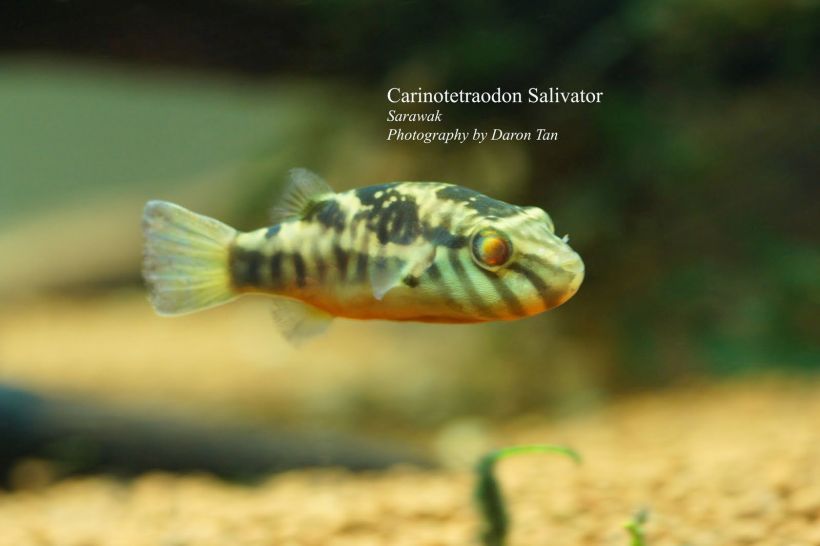
Carinotetraodon salivator
Tetraodontidae · Lim & Kottelat, 1995
It is included in a group often referred to as 'red-eyed puffers', which currently contains four recognised species distributed in Indochina and the Greater Sunda Islands. It can be distinguished from C. borneensis, C. irrubesco, and C. lorteti, the remaining members of this group, by the following combination of characters: 11 dorsal-fin rays; 16 pectoral-fin rays; 11-13 anal-fin rays; 11 caudal-fin rays; eyes not bulging above the head; in males dorsal-fin hyaline, black spot on dorsal-fin base present, pectoral-fin base hyaline, anal-fin hyaline with no black spot at base...
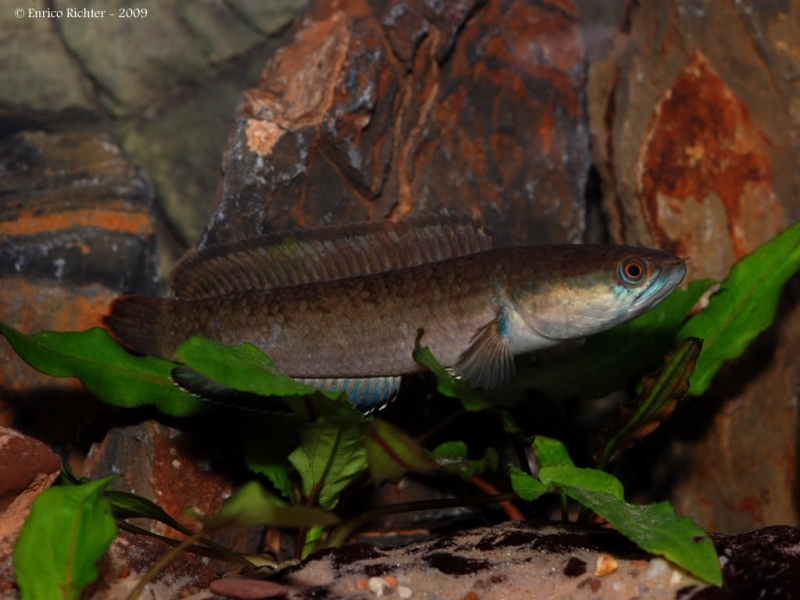
Channa gachuaDwarf Snakehead
Channidae · Hamilton, 1822
Generally considered to have an enormous natural range extending from Iran to Taiwan and Bali, with records existing from Iran, Iraq, Afghanistan, Pakistan, Nepal, India, Sri Lanka, Bangladesh, Bhutan, China, Myanmar, Thailand, Laos, Cambodia, Vietnam, Malaysia, Indonesia, and Singapore. However there exists significant evidence to suggest that C. gachua as currently understood represents a complex of similar-looking species, and a taxonomic review of the group is clearly required.
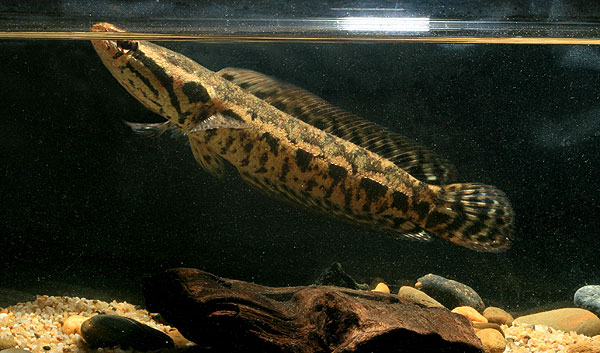
Channa luciusForest Snakehead
Channidae · Cuvier, 1831
Prefers a dimly-lit aquarium with plenty of cover in the form of live plants, driftwood branches, terracotta pipes, plant pots, etc., arranged to form a network of nooks, crannies, and shaded spots. Surface vegetation such as Ceratopteris spp. is also appreciated and makes the fish less inclined to conceal themselves.
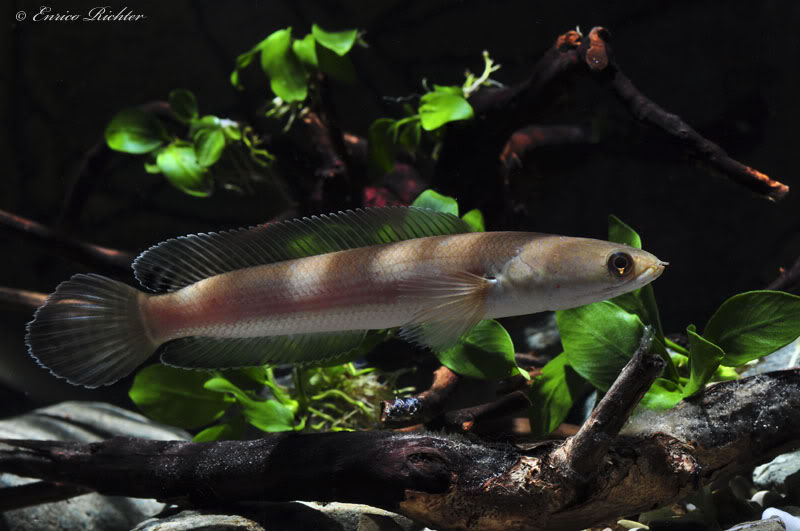
Channa melasomaBlack Snakehead
Channidae · Bleeker, 1851
This species can be told apart from the similar-looking congener C. baramensis (once considered synonymous with C. melasoma) by absence (vs. presence) of a black spot in the centre of numerous body scales and absence (vs. presence in specimens larger than 120 mm SL) of a barred caudal-fin pattern.
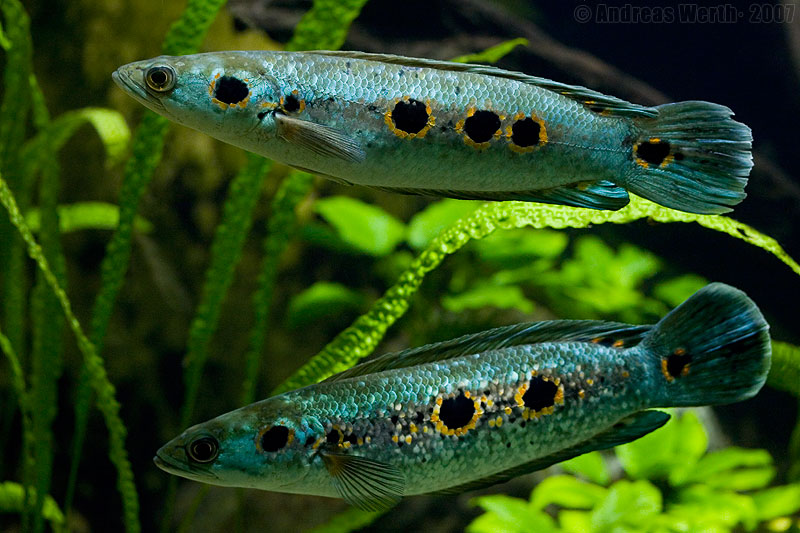
Channa pleuropthalmaOcellated Snakehead
Channidae · Bleeker, 1851
Channa pleuropthalma
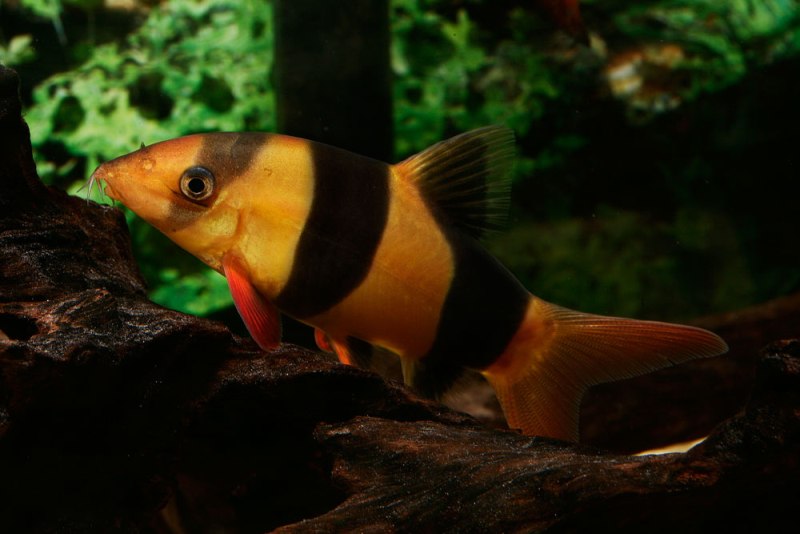
Chromobotia macracanthusClown Loach
Botiidae · Bleeker, 1852
This species is arguably one of the most misunderstood in the hobby since it's wholly unsuitable for smaller aquaria despite its ubiquitous availability. Most retailers sell it without providing what should be considered essential information regarding long-term care and most specimens undoubtedly fail to reach their potential in captivity. The purchase of a group is also a considerable investment given that if properly cared for typical life span is in excess...
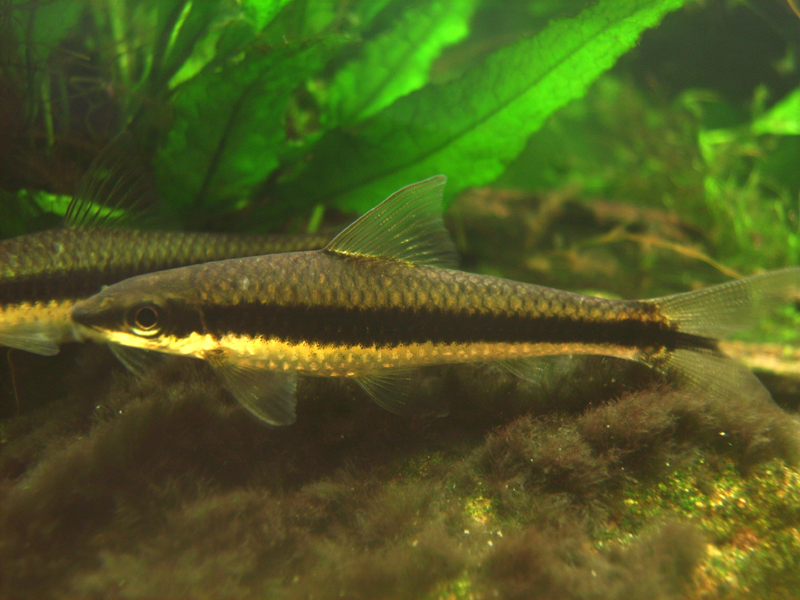
Crossocheilus langeiSiamese Algae Eater
Cyprinidae · Bleeker, 1860
C. oblongus is another name widely misused in the trade but that species has seemingly never been exported and was described as a blueish fish with yellow fins. It's native to streams of Gunung Salak mountain in Bogor Regency, West Java, Indonesia where collecting of ornamental fishes is almost non-existent. Other species of laterally-striped Crossocheilus also exist and may be available from time-to-time but are more easily told apart from the group described above.
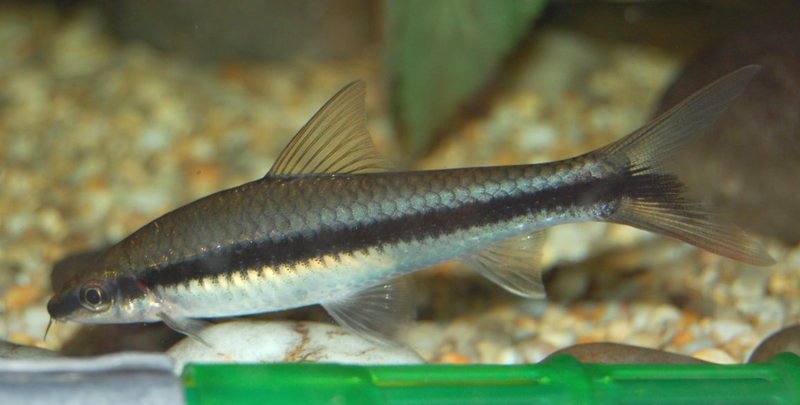
Crossocheilus nigriloba
Cyprinidae · Popta, 1904
While separating some of the fish that may be found on sale as 'C. siamensis' is a tricky task, C. nigriloba is quite simple to identify. The dark lateral body stripe uniquely breaks up into a series of blotches when the fish are sparring, stressed or sleeping and the lower caudal fin lobe contains dark pigmentation suffused with red. The latter feature has given rise to the trade name of 'penguin flying fox'.
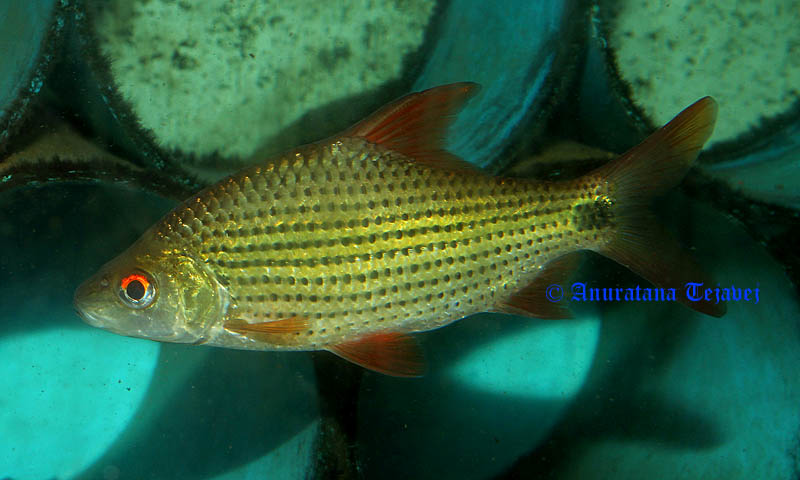
Cyclocheilichthys apogonBeardless Barb
Cyprinidae · Valenciennes, 1842
In the aquarium trade this species may also be seen on sale as 'skinhead barb'. As with others in the genus little has been written regarding its captive care but it makes a peaceful and unusual addition to larger aquaria. The best way of obtaining it may be to keep an eye on shipments of wild fishes from Indochina and the Greater Sunda Islands as it's rarely imported in large numbers and most often arrives as bycatch.
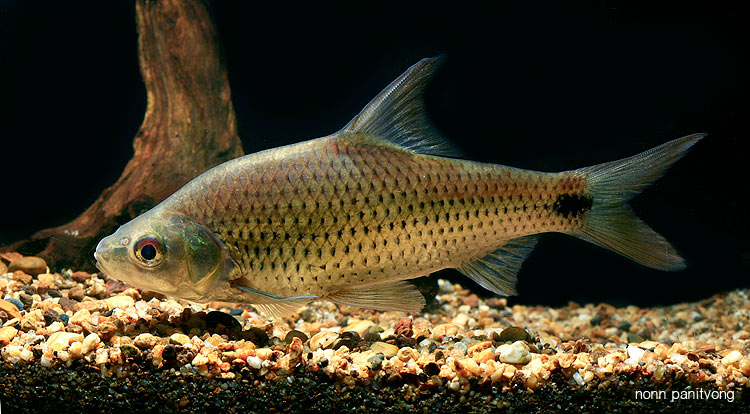
Cyclocheilichthys armatus
Cyprinidae · Valenciennes, 1842
It can be distinguished from congeners by possessing one or two pairs of barbels, a black blotch at the base of the caudal-fin, and rows of dark spots along the lateral scale rows. Members of Cyclocheilichthys are characterised by possessing a serrated dorsal fin spine, 9 branched pelvic fin rays, a conical snout, small, subterminal...
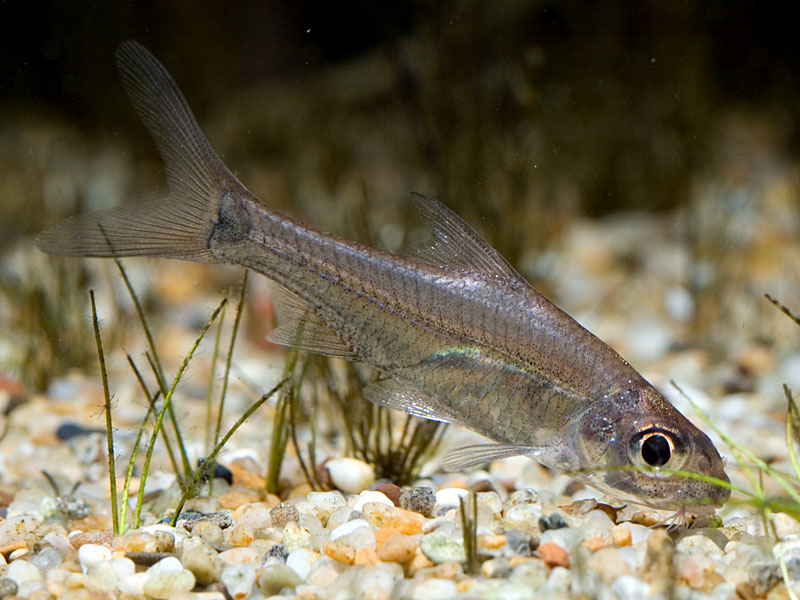
Cyclocheilichthys heteronema
Cyprinidae · Bleeker, 1854
This species is currently understood to have a considerable natural range extending eastwards from Myanmar via Thailand, Laos, Cambodia as far as Vietnam and to the south through Peninsular Malaysia and into the Greater Sunda Islands of Borneo and Sumatra. It thus occurs in the Mekong, Mae Klong and Chao Phraya drainages as well as a host of other river basins, lakes and reservoirs including the Tonlé Sap river...
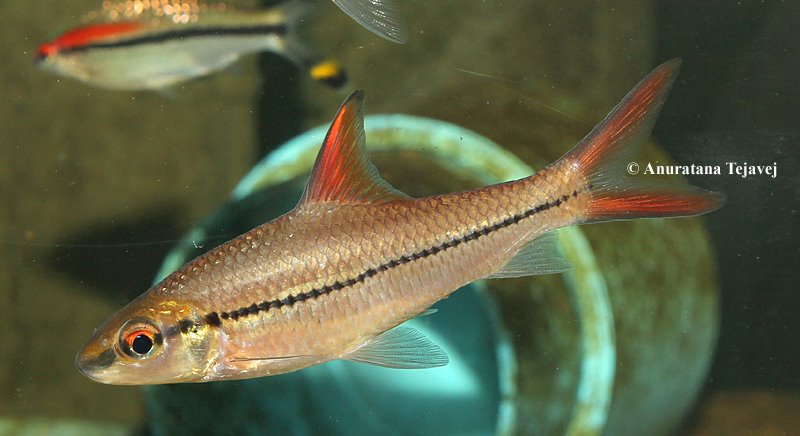
Cyclocheilichthys janthochir
Cyprinidae · Bleeker, 1854
In the exceptionally diverse Danau Sentarum lake system of the upper Kapuas River basin, West Kalimantan, sympatric species include Scleropages formosus, Barbonymus gonionotus, B. schwanenfeldii, Crossocheilus nigriloba, Cyclocheilichthys apogon, C. repasson, Epalzeorhynchos kalopterus, Labiobarbus ocellatus , Leptobarbus hoevenii, Luciosoma spilopleura plus various representatives of Barbodes, Rasbora and Osteochilus.
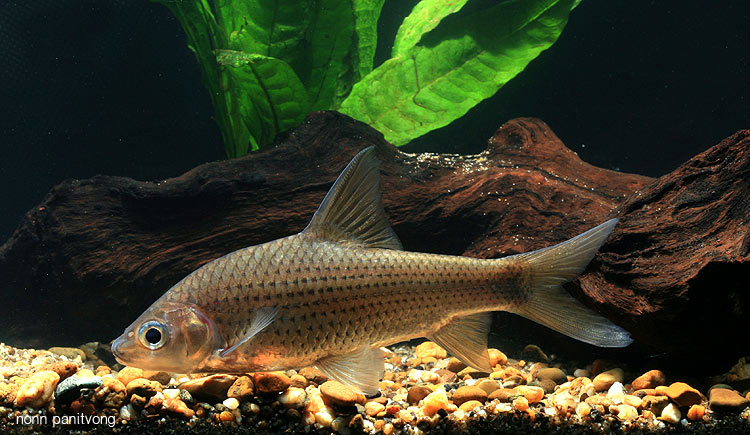
Cyclocheilichthys repasson
Cyprinidae · Bleeker, 1853
An ideal resident of the larger, well-furnished community set-up though it might upset slow-moving or timid companions simply by its size. There are plenty of suitable tankmates including many cyprinids, loaches, cichlids, catfish and characins, but as always when selecting a compatible community of fish proper research is essential. A community based around one of its native countries or river basins...
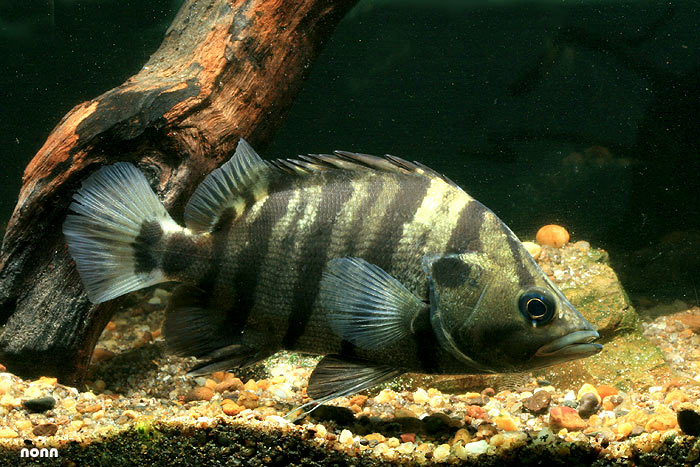
Datnioides polotaSilver Tiger Perch
Datnioididae · Hamilton, 1822
D. polota is sometimes referred to as D. quadrifasciatus (Sevastianov, 1809) but the original name of the latter, Chaetodon quadrifasciatus Sevastianov, 1809, is a junior primary homonym of the older Chaetodon quadrifasciatus Bloch & Schneider 1801, thus Coius polota Hamilton, 1822 takes precedence.
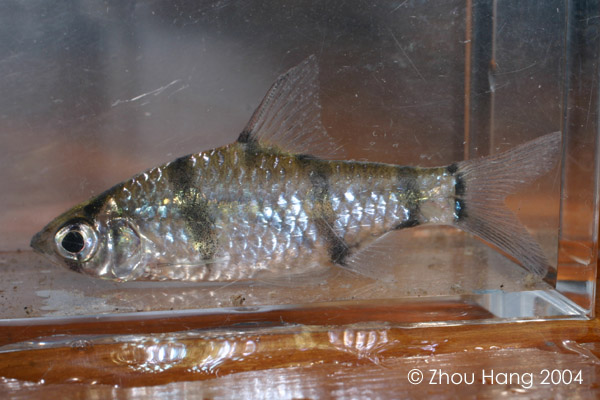
Desmopuntius endecanalis
Cyprinidae · Roberts, 1989
Probably a micropredator feeding on small insects, worms, crustaceans and other zooplankton in nature. In the aquarium it will accept dried foods of a suitable size but should not be fed these exclusively. Daily meals of small live and frozen fare such as Daphnia, Artemia, and suchlike will result in the best colouration and encourage the fish to come into breeding condition. It's a schooling species by natur...
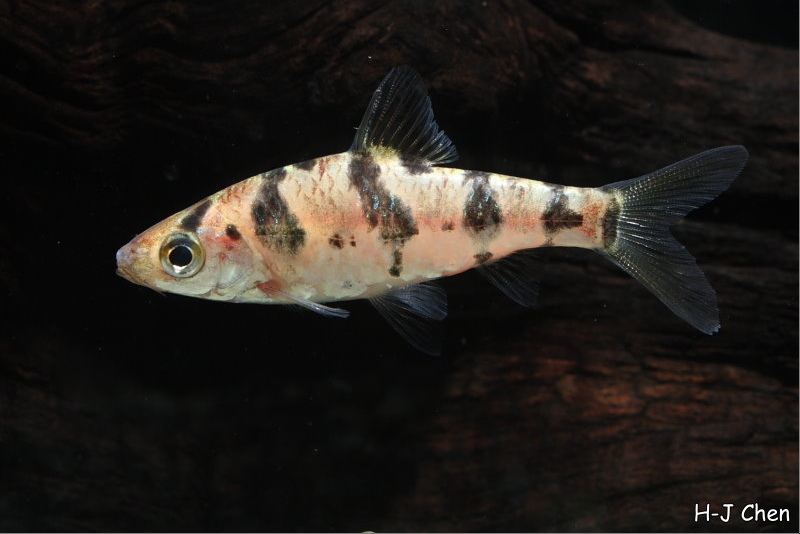
Desmopuntius foerschi
Cyprinidae · Kottelat, 1982
D. foerschi is sometimes traded as 'boomerang barb' or 'Foersch's fire barb' and is included in a group of closely-related, similar-looking fishes which were moved into the new genus Desmopuntius by Kottelat (2013). It can be told apart from other vertically-striped congeners by possession of additional dark blotches between the second, third and fourth vertical bars and a further marking at the posterior base o...
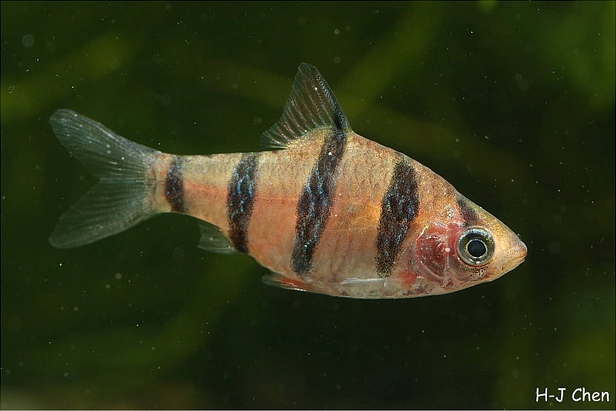
Desmopuntius hexazona'Pentazona' Barb
Cyprinidae · Weber & de Beaufort, 1912
Native to parts of southern Borneo, eastern Sumatra, Singapore, and the Malay Peninsula. In Singapore it's considered highly-endangered and is now restricted to the Central Catchment nature reserve. Type locality is 'Tuluk and Gunung Sahilan, Sumatra, Indonesia' which appears to correspond to localities within the Kampar River drainage of which the former is now known as Teluk Meranti and is o...
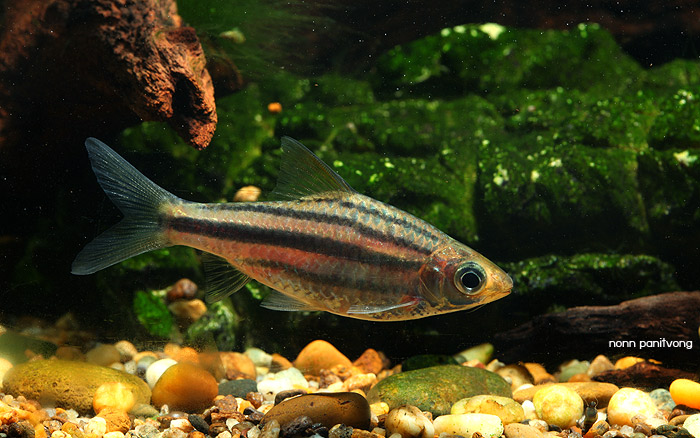
Desmopuntius johorensisStriped Barb
Cyprinidae · Duncker, 1904
D. johorensis can be distinguished by the following combination of characters: 5-6 dark, lateral stripes on body in specimens larger than 40 mm; stripes immediately above and below the central stripe (stripes '+1' and '-1', respectively) located on scale rows +2 and -2, not touching dorsal and ventral midlines (except in some small specimens from Peninsular Malaysia); stripes broad, typically between 0.5-1 scale rows deep...
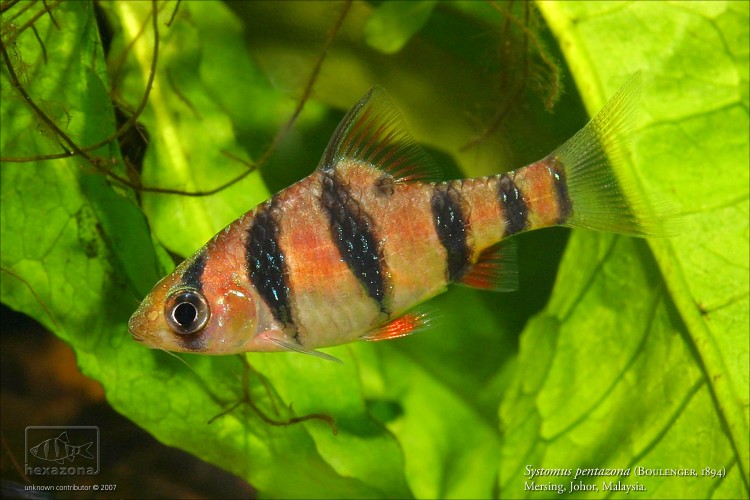
Desmopuntius pentazonaFive-banded Barb
Cyprinidae · Boulenger, 1894
This species is rare in the aquarium trade with the majority of fish available under the name or the vernacular 'pentazona barb' being the closely-related D. hexazona. The two are almost identical in terms of both appearance and meristics but can be separated by the fact that D. pentazona possesses a small dark marking at the posterior base of the dorsal-fin which is absent in D. hexazona.
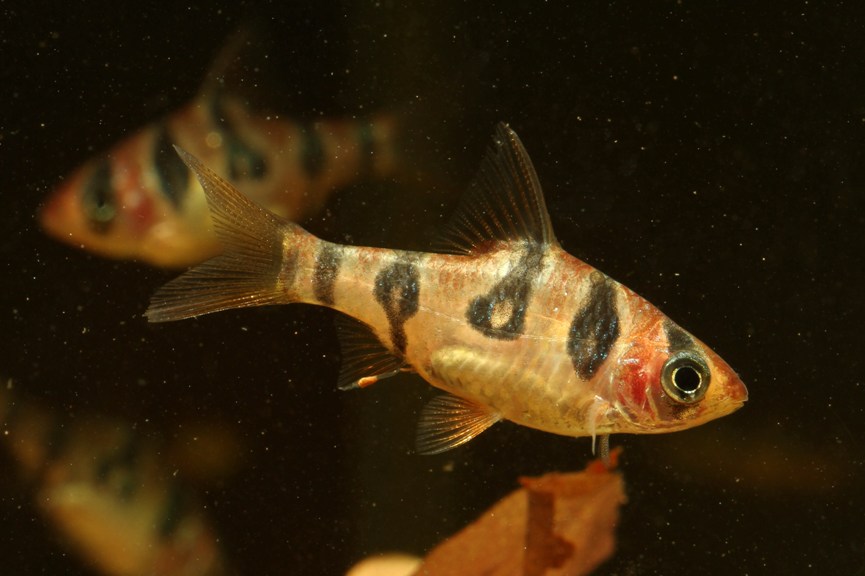
Desmopuntius rhomboocellatusSnakeskin Barb
Cyprinidae · Koumans, 1940
Endemic to southern Kalimantan, the Indonesian portion of Borneo where it's been recorded from several river systems including the Kapuas, Kepayang, Barito and Kahajan. Type locality is given as 'Canal along the highway from Oelin to Bandjermasin, about 15 kilometers from Bandjermasin, Borneo.' Often referred to as the 'rhomb' or 'rhombo' barb and included in a group of closely-related, similar-looking congeners which also includes...
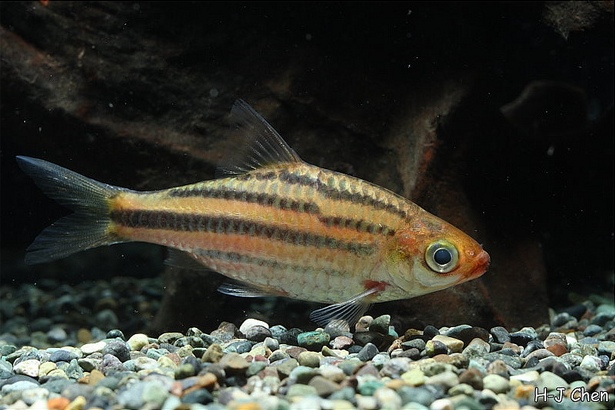
Desmopuntius trifasciatus
Cyprinidae · Kottelat, 1996
This species is one of three similar-looking members of the genus alongside D. johorensis and D. trifasciatus, while it may also be confused with Striuntius lineatus. Juveniles of all except S. lineatus exhibit a vertically-barred rather than laterally-striped colour pattern, the metamorphosis to adult patterning beginning at around 20 mm SL and normally being complete by 30-40 mm.
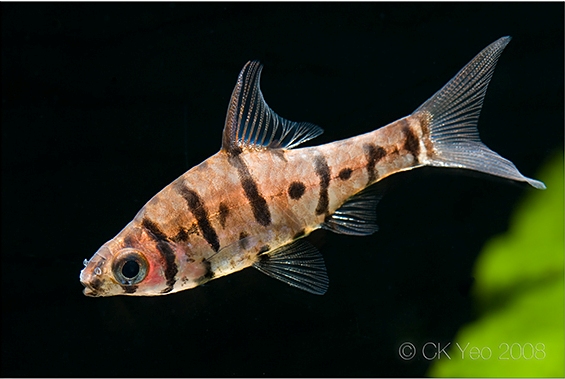
Eirmotus insignis
Cyprinidae · Tan & Kottelat, 2008
Typically inhabits slow-moving, shallow, shady rainforest streams and swamps with dense submerged and marginal vegetation. The conditions are often rather turbid and the substrate composed of mud or fallen leaves, twigs and branches. Such environments characteristically contain soft, weakly acidic water and are often dimly-lit due to the rainforest canopy above. The fish are found sheltering among overhanging tree roots and aquatic vegetation.
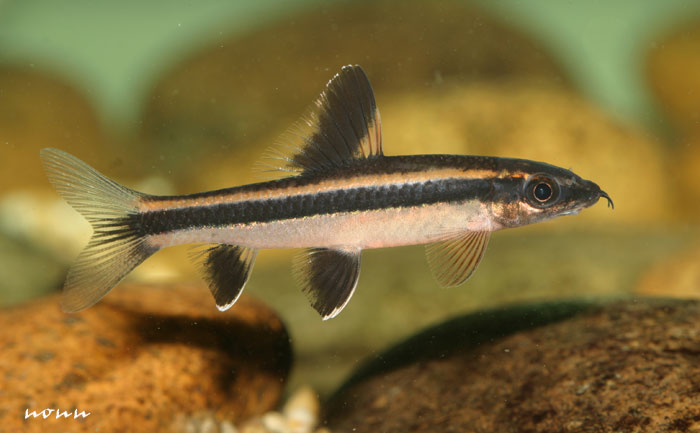
Epalzeorhynchos kalopterumFlying Fox
Cyprinidae · Bleeker, 1850
Confusion with similar-looking fishes from other genera, such as Garra cambodgiensis, laterally-striped Crossocheilus spp. or Gyrinocheilus aymonieri is not uncommon, and are largely attributable to the use of trade names such as 'false flying fox' or 'Siamese flying fox'. When compared with the other species E. kalopterus exhibits several unique characters but perhaps the simplest way to identify it is by the characteristic white-edged, red and black coloured fins and the presence of two pairs of barbels.
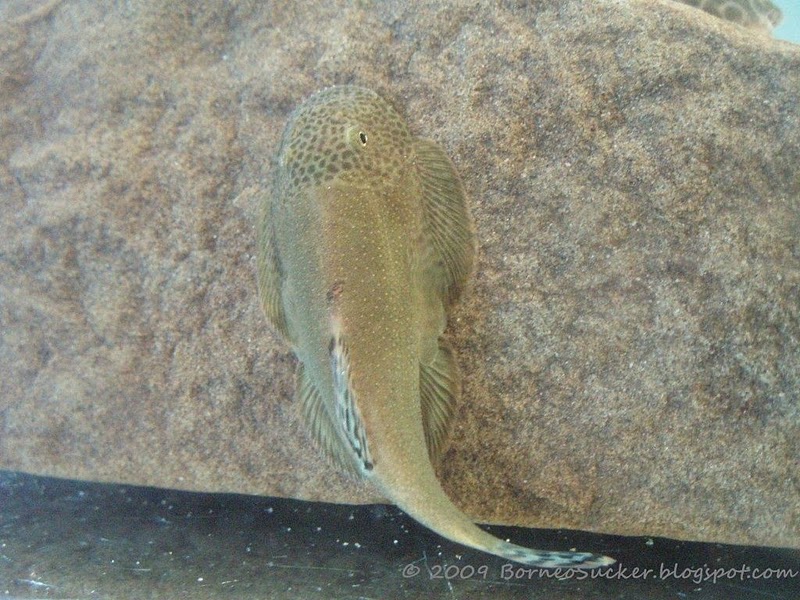
Gastromyzon aeroides
Gastromyzontidae · Tan & Sulaiman, 2006
Field observations have revealed that individuals almost always position themselves facing into the flow, either along the sides, behind or under rocks, their specialised morphology (see 'Notes') allowing them to feed and maintain position without being swept away. Not many fishes have been able to successfully colonise this narrow ecological niche, but syntopic species in nature include Gastromyzon extrorsus (Petagas River), G. introrsus, G. lepidogaster (Pad...
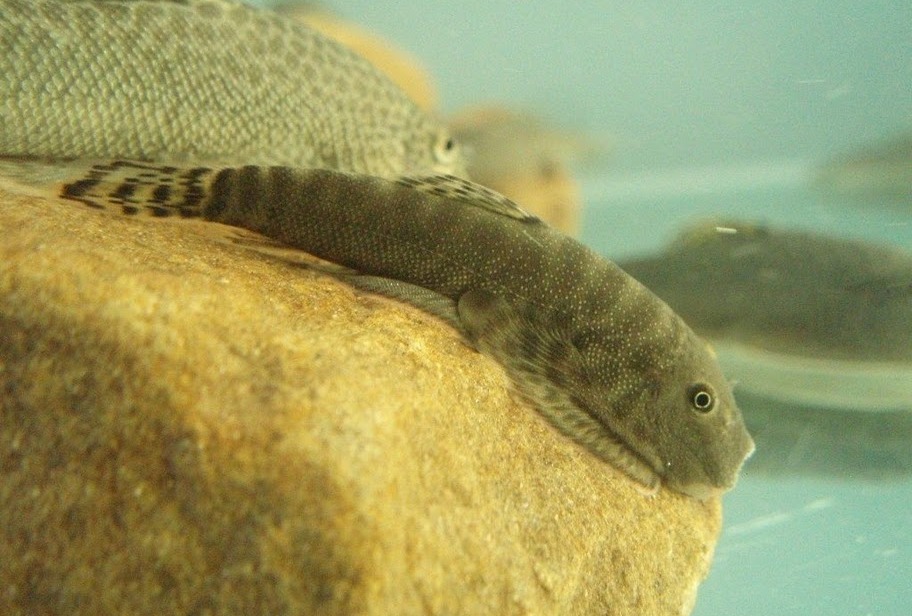
Gastromyzon cornusaccus
Gastromyzontidae · Tan, 2006
G. cornusaccus can be distinguished from congeners by the following combination of characters: secondary rostrum present; incomplete postoral pouch present reduced to pockets located posterior to mouth corners; sublacrymal groove present and visible when viewed laterally; juveniles with thick, cream-coloured bars and blotches on body, adults uniformly-coloured; head dorsum plain; subopercular groove absent; gill slit vertical; snout truncate when viewed dorsally; no scales on abdomen; 55-61 lateral line scale...
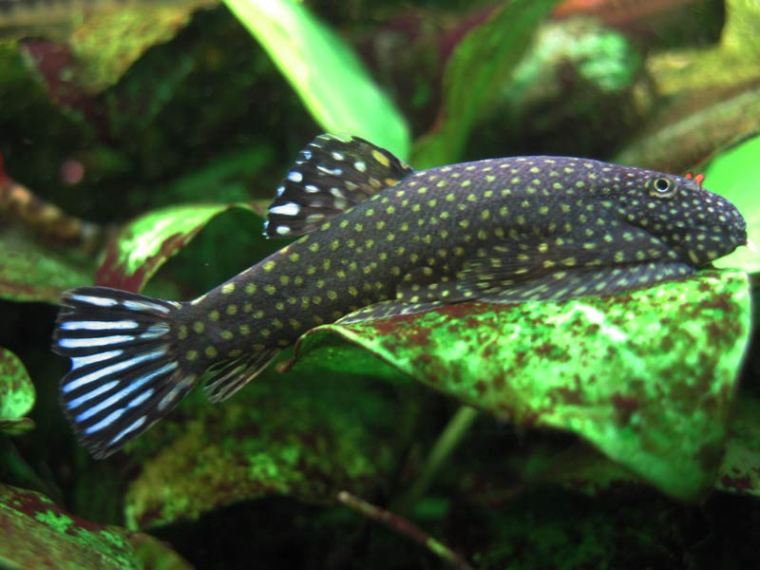
Gastromyzon ctenocephalus
Gastromyzontidae · Roberts, 1982
One of the more commonly-traded members of the genus and often found in mixed shipments which may contain other Gastromyzon spp. or related fishes like Beaufortia kweichowensis, these often labelled collectively as 'Borneo sucker', 'Hong Kong pleco', 'butterfly loach', etc. It's sometimes misidentified as G. punctulatus, a species not currently traded which possesses yellow finnage and a lighter-coloured, less-intensely spotted body.
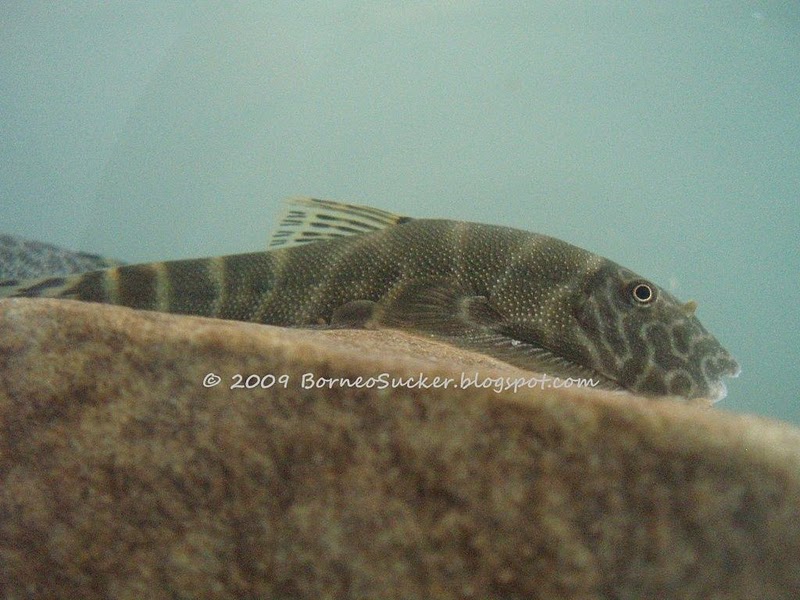
Gastromyzon extrorsus
Gastromyzontidae · Tan, 2006
This species has probably not been seen in the aquarium trade yet but has been maintained by a few private collectors. It can be distinguished from congeners by the following combination of characters: secondary rostrum present; complete postoral pouch present; body colour brown with up to 9 thin gold stripes; head dorsum dark brown with gold reticulate pattern; subopercular groove absent; gill slit vertical; sublacrymal groove present; sno...
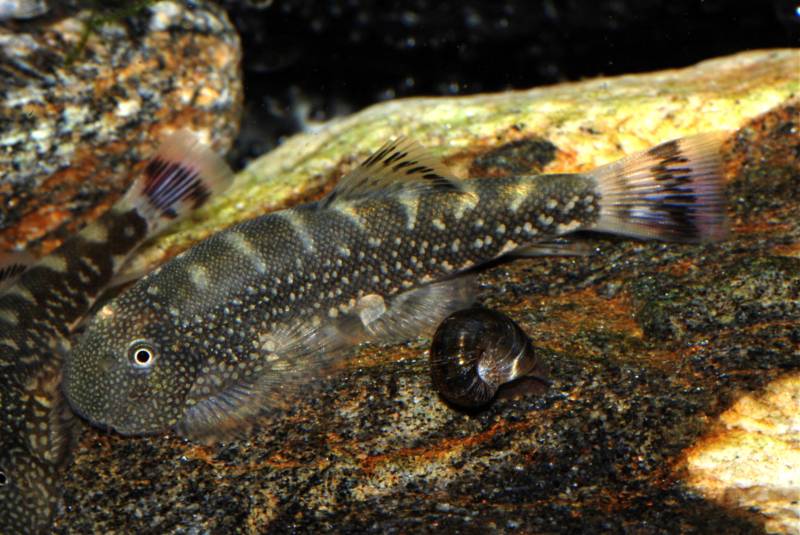
Gastromyzon farragus
Gastromyzontidae · Tan & Leh, 2006
In fact G. farragus and G. ocellatus represent one of 12 pairs of cryptospecies to be found in the genus, differing in subtle aspects of patterning. Cryptospecies are defined as morphologically similar, but reproductively isolated species which in fishes often inhabit adjacent river basins but in some cases occur sympatrically. The phenomenon may be a result of parallel evolution, and is not normally considered to represent an early stage of speciation.
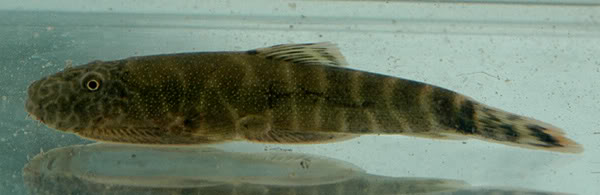
Gastromyzon introrsus
Gastromyzontidae · Tan, 2006
The type locality was a fast-flowing, shallow (50 - 80 cm deep) river between 5-10 metres in width with a substrate of gravel and large rocks. PH was measured at 7.7 and the habitat was unshaded with on...
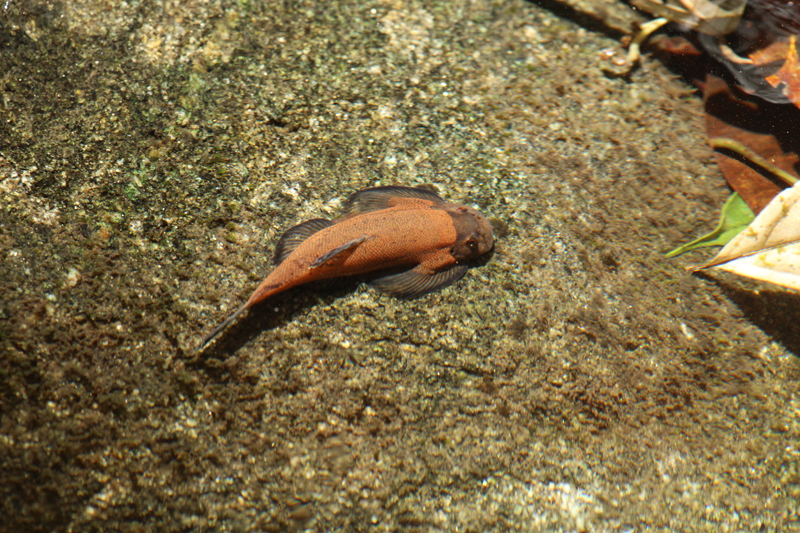
Gastromyzon lepidogaster
Gastromyzontidae · Roberts, 1982
This species is variable in terms of colour. Large adults may be bright green, orange or barred but are apparently capable of changing from barred to plain in just a few seconds. These different forms have been recorded in the same natural habitats, and some individuals also possess prominent nuptial tubercules covering much of the body.
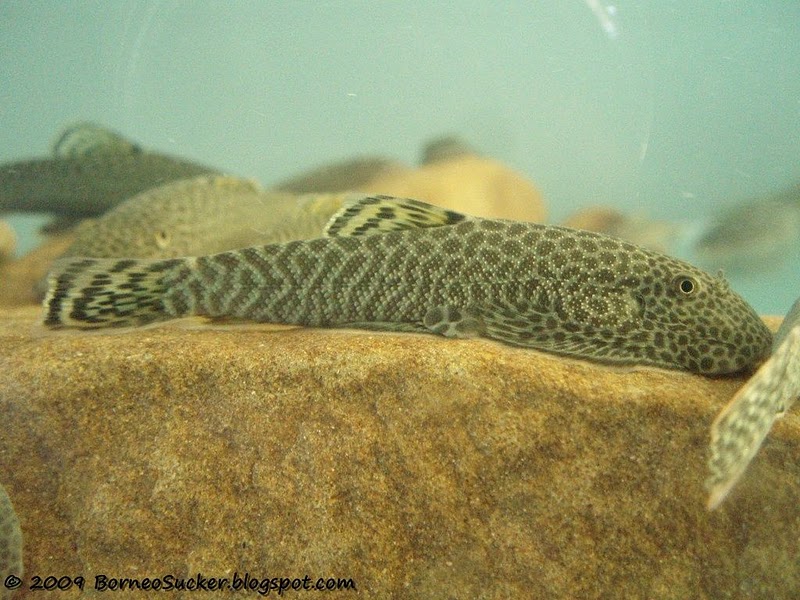
Gastromyzon monticola
Gastromyzontidae · Vaillant, 1889
Field observations have revealed that individuals almost always position themselves facing into the flow, either along the sides, behind or under rocks, their specialised morphology (see 'notes') allowing them to feed and maintain position without being swept away. In nature G. monticola occurs sympatrically alongside Garra borneensis, Osteochilus ingeri, Gastromyzon auronigrus, G. cornusaccus, Nemacheilus olivaceus,...
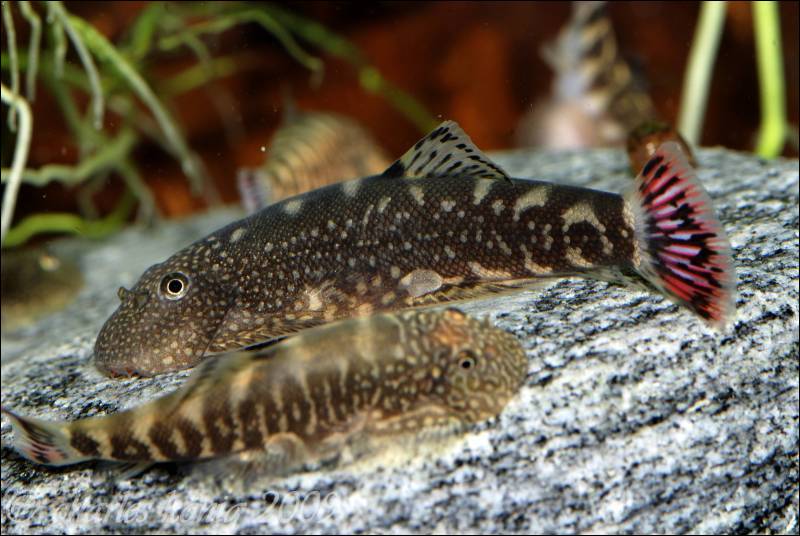
Gastromyzon ocellatus
Gastromyzontidae · Tan & Ng, 2004
Some individuals do appear very similar to G. farragus, with noticeable spotting on the head, but can usually still be told apart by examining the caudal-fin which tends to contain only a single thick, dark vertical bar in G. farragus whereas in G. ocellatus there are more often two bars, one thick, one thinner. Intermediate forms do exist though meaning identification is sometimes tricky.
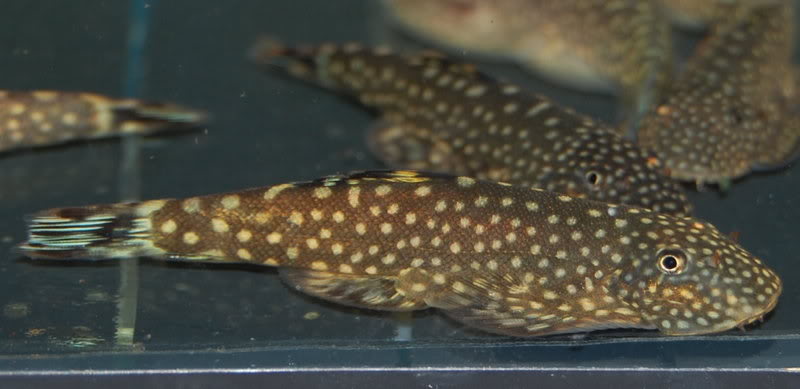
Gastromyzon scitulus
Gastromyzontidae · Tan & Leh, 2006
It can be distinguished from congeners by the following combination of characters: gill slit angular; presence of subopercular groove, running continuous to origin of pectoral-fin; body black with numerous, small, evenly-spaced light brown spots; head dorsum black with numerous cream spots; pectoral and pelvic fins with cream spots; caudal-fin with iridescen...
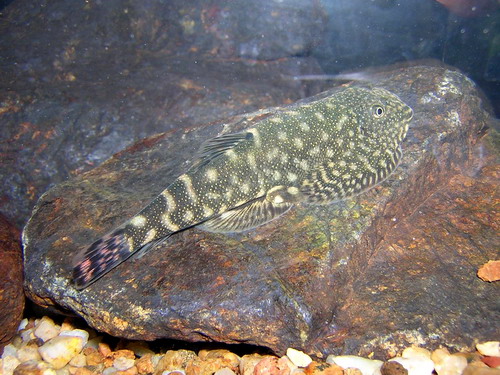
Gastromyzon sp. 'SK01'
Gastromyzontidae · authority not recorded
This undescribed species has probably not been seen in the aquarium trade yet but is occasionally maintained private collectors. The 'SK' numbering system used here refers to 'South Kalimantan', home to several unidentified members of the genus. Gastromyzon spp. are placed into various 'species groups' (artificial assemblages of species which may or may not be monophyletic) for ease of reference, and based on colour and patterning G. sp. 'SK01' appears similar to members of the G. ridens group which also includes G. crenastus, G. stellatus and G. zebrinus.
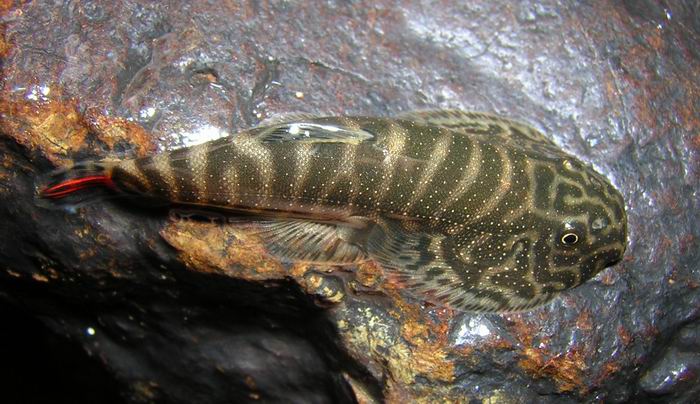
Gastromyzon sp. 'SK02'
Gastromyzontidae · authority not recorded
Known only from headwaters of the Sungai (river) Amandit, a tributary of the larger Barito basin in the Meratus mountain range, Kalimantan Selatan (South Kalimantan) province, Indonesian Borneo. There currently exist 36 officially-described members of the genus, all of which are endemic to the island with over half restricted to a single river basin or sub-basin.
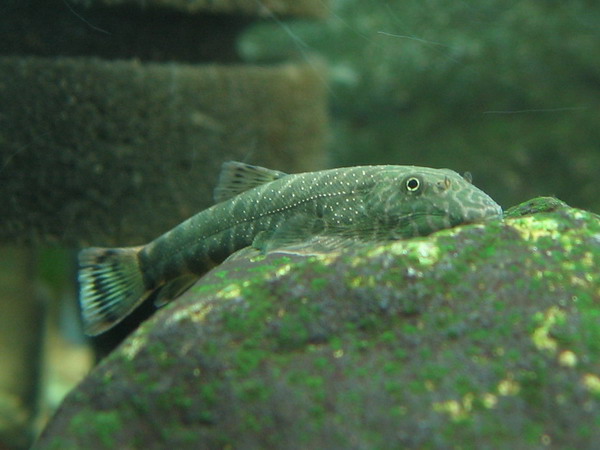
Gastromyzon sp. 'SK03'
Gastromyzontidae · authority not recorded
Gastromyzon spp. are obligate dwellers of swift, shallow streams containing clear, oxygen-saturated water and have been recorded from sea level to 1350 m amsl throughout hill regions of Borneo. They typically inhabit riffles and runs and are often found above or below cascades and waterfalls. Substrates are generally composed of gravel, rocks, boulders or bedrock carpeted with a rich biofilm formed by algae and other micro-organisms.
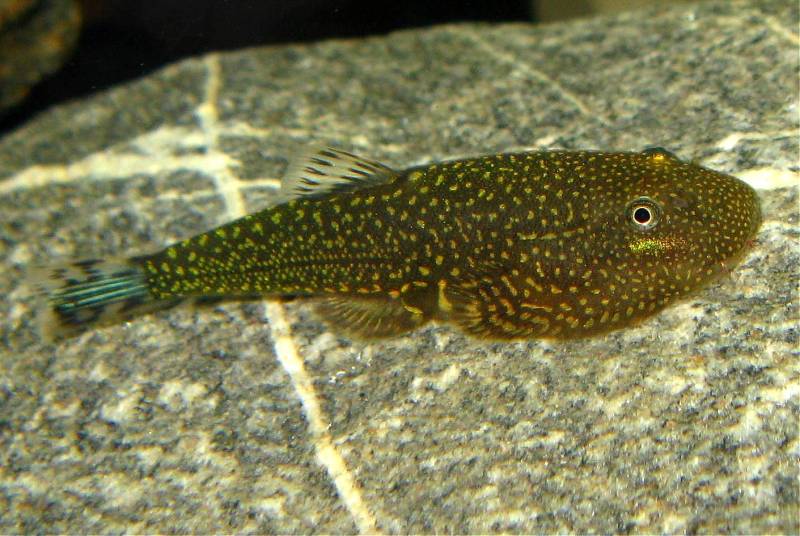
Gastromyzon stellatus
Gastromyzontidae · Tan, 2006
One of the more commonly-traded members of the genus and often found in mixed shipments which may contain other Gastromyzon spp. or related fishes like Beaufortia kweichowensis. These are typically labelled 'Borneo sucker', 'Hong Kong pleco', 'butterfly loach', etc. regardless of species. It's sometimes misidentified as G. punctulatus, a species not currently traded which possesses yellow finnage and a lighter-coloured, less-intensely spo...
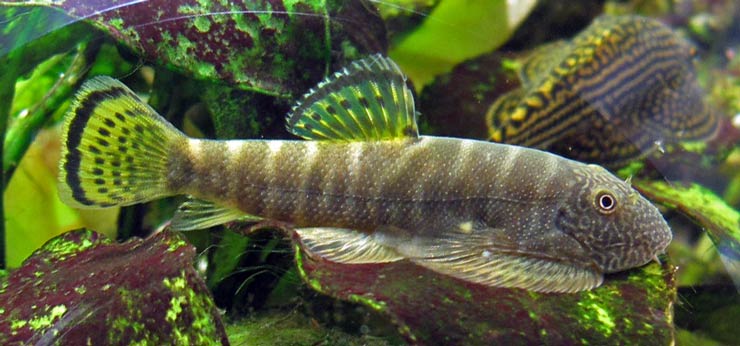
Gastromyzon viriosus
Gastromyzontidae · Tan, 2006
Many loaches from the families Nemacheilidae, Balitoridae and Gastromyzontidae are also suitable but research your choices before purchase in order to be sure as some are excessively aggressive or otherwise competitive. Gastromyzon spp. tend to exist in lo...
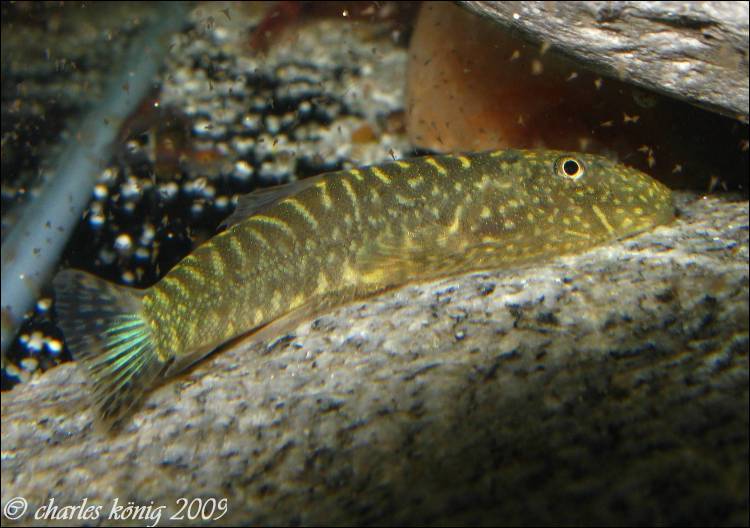
Gastromyzon zebrinus
Gastromyzontidae · Tan, 2006
Much of the natural diet is likely to be composed of benthic algae plus associated micro-organisms which are rasped from solid surfaces. In captivity it will accept good-quality dried foods and meatier items like live or frozen bloodworm but may suffer internal problems if the diet contains excessive protein. Home-made foods usi...
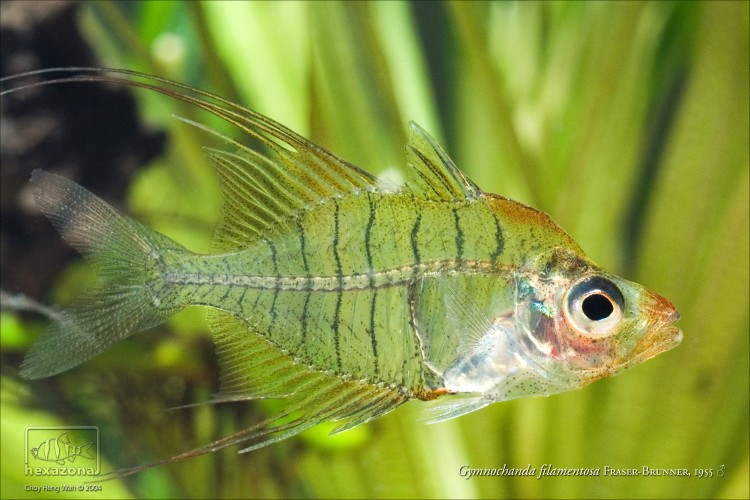
Gymnochanda filamentosa
Ambassidae · Fraser-Brunner, 1955
G. filamentosa has appeared in the ornamental trade but is evidently delicate and therefore recommended only to experienced aquarists. It can be told apart from congeners by the following combination of characters: possession of filamentous dorsal and anal-fin rays in males; body transparent to translucent yellowish-brown colour in life; absence of a highly-extended second anal-fin spine; absence of carmine-red pigmentation in the dorsal, anal an...
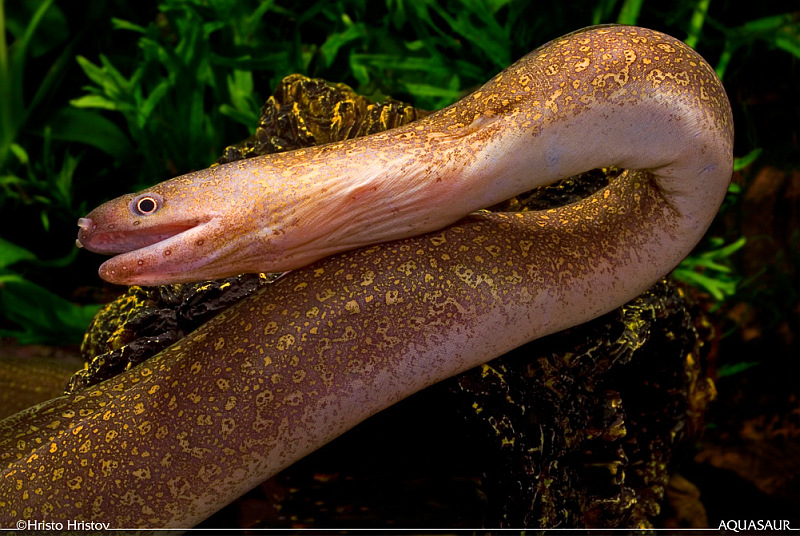
Gymnothorax tile'Freshwater' Moray Eel
Muraenidae · Hamilton, 1822
Gymnothorax tile
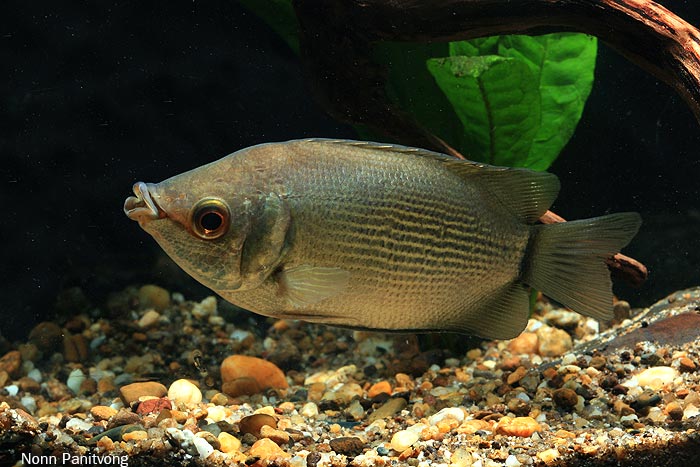
Helostoma temminkiiKissing Gourami
Helostomatidae · Cuvier, 1829
The pinkish-white form of this species is among the most widely-traded aquarium fishes in the world but does not occur naturally and is in fact a leucistic variant bred specifically for ornamental purposes. The 'short-bodied' or 'balloon' variety also continues to be fashionable but under no circumstances do we recommend the purchase of these intentionally disfigured animals which tend to have much shorter life spans than the naturally-shaped fish. There also exists a less-po...
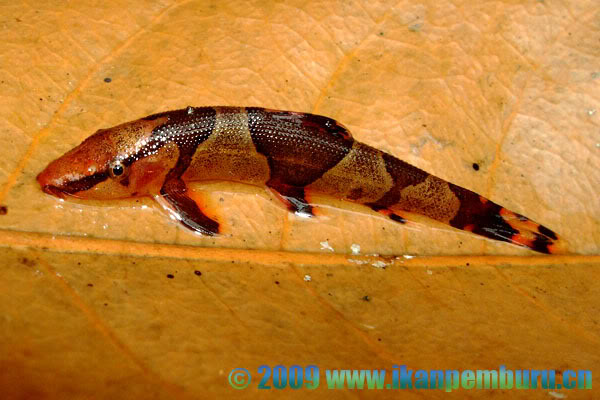
Homaloptera orthogoniataSaddle-back Loach
Balitoridae · Vaillant, 1902
This species appears is rare in the aquarium hobby with the majority of images both online and in the published literature instead depicting H. confuzona or H. parclitella. All three are members of the H. ocellata 'group' within the genus which currently contains H. ocellata, H. bilineata, H. confuzona, H. orthogoniata, H. ogilviei and H. parclitella. Following Tan and Ng (2005) these share possession of...
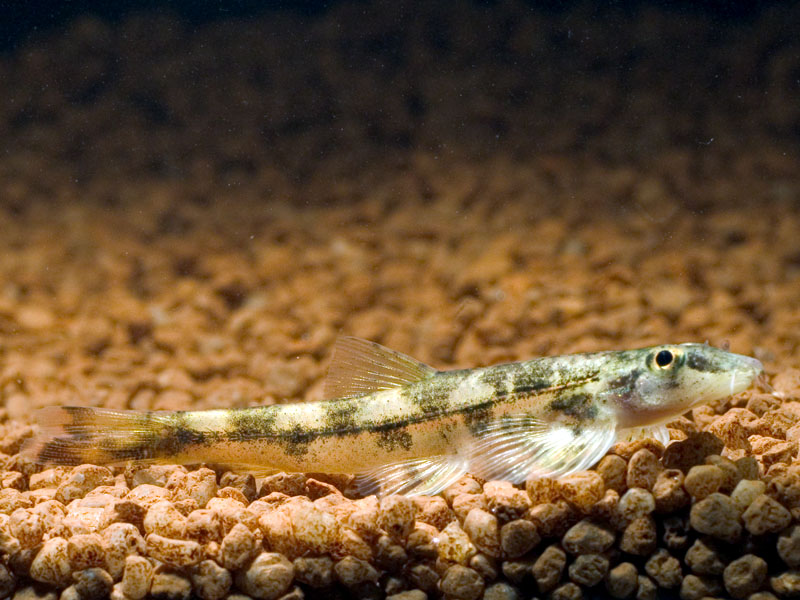
Homalopteroides nebulosus
Balitoridae · Alfred, 1969
The genus Homalopteroides was revalidated by Randall and Page (2012) and is told apart from the related Homaloptera by the following character combination: dorsal-fin origin above pelvic-fin; ≤ 60 lateral-line scales; ≤ 30 predorsal scales; oral morphology consisting of two thin and widely separated rostral barbels on each side of the mouth, thin crescent-shaped lips, the absence of any structure such as a mental pad or lobes between the lateral portions of the lower lip, and a chin that extends anterior to the lateral portions of the lower lip.
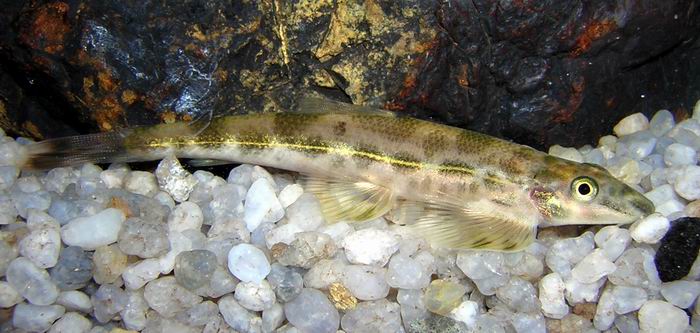
Homalopteroides stephensoni
Balitoridae · Hora, 1932
Tan (2009) redescribed H. stephensoni and it possesses the following unique character set: sub-inferior mouth with thin barbels; five principle, 12-13 secondary pectoral fin rays (usually 12); scaleless belly; pattern of keeled scales on anterior, dorsal portion of body consisting of a single central keel in the posterior third of each scale; 43-50 lateral line...
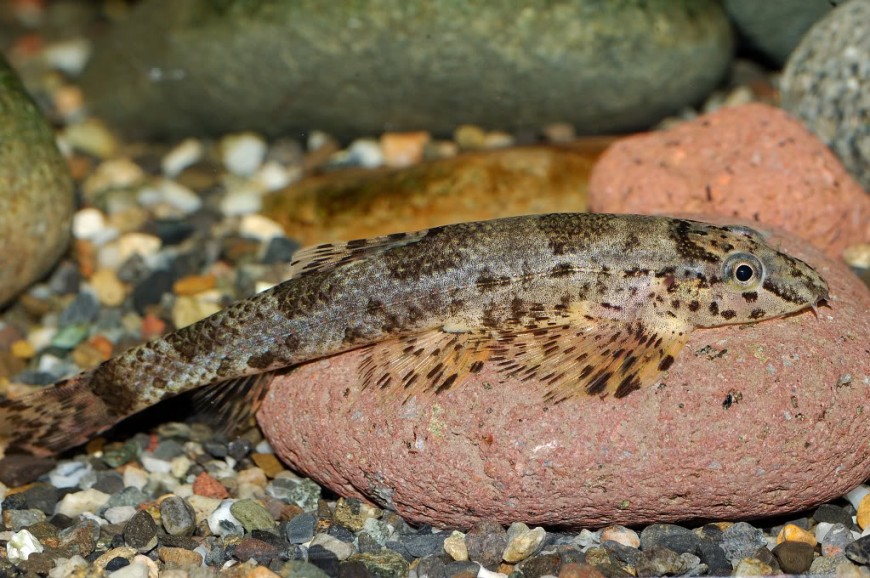
Homalopteroides tweediei
Balitoridae · Herre, 1940
Described from Kota Tinggi district, Johor state, Peninsular Malaysia but since recorded throughout much of the country as well as parts of the the Mekong river system in Thailand, Laos, Cambodia and Vietnam plus the Kapuas and several other river basins in Kalimantan Barat (West Kalimantan) province, Indonesian Borneo. In the Kahang River, part of the Endau drainage in Jo...
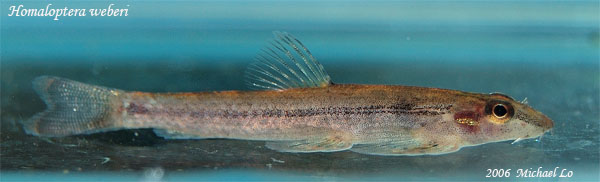
Homalopteroides weberi
Balitoridae · Hora, 1932
An obligate dweller of swiftly-flowing streams and headwaters containing clear, oxygen-saturated water. It often inhabits riffles and runs and is likely to display a preference for shallower zon...
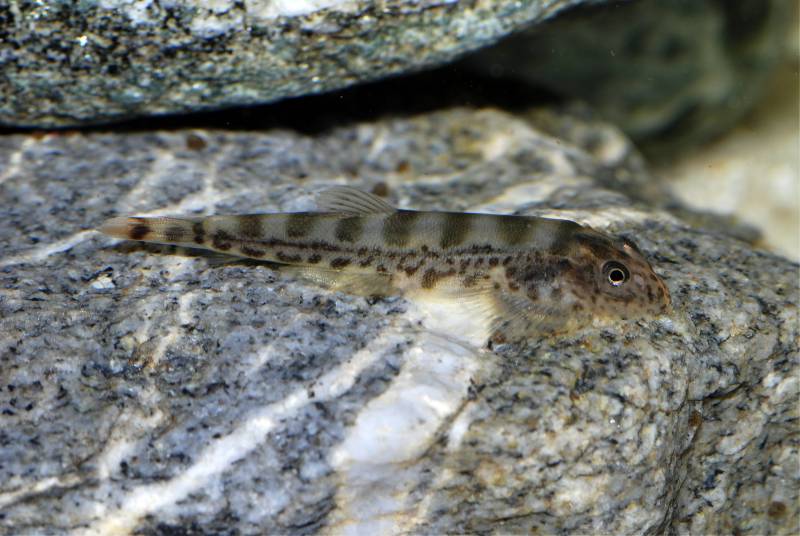
Hypergastromyzon humilis
Gastromyzontidae · Roberts, 1989
The differences in pelvic-fin structure and gill openings led Roberts to redefine the genus when describing H. eubranchus, whereas Tan (2006) expressed doubts that the two are even congeneric but was unable to reach a definitive conclusion in the absence of fresh material. At any rate both species can be easily differentiated from Gastromyzon and Neogastromyzon spp. by observing the mo...
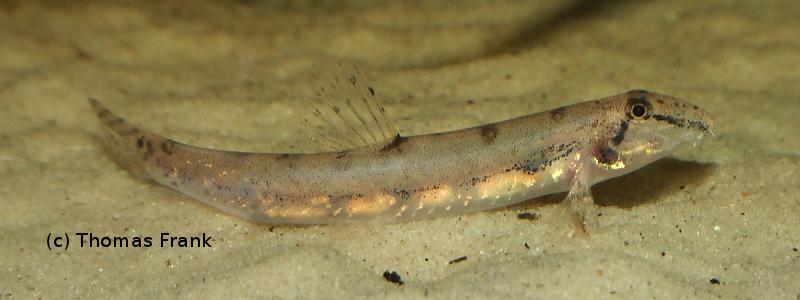
Kottelatlimia hipporhynchos
Cobitidae · Kottelat & Tan, 2008
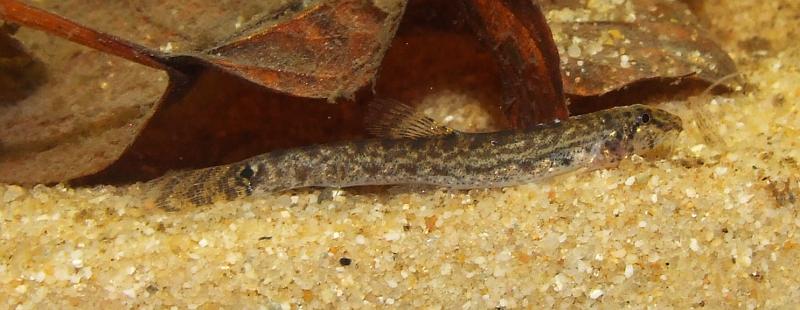
This species differs from congeners in the presence of papillae covering the mouthparts (lips, barbels, and lobes) which are absent in other species. It's also the largest species in the genus and the serrae on the second pectoral fin rays in males form a broa...
Kottelatlimia pristes
Cobitidae · Roberts, 1989
The genus Kottelatlimia was erected by Nalbant (1994) to accommodate K. katik which had previously been assigned to Lepidocephalichthys but differs in various aspects noted earlier by Kottelat and Lim (1992) including: relatively small adult size; scaleless...
Kryptopterus bicirrhis
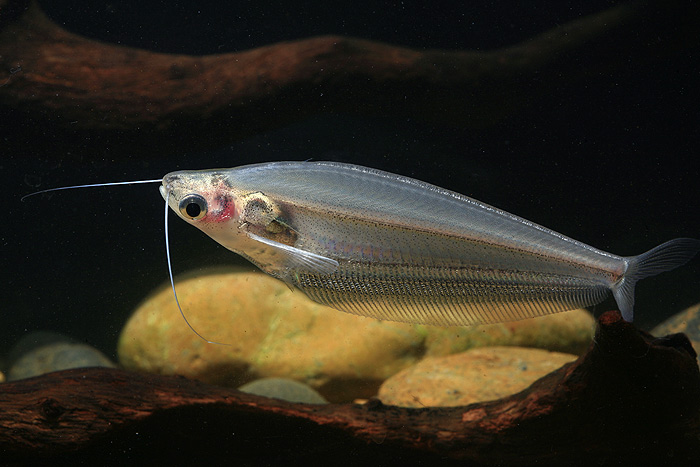
Siluridae · Valenciennes, 1840
Generally peaceful though it may predate on smaller fishes and is somewhat timid so does not compete well with much larger, robust or otherwise boisterous species. Peaceful, comparably-sized cyprinids, loaches and other catfishes perhaps constitute the best options but be sure to research your choices thoroughly prior to purchase.
Kryptopterus cryptopterusBlue Sheatfish
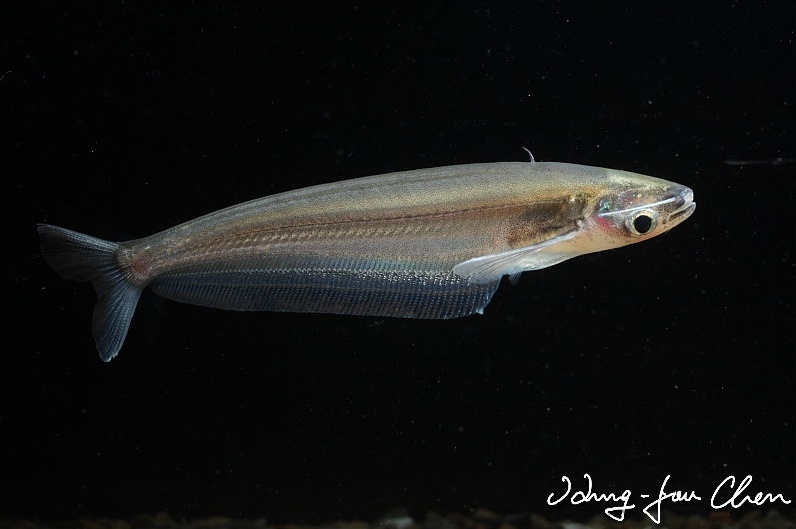
Siluridae · Bleeker, 1851
Known from the Malay Peninsula and Singapore plus Greater Sunda Islands of Sumatra, Borneo and Java in Indonesia with populati0ns from Thailand, Cambodia, Laos and Vietnam formerly considered as conspecific now referred to K. geminus (Ng, 2003). Type locality is given as 'Bandjarmassing' which corresponds to a town now more commonly referred to as 'Banjarmasin' in South Kalimantan (Kalimantan Selatan) province, Indonesia (Borneo).
Kryptopterus limpok
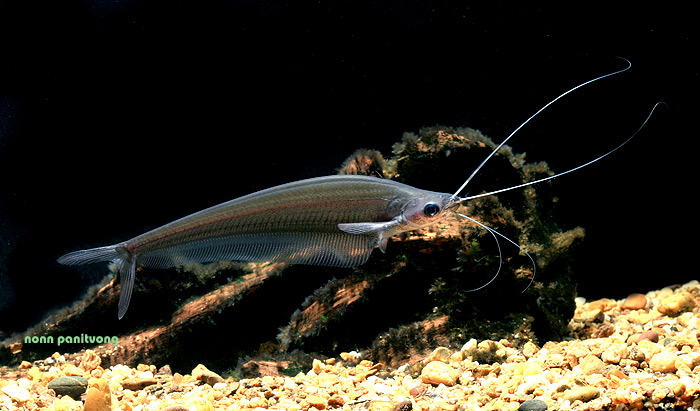
Siluridae · Bleeker, 1852
Type locality is 'Palembang, Sumatra, Indonesia', but this species is widely-distributed throughout much of Southeast Asia including major river systems in Thailand, Laos, Cambodia, Vietnam and Peninsular Malaysia plus the Greater Sunda Islands of Sumatra, Borneo and Java. It's been extensively recorded from the Mekong, Cha...
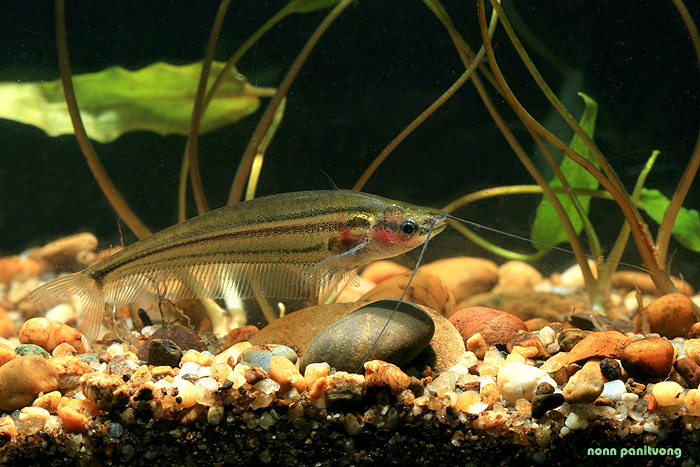
Kryptopterus macrocephalusStriped Glass Catfish
Siluridae · Bleeker, 1858
Has been recorded in fast-flowing environments but most commonly associated with peat swamp forests and associated blackwater streams. Many such habitats have suffered degradation of some kind but in unaltered cases the dense canopy of branches above means very little light penetrates the surface of such environments, and riparian vegetation also tends to grow thickly.
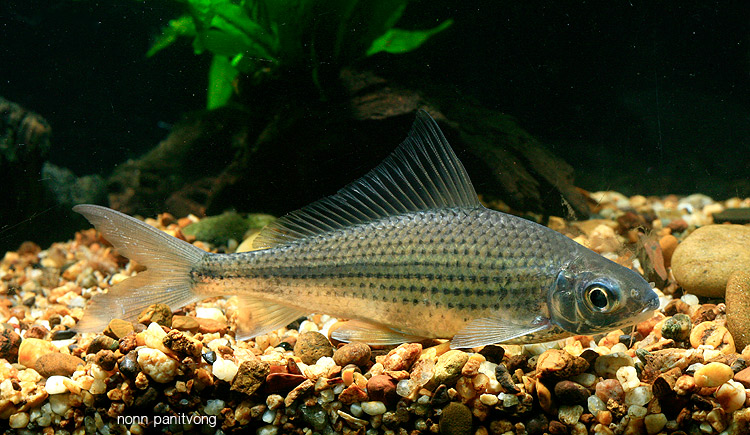
Labiobarbus leptocheilus
Cyprinidae · Valenciennes, 1842
Different populations vary in appearance somewhat (see image of Salween specimen for example), and L. leptocheilus may turn out to represent a group of closely-related species rather than a single taxon. The population from the Cambodian Mekong has been considered to represent a distinct species, Labiobarbus lineatus, although that name is currently a synonym of L. leptocheilus following Kottelat (2013). It is widely used in the ornamental trade, however.
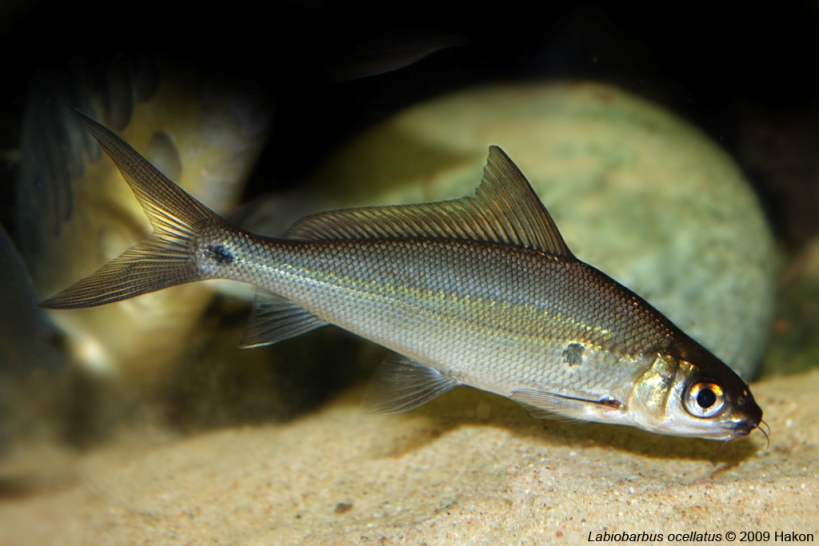
Labiobarbus ocellatus
Cyprinidae · Heckel, 1843
It can be distinguished from congeners by the following combination of characters: 61-68 scales in the lateral series; a small, well-defined, sometimes ocellated black spot on the shoulder and another in the centre of the caudal peduncle; body without longitudinal stripes formed by spots on scales; caudal fin uniformly dusky or colourless, lobes without stripes or black margins.
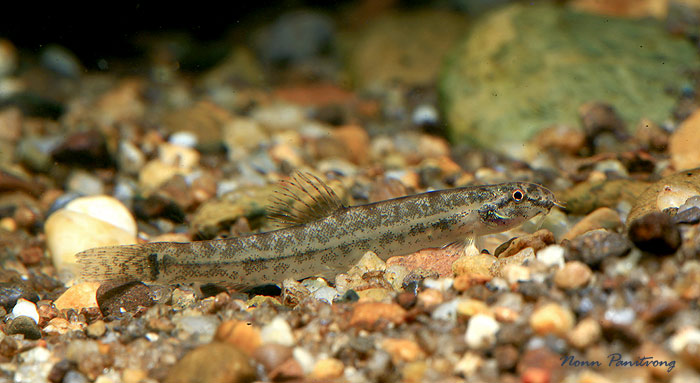
Lepidocephalichthys hasselti
Cobitidae · Valenciennes, 1846
At one locality close to Ban Na Hwai, Chiang Mai Province, Thailand L. hasselti was collected from a shallow (<0.5 m) pool in a swampy zone between forest and rice fields. The substrate was of mud, there was no aquatic vegetation and it was being used as drinking water by local animals, with the only effluent connected to a 'small creek'. Other species found there were Physoschistura pseudobrunneana, Rasbora hobelmani and Systomus cf. orphoides.
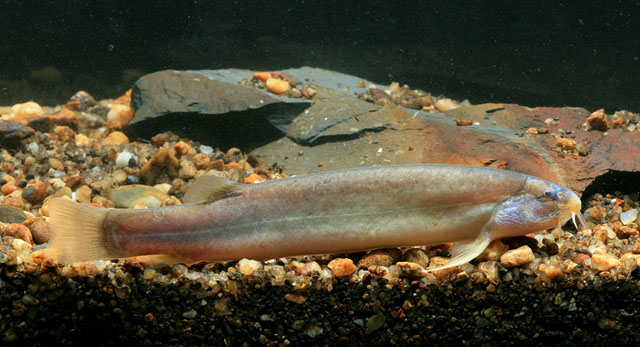
Lepidocephalus macrochir
Cobitidae · Bleeker, 1854
The distribution records for this species are somewhat confusing. It was described from the confluence of the Lamatang and Enim rivers, Palambang Province, Sumatra and has since been recorded from Thailand (Chao Phraya River), Peninsular Malaysia (Pahang River) plus the islands of Java (Solo River) and Borneo (Kapuas and Barito rivers).
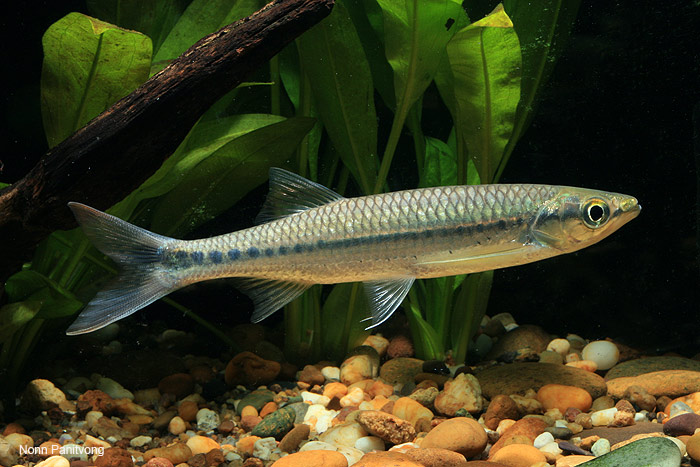
Luciosoma setigerumApollo Shark
Cyprinidae · Valenciennes, 1842
There is a fish of unknown geographical origin which matches the majority of diagnostic features for L. setigerum with the exception that the dark lateral stripe is absent in the anterior portion of the body and is not composed of interconnected spots. It is relatively common in the aquarium trade and included here as L. cf. setigerum until a confirmed identity is established.
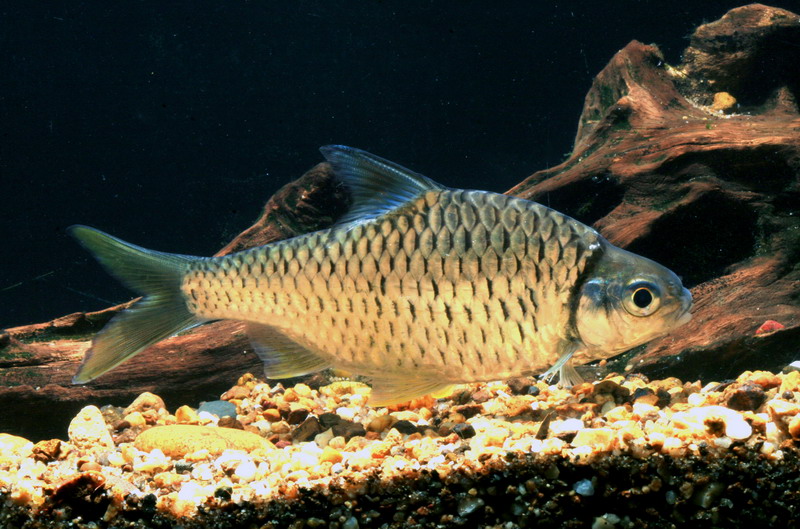
Mystacoleucus obtusirostris
Cyprinidae · Valenciennes, 1842
This species is occasionally marketed as 'Burmese Rainbow Barb' in the ornamental trade. others may have been exported in small numbers or as bycatch among shipments of other species. It was referred to as Mystacoleucus marginatus for decades, but that name is a simultaneous subjective synonym of M. obtusirostris following Kottelat (2013).
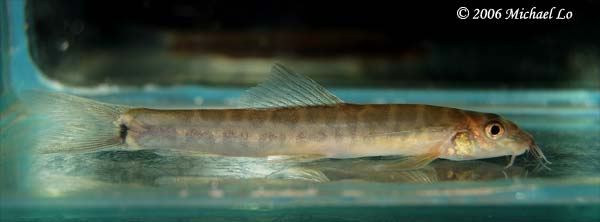
Nemacheilus saravacensis
Nemacheilidae · Boulenger, 1894
Images depict clear, tea-coloured forest streams with dense marginal vegetation and substrates of sand and/or small rocks and pebbles. It's also known from environments with sandy substrate and organic debris in the form of submerged roots/branches and le...
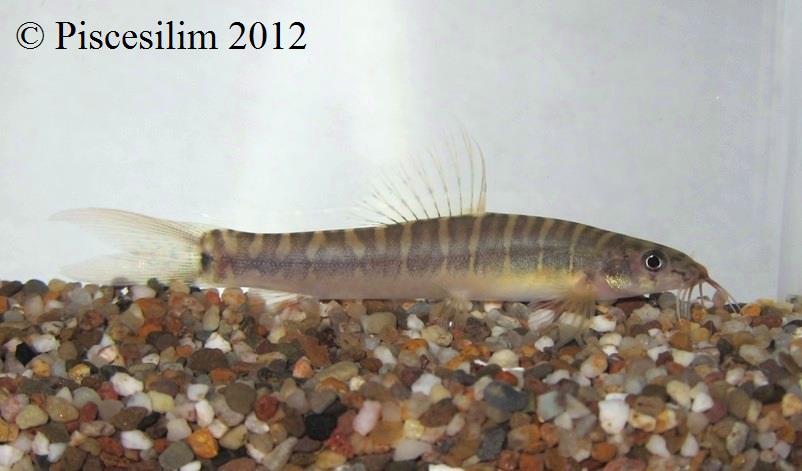
Nemacheilus selangoricus
Nemacheilidae · Duncker, 1904
N. selangoricus is most similar to N. spiniferus since it possesses acuminate scales above and below the lateral line on the caudal peduncle, a feature not shared with any other congener. It can however be distinguished by the following characters: presence of 8-12 very regular dark bars on flanks (vs. 10-13 irregularly-shaped bars in N. spiniferus), 3-5 times...
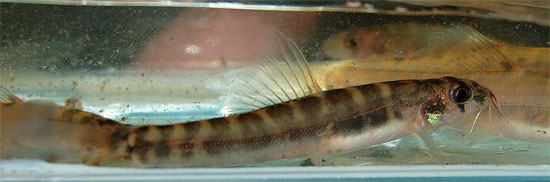
Nemacheilus spiniferus
Nemacheilidae · Kottelat, 1984
It's a member of the N. selangoricus group of species within the genus, an assemblage first recognised by Hadiaty and Kottelat (2009) and characterised by possession of two rows of horizontally-arran...
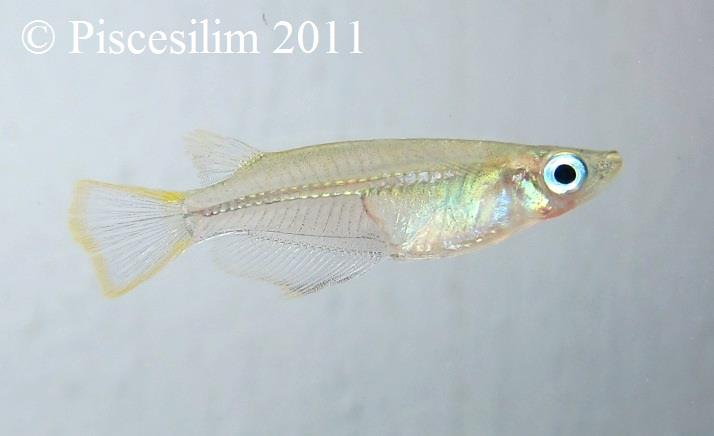
Oryzias javanicusJavanese Ricefish
Adrianichthyidae · Bleeker, 1854
This species is widely-distributed throughout Peninsular Thailand, Malaysia (Malay Peninsula plus the states of Sabah and Sarawak, Borneo), Singapore and Indonesia, with records from the Riau Archipelago, Sumatra, Java, Borneo, Bali, Lombok, and Sulawesi existing in the latter. Type locality is 'Panimbang River, Perdana, Indonesia'. It's typically found in coastal, normally brac...
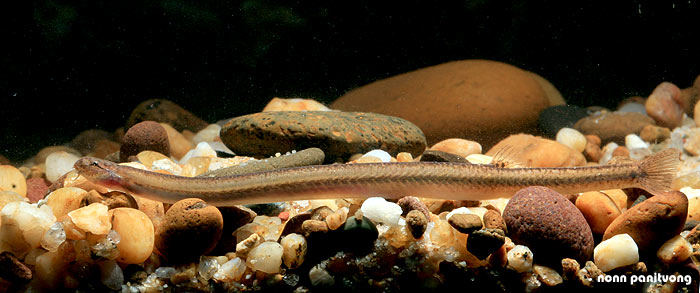
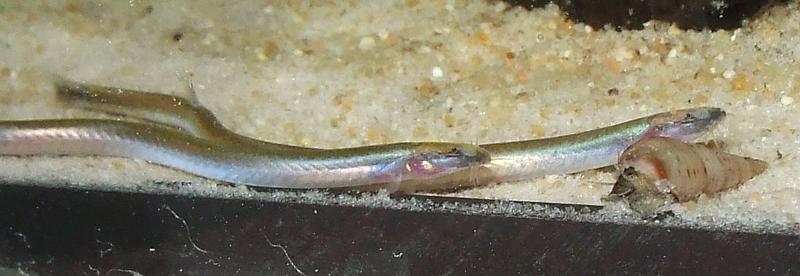
Pangio anguillaris
Cobitidae · Vaillant, 1902
One of a handful of Pangio spp. traded under the generic name 'eel loach'. Wild populations tend to differ in colour pattern to some extent, with some exhibiting a more intense lateral stripe while others display an irregular pattern of fine dark spots on the body, for example.
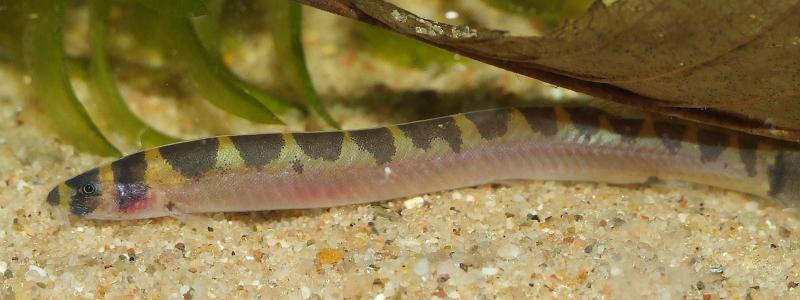
Pangio doriae
Cobitidae · Perugia, 1892
One of a handful of Pangio spp. traded under the generic name 'eel loach', though it's most commonly available as bycatch among shipments of other fishes. Some authors have suggested it may be synonymous with P. anguillaris bu...
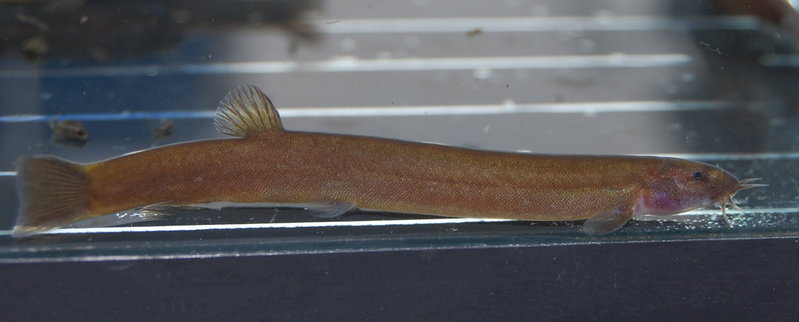
Pangio malayana
Cobitidae · Tweedie, 1956
Originally known only from Johor and Pahang states, Peninsular Malaysia but since recorded from the Batang Hari river drainage, Sumatra and the Kapuas system, Kalimantan Barat (West Kalimantan) province, Indonesian Borneo. Type locality is 'Tahan River, Pahang, Malaysia'.
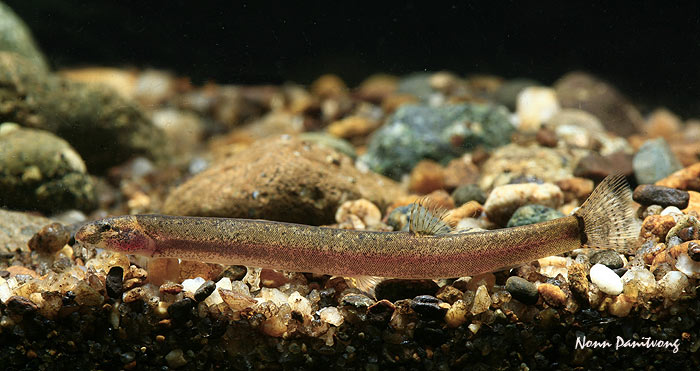
Pangio oblongaBlack Kuhli Loach
Cobitidae · Valenciennes, 1846
Described from close to the city of Bogor, Jawa Barat (West Java) province on the island of Java, Indonesia, but currently considered widespread with recorded occurrences on Java, Sumatra, Borneo and mainland Peninsular Malaysia. Some populations exhibit lighter...
Pangio piperata
Cobitidae · Kottelat & Lim, 1993
Some Sumatran and Bornean populations of the highly variable P. shelfordii superficially resemble P. piperata which can cause issues with identification as the two often occur together. In general however the body patterning in P. piperata is than that of P. shelfordii and they differ in vertebral counts (mode 47 vs. 50, respectively).
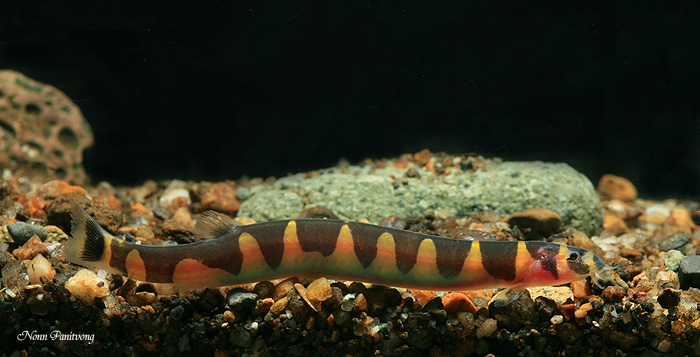
Pangio semicincta'Kuhli' Loach
Cobitidae · Fraser-Brunner, 1940
This species is among the most frequently-misidentified in the hobby, almost always being traded as P. kuhlii. However the latter is currently considered endemic to Java, from where commercial collections are almost unheard of, and has possibly never been seen in aquaria.
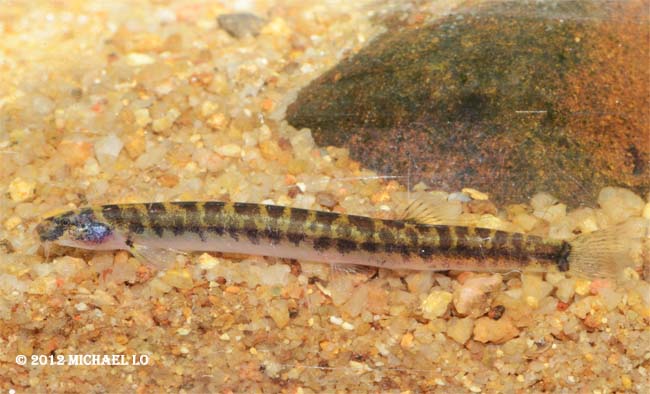
Pangio shelfordii
Cobitidae · Popta, 1903
Patterning is highly variable depending both within and between populations and the species may comprise an assemblage containing a number of taxa (Kottelat and Lim, 1993; Tan and Kottelat, 2009). For example, those from Singapore and Johor possessing intricate mottling on the dorsal surface while individuals from Terengganu have a series of saddle-like markings either alternating or connecting with the midlateral markings.
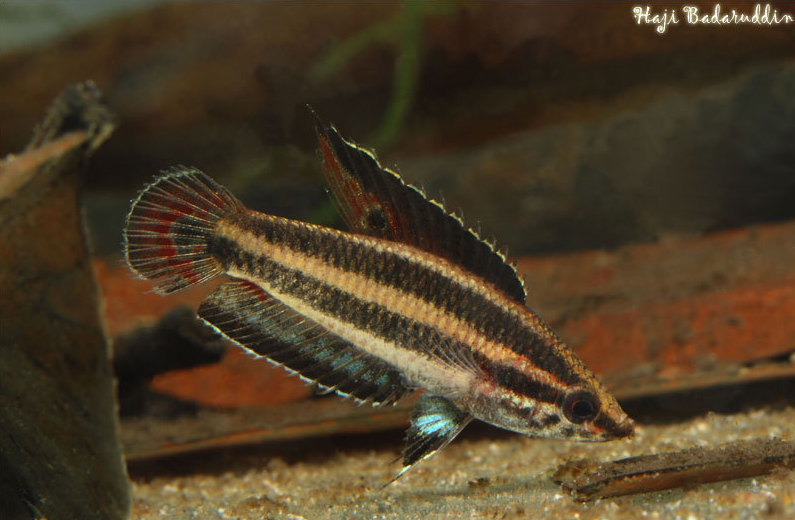
Parosphromenus allani
Osphronemidae · Brown, 1987
Type locality is given only as 'Sarawak state, Borneo, East Malaysia', with the material deriving from Sibu Division in western Sarawak. It's since been recorded at other localities within Sarawak, to which it appears endemic, but it remains unclear whether all represent a single species or not with those from the area around Lundu in northwestern Kuching Division in par...
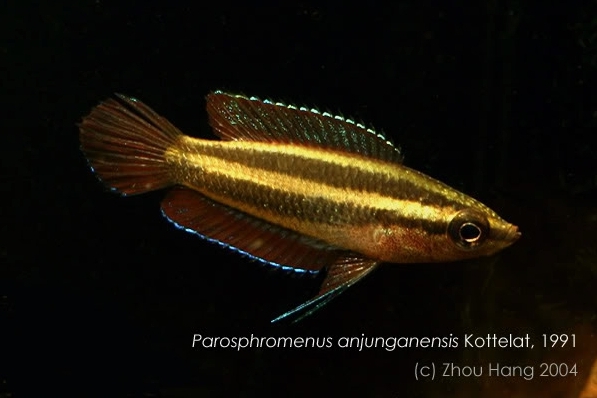
Parosphromenus anjunganensis
Osphronemidae · Kottelat, 1991
It's care requirements, disposition, and especially conservation status dictate that it should be maintained alone or alongside a group of small, peaceful cyprinids such as Boraras or Sundadanio spp. Likewise, different Parosphromenus spp. should not be kept together since the females of many are very difficult to tell apart and some are undoubtedly capable of hybridising.
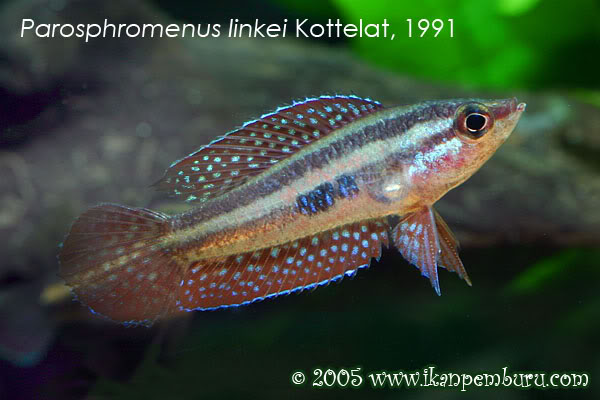
Parosphromenus linkei
Osphronemidae · Kottelat, 1991
This species is said to be slightly easier to maintain than the majority of congeners and is therefore a recommended choice for those new to maintaining Parosphromenus spp. in the aquarium. It's occasionally available on a commercial basis and we've seen it traded as 'moonspot licorice gourami' in the past. There exist at least three colour forms on...
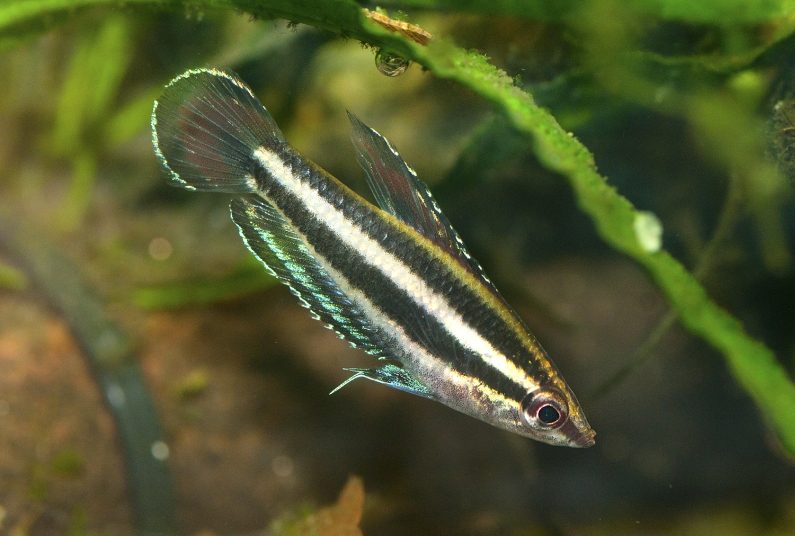
Parosphromenus opallios
Osphronemidae · Kottelat & Ng, 2005
Endemic to Central Kalimantan (Kalimantan Tengah) province, Borneo, Indonesia although the full extent of its range remains somewhat unclear. Initial collections were from the southwestern tip of the province, in the Jelai Bila river basin near Sukamara and Lamand basin close to Pangkalan Bun, both of which are tributaries within the Arut drainage, while it's subsequently been recorded in the Benipah river system further east.
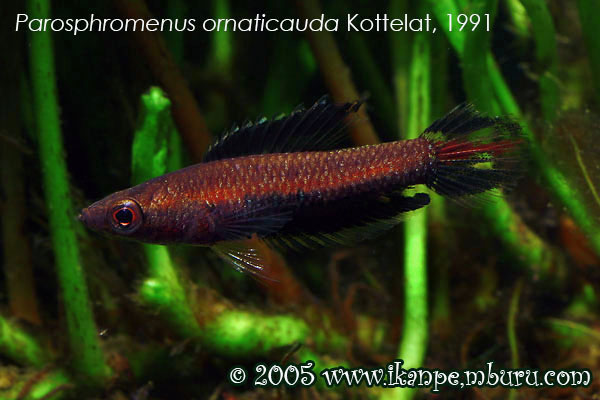
Parosphromenus ornaticauda
Osphronemidae · Kottelat, 1991
This species has occasionally appears in the aquarium trade in substantial quantities but is not an easy species to maintain in captivity and often susceptible to disease post-import. It's sometimes sold as 'ornate licorice gourami'. It's among the smallest members of the gen...
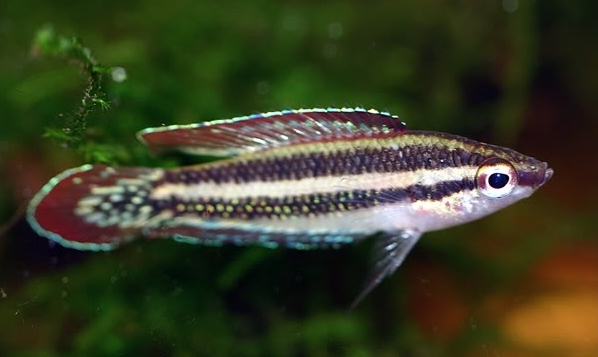
Parosphromenus quindecim
Osphronemidae · Kottelat & Ng, 2005
This species has occasionally been traded on a commercial basis and was known as P. sp. 'Manis Mata' prior to description, with the latter apparently referring to a location some 100 km away from the type locality where the fish do not occur. It's said to be slightly easier to maintain than the majority of congeners and is therefore a recommended choice for those ne...
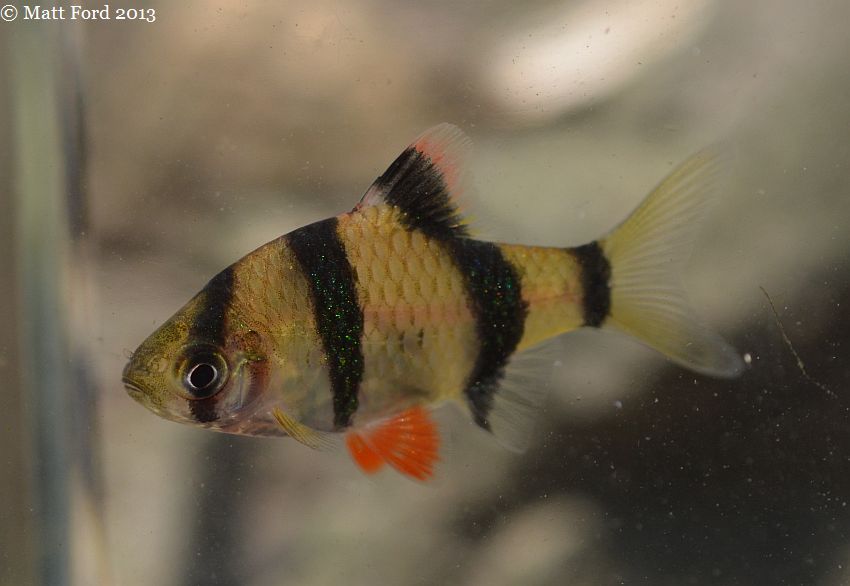
Puntigrus anchisporus
Cyprinidae · Vaillant, 1902
This species occasionally appears in the aquarium hobby, but the trade is largely reliant on commercially-produced 'tiger barbs' of questionable origin. It is distinguished from congeners by the following combination of characters: lateral line complete; 14 circumpeduncular scales; 21-23+2 scales in the lateral row; dorsal-fin black with red outer band; pelvic fins red.
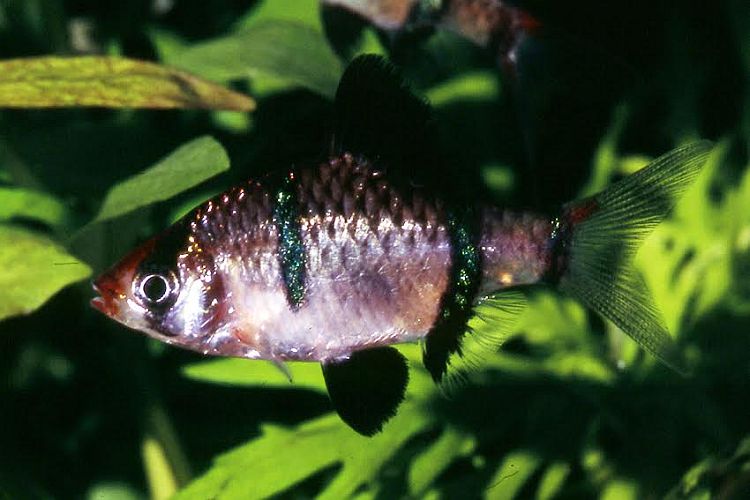
Puntigrus pulcher
Cyprinidae · Rendahl, 1922
This species occasionally appears in the aquarium hobby, but the trade is largely reliant on commercially-produced 'tiger barbs' of questionable origin. It was considered a synonym of P. anchisporus for a number of decades following Alfred (1963), but revalidated by Kottelat and Tan (2011).
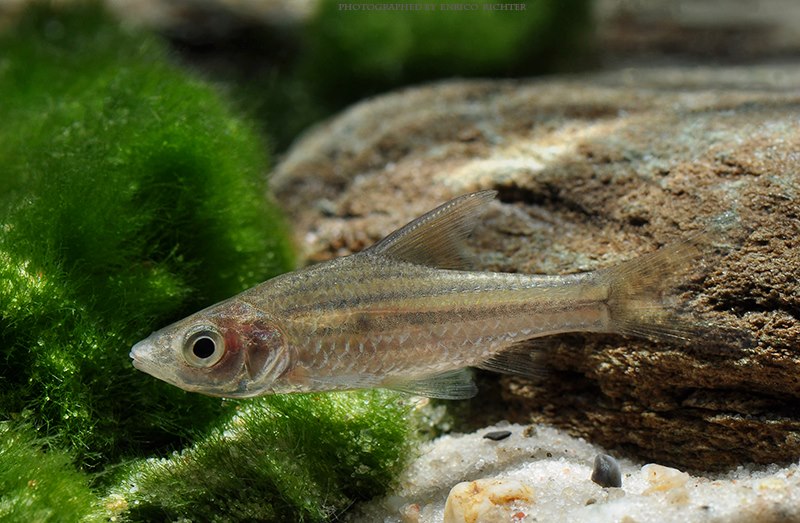
'Puntius' lineatusLined Barb
Cyprinidae · Duncker, 1904
One of four similar-looking, laterally-striped 'Puntius' spp. native to Southeastern Asia alongside 'P.' gemellus, 'P.' johorensis, and 'P.' trifasciatus. Of these 'P.' lineatus is most often confused with 'P.' johorensis by virtue of the fact that these two seem most common in the aquarium trade. Telling them apart is relatively simple since 'P.' lineatus has 0 - 1 pairs of barbels (vs. 2 pairs in the other three species), juv...
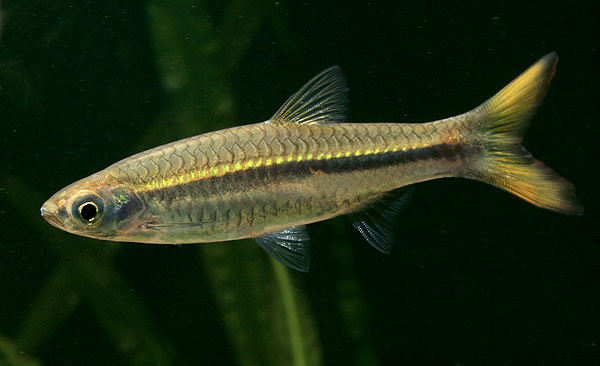
Rasbora dusonensis
Cyprinidae · Bleeker, 1850
The identity of this species was unclear for a number of decades prior to its redescription by Ng and Kottelat (2013). The confusion originated with Brittan (1954) who misidentified specimens of R. tornieri as R. dusonensis and was exacerbated by Alfred (1963) who concluded that the holotype of R. dusonensis was conspecific with R. myersi.
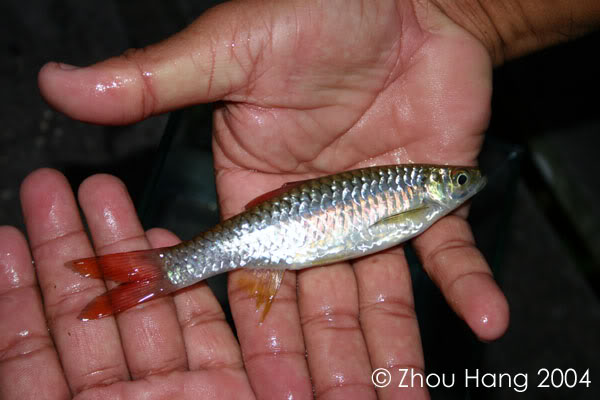
Rasbora tornieri
Cyprinidae · Ahl, 1922
Type locality is 'Central Sumatra, Indonesia', with additional records existing from Cambodia (Mekong drainage), Peninsular Malaysia (Perak River), Sumatra (from the Siak River, Riau province to the Musi River, South Sumatra (Sumatera Selatan) province) and Borneo (south and westwards from the Belait river basin in Brunei Darussalam to the Sambas drainage in West Kalimantan (Kalimantan Barat) province, Indonesia and probably in Sarawak, Malaysia).
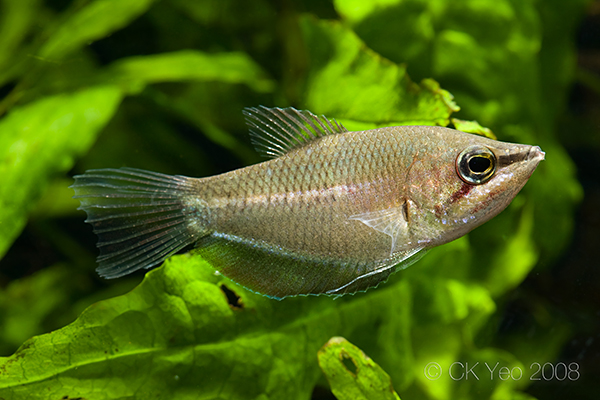
Sphaerichthys acrostomaGiant Chocolate Gourami
Osphronemidae · Vierke, 1979
This species is traded under several names of which others include 'sharp-nosed gourami', 'moonlight chocolate gourami', 'black-lined chocolate gourami' and 'black-tailed chocolate gourami', though it's far from common in the hobby. Its unique colour pattern makes it difficult to confuse with any of the three other members of the genus even in the absence of meristic data.
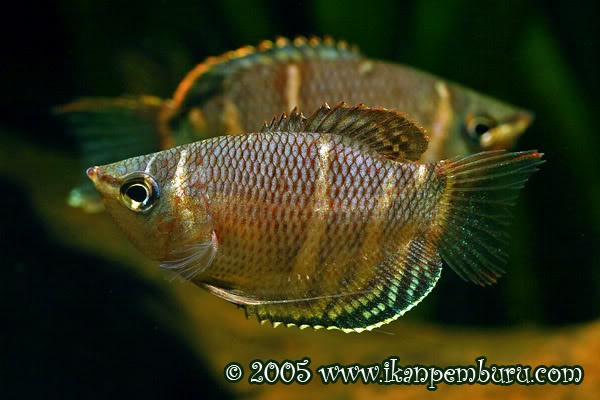
Sphaerichthys osphromenoidesChocolate Gourami
Osphronemidae · Canestrini, 1860
The genus Sphaerichthys currently comprises four species with S. osphromenoides by far the best known in the hobby. It's easily distinguishable from the congeners S. vaillanti and S. acrostoma since both exhibit a notably more elongate head and body profile, reverse sexual dimorphism (i.e. females are the more colourful/strongly-patterened), and are paternal mouthbrooders.
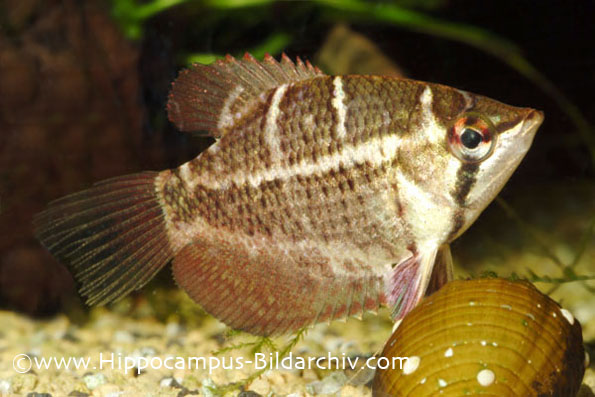
Sphaerichthys selatanensisCrossband Chocolate Gourami
Osphronemidae · Vierke, 1979
This species is only occasionally seen in the hobby and sometimes sold as 'cherry chocolate gourami'. It was originally described as a subspecies of S. osphromenoides since the two are very similar-looking but has been considered a species in its own right since the late 1980s. The two differ in the number ofrays (7 in S. selatanensis vs. 9-10 in S. osphromenoides),rays (7 vs. 8),...
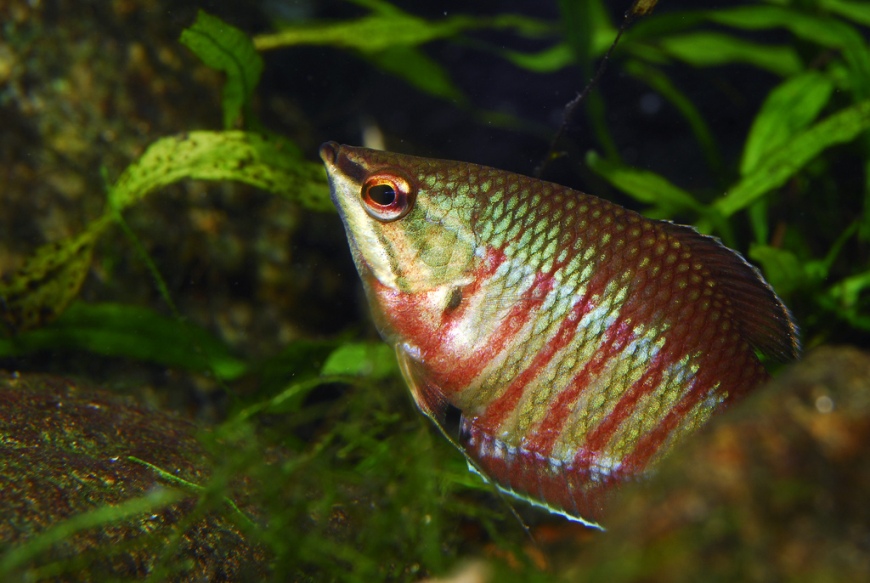
Sphaerichthys vaillantiVaillant's Chocolate Gourami
Osphronemidae · Pellegrin, 1930
This species is traded under several names of which others include 'Samurai gourami' and 'Samurai Zebra Chocolate Gourami'. Though the former of these is arguably the most common, these names are potentially misleading since the fish is neither especially combative nor from Japan. Its unique colour pattern makes it difficult to confuse with any of the three other members of the genus even in the abse...
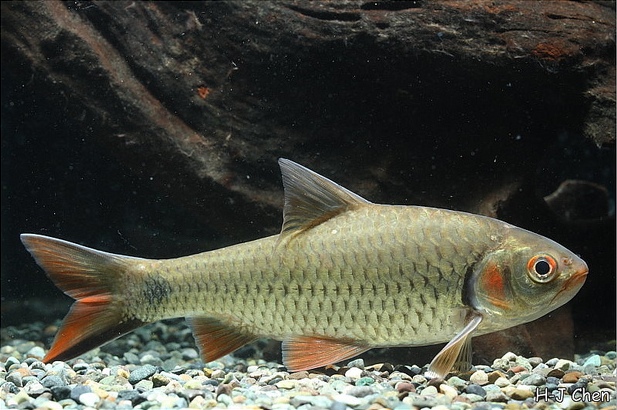
Systomus orphoides
Cyprinidae · Valenciennes, 1842
The genus Puntius is currently viewed as something of a catch-all for well over 100 species of small to mid-sized cyprinid. Most experts agree that a full revision is required with the likely outcome that many species will be placed into new or different genera since it is clearly polyphyletic. When describing the grouping in 1822 Hamilton identified the defining characteristics as: presence or absence o...
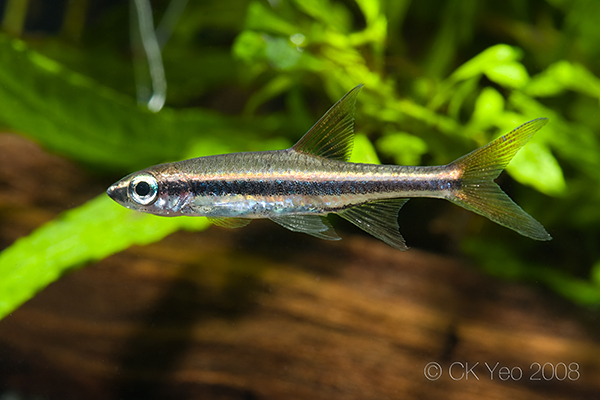
Trigonopoma gracile
Cyprinidae · Kottelat, 1991
This species occurs in several colour forms depending on collection locality with some exhibiting more intense pigmentation in the fins or an additional reddish lateral stripe, for example. It's sometimes said to closely resemble and occur sympatrically with Rasbora agilis, but that name is currently considered a junior synonym of the congener Trigonopoma pauciperforatum. R. agilis had previously been us...
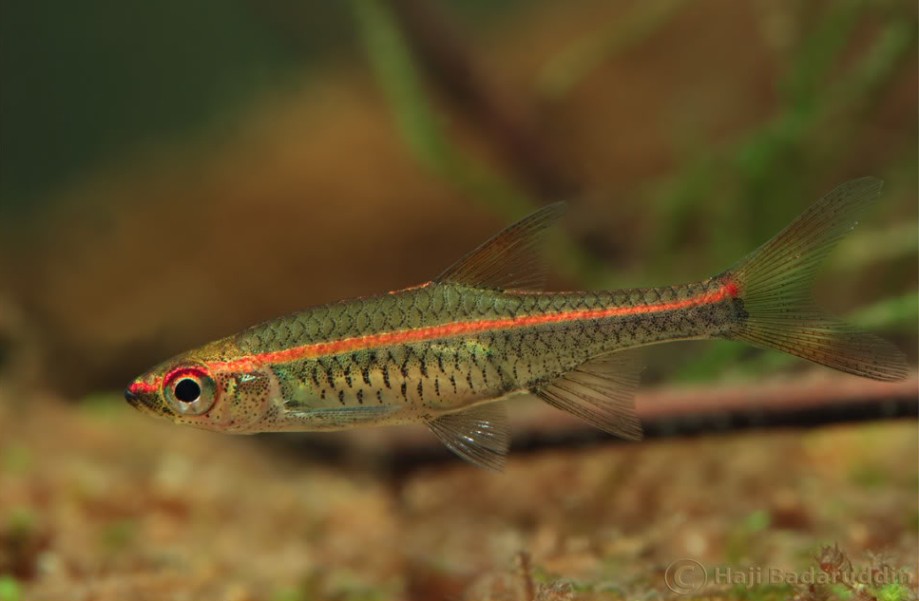
Trigonopoma pauciperforatumGlowlight Rasbora
Cyprinidae · Weber & de Beaufort, 1916
This species is also sold as the 'redline' rasbora which is something of a misnomer as in reality the colour of the lateral stripe that gives rise to the name can vary from deep orange to golden depending upon the collection locality of the fish as well as diet, condition, and even mood. Some specimens also have a second, darkish stripe beneath the other which seems to vary in length and intensity depending on a similar array of factors. Older fish tend to possess a greater degree of black edging to the scales, especially in the ventral portion of the body.
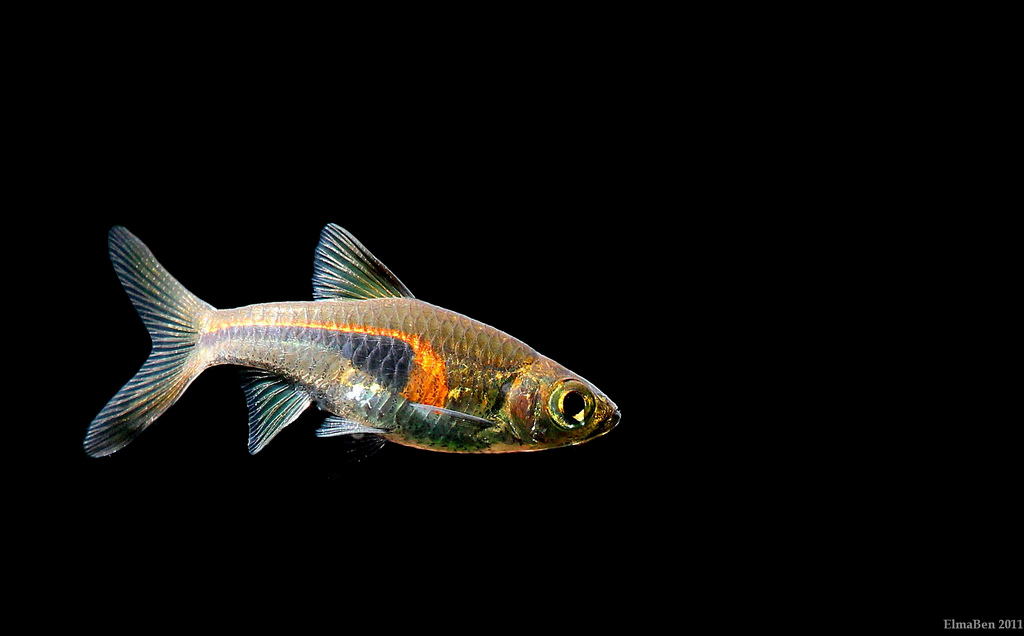
Trigonostigma hengeli
Cyprinidae · Meinken, 1956
T. hengeli is sometimes seen for sale with the trade name of 'glowlight rasbora' due to the distinctive orange patterning on the posterior part of the body but we've refrained from using that name here because it's also commonly applied to Trigonopoma pauciperforatum. It can be confused with the similar-looking T. heteromorpha and T. espei although on close inspection they're actually quite easy to tell...
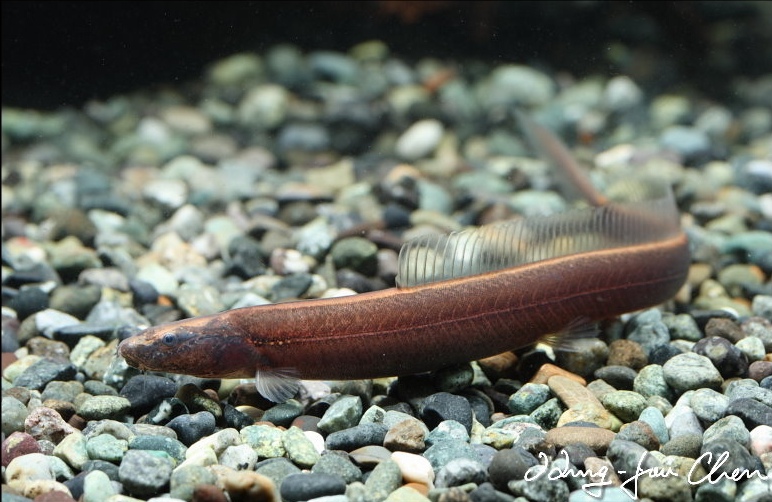
Vaillantella maassiFork-tailed Loach
Vaillantellidae · Weber & de Beaufort, 1912
This species is traded under various names including 'chocolate scissor-tailed loach', chocolate long-finned loach', 'red line cobra loach', 'spiny eel loach' and 'dragon loach'. It's apparently difficult to find in its natural habitats and thus time-consuming to collect, meaning it's rarely traded in numbers, sought after by enthusiasts and tends to carry a relatively high price tag when available. The genus currently contains just three...
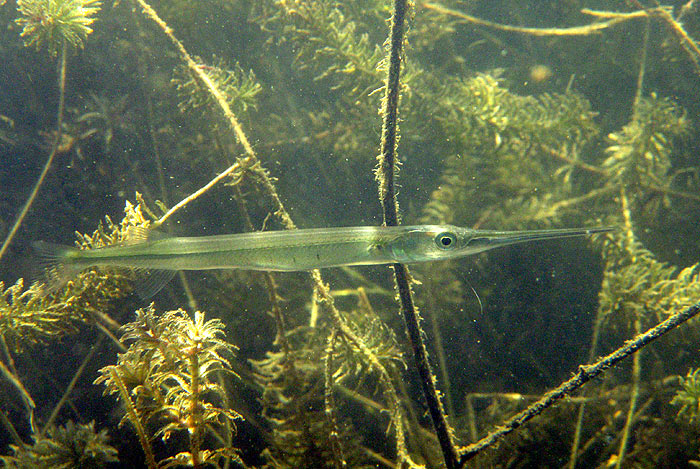
Xenentodon canciloides
Belonidae · Bleeker, 1854
This species is a near-exclusive inhabitant of the upper water column and appreciates surface cover in the form of floating or overhanging vegetation. Other décor is relatively unimportant but can consist of a sandy substrate with leaf litter plus some large driftwood branches and twisted roots. Plants which can grow rooted in sand can al...
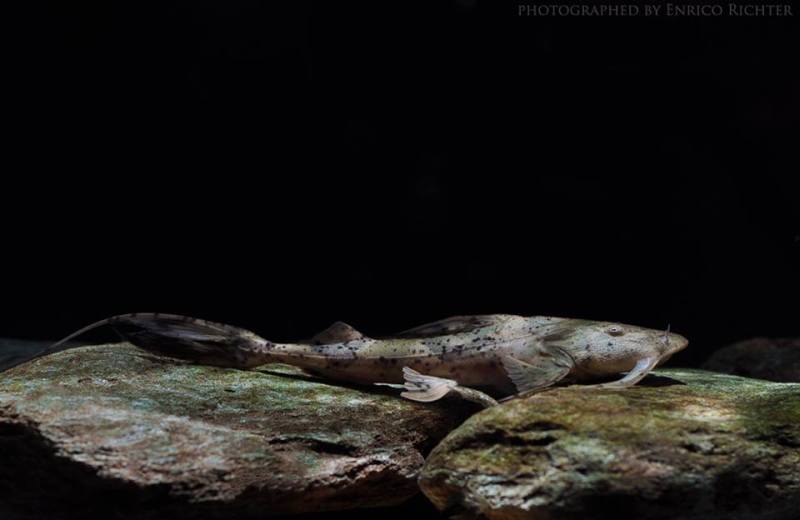
Bagarius yarrelliGoonch
Sisoridae · Sykes, 1839
This species is clearly unsuitable for the home aquarium given its eventual size and natural behaviour, and we know of only a handful of private aquarists with the facilities required to house it long-term. The grouping currently contains four species but is in urgent need of review with a number of additional taxa thought to exist and B. yarrelli possibly representing a synonym of B. bagarius.
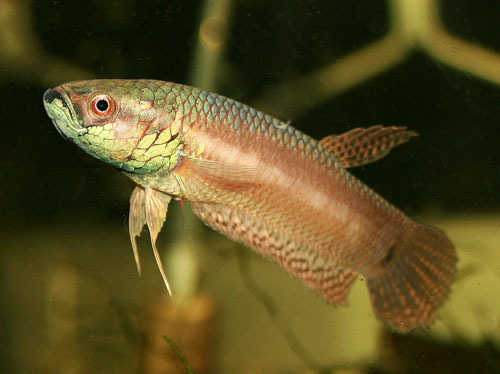
Betta pallifina
Osphronemidae · Tan & Ng, 2005
This species is included in the Betta unimaculata complex of closely-related species within the genus, of which members share the following set of characters: body long and slender with depth at dorsal fin origin 18-25 % SL; head large and blunt with width 19-24 % SL; long maxilla and lower lip with distance from tip of lower jaw to posterior end of maxilla 27-54 % HL; caudal-fin rounded in shape, occasionally with elongated median rays; pelvic-fin short and filamentous; dorsal and anal fins relatively pointed.
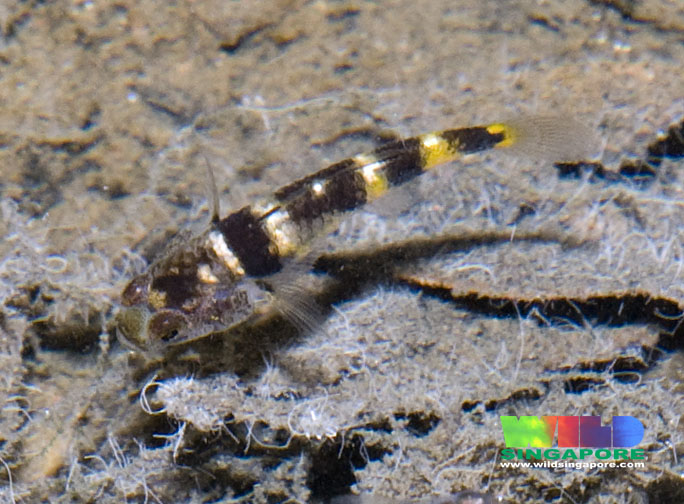
Brachygobius kabiliensisKabili bumblebee goby
Gobiidae · Inger, 1958
It can be diagnosed as follows: <30 lateral scales; two black body bands reaching ventral midline posterior to anal-fin; band above anal-fin also reaching ventral midline no black band on head, though the first band may touch the posterior margin of the eye; band above anal-fin not reaching ventral midline; 6 branched anal-fin rays; 7-8 predorsal scales. Brachygobius currently contains 9 described species but is likely to prove more diverse should a review be carried out. Alt...
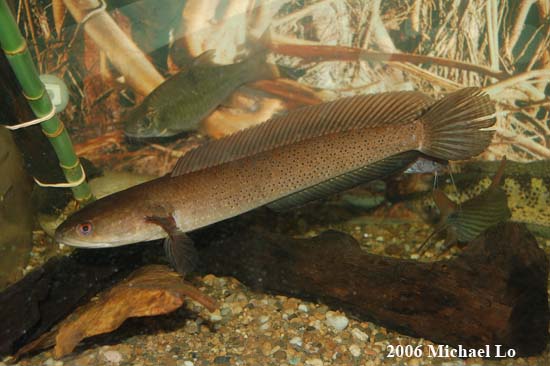
Channa baramensisBaram Snakehead
Channidae · Steindachner, 1901
This species was considered a synonym of Channa melasoma for a number of years prior to its revalidation by Ng. et al. (1996). Specimens larger than around 120 mm SL can be distinguished by possession of a black spot in the centre of numerous body scales and a barred caudal-fin pattern, characters which are missing in both C. melasoma and the similar-looking C. cyanospilos.
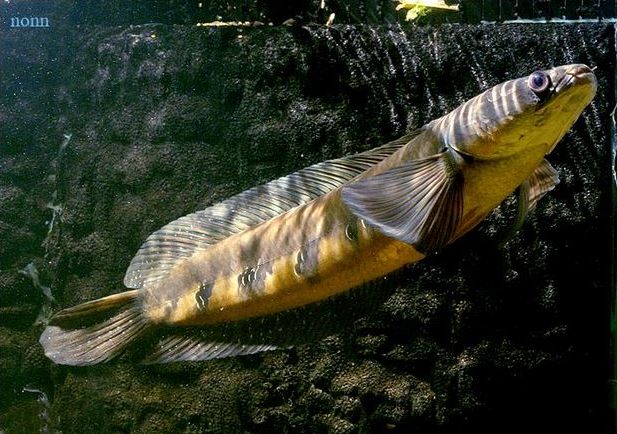
Channa marulioidesEmperor Snakehead
Channidae · Bleeker, 1851
This species is often confused with the nominal congeners C. marulius (Hamilton, 1822) and C. melanoptera (Bleeker, 1855) with all three presenting taxonomic problems. For example, C. marulioides exhibits a number of variations in colour pattern depending on collection locality with the most common possessing a brownish base colour with a series of dark, chevron-like markings along each flank and some scales margined posteriorly in white.
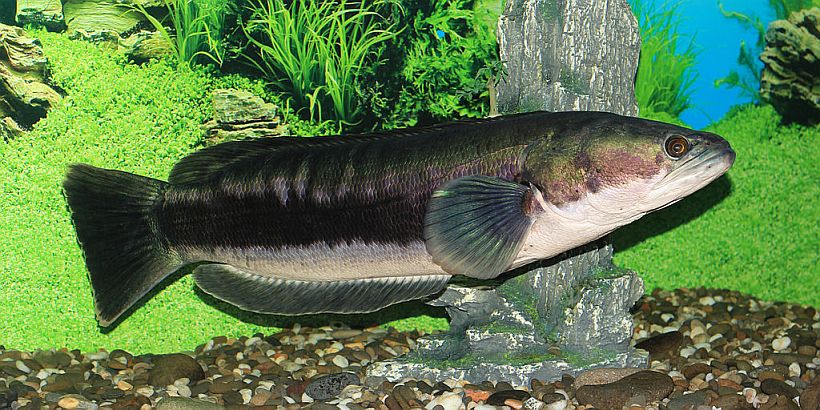
Channa micropeltesGiant Snakehead
Channidae · Cuvier, 1831
C. micropeltes is also referred to as 'Indonesian', 'red', or 'redline' snakehead, the latter names in reference to the appearance of juveniles which often appear in the ornamental trade despite its unsuitability for home aquaria. It is somewhat hyperbolised in the media as a fearsome, invasive "monster" fish with a reputation for killing more fish than it can eat, and even the occasional human, although in reality...
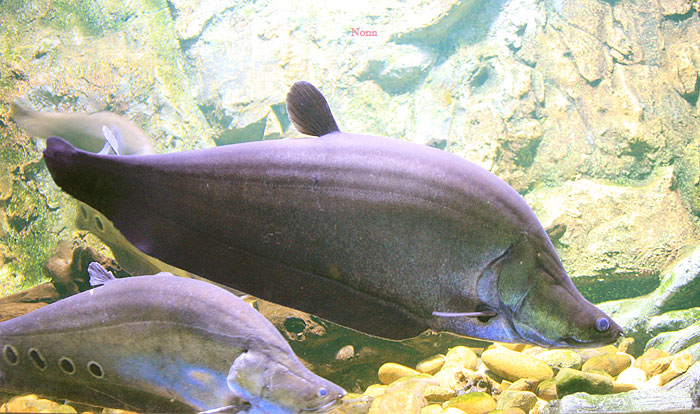
Chitala lopisGiant Featherback
Notopteridae · Bleeker, 1851
This species is not collected for the aquarium trade at time of writing. In contrast to other members of the genus older juvenile and adult individuals lack dark markings on the body while the jaw is more pronounced.
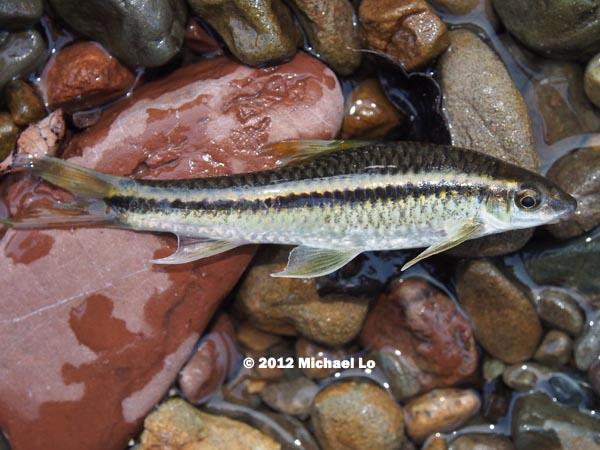
Crossocheilus cobitis
Cyprinidae · Bleeker, 1854
Given its wide natural range it seems logical that this species is or has been available in the aquarium trade, although its correct name may never have been applied. It is told apart from congeners by the following combination of characters: two pairs of barbels; a continuous midlateral stripe from the tip of the snout to the base of the caudal-fin, with a conspicuous small blotch at the posterior extremity, faintly marked on the caudal-fin; a faint mark between the anus and the anal-fin origin in juveniles; a narrow mouth.
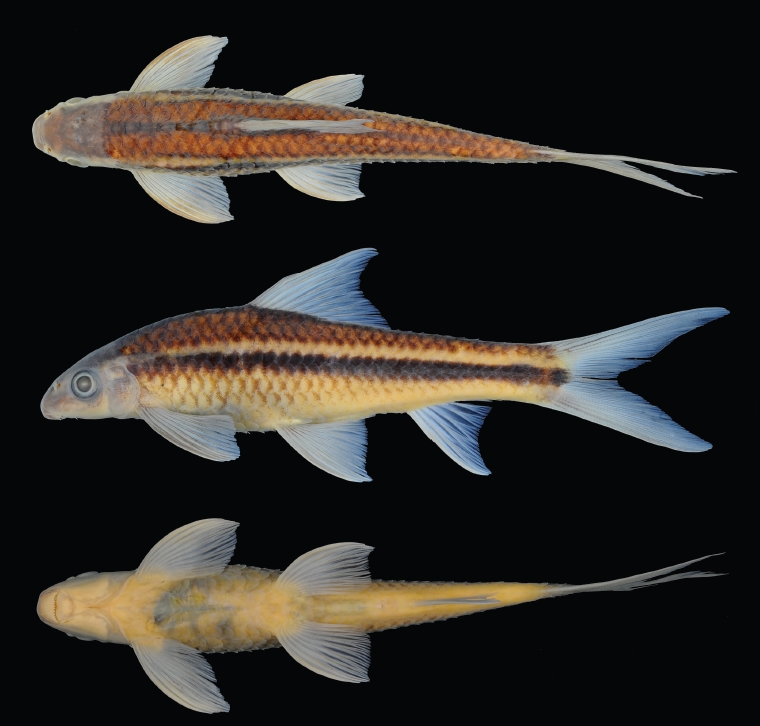
Crossocheilus elegans
Cyprinidae · Kottelat & Tan, 2011
This species can be most easily distinguished from other members of the genus by its colour pattern which consists of a blackish midlateral stripe extending from the tip of the gill opening to the middle of the caudal-fin base, which is separated from the dark brown dorsum by a pale yellowish brown stripe. This differs from the pattern seen in other Crossocheilus species with a black midlateral stripe in which the the dorsum is olive brown and much paler than the midlateral stripe, there is no yellow stripe between the dorsum and the black stripe, and the black stripe extends to the tip of the snout.
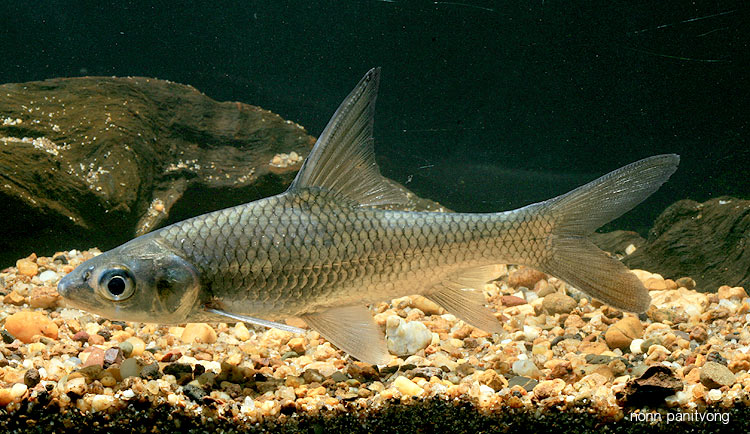
Cyclocheilos enoplos
Cyprinidae · Bleeker, 1849
In the Mekong, it has been observed to migrate upstream from Phnom Penh to Khone Falls between November and February, returning downstream between May and August. The downstream migration ends in the Mekong delta area in Vietnam, where the fish remain until the floods reach their peak in October and November. These lower Mekong migrations mostly comprise juveniles and sub-adults, whereas above Khone Falls...
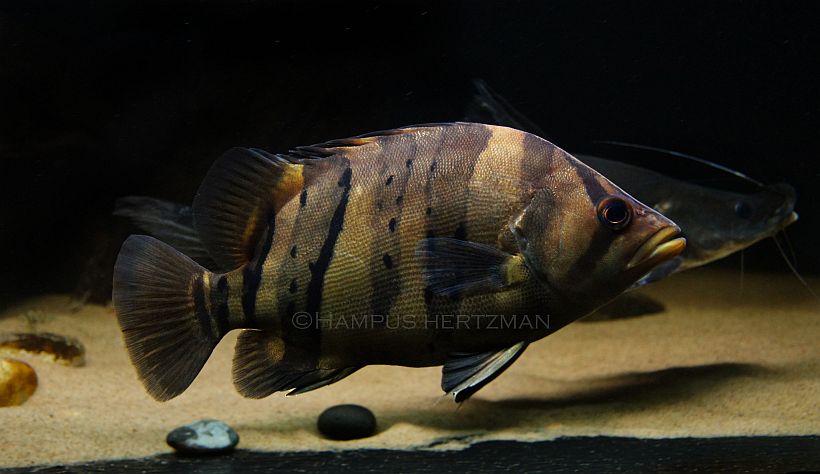
Datnioides microlepisIndonesian Tiger Perch
Datnioididae · Bleeker, 1854
In aquarium literature this species is also referred to as 'fine scaled tiger fish', 'Indonesian tiger fish', 'Sumatran tiger fish', 'Indo datnoid', and 'Indo dat'. The common name of 'tiger fish' is also used in reference to the African alestid genus Hydrocynus, and the more appropriate 'tiger perch' was suggested by Roberts and Kottelat (1994).
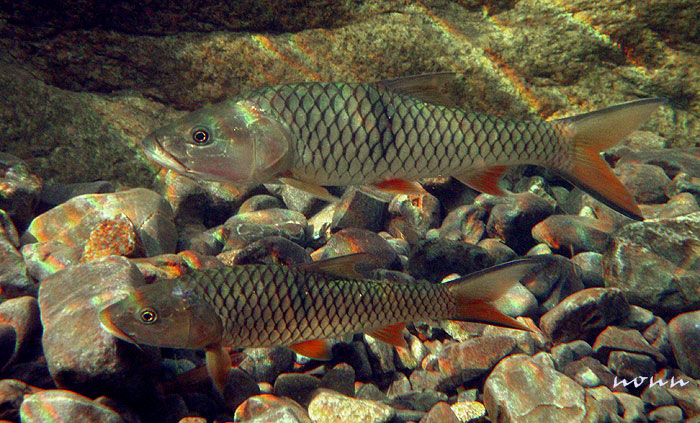
Hampala macrolepidotaHampala Barb
Cyprinidae · Kuhl & van Hasselt, 1823
This species is also known by the vernacular 'jungle perch' or 'sidebar barb' and should not be considered an aquarium subject in all but the most extreme circumstances since it can grow to over 2 feet in length, weigh in excess of 5 kg and is a powerful, pelagic predator. It's also a popular sport fish with a reputation for striking hard.
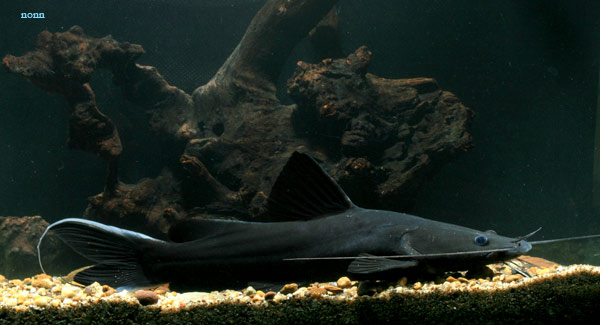
Hemibagrus wyckiiCrystal-eyed Catfish
Bagridae · Bleeker, 1858
Aggressively territorial and incompatible with other fishes in all but the largest public installations and even then may attack its tankmates. It's also one of few freshwater fishes that appear unafraid of humans meaning care must be exercised when performing maintenance.
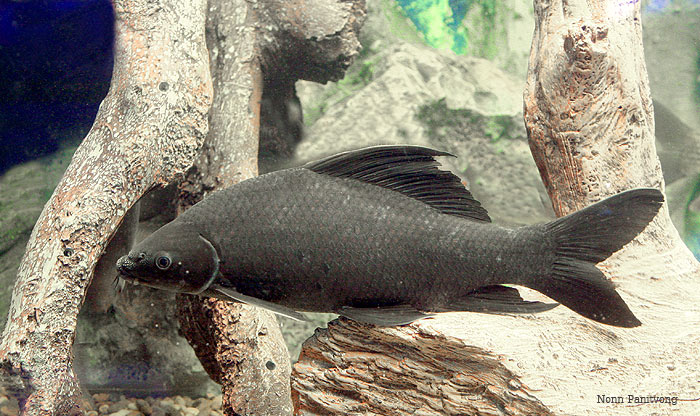
Labeo chrysophekadionBlack Shark
Cyprinidae · Bleeker, 1849
L. chrysophekadion is also known as 'black sharkminnow'. It continues to be available in the ornamental trade despite its patent unsuitability for the home aquarium, and an albino form has been selectively bred for the purpose. It can be distinguished from other members of the genus by the following combination...
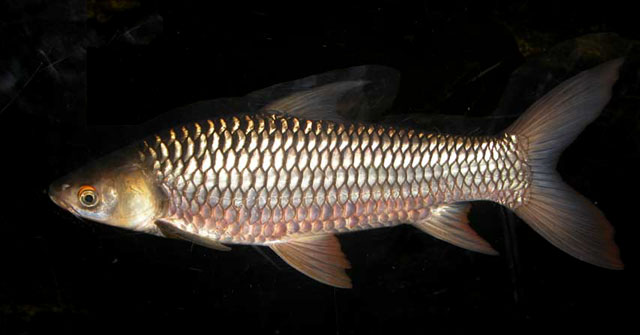
Leptobarbus hoeveniiMad Barb
Cyprinidae · Bleeker, 1851
Apparently native to Peninsular Malaysia plus the Greater Sunda Islands of Borneo, Sumatra, and Java. Reports of this species from the Mekong, Chao Phraya, and other rivers in Indochina refer to the congener L. rubripinna (see 'Notes'). Type locality is 'Indonesia: Borneo: Kalimantan Selatan: Banjarmasin'.
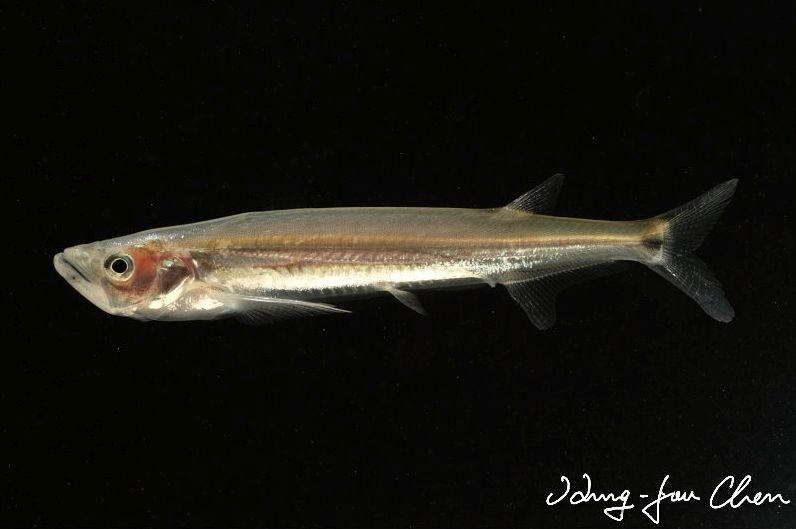
Macrochirichthys macrochirusGiant Sword Minnow
Cyprinidae · Valenciennes, 1844
It is thought to have been extirpated from the Chao Phraya and Mae Klong rivers, Lake Songkhla, and the entire island of Java due to a variety of anthropogenic factors, and the Mekong populations have also been drastically reduced. In particular, it is sensitive to pollution and gillnetting, and is heavily overfished.
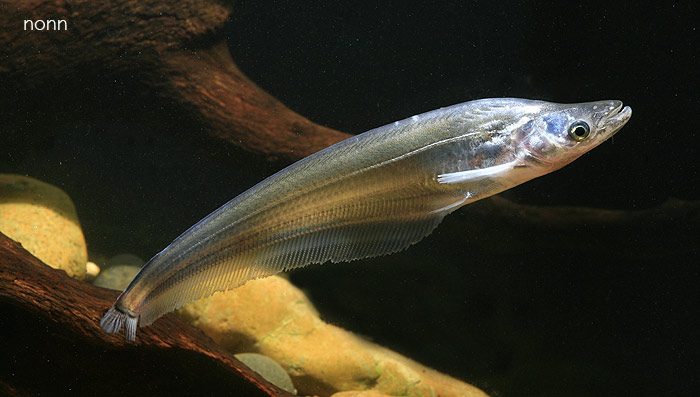
Phalacronotus apogon
Siluridae · Bleeker, 1851
P. apogon has formerly been placed within the genera Kryptopterus, Micronema (Rainboth, 1996) and more recently Phalacronotus (Ferraris, 2007) and is an important food fish across much of its native range. It's very similar to P. micronema but can be told apart by its longer head (HL fits 4.6± 5.3 times in...
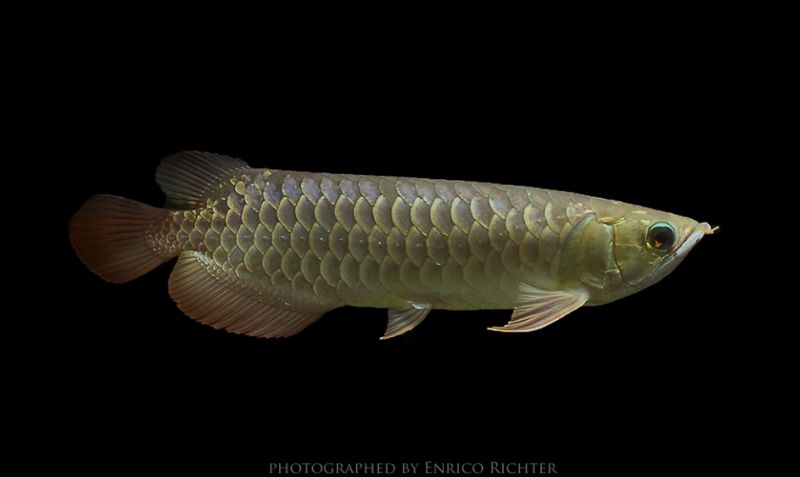
Scleropages formosusAsian Arowana
Osteoglossidae · Müller & Schlegel, 1840
This species is distinguished from its Australian congeners S. jardinii and S. leichardti by possessing a lower number of lateral line scales (21-26 vs 32-36). It occurs naturally in a number of colour forms of which three were elevated to distinct species status in 2003, but the current majority view is that all represent S. formosus pending a detailed review. Kottelat (2013) mentions that the red form may...
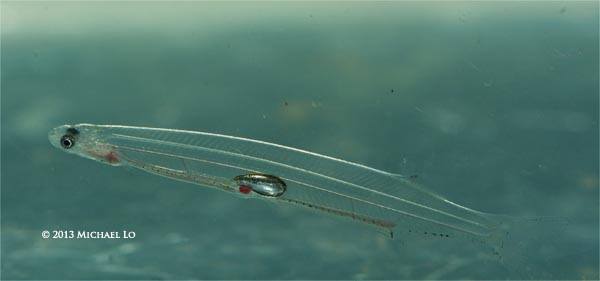
Sundasalanx microps
Sundasalangidae · Roberts, 1981
The genus Sundasalanx is distributed throughout much of Southeast Asia and currently comprises seven species which have primarily been distinguished on the basis of oral and dental morphology, gill rakers and eye size. S. microps possesses 0-3 small conical teeth on ceratobranchial 5, 0-2 minute gill rakers on the first arch and a small eye measuring less...
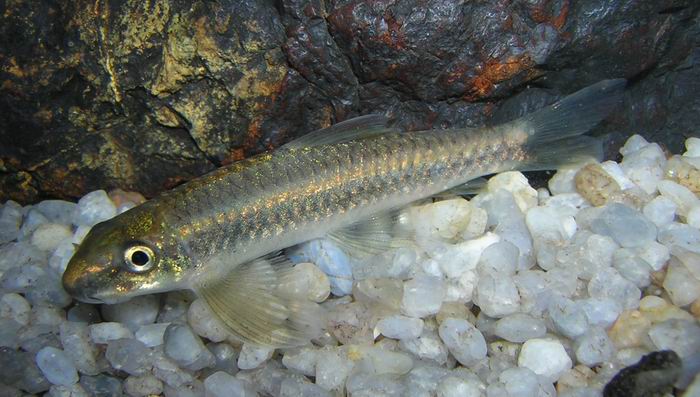
Garra borneensis
Cyprinidae · Vaillant, 1902
Substrates are generally composed of gravel, rocks, boulders or bedrock carpeted with a rich biofilm formed by algae and other micro-organisms. At a habitat in the Mendawai river basin in central Kalimantan, H. borneensis was collected from a foothill stream running swiftly over a rock and gravel substrate with clear water of pH 6.4.
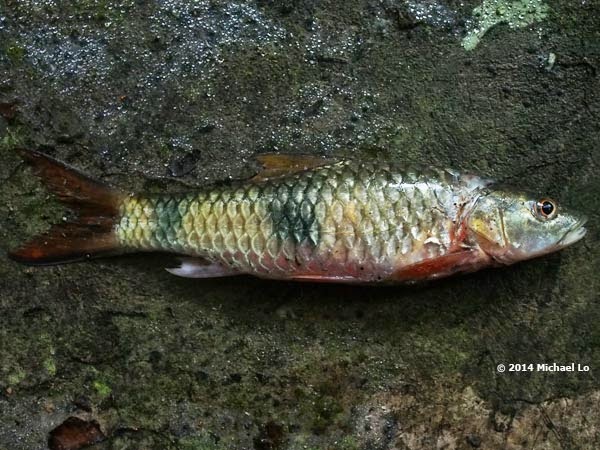
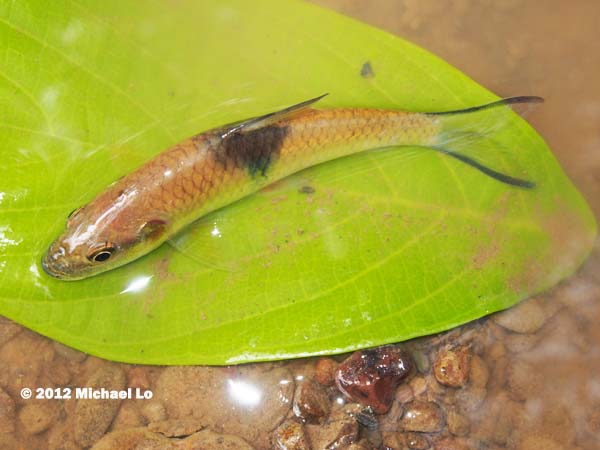
Hampala bimaculata
Cyprinidae · Popta, 1905
Predominantly a riverine fish preferring clear, well-oxygenated, running waters with substrates of sand, gravel, rock or mud, typically flowing through tropical forest. In the habitat seen in our images sympatric fish species included Barbonymus balleroides, B. collingwoodi, Cyclocheilichthys repasson, C. apogon, Diplocheilichthys pleurotaenia, Garra borneensis, Leptobarbus hosii, and an unidentified Gastromyzon sp.
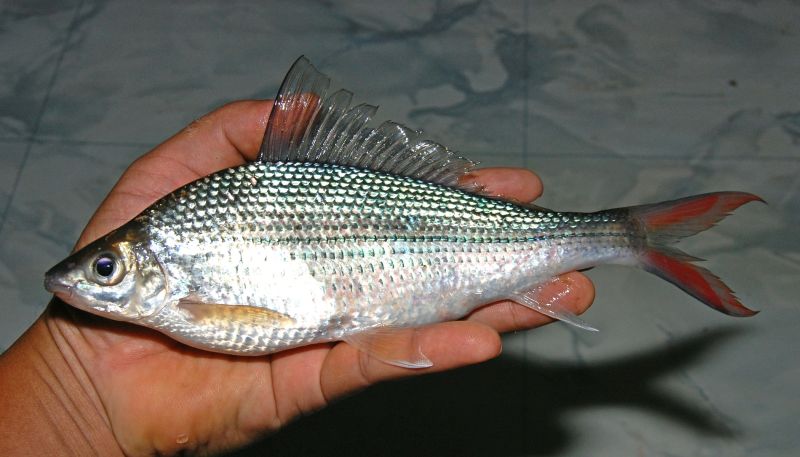
Hampala sabana
Cyprinidae · Inger & Chin, 1962
Predominantly a riverine fish preferring clear, well-oxygenated, running waters with substrates of sand, gravel, rock or mud, and apparently displays a preference for deeper, slower-moving stretches. In Sabah such habitats typically flow through tropical forest, although in recent years freshwater habitats throughout much of the state have been extensively modified by human activity such as conversion to palm or rubber plantations.
Labiobarbus fasciatus
Cyprinidae · Bleeker, 1853
Known from the Pahang River system in southern Peninsular Malaysia, and the Greater Sunda Islands of Sumatra and Borneo. On the latter records exist from the Kapuas, Barito, and Mahakam watersheds in Kalimantan, the Indonesian portion of the island Type locality is 'Pangabuang, Lampong Province, Sumatra, Indonesia'.
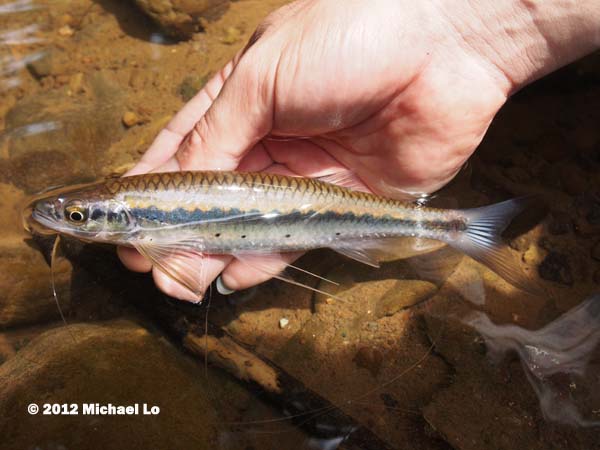
Luciosoma pellegrinii
Cyprinidae · Popta, 1905
The five species which currently comprise Luciosoma can be distinguished by elements of colour pattern. Popta described the colour pattern of L. pellegrinii as follows: body colour olive dorsally, with dark-edged scales, yellow ventrally; a lateral series of dark spots on the flank forming a midlateral band which extends onto the opercle but not the head; 4-8 blackish-brown, distinctly-separate spots on the lateral line; fins yellow; dorsal and anal fins with a blackish-brown band; anterior half of some pectoral-fin rays blackish-brown...
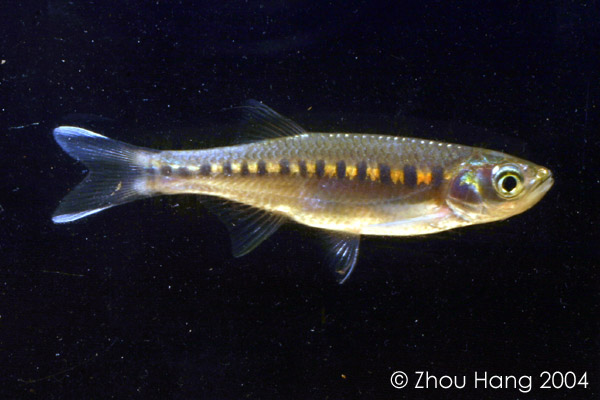
Luciosoma spilopleura
Cyprinidae · Bleeker, 1855
This species is poorly known in general and is not present in the ornamental trade, although its name is widely misapplied to other Luciosoma species. Its congeners are mostly marketed as 'apollo shark', 'shark minnow', or similar, and often labelled with incorrect scientific names. Identification of the fish pictured here is based on Bleeker (1855, 1860) and Roberts (1989), plus drawings by Bleeker, thus...
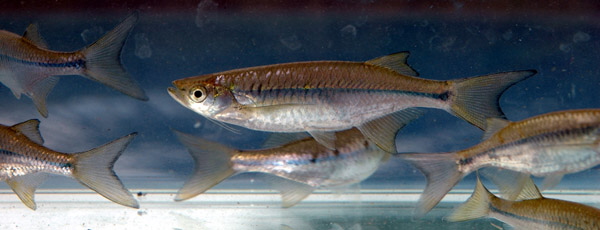
Nematabramis borneensis
Cyprinidae · Inger & Chin, 1962
It looks particularly similar to N. alestes with both species possessing a colour pattern comprising a dark lateral stripe on the body, but can be distinguished immediately by possessing barbels longer than the head (vs. shorter than the head in N. alestes).
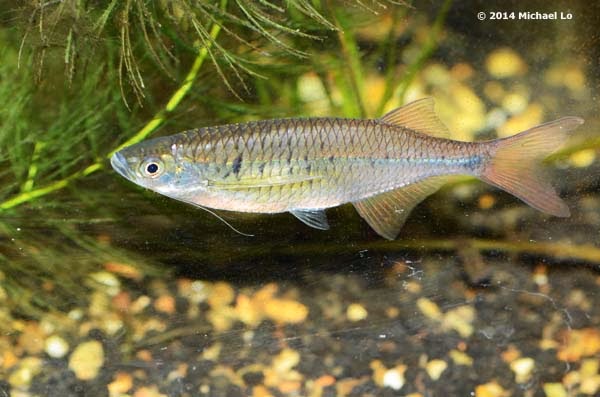
Nematabramis everetti
Cyprinidae · Boulenger, 1894
Nematabramis species are found a variety of habitat-types, from swiftly-flowing affluent streams to pools, lakes, and degraded swamps. Based on the available collection records juveniles and subadults of N. everetti display a preference for fast-moving water whereas adults are found in deeper, slower stretches of minor tributaries.
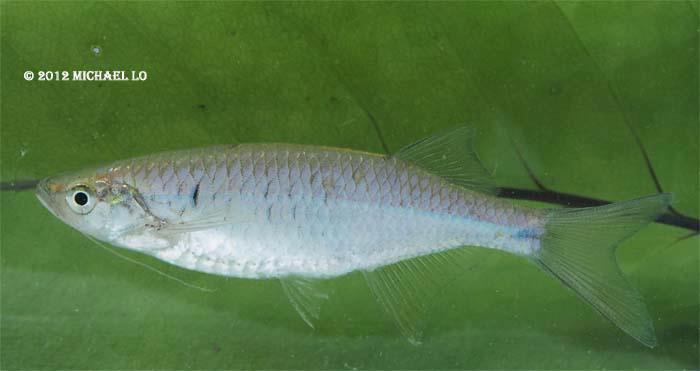
Nematabramis steindachnerii
Cyprinidae · Popta, 1905
Endemic to northern and central Borneo, with records from the Malaysian states of Sarawak and Sabah, Brunei Darussalam, and the Indonesian provinces North Kalimantan (Kalimantan Utara) and East Kalimantan (Kalimantan Timur). Type locality is 'Kajan River, eastern slope of central Kalimantan, Indonesia [Borneo]'.
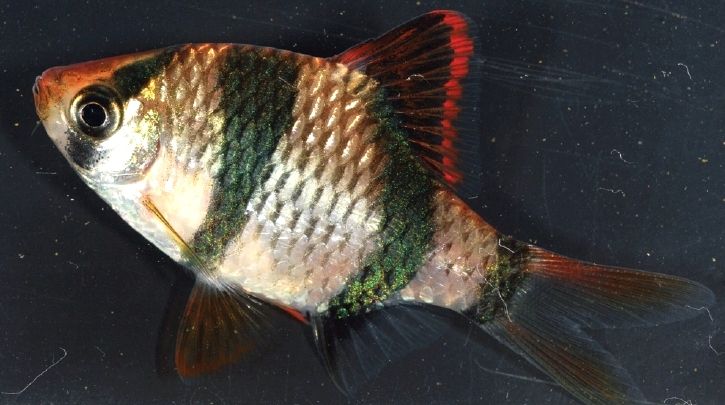
Puntigrus navjotsodhii
Cyprinidae · Tan, 2012
The type series was collected from a small clear-water stream with a pH of 6.0, forming a series of riffles and deeper pools, with a maximum width of 5 metres and depth ranging from 10 cm to 1 metre. The substrate was composed of sand gravel and rocks, with some leaf litter and overhanging marginal vegetation.