Results for “bar”
Type a name: scientific, common, or one a species used to go by. Or narrow the catalogue with the filters.
Filters
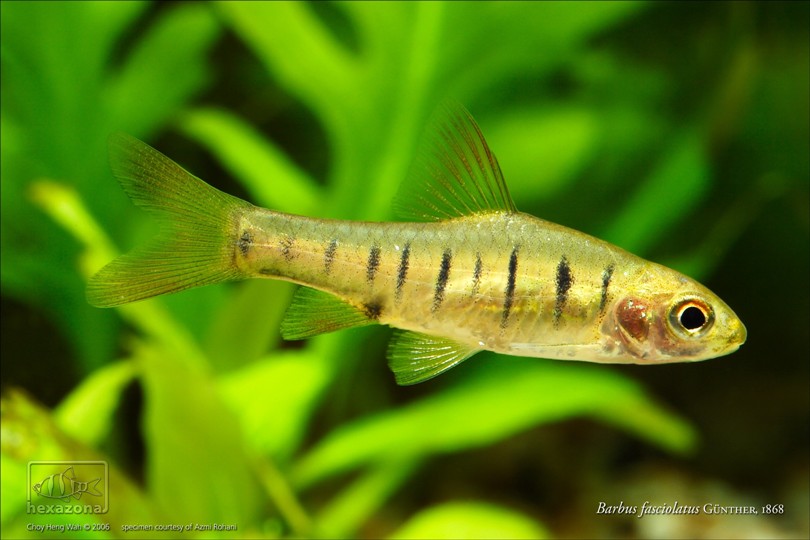
'Barbus' fasciolatusAfrican Banded Barb
Günther, 1868
Matched on the common name African Banded Barb
Max length60mm SL2.4in SLTank75 × 30cm30 × 12inTemp20–26°C68–79°FpH5.0–6.5For many years this species was imported and sold as Barbus/Barbodes barilioides, now recognised as a junior synonym of 'B.' fasciolatus, and is sometimes called the Blue Banded or Angola Barb. It's an exceptionally attractive little fish when in good condition but like all African barbs is quite rare in the hobby due to sporadic exports from the countries in which it is found. Distinguishing features include 25-30 late...
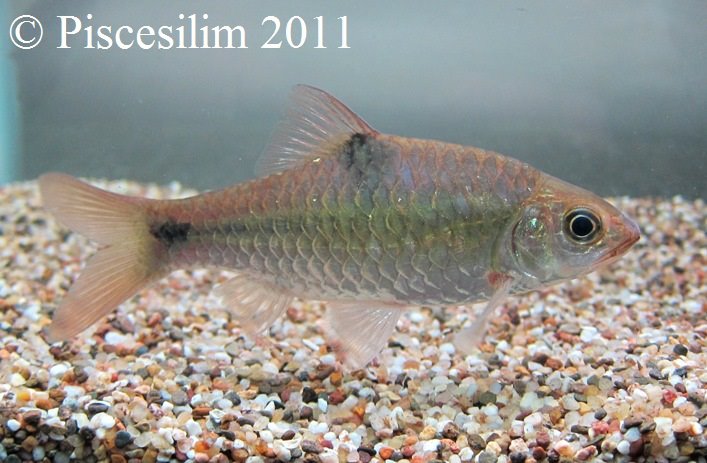
Barbodes binotatusSpotted Barb
Valenciennes, 1842
Matched on Barbus binotatus, a name it was formerly known by
Max length200mm SL8in SLTank120 × 45cm48 × 18inTemp18–30°C64–86°FpH6.0–7.5This species is so ubiquitous across its natural range that it's often referred to simply as 'common barb'. Basic adult colour pattern consists of a small, dark spot at the base of the dorsal-fin origin and another on the caudal peduncle but overall appearance varies somewhat depending on origin, with the anterior dark spot enlarged ventrally forming a bar or posterior spot extending into the caudal-fin, for example. The spots may also appear darker or lighter in some individuals.
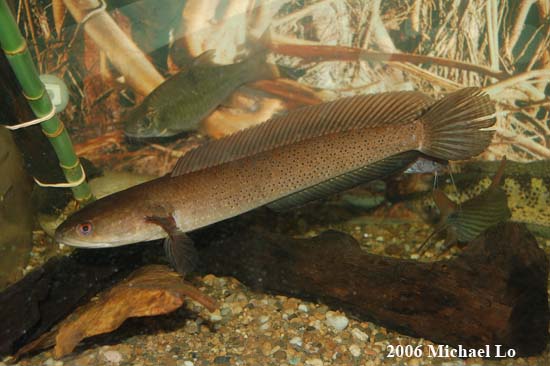
Channa baramensisBaram Snakehead
Steindachner, 1901
Matched on Ophiocephalus baramensis, a name it was formerly known by
Max length220mm SL9in SLTank120 × 45cm48 × 18inTemp22–28°C72–82°FpHnot recordedThis species was considered a synonym of Channa melasoma for a number of years prior to its revalidation by Ng. et al. (1996). Specimens larger than around 120 mm SL can be distinguished by possession of a black spot in the centre of numerous body scales and a barred caudal-fin pattern, characters which are missing in both C. melasoma and the similar-looking C. cyanospilos.
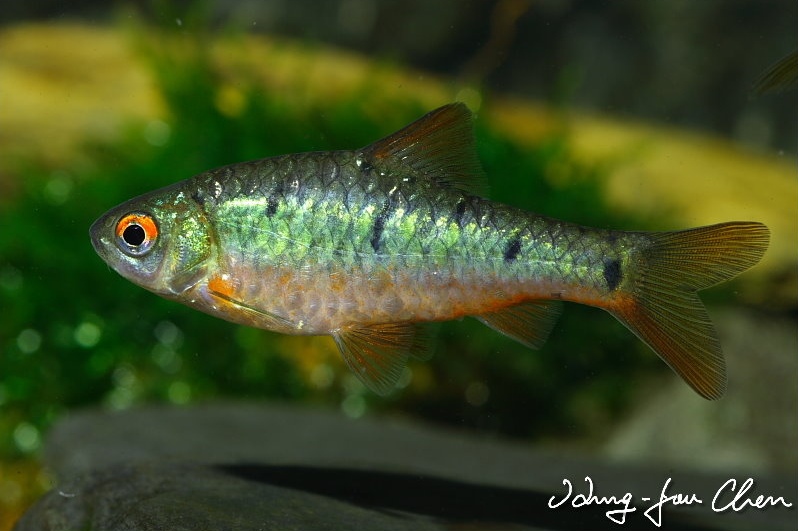
Barbodes semifasciolatusGolden Barb*
Günther, 1868
Matched on Barbus semifasciolatus, a name it was formerly known by
Max length75mm SL3.0in SLTank90 × 30cm36 × 12inTemp16–24°C61–75°FpH6.0–8.0This species is also known by the alternative names 'green' or 'Chinese' barb. The natural 'green' form is an infrequent find in the aquarium trade whereas the selectively-bred 'golden' variant is farmed in huge numbers and is among the most popular of freshwater aquarium fish. The latter was first produced in the 1960s and is now so ubiquitous that many hobbyists are initially unaware that it is not the natural form.
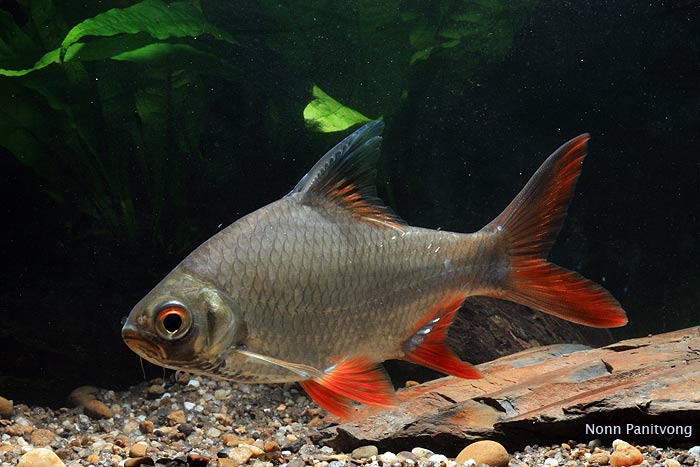
Barbonymus altusRed-tailed Tinfoil Barb
Günther, 1868
Matched on Barbus altus, a name it was formerly known by
Max length210mm SL8in SLTank150 × 60cm60 × 24inTemp20–27°C68–81°FpH6.0–8.0This is one of two species sold with the common/trade name of "tinfoil barb", the other being the more widely-recognised B. schwanenfeldii. Despite this it appears that B. altus is just as widely available as B. schwanenfeldii and in many cases is seen on sale more regularly. Unfortunately both are usually offered at a small size (usually around 2 - 3"/5 - 7.5cm) with little to no information regarding the eventual size of the fish. Although B. altus is the ...
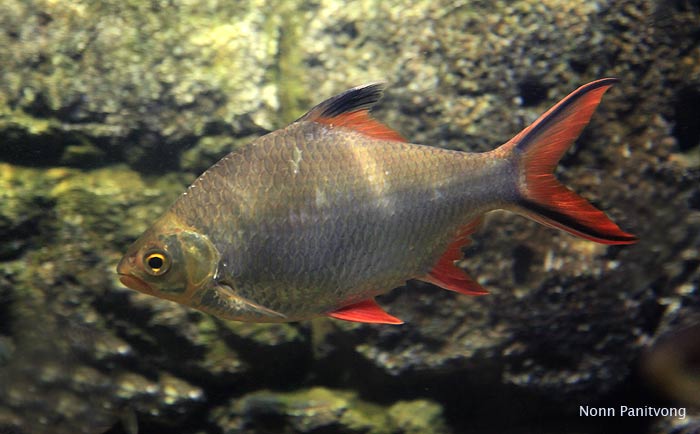
Barbonymus schwanefeldiiTinfoil barb
Bleeker, 1854
Matched on Barbus schwanenfeldii, a name it was formerly known by
Max length355mm SL14in SLTank210 × 60cm84 × 24inTemp20–28°C68–82°FpH6.0–8.0This is one of two species traded under the vernacular name 'tinfoil barb', the other being the less well-known congener B. altus. Despite this it appears that B. altus is just as widely available as B. schwanefeldii and in many cases is seen on sale more regularly. Unfortunately both are usually offered at a small size (usually around 50 - 75 mm) with little to no information regarding the eventual size of the fish.
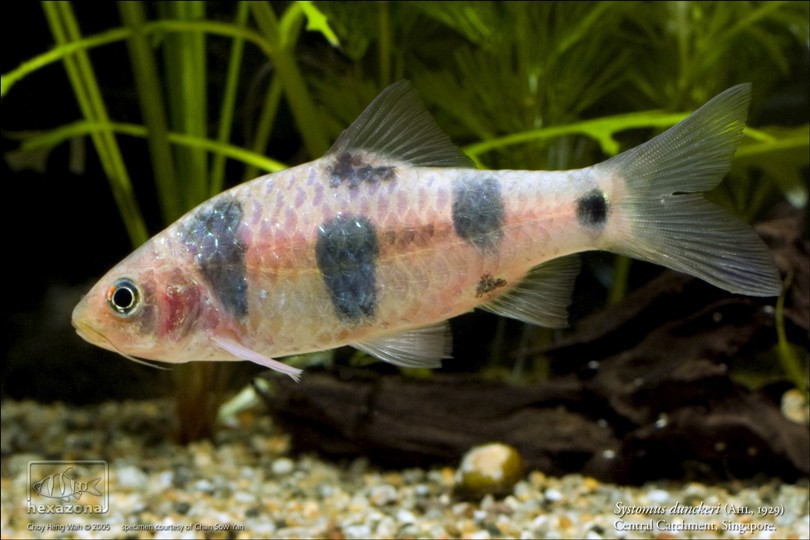
Barbodes dunckeriClown Barb
Ahl, 1929
Matched on Barbus dunckeri, a name it was formerly known by
Max length120mm SL5in SLTank120 × 45cm48 × 18inTemp18–28°C64–82°FpH6.0–7.5Although sometimes referred to by the vernacular name 'big spot barb' this species is better known in the aquarium hobby as 'clown barb'. It has been widely misidentified as the congener B. everetti, a distinct and uncommonly-traded species from Borneo and thus appears under that name in the majority of available literature. The two are quite easy to tell apart, with B. everetti an overall les...
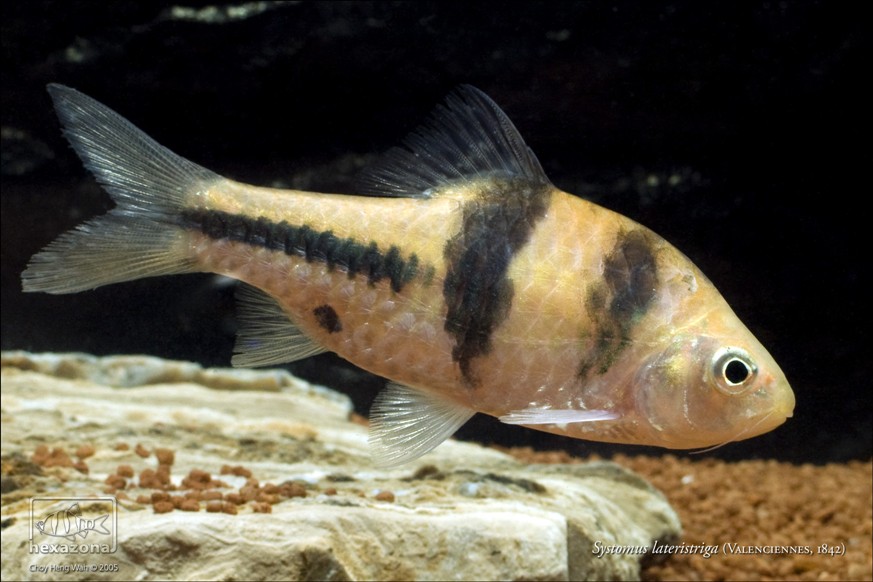
Barbodes lateristrigaSpanner Barb
Valenciennes, 1842
Matched on Barbus lateristriga, a name it was formerly known by
Max length150mm SL6in SLTank150 × 45cm60 × 18inTemp20–28°C68–82°FpH6.0–8.0This species is commonly-referred to as 'T-barb' in some countries. It's closely-affiliated with and sometimes traded as the congener B. kuchingensis but that species can be told apart by colour pattern comprising a prominent row of dark spots along the lateral line, plus a short, horizontally-orientated streak extending from the upper part of the operculum. In B. lateristriga the lateral markings usually form a solid stripe and there is no streak extending from the operculum.
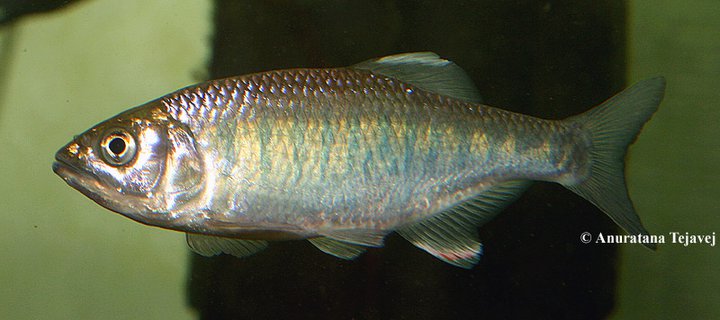
Barilius gatensisMalabar Baril
Valenciennes, 1844
Matched on Barilius rugosus, a name it was formerly known by
Max length130mm SL5in SLTank150 × 60cm60 × 24inTemp18–26°C64–79°FpH6.0–7.5This species is traded very occasionally, sometimes under the alternative vernacular names of 'river baril, 'river carp-baril', or 'striated hill trout'. It can be told apart from congeners by the following combination of characters: 1 pair of minute rostra...
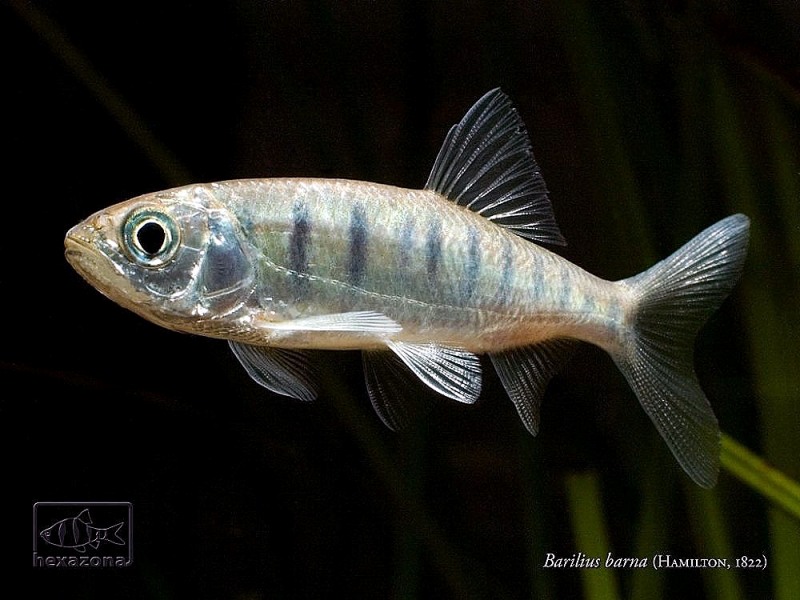
Opsarius barna
Hamilton, 1822
Matched on Cyprinus barna, a name it was formerly known by
Max length130mm SL5in SLTank150 × 60cm60 × 24inTemp16–24°C61–75°FpH6.0–8.0This species occasionally appears in the ornamental trade, usually as 'striped hill trout' or 'banded hill trout'. It can be distinguished from congeners by the following combination of characters: lateral line complete with 40-42 scales; barbels absent; 10-13 anal-fin rays; body with 9-11 dark blue vertical bars; last dorsal-fin ray extending to caudal-fin base.
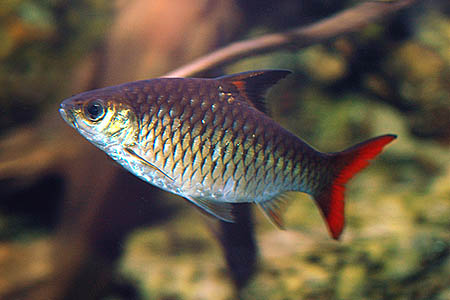
'Barbus' guiraliAfrican Blackfin Barb
Thominot, 1886
Matched on the common name African Blackfin Barb
Max length155mm SL6in SLTank150 × 45cm60 × 18inTemp22–26°C72–79°FpH5.5–6.5A stylish-looking but rare barb in the hobby and unfortunately little information is available regarding its captive care. Forum member Andy Rushworth has kept a lone individal and told us it was a perfect aquarium inhabitant in terms of behaviour and maintenance. He also mentioned that the fish he had looked exactly like the specimen in our images but that he has seen at least one batch of what appeared to be a different species imported under the same na...
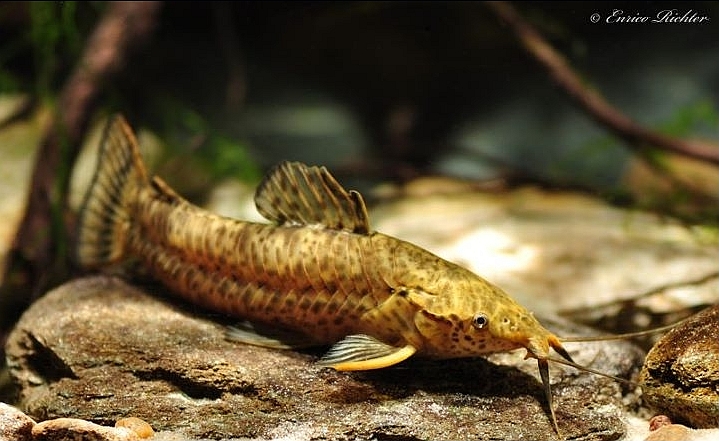
Megalechis pictaBar-tailed Hoplo
Müller & Troschel, 1849
Matched on the common name Bar-tailed Hoplo
Max length120mm SL5in SLTank120 × 45cm48 × 18inTemp18–28°C64–82°FpH5.0–7.5This species was previously referred to as M. thoracata, but that name is now applied to the species with a relatively short dorsal-fin spine which was formerly known as M. personata. M. picta can be told apart from M. thoracata by presence of a dark vertical bar in the caudal-fin, a comparatively longer dorsal-fin spine (52.0-64.0% vs. 32.0-48.0% of dorsal-fin base in specimens measur...
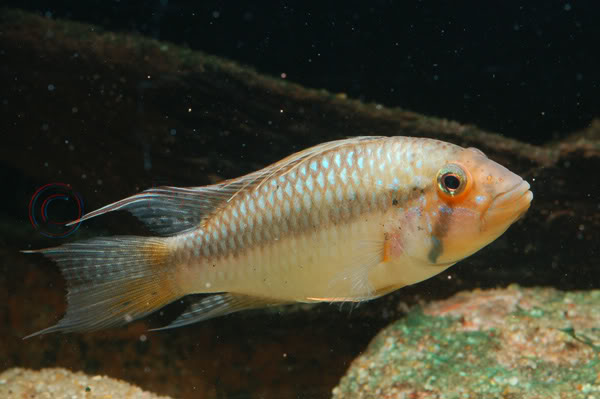
Apistogramma barlowiA174
Römer & Hahn, 2008
Matched on the common name Barlow's Dwarf Cichlid
Max length♂ 65 · ♀ 40mm SL♂ 2.6 · ♀ 1.6in SLTank60 × 30cm24 × 12inTemp22–29°C72–84°FpH4.5–6.5This species has been assigned the code A174 under the DATZ system, and is also known by the trade names A. sp. 'Maulbrüter/mouthbrooder', A. sp. 'Glaser' (these referring to the 'red' colour form) and A. sp. 'Hauswell' (referring to the 'white' colour form). It can be told apart from other members of the genus most eas...
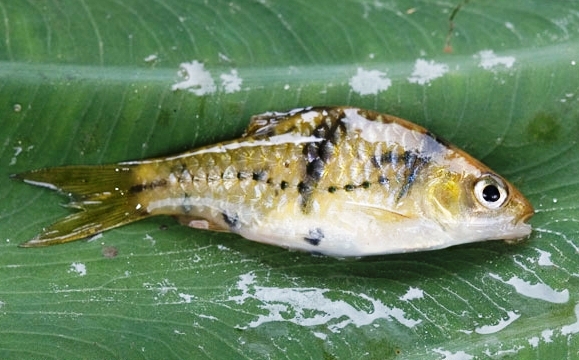
Barbodes kuchingensisFalse Spanner Barb
Herre, 1940
Matched on the common name False Spanner Barb
Max length120mm SL5in SLTank120 × 45cm48 × 18inTemp20–28°C68–82°FpH5.0–7.5This species is rarely-exported for the aquarium hobby but is available on occasion. The name 'P.' kuchingensis is frequently misapplied, however, with subadult forms of 'P.' everetti and some populations of the geographically-variable 'P.' lateristriga regularly traded as such, for example. Though closely-affiliated with and superficially very similar to...
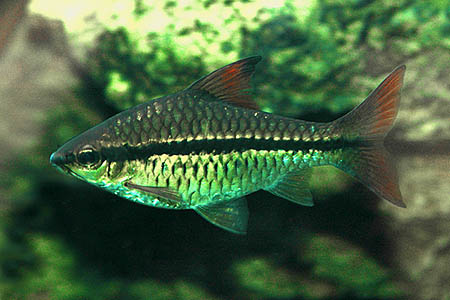
'Barbus' holotaeniaSpotscale Barb
Boulenger, 1904
Matched on the common name Spotscale Barb
Max length120mm SL5in SLTank120 × 45cm48 × 18inTemp24–30°C75–86°FpH6.0–7.0This species is native to Central West Africa where it is principally found in the great Ogooué and Congo River systems. It therefore has an extensive range and has been recorded at numerous localities right across the Democratic Republic of Congo (DRC) from the Ituri River in the far east of the country to the Luki River basin in the extreme west. The Congo River appears to represent the southernmost limit of its range as a...
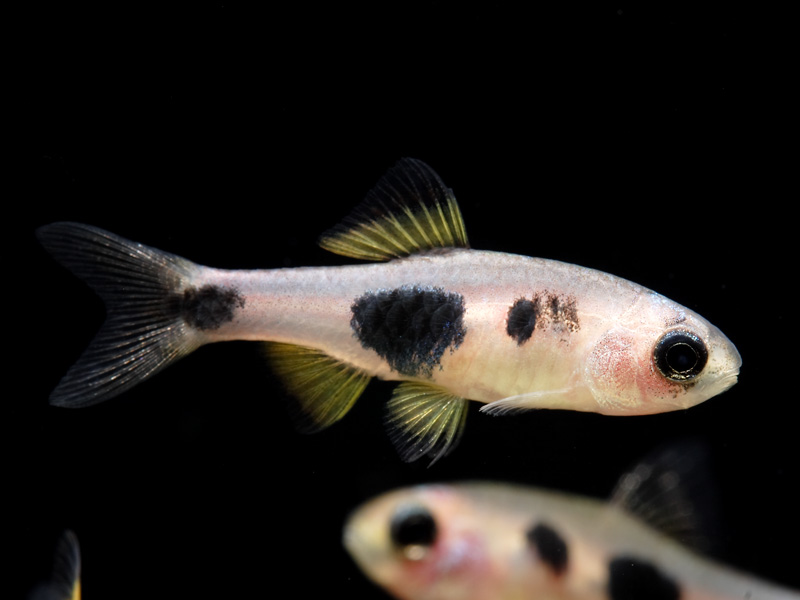
'Barbus' hulstaertiAfrican Butterfly Barb
Poll, 1945
Matched on the common name African Butterfly Barb
Max length35mm SL1.4in SLTank45 × 30cm18 × 12inTemp17–24°C63–75°FpH5.0–6.5Two closely-related species are also found in the Congo basin and infrequently seen in the trade. 'B.' candens has been collected northeast of the range of 'B.' hulstaerti around the city of Kisangani (formerly Stanleyville) and nearby town of Yangambi. It can be distinguished from 'B.' hulstaerti by its paler body colouration, smaller dark markings on the body and red ventral and anal fins in males. 'B.' papillo is known only from its type locality close to the eastern town of Kindu between the Lualaba and Lomami rivers. It has an elongated central body marking and males possess black dorsal, ventral and anal fins.
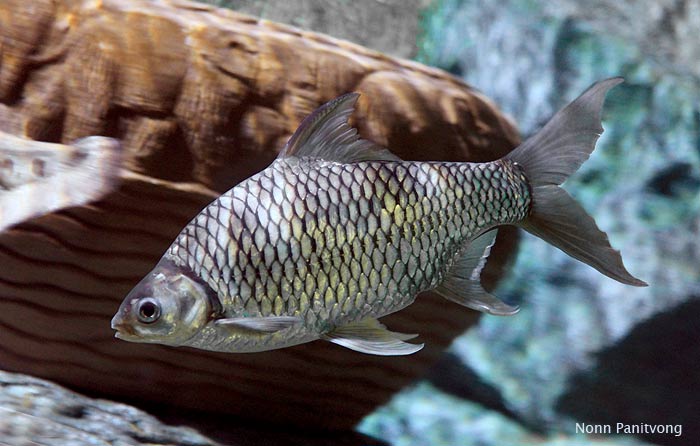
Barbonymus gonionotus
Bleeker, 1849
Matched on Barbus gonionotus, a name it was formerly known by
Max length300mm SL12in SLTank210 × 60cm84 × 24inTemp20–26°C68–79°FpH6.0–8.0The genus Barbonymus was erected by Kottelat in 1999 and contains former members of Barbodes from southeast Asia. The type species is B. schwanenfeldii and currently there exist only three other representatives; B. altus, B. collingwoodii and B. gonionotus. The latter two are rare in the hobby although an SF member has kept B. gonionotus in the past so they are worth looking out for if you harbour an...
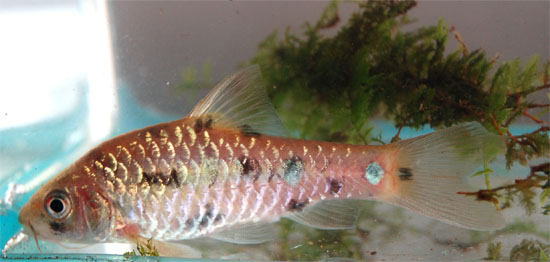
Barbodes everetti
Boulenger, 1894
Matched on Barbus everetti, a name it was formerly known by
Max length120mm SL5in SLTank120 × 45cm48 × 18inTemp18–28°C64–82°FpH6.0–7.0This species is uncommon in the aquarium hobby, although the scientific name is widely misapplied to Barbodes dunckeri, a similar-looking species native to Peninsular Malaysia and Singapore commonly referred to as 'clown barb' and labelled as B. everetti in the majority of available literature. The two are quite easy to tell apart, with B. everetti an overall less...
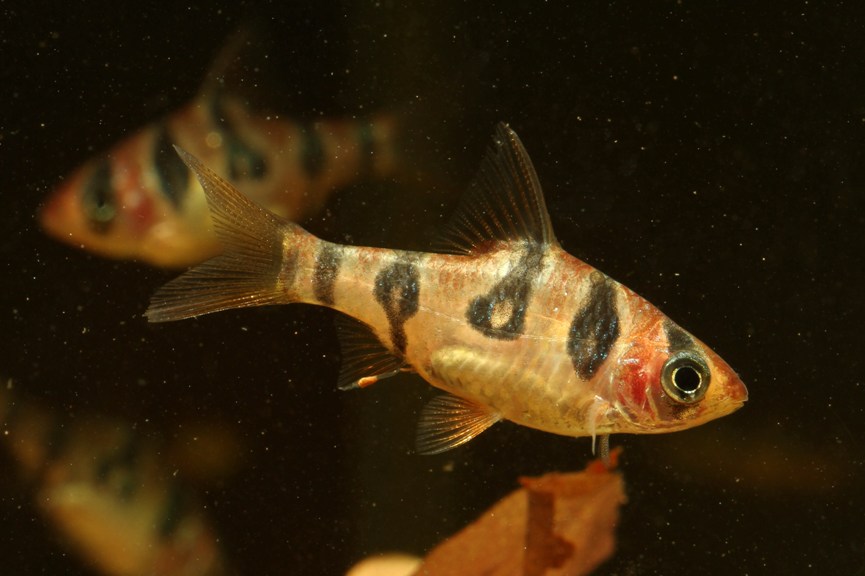
Desmopuntius rhomboocellatusSnakeskin Barb
Koumans, 1940
Matched on Barbus kahajani, a name it was formerly known by
Max length55mm SL2.2in SLTank80 × 30cm31 × 12inTemp20–28°C68–82°FpH4.0–7.0Endemic to southern Kalimantan, the Indonesian portion of Borneo where it's been recorded from several river systems including the Kapuas, Kepayang, Barito and Kahajan. Type locality is given as 'Canal along the highway from Oelin to Bandjermasin, about 15 kilometers from Bandjermasin, Borneo.' Often referred to as the 'rhomb' or 'rhombo' barb and included in a group of closely-related, similar-looking congeners which also includes...
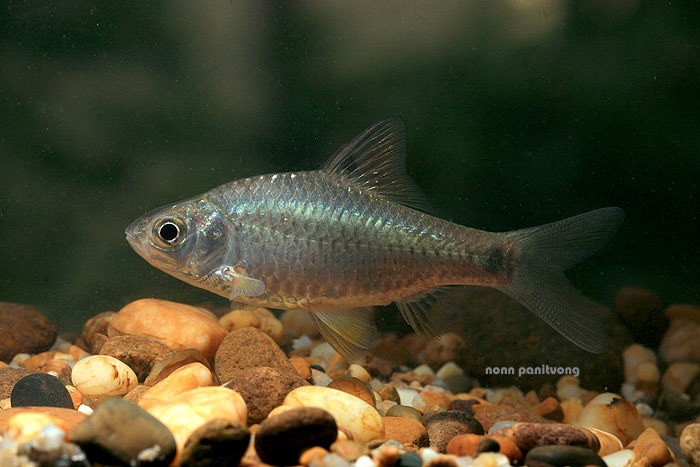
Puntius cholaSwamp Barb
Hamilton, 1822
Matched on Barbus chola, a name it was formerly known by
Max length130mm SL5in SLTank120 × 45cm48 × 18inTemp18–26°C64–79°FpH5.5–8.0P. chola was retained in Puntius sensu stricto, of which members are defined by the following combination of characters: adult size usually less than 120 mm SL; maxillary barbels absent or present; rostral barbels absent; 3-4 unbranched and 8 branched dorsal-fin rays; 3 unbranched and 5 branched anal-fin rays; last unbranched dorsal-fin ray weak or strong and unserrated; lateral line complete with 22-28 pored body scales...