Abramites hypselonotus
Marbled Headstander · Brachsensalmler
Formerly Leporinus hypselonotus Günther, 1868 · Leporinus solarii Holmberg, 1891 · Abramites microcephalus Norman, 1926 · Abramites ternetzi Norman, 1926 · Leporinus nigripinnis Meinken, 1935
On this page13 sections
Quick facts
Difficulty5 of 6 measures
More bars, more demanding.
- Space
- large tank
- Water
- tap water
- Temp
- unfussy
- Temperament
- unknown
- Social
- kept alone
- Compatibility
- not a community fish
Abramites spp. are separated from other anostomids primarily on the basis of their relatively deeper bodies and presence of a prominent, post-pelvic median keel, a feature unique to the genus. At time of writing A. eques is the only other species recognised and is native to the Río Magdalena drainage in western Colombia. It can be distinguished by possession of 13-14 bra...
Etymology
Abramites: named for genus members' “superficial” resemblance to the Eurasian Common Bream Abramis brama (Cypriniformes: Leuciscidae), in combination with the Greek -ites (Gr. -ίδες), meaning 'like'.
hypselonotus: from the Greek hypsēlós (Gr. ὑψηλός), meaning 'high', and nṓtos (Gr. νῶτος), meaning 'back', referring to this species' steep dorsal profile and resulting 'high-backed' appearance.
Distribution
Described from 'Xeberos', Peru which presumably refers to modern-day Jeberos district, Alto Amazonas Province, Loreto region in northeastern (Amazonian) Peru.
As currently recognised though it has an enormous natural range, occurring throughout much of the Amazon and Orinoco river basins in Bolivia, Brazil, Colombia, Ecuador, Guyana, Peru and Venezuela plus the Paraguay-Paraná system in southern Brazil, Paraguay and Argentina.
Habitat
This species is an ecological generalist and found in many habitat types from main river channels with turbid, flowing water to minor tributaries and backwaters.
It also enters temporarily-inundated zones during the annual floods.
Aquarium size
An aquarium with base dimensions of 120 ∗ 30 cm48 ∗ 12 in or equivalent should be the smallest considered, even for a single specimen.
Maintenance
Not critical provided basic maintenance requirements are fulfilled although soft-leaved plants may be consumed.
Water conditions
These boxes carry affiliate links and we may earn a commission. What they recommend comes from each profile’s own figures, never chosen by hand or paid for.
Diet
Anostomids are opportunistic omnivores feeding chiefly on benthic items including sponges, insect larvae, organic detritus, seeds, leaves and filamentous algae in nature.
Captive specimens are generally adaptable and will accept most good quality prepared foods as well as live or frozen bloodworm, Daphnia, Artemia, etc. but should be offered a varied diet ideally including some greenery in the form of fresh algae, fruit, vegetables or a dried product containing a high proportion of Spirulina or similar.
Behaviour and compatibility
Sexual dimorphism
Sexually mature females are normally deeper-bodied than males.
Reproduction
No recorded accounts of captive breeding exist.
Notes
Abramites spp. are separated from other anostomids primarily on the basis of their relatively deeper bodies and presence of a prominent, post-pelvic median keel, a feature unique to the genus.
At time of writing A. eques is the only other species recognised and is native to the Río Magdalena drainage in western Colombia.
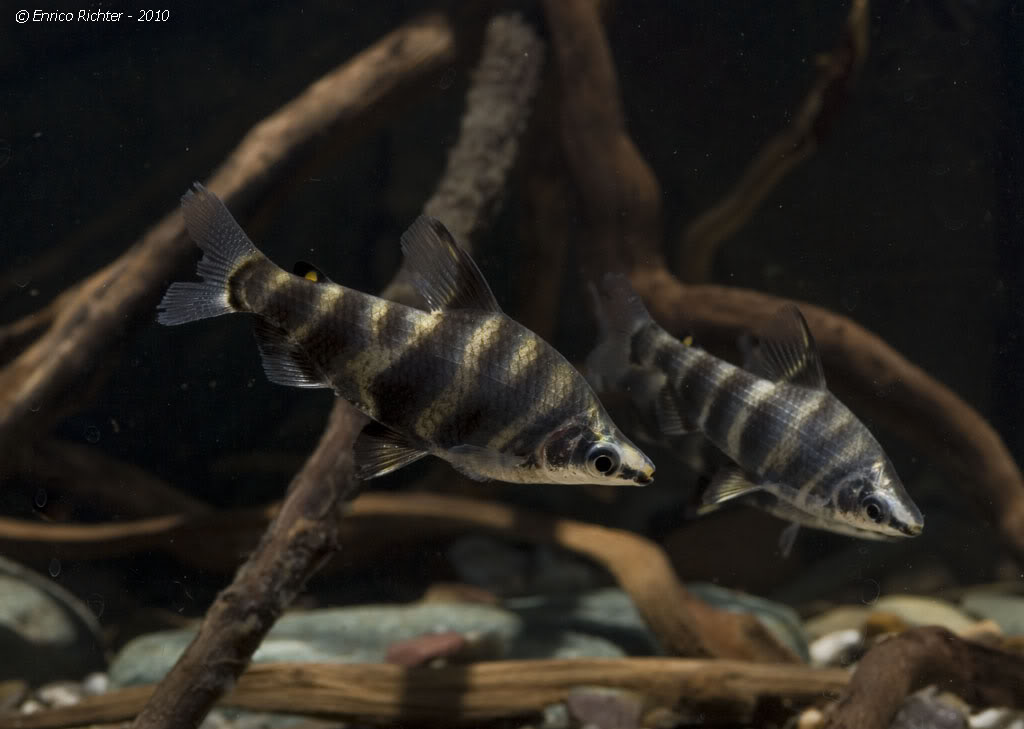
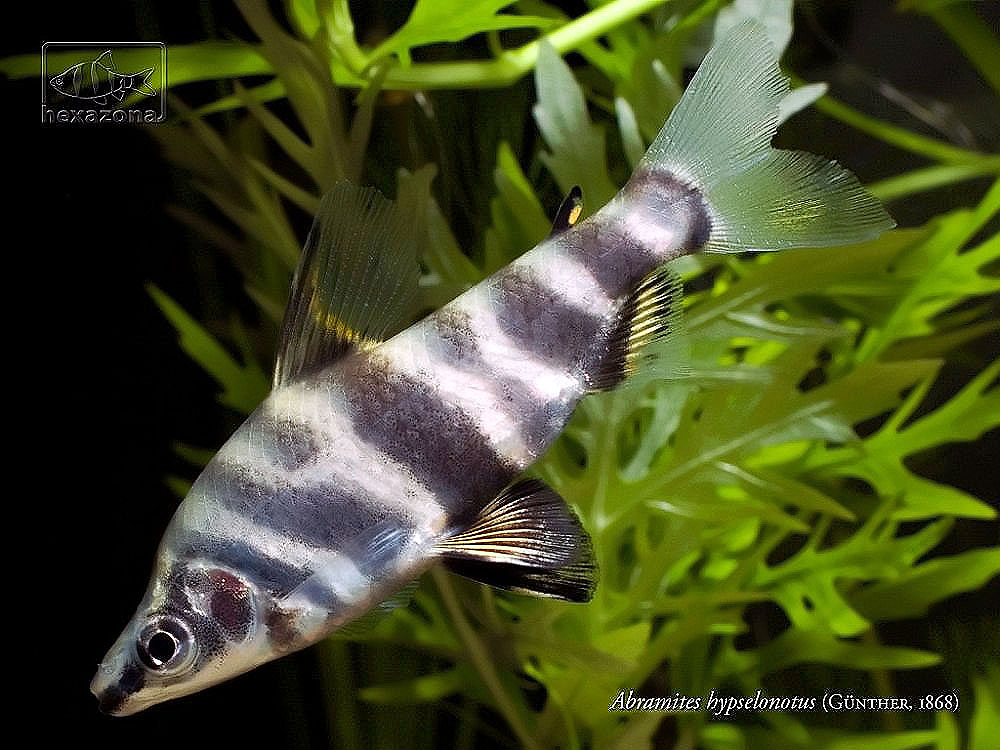
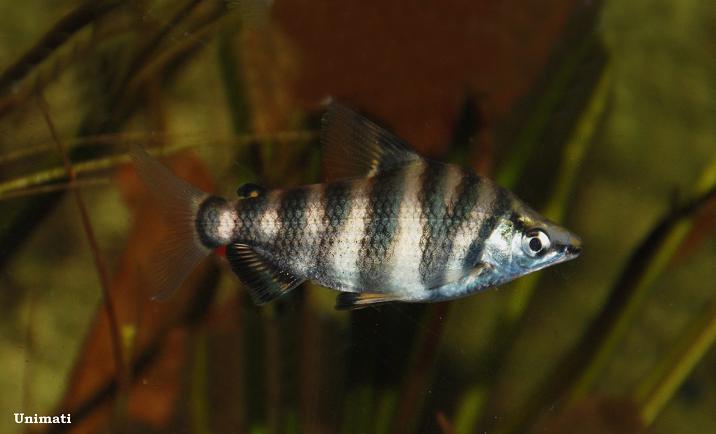
It can be distinguished by possession of 13-14 branched anal-fin rays (vs. 10-12 in A. hypselonotus) and 5 transverse bars, with the anteriormost positioned under the dorsal-fin, on the body (vs. 8 bars distributed over the entire body).
Following Sidlauskas and Vari (2008)[3] the family Anostomidae contains 14 genera, all native to South America.
Their phylogenetic analysis suggests that within this grouping Abramites forms a very distinct clade most closely-related to Leporinus.
Anostomids are distinguished from other Characiformes by the unique presence of only three or four teeth arranged in a step-like fashion in each premaxillary or dentary.
Many species are known for their inclined feeding posture, a behaviour which has given rise them being referred to by the generalised term 'headstander'.
References
- Günther, A. (1868). Diagnoses of some new freshwater fishes from Surinam and Brazil, in the collection of the British Museum. Annals and Magazine of Natural History (Series 4) v. 1(6), 475-481
- Reis, R. E., S. O. Kullander and C. J. Ferraris, Jr. (eds) (2003). Check list of the freshwater fishes of South and Central America. CLOFFSCA. EDIPUCRS, Porto Alegre, i-xi + 1-729
- Sidlauskas, B. L. and R. P. Vari (2008). Phylogenetic relationships within the South American fish family Anostomidae (Teleostei, Ostariophysi, Characiformes). Zoological Journal of the Linnean Society 154, 70–210
- Vari, R. P. and A. M. Williams (1987). Headstanders of the neotropical anostomid genus Abramites (Pisces: Characiformes: Anostomidae). Proceedings of the Biological Society of Washington 100(1), 89-103
Species images · 3
Used with the photographer’s permission. Not licensed for reuse.