Brachydanio feegradei
Yoma 'Danio'
Formerly Danio feegradei Hora, 1937
On this page13 sections
Quick facts
Difficulty5 of 6 measures
More bars, more demanding.
- Space
- large tank
- Water
- mild adjustment
- Temp
- unfussy
- Temperament
- unknown
- Social
- shoal
- Compatibility
- community tank
Typically inhabits small forest streams. In the Yan Khaw Chaung (Yan Khaw stream) it occurs alongside Devario xyrops, Garra rakhinica, G. vittatula, Xenentodon cancila, Sicyopterus fasciatus and unidentified species of Lepidocephalichthys and Channa (Fang and Kullander, 2009). When sampled during the dry season the habitat consisted of nothing more than a series of small, interconnected po...
Etymology
Brachydanio: from the Ancient Greek βραχύς (brakhús), meaning 'short', and Dhani, a Bengalese vernacular term for small, minnow-like cyprinids.
feegradei: in honour of Lieutenant E. S. Feegrade, malariologist and Public Health Department of Burma, who collected the type series.
Distribution
Currently considered endemic to the Rakhine Yoma/Arakan mountains in Rakhine state, western Myanmar; this range forms a natural barrier which cuts the state off from the remainder of the country.
Type locality is 'roadside drains, Sandoway, lower Myanmar', Sandoway being the former name of modern-day Thandwe in Rakhine state.
D. feegradei occurs only on the western slopes and has been recorded both to the north and south of Thandwe city; this area is home to a number of endemic fish species including Brachydanio aesculapii, Devario xyrops, Channa pulchra, Akysis vespertinus, Hara spinulosus and Batasio elongatus plus several Garra species including G. flavatra and G. spilota.
Habitat
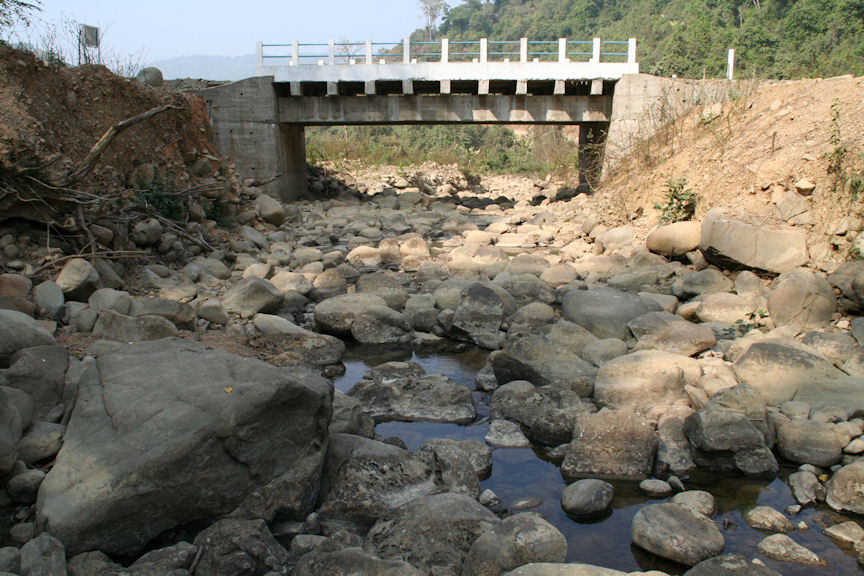
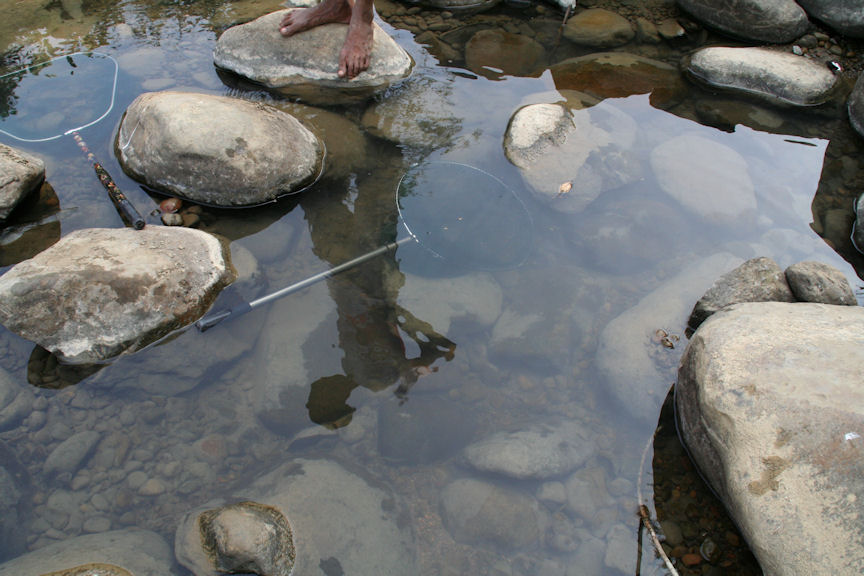
Typically inhabits small forest streams. In the Yan Khaw Chaung (Yan Khaw stream) it occurs alongside Devario xyrops, Garra rakhinica, G. vittatula, Xenentodon cancila, Sicyopterus fasciatus and unidentified species of Lepidocephalichthys and Channa (Fang and Kullander, 2009)[3].
When sampled during the dry season the habitat consisted of nothing more than a series of small, interconnected pools, never more than 2 m wide or 1 m deep.
The water flowed only slowly or not at all and was totally clear and colourless, with substrates of mixed rocks, stones and gravel.
There were no aquatic plants but the margins were composed of shrub and forest.
In fact all its habitats are seasonal in nature; Rakhine is located within a tropical monsoon region and has a pronounced rainy season between May and October, while at other times it can be quite dry.
The streams thus swell in depth by a metre or more and flow much more rapidly during the wet season.
Collection of fish, for both scientific and commercial purposes, is normally conducted during the dryer months in monsoon-affected areas due to difficulties encountered during times of high water levels and/or poor weather.
Aquarium size
Even a small group needs an aquarium with base measurements of 120 ∗ 45 cm48 ∗ 18 in or more.
Maintenance
Looks particularly effective in a heavily-planted arrangement with a darker substrate, and may appear paler in sparsely-decorated set-ups.
We suggest maintaining it in a well-planted aquarium or set-up designed to resemble a flowing river or stream, with a substrate of variably-sized rocks and gravel and some large water-worn boulders.
Additional powerhead(s) or filter outlets can be used to provide flow but torrent-like conditions should be avoided since small danionins tend to occupy calmer stretches and marginal zones in nature.
Driftwood roots, branches and aquatic plants, with hardy genera such as Microsorum, Bolbitis or Anubias ideal since they can be grown attached to the décor, can also be added.
The aquarium must have a very tightly-fitting cover as members of this genus are accomplished jumpers and can fit through surprisingly small gaps.
Water conditions
These boxes carry affiliate links and we may earn a commission. What they recommend comes from each profile’s own figures, never chosen by hand or paid for.
Diet
Probably preys on insects and their larvae in nature. In the aquarium it's largely an unfussy feeder and will accept most foods.
A good quality dried product or two can be used as the staple diet but this should be supplemented with regular meals of small live and frozen fare such as bloodworm, Daphnia, Artemia, etc. for the fish to show the best colouration and conditioning.
Behaviour and compatibility
Not an aggressive fish but may upset very slow-moving or timid tankmates with its constant activity and vigorous feeding behaviour so can only be considered appropriate for larger tanks containing robust, similarly-sized fishes.
There are plenty of suitable choices including many cyprinids, loaches, cichlids, catfish and characins although as always when selecting a compatible community of fish proper research is essential.
Other species from the Rakhine Yoma available in the trade include Rasbora daniconius, R. rasbora, Garra flavatra, G. spilota, Lepidocephalichthys berdmorei, Opsarius barna and Devario xyrops.
Though gregarious by nature it's a shoaling rather than schooling fish which only groups together very tightly when threatened, while at other times rival males spar regularly.
Maintaining it in numbers of 10 or more will allow sub-dominant fish of both sexes some respite from the alpha individual(s) which can be quite aggressive at times.
It's not uncommon to see nipped fins in lesser fish and SF members who've kept it have even experienced losses of otherwise healthy specimens; another reason we recommend keeping this species only in larger aquaria.
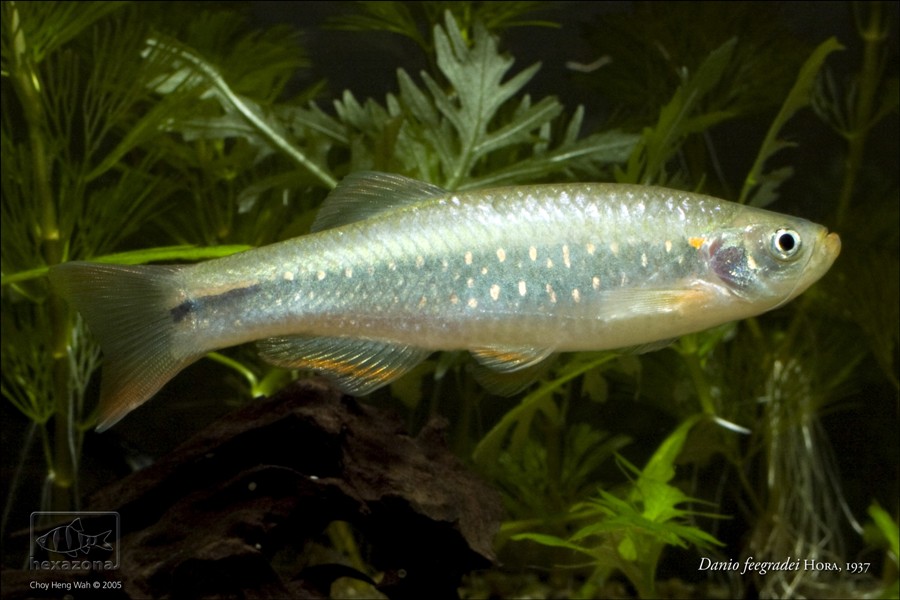
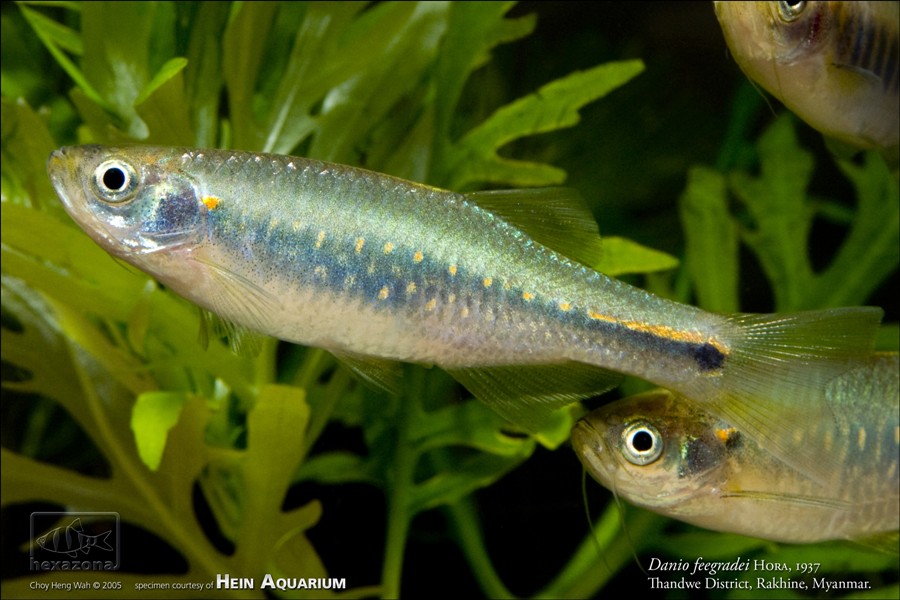
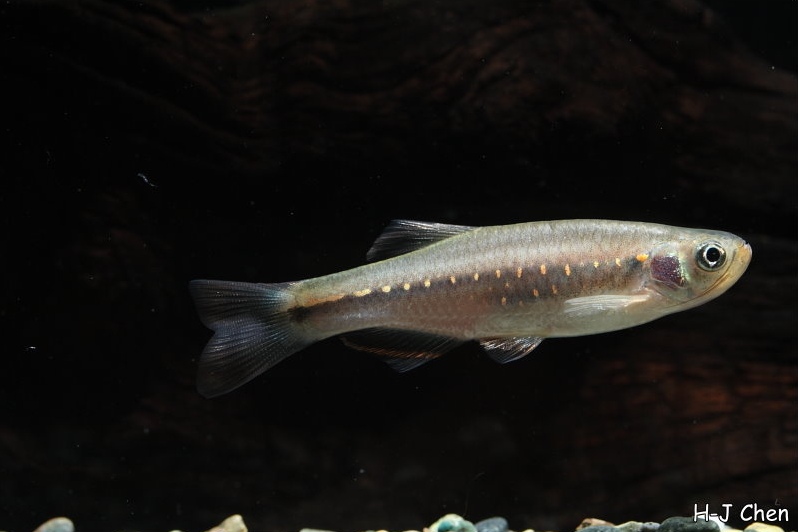
Alpha males are clearly distinguishable by their brighter, more intense colouration.
Sexual dimorphism
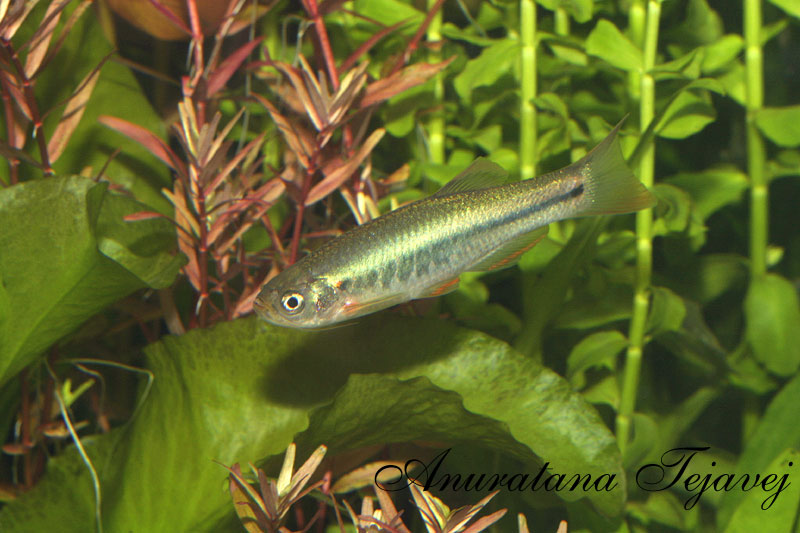
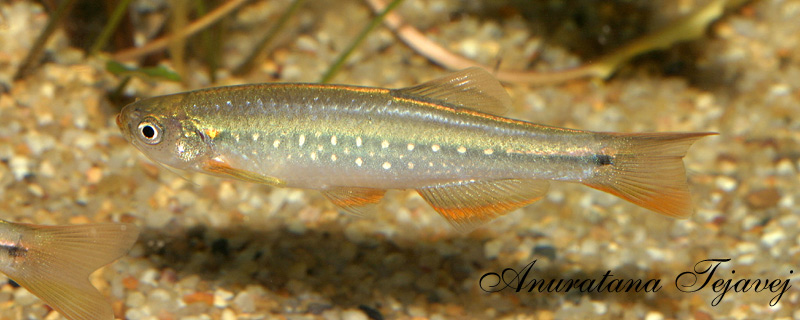
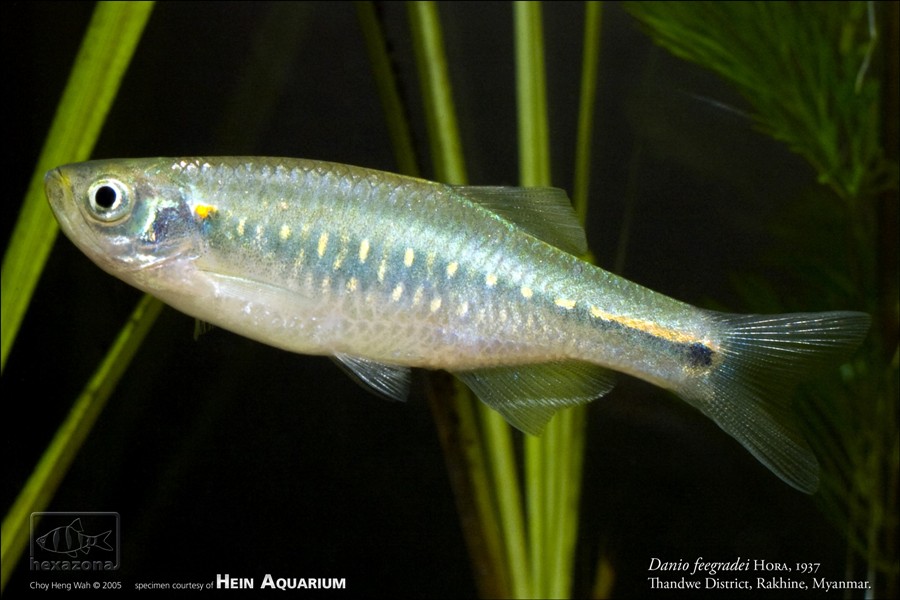
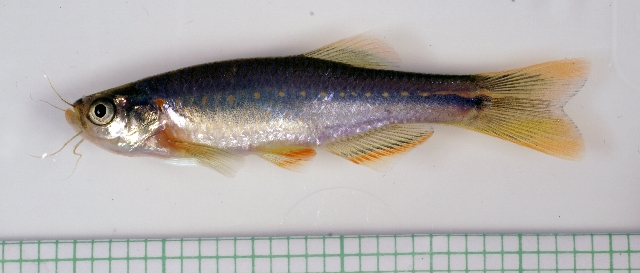
Mature males are the more colourful and noticeably slimmer sex plus they have orange, as opposed to white in females, edges to the ventral and anal fins.
In groups containing multiple males one or more specimens typically develop(s) 'alpha' status and become more intensely-coloured still.
Reproduction
Like most cyprinids this species is an egg-scattering spawner that exhibits no parental care.
That is to say when the fish are in good condition they will spawn often and in a densely-planted, mature aquarium it is possible that small numbers of fry may start to appear without human intervention.
However if you want to increase the yield of fry a slightly more controlled approach is required and we suggest upscaling an approach that has proven successful for smaller members of the genus.
The adult group can still be conditioned together but one or more long, shallow, say 65-85 litre, containers should also be set up and half-filled with water.
Much of the available space should be filled with a suitable spawning medium such as Java moss, wool mops or a spawning grid.
The water should be of slightly acidic to neutral pH with a temperature towards the upper end of the range suggested above.
An internal power filter can be added initially and this should be positioned so that the flow is directed down the full length of the tank.
When the adult fish are well-conditioned and the females appear full of eggs one or two pairs should then be introduced to each container.
Spawning can be initiated by adding small amounts of cool water every few hours in such a way that the tank is gradually topped up and feeding small amounts of live and frozen foods, or by performing a large (50-60%) water change in the evening.
Several spawning events will probably occur before a female is spent of eggs.
The adults will eat any they find and are best removed once eggs are spotted.
At this point the power filter (if using) should be switched for a mature sponge-type unit in order to avoid fry being sucked into the mechanism.
Incubation in is temperature-dependant to an extent but usually takes between 3-7 days with the young free-swimming 24 to 48 hours later.
Initial food should be Artemia nauplii or a proprietary dry food of sufficiently small grade.
Notes
This species was first seen in the hobby around 2005 and has been available on a sporadic basis since, often under alternative names such as 'Danio sp. Yoma', 'D. sp. gold laser' and 'D. sp. rocket'.
It is quite variable in patterning, especially in terms of the spot-like markings on the flanks which some specimens lack entirely.
There is another Brachydanio sp. from Rakhine known in the trade as 'Danio sp. TW01' that may represent an undescribed species but could equally turn out to be a colour form of B. feegradei. It has a barred, as opposed to spotted, patterning on the body and is a bit smaller in size.
In recent years it's become commonplace to refer to the stripes on the body and fins of danionins as follows:
- P stripe: or "pigment stripe" is the central, dark, lateral stripe on the body which extends into the caudal-fin in some species. Stripes above it are numbered P+1, P+2, etc. and those beneath P-1, P-2, P-3.
- A stripe: the central stripe on the anal-fin; the proximal stripe (above it) is A+1 and the distal stripe (beneath) A-1.
- D stripe: The submarginal dorsal-fin stripe.
Following Fang (2003) Brachydanio spp. are characterised by the presence of an A stripe on the anal-fin and two or more P stripes on the caudal, plus some internal characteristics such as enlarged nasal lamellae.
The genus has undergone some significant taxonomic reshuffling in recent years following the publication of a series of phylogenetic studies.
Older, molecular, phylogenies tended to agree that it represented a monophyletic group consisting of two major clades; the 'Danio devario' group containing the larger, deeper-bodied species and the 'D. rerio' clade comprising the smaller, slimmer fish.
However in 2003 Fang conducted a more detailed study based on morphological characters which included members of other related genera, and the results suggested for the first time that the genus Danio as previously considered represents a polyphyletic grouping, i.e., not all members derived from a single common ancestor.
The genus name Devario was suggested for the larger species with Danio being applied only to the smaller fish (with the exception of the type species, D. dangila which can grow to around 89 mm3.5 in SL). Recent molecular studies by Mayden et al. (2007) and Fang et al. (2009) resulted in further changes, with the latter study considering the genus Danio to be composed of three subclades. These were subsequently split into distinct genera by Kottelat (2013), as follows:
The former species D. erythromicron, D. margaritatus, D. choprae and D. flagrans are grouped together in the revalidated genus Celestichthys Roberts, 2007. These exhibit unique body patterning consisting of vertical bars (C. erythromicron, C. choprae, C. flagrans) or light spots (C. margaritatus) and possess either very short barbels or none at all.
The genus Danio contains only the type species, D. dangila, separated on the basis of its larger size and the shape of the caudal-fin, which in adults is only slightly emarginate or even truncate in shape, a feature it shares only with Tinca tinca (the common tench) among other cyprinids.
The remaining species, of which B. rerio is thought to be the most ancient, are included in the revalidated genus Brachydanio Weber & de Beaufort, 1916.
References
- Conway, K. W., W.-J. Chen and R. L. Mayden (2008). The 'Celestial Pearl danio' is a miniature Danio (s.s) (Ostariophysi: Cyprinidae): evidence from morphology and molecules. Zootaxa 1686, 1-28
- Fang, F. (2003). Phylogenetic Analysis of the Asian Cyprinid Genus Danio (Teleostei, Cyprinidae). Copeia 2003(4), 714-728
- Fang, F. and S. O. Kullander (2009). Devario xyrops, a new species of danionine fish from south-western Myanmar (Teleostei: Cyprinidae). Zootaxa 2164, 33-40
- Fang, F., M. Norén, T. Y. Liao, M. Källersjö and S. O. Kullander (2009). Molecular phylogenetic interrelationships of the south Asian cyprinid genera Danio, Devario and Microrasbora (Teleostei, Cyprinidae, Danioninae). Zoologica Scripta 38(1), 1-20
- Mayden, R. L., K. L. Tang, K. W. Conway, J. Freyhof, S. Chamberlain, M. Haskins, L. Schneider, M. Sudkamp, R. M. Wood, M. Agnew, A. Bufalino, Z. Sulaiman, M. Miya, K. Saitoh, S. He (2007). Phylogenetic relationships of Danio within the order Cypriniformes: a framework for comparative and evolutionary studies of a model species. Journal of Experimental Zoology, Molecular Development and Evolution 308B, 642-654
- Roberts, T. R. (2007). The 'Celestial Pearl Danio', a new genus and species of colourful minute cyprinid fish from Myanmar (Pisces: Cypriniformes). Raffles Bulletin of Zoology 55(1), 131-140
- Kottelat, M. (2013). The fishes of the inland waters of southeast Asia: a catalogue and core bibiography of the fishes known to occur in freshwaters, mangroves and estuaries. The Raffles Bulletin of Zoology Supplement 27, 1-663
- Hora, S. L. (1937). Notes on fishes in the Indian Museum. XXXI. On a small collection of fish from Sandoway, Lower Burma. Records of the Indian Museum (Calcutta) v. 39 (pt 4), 323-331
Species images · 9
Used with the photographer’s permission. Not licensed for reuse.
Distribution
Profile completeness22 of 24
92% complete
Missing: temperament, water condition notes.