Dario urops
On this page8 sections
Quick facts
Difficulty3 of 6 measures
More bars, more demanding.
- Space
- any tank
- Water
- unknown
- Temp
- unknown
- Temperament
- unknown
- Social
- in a pair
- Compatibility
- not a community fish
This species has not yet entered the aquarium trade but is maintained by a handful of private collectors. Though described in 2012 it was in fact first collected in the latter half of the 19th century with Day (1875-1878) having mentioned the presence of Badis dario in ‘Wynaad’ and its occurrence "along the Western Ghats" (the chain of mountains in southwestern India).
Etymology
Dario: derived from the specific epithet of the type species, dario, which in turn is from its Bangla name, Darhi.
urops: from the Greek ourá (ουρά), meaning 'tail', and ops (ὄψ), meaning 'eye', in reference to the conspicuous eye spot on the caudal peduncle.
Distribution
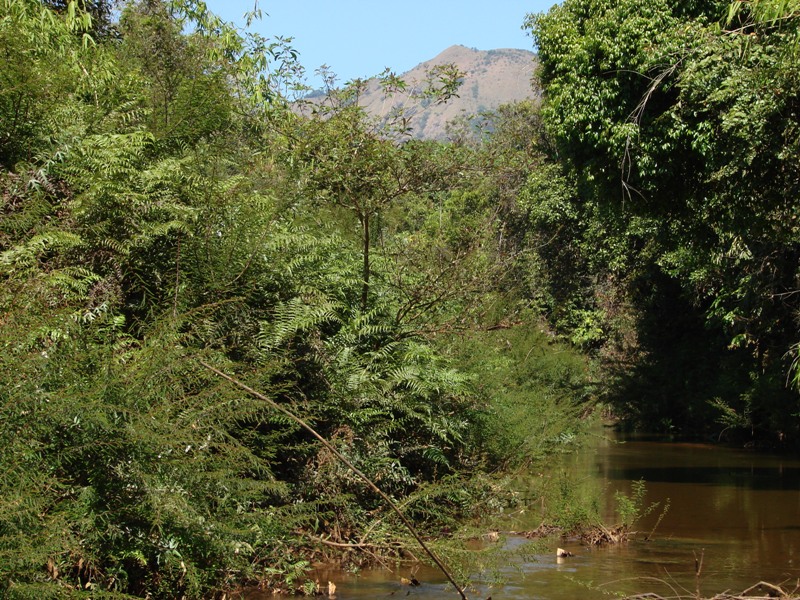
Known ofrom a single locality within the Valapattanam river system in southern Karnataka state, southwestern India with additional populations records from Agumbe in Karnataka, plus headwaters of the Cauvery River in Wayanad District, northeastern Kerala state.
While the Valapattanam drains westward into the Arabian Sea the Cauvery is an extensive drainage that flows east and empties into the Bay of Bengal.
Type locality is 'India: Karnataka: from a small unnamed stream, off the Barapole tributary of Valapattanam river, 12°00.310’N 75°53.408’E; 811m asl'.
Habitat
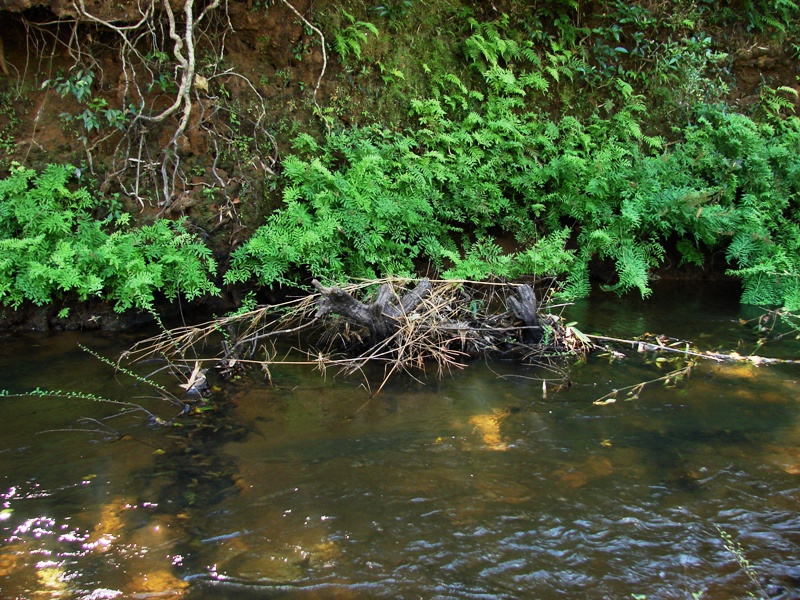
The type locality is a small stream with a maximum width of 10 m and depth of 2 m.
In January 2012 it contained clear water and the substrate was composed of sand, mud and larger boulders with extensive growth of semi-submerged Lagenandra sp.
D. urops was typically found among tree roots hanging into the water along the margins and thick layers of leaf litter in slower-moving parts of the stream.
Diet
Dario species are micropredators feeding on small aquatic crustaceans, worms, insect larvae and other zooplankton.
In captivity they should be offered small live or frozen fare such as Artemia nauplii, Daphnia, grindal, micro-, and banana worm.
They're noted as somewhat shy, deliberate feeders (see 'Behaviour and Compatibility') and it's also important to note that all badids develop issues with obesity and become more susceptible to disease when fed chironomid larvae (bloodworm) and/or Tubifex so these should be omitted from the diet.
These boxes carry affiliate links and we may earn a commission. What they recommend comes from each profile’s own figures, never chosen by hand or paid for.
Sexual dimorphism
Little information is available, but males certainly develop extended pelvic, dorsal and anal fins as they mature.
Notes
This species has not yet entered the aquarium trade but is maintained by a handful of private collectors.
Though described in 2012 it was in fact first collected in the latter half of the 19th century with Day (1875-1878) having mentioned the presence of Badis dario in ‘Wynaad’ and its occurrence "along the Western Ghats" (the chain of mountains in southwestern India).
Following discovery of D. urops, but prior to publication of its description, principle author Dr. Ralf Britz searched Day’s material at the Natural History Museum, London and came across two lots labelled as Badis dario from 'Wynaad' which turned out to be conspecific with the new material.
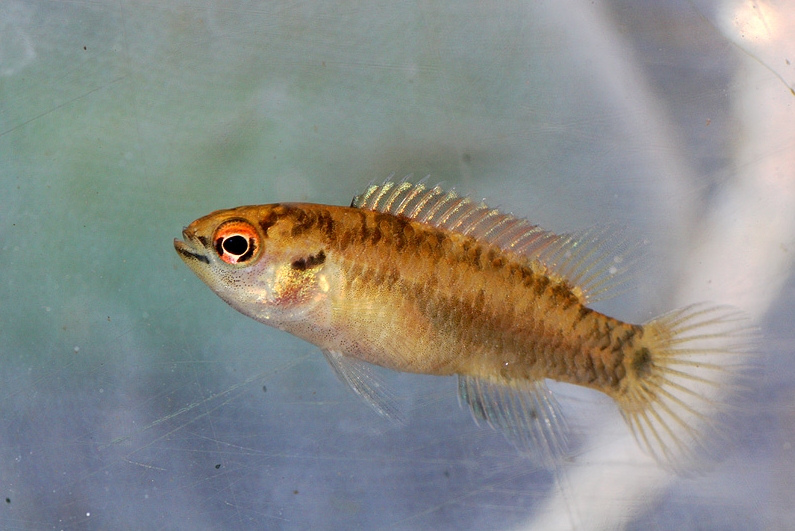
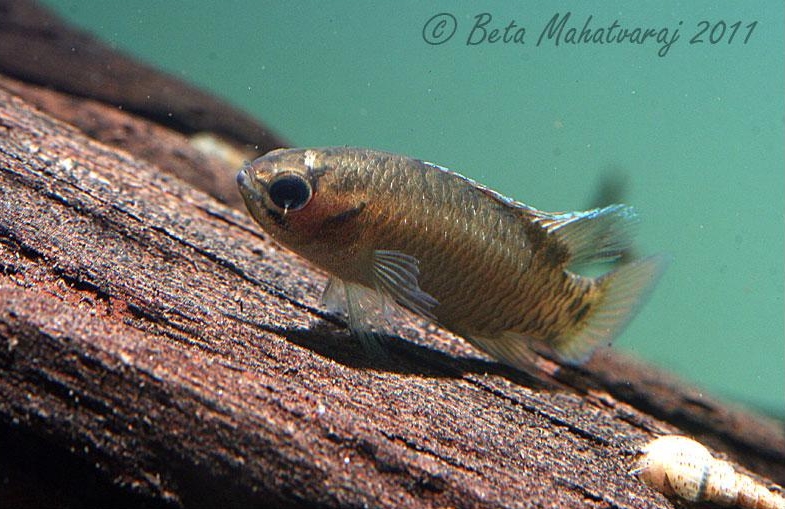
D. urops can be told apart from congeners by the following characters: presence of a conspicuous black blotch on the caudal peduncle (vs. absence), by the presence of a horizontal suborbital stripe (vs. absence in all other Dario species); anterior dorsal fin lappets in males not extending beyond fin spines (vs. extending considerably beyond spines); possession of 14+14–15= 28–29 vertebrae (vs. 11–13+12–14=24–27).
It can also be told apart from D. dario and D. hysginon by lacking a dark stripe on the anterior margin of the pelvic-fin, and from D. dario by lacking vertical bars on the flanks.
Dario currently contains five species, of which four are considered miniature species since they do not exceed 26 mm1.0 in in standard length (SL).
The fifth, D. urops, not only grows larger, to at least 28.0 mm SL, but occurs in southwestern India whereas the others are native to the Brahmaputra, Meghna, and Ayeyarwaddy river systems in northern India, Myanmar, and southwestern China, and this raises interesting questions regarding their biogeography.
In addition, D. urops lacks some diagnostic characters of Dario and thus may represent the sister group to other members of the genus, though this hypothesis remains to be tested.
Prior to 2002 the family Badidae included just five species but an extensive revision paper published that year contained descriptions of ten new species along with the genus Dario of which the former Badis dario was designated type species.
Dario is most easily distinguished from Badis by the small adult size of member species, predominantly red colouration, more extended first few dorsal rays and pectoral fins in males, straight-edged (vs. rounded) caudal-fin, lack of visible lateral line and less-involved parental behaviour.
Badids have historically been considered members of the families Nandidae or Pristolepididae and it was not until 1968 that Barlow proposed a separate grouping for them.
They share some characteristics with anabantoids, nandids and channids, perhaps most notably the typical spawning embrace in which the male wraps his body around that of the female.
More recent studies have concluded that this procedure is an ancient trait inherited from a common ancestor to all these families.
All Badis, Dario and Nandus species were found to share a uniquely bifurcated (split) hemal spine on the penultimate vertebra and this may provide evidence that the group is monophyletic (Kullander and Britz, 2002)[1].
The family Nandidae is currently restricted to include only Nandus species and it's separated from Badidae by differences in morphology and egg structure with their phylogenetic relationships yet to be studied in detail.
References
- Kullander, S. O. and R. Britz (2002). Revision of the family Badidae (Teleostei: Perciformes), with description of a new genus and ten new species. Ichthyological Exploration of Freshwaters 13(4), 295-372
- Rüber, L., R. Britz, S. O. Kullander and R. Zardoya (2004). Evolutionary and biogeographic patterns of the Badidae (Teleostei: Perciformes) inferred from mitochondrial and nuclear DNA sequence data. Molecular Phylogenetics and Evolution 32(3), 1010-1022
- Britz, R. and S. O. Kullander (2013). Dario kajal, a new species of badid fish from Meghalaya, India (Teleostei: Badidae). Zootaxa 3731(3), 331-337
- Britz, R., A. Ali and S. Philip (2012). Dario urops, a new species of badid fish from the Western Ghats, southern India (Teleostei: Percomorpha: Badidae). Zootaxa 3348, 63-68
Species images · 5
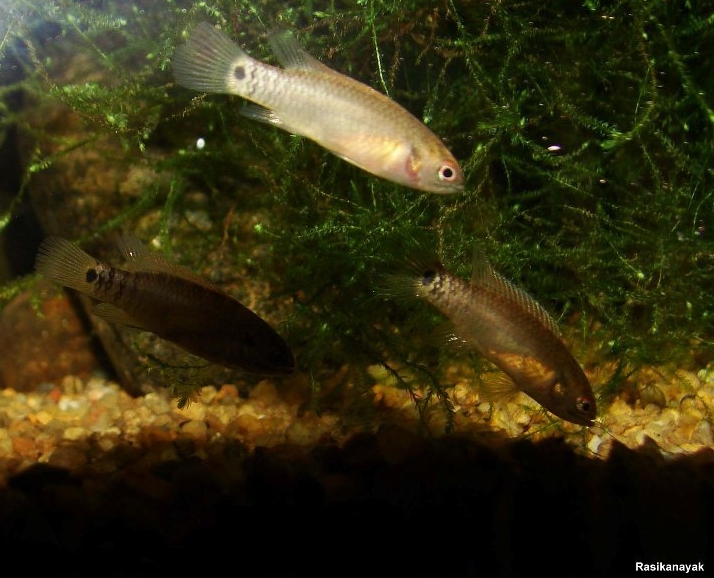
Used with the photographer’s permission. Not licensed for reuse.
Distribution
Profile completeness14 of 24
58% complete
Missing: water parameters, hardness, aquarium size, a common name, temperament, aquarium notes, maintenance, water condition notes, behaviour and compatibility, reproduction.