Esomus danrica
Flying Barb
Formerly Cyprinus danrica Hamilton, 1822 · Cyprinus jogia Hamilton, 1822 · Cyprinus sutiha Hamilton, 1822 · Perilampus recurvirostris M'Clelland, 1839 · Perilampus macropterus M'Clelland, 1839 · Perilampus thermophilus M'Clelland, 1839 · Perilampus macrourus M'Clelland, 1839 · Leuciscus vittatus Swainson, 1839 · Esomus malabaricus Day, 1867 · Pogonocharax rehi Regan, 1907 · Nuria danrica var. grahami Chaudhuri, 1912 · Esomus lineatus Ahl, 1924 · Cyprinus barbiger Hora, 1933 · Esomus danricus jabalpurensis Visweswara Rao & Sharma, 1973 · Esomus manipurensis Tilak & Jain, 1990
On this page13 sections
Quick facts
Difficulty5 of 6 measures
More bars, more demanding.
- Space
- large tank
- Water
- tap water
- Temp
- unfussy
- Temperament
- unknown
- Social
- shoal
- Compatibility
- community tank
Found in various types of habitat but shows a marked preference for shallow, slow-moving and standing waters such as rice paddies and other temporally-inundated environments with dense aquatic vegetation.
Etymology
Esomus: from the Latin preposition e-, meaning 'out of', and Ancient Greek σῶμα (sôma), meaning 'body', presumably in reference to the extremely long maxillary barbels.
danrica: from a vernacular Bengali name for this species.
Distribution
Habitat
Found in various types of habitat but shows a marked preference for shallow, slow-moving and standing waters such as rice paddies and other temporally-inundated environments with dense aquatic vegetation.
It has also been collected from muddy ditches, semi-polluted canals and small streams, but is generally absent from major river channels.
Aquarium size
An aquarium with base dimensions of 120 ∗ 30 cm48 ∗ 12 in should be the smallest considered.
Maintenance
Choice of décor is not as critical as water quality although this species does look particularly effective in a well-planted tank with a dark substrate. The addition of some floating plants and driftwood roots or branches to diffuse the light seems to reduce skittish behaviour as well as adding a more natural feel.
Water movement does not need to be particularly strong as it mostly hails from sluggish waters, and do not add this fish to a biologically-immature tank as it can be susceptible to swings in water chemistry. Also be sure to add a tightly-fitting cover as it's an accomplished jumper and able to escape through the tiniest of gaps.
Water conditions
These boxes carry affiliate links and we may earn a commission. What they recommend comes from each profile’s own figures, never chosen by hand or paid for.
Diet
Feeds on terrestrial and aquatic invertebrates and their larvae in nature. In the aquarium it will accept dried foods of a suitable size but should also be offered live and frozen Daphnia, Artemia, chironomid larvae (bloodworm), etc., on a regular basis.
Behaviour and compatibility
There exist mixed reports on this species' suitability for community aquaria. Some have observed a pronounced tendency to nip the fins of tankmates while others report no problems. Any aggressive behaviour is likely to be more pronounced when it is maintained in insufficient numbers or with slow-moving or long-finned species.
Though gregarious it's a shoaling rather than schooling fish which develops a hierarchical pecking order. It therefore should always be maintained in a group of 8 or more since weaker individuals may be bullied incessantly if smaller numbers are kept. You'll be rewarded with a more natural-looking display plus interesting behaviour from the fish as they interact with one another.
Sexual dimorphism
Adult males are noticeably slimmer and usually a little smaller than females.
Reproduction
Unreported.
Notes
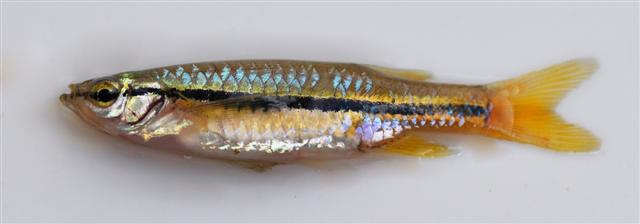
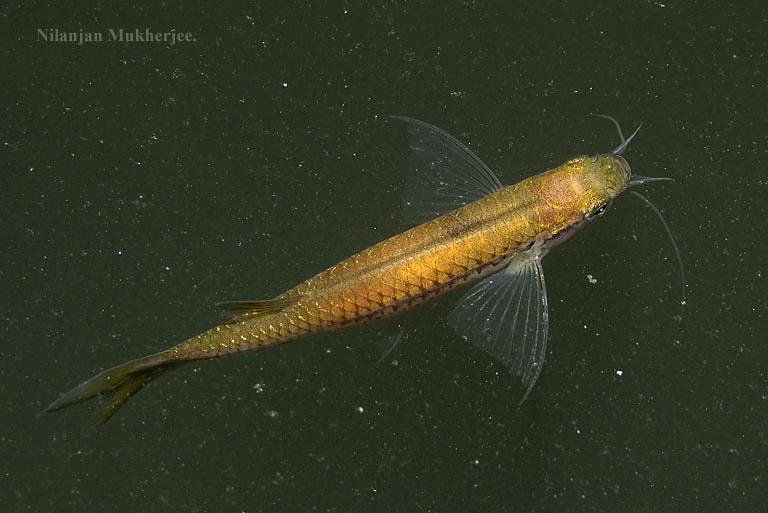
There currently exist a dozen described Esomus specie,s although few are seen in the ornamental trade and none are especially popular. Most are commonplace in their native countries but are generally overlooked by collectors due to their relatively plain colouration. Their most common use in some areas is actually as a feeder fish in the aquaculture of larger species. They are characterised by greatly-enlarged pectoral fins and two pairs of barbels, of which the maxillary pair are extremely long and usually reach the pectoral fins.
In recent years a number of phylogenetic studies involving Esomus and its near relatives have been conducted and conflicting results published. For example a 2003 study by Fang et al. concluded that the genus is the sister group, i.e., most closely-related to, Danio whereas Mayden et al. (2007) placed the genera Chela, Microrasbora, Devario and Inlecypris as sisters to Danio with Esomus as a basal sister group to that larger clade.
A further analysis by Fang et al. published in 2009 recovered Esomus as sister to Danio but noted that its exact placement is uncertain due to conflicting results depending on the type of analysis performed. The authors go on to state that more detailed studies into the molecular and morphological characters of the genus are needed in order to identify its exact relationships with its closest relatives.
Some aquarium hobbyists have recorded a type of wasting disease that can appear in Esomus spp. characterised by a rapid reduction in body mass of affected specimens. The problem manifests itself as an initial thinning of the ventral part of the body just behind the gills and usually results in death within a couple of weeks. As yet no treatment is known.
References
- Hamilton, F. (1822). An account of the fishes found in the river Ganges and its branches. An account of the fishes found in the river Ganges and its branches., i-vii + 1-405
- Kottelat, M. (2013). The fishes of the inland waters of southeast Asia: a catalogue and core bibiography of the fishes known to occur in freshwaters, mangroves and estuaries. The Raffles Bulletin of Zoology Supplement 27, 1-663
- Fang, F., M. Norén, T. Y. Liao, M. Källersjö and S. O. Kullander (2009). Molecular phylogenetic interrelationships of the south Asian cyprinid genera Danio, Devario and Microrasbora (Teleostei, Cyprinidae, Danioninae). Zoologica Scripta 38(1), 1-20
- Fang, F. (2003). Phylogenetic Analysis of the Asian Cyprinid Genus Danio (Teleostei, Cyprinidae). Copeia 2003(4), 714-728
- Mayden, R. L., K. L. Tang, K. W. Conway, J. Freyhof, S. Chamberlain, M. Haskins, L. Schneider, M. Sudkamp, R. M. Wood, M. Agnew, A. Bufalino, Z. Sulaiman, M. Miya, K. Saitoh, S. He (2007). Phylogenetic relationships of Danio within the order Cypriniformes: a framework for comparative and evolutionary studies of a model species. Journal of Experimental Zoology, Molecular Development and Evolution 308B, 642-654
- Shrestha, T. K. (2008). Ichthyology of Nepal. A study of fishes of the Himalayan waters. Himalayan Ecosphere, Kathmandu, Nepal., 389 pp., 72 pls.
- Mirza, M. R. (2003). Checklist of freshwater fishes of Pakistan. Zoological Society of Pakistan Supplementary Series 3, 1-30
Species images · 2
Used with the photographer’s permission. Not licensed for reuse.