Julidochromis ornatus
Golden Julie
Last revised 2026Edit this page
On this page11 sections
Quick factsEdit
Difficulty5 of 8 measures
- Space
- medium tank
- Water
- flexible
- Temp
- needs a steady temperature
- Diet
- unknown
- Temperament
- territorial
- Social
- best in a pair
- Compatibility
- unknown
Other demands
Each of these can raise the rating on its own, whatever the measures above say.
- Hardiness
- unknown
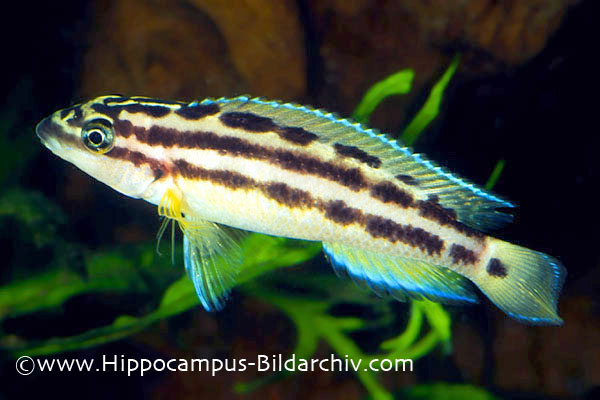
The golden julie, Julidochromis ornatus, is a cave-spawning cichlid endemic to Lake Tanganyika, found mainly in the north of the lake. One of the most common Julie species in aquaria, it may also be sold as the yellow or ornate julie. Most specimens available are tank bred and lack the bright colouration of wild fish. Several geographical morphs and an albino aquarium sport exist, and none should be kept with other Julidochromis as they may hybridise.
Distribution
EditEndemic to Lake Tanganyika.
Habitat
Write a noteEditIt occurs in rocky areas of the intermediate zone between the shoreline and open water. It mainly inhabits the northern part of the lake although one morph is found in the southern end, around Mpulungu.
Aquarium size
Write a noteEdit30" x 12" x 12" (75cm x 30cm x 30cm) - 70 litres is suitable for a single pair.
Maintenance
Write a noteEditShould be housed in a Lake Tanganyika biotope setup, with piles of rocks arranged to form caves filling much of the aquarium. A sandy substrate is preferable
Water conditions
EditTemperature: 23 – 27 °C73 – 81 °F
pH: 7.5-9.0
Hardness: 10-25°H
Diet
Write a noteEditLive and frozen foods should comprise a large proportion of the diet. Dried foods can be fed, but less often. Some vegetable matter, such as spirulina or blanched spinach should also be fed.
These recommendations come from this profile’s own figures. They contain affiliate links, so we may earn a commission.
Behaviour and compatibility
Write a noteEditA territorial species. It can be maintained successfully with other small to medium-sized Tanganyikan cichlids that occupy different areas of the tank, such as Neolamprologus shelldwellers and Cyprichromis species. J. ornatus should be kept as a pair as it is aggressive towards conspecifics. A suitably large aquarium is required if several are to be kept.
Sexual dimorphism
Write a noteEditThe genital papillae of males is more extended and pointed than that of females. Adult females are also larger than males.
Reproduction
Write a noteEditEasy but patience is required. Bi-parental cave spawner. We suggest the purchase of a group of young fish and allowing these to pair off naturally. Once a pair forms (this may take a year or more), the other fish should be removed from the aquarium, as the pair will remain together for life. Buying an adult male and female will not guarantee a pair and often results in the female being harassed to death. The aquarium itself should be at least 36" in length and set up as suggested above. The pH should be around 8.2-9.0 and the temperature 25 – 26.5 °C77 – 80 °F.
The pair will spawn very secretively in a cave, with the female laying up to 100 eggs (but usually far less) on the wall or roof of it. It is often very difficult to tell if they have spawned until the fry are seen, especially as the parents may show increased activity around the selected cave for up to a month prior to spawning. Once spawning has occured, the female will tend to the eggs while the male guards the area around the cave. The eggs hatch in 2-3 days.
The fry may still have some yolk sac remaining when they are released and do not need to be fed until this has disappeared. If they are released with no yolk sacs you can start to feed immediately. The fry are large enough to take brine shrimp nauplii from birth. Brood care is quite long-lived and they can remain with the parents until they are around 1" in length. At this point they should be removed, as the adults may turn on them. The parents may spawn again whilst the brood are still in the aquarium and will form a nuclear family with the older fry remaining in the parents' territory and tending to new broods of eggs..
Notes
EditJulidochromis are commonly known as "Julies" in the hobby. This is one of the most common Julie species encountered in aquaria and may also be sold as the Yellow or Ornate Julie. The majority of specimens available are tank bred and do not exhibit as bright colouration as wild fish. As with other Julies, large water changes should be avoided as this can cause mated pairs to turn on one another.
Several geographical morphs of this species are available, as is an aquarium sport albino form. No two species or morphs of Julidochromis should be kept together in aquaria as they may hybridise.
Species images · 4
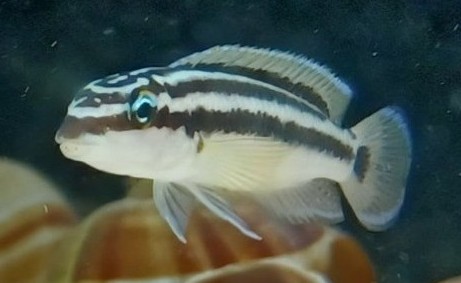
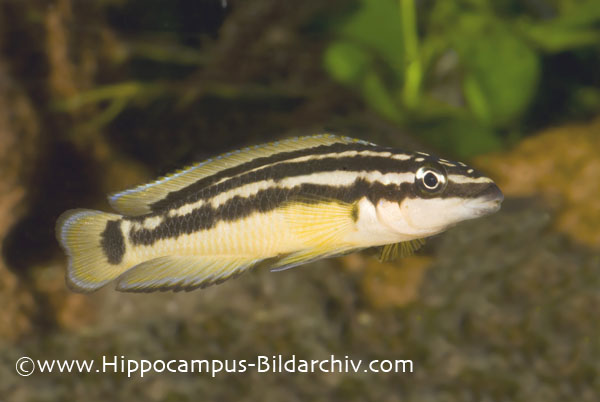
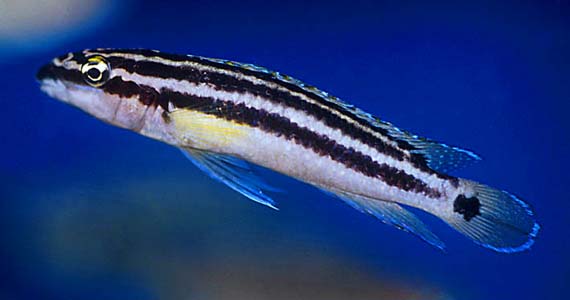
These photographs are used with each photographer’s permission.
Send a photographDistribution
Profile completeness19 of 24
79% complete
Also missing: aquarium size, taxonomic authority, etymology.
Contributors
Improved by
- CowPuppet59
The number beside each name is how many contributions that person has had accepted on Seriously Fish.
Community
Questions about Julidochromis ornatus?
Ask on Discord