Laetacara fulvipinnis
On this page10 sections
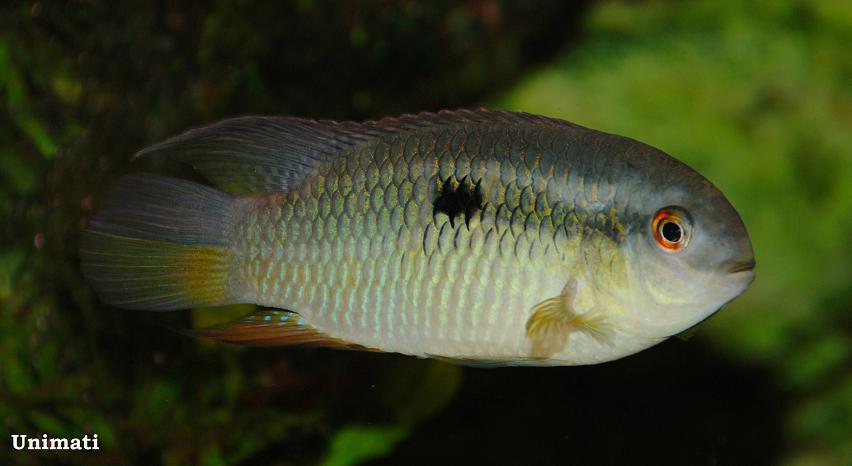
Quick facts
Difficulty5 of 6 measures
More bars, more demanding.
- Space
- modest tank
- Water
- tap water
- Temp
- unfussy
- Temperament
- unknown
- Social
- in a pair
- Compatibility
- community tank
Has been collected from habitats containing clear, soft, acidic, tea-coloured blackwater, most typically among leaf litter or submerged vegetation in very shallow (10-50 cm depth) water along the margins of streams and other minor tributaries. At a village called El Niñal close to the mouth of the rio Pasimoni in the Casiquiare drainage pH was...
Etymology
Laetacara: from the Latin laetus, meaning 'happy', and acará, a vernacular term used for cichlids in certain parts of South America, in reference to patterning around the mouth and snout which give members of this genus a 'smiling' appearance.
fulvipinnis: from the Latin fulvus, meaning 'reddish-yellow, tawny', and pinna, meaning 'fin', in reference to the colour of the anal and caudal fins.
Distribution
Native to the upper and middle río Orinoco, the rio Casiquiare (aka Casiquiare Canal) and the upper and middle rio Negro in Venezuela and Brazil, with confirmed localities lying between Puerto Ayacucho, Venezuela and Barcelos on the rio Negro in Brazil.
Given this range it would not be suprising if it also occurs in eastern Colombia.
Type locality is 'lagoon at the village of Arigua, 1°50'13"N, 67°02'29"W, a few kilometers south of San Carlos de río Negro, Venezuela'.
Habitat
Has been collected from habitats containing clear, soft, acidic, tea-coloured blackwater, most typically among leaf litter or submerged vegetation in very shallow (10 – 50 cm3.9 – 20 in depth) water along the margins of streams and other minor tributaries.
At a village called El Niñal close to the mouth of the rio Pasimoni in the Casiquiare drainage pH was 4.4, electrical conductivity 10 μS/cm and temperature 26.3 °C79 °F.
Other cichlid species at the locality included Apistogramma uaupesi, Mesonauta insignis, Heros severus and an unidentified Heros sp.
Water conditions
Diet
Wild fish are probably foragers feeding on algae, organic detritus, small insects, worms, crustaceans, and other zooplankton.
In the aquarium it's easily-fed but the best condition and colours offer regular meals of small live and frozen foods such as bloodworm, Daphnia, and Artemia, alongside good quality dried flakes and granules, at least some of which should include additional plant or algal content.
These boxes carry affiliate links and we may earn a commission. What they recommend comes from each profile’s own figures, never chosen by hand or paid for.
Sexual dimorphism
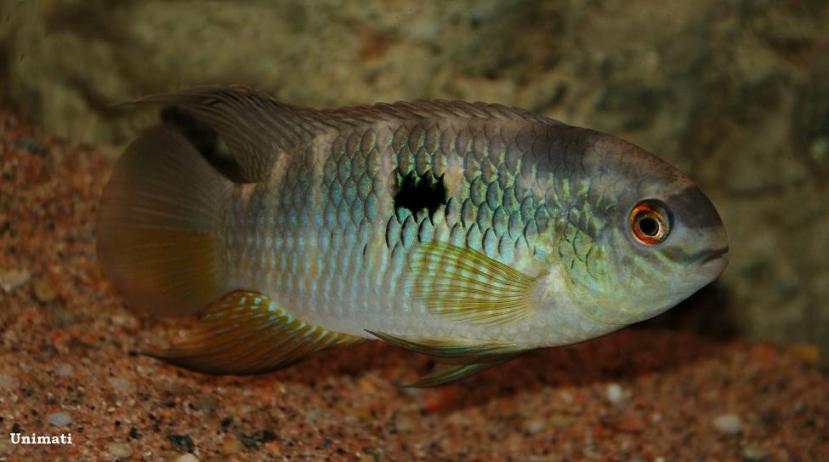
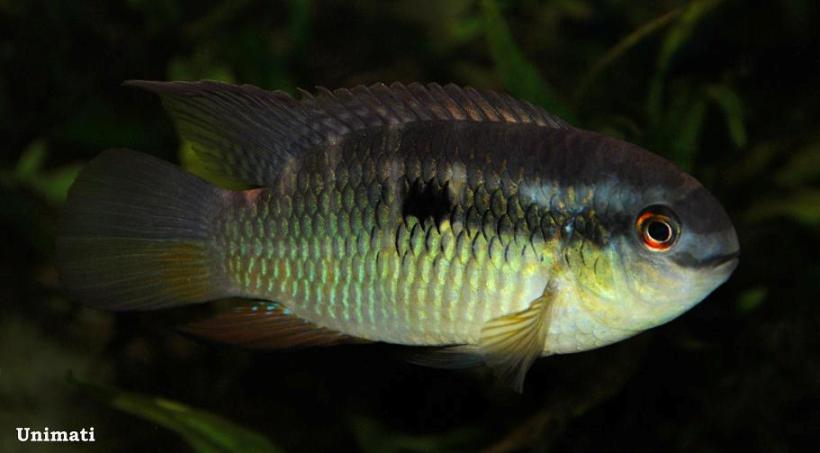
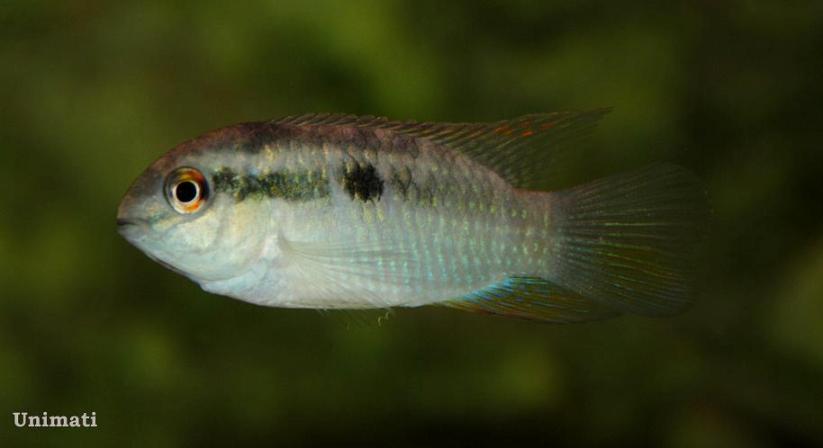
Males grow larger than females and possess more-extended dorsal, anal and caudal fins, while older males tend to develop a steeper head profile.
Nuptial individuals of both sexes develop red colouration on the lower head, opercula and anterior portion of the body but this is not as extensive as in L. dorsigera.
Reproduction
Biparental substrate-spawner which deposits its eggs on a solid surface such as a plant leaf.
Incubation is around three days and the fry are free-swimming approximately a week later.
Notes
This species was known as L. sp. 'orangeflossen' (orange fins) in the aquarium hobby prior to publication of its official description.
The genus Laetacara currently contains seven valid species and L. fulvipinnis can be told apart from all congeners by the following combination of characters: dorsal-fin usually with 15 spines and 10 rays; 23–25 scales in the E1 row (the row of scales in the horizontal series directly above the longitudinal row and including the lower lateral line); dorsal-fin base only moderately scaly; caudal-fin without a conspicuous pattern of small pale dots; maximum size 74 mm2.9 in SL.
References
- Staeck, W. and I. Schindler (2007). Description of Laetacara fulvipinnis sp. n. (Teleostei: Perciformes: Cichlidae) from the upper drainages of the rio Orinoco and rio Negro in Venezuela. Vertebrate Zoology 51(1), 63-71
- Ottoni, F. P., P. H. N Bragança, P. F. Amorim and C. S. Gama (2012). A new species of Laetacara from the northern Brazil coastal floodplains (Teleostei: Cichlidae). Vertebrate Zoology 62(2), 181-188
- Ottoni, F. P. and W. J. E. M. Costa (2009). Description of a new species of Laetacara Kullander, 1986 from central Brazil and re-description of Laetacara dorsigera (Heckel, 1840) (Labroidei: Cichlidae: Cichlasomatinae). Vertebrate Zoology 59(1), 41-48
Species images · 6
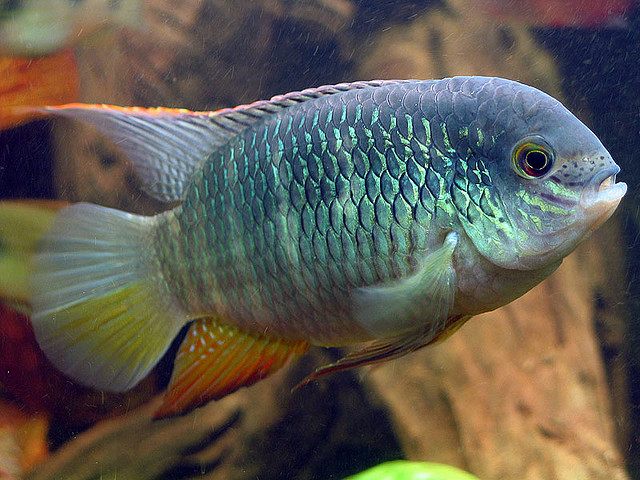
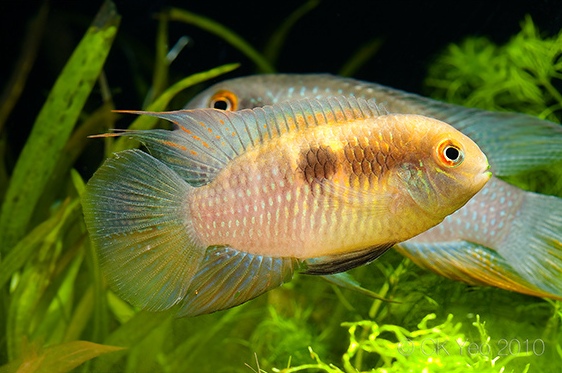
Used with the photographer’s permission. Not licensed for reuse.