Results for “killifish”
Search by scientific name, common name or former name. You can also narrow the catalogue with the filters.
Filters

Epiplatys annulatusClown Killifish
(Boulenger, 1915)
Matched on the common name Clown Killifish
Max length35mm SL1.4in SLTank45 × 30cm18 × 12inTemp20–26°C68–79°FpH4.0–7.0The clown killifish, Epiplatys annulatus, is a small killifish from coastal lowlands of southern Guinea, Sierra Leone and northwestern Liberia. Also traded as 'rocket killifish' and 'banded panchax', it has four very broad dark bars alternating with yellowish ones. Fin colour varies between populations, which aquarists keep labelled by locality, and it is relatively easy to breed.

Fundulopanchax gardneriSteel-blue Killifish
(Boulenger, 1911)
Matched on the common name Steel-blue Killifish
Max length55mm SL2.2in SLTanknot recordedTemp20–26°C68–79°FpH6.0–7.5The steel-blue killifish, Fundulopanchax gardneri, is native to the Cross River system in Nigeria and Cameroon and the Benue River drainage. Also known as Gardner's killi or blue lyretail, the common aquarium forms are among the best choices for those new to killifishes. Wild populations come in numerous colour forms, three of them described as subspecies. Its eggs can withstand a period of drying but will also hatch when kept submerged.

Fundulus xenicusDiamond Killifish
Jordan & Gilbert, 1882
Matched on the common name Diamond Killifish
Max length50mm SL2.0in SLTanknot recordedTemp21–35°C70–95°FpH7.5–9.0The diamond killifish, Fundulus xenicus, is a killifish native to the coastal waters of the northern Gulf of Mexico, from southern Florida to Texas. It lives in shallow lagoons, salt marshes and pools, usually in brackish water, and fares poorly with prolonged exposure to fresh water, so marine salt at 3-10 g/L is considered essential in the aquarium. Uncommon in the hobby, it is best kept on its own in a group of two or three females to each male.

Anatolichthys anatoliaeAnatolian Toothcarp
(Leidenfrost, 1912)
Matched on the common name Anatolian Giant Killifish
Max length55mm SL2.2in SLTank120 × 30cm48 × 12inTemp2–30°C36–86°FpH7.0–8.5The Anatolian toothcarp, Anatolichthys anatoliae, is a small killifish from central and western Anatolia in Turkey. The most widely distributed of the Anatolian species, it lives in fresh and mildly saline waters, and around Lake Tuz several populations have disappeared through pollution and water extraction. It needs a cold winter period, and given its conservation status it is best kept on its own, in a group with two or three females to each male.

Heterandria formosaLeast Killifish
(Girard, 1859)
Matched on the common name Least Killifish
Max length20mm SL0.8in SLTanknot recordedTemp20–26°C68–79°FpH7.0–8.0The least killifish, Heterandria formosa, is a tiny livebearer from the United States, found in heavily vegetated margins of still or sluggish water. The smallest known livebearing fish, it is peaceful but not a community fish in the general sense, as the males reach only 2 cm and many commonly kept species will eat them. It is sometimes confused with the much more aggressive mosquito fish of the genus Gambusia.

Kosswigichthys asquamatusHazar Toothcarp
Sözer, 1942
Matched on the common name Scaleless Killifish
Max length40mm SL1.6in SLTank120 × 30cm48 × 12inTemp12–28°C54–82°FpHnot recordedThe Hazar toothcarp, Kosswigichthys asquamatus, is a relict species endemic to Lake Hazar in southeastern Anatolia, Turkey. It has a more elongate body than other Aphanius, almost no scales and conical teeth. The lake water is hard, alkaline and rich in magnesium chloride, and in aquaria it seems to need certain salts for proper egg and fry development. Outside the spawning season it forms schools.

Aphyosemion australeGolden Lyretail
(Rachow, 1921)
Max length60mm SL2.4in SLTank45 × 25cm18 × 10inTemp21–32°C70–90°FpH5.5–7.0Aphyosemion australe, the golden or Cape Lopez lyretail, is a killifish from lowland coastal areas of Gabon and Congo. It lives in swamps and small streams and is not an annual species. Among the first killifishes to be widely kept, it is easy to spawn and can live over three years, and wild forms are kept labelled by collection locality to preserve bloodlines.

Aphyosemion gabunenseGabon Lyretail
Radda, 1975
Max length50mm SL2.0in SLTank45 × 25cm18 × 10inTemp22–28°C72–82°FpH6.5–7.2The Gabon lyretail, Aphyosemion gabunense, is a killifish thought endemic to the lower Ogooué river basin in western Gabon. Found in swamps, small streams and pools, it is not an annual species and makes a good beginner's killifish. A very peaceful, shy fish, it is easily outcompeted by more vigorous tankmates and needs a tight-fitting cover, being an accomplished jumper.
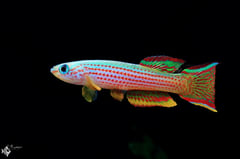
Aphyosemion striatumRed-Striped Lyretail
(Boulenger, 1911)
Max length50mm SL2.0in SLTank45 × 30cm18 × 12inTemp20–26°C68–79°FpH6.5–7.5The red-striped lyretail, Aphyosemion striatum, is a killifish from coastal Equatorial Guinea and Gabon, as far south as the lower Ogooué basin. It inhabits perennial lowland rainforest streams, pools and freshwater swamps. Easy to breed and relatively long-lived, since it is not an annual species, it is a good beginner's killifish, though a shy one easily out-competed by more vigorous fishes.

Epiplatys dagetiRed-chinned Panchax
Poll, 1953
Max length45mm SL1.8in SLTank60 × 30cm24 × 12inTemp20–30°C68–86°FpH5.0–7.0The red-chinned panchax, Epiplatys dageti, is a killifish from coastal savanna in southwestern Ghana, southern Côte d'Ivoire and southern Liberia. An aquarium stalwart since the red-throated form was first exported from Monrovia in 1908, it is relatively hardy and easy to breed, and a good choice for those new to killifishes. The Monrovia fish is often labelled E. dageti monroviae in aquarium literature.
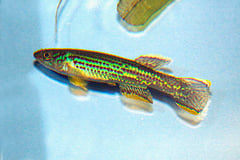
Fundulopanchax marmoratusMarbled Lyretail
authority not recorded
Max length60mm SL2.4in SLTank45 × 25cm18 × 10inTemp21–24°C70–75°FpH6.0–7.0The marbled lyretail, Fundulopanchax marmoratus, is a rare killifish endemic to Cameroon, found in a single area of coastal rainforest. It inhabits small streams and ponds and occurs only in permanent water, so it is not an annual species. It needs cooler temperatures than most killifishes and is best kept in a species tank.
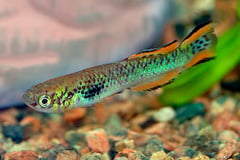
Fundulopanchax walkeri
authority not recorded
Max length65mm SL2.6in SLTank45 × 25cm18 × 10inTemp20–23°C68–73°FpH6.0–7.0Fundulopanchax walkeri is a predatory killifish from the Ivory Coast and Ghana. It lives in small streams, swamps and ponds in coastal rainforest and forested savanna, and occurs as both an annual and a non-annual fish, so it can breed in permanent and temporary water. It needs cooler water than many killifishes, and will eat any fish that fits in its mouth. Some wild populations are threatened or extinct through rapid human development.
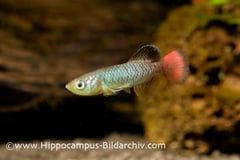
Nothobranchius guentheriGunther's Nothobranch
(Pfeffer, 1893)
Max length♂ 41 · ♀ 32mm SL♂ 1.6 · ♀ 1.3in SLTank45 × 30cm18 × 12inTemp22–25°C72–77°FpH6.5–8.0Gunther's nothobranch, Nothobranchius guentheri, is an annual killifish endemic to Unguja, the main island of Zanzibar, Tanzania. It lives in seasonal coastal pools that dry out completely, surviving the dry season as eggs in the mud. One of the easier Nothobranchius to keep and breed, it is often recommended for a first attempt at an annual killifish. The IUCN lists it as Endangered because its pools are being lost to farming.
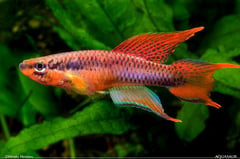
Aphyosemion bitaeniatumTwo-Striped Lyretail
(Ahl, 1924)
Max length45mm SL1.8in SLTanknot recordedTemp24–30°C75–86°FpH5.0–6.5The two-striped lyretail, Aphyosemion bitaeniatum, is a killifish from lowland coastal regions of Togo, Benin and Nigeria. Its range reaches the Cross River delta and some inland localities along the lower Niger River. Populations in Cameroon, Equatorial Guinea and Gabon are now considered to represent other species.
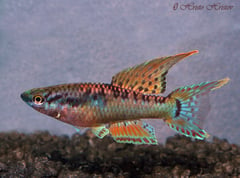
Aphyosemion bivittatumTwo-Banded Lyretail
(Lönnberg, 1895)
Max length50mm SL2.0in SLTanknot recordedTempnot recordedpHnot recordedThe two-banded lyretail, Aphyosemion bivittatum, is a killifish that appears restricted to coastal plains along the Cameroon and Nigeria border. Its range includes the Korup and Cross River National Parks, and the type locality is close to a waterfall on the Ndian River in southwestern Cameroon.
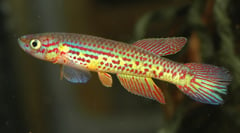
Aphyosemion bochtleriBochtler's Lyretail
Radda, 1975
Max length50mm SL2.0in SLTanknot recordedTemp18–22°C64–72°FpH6.0–7.0Bochtler's lyretail, Aphyosemion bochtleri, is a killifish from northern Gabon, where it occurs in the upper Ivindo River basin of the Ogooué system. It was described from a rainforest stream near Mintoum. Considered a synonym of A. herzogi for a number of years, it is currently recognised as distinct.
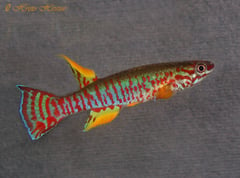
Aphyosemion bualanumBouala Lyretail
(Ahl, 1924)
Max length50mm SL2.0in SLTanknot recordedTempnot recordedpHnot recordedThe Bouala lyretail, Aphyosemion bualanum, is a killifish from the upper Benue and Mayo Kébbi systems in Cameroon, Central African Republic and Chad. It is listed as endangered by the IUCN. Before 1990 the name was misused for various populations of A. elberti.
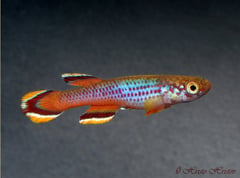
Aphyosemion celiaeCelia's Lyretail
Scheel, 1971
Max length65mm SL2.6in SLTanknot recordedTemp20–26°C68–79°FpH6.0–7.6Celia's lyretail, Aphyosemion celiae, is a killifish from western Cameroon, where it appears restricted to parts of the central Mungo River basin. It was described from a small stream in Mambanda, near Kumba.
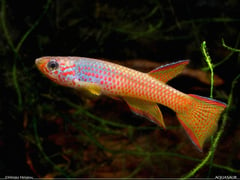
Aphyosemion cognatumRed-Spotted Lyretail
Meinken, 1951
Max length50mm SL2.0in SLTanknot recordedTempnot recordedpHnot recordedThe red-spotted lyretail, Aphyosemion cognatum, is a killifish from the Democratic Republic of Congo. Its range appears extensive in the middle and lower Congo regions. The type material came from a commercial shipment from Kinshasa and was presumed to have been collected nearby. Specimens from Lac Fwa in the Sankuru River drainage, many hundreds of kilometres from Kinshasa, have been identified as this species.
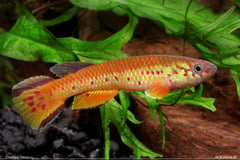
Aphyosemion congicumCongo Lyretail
(Ahl, 1924)
Max length45mm SL1.8in SLTanknot recordedTempnot recordedpHnot recordedThe Congo lyretail, Aphyosemion congicum, is a killifish from western Democratic Republic of Congo. It may be restricted to the area between the Kwango and Gamba rivers, but the type series came from a commercial shipment and its natural range remains unconfirmed. The Kwango drains to the Congo through the Kasai.