Channa marulius
Bullseye Snakehead
Formerly Ophicephalus marulius Hamilton, 1822 · Ophicephalus grandinosus Cuvier, 1831 · Ophicephalus sowara Cuvier, 1831 · Channa theophrasti Valenciennes, 1840 · Ophicephalus leucopunctatus Sykes, 1839 · Ophiocephalus theophrasti Valenciennes, 1840 · Ophiocephalus pseudomarulius Günther, 1861 · Ophiocephalus aurolineatus Day, 1870 · Ophiocephalus marulius ara Deraniyagala, 1945
On this page11 sections
Quick facts
Difficulty6 of 6 measures
More bars, more demanding.
- Space
- very large tank
- Water
- tap water
- Temp
- unfussy
- Temperament
- species tank
- Social
- kept alone
- Compatibility
- not a community fish
This species is also referred to as 'giant', 'great', 'cobra', or 'Indian' snakehead. Although currently-considered to be distributed throughout much of southern Asia it is widely-accepted to represent a complex of related species in need of additional research. A number of geographical variants exhibiting diffe...
Etymology
Channa: from the Latin channe, used to refer to an unspecified species of sea perch.
marulius:
Distribution
Recorded from Pakistan through India, Sri Lanka, Bangladesh, Nepal, Myanmar, and Thailand to southern China, Laos and Vietnam although likely to be far less widespread pending future research (see 'Notes').
Type locality is unspecified with Hamilton simply stating that this species is found 'in all parts of India that I have visited', but is assumed to be within the Ganges river system.
A population has apparently become established in Broward County, Florida, United States.
Habitat
Tends to inhabit larger river channels, inland lakes, canals, and swamps where it is often associated with aquatic vegetation.
Aquarium size
Suitable only for public installations or the very largest private aquaria.
Maintenance
Relatively unfussy although some surface cover in the form of floating or overhanging vegetation or branches is appreciated.
Unlike most Channa spp. it's pelagic and requires plenty of room to swim.
It’s essential to use a tightly-fitting hood since Channa spp. are notorious for their ability to escape, and a gap should be left between this and the water surface as they require access to a layer of humid air.
Water conditions
Diet
An obligate predator which probably feeds on smaller fishes, amphibians and terrestrial insects in nature but in most cases adapts well to dead alternatives in captivity.
Some specimens even accept dried foods though these should never form the staple diet.
Young fish can be offered chironomid larvae (bloodworm), small earthworms, chopped prawn and suchlike while adults will accept strips of fish flesh, whole prawns/shrimp, mussels, etc.
This species should not be fed mammalian or avian meat such as beef heart or chicken since some of the lipids contained in these cannot be properly metabolised by the fish and may cause excess fat deposits and even organ degeneration.
Similarly there is no benefit in the use of 'feeder' fish such as livebearers or small goldfish which carry with them the risk of parasite or disease introduction and at any rate tend not have a high nutritional value unless properly conditioned beforehand.
These boxes carry affiliate links and we may earn a commission. What they recommend comes from each profile’s own figures, never chosen by hand or paid for.
Behaviour and compatibility
Best-maintained in a species-specific aquarium.
Juveniles and subadults are relatively peaceful with one another but become aggressive when they reach sexual maturity.
Notes
This species is also referred to as 'giant', 'great', 'cobra', or 'Indian' snakehead.
Although currently-considered to be distributed throughout much of southern Asia it is widely-accepted to represent a complex of related species in need of additional research.
A number of geographical variants exhibiting differences in morphology and colour pattern have been observed and relatively high intraspecific genetic differentiation detected between populations from northern and southern India (Benziger et al., 2011).
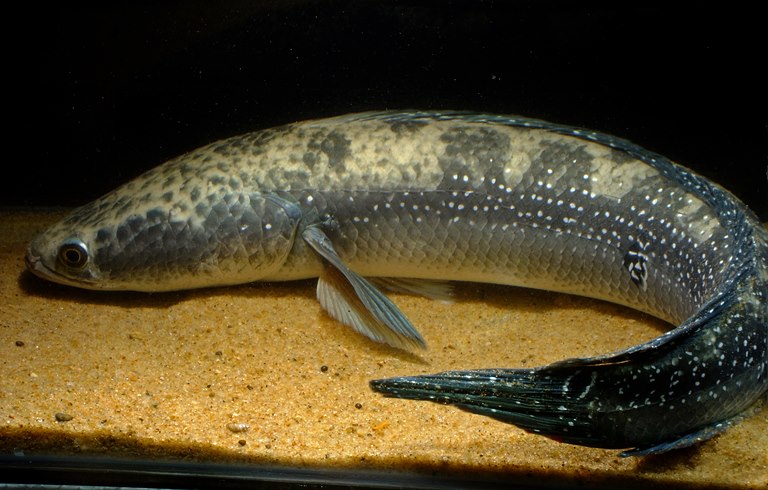
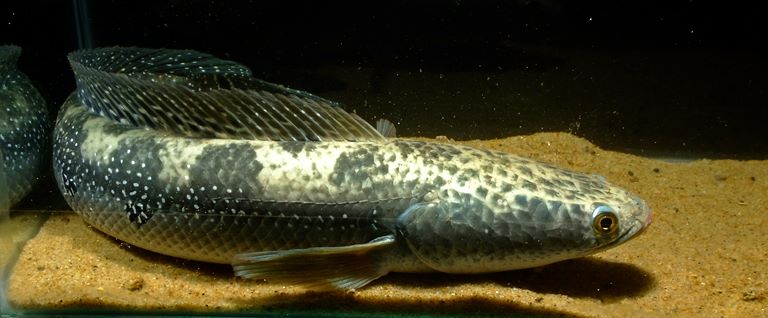
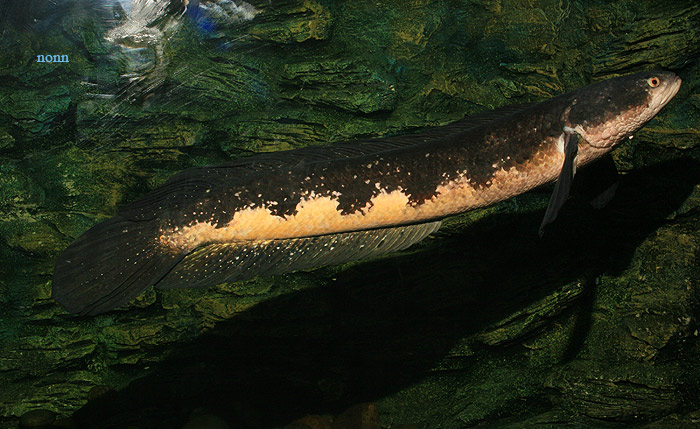
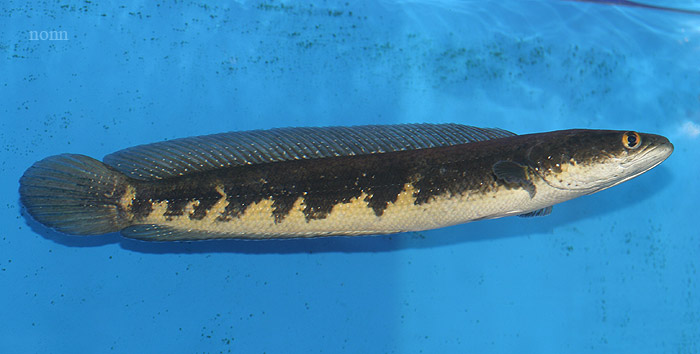
Distinguishing morphological characters in C. marulius include: gular scales absent; dorsal-fin rays 45-55; anal-fin rays 28-36; pectoral-fin rays 16-18; pelvic-fin rays 6; lateral line scales 60-70; predorsal scales 16; lateral line scales drop two rows between the 16th and 18th perforated scale; scale rows between posterior margin of orbit and preopercular angle 10; scales on top of head moderately-sized with a rosette of head scales between the orbits, the frontal head scale in the center of the rosette; two scales between rosette and basal head scale; 10 scale rows between preopercular angle and posterior border of orbit; pectoral-fin length about half head length; mouth large, lower jaw with 7 to 18 canines behind a single row of villiform teeth that widen to 5-6 rows at jaw symphysis; teeth present on prevomer but absent on palatines.
It is commonly confused with the nominal congeners C. marulioides (Bleeker, 1851) and C. melanoptera (Bleeker, 1855) although these also present taxonomic problems.
In general any fish from Peninsular Thailand, Malaysia, or Indonesia is currently assigned to C. marulioides while C. melanoptera may represent a juvenile synonym of C. marulioides or a related species with distribution restricted to the Sambas river in West Kalimantan (Kalimantan Barat) province, Indonesian Borneo (Tan & Ng, 2005)[7].
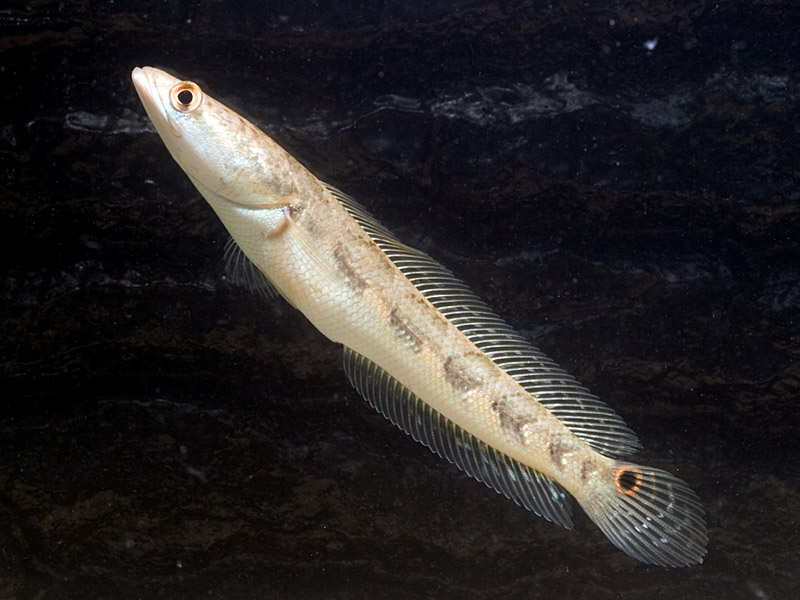
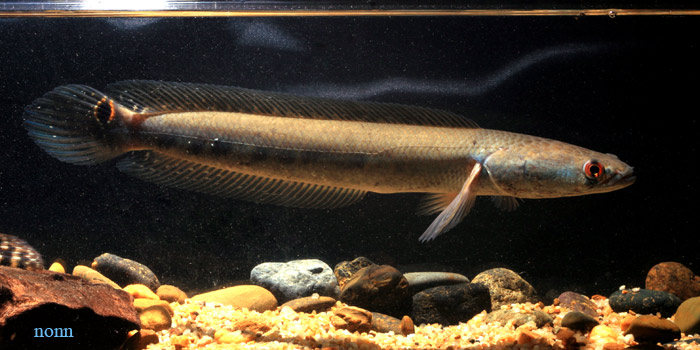
Although C. marulioides is sometimes said to be identified by presence of an ocellus in the upper part of the caudal-fin, this fades in specimens larger than ca. 50 mm2.0 in SL but tends to be retained in adults of C. marulius (though not in all populations, e.g., Mekong basin; see Kottelat, 2001).
Members of the family Channidae are commonly referred to as 'snakeheads' due to possession of large scales on the head of most species which are reminiscent of the epidermal scales (cephalic plates) on the heads of snakes.
There currently exist over 30 valid species but diversity within the group is likely to prove significantly greater.
Species from northeastern India were divided into the C. marulius and C. gachua groups by Vishwanath and Geetakumari (2009)[6].
C. marulius is included in the former assemblage which the authors characterise by possessing the following combination of characters: a prominent V-shaped sharp isthmus; cephalic sensory pores arranged in groups; absence of scales on the lower jaw; a sharp, prominent, spinelike hypurapophysis; more branchial than epibranchial toothplates; an elongate urostyle.
All Channa spp. posses-s supplementary breathing apparatus in the form of paired suprabranchial chambers located behind and above the gills, although these are not labyrinthic but lined with respiratory epithelium.
These chambers allow the fish to breathe atmospheric air and survive in hypoxic conditions or even out of the water for a considerable period of time, and in aquaria they are often seen rising to the surface to take gulps of air.
References
- Brede, N. and P. Antler (2009). Schlangenkopffische—Die Gattungen Channa und Parachanna. Natur und Tier Verlag, Münster, 62 pp.
- Hamilton, F. (1822). An account of the fishes found in the river Ganges and its branches. An account of the fishes found in the river Ganges and its branches., i-vii + 1-405
- Kottelat, M. (2001). Fishes of Laos. WHT Publications, Colombo, 1-198
- Courtenay, W. R., Jr. and J. D. Williams (2004). Snakeheads (Pisces, Channidae) - a biological synopsis and risk assessment. Circular, U. S. Department of the Interior, Geological Survey No. 1251, i-v + 1-143
- Benziger, A., S. Philip, R. Raghavan, P. H. Anvar Ali, M. Sukumaran, J. C. Tharian, N. Dahanukar, F. Baby, R. Peter, K. Rema Devi, K. V. Radhakrishnan, M. A. Aniffa, R. Britz, and A. Antunes (2013). Unraveling a 146 Years Old Taxonomic Puzzle: Validation of Malabar Snakehead, Species-Status and Its Relevance for Channid Systematics and Evolution. PLoS ONE 6(6), e21272
- Vishwanath, W. and Kh. Geetakumari (2009). Diagnosis and interrelationships of fishes of the genus Channa Scopoli (Teleostei: Channidae) of northeastern India. Journal of Threatened Taxa 1(2), 97- 105
- Tan, H. H. and P. K. L. Ng (2005). The labyrinth fishes (Teleostei: Anabanatoidei, Channoidei) of Sumatra, Indonesia. Raffles Bulletin of Zoology Supplement 13, 115-138
- Rafique, M. (2000). Fish diversity and distribution in Indus River and its drainage system. Pakistan Journal of Zoology 32(4), 321-332
- Musikasinthorn, P. (2000). Channa aurantimaculata, a new channid fish from Assam (Brahmaputra River basin), India, with designation of a neotype for C. amphibeus (McClelland, 1845). Ichthyological Research 47(1), 27-37
- Musikasinthorn, P. (1998). Channa panaw, a new channid fish from the Irrawaddy and Sittang River basins, Myanmar. Ichthyological Research 45(4), 355-362
- Rainboth, W. J. (1996). FAO species identification field guide for fishery purposes. Fishes of the Cambodian Mekong. Rome, FAO, 1-265
Species images · 8
Used with the photographer’s permission. Not licensed for reuse.