Every species
Every freshwater profile, A–Z.
Filters
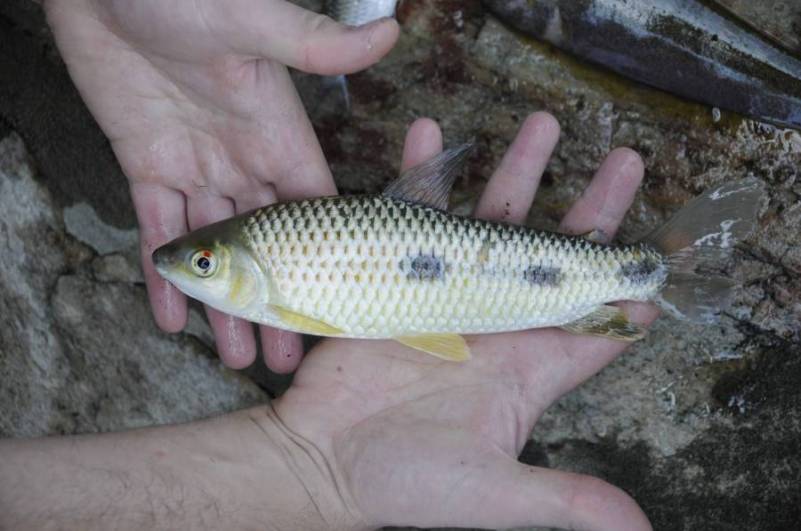
Leporinus fridericiThreespot Leporinus
Bloch, 1794
Max length400mm SL16in SLTank240 × 90cm96 × 36inTemp20–28°C68–82°FpH5.0–8.0This species was described from Suriname but no specific locality was given. It's currently accepted to occur throughout much of the Amazon river system in Brazil, Peru and Bolivia with additional records from coastal drainages of Guyana, Suriname and French Guiana plus the island of Trinidad (Trinidad and Tobago).
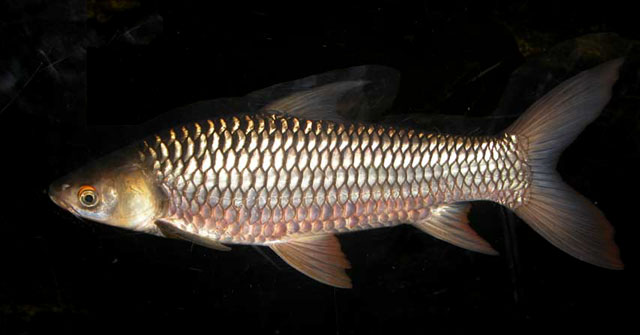
Leptobarbus hoeveniiMad Barb
Bleeker, 1851
Max length1000mm SL39in SLTanknot recordedTemp20–26°C68–79°FpH6.0–8.0Apparently native to Peninsular Malaysia plus the Greater Sunda Islands of Borneo, Sumatra, and Java. Reports of this species from the Mekong, Chao Phraya, and other rivers in Indochina refer to the congener L. rubripinna (see 'Notes'). Type locality is 'Indonesia: Borneo: Kalimantan Selatan: Banjarmasin'.
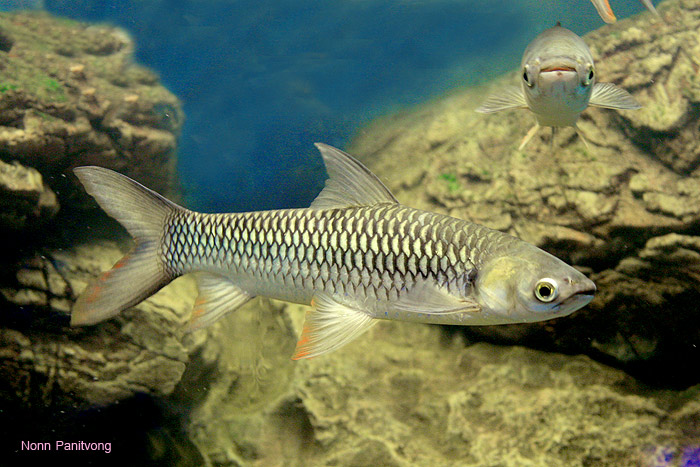
Leptobarbus rubripinnaRed-finned Cigar Shark
Fowler, 1937
Max length1000mm SL39in SLTanknot recordedTemp20–26°C68–79°FpH6.0–8.0This species was referred to as its congener Leptobarbus hoevenii for a number of decades and continues to be misidentified as such in the aquarium hobby, with both species traded under the same name. It is a popular sport fish in its native countries and is wholly unsuitable for private aquaria. Unfortunately it is...
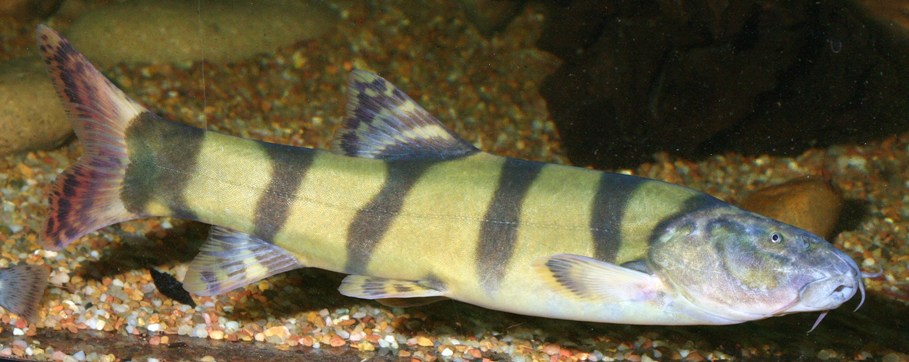
Leptobotia elongataImperial Flower Loach
Bleeker, 1870
Max length500mm SL20in SLTank360 × 90cm142 × 36inTemp15.5–21°C60–70°FpH6.5–7.5This species is rare in the aquarium trade, increasingly so in nature and as a result prohibitively expensive when available. Given its adult size and probable longevity this is therefore a species for the specialist possessing the necessary time, money and dedication to house it long term.
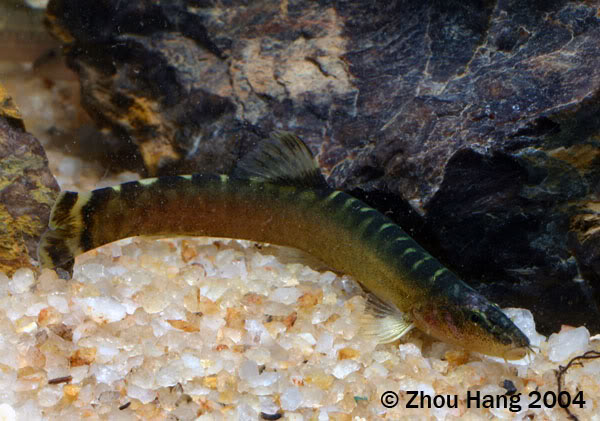
Leptobotia guilinensis
Chen, 1980
Max length100mm SL3.9in SLTank120 × 30cm48 × 12inTemp15.5–21°C60–70°FpH6.5–7.5L. elongata is the type species of the genus but according to current knowledge there exist 13 members in total, all of which are endemic to China and northern Vietnam. They're diagnosable by the following shared characters: possession of a simple (non-bifurcated), short sub-ocular spine not extending beyond the posterior edge of the eye; a laterally-compressed body; relatively deep caudal peduncle; pelvic fins reaching origin of anal-fin; anus below base of dorsal-fin and equidistant between pelvic and anal-fin origins.
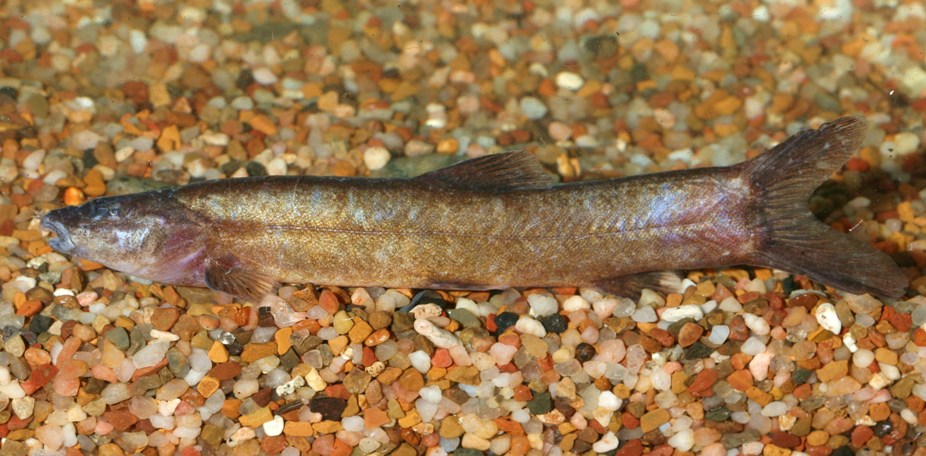
Leptobotia microphthalma
Fu & Ye, 1983
Max length150mm SL6in SLTank120 × 45cm48 × 18inTemp15.5–21°C60–70°FpH6.5–7.5Superficially similar to L. tientainensis but according to the formal description can be separated by a combination of characters including: more deeply-forked caudal-fin (shortest central rays fit 2.6-2.9 times in the outer rays vs. 1.7-2.5 times); significantly smaller eye (fits 26 times in head length vs. 10 times); caudal-fin with 1-2 dark bands at lateral edges v...
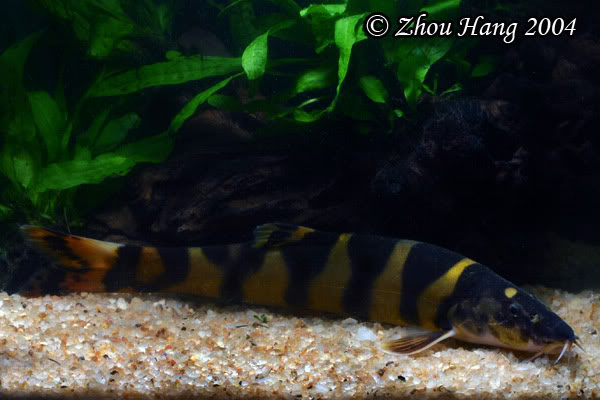
Leptobotia pellegrini
Fang, 1936
Max length200mm SL8in SLTank120 × 45cm48 × 18inTemp20–24°C68–75°FpH6.5–8.0Described from Sichuan province, southwestern China (presumably the upper Yangzte River, aka Chang Jiang, drainage) and also known from parts of the Pearl River (Zhu Jiang) basin in Guangxi Autonomous Region. The latter area is one of the most populous and industrialised in China meaning much of the main river channel is now highly polluted. Its relatively wide distribution probably explains why it's commoner in the aquarium hobby than the similar-looking...
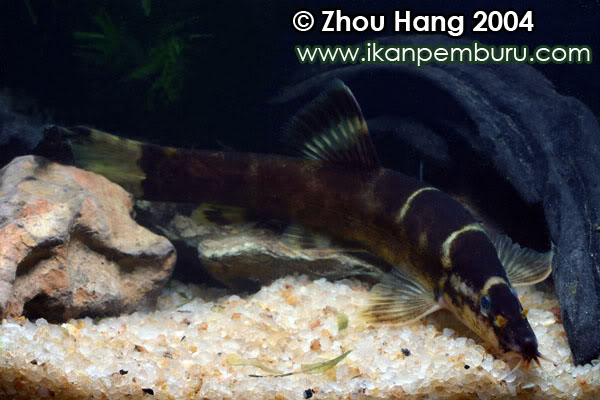
Leptobotia rubrilabris
Dabry de Thiersant, 1872
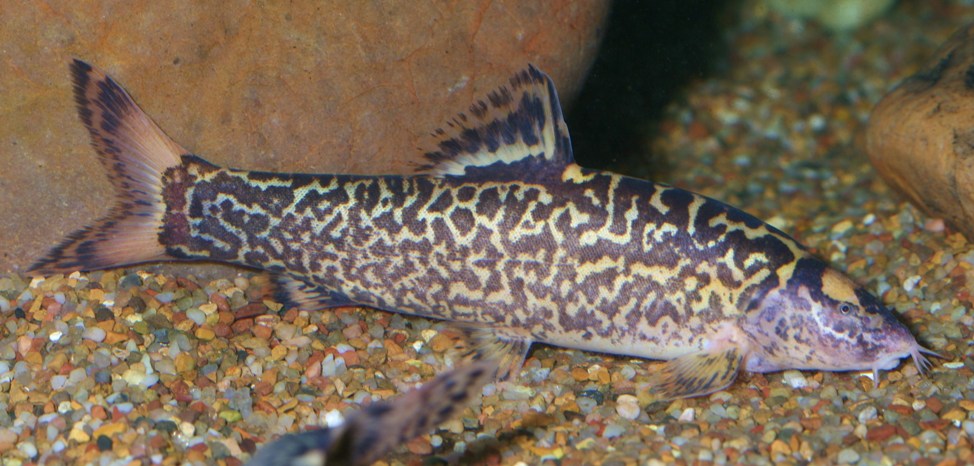
Max length150mm SL6in SLTank120 × 45cm48 × 18inTemp15.5–21°C60–70°FpH6.5–7.5Should be kept in a set-up designed to resemble a flowing stream with a substrate of variably-sized rocks, gravel and some water-worn boulders. This can be further furnished with driftwood roots and branches arranged to form some shaded spots while lengths of PVC piping or similar can be used to provide additional cover. Although most plant species will fail to thrive in such surroundings hardy genera such as Microsorum, Bolbitis or Anubias spp. can be grown attached to the décor and bright lighting will promote the growth of aufwuchs.
Leptobotia taeniops
Sauvage, 1878
Max length150mm SL6in SLTank120 × 45cm48 × 18inTemp15.5–21°C60–70°FpH6.5–7.5L. taeniops is almost unheard of in the aquarium trade although we know of one or two private collectors maintaining it. It was previously included in the related genus Parabotia. L. elongata is the type species of the genus but according to current thinking there exi...
Leptodoras linnelliElongate Mouse Catfish
authority not recorded
Max length230mm SL9in SLTank120 × 45cm48 × 18inTemp18–22°C64–72°FpH5.8–7.0The genus Leptodoras currently contains 10 species, none of which are particularly well known in the hobby. There is little published information regarding the genus, and its members are seldom exported for the aquatic trade. L. linnelli is no exception, usually only turning up as bycatch among shipments of other species such as Opsodoras leporhinus or Hassar orestis. According to Fishbase, it can be distinguished from all other members of the genus except L. acipenserinus by the presence of...
Lestradea perspicax
authority not recorded
Max length135mm SL5in SLTank120 × 30cm48 × 12inTemp24–27°C75–81°FpH7.8–9.0There is some confusion regarding the taxonomy of this species and its congener L. stappersi. L. stappersi was originally regarded as a subspecies of perspicax but is now considered a distinct species. It is not often seen in the hobby....
Limia melanogasterBlack-bellied Limia
authority not recorded
Max length40mm SL1.6in SLTank60 × 30cm24 × 12inTemp22–28°C72–82°FpH7.5–8.5This species was originally classified in the genus Limia before this was made a sub-genus of Poecilia. Confusingly they have been reclassified once more into Limia, but are still referred to as members of Poecilia in much of the available literature. L. melanogaster is endemic to Jamaica. It is not often seen for sale in the hobby....
Limia nigrofasciataHump-backed Limia
authority not recorded
Max length63mm SL2.5in SLTank45 × 30cm18 × 12inTemp22–26°C72–79°FpH7.0–8.0The hump that develops along the spine of adult males is caused by deposition of fatty tissue.
Liniparhomaloptera disparisBroken-band Hillstream Loach
Lin, 1934
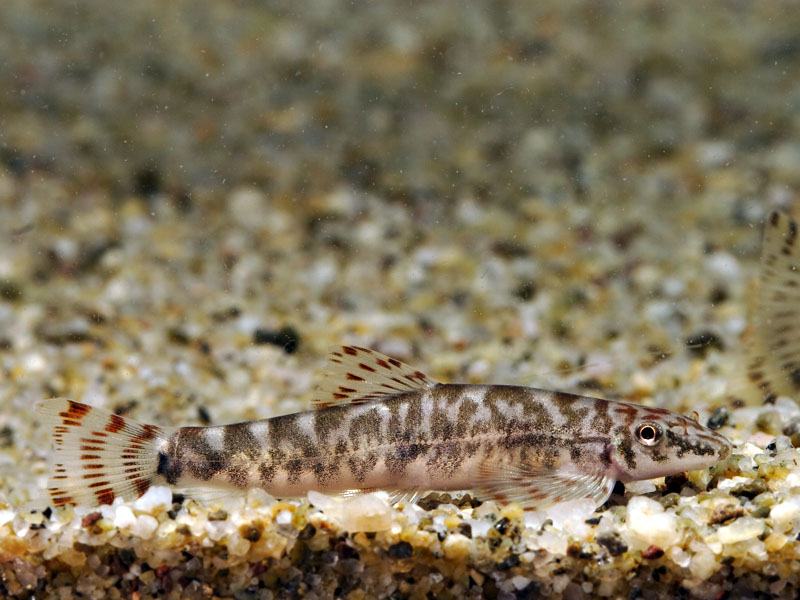
Max length80mm SL3.1in SLTank80 × 30cm31 × 12inTemp20–24°C68–75°FpH6.5–8.0L. disparis is sometimes available as bycatch among shipments of other species such as Rhinogobius duospilus but also appears on trade lists under the fictitious scientific name 'Homaloptera hoffmani'. It can be told apart from similar-looking members of the genus Formosania by its noticeably shorter barbels and from Vanmanenia spp. by the fact that the rostral fold is not lobed and the mouth is relatively small (25% head width. In addition the lower lip in Liniparhomaloptera is not divided and has a flat, papillated edge.
Liosomadoras morrowiFalse Jaguar Catfish
authority not recorded
Max length150mm SL6in SLTank120 × 30cm48 × 12inTemp20–25°C68–77°FpH6.0–7.0Often confused with its congener L. oncinus, the false jaguar cat can be distinguished by its less attractive, duller patterning. It's a good bottom dweller for the larger community....
Liosomadoras oncinusJaguar Catfish
authority not recorded
Max length250mm SL10in SLTank120 × 45cm48 × 18inTemp20–28°C68–82°FpH4.8–7.2Often confused with its congener, L. morrowi, the jaguar cat can be distinguished by its more attractive, brighter patterning and larger adult size. It's an ideal and good looking bottom dweller for the larger community. Previously considered a member of the Doradidae, due to the opercular spines, it has now been reclassified. It occurs over a wide range in nature, hence its apparent tolerance to wildly different water chemistry. In reality, its requirements are determined by collection loc...
Lobocheilos melanotaenia
Fowler, 1935
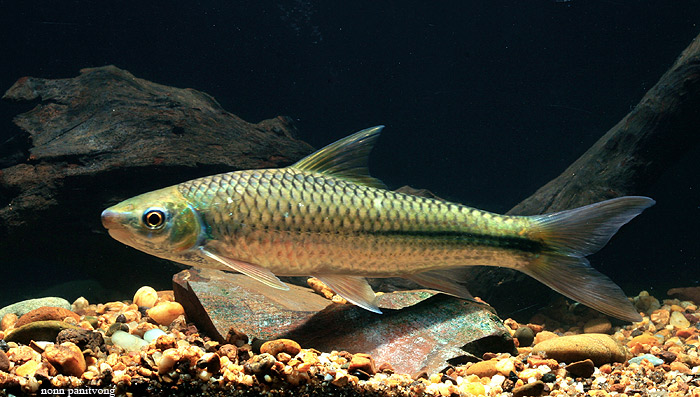
Max length200mm SL8in SLTank180 × 60cm72 × 24inTemp20–26°C68–79°FpH6.0–8.0The majority of Lobocheilos species are endemic to the Greater Sunda Islands of Borneo, Sumatra, and Java, and are uncommon in the aquarium trade, but the widespread Indochinese taxa L. melanotaenia and L. rhabdoura are available on a sporadic basis. L. melanotaenia can be distinguished from L. rhabdoura by the following comb...
Lobocheilos rhabdoura
Fowler, 1934
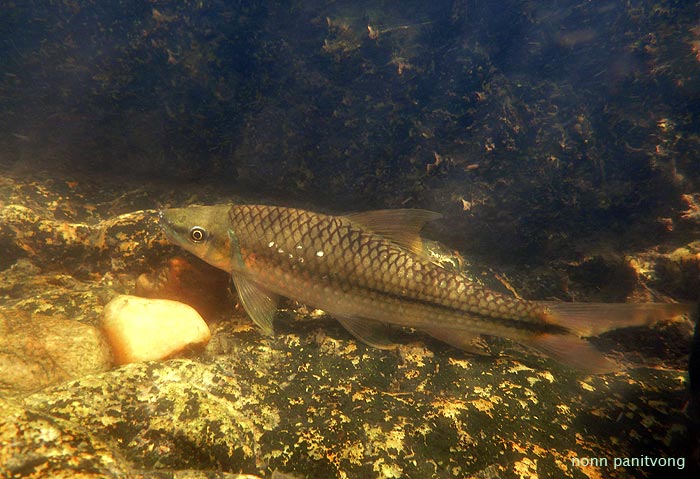
Max length220mm SL9in SLTank180 × 60cm72 × 24inTemp20–26°C68–79°FpH6.0–8.0Lobocheilos species are specialised grazers of periphyton, benthic algae, and other organisms which grow attached to rocks and other solid surfaces, and they typically leave visible scrape marks in places where they have been feeding. They are by no means herbivorous and should be offered meaty foods such as live or frozen chironomid larvae (bloodworm), Tubifex, Artemia, chopped prawn, etc., along with good quality, sinking dried products, at lea...
Lophiobagrus cyclurusAfrican Bullhead
authority not recorded
Max length100mm SL3.9in SLTank75 × 30cm30 × 12inTemp23–26°C73–79°FpH7.5–9.0An interesting addition to the Tanganyikan community that is not often seen in the hobby. There is a rumour that this cat can secrete a poisonous mucous when stressed that can kill other fish in the aquarium but this has not yet been 100% confirmed. It may be wise to keep it in as large an aquarium as possible just in case. There are currently just 4 species of Lophiobagrus described. All are from Lake Tanganyika....
Loricaria simillimaMarbled Whiptail
authority not recorded
Max length180mm SL7in SLTanknot recordedTemp24–27°C75–81°FpH5.6–7.8The pictures here show the fish that is most commonly referred to as L. simillima, but there is a great deal of uncertainty surrounding its true identity. As suggested above, it seems unlikely that its natural distribution is so wide, and we are probably dealing with several species or subspecies. This argument is strengthened by the fact that several differently coloured fish are imported as this species, with darker specimens being collected from acidic blackwaters and lighter fish hailing fro...