Every species
Every freshwater profile, A–Z.
Filters
Luciocephalus pulcherGiant Pikehead
authority not recorded
Max length200mm SL8in SLTank120 × 30cm48 × 12inTemp22–26°C72–79°FpHnot recordedWith a reputation as a difficult species to maintain in captivity, L. pulcher is recommended only to those enthusiasts able to provide the specialist diet and care it requires for its long-term health. It seems to travel very poorly, and is often seen on sale in a weakened, emaciated state. It is also particularly susceptible to bacterial infections when initially imported. Observe the fish carefully when buying and avoid any that are showing red patches around the mouthparts or fins, or that ap...
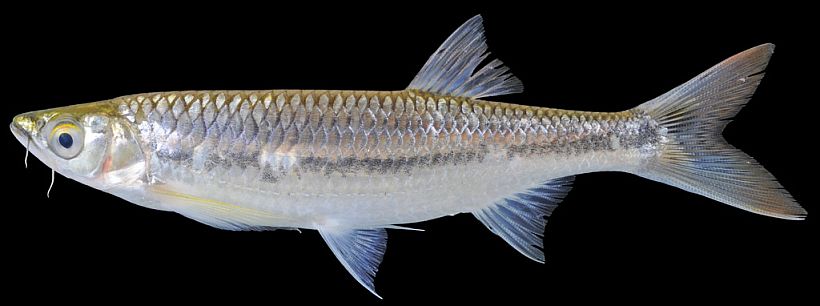
Luciosoma bleekeri
Steindachner, 1878
Max length210mm SL8in SLTank240 × 60cm96 × 24inTemp20–26°C68–79°FpH6.0–8.0L. bleekeri is most-easily distinguished from the congener L. setigerum, with which it is frequently confused, by absence (vs. presence) of a series of black spots on the lateral line scales.
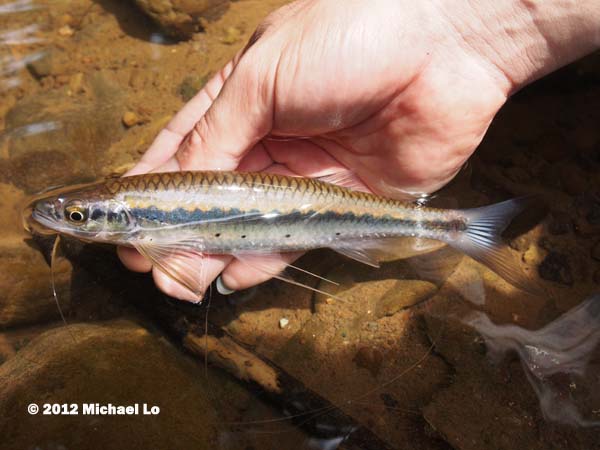
Luciosoma pellegrinii
Popta, 1905
Max length170mm SL7in SLTanknot recordedTempnot recordedpHnot recordedThe five species which currently comprise Luciosoma can be distinguished by elements of colour pattern. Popta described the colour pattern of L. pellegrinii as follows: body colour olive dorsally, with dark-edged scales, yellow ventrally; a lateral series of dark spots on the flank forming a midlateral band which extends onto the opercle but not the head; 4-8 blackish-brown, distinctly-separate spots on the lateral line; fins yellow; dorsal and anal fins with a blackish-brown band; anterior half of some pectoral-fin rays blackish-brown...
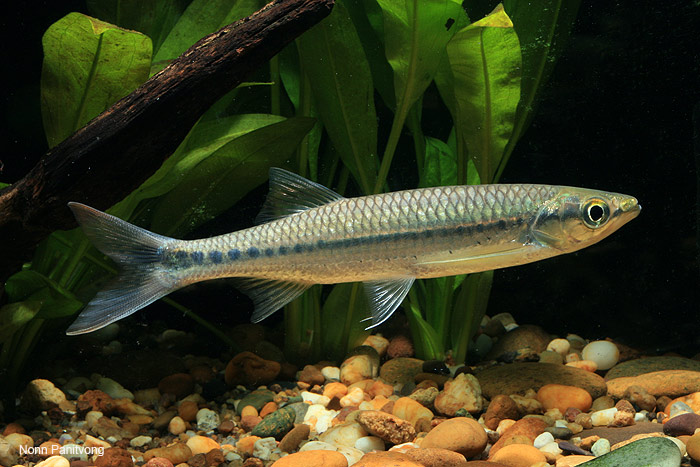
Luciosoma setigerumApollo Shark
Valenciennes, 1842
Max length220mm SL9in SLTank240 × 60cm96 × 24inTemp20–26°C68–79°FpH6.0–8.0There is a fish of unknown geographical origin which matches the majority of diagnostic features for L. setigerum with the exception that the dark lateral stripe is absent in the anterior portion of the body and is not composed of interconnected spots. It is relatively common in the aquarium trade and included here as L. cf. setigerum until a confirmed identity is established.
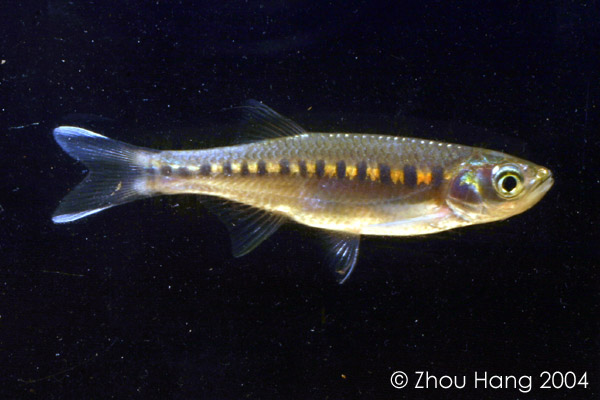
Luciosoma spilopleura
Bleeker, 1855
Max length82mm SL3.2in SLTanknot recordedTempnot recordedpHnot recordedThis species is poorly known in general and is not present in the ornamental trade, although its name is widely misapplied to other Luciosoma species. Its congeners are mostly marketed as 'apollo shark', 'shark minnow', or similar, and often labelled with incorrect scientific names. Identification of the fish pictured here is based on Bleeker (1855, 1860) and Roberts (1989), plus drawings by Bleeker, thus...
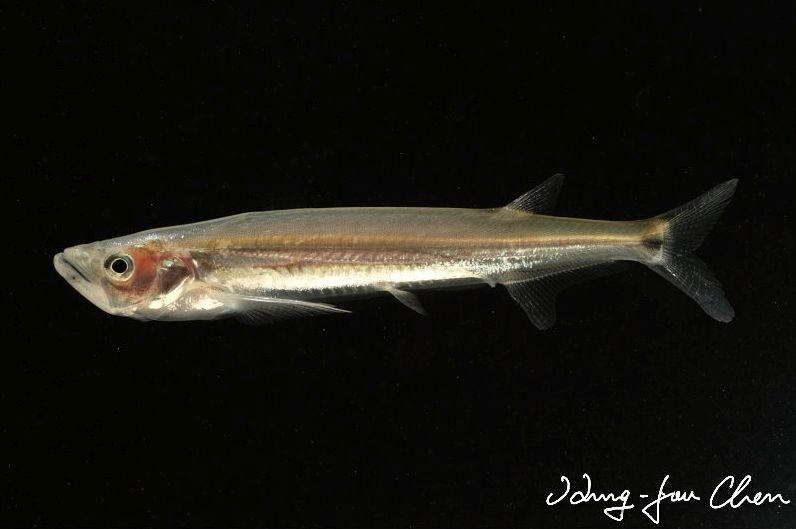
Macrochirichthys macrochirusGiant Sword Minnow
Valenciennes, 1844
Max length800mm SL31in SLTanknot recordedTemp20–26°C68–79°FpH6.0–8.0It is thought to have been extirpated from the Chao Phraya and Mae Klong rivers, Lake Songkhla, and the entire island of Java due to a variety of anthropogenic factors, and the Mekong populations have also been drastically reduced. In particular, it is sensitive to pollution and gillnetting, and is heavily overfished.
Macrognathus zebrinusZebra Spiny Eel
authority not recorded
Max length460mm SL18in SLTank120 × 45cm48 × 18inTemp23–26°C73–79°FpH6.5–7.5One of the newer and prettier spiny eels in the hobby, M. zebrinus was previously considered a member of the closely related Mastacembelus genus. Care should be exercised when handling spiny eels, as the common name is derived from the sharp dorsal rays that can easily puncture the skin of a human....
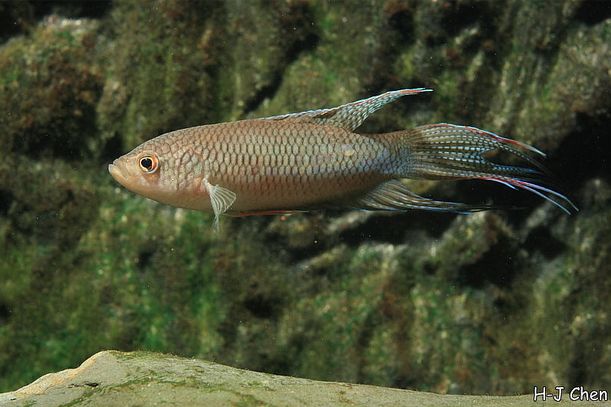
Macropodus erythropterus
Freyhof & Herder, 2002
Max length80mm SL3.1in SLTank80 × 30cm31 × 12inTemp20–30°C68–86°FpH6.0–8.0This species is frequently mistaken for the similar-looking congener M. spechti Schreitmüller 1936, which is easily-identified by the absence of reddish pigmentation in the dorsal, anal, and caudal fins. There has been some debate as to whether these two represent the same taxon, however, with Winstanley and Clements (2008) proposing that M. erythropterus be considered a synonym of M. spechti because they were unable to separate the two species by morphological characters, and specimens with red pigmentation on the unpaired fins were coll...
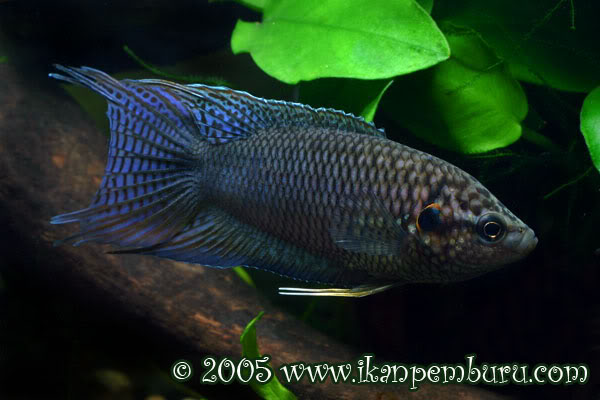
Macropodus hongkongensis
Freyhof & Herder, 2002
Max length70mm SL2.8in SLTank80 × 30cm31 × 12inTemp15–25°C59–77°FpH6.0–8.0In 1996 the species was known from five localities in Hong Kong, but at least one of these has been destroyed and it is now known only from Tai Po and Sai Kung districts. Additional populations have subsequently been discovered in Guangdong and Fujian provinces on the southern Chinese mainland. Type locality is 'China: Hong Kong: Tai Po: Sha Lo Tung'.
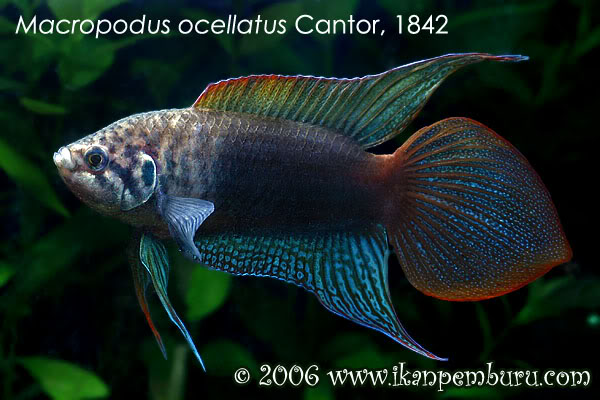
Macropodus ocellatusRoundtail Paradise Fish
Cantor, 1842
Max length80mm SL3.1in SLTank80 × 30cm31 × 12inTemp10–22°C50–72°FpH6.0–7.5M. ocellatus can be distinguished from congeners by the following combination of characters: caudal-fin rounded; eye stripe not connecting spot on posterior projection of opercle with eye; dorsal-fin rays filamentous posterior to a vertical through the posterior anal-fin rays in adults; 16-19 spinous dorsal-fin rays; 6-13 rakers on ceratobranchial of first gill arch; posterior tip or margin of body scales not darker than scales.
Macropodus opercularisParadise Fish
Linnaeus, 1758
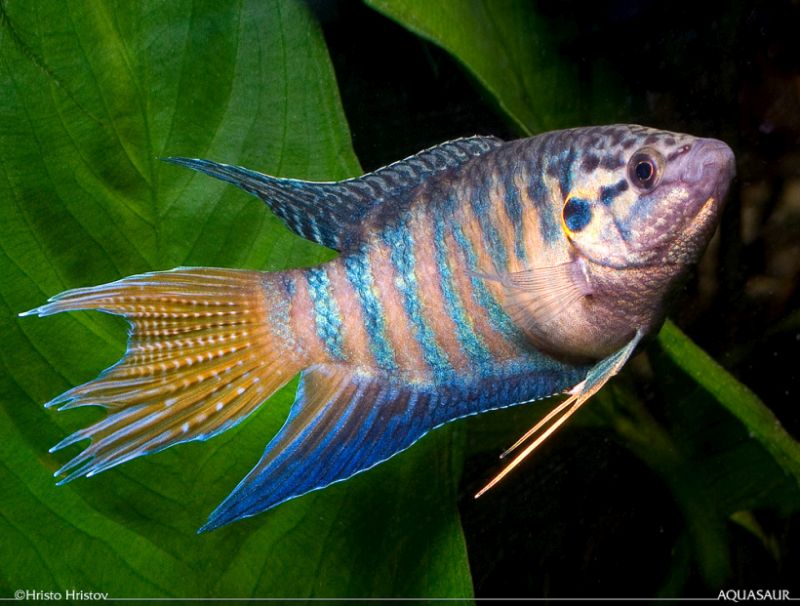
Max length80mm SL3.1in SLTank80 × 30cm31 × 12inTemp10–22°C50–72°FpH6.0–8.0M. opercularis is a classic aquarium fish, having been introduced to the hobby by a French soldier named Gerault in 1869. Of the initial 100 specimens shipped, 22 survived and were successfully bred later that same year by another Frenchman, the Parisian Pierre Carbonnier. This gives the species the distinction of being one of the very first ornamental fish imported to Europe. It is also known as 'Chinese fighting fish', 'paradise gourami', and 'blue paradise fish'.
Macropodus spechtiBlack Paradise Fish
Schreitmüller, 1936
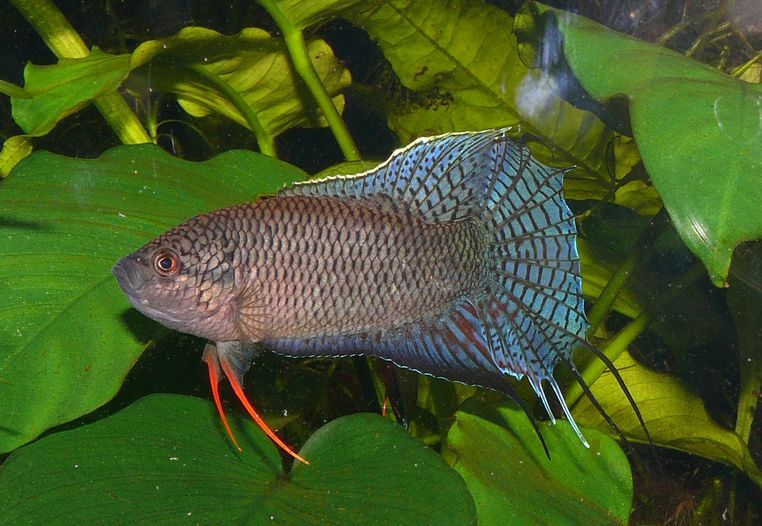
Max length80mm SL3.1in SLTank80 × 30cm31 × 12inTemp20–30°C68–86°FpH6.0–8.0M. spechti is also sometimes referred to as M. concolor, particularly in older literature. A dispute regarding conservation of that name was resolved by the ICZN in 2006, however, since M. concolor Ahl, 1937 is a junior primary homonym of M. concolor Schreitmüller, 1936 and thus permanently invalid.
Malpulutta kretseriOrnate Paradisefish
Deraniyagala, 1937
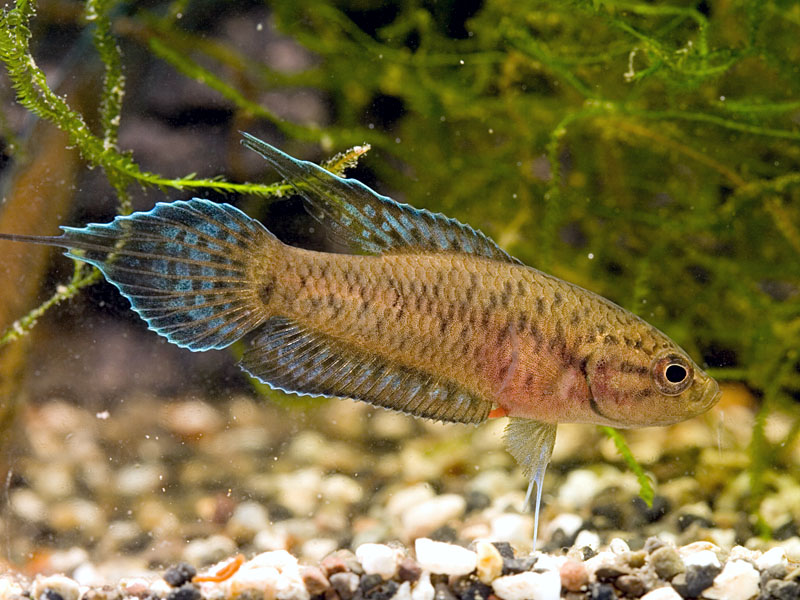
Max length50mm SL2.0in SLTank40 × 20cm16 × 8inTemp16–22°C61–72°FpH5.0–7.5This species is also referred to as 'Kretser's paradisefish' and 'spotted gourami'. There exist three colour forms, two of which exhibit a greater degree of reddish or violet pigmentation in the fins, respectively. The third is more bluish and was described as M. kretseri minor by Deraniyagala (1958).
Marosatherina ladigesiCelebes Rainbowfish
authority not recorded
Max length80mm SL3.1in SLTank76 × 30cm30 × 12inTemp22–28°C72–82°FpH7.0–8.0For many years, this species was included in the genus Telmatherina, and is still listed as such in much of the avilable literature. In fact it's now the only species in the recently erected genus Marosatherina. Unfortunately, it has been overfished for the aquarium trade in its native waters and is listed as 'vulnerable' on the IUCN red list of threatened species. Thankfully, it's now being mass-produced on fish farms in both the Far East and Eastern Europe, meaning that few...
Mastacembelus armatusTyre-Track Eel
authority not recorded
Max length910mm SL36in SLTank120 × 60cm48 × 24inTemp24–28°C75–82°FpH6.0–7.0The tyre track eel is also referred to as the white-spotted spiny eel. A member of the spiny eel family, which range across tropical Asia and Africa, Mastacembelus armatus is one of the more common species available to the hobby, along with the peacock eel ((Macrognathus siamensis)and the fire eel (Mastacembelus erythrotaenia). These species are all from Asia but there are some members of the family from Africa that are occasionally seen for sale. These majority of these species are from the ...
Mastacembelus ellipsiferTanganyikan Spiny Eel
authority not recorded
Max length450mm SL18in SLTank120 × 45cm48 × 18inTemp23–27°C73–81°FpH8.0–9.5M. ellipsifer is a stunning eel that makes a nice 'alternative' species for the Tanganyikan community tank. The species in the family Mastacembelidae are known as "spiny" eels because the dorsal rays are very hard. Care must therefore be exercised when handling them to avoid injuries. The swim bladder in these eels has also disappeared completely, an adaptation to their bottom-dwelling lifestyle. The African species such as this one can be distinguished from their Asian relat...
Mastacembelus erythrotaeniaFire Eel
authority not recorded
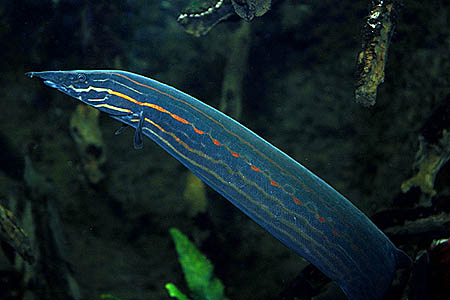
Max length1000mm SL39in SLTank120 × 60cm48 × 24inTemp24–28°C75–82°FpH6.0–7.0A member of the spiny eel family, which range across tropical Asia and Africa, Mastacembelus erythrotaenia is one of the more common species available to the hobby, along with the peacock eel (Macrognathus siamensis)and the tyre-track eel (Mastacembelus favus). These species are all from Asia but there are some members of the family from Africa that are occasionally seen for sale. These majority of these species are from the Afromastacembelus genus, with the most common representative being the...
Maylandia callainosCobalt Blue Zebra
authority not recorded
Max length135mm SL5in SLTank120 × 30cm48 × 12inTemp24–28°C75–82°FpH7.6–8.8This species was formerly classified as Pseudotropheus callainos and Metriaclima callainos and is still named as one of these by many sources. It has also been seen for sale as Pseudotropheus zebra "pearly". The genus name Maylandia is now used to describe all former members of the 'zebra' group of Pseudotropheus. It exists in three main colour forms, namely "cobalt blue", "orange blotch" and "pearl zebra". It is very easily confused with similar...
Maylandia greshakeiRed Top Ice Blue Zebra
authority not recorded
Max length135mm SL5in SLTank90 × 45cm36 × 18inTemp24–28°C75–82°FpH7.6–8.8This species was formerly classified as Pseudotropheus greshakei and Metriaclima greshakei and is still named as either of these by many sources. The genus name Maylandia is now used to describe all former members of the 'zebra' group of Pseudotropheus. An albino form of this species exists in aquaria and is occasionally available....
Maylandia zebraZebra Mbuna
authority not recorded
Max length152mm SL6in SLTank120 × 38cm48 × 15inTemp22–28°C72–82°FpH7.6–8.6...