Search the catalogue
Type a name: scientific, common, or one a species used to go by. Or narrow the catalogue with the filters.
Filters1
Trichogaster fasciataBanded Gourami
authority not recorded
Max length100mm SL3.9in SLTanknot recordedTemp21–28°C70–82°FpH6.0–7.5This species is a popular food fish in it's native countries. It is not often seen for sale these days, although it is both beautiful and peaceful. The alternative common name of 'Giant Gourami' is not particularly apt, although it is the largest species in the genus. Like others in the suborder Anabantoidei, the species possesses an accessory breathing organ known as the labyrinth organ. So-called due to its maze-like structure, this organ allows the fish to breathe atmospheri...
Trichogaster labiosaThick-lipped Gourami
authority not recorded
Max length100mm SL3.9in SLTank74 × 30cm29 × 12inTemp22–27°C72–81°FpH6.0–7.5Despite its ease of keeping and peaceable nature, this species is not particularly popular in the hobby, although it is imported quite regularly. A gold or 'sunset' strain exists, in which the barred patterning is replaced by an overall orange/gold colouration. This is not a natural variation, but has been selectively bred for the trade. The female of this form is almost as colourful as the male. Like others in the suborder Anabantoidei, the species possesses an accessory breathing...
Trichogaster laliusDwarf Gourami
authority not recorded
Max length88mm SL3.5in SLTanknot recordedTemp22–27°C72–81°FpH6.0–7.5The Dwarf Gourami is one of the most ubiquitous freshwater species in the aquarium hobby, and is unarguably a beautiful fish. Several colour forms have been line-bred for the trade and have also proved popular. These include "Sunset" (also sold as "Red" or "Robin") and "Neon" varieties, although it's highly debatable whether these come close to matching the brilliance of the natural form. Unfortunately the general quality of dwarf gouramis availab...
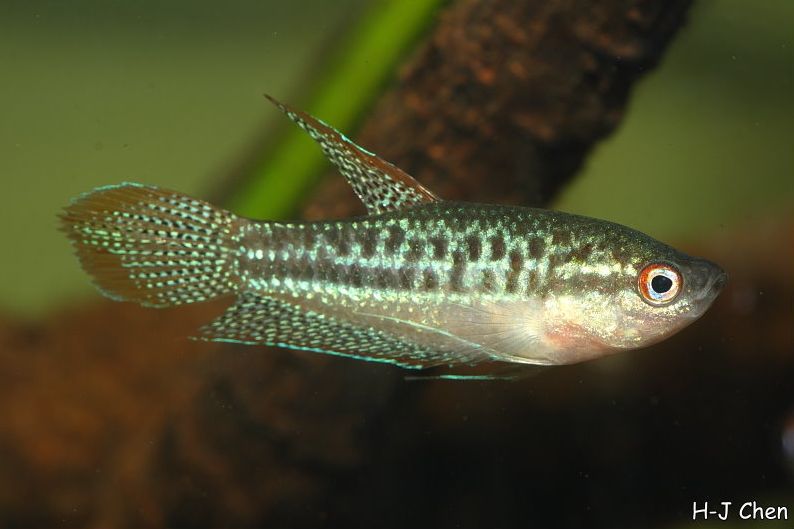
Trichopsis pumilaSparkling Gourami
Arnold, 1936
Max length40mm SL1.6in SLTank45 × 30cm18 × 12inTemp22–28°C72–82°FpH5.0–7.5It can be distinguished from congeners by its small adult size and presence of a single solid dark midlateral stripe on the body, above which is a series of dark blotches forming a second stripe. In the similar but larger, T. schalleri the upper stripe is more variable depending on the mood of the fish, sometimes fading entirely.
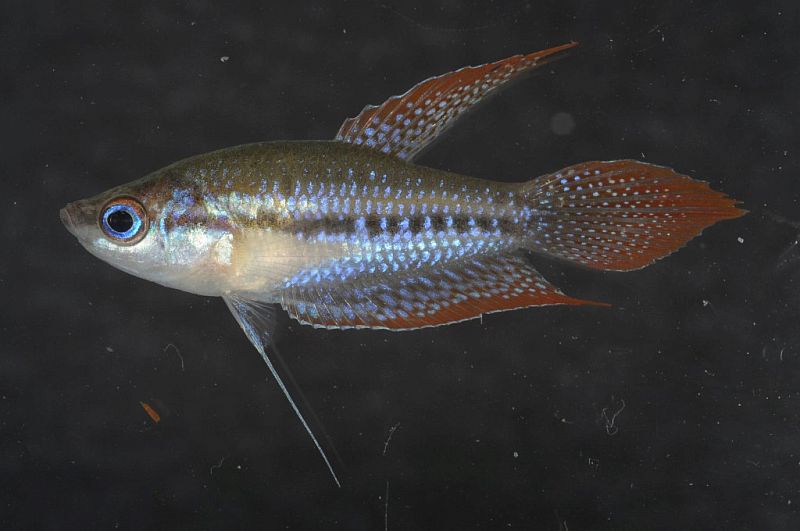
Trichopsis schalleri
Ladiges, 1962
Max length50mm SL2.0in SLTank60 × 30cm24 × 12inTemp22–28°C72–82°FpH5.0–7.5Known from the lower Mekong River basin in Laos, Thailand, Cambodia, and Vietnam, plus tributaries of the Chao Phraya watershed in central Thailand, and drainages between the Chao Phraya and Mekong in eastern Thailand. Type locality is 'Nam-Mun at Korat, 135 miles northeast of Bangkok, Thailand'.
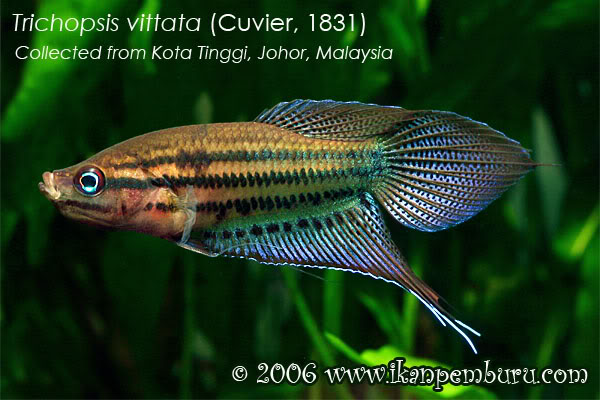
Trichopsis vittataCroaking gourami
Cuvier, in Cuvier & Valenciennes, 1831
Max length70mm SL2.8in SLTank60 × 30cm24 × 12inTemp22–28°C72–82°FpH5.0–7.5The common name is derived from the ability of genus members to produce audible sounds via a specialised pectoral mechanism which is unique within the family Osphronemidae. The structure comprises modified pectoral-fin tendons and muscles which are stretched and plucked by basal elevations of two fin rays in a similar way to guitar strings via rapid beating of the fins. The pectoral-fins beat alternately, each able to generate short or long bursts of sound. These sounds are produced by both sexes, predom...
Xenotoca eiseniRedtail Goodeid
authority not recorded
Max length60mm SL2.4in SLTank60 × 30cm24 × 12inTemp15–30°C59–86°FpH6.0–8.0An incredibly hardy and adaptable species that is not so popular in the hobby as it once was, probably due to its often aggressive nature. As with other goodeids, there is less of a size difference between the sexes than in many other livebearers. This is thought to be related to the relatively primitive structure of the andropodium, as the fish tend to choose mates that are of similar size so that the sex organs are synchronised. Goodeids are unique among livebearers in that the developi...
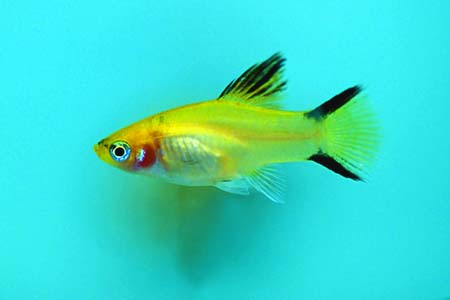
Xiphophorus maculatusPlaty
Gunther, 1866
Max length50mm SL2.0in SLTank60 × 30cm24 × 12inTemp20–26°C68–79°FpH7.0–8.2Another massively popular aquarium fish, with dozens of selectively bred varieties available, including mickey mouse, wagtail, tuxedo, moon, blue, red, comet and hi-fin. Some of these are produced by crossbreeding with X.helleri or X. variatus. Unfortunately many commercially bred platies are not very hardy due to inbreeding and over-production and are prone to disease and premature death. Wild fish are almost never seen in the hobby. As long as the ph remains above neutral this fish is ...
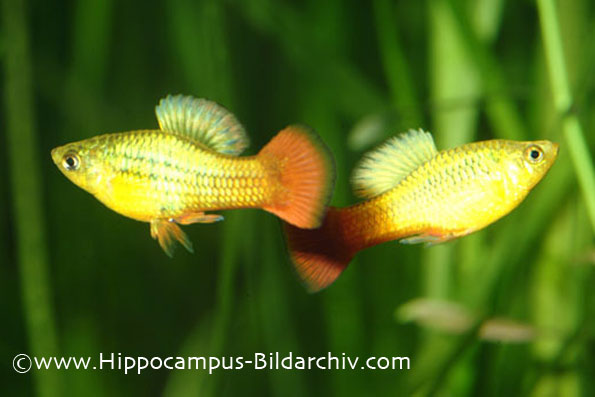
Xiphophorus variatusVariable Platy
Meek, 1904
Max length50mm SL2.0in SLTank60 × 30cm24 × 12inTemp20–26°C68–79°FpH7.0–8.2Another massively popular aquarium fish, with dozens of selectively bred varieties available. Some of these are produced by crossbreeding with X.helleri or X. maculatus. Unfortunately many commercially bred platies are not very hardy due to inbreeding and over-production and are prone to disease and premature death. The wild X. variatus can be distinguished from X. maculatus by its slimmer, more elongated body shape and slightly longer dorsal fin. This last feature has been seized upon by many...
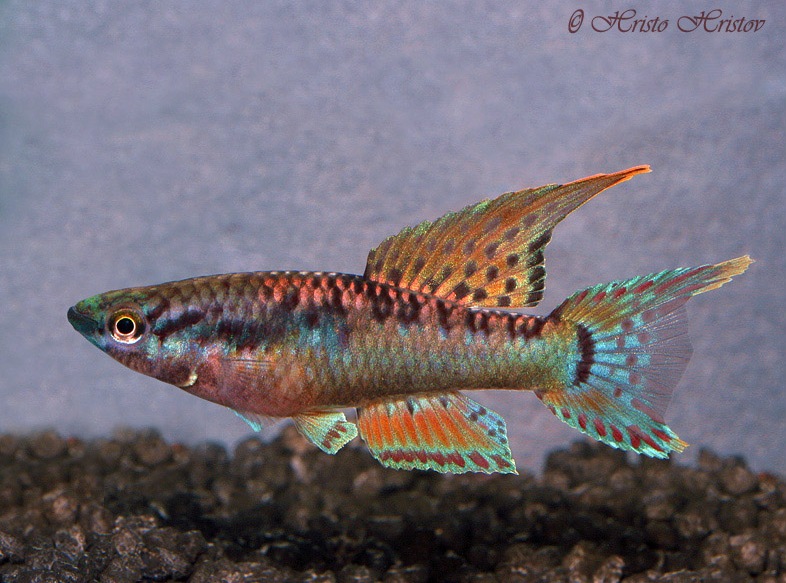
Aphyosemion bivittatumTwo-Banded Lyretail
Lönnberg, 1895
Max length50mm SL2.0in SLTanknot recordedTempnot recordedpHnot recordedType locality is close to a waterfall on the Ndian River in southwestern Cameroon, and appears restricted to the coastal plains either side of the border between Cameroon and Nigeria, including the Korup and Cross River National Parks.
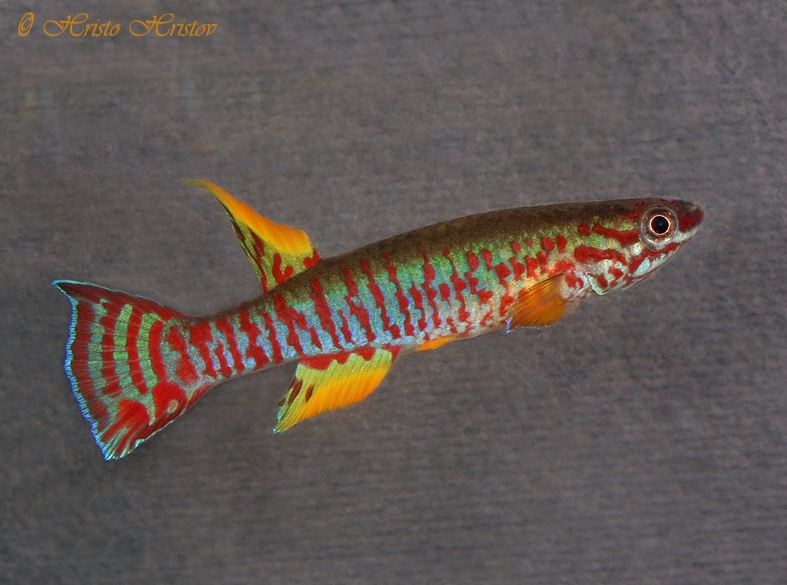
Aphyosemion bualanumBouala Lyretail
Ahl, 1924
Max length50mm SL2.0in SLTanknot recordedTempnot recordedpHnot recordedDescribed from 'Buala, Cameroon', which corresponds to modern-day Bouala in Central African Republic. It's known distribution includes parts of northern Cameroon, western Central African Republic, southeastern Chad and possibly eastern Nigeria in the upper Benue and Mayo Kébbi river systems. The specific name was mis-used to refer to various populations of the congener A. elberti prior to 1990, and we've been unable to confirm if the specimen pictured here is correctly identified or not. It is listed as 'endangered' by the IUCN.
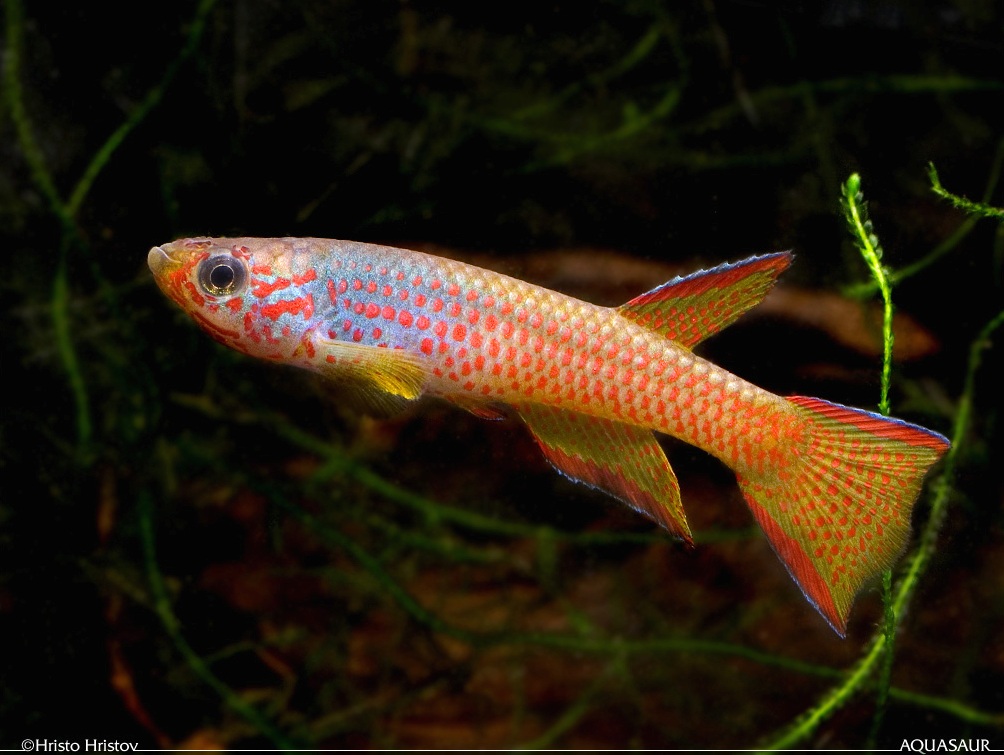
Aphyosemion cognatumRed-Spotted Lyretail
Meinken, 1951
Max length50mm SL2.0in SLTanknot recordedTempnot recordedpHnot recordedThe type material was derived from a commercial shipment of fishes from Leopoldville, now Kinshasa, Democratic Republic of Congo, and presumed to have been collected in the vicinity. The precise extent of its distribution unknown but appears extensive in the middle and lower Congo regions, with specimen collected from Lac Fwa (Sankuru River drainage, a Congo River tributary), many hundreds of kilometres west of Kinshasa, identified as belonging to this species.
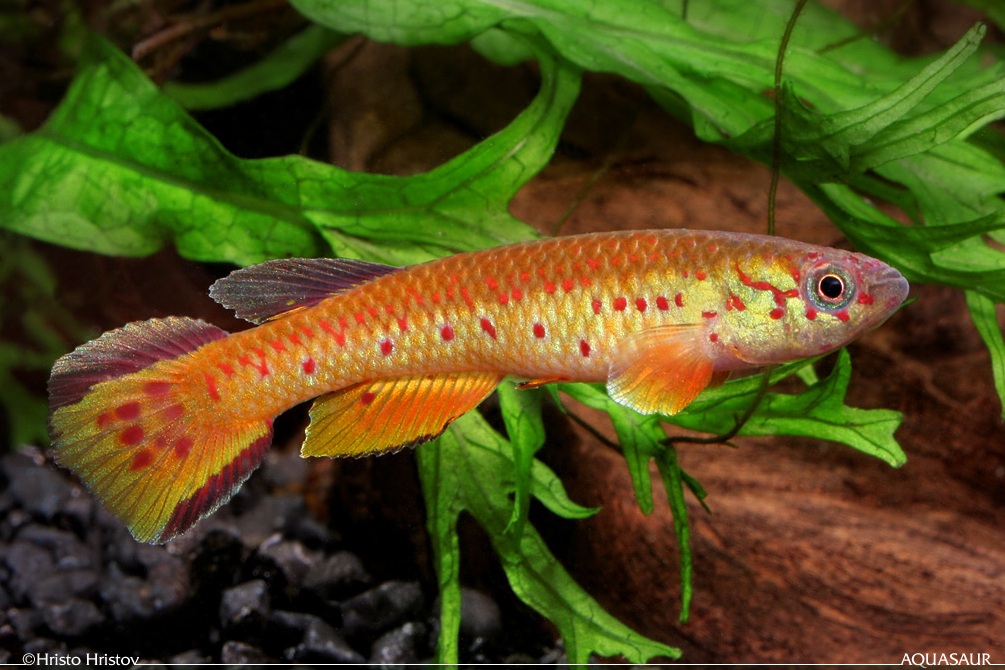
Aphyosemion congicumCongo Lyretail
Ahl, 1924
Max length45mm SL1.8in SLTanknot recordedTempnot recordedpHnot recordedThe type series was derived from a commercial shipment and this species' natural range remains unconfirmed. It may be restricted to the area between the Kwango and Gamba rivers, the latter a tributary of the former, in western Democratic Republic of Congo. The Kwango is itself a tributary of the Kasai, an affluent of the Congo.
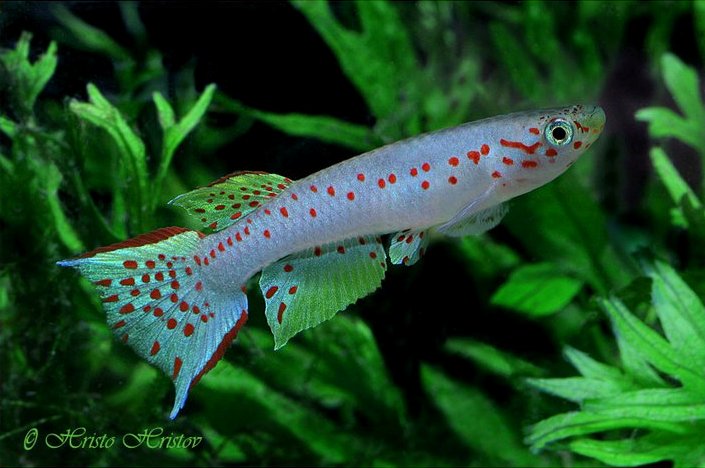
Aphyosemion decorseiDecorse's Lyretail
Pellegrin, 1904
Max length50mm SL2.0in SLTanknot recordedTempnot recordedpHnot recordedType locality is the settlement of Bessou, Lobaye prefecture, Central African Republic, which lies within the Ubangi (also spelled Oubangui) River basin. The Ubangi is a major tributary of the Congo River and this species appears restricted to its middle section and thus probably extends into northern Republic of Congo and Democratic Republic of Congo.
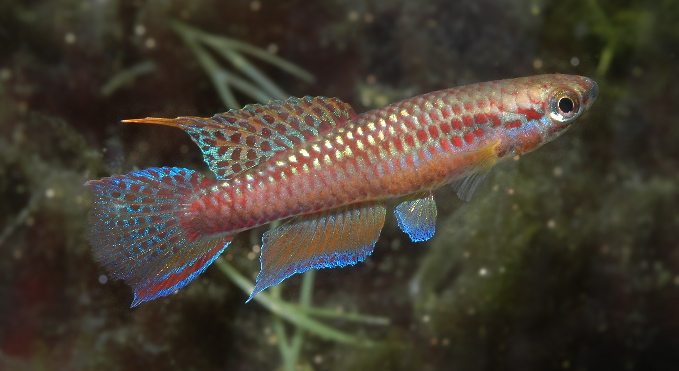
Aphyosemion erythronReddish Lyretail
Sonnenberg, 2008
Max length25mm SL1.0in SLTanknot recordedTempnot recordedpHnot recordedDescribed from Río Muni, Equatorial Guinea and appears endemic to south-western parts of the country, with additional collections having occurred in the Río Aye, Río Ecucu and lower Río Benito drainages.
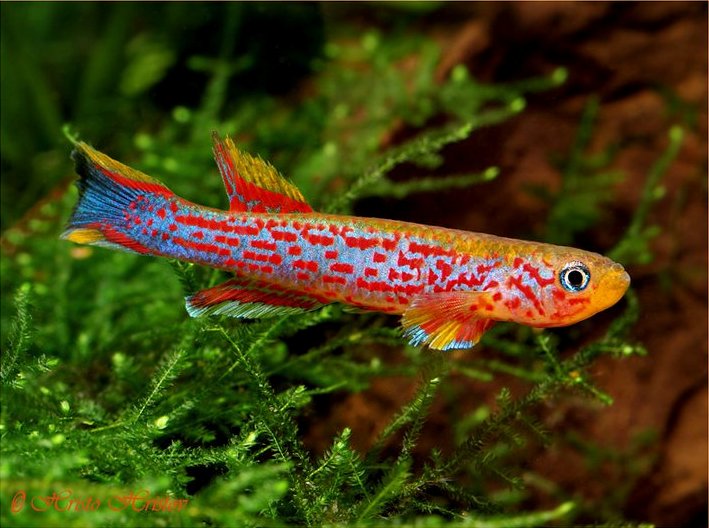
Aphyosemion hanneloreaeHannelore's Lyretail
Radda & Pürzl, 1985
Max length40mm SL1.6in SLTanknot recordedTempnot recordedpHnot recordedType locality is Malinga, located in the middle of the Du Chaillu mountain range in Ngounié province, southern Ghana. This lies very close to Republic of the Congo, and the species may also occur across the border.
Aphyosemion rectogoense
Radda & Huber, 1977
Max lengthnot recordedTanknot recordedTemp20–26°C68–79°FpH5.0–6.5Known only from the Batéké plateau region and surrounding area in southeastern Gabon where it's been recorded from the Léconi-Djouya and upper Mpassa rivers, these forming a portion of the much larger Ogooué basin. Type locality is '6 km west of Léconi', the latter presumably referring to the settlement of that name.
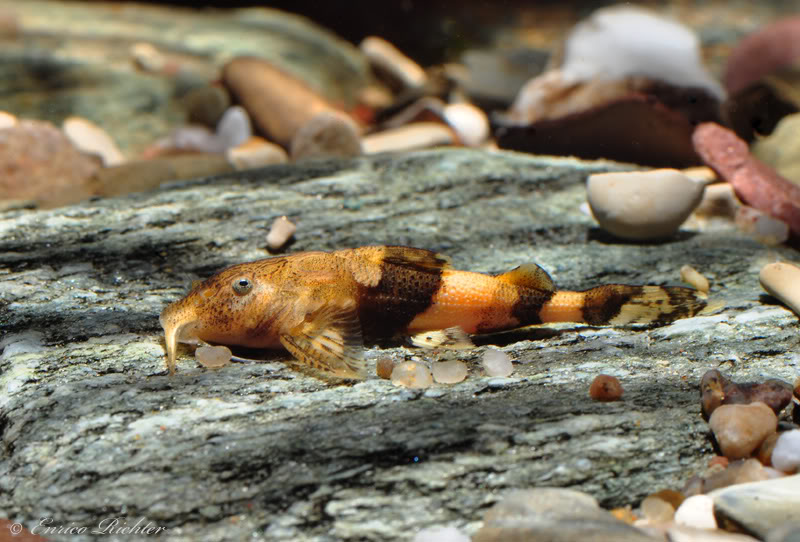
Caelatoglanis zonatus
Ng & Kottelat, 2005
Max lengthnot recordedTanknot recordedTempnot recordedpHnot recordedKnown only from the Ataran River system in Kayin state, Myanmar. The Ataran forms the headwaters of part of the larger Salween drainage, and some of its tributaries extend across the nearby border into Thailand, where it’s known as the Kasat. Type locality is 'Stream ''Chon Son' between Kyondaw and Phadaw, about 20 kilometers north...
Channa stewartii
authority not recorded
Max lengthnot recordedTanknot recordedTempnot recordedpHnot recordedChanna stewartii
Ctenochromis polli
authority not recorded
Max lengthnot recordedTanknot recordedTemp24–28.3°C75–83°FpHnot recorded...